Cochrane
Database of Systematic Reviews
Assistive devices, hip precautions, environmental
modifications and training to prevent dislocation and improve
function after hip arthroplasty (Review)
Smith TO, Jepson P, Beswick A, Sands G, Drummond A, Davis ET, Sackley CM
Smith TO, Jepson P, Beswick A, Sands G, Drummond A, Davis ET, Sackley CM.
Assistive devices, hip precautions, environmental modifications and training to prevent dislocation and improve function after hip arthro-plasty.
Cochrane Database of Systematic Reviews2016, Issue 7. Art. No.: CD010815.
DOI: 10.1002/14651858.CD010815.pub2.
T A B L E O F C O N T E N T S
1 HEADER . . . .
1 ABSTRACT . . . .
2 PLAIN LANGUAGE SUMMARY . . . .
4 SUMMARY OF FINDINGS FOR THE MAIN COMPARISON . . . .
6 BACKGROUND . . . .
7 OBJECTIVES . . . .
7 METHODS . . . .
[image:2.595.76.542.83.316.2]12 RESULTS . . . .
Figure 1. . . 13 Figure 2. . . 16 Figure 3. . . 17 20 ADDITIONAL SUMMARY OF FINDINGS . . . .
26 DISCUSSION . . . .
28 AUTHORS’ CONCLUSIONS . . . .
29 ACKNOWLEDGEMENTS . . . .
29 REFERENCES . . . .
33 CHARACTERISTICS OF STUDIES . . . .
42 DATA AND ANALYSES . . . .
Analysis 1.1. Comparison 1 Provision of hip precautions with versus without postoperative equipment and functional restriction, Outcome 1 Global assessment of treatment success: participant reported questionnaire of perceived pace of recovery at 6 month follow-up. . . 42 Analysis 1.2. Comparison 1 Provision of hip precautions with versus without postoperative equipment and functional
restriction, Outcome 2 Hip dislocation: incidence of event at 6 month follow-up. . . 43 43 ADDITIONAL TABLES . . . .
44 APPENDICES . . . .
48 CONTRIBUTIONS OF AUTHORS . . . .
48 DECLARATIONS OF INTEREST . . . .
48 SOURCES OF SUPPORT . . . .
[Intervention Review]
Assistive devices, hip precautions, environmental
modifications and training to prevent dislocation and improve
function after hip arthroplasty
Toby O Smith1, Paul Jepson2, Andrew Beswick3, Gina Sands4, Avril Drummond5, Edward T Davis6, Catherine M Sackley7
1Faculty of Medicine and Health Sciences, University of East Anglia, Norwich, UK.2School of Sport, Exercise & Rehabilitation
Sciences, University of Birmingham, Birmingham, UK.3Musculoskeletal Research Unit, University of Bristol, Bristol, UK.4CLAHRC East Midlands, School of Medicine, University of Nottingham, Nottingham, UK.5Faculty of Medicine and Health Sciences, University
of Nottingham, Nottingham, UK.6The Royal Orthopaedic Hospital NHS Foundation Trust, Birmingham, UK.7Faculty of Life
Sciences & Medicine, King’s College London, London, UK
Contact address: Catherine M Sackley, Faculty of Life Sciences & Medicine, King’s College London, London, UK. [email protected].
Editorial group:Cochrane Musculoskeletal Group.
Publication status and date:New, published in Issue 7, 2016. Review content assessed as up-to-date: 29 April 2016.
Citation: Smith TO, Jepson P, Beswick A, Sands G, Drummond A, Davis ET, Sackley CM. Assistive devices, hip precautions, environmental modifications and training to prevent dislocation and improve function after hip arthroplasty.Cochrane Database of Systematic Reviews2016, Issue 7. Art. No.: CD010815. DOI: 10.1002/14651858.CD010815.pub2.
Copyright © 2016 The Cochrane Collaboration. Published by John Wiley & Sons, Ltd.
A B S T R A C T Background
Total hip arthroplasty (THA) is one of the most common orthopaedic operations performed worldwide. Painful osteoarthritis of the hip is the primary indication for THA. Following THA, people have conventionally been provided with equipment, such as raised toilet seats and chairs, and educated to avoid activities that could cause the hip joint to be in a position of flexion over 90 degrees, or adduction or rotation past the midline. These aspects of occupational therapy have been advocated to reduce the risks of prosthesis dislocation. However, the appropriateness of these recommendations has been questioned.
Objectives
To assess the effects of provision of assistive devices, education on hip precautions, environmental modifications and training in activities of daily living (ADL) and extended ADL (EADL) for people undergoing THA.
Search methods
We searched MEDLINE (1946 to April 2016), EMBASE (1947 to April 2016), the Cochrane Library including CENTRAL (Issue 4 of 12, 2016), Database of Reviews of Effects (DARE), Health Technology Assessment (HTA), Economic Evaluations Database (EED), CINAHL, PEDro and CIRRIE from inception to April 2016. In addition we checked Controlled Clinical Trials, Clinicaltrials.gov, the National Institutes of Health Trial Registry, the World Health Organization International Clinical Trials Registry Platform (WHO ICTRP) and the OpenGrey database from inception to April 2016.
Selection criteria
Data collection and analysis
We used standard methodological procedures recognised by Cochrane. We conducted a systematic literature search using several databases and contacted corresponding authors, appraised the evidence using the Cochrane risk of bias tool, analysed the data using a narrative analysis approach (as it was not possible to conduct a meta-analysis due to heterogeneity in interventions), and interpreted all outcomes using the GRADE approach.
Main results
We included three trials with a total of 492 participants who had received 530 THA. The evidence presented with a high risk of performance, detection and reporting bias.
One study (81 participants) compared outcomes for participants randomised to the provision of hip precautions, equipment and functional restrictions versus no provision of hip precautions, equipment or functional restrictions. Due to the quality of evidence being very low, we are uncertain if the provision of hip precautions, equipment and functional restrictions improved function measured using the Harris Hip Score at 12 month follow-up, or health-related quality of life (HRQOL) measured by the Short Form-12 at four week follow-up, compared to not providing this. There were no incidences of hip dislocation or adverse events in either group during the initial 12 postoperative months. The study did not measure pain score, global assessment of treatment success or total adverse events.
One study (265 participants; 303 THAs) evaluated the provision of hip precautions with versus without the prescription of postoperative equipment and restrictions to functional activities. Due to the quality of evidence being very low, we are uncertain if perceived satisfaction in the rate of recovery differed in people who were not prescribed postoperative equipment and restrictions (135/151 satisfied) compared to those prescribed equipment and restrictions (113/152) (risk ratio (RR) 0.83, 95% confidence interval (CI) 0.75 to 0.93; 265 participants, one trial; number needed to treat for an additional beneficial outcome (NNTB) = 7). Due to the low quality evidence, we are uncertain if the incidence of hip dislocation differed between participants provided with hip precautions with (1/152) compared to without providing equipment or restrictions post-THA (0/151) (RR 2.98, 95% CI 0.12 to 72.59). The study did not measure pain, function, HRQOL, re-operation rates or total adverse events.
One study (146 participants) investigated the provision of an enhanced postoperative education and rehabilitation service on hospital discharge to promote functional ADL versus a conventional rehabilitation intervention in the community. This study was of very low quality evidence. We were uncertain if the provision of enhanced postoperative education and rehabilitation improved function at six months follow-up, when assessed using the Objective and Subjective Functional Capability Index (146 participants, one trial; P > 0.05; no numerical results provided) compared to conventional rehabilitation. The study did not measure pain score, HRQOL, global assessment of treatment success, hip dislocation, re-operation rate or total adverse events.
Authors’ conclusions
Very low quality evidence is available from single trials, thus we are uncertain if hip precautions with or without the addition of equipment and functional restrictions are effective in preventing dislocation and improving outcomes after THA. There is also insufficient evidence to support or refute the adoption of a postoperative community rehabilitation programme consisting of functional reintegration and education compared to conventional rehabilitation strategies based on functional outcomes.
Further high-quality trials are warranted to assess the outcomes of different occupational therapy interventions both in the short and longer-term for those who undergo THA. An assessment of the impact of such interventions on pain and restriction on personal ADL, EADL and instrumental ADL is needed, and also of functional integration-type interventions rather than just hip precautions, equipment and restrictions.
P L A I N L A N G U A G E S U M M A R Y Occupational therapy after hip replacement
Background
occupational therapists after a THA. We wanted to find out whether these types of treatments improve a person’s recovery following a THA.
Study characteristics
This Cochrane review is current to 29 April 2016. We searched the available evidence and included three studies, which had 492 people who had received a THA. Two of these studies investigated providing people with equipment, such as raised toilet seats and rails, and restricting their body movements (one of these studies also provided people with physiotherapy). One study investigated teaching participants about doing certain activities of daily living in a safe way to promote self-care without the risk of dislocating the new hip. The interventions were different and thus we did not combine the results.
Key results
One study compared outcomes for participants randomised to the provision of hip precautions, equipment and functional restrictions versus no provision of hip precautions or equipment or functional restrictions. This is the main comparator in the review.
Health-related quality of life (lower scores mean better quality of life)
We cannot tell from our results whether the intervention has an important effect on health-related quality of life (no numerical results provided) because the sample size was small and the study design flawed.
Function
We cannot tell from our results whether the intervention has an important effect on functional outcomes (no numerical results provided) because the sample size was small and the study design flawed.
Complications and adverse events
There were no dislocations or adverse events.
Outcomes of interest not measured
Pain, treatment success and re-operation rate were not measured.
Quality of the evidence
S U M M A R Y O F F I N D I N G S F O R T H E M A I N C O M P A R I S O N [Explanation]
Provision of hip precautions or equipment or functional restrictions compared with no provision of hip precautions, equipment and functional restrictions for people following primary total hip arthroplasty (THA)
Patient or population:people f ollowing prim ary uncem ented THA Settings:hospital and hom e settings
Intervention:provision of hip precautions, equipm ent and f unctional restrictions and outpatient physiotherapy Comparison:no provision of hip precautions or equipm ent or f unctional restrictions and outpatient physiotherapy
Outcomes Illustrative comparative risks* (95% CI) Relative effect (95% CI)
Number of participants (studies)
Quality of the evidence (GRADE)
Comments
Assumed risk Corresponding risk
Outpatient physiother-apy without hip precau-tions, equipment and functional restrictions
Hip precau-tions, equipment and functional restrictions and outpatient physio-therapy
Pain Not assessed Not assessed Not estim able Not assessed Not assessed No studies m easured
this outcom e1
Function Harris Hip Score Follow-up: 3 m onths
M ean score not re-ported.
M ean score not re-ported.
Not estim able 81 (1) ⊕
very low3,4,5
M ean scores not re-ported, thus we could not calculate the rela-tive ef f ect2
The trial authors re-ported M D 0.41 (no 95% CIs reported)
Health-related quality of lif e
Short Form -12 Follow-up: 12 m onths
M ean score not re-ported.
M ean score not re-ported.
Not estim able 81 (1) ⊕
very low3,4,5
38 (no 95% CIs) at 4 weeks.
Global assessm ent of treatm ent success
Not assessed Not assessed Not estim able Not assessed Not assessed No studies m easured
this outcom e1
Hip dislocation Incidence of events Follow-up: 12 m onths
No hip dislocations No hip dislocation Not estim able 81 (1) ⊕
very low3,4,6
There were no hip dislo-cations in either group
Reoperation rate Not assessed Not assessed Not estim able Not assessed Not assessed No studies m easured
this outcom e1
Total adverse events Incidence of events Follow-up: 12 m onths
No adverse events No adverse events Not estim able 81 (1) ⊕
very low3,4,6
There were no reported adverse events in either group
* The basis f or the assum ed risk (e.g. the m edian control group risk across studies) is provided in f ootnotes. The corresponding risk (and its 95% CI) is based on the assum ed risk in the com parison group and the relative ef f ect of the intervention (and its 95% CI).
Abbreviations: CI: conf idence interval; M D: m ean dif f erence; RR: risk ratio; SD: standard deviation; THA: total hip arthroplasty
GRADE Working Group grades of evidence
High quality:f urther research is very unlikely to change our conf idence in the estim ate of ef f ect.
M oderate quality:f urther research is likely to have an im portant im pact on our conf idence in the estim ate of ef f ect and m ay change the estim ate. Low quality:f urther research is very likely to have an im portant im pact on our conf idence in the estim ate of ef f ect and is likely to change the estim ate. Very low quality:we are very uncertain about the estim ate.
1Outcom e not m easured.
2M ean value not provided to calculate the ef f ect and 95% CI.
3No blinding of assessors to group allocation theref ore risk of detection bias. 4No blinding of participants or personnel theref ore risk of perf orm ance bias.
5Lim ited data provided on Harris Hip Score or Short Form -12 assessm ents and theref ore downgrade f or reporting bias and
im precision.
6This outcom e was based on a sm all num ber of events.
B A C K G R O U N D
Description of the condition
Total hip arthroplasty (THA) surgery involves replacement of the femoral head and acetabular components of the diseased hip joint with a new artificial joint that replicates the function of the hip. Usually, the prosthetic hip is constructed from either metal, plastic, ceramic materials or a combination. Although some THA surgery is performed following traumatic hip injuries, most THA surgery is for degenerative hip diseases and is planned in advance. This is termed ‘elective’ surgery.
THA is one of the most common orthopaedic operations per-formed worldwide. In 2013, the National Joint Registry for Eng-land and Wales recorded 89,945 THAs (National Joint Registry 2014). Of these, 80,194 were primary (first time) procedures and 9751 were revision (replacement of the prosthesis) surgeries. In 2012, the Swedish Joint Registry recorded that 18,261 THA pro-cedures were performed, of which 15,978 were primary and 2283 were revisions (Swedish JRU 2013). Similarly, 44,308 (primary THA) and 2767 (revision THA) were performed in Canada from 2012 to 2013 (Canadian Joint Replacement Registry 2014) and over 193,000 THAs per annum in the USA (Graver 2010). Osteoarthritis is the principal indication for THA, and accounts for between 83% (Swedish JRU 2013) to 93% (National Joint Registry 2014) of all primary THA procedures. With an ageing population, increasing rates of obesity and increasing quality of life expectations, the annual increase in operative rates is likely to continue (Birrell 1999;Kurtz 2007). Although THA is considered to be one of the most effective orthopaedic procedures performed for relieving pain and improving the quality of people’s lives ( Hawker 2006;McMurray 2000;NICE 2000), its provision carries substantial associated costs. For example, in the USA, the cost in 2006 for THA was estimated as USD 5 billion, of which 70% of the costs related directly to hospital stay (Graver 2010). Although costs in other developed counties are lower, they are still substantial (Sigurdsson 2008). The high cost of the hospitalisation phase has resulted in a drive by healthcare providers to reduce the overall length of stay (Cookson 2011). As a result of this decreased length of stay, increased emphasis needs to be placed on pre-admission education services, efficient discharge planning and immediate postoperative rehabilitation (Westby 2006).
Description of the intervention
Occupational therapists use purposeful activity or interventions designed to help people perform activities of daily living (ADL) at home or at work (AOTA 1994). For people undergoing THA, the interventions provided by occupational therapists generally aim to improve function and prevent dislocation following THA. These have been categorised as the following.
• Provision of assistive devices designed to assist ADL (such as raised toilet seats, furniture raises, dressing aids, perching stools, long-handled reaches and commodes).
• Postoperative education in joint protection by advising on following ’hip precautions’ that is, avoiding specific movements such as hip flexion beyond 90°, hip adduction beyond the midline, and internal and external rotation of the hip beyond 20° from neutral (Lucas 2008).
• Environmental modifications (removal of trip hazards, layout of furniture to improve access around the home, installation of handrails or grab rails).
• Training to improve basic ADL, such as washing, dressing, feeding and toileting.
• Training to improve extended ADL (EADL) or instrumental ADL (IADL) (e.g. cooking, household activities, leisure pursuits and community engagement).
• Provision of specific advice about coping strategies to manage pain.
• Provision of specific advice on how to access other services for support following THA (e.g. access to other professional services for mental well-being).
All these interventions may be provided preoperatively or postop-eratively, or both, and may be delivered in acute hospitals, or in community or primary care.
It has been recommended that postoperative rehabilitation follow-ing THA should be delivered by multidisciplinary teams (Tian 2010). This has become common practice within Western Eu-rope, the USA and Australasia (De Jong 2009;Grotle 2010;Tian 2010). However, it remains unclear whether this occurs in less de-veloped nations that do not have access to occupational therapy as a specific profession (Fudge 1992;Krefting 1992;Wilson-Braun 1992). Consequently, physiotherapists or nurses may administer the provision of hip precaution equipment and functional train-ing rather than only by occupational therapists. Therefore, we re-flected this potential variability in the professional group who pro-vides these interventions in the inclusion criteria of this Cochrane review.
How the intervention might work
dislocation, and the provision of equipment such as raised toilet seats, furniture raises, perching stools and long-handled reaches to avoid hip flexion over 90° (Drummond 2012). The assessment and provision of environmental adaptations, such as removal of trip hazards, evaluation of the layout of furniture and installa-tion of handrails or grab rails, may be useful to reduce the risk of falls and facilitate functional capability during the recovery period (Pighills 2011).
Why it is important to do this review
A recent survey of occupational therapists working in orthopaedic settings in the UK reported that, on average, people who have had THA comprise 40% of their caseload, despite a paucity of evi-dence on the clinical or cost-effectiveness of occupational therapy interventions (Drummond 2012). Most reviews to date that inves-tigate rehabilitation following THA have focused predominantly on physiotherapy, exercise, preoperative education or multidis-ciplinary rehabilitation programmes (Ackerman 2004;Coudeyre 2007; Dauty 2007;Di Monaco 2009; Kuster 2002). Previous Cochrane systematic reviews that have addressed preoperative edu-cation (McDonald 2014) and multidisciplinary rehabilitation pro-grammes (Khan 2008) specifically excluded unidisciplinary inter-ventions and included studies that contained both THA and knee arthroplasty populations. Furthermore, a protocol for a review of postacute physiotherapy for THA patients is awaiting publication (Westby 2006). However, no review of the postoperative occupa-tional therapy interventions for people following THA has been undertaken.Steultjens 2005, who assessed the efficacy of occupa-tional therapy for different conditions, reiterated this.Steultjens 2005concluded that no reviews have been undertaken on occu-pational therapy rehabilitation for people following THA. Therefore, despite endorsements in the UK by NICE (NICE 2003) and the British Orthopaedic Association (BOA) (British Orthopaedic Association 2006) for the provision of assistive de-vices as a key aspect of occupational therapy in THA rehabilita-tion, there has been no specific assessment of the evidence-base to underpin these recommendations. As a result, existing protocols on occupational therapy management following THA have been based on clinical experience, surgeon preference or anecdotal re-ports (Westby 2006). The UK College of Occupational Therapists recognised the limitations in practice guidelines and subsequently recently released their first clinical guidelines on this topic (College of Occupational Therapists 2012). They recommend the applica-tion of the intervenapplica-tions menapplica-tioned above, but acknowledge the paucity of literature that evaluates the effectiveness of these inter-ventions for people after THA.
O B J E C T I V E S
To assess the effects of provision of assistive devices, education on hip precautions, environmental modifications and training in activities of daily living (ADL) and extended ADL (EADL) for people undergoing THA.
M E T H O D S
Criteria for considering studies for this review
Types of studies
We included randomised controlled trials (RCTs) (individual and cluster) and quasi-RCTs. Quasi-RCTs are those where the gener-ated sequence to allocate participants is not strictly random, for example by hospital number. We excluded non-RCTs. We did not place any restrictions on the inclusion of studies based on the language that papers are published in or the publication status of studies.
Types of participants
We included participants who underwent primary THA surgery for osteoarthritis or revision THA. If we had excluded studies that included a few participants who received a THA for reasons other than osteoarthritis, this may have limited the information avail-able for inclusion in this review. Therefore, we included studies if most participants (over 80%) who underwent THA surgery for osteoarthritis. We included trials that included various pathologies and various orthopaedic surgeries (that is total knee arthoplasty, hip resurfacing, hemi-arthroplasty) if the study authors presented results for THA for osteoarthritis. We considered all types of pros-theses, fixation methods and surgical approaches for inclusion.
Types of interventions
We included studies that examined one or more of the following interventions.
• Provision of and education about using assistive devices for preventing dislocation. Such assistive devices included: raised toilet seats, furniture raises, dressing aids, perching stools, long-handled grabbers and commodes.
• Postoperative education about hip precautions and specifically on teaching joint positions associated with joint dislocation (hip flexion beyond 90°, adduction beyond the midline, and to avoid internal and external rotation beyond 20° from neutral (Lucas 2008)).
• Assessment, facilitation, practice and re-assessment of self-care activities of daily living (ADL) tasks to foster independence and skills in these activities.
• Training of extended ADL (EADL) or (also known as) instrumental ADL (IADL) as these skills are aimed at improving health-related quality of life (HRQOL). This may have included specific training to facilitate activities beyond personal or self-care ADL and may therefore have included activities such as gardening, shopping and social pursuits.
• Provision of specific advice about coping strategies to manage pain and activity pacing.
• Postoperative education sessions designed to inform participants of their expected pathway from the operative procedure to recovery at home to reduce anxiety and improve preparation for hospital discharge, and specific advice on how to access other services for support following THA (e.g. access to other professional services).
We included studies where these interventions were applied post-operatively, either in a healthcare setting or in any community setting. Also we included trials that looked at complex packages of care delivered by multidisciplinary teams if we could indepen-dently evaluate the effect of the occupational therapy tions. We included studies if therapy assistants provided interven-tions under the supervision of qualified occupational therapy staff. We accepted interventions which were provided by healthcare staff other than designated occupational therapists, ensuring that they were commensurate with accepted occupational therapy practice. One review author (AD) assessed any studies of this nature to en-sure the intervention met accepted occupational therapy practice. We included occupational therapy interventions provided as part of a multidisciplinary package if the study authors adequately de-scribed the nature of the occupational therapy intervention and we could independently assess the outcome or, if it could not be isolated, the occupational therapy aspects of the study constituted more than 75% of the time allocated to the whole multidisci-plinary intervention package. If we could not isolate the nature of the occupational therapy intervention, or it formed less than 75% of the overall intervention package, we excluded the study. We did not include trials that investigated education interventions provided preoperatively since another Cochrane review has inves-tigated this (McDonald 2014).
Comparison interventions included the following. • Rehabilitation therapy excluding the interventions of interest (assistive devices, hip precautions, environmental modifications).
• No rehabilitation therapy provided. • One intervention of interest versus another.
Types of outcome measures
Major outcomes
• Pain as measured with tools such as a visual analogue or rating scale, or formal tools such as the McGill Pain Questionnaire (Melzack 1971).
• Function, as measured by WOMAC function (Bellamy 1988); Oxford Hip Score (Dawson 1996); Harris Hip Score (Harris 1969); Short Form (SF)-36 Physical Component Score (Stewart 1988); SF-12 (Ware 1996); Health Assessment Questionnaire (Fries 1980); Objective Functional Capability Index (OFCI) and Subjective Functional Capability Index (SFCI).
• HRQOL (e.g. SF-36 (Stewart 1988), SF-12 (Ware 1996), Frenchay Activities Index (Schuling 1993), EuroQoL, Nottingham Health Profile (NHP) (Hunt 1980)).
• Global assessment of treatment success. • Hip dislocation, as reported (e.g. the number of participants requiring a manipulation under anaesthetic to reduce a dislocated hip prosthesis, or the requirement of a revision procedure due to recurrent hip dislocation).
• Reoperation rate.
• Total adverse events (e.g. infection, thrombosis, falls).
We reported the major outcomes using a ’Summary of findings’ table.
Minor outcomes
• Limitations in personal ADL during the initial six weeks, which are defined as the basic activities that everyone undertakes to maintain a personal level of care (e.g. feeding, toileting, washing, bathing, transfer in and out of bed or on/off a chair, mobilising). Personal ADL may be assessed using instruments such as the Barthel Score (Collin 1988) or Iowa Level of Assistance Score (Shields 1995).
• Restrictions in performance in extended ADL (EADL) or instrumental ADL (IADL), which are defined as the skills required to live independently and manage a dwelling (e.g. preparing own meals, doing housework, managing own money, shopping). This may be assessed using instruments such as the Oxford Hip Score (Dawson 1996) or the Nottingham extended ADL scale (Nouri 1987).
• Societal reintegration or discretionary activities. These are the higher function activities such as driving, using local services, using public transport, socialising with friends, attending social or cultural events. This outcome measure differs from HRQOL measures since this outcome specifically relates to social interaction and participation activities rather than more generic ADL, which are captured through the HRQOL outcomes.
• Length of hospital stay following THA.
• Cost-analysis. This includes specific occupational therapy costs, overall rehabilitation costs, or overall hospital costs.
Minor outcomes are reported in ’Additional tables’.
all validated outcome measures. The review team decided by con-sensus to analyse or reject non-validated measures. We decided to reject or accept non-validated measures before we examined the trial results.
Follow-up time points
It is common in rehabilitation trials for outcome data to be col-lected at multiple follow-up time points. If included trials mea-sured outcomes at more than one time point, we categorised the follow-up time points as follows.
• Short term (less than six weeks following THA surgery). • Intermediate term (six weeks to six months following THA surgery).
• Long term (greater than six months following THA surgery).
In the case of multiple time points within a category (e.g. four-week and five-four-week measurements in the short term category), we extracted the last time point (that is five weeks). For the ’Summary of findings’ table, we chose the final time-point reported for each comparison for each primary outcome measure.
Search methods for identification of studies
Electronic searches
We designed a sensitive search strategy to retrieve observational studies from electronic bibliographic databases. We identified items from the following databases on 29 April 2016.
• MEDLINE via OVID (1946 to 29 April 2016). • EMBASE via OVID (1947 to 29 April 2016).
• Cochrane Library via Wiley (Issue 4 of 12, 2016) including the CENTRAL, Database of Reviews of Effects (DARE), Health Technology Assessment (HTA), Economic Evaluations Database (EED).
• CINAHL via EbscoHost (Cumulative Index to Nursing and Allied Health Literature).
• PEDro (Physiotherapy Evidence database) viahttp:// www.pedro.org.au/.
• CIRRIE (Centre for International Rehabilitation Research Information and Exchange) viahttp://cirrie.buffalo.edu/ database/.
We have presented the electronic search strategy for each search strategy inAppendix 1.
We searched the reference lists of included articles to ascertain if any relevant trials had not been identified by the electronic searches. We searched for ongoing trials through the following tri-als registers and their respective websites on 29 April 2016: Con-trolled Clinical Trials (www.conCon-trolled-trials.com), the National Institutes of Health Trial Registry (http://clinicaltrials.gov) and
the World Health Organiziation International Clinical Trials Reg-istry Platform (WHO ICTRP) (http://apps.who.int/trialsearch/). Also, we used the OpenGrey database to identify relevant grey literature (http://www.opengrey.eu/).
Searching other resources
We searched conference abstracts from the European League Against Rheumatism (EULAR) and the Society of Research in Rehabilitation (SRR) to identify other unpublished studies from the earliest abstract archive (2005 and 2001 respectively) to the present. We checked the citations of key articles using the Web of Science citation search facility. We contacted national and in-ternational experts in occupational therapy orthopaedic research for any information regarding ongoing studies, published data un-available electronically or unpublished work.
Data collection and analysis
Selection of studies
Two review authors (TS and GS) independently screened all ti-tles and abstracts identified from the search against the selection criteria. They independently selected studies as possibly relevant (those that met the criteria and those where insufficient informa-tion was provided to definitively exclude studies based on title and abstract) and excluded those that clearly did not meet the inclusion criteria. We obtained the full-text papers for all studies deemed possibly relevant. Two review authors (TS and GS) independently assessed whether they met the selection criteria. If necessary, they contacted the study authors for further information to determine if the study met the inclusion criteria. We consulted a researcher and registered occupational therapist (AD) about any uncertainty on occupational therapy involvement in the study. If they could not reach agreement about suitability of a study for inclusion, a third review author (AD) resolved this. We recorded the selection process in sufficient detail to complete a PRISMA flow diagram and ’Characteristics of excluded studies’ table.
Data extraction and management
the Cochrane ’Risk of bias’ tool (Higgins 2011) detailed below. Two review authors (TS and GS) appraised each included study. They resolve any disagreements by consensus decision. If disagree-ment persisted, they consulted one of the three expert review au-thors (CS, ED or AB). We discussed any disagreement that specif-ically surrounded occupational therapy practice with the occupa-tional therapy expert (AD) first before arbitration by the expert review authors. We attempted to contact the study authors and ask them to provide additional data and to clarify methods if in-sufficient detail was in the published report. We contacted all cor-responding study authors by email to request verification on data extracted and missing measurements of variance (such as standard deviation (SD) values). However, none responded.
We established a priori decision rules to assist in the selection of which data to extract in the event of multiple outcome reporting. • Where trial authors reported outcomes for more than one pain score, we extracted data on the scale highest on the following list: (i) visual analogue or rating scale; (ii) formal tools such as the McGill Pain Questionnaire; (iii) any other pain score.
• Where trial authors reported outcomes for more than one function scale, we extracted data on the scale that was highest on the following list: (i) WOMAC function; (ii) Oxford Hip Score; (iii) Harris Hip Score; (iv) SF-36 Physical Component Score; (v) Health Assessment Questionnaire; (vi) any other function scale.
• Where trial authors reported outcomes for more than one limitation in personal ADL score, we extracted data on the scale highest on the following list: (i) Iowa Level of Assistance Score; (ii) Barthel Score; (iii) any other personal ADL score.
• Where trial authors reported outcomes for more than one HRQOL scale, we extracted data on the scale highest on the following list: (i) SF-36; (ii) SF-12; (iii) Frenchay Activities Index; (iv) EuroQoL; (v) Nottingham Health Profile; (vi) any other HRQOL scale.
• Where trial authors reported outcomes for more than one limitation to extended ADL score, we extracted data on the scale highest on the following list: (i) Oxford Hip Score; (ii) the Nottingham extended ADL scale; (iii) any other extended ADL score.
• If the study authors reported both final values and change from baseline values for the same continuous outcome, we used final scores rather than change from baseline scores.
• If the study authors reported both unadjusted and adjusted values for the same outcome, we reported the unadjusted values but also extracted adjusted values for sensitivity analyses.
• If data were analysed based on an intention-to-treat (ITT) sample and another sample (e.g. per protocol, as treated), we reported the ITT sample but also extracted the per protocol or as treated sample and analysed the results as a sensitivity analysis.
Assessment of risk of bias in included studies
We used the Cochrane ’Risk of bias’ tool (Higgins 2011) to assess the quality of the included studies. We assessed the following
do-mains.
• Random sequence generation. • Allocation concealment. • Blinding of outcome assessment. • Incomplete outcome data. • Selective reporting.
• Other potential sources of bias such as: whether a potential source of bias was related to the specific study design; whether a trial stopped early due to some data-dependent process; whether there were extreme baseline imbalances; and whether the trial has been claimed to be fraudulent (Higgins 2011).
In rehabilitation trials it is not usually possible for the partici-pants or the study personnel to remain blinded to the interven-tion. However, we evaluated the ‘blinding of participants and per-sonnel’ domain as the study may still be subject to performance bias even if it is not possible to blind the participants. Blinding of the outcome assessors is practicable and is considered highly important when using subjective outcomes (Boutron 2006). Fur-thermore, we separately assessed blinding of self-reported subjec-tive outcomes (such as pain, function, HRQOL) and blinding of independent outcome assessors of objective outcomes (such as re-operation rate, adverse events).
Two review authors (TS and GS) independently assessed the risk of bias of the study for each domain and rated this as either at low, high or unclear risk of bias. If they were unable to agree, they consulted a third review author (CS).
Measures of treatment effect
We based our analyses on the ITT data from the included stud-ies. We planned to express dichotomous outcome data (such as frequency of prosthesis dislocation, adverse events) as risk ratios (RR) with 95% confidence intervals (CIs) and continuous out-comes (such as the visual analogue pain score, Oxford Hip Score, McGill Pain Questionnaire) as mean differences (MDs) with 95% CIs for continuous outcomes if study authors used the same scale to measure the same outcome across studies. Where study authors used different scales to measure the same outcome, we planned to use the standardised mean difference (SMD) with 95% CIs. To enhance interpretability of results, we planned to back-transform pooled SMDs to a representative original scale, highest on the prior hierarchy of outcomes reported, by multiplying the SMD and 95% CI values by a representative SD at baseline from one included trial.
Unit of analysis issues
study authors to obtain these data at a participant rather than a THA unit level. In the event of trials with more than two treat-ment arms, we only extracted data from those interventions that related to the interventions of interest in this Cochrane review.
Dealing with missing data
We attempted to contact all authors of studies to obtain any miss-ing data, and to gather all data to perform an ITT analysis. Due to difficulties in obtaining data and particularly ITT data, this was not possible. For dichotomous outcomes, we used the number of participants allocated to each group as the denominator for all analyses. For missing data, we assumed that all participants had the worst possible outcome. For continuous outcomes with no SDs reported, we planned to calculate these from standard errors, CIs or P values if reported. If it was not possible to calculate SDs, we first planned to use baseline SDs; if this was not possible, we planned to impute SDs from other included THA studies.
Assessment of heterogeneity
First we assessed all included trials for clinical homogeneity in terms of participants, interventions and comparators by a con-sensus decision. As stated, all included studies were heterogenous for the interventions under investigation. We planned to assess all studies we judged to be homogeneous for the potential statistical variability of the treatment effects due to heterogeneity via cal-culation of the I² statistic. This measure describes the percentage total variation across studies that results from heterogeneity rather than chance. We used the following guidelines for interpretation (Deeks 2011): 0% to 40% may be unimportant; 30% to 60% may represent moderate heterogeneity; 50% to 90% may repre-sent substantial heterogeneity; 75% to 100% considerable hetero-geneity. We analysed the content of the occupational therapy in-terventions in the included studies and matched them to one or more of the categories listed in the ’Types of interventions’ section. We planned to combine studies for analysis in the following way.
• Studies that contained the same intervention only with a common comparator.
• Studies that combined training for basic ADL with training for EADL or IADL.
• Complex occupational therapy interventions that contained intervention components which aimed to address specific treatment needs, e.g. increasing ADL, social reintegration and sleep hygiene.
Assessment of reporting biases
We searched the WHO ICTRP (http://apps.who.int/trialsearch/) to evaluate if selected reporting of outcomes was present (outcome reporting bias) by comparing outcomes specified in trial protocols with the outcomes reported in the corresponding trial publica-tions. We decided a priori that if we had included 10 or more
studies in the meta-analyses, we would examine the data for re-porting bias via visual inspection of a funnel plot. We planned to assess the presence of small study bias in the overall meta-analysis by checking if the random-effects model estimate was more bene-ficial than the fixed-effect model estimate (Sterne 2011). Since we could not perform any meta-analysis, we did not report this.
Data synthesis
We analysed data using Review Manager (RevMan) (RevMan 2014). We planned to combine data from individual trials for meta-analyses if the interventions, participant groups and out-comes were sufficiently similar. We determined this by a consen-sus decision amongst the review authors. We did not report the results of any meta-analysis we undertook if the I² statistic was greater than 75%. We planned to use a random-effects model as the default analytical methodology.
Due to the heterogeneity of the interventions identified, it was inappropriate to undertake a meta-analysis. We therefore adopted a narrative approach to data synthesis. We presented the results of the review separately by intervention to assess the effectiveness of each intervention.
We identified the following comparisons.
• Provision of hip precautions, equipment, functional restrictions and outpatient physiotherapy versus outpatient physiotherapy without provision of hip precautions, equipment or functional restrictions.
• Provision of hip precautions with versus without postoperative equipment and functional restriction.
• Provision of an enhanced postoperative education and rehabilitation service with conventional hospital discharge to promote functional ADL versus a conventional traditional discharge and rehabilitation intervention in the community.
’Summary of findings’ table
We presented the primary outcomes in a ’Summary of findings’ ta-ble, which provides key information concerning the quality of the evidence, the magnitude of effect of the interventions examined, and the sum of available data measuring changes in all outcomes, as recommended by Cochrane (Schünemann 2011a). The outcomes were: (i) pain; (ii) function; (iii) HRQOL; (iv) global assessment of treatment success; (v) reoperation rate; (vi) hip dislocation; and (vii) adverse events (including infection, thrombosis, falls). The ’Summary of findings’ table included an overall assessment of the quality of the evidence related to each primary outcome using the Grading of Recommendations Assessment, Development and Evaluation (GRADE) approach, which assesses study limitations, consistency of effect, imprecision, indirectness and publication bias (Schünemann 2011b). For all outcomes, we included data for the latest time point available.
event rate and the relative risk using the visual treatment num-ber needed to treat for an additional beneficial outcome (NNTB) calculator (Cates 2008). We planned to calculate the NNTB for continuous measures using the Wells calculator (available at the Cochrane Musculoskeletal Group (CMSG) Editorial office,http:/ /musculoskeletal.cochrane.org/). However, we were unable to cal-culate this due to the limited data available.
For dichotomous outcomes, we planned to calculate the abso-lute risk difference using the risk difference statistic in RevMan (RevMan 2014) and to express the result as a percentage. For con-tinuous outcomes, we planned to calculate the absolute benefit as the improvement in the intervention group minus the improve-ment in the control group, in the original units.
We planned to determine the relative per cent change for dichoto-mous data as the risk ratio - 1 and expressed as a percentage. For continuous outcomes, we planned to calculate the relative differ-ence in the change from baseline as the absolute benefit divided by the baseline mean of the control group. However, we were unable to calculate this as none of the included papers presented baseline data.
Subgroup analysis and investigation of heterogeneity
We planned to conduct three subgroup analyses based on suffi-cient numbers of trials being available. Whilst we had planned the following subgroup analyses, there were insufficient data to perform the analyses.
• Primary versus revision THA procedure.
• Delivery of the intervention by occupational therapists or other health professionals.
• Comparison of multiple interventions (e.g. assistive devices plus hip precautions plus environmental modifications) versus single interventions alone.
Sensitivity analysis
We planned a sensitivity analysis to assess the effect of adequate allocation concealment on the treatment effect for the main out-come measurements. Removal of trials identified in the ’Risk of bias’ section as having inadequate or unclear allocation conceal-ment from the meta-analyses may change the overall treatconceal-ment fect. We planned to perform a sensitivity analysis to analyse the ef-fect of adequate blinding of self-reported subjective outcomes (e.g. pain, function, HRQOL) on treatment effects. However, there were insufficient data to perform any of the planned sensitivity analyses.
R E S U L T S
Description of studies
We have presented a summary of the included and excluded studies in the ’Characteristics of included studies’ and ’Characteristics of excluded studies’ tables.
Results of the search
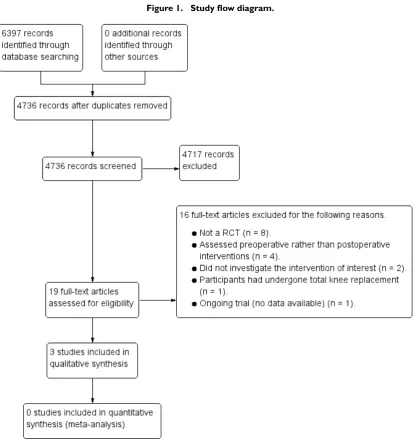
Figure 1. Study flow diagram.
Of the identified articles, we considered 19 citations potentially eligible after screening the titles/abstracts. After we reviewed the full-text articles to re-assess eligibility, 15 papers did not satisfy the eligibility criteria. Three papers did and we included them in the review. One study is currently ongoing (Peters 2015), and we have summarised it in the ’Characteristics of ongoing studies’ table. We contacted all three corresponding authors from each included study for additional information. None responded after repeated attempts.
Included studies
The three included trials randomised a total of 492 participants (530 THAs). This consisted of 287 participants who received an ’experimental’ rehabilitation approach following THA and 242 participants who received a control or ’usual treatment’ approach following THA. Two trials were conducted in the USA (Peak 2005; Ververeli 2009), whilstWong 1990was undertaken in Canada.
[image:15.595.101.522.78.520.2]Surgery
All participants underwent THA.Peak 2005andVervereli 2009 described this as an uncemented procedure, whilstWong 1990 did not document the method of prosthesis fixation. All partici-pants in thePeak 2005cohort underwent an anterolateral surgical approach, whilst a modified anterolateral approach was adopted in theVervereli 2009cohort.Wong 1990did not document the surgical approach for their participants. WhilstWong 1990did not document whether this was a primary or revision procedure, all participants were primary THA inPeak 2005andVervereli 2009cohorts.Ververeli 2009used a 32, 36 to 40 mm femoral head in their cohort. The most common femoral head size used in the Peak 2005cohort was a 28 mm (range 22 mm to 36 mm).Wong 1990did not document this. The required position of acetabular component anteversion was 10° inVervereli 2009and between 10° and 15° inPeak 2005.Wong 1990did not document this.
Gender
In total the three included studies randomised 243 males and 249 females.
Age
The mean age of the cohort groups ranged from 57.4 years ( Ververeli 2009) to 71.1 years (Wong 1990).
Body Mass Index (BMI)
Two studies presented data on baseline BMI (Peak 2005;Ververeli 2009). Mean BMI ranged from 27.8 kg/m² in females in the con-trol group ofVervereli 2009to 29.8 kg/m² for males in the control group ofVervereli 2009. Mean BMI was 29.3 kg/m² in in the control group and 28.7 kg/m² in the experimental (unrestricted hip movements) inPeak 2005.
Indication for THA
OnlyWong 1990presented data on the indication for THA. In this cohort the most frequent reason for THA was osteoarthritis of the hip in 87% to 92% of cases dependent on group allocation. The remaining reasons were due to rheumatoid arthritis and frac-tured neck of femur in up to 8% of cases.
Co-morbidities
OnlyWong 1990presented data on the frequency of morbidi-ties. Whilst the study did not indicate what morbidities the co-hort reported,Wong 1990documented that, dependent on group allocation, between 30% to 32% of their groups presented with a concurrent medical condition.
Intervention
The three included studies investigated three interventions. • The provision of hip precautions, equipment and functional restriction versus no provision of hip precautions or equipment or functional restrictions (Ververeli 2009).
• The provision of hip precautions with versus without postoperative equipment and functional restrictions (Peak 2005).
• The provision of an enhanced postoperative education and rehabilitation service with early hospital discharge to promote functional activities of daily living (ADL) versus a conventional traditional discharge and rehabilitation intervention in the community (Wong 1990).
All people in the intervention group inVervereli 2009received instruction on hip precautions (avoid hip flexion greater than 90°, avoid crossing the legs at the thighs, avoid riding in a car, pro-vision of an elevated toilet seat and elevated chair, instructed to sleep supine with a pillow between their legs) plus home physio-therapy. During the second and third postoperative month, par-ticipants were permitted to ride in a car and attend an outpatient physiotherapy programme, but were instructed to maintain their hip precautions with no hip flexion greater than 90° or adduction greater than 5°. All people in the comparator group received no specific hip precautions (except an instruction to avoid crossing legs at the thighs) or postoperative equipment, such as toilet raises, chair raises or abduction pillows, and received outpatient phys-iotherapy. The studies did not report participant deviation from group allocation or compliance to interventions allocated to either group. The studies did not report on the outpatient physiotherapy treatment received by either group.
InPeak 2005, all participants allocated to the intervention group received an abduction pillow, elevated toilet seats and elevated chairs, and instructions to avoid sleeping on their side, avoid driv-ing or bedriv-ing a passenger in an automobile plus hip precautions, which consisted of limiting hip range of motion for the initial six weeks to less than 90° flexion, 45° external and internal rotation and to avoid hip adduction versus the comparator group who re-ceived hip precautions alone.Peak 2005provided self-reported data on participant compliance to equipment and functional striction during the initial six postoperative weeks. Whilst they re-ported 100% compliance for the use of a postoperative abduction pillow and 96% compliance to range of movement restriction, compliance for the use of elevated toilet seats (78%) and elevated chairs (56%), and for avoiding being a passenger in an automobile (34%) was lower.
equipment, we determined that the two groups who received a conventional inpatient discharge pathway were the groups of in-terest. From these two groups, the intervention group received a supportive discharge intervention consisted of patient informa-tion delivered by a pamphlet and videotape, and community nurse review. The pamphlet and videotape provided information on the safe performance of ADL to avoid hip dislocation, postdischarge exercises, early detection of complications, safe and correct use of aids for walking, bathing, dressing and toileting, expected stages of progress during the first six months, and the potential impact of the operation on the participant’s perception and the availability of community resources. In addition participants received regu-lar postdischarge home visits by a community health nurse. The objective of this visit was to procure walking and ADL aids as ap-propriate, counsel the participant on planning and implementing changes, provide supportive actions and reinforce teaching initi-ated in the hospital. These visits were during the fifth or sixth postoperative day in hospital, on the day before discharge, and then one week and three and six months postdischarge at the par-ticipant’s home. The comparator group received a traditional re-habilitation programme after a conventional inpatient discharge pathway without this supportive discharge regime. No data were provided on participant deviation from group allocation or on compliance to interventions allocated to either group.
Outcome measures
The follow-up periods ranged from six months (intermediate term: Peak 2005; Wong 1990) to 12 months (longer-term;Ververeli 2009).
The primary outcomes reported were: function as assessed with the Harris Hip Score in Ververeli 2009andWong 1990 using the Objective Functional Capability Index (OFCI) and Subjective Functional Capability Index (SFCI); two studies assessed global assessment of treatment success using patient satisfaction (Peak 2005;Ververeli 2009); hip dislocation (Peak 2005); andVervereli 2009recorded the frequency of complications. This included the incidence of hip dislocation as well as more general complications, such as infection, thrombosis and falls. No studies assessed the primary outcomes: pain, health-related quality of life (HRQOL) or reoperation rates.
The secondary outcomes reported were: presence of a limp on observation of gait pattern, the number of days until participants walked without a limp (Ververeli 2009), and the frequency of
re-turn to ADL at follow-up interval (Peak 2005), which were consid-ered limitations in personal ADL.Ververeli 2009also assessed the number of days until participants walked with a stick, the number of days until participants walked without a stick, the number of days until participants drove and the number of days required be-fore participants walked without a limp (Peak 2005) percentage of their usual ADL which participants could perform at the time of assessment (Peak 2005). The frequency to which participants had returned to work was considered as a measure of societal reinte-gration (Peak 2005).Peak 2005also assessed societal reintegration or discretionary activities such as duration until participants re-turned to work, and travelled in a car. Finally,Peak 2005explored hospital length of stay and costs associated with the interventions, but the other included studies did not examine this. No studies assessed the secondary outcomes of restrictions in performance in extended ADL (EADL).
Outcomes that we did not consider in this Cochrane review but that an included trial reported were: adherence to postoperative guidelines (Peak 2005), adherence to use of equipment (Peak 2005) and time-point when participants stopped using equipment (Peak 2005).
Excluded studies
We excluded 16 studies after we assessed the full-texts of these papers (Figure 1). We have presented the reasons for exclusion in the ’Characteristics of excluded studies’ table and one study is still ongoing (Peters 2015;Characteristics of ongoing studies). We ex-cluded eight studies as they were not randomised controlled trials (RCTs) (Gillen 2007;Gromov 2015;McMurray 2000;Mikkelsen 2014;Satoh 2007;Stewart 2011;Stinnett 1996;Thomas 2010). We excluded four trials as they evaluated interventions that were delivered preoperatively rather than postoperatively (Bitterli 2011; Jepson 2016; Lewis 2002;McGregor 2004). We excluded two studies as they did not investigate an intervention that was of rel-evance to this review (Akarcali 2003;Bai 2009).Bai 2009did not satisfy the inclusion criteria as the intervention was solely exer-cise-based. We excluded one study as it investigated an interven-tion for participants who had undergone a total knee arthroplasty (Jacofsky 2010).
Risk of bias in included studies
Allocation
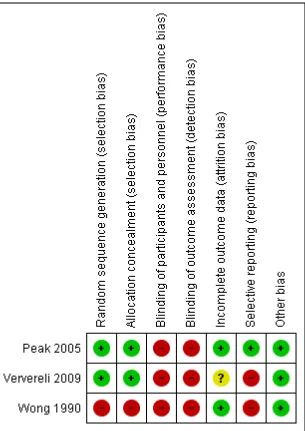
Two studies were at low risk of selection bias, due to adequate ran-dom sequence generation and allocation concealment (Peak 2005; Ververeli 2009).Peak 2005generated the allocation sequence us-ing a computer number generator and blinded to group allocation, whereasVervereli 2009generated the sequence allocation using a random number table and the research co-ordinator assigned it. Wong 1990provided no information on sequence generation and we assigned this study as at high risk of bias for this ’Risk of bias’ domain.
Peak 2005andVervereli 2009assigned allocation through a sealed envelope method.Wong 1990did not report allocation and there-fore we judged this study as at high risk of bias for this ’Risk of bias’ domain.
Blinding
We considered all three included studies at high risk of bias for performance bias. This was understandable given that it would have been logistically difficult to be able to blind participants or personnel to group allocation due to the nature of the equipment and interventions under investigation in these studies. However, assessors could have been blinded to group allocation during each of the data collection phases. WhilstWong 1990reported blind-ing their assessors to group allocation for the OFCI, since the SFCI was a subjective assessment, there was a high risk of bias as the participants were not (and could not be) blinded to group allocation. Two studies did not clearly document that their asses-sors were blinded to group allocation (Peak 2005;Ververeli 2009). Therefore, we judged these as at high risk of detection bias.
Incomplete outcome data
We judged two papers as at low risk of attrition bias (Peak 2005; Wong 1990). There was no clear loss to study follow-up inPeak 2005andWong 1990papers. However, inVervereli 2009it was unclear whether or not participant attrition had occurred and was accounted for in the analyses. Therefore, we considered this study as at unclear risk of attrition bias.
Selective reporting
One study,Peak 2005, was at low risk of reporting bias.Peak 2005 reported all outcomes acknowledged within the paper. However, there was no study protocol provided or a reference number to a study protocol. We judged that bothVervereli 2009andWong 1990papers were at high risk of reporting bias.Ververeli 2009 did not provide any data regarding participant satisfaction and provided only limited data for Harris Hip Score or Short Form-12 (SF-Form-12). Finally, due to the presentation ofWong 1990data, it
was difficult to interpret the descriptive statistical results of their outcomes, which limited the reporting of the data.
Other potential sources of bias
We did not detect any other forms of bias in the included studies (Peak 2005;Ververeli 2009;Wong 1990).
Effects of interventions
See:Summary of findings for the main comparison’Summary of findings’ table 1;Summary of findings 2’Summary of findings’ table 2;Summary of findings 3’Summary of findings’ table 3 The three included studies investigated three interventions. Due to the heterogeneity in intervention, we did not pool the data from these studies but have presented them individually by intervention.
1. Provision of hip precautions, equipment, functional restrictions and outpatient physiotherapy versus outpatient physiotherapy without provision of hip precautions, equipment or functional restrictions
A single trial (81 participants),Ververeli 2009, compared rehabil-itation with hip precautions, equipment, functional restrictions and outpatient physiotherapy versus outpatient physiotherapy with no specific hip precautions, equipment or functional restric-tions. Using the Grading of Recommendations Assessment, De-velopment and Evaluation (GRADE) approach, we downgraded the quality of the evidence forVervereli 2009for all outcomes ex-cept the frequency of complications by two levels (nominally two levels for limitations in design and implementation that related to potential risk of bias) to low, whilst we downgraded the frequency of complications by three levels for limitations in design and im-plementation related to the risk of bias, and one for imprecision due to the small number of complication events (see ’Summary of findings’ table 1:Summary of findings for the main comparison). Accordingly, we are very uncertain about the estimated effects for this trial’s outcomes.
Major outcomes
variance, we could not substantiate their results. No participants in either group (0/38 in the no precautions group versus 0/43 in the precautions group) reported hip joint dislocation during the 12 month follow-up period, or postoperative complication at 12 months follow-up.
The trial did not report the following outcomes: pain, global as-sessment of treatment rates or total adverse events.
Minor outcomes
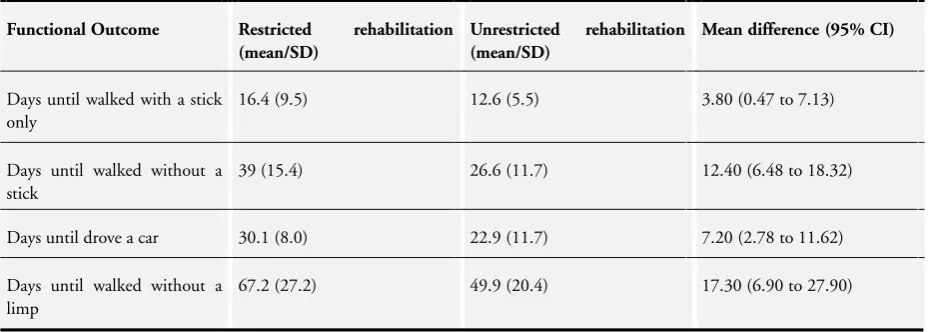
Participants in the group with provision of hip precautions re-ported a significantly slower recovery in respect to functional out-comes compared to those who were not advised to follow and use hip precautions, equipment and restrictions. People who received precautions mobilised slower with only a stick, compared to those who were not provided with hip precautions, equipment and func-tional restrictions. Those in the precautions group walked with a stick at a mean of 16.4 days, compared to 12.6 days in the no pro-vision of precautions, equipment and functional restriction group (MD 3.80 days, 95% CI 0.47 to 7.13; Table 1). Similarly, the precautions group reported a longer time until they could walk without a stick (mean: 39 days), compared to the no precautions, equipment and functional restrictions group (mean: 27 days) (MD 12.40, 95% CI 6.48 to 18.32;Table 1). The precautions group reported a longer period of time until they recommenced driving (mean: 30 days precautions group versus 23 days non-precautions group) (MD 7.20, 95% CI 2.78 to 11.62;Table 1), whilst those allocated to the precautions group also reported a longer period of time until they could walk without a limp (mean: 67 days), when compared to those who did not receive precautions, equipment and functional restrictions (mean: 50 days) (MD 17.30, 95% CI 6.90 to 27.90;Table 1).
2. Provision of hip precautions with versus without postoperative equipment and functional restriction
A single trial (265 participants; 303 THAs) compared the provi-sion of hip precautions with versus without postoperative equip-ment and functional restriction. Using the Grading of Recommen-dations Assessment, Development and Evaluation (GRADE) ap-proach, we downgraded the quality of the evidence forPeak 2005 outcomes by three levels (nominally two levels for limitations in design and implementation that related to potential risk of bias and one for imprecision) to very low, meaning that we are very uncertain about the estimated effect (see ’Summary of findings’ table 2:Summary of findings 2).
Major outcomes
Peak 2005 measured global assessment of treatment success through patient satisfaction questionnaires in the intermediate pe-riod. There was a significant difference between the groups with those allocated to the restricted group significantly less satisfied
with the pace of their recovery than the unrestricted group (RR 0.83, 95% CI 0.75 to 0.93; NNTB: 7 (4 to 16);Analysis 1.1). There was no statistically significant difference in the incidence of hip joint dislocation between the groups with hip precautions (1/152 participants) with versus without postoperative equipment and functional restriction (0/151 participants) (RR 2.98, 95% CI 0.12 to 72.59;Analysis 1.2). However, as there was only one event, this estimate is very uncertain.
One participant in the postoperative equipment and functional restriction group dislocated during transfer from the operating ta-ble to a bed postoperatively. No subsequent dislocation or insta-bility occurred after this was managed with closed reduction in either the no equipment and functional restriction group (0/151 participants) nor the equipment and functional restriction group (0/152 participants). Similarly, no participants in either the no equipment and functional restriction group (0/151 participants) nor the equipment and functional restriction group (0/152 par-ticipants) experienced an adverse event.
The trial did not assess the following primary outcomes of interest in this Cochrane review: pain, function, HRQOL, reoperation rate or total adverse events.
Minor outcomes
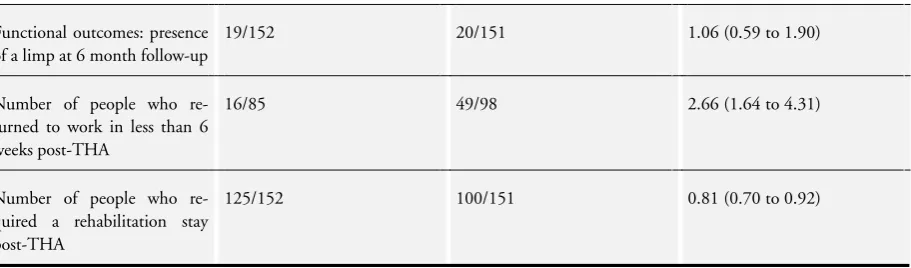
In respect to limitation of ADL, at six months participants in the restricted group reported statistically significantly less patient sat-isfaction regarding return to preoperative levels of ADL compared to the group who did not received postoperative equipment and functional restriction (P = 0.02). The study author did not pro-vide any numerical results for this outcome in the paper or after we contacted the study authors. Accordingly, we reported these results directly from the trial. There was a difference between the groups for time to return to sleeping on their side; those in the restricted group took a longer period of time (mean: 5.8 weeks) compared to the unrestricted group (mean: 3.2 weeks; P < 0.001). There were no standard deviation (SD) values for this outcome and therefore we reported the data directly from the trial paper for this outcome. There was no statistically significant difference between the two groups for the prevalence of a limp at six months (RR 1.06, 95% CI 0.59 to 1.90;Table 2).
reported the data directly from the trial paper for these outcomes. The proportion of participants who returned to work in less than six weeks was also lower in the restricted group compared to the participants who were not provided with postoperative equipment and functional restriction (RR 2.66, 95% CI 1.64 to 4.31;Table 2).
There was no significant difference between the groups for acute hospital length of stay where both the restricted and unrestricted group had a mean length of stay of 3.5 days (P = 0.88). There were no SD values presented for acute hospital length of stay. Therefore we reported the data directly from the trial paper for this outcome. However, there was a significant difference between the groups in requirement for rehabilitation, where there were a greater number of participants who required a rehabilitation stay if they received postoperative equipment and functional restriction compared to no equipment and restriction (RR 0.81, 95% CI 0.70 to 0.92; Table 2).
Peak 2005 calculated the costs associated with the additional equipment.Peak 2005estimated that the cost associated with the provision of this equipment was an additional USD 655 per par-ticipant, where the abduction pillow cost USD 120, elevated toilet seat USD 65, and elevated chair USD 955 to purchase or USD 15 per day to rent. This estimation did not include cost of transport required for people in the restricted group, loss of wages related to delayed return to work or greater rehabilitation requirements in the restricted group.
This trial did not report data on restriction to extended ADL.
3. Provision of an enhanced postoperative education and rehabilitation service with conventional hospital discharge to promote functional ADL versus a conventional traditional discharge and rehabilitation intervention in the community
A single trial (146 participants),Wong 1990, compared these
in-terventions. Using the GRADE approach, we downgraded the quality of the evidence for the hospital length of stay and func-tional assessments using the OFCI and SFCI by the maximum of three levels (nominally, two levels for limitations in design and implementation that related to potential risk of bias; and one level for inconsistency in results) to very low, meaning that we are very uncertain about the estimated effect. The recorded outcomes were hospital length of stay, OFCI and SFCI, evaluated at six months.
Major outcomes
Regarding function through the OFCI and SFCI, there was no statistically significant difference between those randomised to the enhanced postoperative education and rehabilitation programme at conventional discharge compared to the conventional discharge and traditional rehabilitation programme (P > 0.33). The study authors did not provide any numerical results in the paper nor after we contacted the study authors. Accordingly, we reported the results directly from the trial.
Primary outcomes thatWong 1990did not report included: pain, HRQOL, global assessment of treatment success, hip dislocation, re-operation rate and total adverse events.
Minor outcomes
Whilst not assessed through inferential statistical tests, those al-located to the conventional discharge and rehabilitation regime had a shorter hospital length of stay (mean: 12.75 days) com-pared to those allocated to the conventional hospital discharge and enhance postoperative education and rehabilitation programme (mean: 13.85 days). There were no SD values presented for hos-pital length of stay. Therefore, we reported the data directly from the trial paper for this outcome.
A D D I T I O N A L S U M M A R Y O F F I N D I N G S [Explanation]
Provision of hip precautions with compared to without the provision of postoperative equipment and functional restriction following primary total hip arthroplasty (THA)
Patient or population:people f ollowing prim ary uncem ented THA Settings:hospital and hom e settings
Intervention:provision of hip precautions with the provision of postoperative equipm ent and f unctional restriction Comparison:provision of hip precautions without the provision of postoperative equipm ent and f unctional restriction
Outcomes Illustrative comparative risks* (95% CI) Relative effect (95% CI)
Number of participants (studies)
Quality of the evidence (GRADE)
Comments
Assumed risk Corresponding risk
Hip precautions, but no equipment or func-tional restrictions
Hip precautions, with equipment and with functional restrictions
Pain Not assessed Not assessed Not estim able Not assessed Not assessable No studies m easured
this outcom e1
Function Not assessed See com m ent Not estim able Not assessed Not assessable No studies m easured
this outcom e1
Health-related quality of lif e
Not assessed Not assessed Not estim able Not assessed Not assessable No studies m easured
this outcom e1
Global assessm ent of treatm ent success Satisf actory pace of re-covery
Follow-up: 6 m onths
894 per 1000 742 per 1000 (180 to 704)
RR: 0.83 (0.75 to 0.93) 303 (1) ⊕
very low2,3,4
Global assessm ent of treatm ent success, as assessed with satisf ac-tion with pace of recov-ery was f avoured in the unrestricted group Patients in the unre-stricted group could perf orm 106.4% (range