With 4 text-figures Printed in Great Britain
INFLUENCE OF TEMPERATURE ON THE TRANSMEMBRANE
POTENTIAL OF ASCARIS MUSCLE CELLS
BY JEAN T. D E B E L L AND V. SANCHEZ
Department of Pharmacology, School of Medicine, San Juan, Puerto Rico 00905
{Received 30 October 1967)
INTRODUCTION
Since the initial work of Jarman (1959) on the electrophysiology of the somatic muscle cells of Ascaris lumbricoides, a considerable amount of information has been gathered on this subject. The available data indicate that the rhythmic action potentials which activate the contraction of those cells are of myogenic origin (see del Castillo, de Mello & Morales, 1967). In this paper, an attempt is made to correlate the trans-membrane potential and the frequency of spike firing with temperature.
METHODS
Preparations. All the experiments have been performed on preparations of the body wall of Ascaris lumbricoides var. suum, obtained from a local slaughterhouse. A cylin-drical fragment of the worm, about 2-3 cm. in length, was split open along one of the lateral lines. After removal of the intestine the resulting rectangular piece of tissue was pinned (cuticle side down) on a slab of Teflon inside a double-walled Perspex chamber.
Solutions. Ascaris tissue can be maintained in a functional condition immersed in an isotonic salt solution made by diluting 30 parts of sea water with 70 parts of distilled water (Hobson, Stephenson & Beadle, 1952). Although the ionic content of this solution differs from that of the perienteric fluid of Ascaris, it has been found suitable for electrophysiological work (Jarman, 1959; DeBell, del Castillo & Sanchez, 1963).
Temperature regulation. The temperature of the bathing solution was maintained constant by circulating water from a thermostatically controlled reservoir between the walls of the Perspex chamber, and it was measured with a thermistor placed close to the preparation. When the experiment required rapid thermal changes, 30 % sea water already at the desired temperature was passed directly through the bath until the temperature of the water circulating between the walls of the chamber reached the same value.
Electrical technique. Transmembrane and spike potentials were recorded from the muscle cell bellies with conventional intracellular microelectrodes filled with 3 M-KC1 and connected via a high input impedance amplifier (Bioelectric Instruments, Inc.) to a Tektronix, type 502, cathode-ray oscilloscope.
Drugs. In some experiments D-tubocurarine was added to the 30 % sea water in a concentration of io~* (w/v).
RESULTS
Effect of temperature on the transmembrane potential
Figure i shows the results of a typical experiment. At the beginning the preparation was immersed in a bath kept between 220 and 20° C. and the resting potentials of twenty cells were measured three times at intervals of 20 min. Then the temperature was increased to 380 C. and two more series of twenty measurements were made.
40
- 22° C.
•a 30
20
20° C.
38° C. 38° C.
23° C.
20 60 100
Time (min.)
140 180
Fig. 1. Relationship between transmembrane potential and temperature in one preparation. The centre of each circle is the average value of twenty measurements in separate cells; the standard error and the standard deviation of each set of measurements are represented, respectively, by the diameter of the circle and the length of the vertical lines.
38° C.
22° C.
20 30 40 Membrane potential (mV.)
50 60
Finally, the temperature was lowered and two more groups of measurements were made. In this experiment the average transmembrane potentials recorded at 38 °C. were about 10 mV. lower than those recorded at 200 C.
Figure 2 shows the distribution of the transmembrane potentials of 800 cells; their average values at 220 C. and 380 C. were 33-61 +0-29 and 24-43 ±0-37 mV. respec-tively. The spread of the values is partly due to a significant difference of about 4 mV. in the average transmembrane potential between preparations taken from males and females at all temperatures.
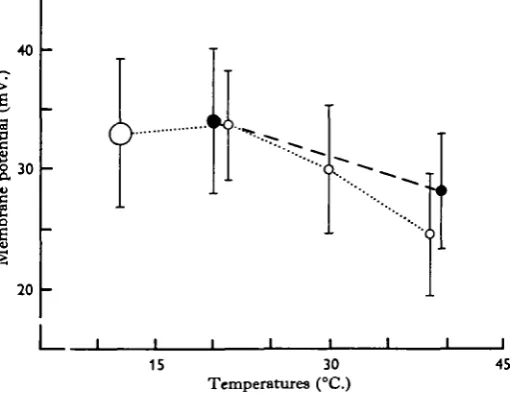
In another series of experiments, the transmembrane potentials of about 150 cells from a dozen preparations (males and females) were measured at 12-5°, 220, 300 and 380 C. The results (Fig*. 3) show that between 380 and 220 C. there is an approximately linear increase in the transmembrane potential of about 0-53 mV./°C. as the ternper-atureis lowered, but between 220 and 12-5° C. the average transmembrane potential remains unchanged.
•a
•a
I 30
£1
20
6-Q,
L.
15 30 Temperatures (°C.)
[image:3.451.98.354.265.463.2]45
Fig. 3. Relationship between the average transmembrane potential and temperature in twelve preparations (open circles). The black circles represent a separate experiment performed in the presence of D-tubocurarine io"4 (w/v). The diameter of the circles is the standard error of each set of measurements. The standard deviation is given by the length of the vertical lines.
Effect of n-tubocurarine on the transmembrane potential at different temperatures The addition of D-tubocurarine in a concentration of io~* (w/v) to the bathing solution, at 38° C , results in an increase of the transmembrane potential of a few millivolts (del Castillo, de Mello & Morales, 1963). In our experiments the trans-membrane potentials of 200 cells were measured at 200 and 390 C. in the presence of D-tubocurarine in the surrounding medium.
Effect of temperature on the frequency of the spikes
Most preparations show a frequency of about 7 impulses/sec, at 400 C , although higher and lower frequencies are not unusual.
A variable reduction of the frequency of the spikes is seen as the temperature is reduced. Most preparations become silent as the temperature is lowered below 300 C. Occasionally, however, preparations are seen that remain active at lower temperatures. In one instance action potentials continued to fire at a rate of 0-25 impulses/sec, for some minutes after the temperature was lowered to 200 C.
6r
a,
20 30 Temperature (°C.)
•40
Fig. 4. Relationship between spike frequency and temperature in one muscle cell. The tempera-ture, initially 390 C , was gradually lowered until the firing stopped. The average change in spike frequency as the temperature is lowered, represented by the broken line, is 0-28 spikes/ sec. °C.
A variable amount of accommodation in the increased firing rate is seen after an increase in temperature. Fresh preparations show a larger static component than those taken from worms collected 1 day or more before they are used. The static component is shown as a function of temperature in Fig. 4. This graph suggests a linear relation-ship between both parameters of about 0-3 impulses/sec. The dynamic response is probably much larger because frequencies up to 16 impulses/sec, have been observed after a rapid increase in temperature of 4° or 50 C. The Q10 is about 2 for the static
component.
DISCUSSION
Effect of temperature on the transmembrane potential
Del Castillo et al. (1963) have suggested that the membrane of cells showing spike activity is maintained in a partly depolarized state by a continuous liberation of acetylcholine from the nerve fibres of the dorsal and ventral nerve cords.
neuromuscular junctions takes place at a physiological temperature. Moreover, the observation that, at temperatures of 200 C. and below, D-tubocurarine ceases to have an effect on the transmembrane potentials suggests that the increase in membrane potential as the temperature is reduced is due to a gradual decrease in the liberation of depolarizing transmitter which would become exceedingly low at 200 C.
These results can be explained by two alternative mechanisms. Either there are cholinergic nerve cells that function as thermal receptors firing impulses at a rate proportional to the temperature, or there is a continuous liberation of acetylcholine from the motor nerve endings which is affected by the temperature in a manner similar to that described by Fatt & Katz (1952) in the amphibian motor terminals.
While we have no evidence in favour of the first suggestion, a low-amplitude noise, reminiscent of the synaptic noise caused by the spontaneous liberation of acetyl-choline in the vertebrate myoneural junction, has been observed in Ascaris (del Castillo et al. 1967). Moreover, this noise decreases and breaks up into small de-polarizations of about 1 mV. or less as the temperature is lowered. This phenomenon must be further investigated before any conclusions on its nature can be drawn, but it strongly supports the second possibility.
Effect of temperature on the frequency of the spikes
The decreased frequency of the spikes as the temperature is lowered is probably due to the increased transmembrane potential. Our data show a o-6 impulse/sec./mV. decrease in the frequency as the transmembrane potential increases upon cooling. However, other factors may determine the generation of spike potentials since we have found that acetylcholine does cause a depolarization of the membrane at 20 °C without eliciting spike activity.
SUMMARY
1. It has been shown that there is an almost linear inverse relationship between the transmembrane potential of the somatic muscle cells of Ascaris lumbricoides and the bath temperature between 380 and 200 C.
2. It has also been shown that the spike frequency reflects these changes, decreasing at a rate of o-6 impulse/sec./mV.
3. D-Tubocurarine interferes with the response of these cells to thermal changes between 380 and 200 C. but it is ineffective below 200 C.
4. It is proposed that the presynaptic nerve fibres are responsible for the thermal sensitivity of the muscle cells, since the amount of depolarizing neurohormone spontaneously released at the neuromuscular junctions would depend upon the temperature.
This work was supported by Grant no. NB-05235 from the National Institutes of Health.
REFERENCES
DEBELL, J. T., DEL CASTILLO, J. & SANCHEZ, V. (1963). Electrophysiology of the somatic muscle cells of Ascaris lumbricoides. J. ceil. Comp. Pkytiol., 6a, 159-^79.
DEL CASTILLO, J., DE MELLO, W. C. & MORALES, T. (1967). The initiation of action potentials in the somatic musculature of Atcaris lumbricoida. J. exp. Biol. 46, 263—79.
FATT, P. & KATZ, B. (1952). Spontaneous subthreshold activity at motor nerve endings. J. Phytiol., Lond. 117, 109-128.
HOBSON, A. D., STEPHENSON, W. & BEADLE, L. C. (1952). Studies in the physiology of Ascarit lumbri-coida. I. The relation of the total osmotic pressure, conductivity and chloride content of the body fluid to that of the external environment. J. exp. Biol. ag, 1-21.