BERGSON, PLOTINUS
and the
HARMONICS OF EVOLUTION
LYNN VIVIEN HUBBARD
A thesis submitted in partial fulfilment of the requirements of the University of the West of England, Bristol for the degree of Doctorate of Philosophy
The Faculty of Health and Applied Sciences, University of the West of England,
Bristol
1
BERGSON, PLOTINUS
and the
HARMONICS OF EVOLUTION
LYNN VIVIEN HUBBARD
A thesis submitted in partial fulfilment of the requirements of the University of the West of England, Bristol for the degree of Doctorate of Philosophy
November 2017
Abstract
*
It has been acknowledged that Bergson and Plotinus share many concepts, however
ambiguities in the texts have presented unresolved challenges to scholars of both
philosophers. The aim of this study is to examine what is explicit and speculate on
what is implicit in the texts, and to argue they both replicate the Pythagorean tradition
by proposing a philosophy of dynamic transformation underpinned by two fundamental
and interlinked premises: a universe generated and governed by a natural law of
musicalharmonics, and the concept of kairos as time signifying the emergence of qualitative change.
Following an examination of the revival of Pythagoreanism in the eras of
Plotinus and Bergson, the concepts central to Pythagorean cosmogony, cosmology and
theory of harmonics are explained. It is proposed these concepts, together with the
2
Plotinus’ Intellect and Soul as an integrated compound series consisting of a
fundamental vibration and its self-generated harmonics, thus potentially clarifying the
nature of the forms, λόγος, the decad, and the various levels of Soul. Furthermore, that Pythagorean concepts and the harmonics model are also at work in Bergson’s
cosmology, in the impulsion and inversion of the élan vital, demonstrating consistency with his arguments for partial finalism, theory of number and the influence of
mathematics. It is argued that for Plotinus and Bergson, contemplation and intuition
respectively is kairos, the moment in which mind and matter, sense perception and memory, freedom and determinacy, integrate, an integration grounded by the
harmonics model.
This new interpretation suggests a previously unacknowledged Pythagorean
influence on Bergson and an underestimation of the influence on Plotinus.
Significantly, it clarifies ambiguities, challenges old perceptions, reinforces the
influence of Plotinus on Bergson, and provides a novel perspective for further
i
BERGSON, PLOTINUS
and the
HARMONICS of EVOLUTION
Contents
*
Acknowledgements iv
List of Illustrations v
List of Abbreviations vi
Introduction 1
Chapter 1 Philosophical and Historical Background
Introduction 11
1.1 Pythagoras and Pythagoreanism 11
1.2 The Pythagorean Influence in the Era of Plotinus 15 1.3 The Pythagorean Influence in the Era of Bergson 19
Conclusion 31
Chapter 2 The Pythagoreans - The Generation of Multiplicity
Introduction 32
2.1 Pythagorean Cosmogony and Cosmology 33
2.1.1 Nature 33
2.1.2 The Principles of Limiting and Unlimited 35
2.1.3 Harmonia (ἁρμονία) 37
2.1.4 The Pythagorean Monad 37
2.2 A Brief History of Pythagorean Harmonics and Number Theory 42
2.3 An Introduction to the Pythagorean Science of Harmonics 46
2.4 Number as Dynamis 51
ii
Chapter 3 Plotinus - The Generation and Nature of Intellect
Introduction 60
3.1 Plotinus’ Principle of Unity – The One (τὸ ἕν) 61 3.2 The Generation and Nature of Intellect, the Form of the First Forms 64
3.3 The Generation of Intellect as Beings 74 3.4 Intelligible Matter, Logos and Substance in the Enneads 82
3.5 The Generation and Nature of Being as Substantial Number 89
Conclusion 98
Chapter 4 Plotinus - The Generation of Soul and Origin of Matter
Introduction 100
4.1 The Levels of Soul and their Relationship with Intellect 101 4.2 The World Soul, Providence and the Making of the Universe 106
4.3 The Integration of Body and Soul 112
4.4 The Nature and Origin of Matter (ύλη) 123
Conclusion 133
Chapter 5 Bergson - God, the Élan Vital and the Generation of Multiplicity
Introduction 136
5.1 Bergson’s Principle of Unity - God/Élan Vital 137
5.2 The Nature and Mechanism of the Élan Vital 149
5.3 The Ontological and Epistemological Transformation of the Élan Vital 157
Conclusion 169
Chapter 6 Bergson - Harmonics of Evolution
Introduction 171
6.1 Bergson’s Partial Finalism 172
6.2 The Role of Number in Bergson’s Creative Evolution 181
6.3 Bergson and Mathematics 188
6.4 Bergson and Pythagorean Number Theory 194
6.5 Bergson and Pythagorean Philosophy 199
6.6 Bergson and Metaphor 203
iii Chapter 7 Kairos (Kαιρός)
Introduction 210
7.1 Chronos and Kairos in Ancient Greece 211
7.2 Kairos in the Pythagorean Tradition 215
7.3 An Introduction to Kairos in Plotinus and Bergson 221
Chapter 8 Plotinus and Kairos
Introduction 222
8.1 Kairos and the World Soul 223
8.2 Kairos and the Individual Soul 226
8.2.1 Sense perception 228
8.2.2 Reasoning and Memory 236
8.3 The Freedom of the Individual Soul 247
Conclusion 251
Chapter 9 Bergson and Kairos
Introduction 254
9.1 Perception, Memory, and Kairos 255
9.1.1 Pure Perception 256
9.1.2 The Preservation of Memories 262
9.1.3 The Recognition and Recollection of Memories 266
9.2 Bergson and Freedom 272
9.3 Kairos in Bergson’s Philosophical Method 279
Conclusion 289
Conclusion 291
Bibliography 310
iv
Acknowledgements
*
I would like to express my thanks to my supervisors, Professor Alison Assiter and Dr.
Sean Watson for their guidance, support and encouragement throughout the years it has
taken to bring this thesis to completion.
I thank Dr. Iain Grant for introducing me to the joy of Plotinus when I was an
undergraduate student and for his encouragement when I was considering my PhD
application. I am grateful to numerous other people from UWE philosophy department
who either read and gave valuable advice on early drafts of parts of the thesis or gave
their support along the way. I would especially like to mention Leone Gazziero (now at
Lille University), Imogen Smith, Michael Lewis (now at Newcastle University) and
Lita Crociani-Windland(Sociology and Psycho-Social Studies). Furthermore, I express
my gratitude to Tim Swift in the mathematics department at UWE for explaining
Riemann’s mathematics with such clarity and enthusiasm, and to Tony Haynes, one of
the founders of the Grand Union Orchestra, its artistic director as well as writer and
arranger of most of its music. Tony kindly commented on the musical information
provided in Chapter 2.
Most importantly, this thesis could not have been completed without the love and
support of my family; my mum, who has always been there and believed in me; my son
Leon, who so enthusiastically encouraged my studies; his inner strength, resilience to
life’s challenges, and academic success has inspired me more than he will ever know;
and my dear husband Mick, my tower of strength, who sadly passed away just four
months before the thesis was submitted. I am truly blessed to have received the gift of
his love and unwavering encouragement, his willingness to hear and discuss my ideas,
proofread my work, and most of all for enabling me to follow my dreams. This thesis
v
List of Illustrations
*
The Pythagoreans
Figure 1 Pythagorean Tetractys 38
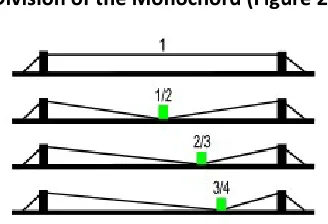
Figure 2 Division of the Monochord 46
Figure 3 Harmonic Series 47
Figure 4 Geometrical and Dynamic Correspondence of Harmonics 48
Plotinus
Figure 5 Creation of the Fundamental 70
Figure 6 Procession and the Creation of Being 71
Figure 7 Creation of the Form of Intellect 73
Figure 8 Harmonic Motion 75
Figure 9 Intellect’s Return to Itself 76
Figure 10 Generation of the Second Harmonic 76
Figure 11 The Generation of Soul 77
Figure 12 Generation of Multiple Harmonics 78
Figure 13 Unities within the Plotinian Decad 96
Figure 14 The Plotinian Decad/Tetractys 97
Figure 15 Generation of World Soul and Soul of Individual Souls 102
Figure 16 Harmonic Generation of Soul and World Soul 104
Bergson
Figure 17 The Creation of Memory 156
Figure 18 The Reflection of the Elan Vital 159
Figure 19 The Alternate Generation of Consciousness and Matter 160
Figure 20 Consciousness, Matter and the Law of Dichotomy 165
Figure 21 Bergson’s Cone Illustration 256
vi
List of Abbreviations
*
C.E. Bergson, H., 1907. L'Évolution créatrice. Paris: Quadrige, PUF
Creative Evolution. Trans. A. Mitchell, 1998.Mineola, New York: Dover.
C.M. Bergson, H., 1934. La pensée et le mouvant; essais et conférences. Paris: F. Alcan
The Creative Mind. Trans. M. L. Andison, 2003 . NY: Citadel Press
D.S. Bergson, H., 1922. Durée et simultanéité.Paris: F. Alcan
Duration and Simultaneity. R. Durie (Ed.), L. Jacobson (Trans), 1999. Manchester: Clinamen Press
M.E. Bergson, H., 1919. L’energie spirituelle. Paris: Quadrige, PUF
Mind-Energy, Lectures and Essays. Trans. H.W. Carr, 1920. NY: Henry Holt and Company.
M.M. Bergson, H., 1896. Matière et mémoire. Paris: Quadrige, PUF
Matter and Memory. Trans. N. M. Paul and W.S. Palmer, 2004. Mineola, New York: Dover.
T.F.W. Bergson, H., 1889. Essai sur les données immédiates de la conscience.
Paris: Quadrige, PUF.
Time and Free Will: An Essay on the Immediate Data of Consciousness. Trans. F.L.Pogson, 2001. Mineola, New York: Dover.
T.S.M.R. Bergson, H., 1932. Les deux sources de la morale et de la religion. Paris: Quadrige, PUF
1
Bergson, Plotinus
and the
Harmonics of Evolution
Introduction
*
But, friend, when you grasp the number and nature of the intervals of sound, from high to low, and the boundaries of those intervals, and how many scales arise from them, which those who came before handed down to us, their followers, to call ‘harmonies,’ and when you grasp the various qualities inhering in the motions of the body, which they said must be measured with numbers and named ‘rhythm’ and ‘metre,’ and when you apprehend that every One and Many should be so investigated, when you have grasped all of that, then you are wise ...
(Plato, Philebus, 17c11-e1, in Kennedy, 2011, p.viii)
The link between Bergson and Plotinus has long been acknowledged. Émile Bréhier,
who attended Bergson’s lectures on Plotinus, commented: “Plotinus is one of the very
rare philosophers with whom Bergson felt an affinity… he treated him, as if he
recognised himself in Plotinus” (Bréhier, 1949, pp.107-108). Despite Bergson’s
affinity with Plotinus, the only Bergson scholar to publish a comprehensive work on
the significance of Plotinus on his philosophy is Rose-Marie Mossé-Bastide whose
Bergson et Plotin, published in French in 1959, is no longer in print and has never been translated into English. Since then, only a few articles have specifically addressed the
Plotinus/Bergson relationship.
Bergson describes Plotinus as his “favourite philosopher” and Mossé-Bastide
2
concepts and differences of their respective philosophies. She proposed that Bergson’s
‘creative evolution’ is a “dynamic schema” that is “rooted in the philosophy of
Plotinus” (Mossé-Bastide, 1959, p.355), having developed it further by integrating the
generative functions of Plotinus’ hypostases, Intellect and Soul, within his concept of duration.
The aim of this study is to build upon Mossé-Bastide’s work and to support the
thesis that the “dynamic schema” underlying both their philosophies is rooted in the
science of harmonics and philosophy of the Pythagorean tradition, an influence
underestimated by commentators on Plotinus, and previously unrecognised by
commentators on Bergson.
The Pythagorean influence on Plotinus arises from its philosophical influence on
Plato, and its revival in the first and second centuries A.D. by Neo-Pythagorean
philosophers including Moderatus, Nicomachus, Numenius, and Plotinus’ teacher
Ammonius Saccas. It must be noted that while being referred to as Neopythagoreans,
they considered themselves to be Platonists (Dillon, 2014, p.250). O’Meara comments:
Plotinus regards himself as interpreting Plato, who expresses with greater clarity truths obscurely and partially indicated by Pythagoras. (O’Meara, 2014, p.404)
The Pythagorean legacy Plotinus continued is slowly coming to light, with Stamatellos’
Plotinus and the Presocratics (Stamatellos, 2007) and Slaveva-Griffin’s Plotinus on Number (Slaveva-Griffin, 2009) being of particular relevance, and it will be proposed that a deeper analysis of the text reveals the nature of the legacy to be of paramount
importance to our understanding of the Enneads.
The Pythagorean influence on Bergson could have presented itself through
personal, educational, scientific, and other cultural influences, and it will be argued that
3
author of Plotinus: Myth, Metaphor and Philosophical Practice, suggests that while some scholars believe exegesis must be confined to “what the text says” without
speculating on it, “scholarly exegesis simply of the text cannot be all we do” because
“all philosophers have more beliefs than they write down, beliefs that may influence
their arguments” and to understand the text “we have to make our own assumptions
about what it might reasonably say”. In referring to Plotinus he proposes that we shall
not understand the Enneads until “we can make a worthwhile guess about what is not said, and develop them in ways Plotinus did not, quite possibly, intend”. Clark claims
that this is what Plotinus did with Plato (Clark, 2016, pp. xii-xvi), and it is suggested
this is what Bergson did with Plotinus. The task of this project is however to present an
interpretation of the texts and make a “worthwhile guess” about what they do not say
with a view to revealing the real intentions rather than developing them in ways that
they did not intend. In this context the conception of “worthwhile” is to make sense of
aspects of the texts scholars have found challenging and therefore remain unexplained,
as well as promoting greater understanding among all who read the texts.
There are a number of aspects of the Enneads Plotinian scholars have found obscure and remain the subject of debate, for example, why procession and reversion
are necessary for the generation of Intellect and the multiplicity within it; the nature and shape of the forms; the nature of logos (λόγος); how number relates to the primary kinds and generates the Beings in Intellect, as well as the nature of the Plotinian decad. There are also disagreements amongst scholars concerning his account of Soul and matter, as well as the role of music and musical metaphors in the Enneads.
While many commentators on Bergson note certain ambiguities in his work,
particularly in Creative Evolution concerning the nature and generative process of the
4
later work presents a summary of his philosophy, and there appears to be an attitude of
acceptance of the ambiguities, with little effort to resolve them; hence there tends to be
a lack of disagreement or debate amongst modern Bergsonian scholars. It is anticipated
the arguments presented in the following chapters will help to resolve some of the
ambiguities and stimulate debate.
My thesis is that there are two fundamental dominant and interlinked themes that
Plotinus and Bergson have assimilated from the Pythagorean tradition: the ancient
Greek science of harmonics and the concept of kairos. A brief introduction to them is
therefore appropriate. The origin of the science of harmonics has been traced to
Pythagoras (c.530 B.C.) who is said to have discovered that musical intervals could be
expressed as ratios. He was the founder of a Pythagorean tradition that considered a
divine cosmos in which multiplicity is generated from a central point of power and
remains unified in the generative process because it is ordered according to a natural
law of musical harmonics based on numerical ratios. ‘Proportion’ was therefore
integral to their cosmogony, cosmology, and intimately linked to their religious values,
ethics and practice of medicine. Musical harmonics was considered a science, along
with geometry and astronomy, for which arithmetic was considered foundational.
The science of harmonics is also closely linked with kairos, one of the concepts the ancient Greeks utilized for time; the other is chronos. Chronos is chronological, sequential, quantitative or measured time, while kairos is purely qualitative as a
moment of action or timing, an occasion signifying the emergence of qualitative change that is situation specific. Kairos is essential in the ontological structure of the shaping of the moment, and so represents the Pythagorean notion of time always present within
the natural evolutionary process involving real change. The Pythagoreans
5
considered as a moment of necessity or providence and in the human inner world it is
the moment of the free act based on good judgement.
A survey of the literature revealsthat kairos is largely neglected by scholars of Plotinus and Bergson, particularly in the English language literature. The articles
written in French are very general in nature and include contributions from Vladimir
Jankélévitch (Jankélévitch, 1959) and J.M. Gebaude (Gebaude, 1991), who has written
specifically about the concept in Bergson’s philosophy, while E. Moutsopoulos, a
philosopher of kairicity, has written about its relevance to the philosophy of Plotinus (Moutsopoulos, 1984; 1991).
Harmonics and kairos have a dynamic and transformative character and entail the integration or synthesis of natural philosophy and psychology. Bergson refers
specifically to harmonics, almost as an aside in some of his texts, but does not mention
kairos, whereas Plotinus refers to kairos but does not mention harmonics. Neither philosopher refers to them explicitly as grounding principles; however, it will be argued
that they are implicit in the texts, and the philosophy of Plotinus and Bergson only
makes sense if it is founded on the model of harmonics, a theory that once understood,
has the potential to resolve many of the perceived ambiguities in their work and
re-enforces their philosophical connection. It is therefore anticipated that the thesis will
be of interest to historians of philosophy as well as to scholars of Plotinus and Bergson.
Furthermore, since it potentially transforms our understanding of their metaphysics it
will raise the profile of harmonics and kairos in the field of metaphysics in general. This is the first time that harmonics and kairos have been studied in both philosophers; hence the arguments presented rely heavily on analysis of the text of the
6
surprisingly, for a thesis on the history of philosophy, that it has been necessary to be
selective whilst being comparative. For example, although presumed to be highly
influential on Plotinus, the role of Pythagorean harmonics in Plato’s texts, particularly
in the Timaeus where he uses Pythagorean harmonic ratios in his cosmology (Timaeus
35a-37e), has not been addressed in detail because significant work on how Plato
applied Pythagorean harmonics in his dialogues has already been published by
commentators. Barker writes about Plato’s musical ethics in the Republic and Laws, as well as harmonics in the Republic and Timaeus (Barker, 2007, pp. 308-327); Cornford examines harmonics in the Timaeus (Cornford, 1935); Crickmore suggests how Pythagorean harmonics underpins Plato’s political and moral theory in the Republic
(Crickmore, 2006); Kennedy proposes that a stichometric analysis of Plato’s
Symposium and Euthyphro reveals a musical scale built in to the text (Kennedy, 2011); McClain explains how Pythagorean mathematics and harmonics was influential in key
dialogues such as the Republic, Timaeus, Critias, Statesman and Laws (McClain, 1978); Pelosi investigates Plato’s philosophy of music as it relates to the body and soul
(Pelosi, 2010) and Moro Tornese has examined the theories of music and harmony in
Proclus' commentaries on Plato's Timaeus and Republic (Moro Tornese, 2010; 2017). Due to the extensive nature of addressing how Plato incorporated Pythagorean
harmonics into his philosophy it is deemed prudent to explore how Plotinus takes
metaphysics beyond Plato to a level in which the ratios of musical harmonics have a
basis in modern physics. The need to be selective has also entailed the isolation of
Bergson from his acknowledged philosophical influence of French Spiritualism, a
detailed analysis of which would divert from the focus of the thesis. While Bergson
disagreed with aspects of Plato’s philosophy to the extent that Plato could be
7
the key conclusions of the thesis is that Pythagoreanism is the tradition that unites them
more strongly than previously realised. The scope of the thesis is therefore limited to a
comparison of the philosophy of Plotinus and Bergson with the Pythagorean tradition.
Chapter Synopsis
This study will be presented in nine Chapters and a Conclusion. Chapter One places
the proposed Pythagorean influence on Bergson and Plotinus within its philosophical
and historical context to provide important background information that supports the
examination of the interlinked concepts of harmonics and kairos explored in
subsequent chapters. The Chapter opens with a brief history of Pythagoreanism and
then examines the influence of Pythagoreanism in the eras of Plotinus and Bergson.
Chapter Two provides an important, but necessarily brief introduction to the
concepts central to Pythagorean cosmogony and cosmology because they will be
referred to in subsequent chapters: Nature, the Principles of Limiting and Unlimited,
Harmonia (ἁρμονία), and the function of the Pythagorean Monad in their number theory. This is followed by a brief history of Pythagorean harmonics and number theory, and a basic introduction to the Pythagorean science of harmonics. Finally, it
will discuss the notion that within the science of harmonics the Pythagoreans conceived
numbers as powers.
Chapter Three examines the generation and nature of Intellect in the Enneads. It commences with an explanation of Plotinus’ theory of the One as the first principle of unity, and the source of multiplicity. This is followed by a summary of Plotinus’
8
series consisting of Intellect as a fundamental vibration and its Beings as self-generated harmonics. This will be followed by clarification of the ontological status of logos as the substance of the Beings in Intellect. While commentators understand logos to imply a logical ordering structure that is commonly defined as ‘rational forming
principle’ or ‘reason principle’, it will be proposed, following an examination of the
ancient Greek meaning of logos and the nature of logos as described by Plotinus, that it could be defined more precisely as ‘ratio’, emulating the term used in the Pythagorean
tradition of musical harmonics. Finally, by analysing how substantial number is
generated with the primary kinds: motion, rest, otherness and sameness, it will be
argued that Plotinus’ concept of Being consists in the decad, which is modelled on the Pythagorean tetractys that represents the structural order or numerical organisation of the universe.
Chapter Four continues the examination of Plotinus’ account of the generation of
multiplicity by examining the generation of Soul and origin of Matter. It will reveal how the harmonics model applies to the Hypostasis Soul and the generation of the
World Soul and Soul of individual souls, and their relationship to Intellect. Then it examines the role of ‘providence’ and harmonia in the making of the universe by the
World Soul,and subsequently explains the application of the concepts of sympathia and
synesis in the integration of body and Soul. Finally, it examines the nature and origin of matter. It will be argued that the model of harmonics provides a solution to ambiguities
debated by scholars and that the Pythagorean influence on Plotinus is greater than
previously realised.
9
examination of the ambiguity surrounding the nature of the élan vital and will argue that Bergson followed Plotinus and the Pythagoreans in presenting a non-pantheist
philosophy in which the First Principle remains distinct from its products. This is
followed with an explanation of the mechanism of the élan vital, and it will be proposed, with the aid of illustrations, that it replicates Plotinus’ movements of
progression and reversion, thusgenerating the ‘form’ of the élan vital as the first harmonic that subsequently divides itself into matter and consciousness as separate
tendencies, thus creating an impersonal supra-conscious memory as a series of
harmonics.
Chapter Six develops the argument that Bergson’s cosmology is modelled on the
generation of harmonics by examining his arguments for partial finalism, his theory of
number, and the influence of mathematics. It will be proposed that since his arguments
are compatible with the 3-stage generative structure of Pythagorean cosmology, this
potential influence suggests that a re-evaluation of the influences normally attributed to
these concepts is necessary. An examination of his lectures on the Pythagoreans will
reveal Bergson’s sympathy with Pythagorean number theory and philosophy of
transformation. Finally, the commonly held view that Bergson’s theory of duration as a
melody is a metaphor will be discussed and contested.
Chapter Seven introduces the concept of kairos as it was understood in ancient Greece by the Pythagoreans, as a prelude to explaining the nature of kairos in Plotinus and Bergson. It explains how kairos is connected to rhetoric under Pythagorean influence.
10
memory, reason, and freedom as they relate to the individual soul, and it will claim that perceived ambiguities can be resolved if the model of harmonics is applied to these
concepts.
Chapter Nine explores how Bergson utilises the ancient concept of kairos in the model of harmonics in his theories of perception and memory as proposed in Matter and Memory, and how kairos is intimately connected to his understanding of morality and individual freedom as proposed in the Two Sources of Morality and Religion.
Finally, it will suggest that kairos in Bergson’s philosophical method of intuition may have been inspired by ancient Greek rhetoric under the influence of the Pythagorean
tradition.
The thesis concludes with a summary of the main points and a discussion about
their relevance as well as opportunities for further work.
All references to Plotinus’ Enneads use the A. H. Armstrong translation in the Loeb Classical Library series published by Harvard University Press unless specified
otherwise.
English translations of Henri Hude’s ‘Introduction to Bergson’s Lecture on the
Pythagoreans’, ‘Bergson’s Lecture on the Pythagoreans’, Henri Hude’s ‘Introduction to
Bergson’s Lectures of Plotinus’ and ‘Bergson’s Lectures on Plotinus’ have not
previously been available. With kind permission of Presses Universitaires de France
my translations are included as Appendices 1, 2, 3 and 4 respectively, as they are
referred to in the thesis and may be of interest to Bergson scholars. Presses
Universitaires de France have granted permission for them to be included in the thesis
11 Chapter 1
Philosophical and Historical Background
*
Introduction
In his ‘Introduction’ to A History of Pythagoreanism,Carl Huffman remarks that the subject of the Pythagorean tradition is ignored by most scholars of ancient history
(Huffman, 2014, p.1); however, it is a subject demanding recognition if we are to
understand its influence on the philosophy of Plotinus and Bergson. Pythagoreanism
was not simply of historical importance to the ancient Greek schools; through its effect
on philosophy, science, as well as the wider culture of the respective eras in which both
philosophers lived, the impact on their lives would have been significant. This Chapter
therefore introduces the Pythagorean tradition and examines the extent of its influence
in the eras of Plotinus and Bergson, thus providing historical context for the
philosophical influence that will be proposed in subsequent chapters.
1.1 Pythagoras and Pythagoreanism
Pythagoras was acknowledged to be a mathematician, philosopher, scientist, mystic,
and founder of a religious order in Croton, southern Italy. Pythagoreans were either
acusmatici, i.e., those who only followed the tradition’s ethical practices; or
mathematici who employed themselves in mathematical or scientific study.1 Despite
12
the differences within the tradition its spiritual character permeated the whole system.
It was a culture whose religious values and ethics were based on the belief in a divine
cosmos ordered on ‘proportion’ or harmonic principles, the key to which is the function
of number, hence the integration or synthesis of psychology and natural philosophy.
The scientific pursuit of harmony or order in nature facilitated the attainment of the
religious ideal of the unity and harmony of the soul and the divine cosmos (Guthrie,
1962, p.246).
The primary sources of information about Pythagoreanism are Aristotle,
Nicomachus, Porphyry and Iamblichus, and according to Iamblichus’s Life of
Pythagoras, the concept of silence was an integral part of the religious ideal of unity, as Riedweg comments:
…the Pythagoreans saw the practice of silence not only as a way of achieving ascetic self-mastery but also for the training for the duty to keep the teachings secret. (Riedweg, 2008, p.101)
Initiates were expected to follow a vegetarian diet and to maintain physical, mental and
emotional balance at all times, facilitated by the therapeutic effects of music. The
primacy attributed to harmonics and music arises because Pythagoras is said to have
discovered that musical intervals could be expressed as ratios, hence the Pythagorean
tradition considered numerical ratios as universal principles that revealed a harmonia, or natural law of tonal order within their cosmology, ethics and practice of medicine.2
The sciences studied by the mathematici included arithmetic, geometry, astronomy and harmonics; arithmetic was foundational for the other sciences, as Huffman explains:
13
… while it does have as its own proper object the counting and multiplying and dividing of objects in the world, it is also involved in each of the other
sciences, insofar as their accounts of the sensible particulars are all given in terms of numbers, ratios and proportions. (Huffman, 2005, p.65)
Pythagoras wrote nothing himself and his followers obeyed a strict rule not to
divulge the secrets of the tradition; however, the earliest written work of Pythagorean
philosophy entitled On Nature was written in the late fifth century B.C. by Philolaus (470-390 B.C.). Philolaus succeeded Pythagoras by approximately one century, and
while there is no evidence that he conducted experiments in harmonic science (Creese,
2010, pp.104-117) it provided the basis for his cosmogony and cosmology; its
application was solely for understanding the nature of reality (Barker, 2007, p.275). Of
the eleven fragments considered to be authentic (Frs. 1, 2, 3, 4, 5, 6, 6a, 7, 13, 16 and
17)3 it has been deduced that while he is not known as a mathematician Philolaus had
an interest in mathematics and demonstrates knowledge of the harmonic ratios
(Huffman, 1993, p.54). He also wrote on psychology, embryology and medicine. His
pupil, Archytas (428-350 B.C.), a contemporary and colleague of Plato (Huffman,
2005, pp.32-42), wrote a number of works of which only a few fragments that remain
are interpreted as being genuinely Pre-Socratic, i.e. not being influenced by Plato,
Aristotle or their followers (Burkert, 1972, pp.144-145).4 The Sectio Canonis, a Pythagorean text attributed to Euclid, dates from the fourth century B.C.
The influence of the Pythagoreans in the ancient world facilitated the
reconceptualization of scientific knowledge, politics, ethics, and hence philosophy. It
is commonly accepted that Pythagoreanism was important for Plato’s cosmology and
3 The surviving fragments of Philolaus are in H. Diels and W. Kranz, Fragmente der
Vorsokratiker, 6th ed. (Berlin, 1951), I: 398-419.
4 The surviving fragments of Archytas’ work appear in H. Diels and W. Kranz, Fragmente der
14
political theory but was concealed in myths and allegory, a subject that has been of
increasing interest to scholars of Plato. It is acknowledged that Pythagorean
mathematics and harmonics was influential in key dialogues such as the Republic, Timaeus, Critias, Statesman and Laws, and the Phaedo incorporates the Pythagorean concepts of purification, reincarnation or metempsychosis, and the forms as
mathematical entities (Hackforth, 1972, pp.4-6).
The Pythagorean School ebbed away after Plato, and according to Kahn, in the
second and third centuries B.C. the acousmatici were “replaced as mendicant philosophers by the Cynics”, and the mathematici were “absorbed into the Platonic school of Speusippus, Xenocrates, and Polemon” (Kahn, 2001, p.72). While
Pythagoras himself became a legendary figure, during this period a corpus of
pseudo-Pythagorean texts emerged making it difficult to distinguish truth from fiction;
however, Centrone argues that they all basically articulate the same system (Centrone,
2014, pp.315-340).
Neo-Pythagoreanism originated with Nigidius Figulus who revived Pythagorean
doctrines in Rome in the first century B.C., while Apollonius of Tyana and Moderatus
of Gades spearheaded the revival in Greece. The trend continued in the second century
A.D. with Nicomachus of Gerasa and Numenius of Apamea who considered
Pythagoreanism to be the influence behind Plato’s concepts of the Good and the
15
1.2 The Pythagorean Influence in the Era of Plotinus
Key Neo-Pythagorean concepts appear in the Enneads, and Porphyry, Plotinus’ student, writes that he was knowledgeable about Neo-Pythagorean philosophy, and even that he
had been accused of plagiarising Numenius, a view that was accepted as wrong
(Porphyry, The Life of Plotinus, 17-18,8). Porphyry refers to a book written by Longinus who comments: “Plotinus … has expounded the principles of Pythagorean
and Platonic philosophy more clearly than anyone else before him” (Porphyry, 20,
71-73). While Plotinus was highly esteemed in Neo-Pythagorean circles, Huffman
suggests that Plotinus was influenced by “Neo-Pythagorean speculation on first
principles”; however, it was his successors that absorbed Neo-Pythagoreanism into
their philosophy. Plotinus himself was not Neo-Pythagorean because he considered
Plato to be divine, not Pythagoras who he treats “as just one among many
predecessors” (Huffman, 2014); however, Chapters 3, 4 and 8 will claim that
Pythagoreanism is more strongly implicated in the Enneads than previously acknowledged.
Stamatellos comments that in the Enneads, Plotinus maintains that his primary influence was Plato (Stamatellos, 2007, pp.11) and as the instigator of Neoplatonism,
Plotinus presents an innovative development of Platonism in which he also respectfully
acknowledged, and was knowledgeable about, the theories of the Pre-Socratic
philosophers who influenced Plato and Aristotle. Stamatellos writes: “His thought
assimilates nearly eight centuries of philosophy and intellectual history” (Stamatellos,
2007, p.1), and referring to doxographical material in Ennead VI.8-9 he suggests:
16
to prove that the fundamental principles of his metaphysical system were rooted in Greek philosophical tradition and the teaching of the ancients. (Stamatellos, 2007, p.28)
Bergson expresses a similar view of Plotinus in a letter dated 31st May 1939 to
Professor Charles Werner, after reading his book on Greek philosophy (Werner, 1938):
…my favorite philosopher has always been Plotinus, who in my eyes
synthesizes all of Greek philosophy and who was also convinced that all Greek
philosophers have said the same thing. (Correspondances, p.1,626)
While Plotinus’ primary philosophical influence was Plato, the influence of
Pythagoreanism in the wider culture of his era cannot be ignored. Joost-Gaugier’s
study of the Pythagorean influence on art and architecture indicates that the influence
of Pythagoreanism continued for centuries after the death of Pythagoras. The sustained
veneration of Pythagoras by his followers is reflected in a consistent tradition of
portraits of him in both Greek and Roman sculpture. It is held that Pythagoras
worshipped one God, Apollo. The cult of Apollo was established in Rome as early as
the fourth century B.C., and by late antiquity Pythagoras was regarded as the son of
Apollo and “thus a deity in his own right, meriting not just veneration but something
approaching ritualized worship”, and furthermore, that “it came to be believed that
Pythagoras was the incarnation of Apollo” (Joost-Gaugier, 2007, p.137). Like
Pythagoras in Greece, Apollo came to be associated with medicine and healing in
Rome. In Porphyry’s ‘Life of Plotinus’ he states that following Plotinus’ death Apollo
was consulted by Amelius, who desired to know where Plotinus' soul had gone
(Porphyry, 22, 8). While there is no suggestion that Plotinus worshipped Apollo, or
17
Less formidable than he was in Greece, the Roman Apollo thus played a socially cathartic role in Rome, where he was accepted by all classes of Roman society. (Joost-Gaugier, 2007, p.152)
The study of harmonics conducted by the Pythagoreans and Aristoxenus5 was
also influential in the fields of Roman architecture and mechanics. In the first century
B.C. Vitruvius wrote that the architect should know music in order to have a grasp of
harmonic and mathematical relations (Vitruvius, 1914, 1.1.8), and as Walden remarks:
“He immediately focuses on the practical importance of ancient Greek music theory for
architectural and mechanical design” (Walden, 2014, p.126), and “proposes a number
of ways in which the musical-architectural theories he describes can be applied in
everyday architectural practice” (Walden, 2014, p.131). Porphyry comments that
Plotinus “had a complete knowledge of geometry, arithmetic, mechanics, optics and
music, but he was not disposed to apply himself to detailed research in these subjects”
(Porphyry, The Life of Plotinus, 13, 8-10), so it is not impossible that Plotinus was familiar with Vitruvius’ work.
The Pythagorean influence was also reflected in Plotinus’ lifestyle. Porphyry
notes that Plotinus was a vegetarian (Porphyry, The Life of Plotinus, 2.5), lived an ascetic existence (Porphyry, The Life of Plotinus, 8, 13-24) and placed an importance on the tradition of silence in his philosophy. Plotinus was sworn to secrecy about the
teaching of his teacher, Ammonius Saccas (Porphyry, The Life of Plotinus, 3, 24-29), and he is silent, for example, when discussing the nature of the One, which is his version of Plato’s Good. Plotinus explains that he considers it information not to be disclosed to the uninitiated:
18
This is the intention of the command given in the mysteries here below not to disclose to the uninitiated; since the Good is not disclosable, it prohibits the declaration of the divine to another who has not also himself had the good fortune to see. (Ennead VI.9.11, 1-4)
Philosophical tradition is important to Plotinus; hence the concepts of concealment,
secrecy and silence are ubiquitous in the Enneads. In 1919 Casel referred to the concept as ‘silentium philosophorum’ (Casel, 1919). Clark helpfully references
Clement of Alexandria and Eunapius of Sardis as confirmation of the tradition of
secrecy (Clark, 2016, p.xii):
It was not only the Pythagoreans and Plato that concealed many things, but the Epicureans too say that they have things that may not be uttered, and do not allow all to peruse those writings. The Stoics also say that by the first Zeno things were written which they do not readily allow disciples to read, without their first giving proof whether or not they are genuine philosophers. And the disciples of Aristotle say that some of their treatises are esoteric, and others common and exoteric. Further, those who instituted the mysteries, being philosophers, buried their doctrines in myths, so as not to be obvious to all. (Clement of Alexandria, Stromata, 5.9, in Roberts and Donaldson (eds.), 1867)
…some philosophers hide their esoteric teachings in obscurity, as poets conceal theirs in myths. (Eunapius 456, in Wright, 1921, p.357)
Plotinus also follows the tradition in considering philosophy to be an initiation
into higher truths; the information is not explicitly given to the student because
initiation is a journey of discovery the student has to undertake for him/herself; the
philosopher is the hierophant, or the one who shows the way. We therefore find that
19
1.3 The Pythagorean Influence in the Era of Bergson
Understanding the Pythagorean influence in Bergson’s era requires a brief history of
developments in the years between Plotinus and Bergson.
The scientific study of the universe ordered according to musical harmonic
principles continued up to the time of Johannes Kepler (1571-1630), who is regarded as
the last genuine Pythagorean scientist (Kahn, 2001, pp.161-171). This shift was
provoked by religious influences dating back to Galileo (1564-1642), when scientific
research into so-called pagan harmonic philosophies was actively discouraged by the
church. Pythagorean philosophy and science were driven underground, concealed in
art and architecture, and held within secret societies such as the Freemasons.
Following Kepler, the fact that musical harmony can be expressed in terms of
numerical ratios was still recognised; however, science dismissed the previously held
thinking that the Good, telos, harmony, and musical ratios are cosmological principles governing all of reality; the focus of science became the physics and mathematics of
acoustics, as noted by Gouk:
By the end of the [17th] century the notion of heavenly harmonies was no longer popular, having largely given way to acoustical studies based on the joint development of classical physics and mathematical analysis, and the harmonies of the heavens had fallen silent. Enlightenment philosophes themselves certinly claimed to have removed the need for occult principles in nature. (Gouk, 2006, pp. 228-229)
Despite this important change, music continued to influence and inspire scientific and
mathematical discoveries. Marin Mersenne (1588-1648) proved the mathematical laws
that pertain to the harmonic series as frequency of oscillation, and the link between
20
physicist and musician. In 1787 Chladni published an article entitled ‘Discoveries
Concerning the Theory of Music’ in which he revealed that sound waves naturally
create geometric patterns in matter. The study of ‘sound made visible’6 uses a
‘tonoscope’ and is now known as ‘cymatics’ from the Greek κῦμα (wave), so called by
Hans Jenny in 1967. Cymatics is now considered both as a science and an art.7
Similarly, in 1827 the English physicist Sir Charles Wheatstone (1802-1875) invented a
kaleidophone to make sound waves visible; he referred to it as a "Philosophical Toy"
(Bowers, 2001, p.22).
Music, or more specifically musical harmonics, lost its status as a mathematical
science by the middle of the eighteenth century and was henceforth considered a
performing art by the scientific community; however, those studying music still
considered it a science and an art. Professor William Crotch, who held the Heather
Chair in Music at Oxford University, quoted Sir William Jones (1746-1794) when
opening his 1831 lectures:
Music … belongs as a science, to an interesting part of natural philosophy, which, by mathematical deductions …explains the causes and properties of sound … but, considered as an art, it combines the sounds which philosophy distinguishes, in such a manner as to gratify our ears, or affect our
imaginations, or by uniting both objects to captivate the fancy while it pleases the sense, and speaking as it were, the language of nature, to raise
corresponding ideas andconnections in the mind of the hearer. It then, and then only, becomes fine art, allied very nearly to poetry, and rhetoric. (Wollenberg, S., 2006, p.6)
6 This phrase was used by Goethe who in 1817 in "Schicksal der Handschrift". Schriften zur
Morphologie said of Chladni: “Who will criticize our Chladni, the nation’s crowning jewel?
The world owes him gratitude, since he made sound visible.” (Goethe, 1817, p.51) (My
translation).
21
Advances in the sciences and mathematics during the nineteenth century were highly
significant for Bergson; in fact, in the first pages of Time and Free Will he
acknowledges them without being specific. They are however linked to discoveries
regarding the electromagnetic spectrum: in 1800 William Herschel discovered infrared
light; Johann Wilhelm Ritter discovered ultraviolet light in 1801; electromagnetism
was discovered by Hans Christian Ørsted in 1820 and in 1845 Michael Faraday
formulated the field theory of electro-magnetism.; in 1886 the physicist Heinrich Hertz
detected radio waves, and later microwaves; and in 1895 Wilhelm Röntgen discovered
x-ray radiation. Gamma rays were not discovered until the early twentieth century.
Significant advances in mathematics were made by the French mathematician Joseph
Fourier who discovered that any temporal wave that has a consistent repeating pattern
or continuous function, can be broken down into an infinite sum of simpler sine and
cosine waves with differing amplitudes (Fourier, 1822), and during the 1860’s James
Maxwell developed four partial differential equations for the electromagnetic field, and
predicted an infinite number of frequencies of electromagnetic waves that all travel at
the speed of light (Maxwell, 1865). These discoveries coincided with advances in the
study of acoustics. Pesic, inMusic and the Making of Modern Science, has surveyed the importance of music in science from the dawn of Pythagorean harmonics to modern
quantum theories, and contends that:
…the Pythagorean theme of harmony remains potent in contemporary physics, though its harmonies are more and more unhearable, ever more embedded in its mathematical formalism” (Pesic, 2014, p.5)
He further comments:
22
While Pesic describes how music influenced and inspired scientists and
mathematicians from the Pythagorean era to the present day, in general, science in
Bergson’s day could not be taken to be consciously influenced by Pythagoreanism.
The mathematics of harmonic motion studied by science ignores its musical counterpart
even though, as will be demonstrated in Chapter 2, there is a correspondence between
the harmonics of music and sound; hence the gap between sound studied as a science
and music studied as an art remains.
The new scientific concept of a vibratory universe coincided with a revival of
Pythagoreanism in the wider culture, which included part of the wave of romantic and
‘traditionalist’ occultism that swept Europe in the nineteenth century as a reaction
against mechanical materialist science. In the Foreword to The Pythagorean Sourcebook and Library, Joscelyn Godwin describes how the nineteenth century “swarms with semi-Pythagoreans” following the publication of Fabre d’ Olivet’s
Golden Verses and commentary in French, Taylor’s Theoretic Arithmetic in 1816 and his translation of Iamblichus’s Life of Pythagoras, which in 1818, formed the basis of Guthrie’s version (Guthrie, 1988, p.13). In France there was a revival of the occult
aspects of Pythagoreanism and an upsurge in numbers of esoteric societies that were
unconnected with the natural sciences, and which were founded on Pythagoreanism
and Neoplatonism, including the Theosophical Society, a middle-class spiritualist
movement established by Helena Blavatsky (1831-1891) who aimed for a synthesis of
science, religion and philosophy. Davis and Taylor propose:
23
Similarly, Bergson claimed that scientific advances supported his theory of duration as
vibrations of energy; hence as Owen remarks:
Bergson’s philosophy spoke to an esoteric understanding of a reality beyond the purview of “modern Science”, and complemented occultists’ long-held assertions that scientific materialism was incapable of penetrating the deepest secrets of the universe. (Owen, 2004, p.137)
The Theosophical Society flourished from roughly 1860 to 1890, and its offshoot, the
Hermetic Order of the Golden Dawn, was established in London in 1888 by Dr William
Wynn Westcott (1943-1925), Dr William Robert Woodman (1828-1891) and Samuel
Liddell Mathers (1854-1918), who all had a background in freemasonry that has
historical links to Pythagoreanism. Samuel Mathers married Bergson’s sister Moina in
the same year, and one of the key practices of the order involved the use of the “will”,
as described by Mary K. Greer:
The student’s goal was to unite the Will with the Highest Self. Will (with a capital W) was the consciously focused intention of one’s highest, divine, or God-like Self, charged by a desire that was purified of all ego-content and actualized through an imagination that used all the senses but was untainted by material illusion. (Greer, 1996, p.57)
This goal is influenced by the mysticism of the Pythagoreans and Plotinus who argued
for the mystical union of the soul and the impersonal One; however, they did not consider selfhood as medium and goal. In TheTwo Sources of Morality and Religion
Bergson utilises concepts of ‘self’ and ‘will’ as applied by the Hermetic Order of the
Golden Dawn, by proposing that the ultimate goal of man is to attain the status of the
mystic who unites his will with the will of God or the élan vital (T.S.M.R., p.99). Furthermore, Bergson, Theosophy and its offshoots, such as the Hermetic Order of the
24
transformation, and it is purposeful evolution as opposed to Darwin who proposed a
materialist purposeless theory of natural selection or adaptation to circumstances. For
Bergson and Theosophy, the purpose of evolution is to be like God and act with love
towards others. In The Two Sources of Morality and Religion Bergson defines the “great mystic” as:
an individual being, capable of transcending the limitations imposed on the species by its material nature, thus continuing and extending the divine action. (T.S.M.R., p.220-221)
Theosophists believe in the Pythagorean theory of reincarnation, and similarly Bergson
is also open to the notion of the survival of the soul after death, if not reincarnation
itself. Bergson’s philosophy was therefore compared to Theosophy by members of the
Society; his work was reviewed over four editions and included in two volumes of the
Theosophical Quarterly, published in New York between 1913 and 1914. The review, authored by John Blake Jr., refers to his work in glowing terms as following the path of
the Theosophist to “the divine nature, to the divine power, to righteousness and to
wisdom and to light”, and significantly he remarks:
he is describing the same effort, the same experience, and his contribution, therefore, has profound significance for the student of all such searchings after Divine Wisdom. (Blake, 1913-1914, p.337)
In the second volume of the magazine the author continues his review of Bergson’s
philosophy and states the following:
25
them available in his search after the Divine Wisdom. (Blake, 1914 (July), p.17)
While Blake does not explicitly suggest that Bergson was influenced by Theosophy, a
subtle inference could be read into the quotation above. The review does however
imply that the popularity of Bergson’s philosophy supported the views of the Society.
To my knowledge, Bergson never accepted nor denied the influence of Theosophy on
him, or the influence of his philosophy on Theosophy.
Following Mathers’ death in 1918, Moina headed a successor organisation, the
‘Rosicrucian Order of the Alpha et Omega’ (Hermetic Order of the Golden Dawn,
2017). All these orders emphasised the acquisition of secret knowledge derived
through processes of ‘will’, education, and initiation, hence the desire to integrate
science and religious belief. Bergson’s desire was to integrate science and metaphysics
through the same means of education and initiation. It is not suggested that Bergson
was personally involved specifically with any of these occult societies; however,
commentators concede that his curiosity about unexplained and hidden knowledge was
an open secret8 and a reflection of contemporary middle-class culture.
Bergson, like his sister, was a member of the Society for Psychical Research
founded in 1882 by Westcott, one of the founders of Golden Dawn, and Bergson
became its president in 1913. Grogin remarks that Bergson was trying to “validate
esoteric ideas through empirical and rational means. This was why he rejected the
more extreme forms of the occult in favour of the empirical methods of psychical
research” (Grogin, 1988, p.43). In his inaugural address as President of the Society he
8 Barnard, 2011, p. 251 and Lefebvre & White, 2012, pp. 297, fn.8 quote Bertrand Méheust,
Who writing about mesmerism in France, in Somnambulisme et médiumnité: Tome 1 et Tome
2, states that Bergson’s interest in the paranormal was an open secret in the society of his
26
suggested that if science had taken the psychological route rather than the
mathematical, the combination of vitalist biology and the science of mind-energy could
be beneficial in medicine:
there would have arisen a medical practice which would have sought to remedy directly the insufficiencies of the vital force; it would have aimed at the cause and not the effects, at the centre instead of the periphery; healing by suggestion or, more generally, by the influence of mind on mind might have taken forms and proportions of which it is impossible for us to form the least idea. (“Phantasms of the Living” and “Psychical Research”, in M.E., p.99)
This view of medicine, grounded in the notion of a vibratory universe and underpinned
by sonorous mathematics, was gaining increasing scientific support, and develops the
Pythagorean approach to healing that had a musical basis and was linked to kairos, as will be explained in Chapter 7.9
The concept of initiation was a preoccupation of every occult organisation,
including the Freemasons, the Theosophists, Hermeticists and others, and a concept
that retained its importance in the twentieth century. While Bergson was quietly
spoken with an unassuming character, his style of lecturing could be considered an
‘initiation’ for those who heard him. In 1913 Arthur Lovejoy described Bergson’s as
“the most Eleusinian of contemporary philosophies” and proposes that Bergson fulfils
the “need for a, new sort of philosophic Eleusinia [that] is recurrent among the
cultivated classes every generation or two” (Lovejoy, 1913, p.254). According to
Synesius, Aristotle wrote, “Initiates do not need to understand anything; rather, they
undergo an experience and a disposition – become, that is, deserving” (Aristotle,
Synesius, Dio, 10, frag. 15, in, Rice and Stambaugh, 2009, p. 143), and furthermore, in
27
referring to states of catharsis Aristotle writes: “All who use these rites experience
release mixed with joy” (Politics 8.7,1342a14, in Burkert 1987, p.19). Bergson also proposes that “joy” is attained by his method of intuition (‘Philosophical Intuition’, in
C.M., pp.128-129) and the emotion attained by the mystics who possess supreme good
sense (T.S.M.R., p.220). If the ultimate aim of Bergson’s philosophy is to experience
the joy of the intuition of duration, he appeared to have achieved it in his writing and
lectures; Le Roy, for example, described the experience of reading Bergson’s
philosophy:
Mr Bergson's readers will undergo at almost every page they read an intense and singular experience. The curtain drawn between ourselves and reality, enveloping everything including ourselves in its illusive folds, seems of a sudden to fall, dissipated by enchantment, and display to the mind depths of light till then undreamt, in which reality itself, contemplated face to face for the first time, stands fully revealed. The revelation is overpowering, and once vouchsafed will never afterwards be forgotten. (Le Roy, 2005, p.3)
Grogin provides many quotes from those who attended Bergson’s lectures, some of
whom, like LeRoy, described it as an emotional and even religious experience (Grogin,
1988, pp.124-126). Grogin writes:
He was more poet than orator, a man using a personal charm and magic to take possession of his listeners. Philosophy in Bergson's hands became something experienced, and students left his room as if in a dream. (Grogin, 1988, p.42)
Bergson was aware of his impact on his readers and those attending his lectures, and
these accounts of the experience of Bergson’s philosophy can only lead one to conclude
he intentionally continued the ancient tradition of regarding philosophy as an initiation.
Like Plotinus, Bergson was knowledgeable about music, mathematics and
28
of Professor at the Geneva Conservatory and Head of the London Conservatory; hence
music was in Bergson’s blood. Before studying philosophy, Bergson completed a
degree in mathematics and would have studied the history of mathematics, including
Pythagorean mathematical science. It would not be unreasonable to conclude that the
Pythagorean study of harmonics would have been of considerable interest to him due to
his musical and mathematical background, and that he would have understood the
correspondence between the mathematics of music and the mathematics underpinning
the science of the electromagnetic spectrum derived from acoustics. Furthermore, it
will be argued in Chapter 9 that Bergson’s method of intuition could also have been
influenced by his study of rhetoric, for which he won a prize (Chevalier, 1928, p.43),
and that it has its roots in ancient Greek rhetoric, and the Pythagorean notion of
kairos.10
As for Bergson’s philosophical influences, he acknowledged being influenced by
the philosophical tradition of French Spiritualism, particularly by Maine de Biran and
Ravaisson who proposed a philosophy that opposed materialism and the notion of an
impassive mind, in favour of the view that the empirical sciences could be founded on
the fact that the inner psychological life is active, dynamic and correlated with the
external objective world. Bergson specifically mentions Plotinus as a positive
influence from ancient philosophy; however, his references to ‘the Ancients’ or Greek
philosophy are usually limited to criticising Plato or Aristotle, and with the obvious
exception of Zeno, he rarely refers specifically to Pre-Socratic philosophy, despite
being fully knowledgeable about the subject. After reading Charles Werner’s book on
Greek philosophy he wrote to him saying:
29
... I was particularly struck by your conclusion that Greek philosophy has lost none of its relevance, being the necessary complement to modern philosophy. I may surprise you by telling you that I almost accept this idea, that Greek philosophy always interested me as much as modern philosophy, and for several years at the College of France, Plotinus was the subject of my course and the topic of literal explanation. … What has always attracted me to the Greek philosophers is the atmosphere they created and which seems to me to be where philosophy must live; with them, I feel at ease. (Correspondances, p.1,626)
For Bergson, ancient Greek philosophy is not a “mere complement” to modern
philosophy, but a philosophy that has evolved throughout the centuries. In 1900 as a
Professor at the Collège de France Bergson accepted the Chair of Greek Philosophy,
and as he mentioned in his letter to Charles Werner, he lectured there on Plotinus for
several years. Prior to that, between 1884 and 1885he lectured on the history of Greek
Philosophy at the Université de Clermont-Ferrand. The lecture notes have now been
published by Henri Hude (Hude, 2000). The timing of these lectures at
Clermont-Ferrand coincides with Bergson’s work on his doctorate, awarded in 1889, and for
which he produced two theses: Quid Aristoteles de loco senserit (On Aristotle's Sense of Place) (Bergson, H., 1889) and Essai sur les donnés immédiatesde la conscience
(Time and Free Will) (Bergson, H., 1889). Pogson, in the ‘Preface’ to Time and Free Will (his translation of the Essai sur les données immédiates de la conscience)
comments: “The book itself was worked out and written during the years 1883 to 1887”
(T.F.W., Preface, p.v); the overlap is therefore significant. In Hude’s publication of
Bergson’s lectures on Greek Philosophy he notes that we find many of the central
themes of the Essai in the substance of these lectures:
30
the same subject, and so do his strong references to Zeller. Furthermore, we find the core interests, the problems and theories of Bergson's Essai. The Ionians are presented as physicists and most of the Presocratics are studied from the standpoint of the philosophy of science. The Eleatics are the subject of special attention (two lessons). Zeno's arguments are detailed and examined with the greatest care. (Hude, 2000, p.12)11
What Hude doesn’t mention is that Bergson considered the Pythagoreans superior to
the Ionians and Eleatics, and in his lectures on the Pythagoreans he expressed sympathy
with their number theory and incorporated their key cosmological concepts into his
metaphysics. This will be explained in Chapter 6.
While Bergson did not adopt an ascetic lifestyle in the vein of the Pythagoreans
or Plotinus, there are noticeable similarities in their method of philosophising, for
example, we find the concept of silence within Bergson’s philosophy in his method of
intuition. By directing attention within we silence the external world and hence
become aware of the rhythms of duration. F. L. Pogson, who collaborated with
Bergson in the translation of Time and Free Will, writes in his ‘Translator’s Preface’:
It is no doubt misleading to attempt to sum up a system of philosophy in a sentence, but perhaps some part of the spirit of Professor Bergson’s
philosophy may be gathered from the motto which with his permission, I
have prefixed to this translation: "If a man were to inquire of Nature the reason of her creative activity, and if she were willing to give ear and answer, she would say – ‘Ask me not, but understand in silence, even as I am silent and am not wont to speak.’” (T.F.W. p.viii)
Interestingly, Pogson keeps his own silence about acknowledging this quotation comes
from Plotinus, Ennead III.8.4, 1-3. It is not known whether this was at Bergson’s
31
request or whether it is nothing more than an implicit reference to the similarity
between them.
Ancient philosophy therefore appears to have retained an important place in
Bergson’s life, through his family, his education, the wider culture, where his
philosophy was considered similar to Theosophy, and via his affinity with Plotinus.
Conclusion
Bergson and Plotinus had much in common; they both lived in eras when
Pythagoreanism was experiencing a revival, and while Plotinus believed and
acknowledged he was following Plato in adopting Pythagorean philosophy, Bergson
acknowledges Plotinus as his favourite philosopher, and even that Plotinus is linked
through Plato to Pythagoreanism (T.S.M.R., p.219) without acknowledging any direct
or indirect Pythagorean influence on himself. The following Chapters will argue that
both philosophers implicitly and intentionally incorporate Pythagorean concepts into their respective philosophies: Plotinus more than has previously been accredited to
him, and Bergson whose Pythagorean influence has not been taken seriously and
therefore recognised as significant by modern commentators. These arguments must
be appreciated alongside the philosophical and historical context presented here.
Chapter two will set the stage by explaining the key Pythagorean concepts that are
32 Chapter 2
The Pythagoreans - The Generation of Multiplicity
*
Introduction
Bergson followed Plotinus who was influenced by an understanding of Pythagorean
philosophy that he considered to be a philosophy of transformation in which
multiplicity is generated from an original unity. This Chapter examines the generation
of multiplicity from a Pythagorean perspective to build a foundation for assessing the
influence of the tradition on Plotinus and Bergson. It provides an important, but
necessarily brief, introduction to the concepts central to Pythagorean cosmogony and
cosmology, and which will be referred to in subsequent chapters: Nature, the Principles
of Limiting and Unlimited, Harmonia (ἁρμονία), and the function of the Pythagorean
Monad in their number theory. Much of the evidence comes from Philolaus; however, we cannot be certain of the extent to which his views are typical of the school. This is
followed by a brief history of Pythagorean harmonics and number theory, and a basic
introduction to the Pythagorean science of harmonics. Finally, it will discuss the notion
that since numbers are implicit within the science of harmonics, the Pythagoreans
conceived numbers as powers.
33 2.1 Pythagorean Cosmogony and Cosmology
The Pythagorean Philolaus wrote a treatise On Nature (Περὶ φύσεως) that begins as follows:
Nature in the world-order [cosmos] was fitted together out of things which are unlimited and out of things which are limiting, both the world-order as a whole and everything in it. (Fr. 1, in Huffman, 1993, p.37)
This opening statement introduces the concept of nature (φύσις) as well as the
principles that underpinned his philosophy: world order (cosmos), fitting together
(harmonia or ἁρμονία), and things which are limited (ἄπειρα) and limiting
(περαίνοντα). Kahn (Kahn, 2001, p24) and Mourelatos follow Huffman in translating
“ἄπειρα” and “περαίνοντα” as “limited things” and “limiting things” respectively, and
Mourelatos explains that it is Philolaus’ intention “to classify … all existing things
under these two broad types” (Mourelatos, 2009, p.66). There is consensus that cosmos
refers to a world that is structurally organised; however, since Philolaus does not
provide definitions in his work, there is considerable debate and little consensus about
the exact meaning of ‘nature’, ‘unlimited’ and ‘limiting’ things, as well as harmonia
with the association of number and musical harmonics. These concepts and the debate
surrounding them will be examined in the following sections.
2.1.1 Nature (φύσις)
Huffman discusses the various interpretations of ‘nature’ including: “real constitution”
as used by Heraclitus in the Pre-Socratic sense; “growth” that can be activated in