728
Memory Graph Networks
for Explainable Memory-grounded Question Answering
Seungwhan Moon, Pararth Shah, Anuj Kumar, Rajen Subba Facebook Assistant
{shanemoon, pararths, anujk, rasubba@}fb.com
Abstract
We introduce Episodic Memory QA, the task of answering personal user questions grounded on memory graph (MG), where episodic memories and related entity nodes are connected via relational edges. We cre-ate a new benchmark dataset first by gen-erating synthetic memory graphs with simu-lated attributes, and by composing 100K QA pairs for the generated MG with bootstrapped scripts. To address the unique challenges for the proposed task, we propose Memory Graph Networks (MGN), a novel extension of memory networks to enable dynamic expan-sion of memory slots through graph traver-sals, thus able to answer queries in which con-texts from multiple linked episodes and exter-nal knowledge are required. We then propose the Episodic Memory QA Net with multiple module networks to effectively handle various question types. Empirical results show im-provement over the QA baselines in top-k an-swer prediction accuracy in the proposed task. The proposed model also generates a graph walk path and attention vectors for each pre-dicted answer, providing a natural way to ex-plain its QA reasoning.
1 Introduction
The task of question and answering (QA) has been extensively studied, where many of the existing applications and datasets have been focused on the fact retrieval task from a large-scale knowl-edge graph (KG) (Bordes et al.,2015), or machine reading comprehension (MRC) approaches given unstructured text (Rajpurkar et al.,2018). In this work, we introduce the new task and dataset for Episodic Memory QA, in which the model an-swers personal and retrospective questions based on memory graphs (MG), where each episodic memory and its related entities (e.g. knowledge graph (KG) entities, participants, ...) are
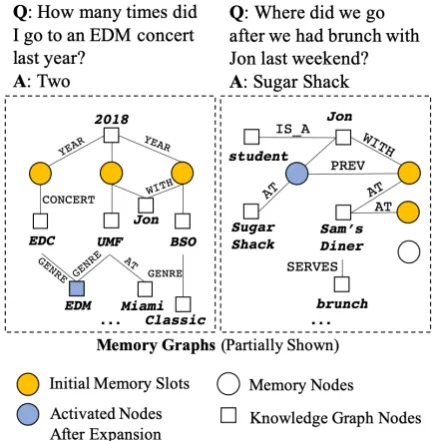
repre-Figure 1: Illustration of Episodic Memory QAwith user queries and memory graphs (MG) with knowledge graph (KG) entities. Relevant memory nodes are pro-vided asinitial memory slotsvia graph search lookup. The Memory Graph Network walks from the initial nodes to attend to relevant contexts andexpands the memory slots when necessary. The main QA model takes these graph traversal paths and expanded memory slots as input, and predicts correct answers via multiple module networks (e.g.COUNT,CHOOSE, etc.)
sented as the nodes connected via corresponding edges (Figure 1). Examples of such queries in-clude “Where did we goafterwe had brunch with Jon?”, “How many times did I go tojazzconcerts last year?”, etc. For Episodic Memory QA, a ma-chine has to understand the contexts of a question and navigate multiple MG episode nodes as well as KG nodes to gather comprehensive information to match the query requirement.
While the ability of querying a personal database could lead to many potential applica-tions, previous work in this domain (Jiang et al.,
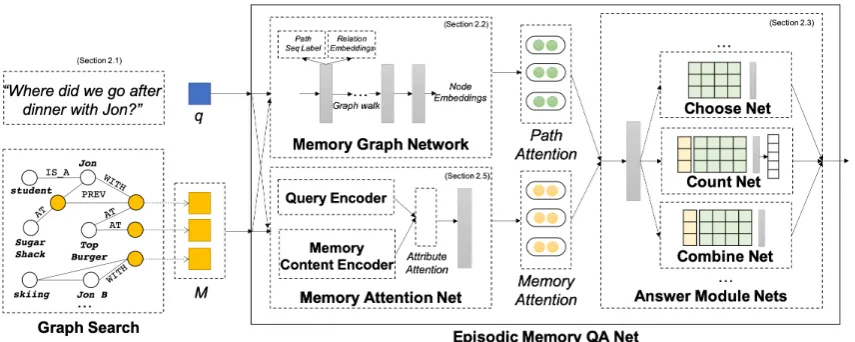
[image:1.595.307.526.226.447.2]Figure 2: Overall architectureof the Episodic Memory QA Network. For an input queryq, candidate memory nodes m = {m(k)} are provided as input memory slots for the Memory QA Network. The Memory Graph Network then traverses the memory graph to expand the initial memory slots and activate other relevant entity and memory nodes based on the input queries. The Answer Module Networks execute the predicted neural programs to decode answers given the memory graph network outputs.
dataset and a unique set of challenges unseen in other tasks: For example, we observe that 1) Mem-ory QA queries often include ambiguous and in-complete descriptions of reference memory (as opposed to many conventional Fact QAs with unambiguous mentions, e.g. “Who painted the Mona Lisa?”), hence requiring extensive candi-date memory generation. Another challenge we observe is the case where 2) target memory is only indirectly linked to reference memory or entities (e.g. “Where did we go after brunch?”), which makes the conventional information retrieval (IR) approaches for generating answer candidates inef-fective. In addition, 3) queries are not confined to retrieval tasks, but include various types of ques-tions such as counting, set comparing, etc., many of which remain unsolved or not considered in many QA tasks.
To this end, we propose a new model called the Memory Graph Network (MGN) to address the specific challenges stated above that come with Memory QA. While Memory Networks have suc-cessfully been used in QA applications, typical limitations are that memory slots are limited to the fixed number of slots, often in sentence or bag-of-symbols forms. MGN extends the popular memory networks by storing graph nodes as mem-ory slots and by allowing the network to dynam-ically expand memory slots through graph traver-sals. We then implement the main Episodic Mem-ory QA Network with multiple module networks such asCHOOSE,COUNT, etc., to effectively han-dle various question types not easily hanhan-dled via
graph networks.
To bootstrap a large-scale dataset collection for Episodic Memory QA, we first build a synthetic memory graph generator, which creates multiple episodic memory graph nodes connected with real entities (e.g. locations, events, public entities) ap-pearing on common-fact KGs. By creating a real-istic memory graph that is synthetically generated, we avoid the need for inferring memory graphs from other structured data (e.g. photo albums) which are often limited in size. We then generate 100K QA pairs for each memory node with tem-plates composed by human annotators, combined with 1K manual paraphrasing steps. More details for dataset collection are provided in Section3.
2 Method
Figure 2 illustrates the overall architecture and the model components that make up the Episodic Memory QA Net. We examine each module in de-tail and provide our rationale about its formulation in the following sections.
Input Module (Section 2.1): For a given query q, its relevant memory nodes m = {m(k)}K
k=1
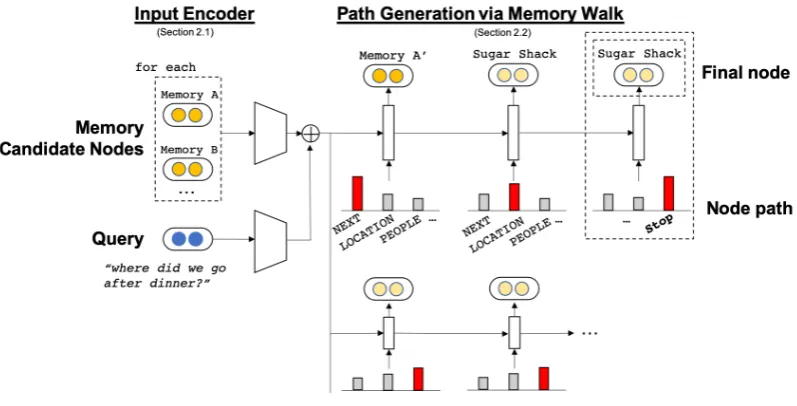
Figure 3:Memory Graph Network (MGN) Walker. Input queryqand candidate memory nodesm={m(k)}
are encoded with the query encoder and the memory encoder, respectively (left). The decoder (right) predicts both the optimal paths and the final nodesp={pt}Tt=1based on their relevance scores as well as soft-attention based walk paths, which expands the initial memory slots.
Memory Graph Networks (MGN)(Section2.2): Many previous work in QA or MRC systems use memory networks to evaluate multiple an-swer candidates with transitive reasoning, and typ-ically store all potentially relevant raw sentences or bag-of-symbols as memory slots. However, naive increase of memory slot size or retention-based sequential update of memory slots often in-crease search space for answer candidates, lead-ing to poor precision especially for the Episodic Memory QA task. To overcome this issue, with MGN we store memory graph nodes as initial memory slots, where additional contexts and an-swer candidates can be succinctly expanded and reached via graph traversals. For each (q,m(k)) pair, MGN predicts optimal memory slot expan-sion steps:p(k) ={[pe,t(k);p(n,tk)]}T
t=1for edge paths
peand corresponding node pathspn(Figure3). QA Modules(Section2.3,2.4): An estimated an-swer aˆ = QA(m,q) is predicted given a query and MGN graph path output from initial memory slots. Specifically, the model outputs a module program{u(k)}for several module networks (e.g.
CHOOSE, COUNT, ...) via module selector, each of which produces an answer vector . The aggre-gated result of module network outputs determines the top-kanswers.
2.1 Input Encoding
Query encoder: We represent each textual query with an attention-based Bi-LSTM language model
(Conneau et al., 2017) with GloVe (Pennington et al.,2014) distributed word embeddings trained on the Wikipedia and the Gigaword corpus with a total of 6B tokens.
Memory encoder: We represent each memory node based on both its structural features (graph embeddings) and contextual multi-modal features from its neighboring nodes (e.g. attribute values).
Structural contexts of each memory node (ms) are encoded via graph embeddings projection ap-proaches (Bordes et al., 2013), in which nodes with similar relation connectivity are mapped closer in the embeddings space. The model for obtaining embeddings from a MG (composed of subject-relation-object (s, r, o) triples) can be for-mulated as follows:
P(Ir(s, o) = 1|θ) =score e(s),er(r),e(o)
(1)
where Ir is an indicator function of a known re-lationrfor two entities (s,o) (1: valid relation, 0: unknown relation),eis a function that extracts em-beddings for entities,er extracts embeddings for relations, and score(·) is a function (e.g. multi-layer perceptrons) that produces a likelihood of a valid triple.
language model as the query encoder:
mc= X
γjmc,j
γ =σ(Wqγq)
Note that the query attention vector γ attenuates or amplifies each attribute of memory based on a query vector to better account for query-memory compatibility accordingly. We then concatenate the structural features with semantic contextual features to obtain the final memory representation (m= [ms;mc]).
2.2 Memory Graph Network
Inspired by the recently introduced graph traversal networks (Moon et al., 2019) which output dis-crete graph operations given input contexts, we formulate our MGN as follows. Given a set of ini-tial memory slots (m) and a query (q), the MGN model outputs a sequence path of walk steps (p) within MG to attend to relevant nodes or expand initial memory slots (Figure3):
{p(k)}=MGN(q,{m(k)}) (2)
Specifically, we define the attention-based graph decoder model which prunes unattended paths, which effectively reduce the search space for memory expansion. We formulate the decod-ing steps for MGN as follows (bias terms for gates are omitted for simplicity of notation):
it=σ(Whiht−1+Wcict−1)
ct= (1−it)ct−1
+ittanh(Wzczt+Whcht−1)
ot=σ(Wzozt+Whoht−1+Wcoct)
ht=WALK(x,zt) =ottanh(ct) (3)
where zt is a context vector at decoding step t, produced from the attention over graph relations which is defined as follows:
x=Wqmx[q;m(k)]
αt=σ(Whαht−1+Wxαx)
zt=ht−1+
X
rj∈R
αt,jrj (4)
whereαt∈R|R|is an attention vector over the re-lations space,rkis relation embeddings, andztis a resulting node context vector after walking from its previous node on an attended path.
The graph decoder is trained with the ground-truth walk paths by computing the combined loss ofLwalk(m,q,p) = P
i,tLe+Ln between pre-dicted paths and each of {pe,pn}, respectively (Le: loss for edge paths, andLnfor node paths):
X
˜ pe6=p(e,ti)
max[0,p˜e·pe,t(i)−αtr·(p(e,ti)−y˜e)>]
+ X
˜ pn6=p(n,ti)
max[0,p˜n·pn,t(i)−ht(i)·(p(n,ti)−p˜n)>]
At test time, we expand the memory slots by activating the nodes along the optimal paths based on the sum of their relevance scores (left) and soft-attention-based output path scores (right) at each decoding step:
p(n,tk)= argmax
p(nk)∈VR,1(p (k)
n,t−1)
ht·p(ni)
>
+Xαt,jrj·p(ek)
>
(5)
2.3 Module Networks
MGN outputs are then passed to module networks for the final stage of answer prediction. We ex-tend the previous work in module networks ( Kot-tur et al., 2018), often used in VQA tasks, to accommodate for graph nodes output via MGN. We first formulate the module selector which out-puts the module label probability{u(k)}given in-put contexts for each memory node, trained with cross-entropy lossLmodule:
{u(k)}=Softmax(MLP(q,{m(k)})) (6)
We then define the memory attention to attenu-ate or amplify all activattenu-ated memory nodes based on their compatibility with query, formulated as follows:
β =MLP(q,{m(k)},{p(k)}) (7)
α=Softmax(W>ββ)∈RK (8)
For this work, we propose the following four modules: CHOOSE,COUNT,CONFIRM,SET OR, and SET AND, hence u(k) ∈ R5. Note that the
formulation can be extended to the auto-regressive decoder in case sequential execution of modules is required.
highest scores, and their node attribute values are considered as answer candidates. COUNT mod-ule counts the query-compatible among the ac-tivated nodes, a = W>K([α;max{α};min{α}]).
CONFIRMuses a similar approach toCOUNT, ex-cept it outputs a binary label indicating whether the memory nodes match the query condition: a = W>b ([α;max{α};min{α}]). SET modules either combine or find intersection among answer candidates by updating the answer vectors with a= max{W>s{a(k)}}ora= min{W>s{a(k)}}.
2.4 Answer Decoding
Answers from each module network (Section2.3
are then aggregated as weighted sum of answer vectors with module probability (Eq.6), guided by memory attention (Eq.7). Predicted answers are evaluated with cross-entropy lossLans
We observe that the model performs better when the MGN component of the model is pre-trained with ground-truth paths. We thus first train the MGN network with the same training split (with-out answer labels), and then train the entire model with module networks, fully end-to-end super-vised withL=Lwalk+Lmodule+Lans.
3 Dataset
To empirically evaluate the proposed approach for the Episodic Memory QA task, we create a new dataset, MemQA, of 100K question and an-swer pairs composed based on synthetic memory graphs that are artificially generated. We specifi-cally use the synthetispecifi-cally generated MG to avoid the need for inferring memory graphs from other structured data (such as publicly available photo albums such as Flicker, etc.) which are often limited in size and domains. We bootstrap our large-scale realistic memory graph dataset with the following procedures: first, we construct a syn-thetic social graph with a set number of artifi-cial users, each with randomly generated interest embeddings. We then create a realistic memory graph by randomly choosing participants within the synthetic social graph as well as activities and associated entities from the curated list (of lo-cations, events, public entities, etc.), which is a subset of common-fact Freebase knowledge base (Bast et al.,2014). Each generated memory node thus has connections to entities appearing in KGs, comprising the memory graph together. Finally, given a set of reference memory nodes and
neigh-Answer Type % Examples
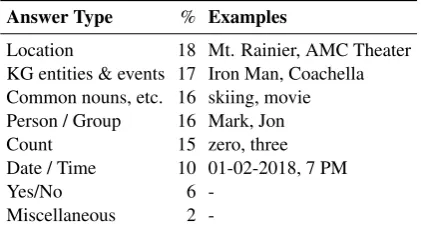
Location 18 Mt. Rainier, AMC Theater KG entities & events 17 Iron Man, Coachella Common nouns, etc. 16 skiing, movie Person / Group 16 Mark, Jon Count 15 zero, three Date / Time 10 01-02-2018, 7 PM
Yes/No 6
-Miscellaneous 2
-Table 1: Types of Answers inM emQA
boring attributes, we pragmatically generate tar-get ground-truth answer samples (e.g. single-hop / multi-hop node value, count, set comparison, yes/no, etc.) We then collect QA pairs for each sample with templates composed with human an-notators, which are combined with 1K manual paraphrasing steps for added variety and confirma-tion. We randomly split the QA corpus into into train (70%), validation (15%), and test sets (15%).
4 Empirical Evaluation
Task: Given a query and a set of initial mem-ory graph nodes via graph search, we evaluate the model on the open-ended question answering pre-diction task.
4.1 Baselines
We choose as baselines the following QA systems (see Section 5 for details), and modify them ac-cordingly to make comparisons with our task:
• MemN2N (Sukhbaatar et al.,2016): uses the end-to-end memory networks with the static set of initial memory slots. Each memory slot is represented with a bag-of-symbols for surrounding attributes and nodes. We use a single Softmax layer for answer classifica-tion. Memory slot size is tuned as a hyper-parameter.
• MemexNet (Jiang et al.,2018): uses the tex-tual representation for multi-modal attributes, and frames the problem into a classification problem via text kernel match approaches to predict approximate answers. Since the dataset does not contain images, we omit the CNN representations.
[image:5.595.313.524.64.179.2]Components Model Precision@k k=1 3 5 10
A MemN2N(Sukhbaatar et al.,2016) 29.7 43.8 51.0 50.5
A Memex(Jiang et al.,2018) 32.6 50.3 58.2 59.1
G MemQANet(ablation) 36.7 56.8 63.5 67.9
[image:6.595.138.464.66.182.2]G + N MemQANet(ablation) 41.1 65.8 75.5 80.0 G + N + E MemQANet(proposed) 45.8 68.1 75.7 80.9
Table 2: QA performance on theMemQAdataset (metric: precision@k). Our proposed model is compared against the selected baseline models as well as several ablation variations of the proposed model (model components (G): Memory Graph Network, (N): Module Networks, (E): graph embeddings).
each component (model components (G): Mem-ory Graph Network, (N): Module Networks, (E): structural graph embeddings).
• (Proposed; G+N+E): is the proposed ap-proach as described in Figure2.
• (G+N): does not structural graph embeddings for MGN, and relies on semantic representa-tion of surrounding nodes.
• (G): does not use any of the module networks (e.g. COUNT, ...), and predicts MGN graph output as answers instead.
4.2 Results
Parameters: We tune the parameters of each model with the following search space (bold in-dicate the choice for our final model): graph em-beddings size:{64,128, 256, 512}, Bi-LSTM hid-den states for the language model: {64,128, 256, 512}, MGN hidden states: {64, 128, 256, 512}, word embeddings size:{100, 200,300}, and max memory slots: {1, 5, 10, 20, 40, 80}. We opti-mize the parameters with Adagrad (Duchi et al.,
2011) with batch size 10, learning rate 0.01, ep-silon10−8, and decay 0.1.
Main Results: Table2shows the results of the top-k predictions of the proposed model and the baselines. It can be seen that the proposed Mem-ory QA model outperforms other QA baselines for precision at allks.
Specifically, with the MGN walker model, the MemQA model learns to condition its walk path on query contexts and attend and expand mem-ory nodes, thus outperforming the baseline mod-els that simply rely on their initial memory slots, typically large in size to maintain reasonable re-call. The node expansion via MGN allows the
model to keep the initial memory slots small (10) and expand only when necessary (e.g. for queries that require references to related memories, ”... where did I go after ...”), thus improving the preci-sion performance. Note that memory slot sizes for baselines are tuned for their performance on the validation set.
In addition, it can be seen that the neural module components (G+N and G+N+E) greatly outper-form the ablation model (G) and the baselines by aggregating answers with the modules specifically designed for various types of questions. These neural modules allow the model to answer ques-tions that are typically hard to answer (e.g. count, set comparison, etc.) by explicitly reducing the answer space accordingly.
Note also that the graph embeddings (G+N+E) improve the performance over the ablation model that does not use structural contexts (G+N), in-dicating that the model learns to better leverage knowledge graph contexts to answer questions.
compre-Question and Answer Model Preidction
Walk Path Neural Module Top-kAnswers
Q:Where did Jon and I go after we watched m1→(NEXT ID)→m01 CHOOSE Symphony Hall,
Avengers? //A:Symphony Hall →(LOCATION) AMC Theatre, ...
Q:Who did I go skiing with last year? m1→(PARTICIPANT) SET OR {Emma, Jacob},
A:{Emma, Jacob} m3→(PARTICIPANT) {Emma, Noah}, ...
Q:How many sci-fi movies have I watched m1→(ENTITY)→e01 COUNT Three,
last year? //A:Two →(GENRE)→a01 Two, Four, ...
Table 3:Error Analysis: Model predictions of walk paths (with expanded memory nodes noted with ’) are partially shown for each question and ground-truth answer pair. The full reference memory graphs are not shown here due to space constraints. Initial memory slot size = 10.
hensive understanding of surrounding knowledge nodes in the context of the query.
5 Related Work
Memory Networks: Weston et al. (2014);
Sukhbaatar et al. (2016) propose Memory Net-works with explicit memory slots to contain aux-iliary multi-input, now widely used in many QA and MRC tasks for its transitive reasoning capabil-ity. Traditional limitations are that memory slots for storing answer candidates are fixed in size, and naively increasing the slot size typically de-creases the precision. Several work extend this line of research, for example by allowing for dy-namic update of memory slots given streams of input (Kumar et al., 2016; Tran et al., 2016;Xu et al., 2019), reinforcement learning based reten-tion control (Jung et al.,2018), etc. By allowing for storing graph nodes as memory slots and for slot expansion via graph traversals, our proposed Memory Graph Networks (MGN) effectively by-pass the issues.
Structured QA systems: often answer ques-tions based on large-scale common fact knowl-edge graphs (Bordes et al., 2015; tau Yih et al.,
2015;Xu et al.,2016;Jain,2016;Yin et al.,2016;
Dubey et al.,2018), typically via an entity linking system and a QA model for predicting graph oper-ations through template matching approaches, etc. Our approach is inspired by this line of work, and we utilize the proposed module networks and the MGN walker model to address unique challenges to Episodic Memory QA.
Machine Reading Comprehension (MRC) systems: aim at predicting answers given evidence documents, typically in length of a few paragraphs (Seo et al.,2017;Rajpurkar et al.,2016,2018;Cao
et al., 2019;tau Yih et al.,2015). Several recent work address hop reasoning within multi-ple documents (Yang et al., 2018; Welbl et al.,
2018; Bauer et al., 2018; Clark et al., 2018) or conversational settings (Choi et al., 2018; Reddy et al.,2018), which require often complex reason-ing tools. Unlike in MRC systems that typically rely on language understanding, we effectively uti-lize structural properties of memory graph to tra-verse and highlight specific attributes or nodes that are required to answer questions.
Visual QA systems: aim to answer questions based on contexts from images (Antol et al.,2015;
Wang et al.,2018;Wu et al.,2018). Recently, neu-ral modules (Kottur et al., 2018) are proposed to address specific challenges to VQA such as visual co-reference resolutions, etc. Our work extends the idea of neural modules for Episodic Memory QA by implementing modules that can take graph paths as input for answer decoding. Jiang et al.
6 Conclusions
We introduce Episodic Memory QA, the task of answering personal user questions grounded on memory graph (MG). The dataset is gener-ated with synthetic memory graphs with simu-lated attributes, and accompanied with 100K QA pairs composed via bootstrapped scripts and man-ual annotations. Several novel model compo-nents are proposed for unique challenges for the Episodic Memory QA: 1) Memory Graph Net-works (MGN) extends the conventional memory networks by enabling dynamic expansion of mem-ory slots through graph traversals, which also nat-urally allows for explainable predictions. 2) Sev-eral neural module networks are proposed for the proposed task, each of which takes queries and memory graphs as input to infer answers. 3) The main Episodic Memory QA Net aggregates an-swer prediction from each neural module to gener-ate final answer candidgener-ates. The empirical results demonstrate the efficacy of the proposed model in the Memory QA reasoning.
References
Stanislaw Antol, Aishwarya Agrawal, Jiasen Lu, Mar-garet Mitchell, Dhruv Batra, C. Lawrence Zitnick, and Devi Parikh. 2015. VQA: Visual Question An-swering. InICCV.
Hannah Bast, Florian Baurle, Bjorn Buchhold, and El-mar Haussmann. 2014. Easy access to the freebase dataset. InWWW.
Lisa Bauer, Yicheng Wang, and Mohit Bansal. 2018. Commonsense for generative multi-hop question an-swering tasks.EMNLP.
Antoine Bordes, Nicolas Usunier, Sumit Chopra, and Jason Weston. 2015. Large-scale simple question answering with memory network.arxiv.
Antoine Bordes, Nicolas Usunier, Alberto Garcia-Duran, Jason Weston, and Oksana Yakhnenko. 2013. Translating embeddings for modeling multi-relational data. InNIPS.
Nicola De Cao, Wilker Aziz, and Ivan Titov. 2019. Question answering by reasoning across documents with graph convolutional networks. NAACL.
Eunsol Choi, He He, Mohit Iyyer, Mark Yatskar, Wen-tau Yih, Yejin Choi, Percy Liang, and Luke Zettle-moyer. 2018. Quac: Question answering in context. EMNLP.
Peter Clark, Isaac Cowhey, Oren Etzioni, Tushar Khot, Ashish Sabharwal, Carissa Schoenick, and Oyvind
Tafjord. 2018. Think you have solved question answering? try arc, the ai2 reasoning challenge. arXiv:1803.05457.
Alexis Conneau, Douwe Kiela, Holger Schwenk, Lo¨ıc Barrault, and Antoine Bordes. 2017. Supervised learning of universal sentence representations from natural language inference data. InEMNLP.
Mohnish Dubey, Debayan Banerjee, Debanjan Chaud-huri, and Jens Lehmann. 2018. Earl: Joint entity and relation linking for question answering over knowl-edge graphs.ESWC.
John Duchi, Elad Hazan, and Yoram Singer. 2011. Adaptive subgradient methods for online learning and stochastic optimization. JMLR.
Drew A Hudson and Christopher D Manning. 2019. Gqa: A new dataset for real-world visual reasoning and compositional question answering. CVPR.
Sarthak Jain. 2016. Question answering over knowl-edge base using factual memory networks.NAACL.
Lu Jiang, Junwei Liang, Liangliang Cao, Yannis Kalan-tidis, Sachin Farfade, and Alexander Hauptmann. 2018. Memexqa: Visual memex question answer-ing.arXiv.
Hyunwoo Jung, Moonsu Han, Minki Kang, and Sungju Hwang. 2018. Learning what to remember: Long-term episodic memory networks for learning from streaming data. arXiv preprint arXiv:1812.04227.
Satwik Kottur, Jos´e MF Moura, Devi Parikh, Dhruv Batra, and Marcus Rohrbach. 2018. Visual corefer-ence resolution in visual dialog using neural module networks. InECCV.
Ankit Kumar, Ozan Irsoy, Peter Ondruska, Mohit Iyyer, James Bradbury, Ishaan Gulrajani, Victor Zhong, Romain Paulus, and Richard Socher. 2016. Ask me anything: Dynamic memory networks for natural language processing. InICML.
Seungwhan Moon, Pararth Shah, Anuj Kumar, and Ra-jen Subba. 2019. Opendialkg: Explainable conver-sational reasoning with attention-based walks over knowledge graphs.ACL.
Jeffrey Pennington, Richard Socher, and Christo-pher D. Manning. 2014. Glove: Global vectors for word representation. InEMNLP.
Pranav Rajpurkar, Robin Jia, and Percy Liang. 2018. Know what you don’t know: Unanswerable ques-tions for squad.ACL.
Pranav Rajpurkar, Jian Zhang, Konstantin Lopyrev, and Percy Liang. 2016. Squad: 100,000+ questions for machine comprehension of text.arXiv:1606.05250.
Minjoon Seo, Aniruddha Kembhavi, Ali Farhadi, and Hannaneh Hajishirzi. 2017. Bidirectional attention flow for machine comprehension.ICLR.
Sainbayar Sukhbaatar, Arthur Szlam, Jason Weston, and Rob Fergus. 2016. End-to-end memory net-works. NIPS.
Ke Tran, Arianna Bisazza, and Christof Monz. 2016. Recurrent memory networks for language modeling. NAACL.
Peng Wang, Qi Wu, Chunhua Shen, Anthony Dick, and Anton van den Hengel. 2018. Fvqa: Fact-based vi-sual question answering. PAMI.
Johannes Welbl, Pontus Stenetorp, and Sebastian Riedel. 2018. Constructing datasets for multi-hop reading comprehension across documents. TACL.
Jason Weston, Sumit Chopra, and Antoine Bor-des. 2014. Memory networks. arXiv preprint arXiv:1410.3916.
Qi Wu, Chunhua Shen, Peng Wang, Anthony Dick, and Anton van den Hengel. 2018. Image captioning and visual question answering based on attributes and external knowledge.PAMI.
Kun Xu, Yuxuan Lai, Yansong Feng, and Zhiguo Wang. 2019. Enhancing key-value memory neural networks for knowledge based question answering. NAACL.
Kun Xu, Siva Reddy, Yansong Feng, Songfang Huang, and Dongyan Zhao. 2016. Question answering on freebase via relation extraction and textual evidence. ACL.
Zhilin Yang, Peng Qi, Saizheng Zhang, Yoshua Ben-gio, William W Cohen, Ruslan Salakhutdinov, and Christopher D Manning. 2018. Hotpotqa: A dataset for diverse, explainable multi-hop question answer-ing. EMNLP.
Wen tau Yih, Ming-Wei Chang, Xiaodong He, and Jianfeng Gao. 2015. Semantic parsing via staged query graph generation: Question answering with knowledge base. ACL.