4407
Episodic Memory Reader: Learning What to Remember
for Question Answering from Streaming Data
Moonsu Han1∗ Minki Kang1∗ Hyunwoo Jung1 Sung Ju Hwang1,2
KAIST1, Daejeon, South Korea AITRICS2, Seoul, South Korea
{mshan92, zzxc1133, hyunwooj, sjhwang82}@kaist.ac.kr
Abstract
We consider a novel question answering (QA) task where the machine needs to read from large streaming data (long documents or videos) without knowing when the questions will be given, which is difficult to solve with existing QA methods due to their lack of scal-ability. To tackle this problem, we propose a novel end-to-end deep network model for reading comprehension, which we refer to as
EpisodicMemoryReader (EMR) that sequen-tially reads the input contexts into an exter-nal memory, while replacing memories that are less important for answeringunseen ques-tions. Specifically, we train an RL agent to replace a memory entry when the memory is full, in order to maximize its QA accuracy at a future timepoint, while encoding the ex-ternal memory using either the GRU or the Transformer architecture to learn representa-tions that considers relative importance be-tween the memory entries. We validate our model on a synthetic dataset (bAbI) as well as real-world large-scale textual QA (TriviaQA) and video QA (TVQA) datasets, on which it achieves significant improvements over rule-based memory scheduling policies or an RL-based baseline that independently learns the query-specific importance of each memory.
1 Introduction
Question answering (QA) problem is one of the most important challenges in Natural Language Understanding (NLU). In recent years, there has been drastic progress on the topic, owing to the success of deep learning based QA mod-els (Sukhbaatar et al., 2015; Seo et al., 2016;
Xiong et al., 2016; Hu et al., 2018;Back et al.,
2018;Devlin et al.,2018). On certain tasks such as machine reading comprehension (MRC), where
* Equal contribution
the problem is to find the span of the answer within a given paragraph (Rajpurkar et al., 2016), the deep-learning based QA models have even sur-passed human-level performances.
Despite such impressive achievements, it is still challenging to model question answering with document-level context (Joshi et al.,2017), where the context may include a long document with a large number of paragraphs, due to problems such as difficulty in modeling long-term depen-dency and computational cost. To overcome such scalability problems, researchers have proposed pipelining or confidence based selection methods that combine paragraph-level models to obtain a document-level model (Joshi et al., 2017; Chen et al.,2017;Clark and Gardner,2018;Wang et al.,
2018b). Yet, such models are applicable only when questions are given beforehand and all sen-tences in the document can be stored in memory.
However, in realistic settings, the amount of context may be too large to fit into the system memory. We may consider query-based context selection methods such as ones proposed in In-durthi et al. (2018) andMin et al. (2018), but in many cases, the question may not be given when reading in the context, and thus it would be diffi-cult to select out the context based on the question. For example, a conversation agent may need to an-swer a question after numerous conversations in a long-term time period, and a video QA model may need to watch an entire movie, or a sports game, or days of streaming videos from security cameras before answering a question. In such cases, exist-ing QA models will fail to solve the problem due to memory limitation.
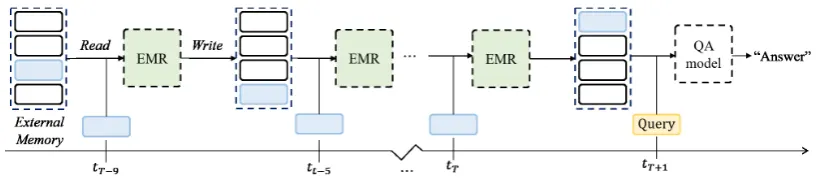
Figure 1:Concept:We consider a novel problem of learning from streaming data, where the QA model may need to answer a question that is given after reading in unlimited amount of context. To solve this problem, our Episodic Memory Reader (EMR) learns to retain the most important context vectors in an external memory, while replacing the memory entries in order to maximize its accuracy on an unseen question given at a future timestep.
model needs to carefully manage what to remem-ber from this streaming data such that the memory contains the most informative context instances in order to answer an unseen question in the future. We pose this memory management problem as a learning problem and train both the memory rep-resentation and the scheduling agent using rein-forcement learning.
Specifically, we propose to train the memory module itself using reinforcement learning to re-place the most uninformative memory entry in or-der to maximize its reward on a given task. How-ever, this is a seemingly ill-posed problem since for most of the time, the scheduling should be performed without knowing which question will arrive next. To tackle this challenge, we imple-ment the policy network and the value network that learn not only relation between sentences and query but also relative importance among the sen-tences in order to maximize its question answer-ing accuracy at a future timepoint. We refer to this network as Episodic Memory Reader (EMR). EMR can perform selective memorization to keep a compact set of important context that will be use-ful for future tasks in lifelong learning scenarios.
We validate our proposed memory network on a large-scale QA task (TriviaQA) and video ques-tion answering task (TVQA) where the context is too large to fit into the external memory, against rule-based and an RL-based scheduling method without consideration of relative importance be-tween memories. The results show that our model significantly outperforms the baselines, due to its ability to preserve the most important pieces of in-formation from the streaming data.
Our contribution is threefold:
• We consider a novel task of learning to re-member important instances from streaming data for question answering task, where the size of the memory is significantly smaller than the length of the data stream.
• We propose a novel end-to-end memory-augmented neural architecture for solving QA from streaming data, where we train a scheduling agent via reinforcement learning to store the most important memory entries for solving future QA tasks.
• We validate the efficacy of our model on real-world large-scale text and video QA datasets, on which it obtains significantly improved performances over baseline methods.
2 Related Work
Question-answering There has been a rapid progress in question answering (QA) in recent years, thanks to the advancement in deep learn-ing as well as the availability of large-scale datasets. One of the most popular large-scale QA dataset is Stanford Question Answering Dataset (SQuAD) (Rajpurkar et al., 2016) that contains 100K question-answering pairs. Unlike Richard-son et al. (2013) and Hermann et al. (2015) that provide multiple-choice QA pairs, SQuAD pro-vides and requires to predict exact locations of the answers. On this span prediction task, at-tentional models (Pan et al., 2017; Cui et al.,
is another important topic where scalability is an issue. Several models (Kim et al., 2017, 2018;
Na et al., 2017; Wang et al., 2018a) propose to solve video QA using attentions and memory aug-mented networks, to perform composite reasoning over both videos and texts; however, they only fo-cus on short-length videos. Most existing work on QA focus on small-size problems due to memory limitation. Our work, on the other hand, considers a challenging scenario where the context is order of magnitude larger than the memory.
Context selection A few recent models propose to select minimal context from the given document when answering questions for scalability, rather than using the full context. Min et al. (2018) proposed a context selector that generates atten-tions on the context vectors, in order to achieve scability and robustness against adversarial in-puts. Choi et al.(2017) andIndurthi et al.(2018) propose a similar method, but they use REIN-FORCE (Williams,1992) instead of linear classi-fiers. Chen et al.(2017) selects the most relevant documents out of the Wikipedia database with re-spect to the query using TF-IDF matching, and
Wang et al. (2018b) propose to tackle the doc-ument ranking problem with RL agents. While these context/document selection methods share our motivation of achieving scability and select-ing out the most informative pieces of information to solve the QA task, our problem setting is com-pletely different from theirs since we consider a challenging problem of learning from the stream-ing datawithout knowing when the question will be given, where the size of the context is much larger than the memory and the question is unseen when training the selection module.
Memory-augmented neural networks Our episodic memory reader is essentially a memory-augmented network (MANN) (Graves et al.,
2014;Sukhbaatar et al.,2015;Xiong et al.,2016;
Kumar et al., 2016) with a RL-based scheduler. While most existing work on MANN assume that the memory is sufficiently large to hold all the data instances, a few tried to consider memory-scheduling for better scalability. G¨ulc¸ehre et al.
(2016) propose to train an addressing agent using reinforcement learning in order to dynamically decide which memory to overwrite based on the query. This query-specific importance is similar to our motivation, but in our case the query is given
after reading in all the context and thus unusable for scheduling, and we perform hard replacement instead of overwriting. Differentiable Neural Computer (DNC) (Graves et al., 2016) extends the NTM to address the issue by introducing a temporal link matrix, replacing the least used memory when the memory is full. However, this method is a rule-based one that cannot maximize the performance on a given task.
3 Learning What to Remember from Streaming Data
We now describe how to solve question answering tasks with streaming data as context. In a more general sense, this is a problem of learning from a long data stream that contains a large portion of unimportant, noisy data (e.g. routine greetings in dialogs, uninformative video frames) with limited memory. The data stream is episodic, where an unlimited amount of data instances may arrive at one time interval and becomes inaccessible after-ward. Additionally, we consider that it is not pos-sible for the model to know in advance what tasks (a question in the case of QA problem) will be given at which timestep in the future (See Figure1
for more details). To solve this problem, the model needs to identify important data instances from the data stream and store them into external memory. Formally, given a data stream (e.g. sentences or images)X ={x(1),· · · ,x(T)}wherex(t) ∈Rd
as input, the model should learn a function F :
X 7→ M that maps it to the set of memory en-triesM ={m1,· · ·,mN}wheremi ∈Rk and
T N. How can we then learn such a func-tion that maximizes the performance on unseen fu-ture tasks without knowing what problems will be given at what time? We formulate this problem as a reinforcement learning problem to train a mem-ory scheduling agent.
3.1 Model Overview
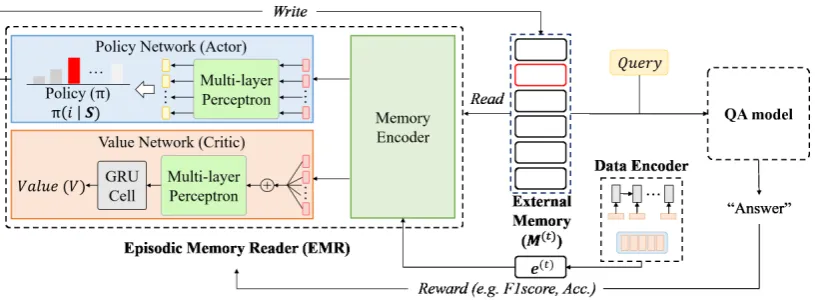
We now describe our model, Episodic Memory Reader (EMR) to solve the previously described problem. Our model has three components: (1) an agentAbased on EMR, (2) an external
mem-oryM = [m1,· · ·,mN], and (3) a solver which
Figure 2: The overview of our Episodic Memory Reader (EMR). EMR learns the policy and the value network to select a memory entry to replace, in order to maximize the reward, defined as the performance on future QA tasks (F1-score, accuracy).
most useful subset in the memory, by interacting with the external memory that encodes the rel-ative importance of each memory entry. When
t ≤ N, the agent simply maps x(t) to m(t). However, when t > N, when the memory be-comes full, it selects an existing memory entry to delete. Specifically, it outputs an action based on
π(i|S(t)), which denotes the selection ofith
mem-ory entry to delete. Here, the state is the con-catenation of the memory and the data instance:
S(t) = [M(t),e(t)], wheree(t)is the encoded in-put at timestep t. To maximize the performance on the future QA task, the agent should replace the least important memory entry. When the agent encounters the task T (QA problem) at timestep
T + 1, it leverages both the memory at timestep
T,M(T)and the task information (e.g. question), to solve the task. For each action, the environ-ment (QA module) provides the rewardR(t), that
is given either as the F1-score or the accuracy.
3.2 Episodic Memory Reader
Episodic Memory Reader (EMR) is composed of three components:(1) Data Encoderthat encodes each data instance into memory vector represen-tation, (2) Memory Encoder that generates re-placement probability for each memory entry, and the(3) Value Networkthat estimates the value of memory as a whole. In some cases, we may use policy gradient methods, in which case the value network becomes unnecessary.
3.2.1 Data Encoder
The data instancex(t)which arrives at timetcan be in any data format, and thus we transform it into a k-dimensional memory vector representa-tione(t)∈Rkto using an encoder:
e(t)=ψ(x(t))
whereψ(·)is the data encoder, which could be any neural architecture based on the type of the input data. For example, we could use a RNN if x(t)
is composed of sequential data (e.g. a sentence composed of wordsx(t)={w1, w2, w3,· · ·, ws})
or a CNN if x(t) is an image. After deleting a memory entrym(t)i , we appende(t) at the end of the memory, which then becomesm(t+1)N .
3.2.2 Memory Encoder
Using the memory vector representationsM(t) =
[m(t)1 ,· · ·,m(t)N]ande(t)generated from the data
encoder, the memory encoder outputs a probabil-ity for each memory entry by considering its rela-tive importance, and then replaces the most unim-portant entry. This component corresponds to the policy network of the actor-critic method. Now we describe our EMR models.
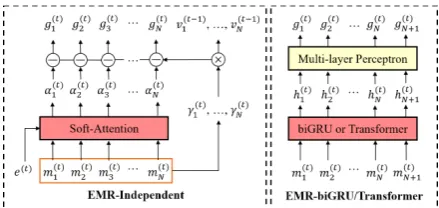
EMR-Independent Since we do not have ex-isting work for our novel problem setting, as a baseline, we first consider a memory encoder that only captures the relative importance of each memory entry independently to the new data in-stance, which we refer to as EMR-Independent. This scheduling mechanism is adopted from Dy-namic Least Recently Use (LRU) addressing in-troduced in G¨ulc¸ehre et al. (2016), but different from LRU in that it replaces the memory entry rather than overwriting it, and is trained without query to maximize the performance for unseen fu-ture queries. EMR-Independent outputs the im-portance for each memory entry by comparing them with an embedding of the new data instance
com-pute the overall importance of each memory en-try, as done in G¨ulc¸ehre et al. (2016), we com-pute the exponential moving average as vi(t) = 0.1vi(t−1) + 0.9a(t)i . Then, we compute the re-placement probabilty of each memory entry with the LRU factorγ(t)as follows:
γi(t) =σ(WγTm(t)i +bγ)
g(t)i =a(t)i −γi(t)v(ti −1)
π(i|[M(t), e(t)];θ) =softmax(gi(t))
where i ∈ [1, N] is the memory index, Wγ ∈ R1×d andbγ ∈ Rare the weight matrix and the
bias term, σ(·) and softmax(·) are sigmoid and softmax functions respectively, and π is the pol-icy of the memory scheduling agent.
EMR-biGRU A major drawback of EMR-Independent is that the evaluation of each memory depends only on the input x(t). In other words, the importance is computed between each memory entry and the new data instance regardless of other entries in the memory. However, this scheme can-not model the relative importance of each mem-ory entry to other memmem-ory entries, which is more important in deciding on the least important mem-ory. One way to consider relative relationships be-tween memory entries is to encode them using a bidirectional GRU (biGRU) as follows:
− →
h(t)i =GRUθf w(m (t) i ,
− →
h(t)i−1)
←−
h(t)i =GRUθbw(m (t) i ,
←−
h(t)i+1)
h(t)i = [−→h(t)i ,←h−(t)i ]
π(i|[M(t),e(t)];θ) =softmax(M LP(h(t)i ))
wherei∈[1, N+ 1]is the memory index, includ-ing the index of the encoded inputm(t)N+1 =e(t),
GRUθ is a Gated Recurrent Unit parameterized
by θ, [−→hi(t),←h−(t)i ] is a concatenation of features.
[image:5.595.306.526.60.164.2]π is the policy of the agent, and MLP is a multi-layer perceptron with three multi-layers with ReLU ac-tivation functions. Thus, EMR-biGRU learns the general importance of each memory entry in re-lation to its neighbors rather than independently computing the importance of each entry with re-spect to the query, which is useful when selecting out the most important entries among highly sim-ilar data instances (e.g. video frames). However,
Figure 3:Detailed architecture of memory encoder in EMR-Independent and EMR-biGRU/Transformer.
the model may not effectively model long-range relationships between memory entries in far-away slots due to the inherent limitation with RNNs.
EMR-Transformer To overcome such subopti-mality of RNN-based modeling, we further adopt the self-attention mechanism fromVaswani et al.
(2017). With queryQ(t), keyK(t), and the value
V(t) we generate the relative importance of the entries with a linear layer that takes m(t) with the position encoding proposed inVaswani et al.
(2017) as input. With multi-headed attention, each component is projected to a multi-dimensional space; the dimensions for each componenets are
Q(t)∈
RH×N× k
H,K(t)∈RH×N× k
H, andV(t)∈ RH×N×
k
H, where N is the size of memory and
H is the number of attention heads. Using these, we can formulate the retrieved output using self-attention and memory encoding as follows:
A(t)=softmax Q
(t)K(t)T
p k/H
!
o(t) =A(t)V(t)
h(t)=WoT[o(t)1 ,o(t)2 ,· · ·,o(t)h ]
π(i|[M(t),e(t)];θ) =softmax(M LP(h(t)i ))
where i is the memory index, o(t)i ∈ RN× d h,
[o(t)1 ,o(t)2 ,· · ·,o(t)h ] ∈ RN×k is a concatentation
of o(t)i , π is the policy of the agent, and M LP
is the same 3-layer multi-layer perceptron used in EMR-biGRU. Memory encodingh(t)is then
com-puted using linear functionWo ∈ Rd×dwithh(t)
as input. Figure3illustrates the architecture of the memory encoder for Independent and EMR-biGRU/Transformer.
3.2.3 Value Network
Figure 4:Example context and QA pair from TriviaQA.
Especially in textual QA tasks (e.g. TriviaQA), storing the evidence sentences that precede span words may be useful as they may provide useful context. However, using only discrete policy gra-dient method, we cannot preserve such context in-stances. To overcome this issue, we use an actor-critic RL method (A3C) (Mnih et al.,2016) to es-timate the sum of future rewards at each state us-ing the value network. The difference between the policy and the value is that the value can be esti-mated differently at each time step and the needs to consider the memory as a whole. To obtain a holistic representation of our memory, we use Deep Sets (Zaheer et al.,2017). FollowingZaheer et al.(2017) we sum up allh(t)i and input them into an MLP (ρ), that consists of two linear layers and a ReLU activation function, to obtain a set sentation. Then, we further process the set repre-sentationρ(PN
i=1h (t)
i )by a GRU with the hidden
state from the previous time step. Finally, we feed the output of the GRU to a multi-layer perceptron to estimate the valueV(t)for the current timestep.
3.3 Training and test
Training Our model learns the memory scheduling policy jointly with the model to solve the task. For training EMR, we choose A3C (Mnih et al., 2016) or REINFORCE (Williams,
1992). At training time, since the tasks are given, we provide the question to the agent at every timestep. At each step, the agent selects the action stochastically from multinomial distribution based on π(i|[M(t),e(t)];θ) to explore various states, and make an action. Then, the QA model provides the agent the reward Rt. We use asynchronous
multiprocessing method illustrated inMnih et al.
(2016) to train several models at once.
Test At test time, the agent deletes the mem-ory index by following the learned policy π:
arg maxiπ(i|[M(t),e(t)];θ). Contrarily from the training step, the model observes the question only
at the end of the data stream. When encountering the question, the model solves the task using the data instances kept in the external memory.
4 Experiment
We experiment our biGRU and EMR-Transformer against several baselines:
1) FIFO (First-In First-Out). A rule-based memory scheduling policy that replaces the oldest memory entry.
2) Uniform. A policy that replaces all memory entries with equal probability at each time.
3) LIFO (Last-In First-Out).A policy that re-places the newest data instance. That is, it first fills in the memory and then discards all following data instances.
4) EMR-Independent. A baseline EMR which learns the importance of each memory entry only relative to the new data instance.
5) EMR-biGRU.An EMR implemented using a biGRU, that considers relative importance of each memory entry to its neighbors when learning the memory replacement policy.
6) EMR-Transformer. An EMR that utilizes Transformer to model the global relative impor-tance between memory entries.
The codes for the baseline models and our mod-els are available at https://github.com/ h19920918/emr. In the next subsections, we present experimental results on bAbI, TriviaQA, and TVQA datasets. For more experimental re-sults, please seesupplementary file.
4.1 bAbI
Dataset bAbI (Weston et al., 2015) dataset, which is a synthetic dataset for episodic question answering, consists of 20 tasks with small amount of vocabulary, that can be solved by remember-ing a person or an object. Among the 20 tasks, we select Task 2, which requires to remember two supporting facts, to evaluate our model. Addition-ally, we generate noisy version of this task using the open-source template provied byWeston et al.
sen-0 5 10 15 20
The number of Memory Entries
0 10 20 30 40 50 60 70 80 90 100
Accuracy LIFO FIFO UNIFORM EMR-Independent EMR-biGRU EMR-Transformer
(a) Original
0 5 10 15 20 The number of Memory Entries
0 10 20 30 40 50 60 70 80 90 100
Accuracy LIFO
FIFO UNIFORM EMR-Independent EMR-biGRU EMR-Transformer
[image:7.595.315.519.60.110.2](b) Noisy
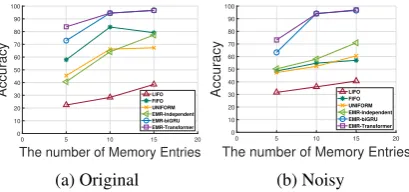
Figure 5: QA performance of baseline models and EMR-variants. The reported results are averages over 3 runs.
tences and 10% of dataset have approximately 60% noise sentences. The length of each episode is fixed to 45 (5 questions + 40 facts), and a ques-tion appears after the arrival of 8 factual sentences.
Experiment Details We adopted MemN2N (Sukhbaatar et al., 2015) for this experiment, which consists of an embedded layer and a multi-hop mechanism that extracts high-level inference. We use MemN2N with position encoding repre-sentation, 3 hops and adjacent weight tying. We set the dimension of memory representations to
k = 20 and compare our model and the base-lines on the Original and Noisy tasks. To generate the memory representation mi, we use the sum
of the three hop value memories from the base MemN2N. We experiment with varying memory size: 5,10 and 15. We train our model and the baselines using ADAM optimizer (Kingma and Ba,2014) with the learning rate 0.0005 for 400K steps on both tasks.
Results and Analysis In Figure 5, we report the experiment results for Original and Noisy tasks. Both our model (biGRU and EMR-Transformer) outperform the baselines, especially with higher gain in the case of Noisy dataset. EMR-independent, which does not consider rela-tive importance among the memory entries, per-forms worse or simlar to FIFO baseline. The re-sults suggest that our methods are able to retain the supporting facts even with small number of memory entries. For further analysis for the ex-periments on the bAbI dataset, pleasesee supple-mentary file.
4.2 TriviaQA
[image:7.595.79.284.66.162.2]Dataset TriviaQA (Joshi et al., 2017) is a real-istic text-based question answering dataset which includes 950K question-answer pairs from 662K documents collected from Wikipedia and the web. This dataset is more challenging than standard
Figure 6:The histogram of number of answers for each doc-ument length for TriviaQA dataset.
QA benchmark datasets such as Stanford Question Answering Dataset (SQuAD) (Rajpurkar et al.,
2016), as the answers for a question may not be directly obtained by span prediction and the context is very long (Figure 4). Since conven-tional QA models (Seo et al., 2016; Back et al.,
2018; Yu et al., 2018; Devlin et al., 2018) are span prediction models, on TriviaQA they only train on QA pairs whose answers can be found in the given context. In such a setting, Trivi-aQA becomes highly biased, where the answers are mostly spanned in the earlier part of the doc-ument (Figure6). We evaluate our work only on the Wikipedia domain since most previous work report similar results on both domains. While TriviaQA dataset consists of both human-verified and machine-generated QA subsets, we use the human-verified subset only since the machine-generated QA pairs are unreliable. We use the validation set for test since the test set does not contain labels.
Experiment Details We employ the pre-trained model from Deep Bidirectional Transformers (BERT) (Devlin et al., 2018), which is the cur-rent state-of-the-art model for SQuAD challenge, that trains several Transformers in Vaswani et al.
(2017) for pretraining tasks for predicting the in-dices of the exact location of an answer. We em-bed20words into each memory cell using a GRU and set the number of cells to20, thus the memory can hold400words at maximum. This is a reason-able restriction since BERT limits the maximum number of word tokens to512, including both the context and the query.
poli-Figure 7:An example of how our model operates in order to solve the memory retention problem. Episodic Memory Reader (EMR) sequentially reads the sentences one by one while replacing least important memories. State 1 and State T represent memory entries in the in the initial state and the last state, respectively. Our EMR retrains the sentences which contain the word ‘France’ (in bold red fonts) in order to answer the given question.
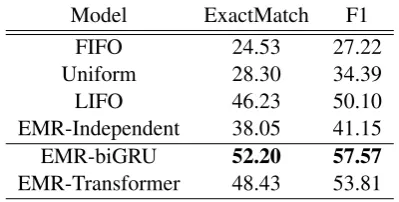
Table 1:Q&A accuracy on the TriviaQA dataset. model.
Model ExactMatch F1 FIFO 24.53 27.22 Uniform 28.30 34.39 LIFO 46.23 50.10 EMR-Independent 38.05 41.15 EMR-biGRU 52.20 57.57
EMR-Transformer 48.43 53.81
cies, but this is due to the dataset bias (See Fig-ure6) where most answers are spanned in earlier part of the documents. To further see whether this improvement is from its ability to remember im-portant context, we examine the sentences that re-main in the memory after EMR finishes reading all the sentences in Figure 7. We see that EMR remembered the sentences that contain key words that is required to answer the future question.
4.3 TVQA
Dataset TVQA (Lei et al.,2018) is a localized, compositional video question-answering dataset that contains 153K question-answer pairs from 22K clips spanning over 460 hours of video. The questions are multiple choice questions on the video contents, where the task is to find a sin-gle correct answer out of five candidate answers. The questions can be answered by examining the annotated clip segments, which spans around 30
frames per clip (See Figure8). The average num-ber of frames for each clip is229. In addition to the video frames, the dataset also provides subti-tles for each video frame. Thus solving the ques-tions requires compositional reasoning capability over both a large number of images and texts.
Experiment Details As for the QA module, we use Multi-stream model for Multi-Modal Video QA, which is the attention-based baseline model
provided in (Lei et al.,2018). For efficient train-ing, we use features extracted from a ResNet-101 pretrained on the ImageNet dataset. For embed-ding subtitles and question-answering pairs, we use GloVe (Pennington et al., 2014). For train-ing, we restrict the number of memory entries for our episodic reader as20, where each memory en-try contains the encoding of a video frame and the subtitle associated with the frame, where the for-mer is encoded using CNN and the latter using GRU. We train our model and the baseline mod-els using the ADAM optimizer (Kingma and Ba,
2014), with the initial learning rate of0.0001. Un-like from the experiments on TriviaQA, we use REINFORCE (Williams,1992) to train the policy. This is because TVQA is composed of consecutive image frames captured within a short time inter-val, which tend to contain redundant information. Thus the value network of the actor-critic model fails to estimate good value of the given state since deleting a good frame will not result in the loss of QA accuracy. Thus we compute the rewardR(t)as
the accuracy difference between at time steptand
t−1then use only the policy with non-episodic REINFORCE for training. With this method, if the task fails to solve the question after deleting certain frame, the frame is considered as impor-tant, and unimportant otherwise.
[image:8.595.81.281.244.345.2]obtain-Figure 8:An example of TVQA dataset and a visualization of how our model operates. The answer in red is the ground truth and the answer with underline is the predicted answer from our QA model. At state 1, since the memory is empty, our model encodes every video frame into the memory until the memory becomes full. At state T, after reading in all the video frames, it retains the most informative frames to answer the question. Note that this retention of the important frames is done without knowing the question in advance.
0 10 20 30 40 50 60 70 80 The number of Memory Entries 35
40 45 50 55 60 65
Accuracy
[image:9.595.94.503.59.278.2]LIFO FIFO UNIFORM EMR-Independent EMR-biGRU EMR-Transformer
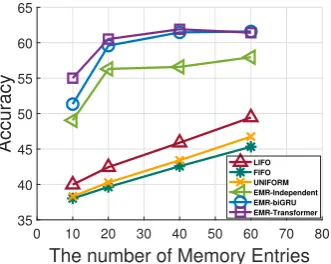
Figure 9:QA accuracy of various memory scheduling poli-cies on the TVQA dataset, reported as a function of the num-ber of memory entries.
ing the best accuracy, which may be due to its abil-ity to capture global relative importance of each memory entry. However, the gap between EMR-Transformer and EMR-biGRU diminishes as the size of memory increases, since then the size of the memory becomes large enough to contain all the frames necessary to answer the question.
As qualitative analysis, we further examine which frames and subtitles were preserved in the external memory after the model has read through the entire sequence in Figure 8. To answer the question for this example, the model should con-sider the relationship between two frames, where the first frame describes Ross showing the paper to others, and the second frame describes Monica entering the coffee shop. We see that our model kept both frames, although it did not know what the question will be.
5 Conclusion
We proposed a novel problem of question an-swering from streaming data, where the model needs to answer a question that is given after reading through unlimited amount of context (e.g. documents, videos) that cannot fit into the sys-tem memory. To handle this problem, we pro-posed Episodic Memory Reader (EMR), which is basically a memory-augmented network with RL-based memory-scheduler, that learns the rel-ative importance among memory entries and re-places the entries with the lowest importance to maximize the QA performance for future tasks. We validated EMR on three QA datasets against rule-based memory scheduling as well as an RL-baseline that does not model relative importances among memory entries, which it significantly out-performs. Further qualitative analysis of memory contents after learning confirms that such good performance comes from its ability to retain im-portant instances for future QA tasks.
Acknowledgements
[image:9.595.93.259.351.483.2]References
Seohyun Back, Seunghak Yu, Sathish Reddy Indurthi, Jihie Kim, and Jaegul Choo. 2018. Memoreader: Large-scale reading comprehension through neural memory controller. InProceedings of the 2018 Con-ference on Empirical Methods in Natural Language Processing, 2018.
Danqi Chen, Adam Fisch, Jason Weston, and Antoine Bordes. 2017. Reading wikipedia to answer open-domain questions. InProceedings of the 55th An-nual Meeting of the Association for Computational Linguistics, ACL 2017.
Eunsol Choi, Daniel Hewlett, Jakob Uszkoreit, Illia Polosukhin, Alexandre Lacoste, and Jonathan Be-rant. 2017. Coarse-to-fine question answering for long documents. InProceedings of the 55th Annual Meeting of the Association for Computational Lin-guistics, ACL 2017.
Christopher Clark and Matt Gardner. 2018. Simple and effective multi-paragraph reading comprehen-sion. InProceedings of the 56th Annual Meeting of the Association for Computational Linguistics, ACL 2018.
Yiming Cui, Zhipeng Chen, Si Wei, Shijin Wang, Ting Liu, and Guoping Hu. 2017. Attention-over-attention neural networks for reading comprehen-sion. InProceedings of the 55th Annual Meeting of the Association for Computational Linguistics, ACL 2017.
Jacob Devlin, Ming-Wei Chang, Kenton Lee, and Kristina Toutanova. 2018. BERT: pre-training of deep bidirectional transformers for language under-standing. CoRR, abs/1810.04805.
Alex Graves, Greg Wayne, and Ivo Danihelka. 2014. Neural turing machines. CoRR, abs/1410.5401.
Alex Graves, Greg Wayne, Malcolm Reynolds, Tim Harley, Ivo Danihelka, Agnieszka Grabska-Barwinska, Sergio Gomez Colmenarejo, Edward Grefenstette, Tiago Ramalho, John Agapiou, Adri`a Puigdom`enech Badia, Karl Moritz Hermann, Yori Zwols, Georg Ostrovski, Adam Cain, Helen King, Christopher Summerfield, Phil Blunsom, Koray Kavukcuoglu, and Demis Hassabis. 2016. Hybrid computing using a neural network with dynamic external memory. Nature, 538(7626):471– 476.
C¸ aglar G¨ulc¸ehre, Sarath Chandar, Kyunghyun Cho, and Yoshua Bengio. 2016. Dynamic neural tur-ing machine with soft and hard addresstur-ing schemes. CoRR, abs/1607.00036.
Karl Moritz Hermann, Tom´as Kocisk´y, Edward Grefenstette, Lasse Espeholt, Will Kay, Mustafa Su-leyman, and Phil Blunsom. 2015. Teaching ma-chines to read and comprehend. In Advances in Neural Information Processing Systems 28: Annual Conference on Neural Information Processing Sys-tems 2015.
Minghao Hu, Yuxing Peng, Zhen Huang, Xipeng Qiu, Furu Wei, and Ming Zhou. 2018. Reinforced mnemonic reader for machine reading comprehen-sion. In Proceedings of the Twenty-Seventh Inter-national Joint Conference on Artificial Intelligence, IJCAI 2018.
Sathish Reddy Indurthi, Seunghak Yu, Seohyun Back, and Heriberto Cuay´ahuitl. 2018. Cut to the chase: A context zoom-in network for reading comprehen-sion. InProceedings of the 2018 Conference on Em-pirical Methods in Natural Language Processing, 2018.
Mandar Joshi, Eunsol Choi, Daniel S. Weld, and Luke Zettlemoyer. 2017. Triviaqa: A large scale distantly supervised challenge dataset for reading comprehen-sion. InProceedings of the 55th Annual Meeting of the Association for Computational Linguistics, ACL 2017.
Kyung-Min Kim, Seong-Ho Choi, Jin-Hwa Kim, and Byoung-Tak Zhang. 2018. Multimodal dual atten-tion memory for video story quesatten-tion answering. In Computer Vision - ECCV 2018.
Kyung-Min Kim, Min-Oh Heo, Seong-Ho Choi, and Byoung-Tak Zhang. 2017. Deepstory: Video story QA by deep embedded memory networks. In Proceedings of the Twenty-Sixth International Joint Conference on Artificial Intelligence, IJCAI 2017.
Diederik P. Kingma and Jimmy Ba. 2014. Adam: A method for stochastic optimization. CoRR, abs/1412.6980.
Ankit Kumar, Ozan Irsoy, Peter Ondruska, Mohit Iyyer, James Bradbury, Ishaan Gulrajani, Victor Zhong, Romain Paulus, and Richard Socher. 2016. Ask me anything: Dynamic memory networks for natural language processing. InProceedings of the 33nd International Conference on Machine Learn-ing, ICML 2016.
Jie Lei, Licheng Yu, Mohit Bansal, and Tamara L. Berg. 2018. TVQA: localized, compositional video question answering.CoRR, abs/1809.01696.
Sewon Min, Victor Zhong, Richard Socher, and Caim-ing Xiong. 2018. Efficient and robust question an-swering from minimal context over documents. In Proceedings of the 56th Annual Meeting of the As-sociation for Computational Linguistics, ACL 2018.
Volodymyr Mnih, Adri`a Puigdom`enech Badia, Mehdi Mirza, Alex Graves, Timothy P. Lillicrap, Tim Harley, David Silver, and Koray Kavukcuoglu. 2016. Asynchronous methods for deep reinforce-ment learning. In Proceedings of the 33nd Inter-national Conference on Machine Learning, ICML 2016.
Boyuan Pan, Hao Li, Zhou Zhao, Bin Cao, Deng Cai, and Xiaofei He. 2017. MEMEN: multi-layer em-bedding with memory networks for machine com-prehension. CoRR, abs/1707.09098.
Jeffrey Pennington, Richard Socher, and Christo-pher D. Manning. 2014. Glove: Global vectors for word representation. In Proceedings of the 2014 Conference on Empirical Methods in Natural Lan-guage Processing, EMNLP 2014.
Pranav Rajpurkar, Jian Zhang, Konstantin Lopyrev, and Percy Liang. 2016. Squad: 100, 000+ questions for machine comprehension of text. InProceedings of the 2016 Conference on Empirical Methods in Nat-ural Language Processing, EMNLP 2016.
Matthew Richardson, Christopher J. C. Burges, and Erin Renshaw. 2013. Mctest: A challenge dataset for the open-domain machine comprehension of text. InProceedings of the 2013 Conference on Em-pirical Methods in Natural Language Processing, EMNLP 2013.
Min Joon Seo, Aniruddha Kembhavi, Ali Farhadi, and Hannaneh Hajishirzi. 2016. Bidirectional at-tention flow for machine comprehension. CoRR, abs/1611.01603.
Sainbayar Sukhbaatar, Arthur Szlam, Jason Weston, and Rob Fergus. 2015. End-to-end memory net-works. InAdvances in Neural Information Process-ing Systems 28: Annual Conference on Neural In-formation Processing Systems 2015.
Makarand Tapaswi, Yukun Zhu, Rainer Stiefelhagen, Antonio Torralba, Raquel Urtasun, and Sanja Fidler. 2016. Movieqa: Understanding stories in movies through question-answering. In2016 IEEE Confer-ence on Computer Vision and Pattern Recognition, CVPR 2016.
Ashish Vaswani, Noam Shazeer, Niki Parmar, Jakob Uszkoreit, Llion Jones, Aidan N. Gomez, Lukasz Kaiser, and Illia Polosukhin. 2017. Attention is all you need. InAdvances in Neural Information Pro-cessing Systems 30: Annual Conference on Neural Information Processing Systems 2017.
Bo Wang, Youjiang Xu, Yahong Han, and Richang Hong. 2018a. Movie question answering: Re-membering the textual cues for layered visual con-tents. In Proceedings of the Thirty-Second AAAI Conference on Artificial Intelligence, (AAAI-18), the 30th innovative Applications of Artificial Intel-ligence (IAAI-18), and the 8th AAAI Symposium on Educational Advances in Artificial Intelligence (EAAI-18).
Shuohang Wang, Mo Yu, Xiaoxiao Guo, Zhiguo Wang, Tim Klinger, Wei Zhang, Shiyu Chang, Gerry Tesauro, Bowen Zhou, and Jing Jiang. 2018b. Rˆ3: Reinforced ranker-reader for open-domain question answering. In Proceedings of the Thirty-Second
AAAI Conference on Artificial Intelligence, (AAAI-18), the 30th innovative Applications of Artificial In-telligence (IAAI-18), and the 8th AAAI Symposium on Educational Advances in Artificial Intelligence (EAAI-18).
Jason Weston, Antoine Bordes, Sumit Chopra, and Tomas Mikolov. 2015. Towards ai-complete ques-tion answering: A set of prerequisite toy tasks. CoRR, abs/1502.05698.
Ronald J. Williams. 1992. Simple statistical gradient-following algorithms for connectionist reinforce-ment learning. Machine Learning, 8:229–256.
Caiming Xiong, Stephen Merity, and Richard Socher. 2016. Dynamic memory networks for visual and textual question answering. InProceedings of the 33nd International Conference on Machine Learn-ing, ICML 2016.
Adams Wei Yu, David Dohan, Minh-Thang Luong, Rui Zhao, Kai Chen, Mohammad Norouzi, and Quoc V. Le. 2018. Qanet: Combining local convolution with global self-attention for reading comprehen-sion.CoRR, abs/1804.09541.