A Joint Model for Semantic Sequences: Frames, Entities, Sentiments
Haoruo Peng Snigdha Chaturvedi Dan Roth University of Illinois, Urbana-Champaign {hpeng7,snigdha,danr}@illinois.edu
Abstract
Understanding stories – sequences of events – is a crucial yet challenging nat-ural language understanding task. These events typically carry multiple aspects of semantics including actions, entities and emotions. Not only does each individ-ual aspect contribute to the meaning of the story, so does the interaction among these aspects. Building on this intuition, we pro-pose to jointly model important aspects of semantic knowledge – frames, entities and sentiments – via a semantic language model. We achieve this by first represent-ing these aspects’ semantic units at an ap-propriate level of abstraction and then us-ing the resultus-ing vector representations for each semantic aspect to learn a joint rep-resentation via a neural language model. We show that the joint semantic language model is of high quality and can gener-ate better semantic sequences than models that operate on the word level. We further demonstrate that our joint model can be applied to story cloze test and shallow dis-course parsing tasks with improved perfor-mance and that each semantic aspect con-tributes to the model.
1 Introduction
Understanding a story requires understanding quences of events. It is thus vital to model se-mantic sequences in text. This modeling process necessitates deep semantic knowledge about what can happen next. Since events involve actions, participants and emotions, semantic knowledge about these aspects must be captured and modeled. Consider the examples in Figure 1. In Ex.1, we observe a sequence of actions (commit, arrest, charge, try), each corresponding to a predicate
Ex.1 (Actions - Frames)Steven Averycommitted
murder. He wasarrested,chargedandtried.
Opt.1Steven Avery was convicted of murder.
Opt.2Steven went to the movies with friends.
Alter.Steven was held in jail during his trial.
Ex.2 (Participants - Entities)It was my first time ever playingfootballand I was so nervous. During the game, I got tackled and it did not hurt at all!
Opt.1I then felt more confident playing football.
Opt.2I realized playing baseball was a lot of fun.
Alter.However, I still love baseball more.
Ex.3 (Emotions - Sentiments)Joe wanted to be-come a professional plumber. So, he applied to a trade school. Fortunately, he wasaccepted.
Opt.1It made Joe very happy.
Opt.2It made Joe very sad.
Alter.However, Joe decided not to enroll because he did not have enough money to pay tuition. Figure 1: Examples of short stories requiring different aspects of semantic knowledge.For all stories, Opt.1 is the correct follow-up, while Opt.2 is the contrastive wrong follow-up demonstrating the importance of each aspect. Alter. showcases an alternative correct follow-up, which requires considering different aspects of semantics jointly.
frame. Clearly, “convict” is more likely than “go” to follow such sequence. This semantic knowl-edge can be learned through modeling frame se-quences observed in a large corpus. This phe-nomena has already been studied in script learn-ing works (Chatman, 1980;Chambers and Juraf-sky, 2008b; Ferraro and Van Durme, 2016; Pi-chotta and Mooney,2016a;Peng and Roth,2016). However, modeling actions is not sufficient; par-ticipants in actions and their emotions are also im-portant. In Ex. 2, Opt.2 is not a plausible answer because the story is about “football”, and it does not make sense to suddenly change the key
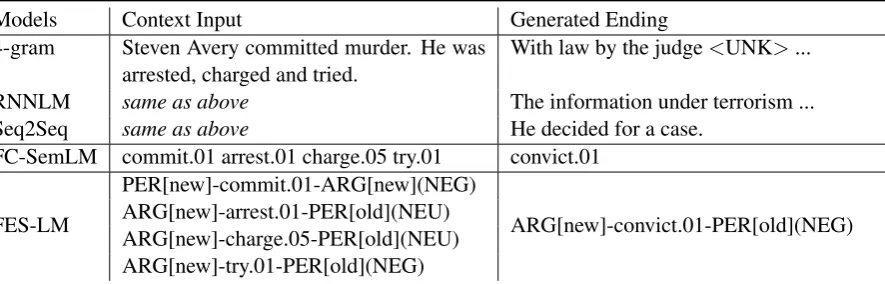
Models Context Input Generated Ending 4-gram Steven Avery committed murder. He was
arrested, charged and tried. With law by the judge<UNK>...
RNNLM same as above The information under terrorism ...
Seq2Seq same as above He decided for a case.
FC-SemLM commit.01 arrest.01 charge.05 try.01 convict.01
FES-LM
PER[new]-commit.01-ARG[new](NEG)
ARG[new]-convict.01-PER[old](NEG) ARG[new]-arrest.01-PER[old](NEU)
[image:2.595.82.525.63.205.2]ARG[new]-charge.05-PER[old](NEU) ARG[new]-try.01-PER[old](NEG)
Table 1: Comparison of generative ability for different models. For each model, we provide Ex.1 as context and compare the generated ending. 4-gram and RNNLM models are trained on NYT news data while Seq2Seq model is trained on the story data (details see Sec.5). These are models operated on the word level. We compare them with FC-SemLM (Peng and Roth,2016), which works on frame abstrac-tions, i.e. “predicate.sense”. For the proposed FES-LM, we further assign the arguments (subject and object) of a predicate with NER types (“PER, LOC, ORG, MISC”) or “ARG” if otherwise. Each argu-ment is also associated with a “[new/old]” label indicating if it is first argu-mentioned in the sequence (decided by entity co-reference). Additionally, the sentiment of a frame is represented as positive (POS), neural (NEU) or negative (NEG). FES-LM can generate better endings in terms of soundness and specificity. The FES-LM ending can be understood as “[Something] convict a person, who has been mentioned be-fore (with an overall negative sentiment)”, which can be instantiated as ”Steven Avery was convicted.” given current context.
tity to “baseball”. In Ex.3, one needs understand that “being accepted” typically indicates a positive sentiment and that it applies to “Joe”.
As importantly, we believe that modeling these semantic aspects should be done jointly; other-wise, it may not convey the complete intended meaning. Consider the alternative follow-ups in Figure 1: in Ex.1, the entity “jail” gives strong indication that it follows the storyline that men-tions “murder”; in Ex.2, even though “football” is not explicitly mentioned, there is a comparison between “baseball” and “football” that makes this continuation coherent; in Ex.3, “decided not to en-roll” is a reasonable action after “being accepted”, although the general sentiment of the sentence is negative. These examples show that in order to model semantics in a more complete way, we need to consider interactions between frames, entities and sentiments.
In this paper, we propose a joint semantic lan-guage model, FES-LM, for semantic sequences, which captures Frames, Entities and Sentiment information. Just as “standard” language mod-els built on top of words, we construct FES-LM by building language models on top of joint se-mantic representations. This joint sese-mantic rep-resentation is a mixture of reprep-resentations
corre-sponding to different semantic aspects. For each aspect, we capture semantics via abstracting over and disambiguating text surface forms, i.e. tic frames for predicates, entity types for seman-tic arguments, and sentiment labels for the over-all context. These abstractions provide the basic vocabulary for FES-LM and are essential for cap-turing the underlying semantics of a story. In Ta-ble1, we provide Ex.1 as context input (although FC-SemLM and FES-LM automatically generate a more abstract representation of this input) and examine the ability of different models to generate an ending. 4-gram, RNNLM and Seq2Seq models operate on the word level, and the generated end-ings are not satisfactory. FC-SemLM (Peng and Roth,2016) works on basic frame abstractions and the proposed FES-LM model adds abstracted en-tity and sentiment information into frames. The results show that FES-LM produces the best end-ing among all compared models in terms of se-mantic soundness and specificity.
where we test the system’s ability to recover a ran-domly dropped frame. We further show that FES-LM improves the performance of sense disam-biguation for shallow discourse parsing. We then re-train the model on short commonsense stories (with the model trained on news as initialization). We perform story cloze test (Mostafazadeh et al., 2017), i.e. given a four-sentence story, choose the fifth sentence from two provided options. Our joint model achieves the best known results in the unsupervised setting. In all cases, our ablation study demonstrates that each aspect of FES-LM contributes to the model.
The main contributions of our work are: 1) the design of a joint neural language model for seman-tic sequences built from frames, entities and sen-timents; 2) showing that FES-LM trained on news is of high quality and can help to improve shallow discourse parsing; 3) achieving the state-of-the-art result on story cloze test in an unsupervised setting with the FES-LM tuned on stories.
2 Semantic Aspect Modeling
This section describes how we capture different aspects of the semantic information in a text snip-pet via semantic frames, entities and sentiments.
2.1 Semantic Frames
Semantic frame is defined by Fillmore (1976):
frames are certain schemata or frameworks of concepts or terms which link together as a system, which impose structure or coherence on some as-pect of human experience, and which may contain elements which are simultaneously parts of other such frameworks. In this work, we simplify it by defining a semantic frame as a composition of a predicate and its corresponding argument partici-pants. The design of PropBank frames (Kingsbury and Palmer, 2002) and FrameNet frames (Baker et al.,1998) perfectly fits our needs. Here we re-quire the predicate to be disambiguated to a spe-cific sense, thus each frame can be uniquely rep-resented by its predicate sense. These frames pro-vide a good level of generalization as each frame can be instantiated into various surface forms in natural texts. For example, in Ex.1, the seman-tic frame in Opt.1 would be abstracted as “con-vict.01”. We associate each of these frames with an embedding. The arguments of the frames are modeled as entities, as described next.
Additionally, in accordance with the idea
pro-Ex.4The doctor told Susan thatshewas busy. The doctor told Susan thatshehad cancer. Mary told Susan thatshehad cancer.
Figure 2:Examples of the need for different lev-els of entity abstraction. For each sentence, one wants to understand what the pronoun “she” refers to, which requires different abstractions for two underlined entity choices depending on context. posed by Peng and Roth (2016), we also ex-tend the frame representations to include discourse markers since they model relationships between frames. In this work, we only consider explicit discourse markers between abstracted frames. We use surface forms to represent discourse markers because there is only a limited set. We also assign an embedding with the same dimension as frames to each discourse marker.
To unify the representation, we formally use
ef to represent an embedding of a disambiguated frame/discourse marker. Such embedding would later be learned during language model training.
2.2 Entities
We consider the subject and object of a predicate as the essential entity information for modeling se-mantics. To achieve a higher level of abstraction, we model entity types instead of entity surface forms. We choose to assign entities with labels produced by Named Entity Recognition (NER), as NER typing is reliable.1
In fact, it is difficult to abstract each entity into an appropriate level since the decision is largely affected by context. Consider the examples shown in Figure2. For the first sentence, to correctly un-derstand what “she” refers to, it is enough to just abstract both entities “the doctor” and “Susan” to the NER type “person”, i.e. the semantic knowl-edge beingperson A told person B that person A was busy. However, when we change the context in the second sentence, the “person” abstraction becomes too broad as it loses key information for this “doctor - patient” situation. The ideal seman-tic abstraction would be “a doctor told a patient that the patient had a disease”. For the third sen-tence, it is ambiguous without further context from other sentences. Thus, entity abstraction is a deli-cate balance between specificity and correctness.
1Though there are a number works on fine-grained entity
Besides type information, Ex.2 in Figure 1 shows the necessity of providingnew entity infor-mation, i.e whether or not an entity is appeared for the first time in the whole semantic sequence. This corresponds well with the definition of anaphroc-ity in co-reference resolution, i.e. whether or not the mention starts a co-reference chain. Thus, we can encode this binary information as an addi-tional dimension in the entity representation.
Thus, we formally define re as the entity rep-resentation. It is the concatenation of two entity vectorsrsubandrobj for subject entity and object entity respectively. Both rsub and robj are con-structed as a one hot vector2 to represent an
en-tity type, plus an additional dimension indicating whether or not it is anew entity(1 if it is new).
2.3 Sentiments
For a piece of text, we can assign a sentiment value to it. It can either be positive, negative, or neutral. In order to decide which one is most appropriate, we first use a look-up table from word lexicons to sentiment, and then count the number of words which corresponds to positive (npos) and negative (nneg) sentiment respectively. Ifnpos > nneg, we determine the text as positive; and ifnpos< nneg, we assign the negative label; and if the two num-bers equal, we deem the text as neutral. We use one hot vector for three sentiment choices, and de-fine sentiment representation asrs.
3 FES-LM - Joint Modeling
We present our joint model FES-LM and the neu-ral language model implementation in this sec-tion. The joint model considers frames, entities and sentiments together to construct FES repre-sentations in order to model semantics more com-pletely. Moreover, we build language models on top of such representations to reflect the sequen-tial nature of semantics.
3.1 FES Representation
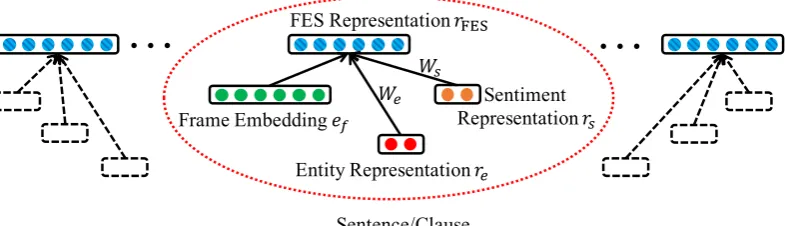
We propose FES-LM as a joint model to em-bed frame, entity and sentiment information to-gether. Thus for each sentence/clause (specific to a frame), we can get individual representations for the frame (i.e. ef), entity types and new entity in-formation corresponds to subject and object of the frame (i.e.re), and sentiment information (i.e.rs).
2Each dimension of the vector indicates an entity type
(bi-nary 0/1), and the vector contains exactly one element of 1.
Thus, we construct the FES representation as:
rFES=ef +Were+Wsrs.
We, Wsare two matrices transforming entity and sentiment representations into the frame embed-ding space, which are added to the correspond-ing frame embeddcorrespond-ing. These two parameters are shared across all FES representations. During lan-guage model training, we learn frame embeddings
efas well asWeandWs. An overview of the FES representation in a semantic sequence is shown in Figure3. Note that if the frame embedding repre-sents a discourse marker, we set the correspond-ing entity and sentiment representations as zero vectors since no entity/sentiment is matched to a discourse marker. It is our design choice to add the entity and sentiment vectors to the frame em-beddings, which creates a unified semantic space. During training, the interactions between different semantic aspects are captured by optimizing the loss on the joint FES representations.3
3.2 Neural Language Model
To model semantic sequences and train FES repre-sentations, we build neural language models. The-oretically, we can utilize any existing neural lan-guage model. We choose to implement the log-bilinear language model (LBL) (Mnih and Hinton, 2007) as our main method since previous works have reported best performance using it (Rudinger et al.,2015;Peng and Roth,2016).
For ease of explanation, we assume that a semantic sequence of FES representations is
[FES1,FES2,FES3, . . . ,FESk], with FESi being theithFES representation in the sequence. It as-signs each token (i.e. FES representation) with three components: a target vectorv(FES), a con-text vectorv0(FES) and a biasb(FES). Thus, we
model the conditional probability of a token FESt given its contextc(FESt):
p(FESt|c(FESt)) =
exp(v(FESt)|u(c(FESt)) +b(FESt)) P
FES∈Vexp(v(FES)|u(c(FESt)) +b(FES)).
Here,V denotes the vocabulary (all possible FES representations) and we define
3An alternative design choice is to concatenate the
Frame Embedding𝑒"
Entity Representation𝑟$
Sentiment Representation 𝑟%
FES Representation𝑟&'(
…
Sentence/Clause 𝑊$
[image:5.595.104.497.68.181.2]𝑊%
…
Figure 3: An overview of the FES representation in a semantic sequence. Semantic frames are represented by vectorrf. The entity representationreis the concatenation ofrsubandrobj, both consist of two parts: an one-hot vector for entity type plus an additional dimension to indicate whether or not it is anew entity. The sentiment representationrsis also one-hot.
u(c(FESt)) = X
ci∈c(FESt)
qiv0(ci).
Note that represents element-wise multiplica-tion andqiis a vector that depends only on the po-sition of an FES representation in context, which is also a model parameter. For language model train-ing, we maximize the overall sequence probability Qk
t=1p(FESt|c(FESt)). 4 Building FES-LM
In this section, we explain how we build FES-LM from un-annotated plain text.
4.1 Dataset and Preprocessing
DatasetWe first use the New York Times (NYT) Corpus4 (from year 1987 to 2007) to train
FES-LM. It contains over 1.8M documents in to-tal. To fine tune the model on short sto-ries, we re-train FES-LM on the ROCStories dataset (Mostafazadeh et al.,2017) with the model trained on NYT as initialization. We use the train set of ROCStories, which contains around 100K short stories (each consists of five sentences)5.
Preprocessing We pre-process all documents with Semantic Role Labeling (SRL) (Punyakanok et al., 2004) and Part-of-Speech (POS) tag-ger (Roth and Zelenko, 1998). We also imple-ment the explicit discourse connective identifica-tion module of a shallow discourse parser (Song et al.,2015). Additionally, we utilize within doc-ument entity co-reference (Peng et al., 2015a) to produce co-reference chains to get thenew entity 4Available at https://catalog.ldc.upenn.edu/LDC2008T19 5Available at http://cs.rochester.edu/nlp/rocstories/
information. To obtain all annotations, we employ the Illinois NLP tools6.
4.2 FES Representation Generation
As shown in Sec. 3, each FES representation is built from basic semantic units: frame / entity / sentiment. We describe our implementation de-tails on how we extract these units from text and how we further construct their vector representa-tions respectively.
Frame Abstraction and EnrichmentWe directly derive semantic frames from semantic role label-ing annotations. As the Illinois SRL package is built upon PropBank frames, we map them to FrameNet frames via VerbNet senses to achieve a higher level of abstraction. The mapping is de-terministic and partial7. For unmapped PropBank
frames, we retain their original PropBank forms. We then enrich the frames by augmenting them to verb phrases. We apply three heuristic rules: 1) if a preposition immediately follows a predicate, we append the preposition e.g. “take over”; 2) if we encounter the role label AM-PRD which indicates a secondary predicate, we append it to the main predicate e.g. “be happy”; 3) if we see the se-mantic role label AM-NEG which indicates nega-tion, we append “not” e.g. “not like”. We further connect compound verbs together as they repre-sent a unified semantic meaning. For this, we ap-ply a rule that if the gap between two predicates is less than two tokens, we treat them as a unified semantic frame defined by the conjunction of the two (augmented) semantic frames, e.g.“decide to
6Available at http://cogcomp.org/page/software/ 7We use the mapping file
Vocabulary Size Sequence Size
FES F E S #seq #token
NYT 4M 15K 100 7 1.2M 25.4M
[image:6.595.70.301.63.113.2]ROCStories 200K 1K 98 7 100K 630K Table 2:Statistics on FES-LM vocabularies and sequences.We compare FES-LM trained on NYT vs. ROCStories; “FES” stands for unique FES representations while “F” for frame embeddings, “E” for entity representations, and “S” for senti-ment representations. “#seq” is the number of se-quences, and “#token” is the total number of to-kens (FES representations) used for training.
buy”being represented by “decide.01-buy.01”. To sum up, we employ the same techniques to deal with frames as discussed in Peng and Roth(2016), which allows us to model more fine-grained semantic frames. As an example of this processing step, “He didn’t want to give up.” is represented as “(not)want.01-give.01[up]”. Each semantic frame (here, including discourse mark-ers) is represented by a 200-dimensional vectoref.
Entity Label Assignment For each entity (here we refer to subject and object of the predicate), we first extract its syntactic head using Collins’ Head Rule. To assign entity types, we then check if the head is inside a named entity generated by NER. If so, we directly assign the NER label to this entity. Otherwise, we check if the entity is a pronoun that refers to a person i.e. I, me, we, you, he, him, she, her, they, them; in which case, we assign “PER” label to it. For all other cases, we simply assign “ARG” label to indicate the type is unknown.
In order to assign “new entity” labels, we check if the head is inside a mention identified by the co-reference system to start a new co-co-reference chain. If so, we assign 1; otherwise, we assign 0. On ROCStories dataset, we add an additional rule that all pronouns indicating a person will not be “new entities”. This makes the co-reference decisions more robust on short stories.8
The entity representation re is eventually con-structed as a one-hot vector for types of 5 dimen-sions and an additional dimension for “new entity” information. As we consider both subjects and ob-jects of a frame,reis of 12 dimensions in total. If either one of the entities within a frame is missing from SRL annotations, we set its corresponding 6 dimensions as zeros.
Sentiment Representation Generation We first
8The same rule is not applied on news, since pronouns
indicating a person can start a co-reference chain in news.
determine the polarity of a word by a look-up ta-ble from two pre-trained sentiment lexicons (Liu et al.,2005;Wilson et al., 2005). We then count the number of positive words versus negative words to decide the sentiment of a piece of text as detailed in Sec.2. This process is done on text corresponding to each frame, i.e. a sentence or a clause. Since we have two different lexicons, we get two separate one-hot sentiment vectors, each with a dimension of 3. Thus, the sentiment repre-sentation is the concatenation of the two vectors, a total dimension of 6.
4.3 Neural Language Model Training
For the NYT corpus, we treat each document as a single semantic sequence while on ROCStories, we see each story as a semantic sequence. Ad-ditionally, we filter out rare frames which appear less than 20 times in the NYT corpus. Statistics on the eventual FES-LM vocabularies (unique FES representations) and semantic sequences in both datasets are shown in Table2. Note that the num-ber of unique FES representations reflects the rich-ness of the semantic space that we model. On both datasets, it is about 200 times over what is mod-eled by only frame representations. At the same time, we do not incur burden on language model training. It is because we do not model unique FES representations directly, and instead we are still operating in the frame embedding space.9
We use the OxLM toolkit (Baltescu et al.,2014) with Noise-Constrastive Estimation (Gutmann and Hyvarinen, 2010) to implement the LBL model. We set the context window size to 5 and pro-duce 200-dimension embeddings for FES repre-sentations. In addition to learning language model parameters, we also learn frame embeddings ef along with parameters forWe(12x200 matrix) and
Ws(6x200 matrix).
5 Evaluation
We first show that our proposed FES-LM is of high quality in terms of language modeling ability. We then evaluate FES-LM for shallow discourse pars-ing on news data as well as application for story cloze test on short common sense stories. In all studies, we verify that each semantic aspect con-tributes to the joint model.
9The FES representation space can be seen as entity and
CBOW SG LBL
Perplexity
FES-LM 133.8 135.8 126.0
Narrative Cloze Test (Recall@30)
FES-LM 38.9 37.3 43.2
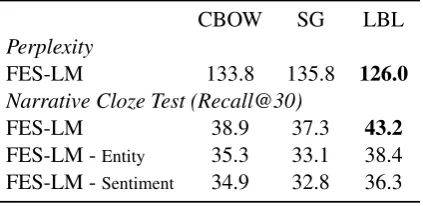
[image:7.595.76.288.63.166.2]FES-LM -Entity 35.3 33.1 38.4 FES-LM -Sentiment 34.9 32.8 36.3 Table 3:Quality comparison of neural language models. We report results for perplexity and nar-rative cloze test. Both evaluations are done on the gold PropBank data (annotated with gold frames). LBL outperforms CBOW and SG on both tests. We carry out ablation studies for narrative cloze test for FES-LM without entity and sentiment as-pects respectively.
5.1 Quality of FES-LM
To evaluate the modeling ability of different neu-ral language models, we train each variant of FES-LM on NYT corpus and report perplex-ity and narrative cloze test results. Here, we choose the Skip-Gram (SG) model (Mikolov et al., 2013b) and Continuous-Bag-of-Words (CBOW) model (Mikolov et al.,2013a) for comparison with the LBL model. We utilize the word2vec package to implement both SG and CBOW. We set the con-text window size to be 10 for SG and 5 for CBOW. We employ the same experimental setting as de-tailed inPeng and Roth(2016). Results are shown in Table 3. They confirm that LBL model per-forms the best with the lowest perplexity and high-est recall for narrative cloze thigh-est.10 Note that the
numbers reported are not directly comparable with those in literature (Rudinger et al.,2015;Peng and Roth,2016), as we model much richer semantics even though the numbers seem inferior. We fur-ther carry out ablation studies for narrative cloze test for FES-LM without entity and sentiment as-pects respectively11. The results show that
senti-ment contributes more than entity information.
5.2 Application on News
We choose shallow discourse parsing as the task to show FES-LM’s applicability on news. In particu-lar, we evaluate on identifying the correct sense of discourse connectives (both explicit and implicit
10We also tried Neural-LSTM (Pichotta and Mooney,
2016a) and context2vec (Melamud et al.,2016) model, but we cannot get better results.
11The ablation study is not done for perplexity test because
FES-LM with less semantic aspects yields smaller vocabu-lary, which naturally leads to lower perplexity.
ones). We chooseSong et al.(2015), which uses a supervised pipeline approach, as our base sys-tem. We follow the same experimental setting as described inPeng and Roth(2016), i.e. we add ad-ditional conad-ditional probability features generated from FES-LM into the base system. We evaluate on CoNLL16 (Xue et al.,2016) test and blind sets, following the train and development split from the Shared Task, and report F1 using the official shared task scorer.
Table 4 shows the results for shallow dis-course parsing with added FES-LM features. We get significant improvement over the base sys-tem(*) (based on McNemar’s Test) and outper-form SemLM, which only utilizes frame infor-mation in the semantic sequences. We also ri-val the top system (Mihaylov and Frank,2016) in the CoNLL16 Shared Task (connective sense clas-sification subtask). Note that the FES-LM used here is trained on NYT corpus. The ablation study shows that entity aspect contributes less than sen-timent aspect in this application.
5.3 Application on Stories
For the story cloze test on the ROCStories dataset. We evaluate in an unsupervised setting, where we disregard the labeled development set and directly test on the test set12. We believe this is a better
set-ting to reflect a system’s ability to model seman-tic sequences compared to the supervised setting where we simply treat the task as a binary classifi-cation problem with a development set to tune.
We first generate a set of conditional probabil-ity features from FES-LM. For each story, we ex-tract semantic aspect information as described in Sec.2and construct the joint FES representation according to the learned FES-LM. We then uti-lize the conditional probability of the fifth sen-tence s5 given previous context sentences C as
features. Suppose the semantic information in the fifth sentence can be represented by rFES k, we can then define the features as p(s5|C) =
p(rFES k|rFES (k-1), rFES (k-2),· · · , rFES (k-t)), t =
1,2,· · ·, k.We get multiple features depending on how long we go back in the context in terms of FES representations. Note that one sentence can contain multiple FES representations depending on how many semantic frames it has. For simplic-ity, we assume a single FES representationrFES k
12The test set contains1,871four-sentences long stories
CoNLL16 Test CoNLL16 Blind Explicit Implicit Overall Explicit Implicit Overall
Base (Song et al.,2015)* 89.8 35.6 60.4 75.8 31.9 52.3
SemLM (Peng and Roth,2016) 91.1 36.3 61.4 77.3 33.2 53.8 Top (Mihaylov and Frank,2016) 89.8 39.2 63.3 78.2 34.5 54.6
FES-LM (this work) 91.0 37.5 61.8 78.3 34.4 54.5
FES-LM -Entity 90.8 37.1 61.6 77.9 34.0 54.1
[image:8.595.81.515.64.177.2]FES-LM -Sentiment 90.5 36.9 61.3 77.3 33.8 53.9
Table 4:Shallow discourse parsing results.With added FES-LM features, we get significant improve-ment (based on McNemar’s Test) over the base system(*) and outperform SemLM, which only models frame information. We also rival the top system (Mihaylov and Frank,2016) in the CoNLL16 Shared Task (connective sense classification subtask).
Baselines
Seq2Seq 58.0%
DSSM (Mostafazadeh et al.,2016) 58.5% Seq2Seq with attention 59.1%
Individual Aspect S. M.V.
F-LM 57.8% 56.3%
E-LM 52.1% 52.6%
S-LM 54.2% 54.9%
Joint Model S. M.V.
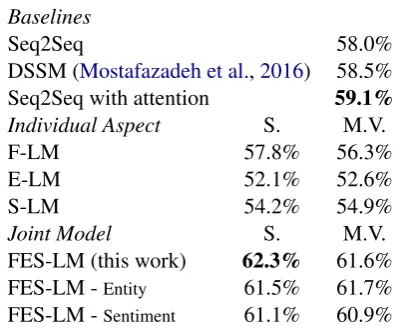
FES-LM (this work) 62.3% 61.6% FES-LM -Entity 61.5% 61.7% FES-LM -Sentiment 61.1% 60.9% Table 5: Accuracy results for story cloze text in the unsupervised setting. “S.” represents the in-ference method with the single most informative feature while “M.V.” means majority voting. FES-LM outperforms the strongest baseline (Seq2Seq with attention) by 3 points. The difference is statistically significant based on McNemar’s Test. Additional ablation studies show that each seman-tic aspect contributes to the joint model.
fors5. In practice, we get at most 12 FES
repre-sentations as context. We align the features byt, indicating how long we consider the story context. Thus, for each story, we generate at most 12 pairs of conditional probability features. Evey pair of such features can yield a decision on which ending is more probable. Here, we test two different infer-ence methods: a single most informative feature (where we go with the decision made by the pair of features which have the highest ratio) or ma-jority voting based on all feature pairs. Note that we need to re-train FES-LM on the stories (train set of ROCStories, 5-sentence stories, no negative examples provided)13.
13It is because of domain difference, e.g. average length of
semantic sequence is different (stories are shorter while news
We compare FES-LM with Seq2Seq base-lines (Sutskever et al., 2014). We also train the Seq2Seq model on the train set of ROCStories, where we set input as the 4-sentence context and the output as the 5th ending sentence for each story. At test time, we get probability of each op-tion ending from the soft-max layer and choose the higher one as the answer. We use an LSTM encoder (300 hidden units) and decode with an LSTM of the same size. Since it is operated on the word level, we use pre-trained 300-dimensional GloVe embeddings (Pennington et al., 2014) and keep them fixed during training. In addition, we add an attention mechanism (Bahdanau et al., 2014) to make the Seq2Seq baseline stronger. We also report DSSM from Mostafazadeh et al. (2016) as the previously best reported result14.
To study how each individual aspect affects the performance, we develop neural language mod-els on frames (F-LM), entities (E-LM) and sen-timents (S-LM) as additional baseline models sep-arately. We use the same language model train-ing and feature generation techniques as FES-LM. Particularly, for F-LM, it is the same model as FC-SemLM defined in Peng and Roth (2016). Note that individual aspects cannot capture the seman-tic difference between two given options for all instances. For those instances that the baseline model fails to handle, we set the accuracy as 50% (expectation of random guesses).
The accuracy results are shown in Table 5. The best result we achieve (62.3%) outperforms the strongest baseline (Seq2Seq with attention, 59.1%). It is statistically significant based on Mc-Nemar’s Test (α = 0.01), illustrating the superior are longer, see in Table2).
14DSSM’s model parameters are trained on the
[image:8.595.79.283.242.407.2]semantic modeling ability of FES-LM. Results are mixed comparing the two inference methods. The ablation study further confirms that each semantic aspect has its worth in the joint model.
6 Related Work
Our work is built upon the previous work (Peng and Roth, 2016). It generated a probabilistic model on semantic frames while taking into ac-count discourse information, and showed appli-cations to both co-reference resolution and shal-low discourse parsing. This line of work is in general inspired by script learning. Early works (Schank and Abelson, 1977;Mooney and DeJong,1985) tried to learn scripts via construc-tion of knowledge bases from text. More recently, researchers focused on utilizing statistical models to extract high-quality scripts from large amounts of data (Chambers and Jurafsky, 2008a; Bejan, 2008; Jans et al., 2012; Pichotta and Mooney, 2014; Granroth-Wilding et al., 2015; Rudinger et al.,2015;Pichotta and Mooney,2016b,a). Other works aimed at learning a collection of structured events (Chambers,2013;Cheung et al.,2013; Bal-asubramanian et al., 2013; Bamman and Smith, 2014; Nguyen et al., 2015; Inoue et al., 2016). In particular,Ferraro and Van Durme(2016) pre-sented a unified probabilistic model of syntactic and semantic frames while also demonstrating im-proved coherence. Several works have employed neural embeddings (Modi and Titov,2014b,a; Fr-ermann et al., 2014;Titov and Khoddam, 2015). Some prior works have used scripts-related ideas to help improve NLP tasks (Irwin et al., 2011; Rahman and Ng,2011;Peng et al.,2015b). Most recently, Mostafazadeh et al. (2016, 2017) pro-posed story cloze test as a standard way to test a system’s ability to model semantics. They re-leased ROCStories dataset, and organized a shared task for LSDSem’17.
7 Conclusion
This paper proposes FES-LM, a joint neural lan-guage model for semantic sequences built upon frames, entities and sentiments. Abstractions on these semantic aspects enable FES-LM to generate better semantic sequences than models working on the word level. Evaluations show that the joint model helps to improve shallow discourse parsing and achieves the best result for story cloze test in the unsupervised setting. In future work, we plan
to extend FES-LM to capture more semantic as-pects and work towards building a general seman-tic language model.
Acknowledgments
This work is supported by the US Defense Ad-vanced Research Projects Agency (DARPA) un-der contract HR0011-15-2-0025, and by the Army Research Laboratory (ARL) under agreement W911NF-09-2-0053, and also by IBM-ILLINOIS Center for Cognitive Computing Systems Re-search (C3SR) - a reRe-search collaboration as part of the IBM Cognitive Horizon Network. The views expressed are those of the authors and do not re-flect the official policy or position of the Depart-ment of Defense or the U.S. GovernDepart-ment.
References
D. Bahdanau, K. Cho, and Y. Bengio. 2014. Neural machine translation by jointly learning to align and translate. arXiv preprint arXiv:1409.0473.
C. F. Baker, C. J. Fillmore, and J. B. Lowe. 1998. The
berkeley framenet project. InCOLING/ACL.
N. Balasubramanian, S. Soderland, O. E. Mausam, and O. Etzioni. 2013. Generating coherent event
schemas at scale. InEMNLP.
P. Baltescu, P. Blunsom, and H. Hoang. 2014. Oxlm: A neural language modelling framework for machine
translation. The Prague Bulletin of Mathematical
Linguistics.
D. Bamman and N. A. Smith. 2014. Unsupervised dis-covery of biographical structure from text. TACL. C. A. Bejan. 2008. Unsupervised discovery of event
scenarios from texts. InFLAIRS Conference.
N. Chambers. 2013. Event schema induction with a
probabilistic entity-driven model. InEMNLP.
N. Chambers and D. Jurafsky. 2008a. Jointly combin-ing implicit constraints improves temporal ordercombin-ing. InEMNLP.
N. Chambers and D. Jurafsky. 2008b. Unsupervised learning of narrative event chains. InACL.
S. B. Chatman. 1980. Story and discourse:
Narra-tive structure in fiction and film. Cornell University Press.
J. C. K. Cheung, H. Poon, and L. Vanderwende. 2013. Probabilistic frame induction. arXiv:1302.4813. F. Ferraro and B. Van Durme. 2016. A unified bayesian
C. J. Fillmore. 1976. Frame semantics and the nature
of language. Annals of the New York Academy of
Sciences.
L. Frermann, I. Titov, and Pinkal. M. 2014. A hierar-chical bayesian model for unsupervised induction of
script knowledge. InEACL.
M. Granroth-Wilding, S. Clark, M. T. Llano, R. Hep-worth, S. Colton, J. Gow, J. Charnley, N. Lavraˇc, M. ˇZnidarˇsiˇc, and M. Perovˇsek. 2015. What hap-pens next? event prediction using a compositional
neural network model. InAAAI.
M. Gutmann and A. Hyvarinen. 2010.
Noise-contrastive estimation: A new estimation principle for unnormalized statistical models. InAISTATS.
N. Inoue, Y. Matsubayashi, M. Ono, N. Okazaki, and K. Inui. 2016. Modeling context-sensitive selec-tional preference with distributed representations. In COLING.
J. Irwin, M. Komachi, and Y. Matsumoto. 2011. Nar-rative schema as world knowledge for coreference
resolution. InCoNLL Shared Task.
B. Jans, S. Bethard, I. Vuli´c, and M. F. Moens. 2012. Skip n-grams and ranking functions for predicting script events. InEACL.
P. Kingsbury and M. Palmer. 2002. From Treebank to
PropBank. InProceedings of LREC-2002.
B. Liu, M. Hu, and J. Cheng. 2005. Opinion observer: Analyzing and comparing opinions on the web. In
WWW.
O. Melamud, J. Goldberger, and I. Dagan. 2016. con-text2vec: Learning generic context embedding with bidirectional lstm. InCoNLL.
T. Mihaylov and A. Frank. 2016. Discourse relation sense classification using cross-argument semantic
similarity based on word embeddings. In CoNLL
Shared Task.
Tomas Mikolov, Kai Chen, Greg Corrado, and Jef-frey Dean. 2013a. Efficient estimation of word
representations in vector space. arXiv preprint
arXiv:1301.3781.
Tomas Mikolov, Wen-tau Yih, and Geoffrey Zweig. 2013b. Linguistic regularities in continuous space
word representations. InNAACL.
A. Mnih and G. Hinton. 2007. Three new graphical models for statistical language modelling. InICML. A. Modi and I. Titov. 2014a. Inducing neural models
of script knowledge. InCoNLL.
A. Modi and I. Titov. 2014b. Learning semantic script
knowledge with event embeddings. InICLR
Work-shop.
R. Mooney and G. DeJong. 1985. Learning schemata for natural language processing. InIJCAI.
N. Mostafazadeh, N. Chambers, X. He, D. Parikh, D. Batra, L. Vanderwende, P. Kohli, and J. Allen. 2016. A corpus and cloze evaluation for deeper
un-derstanding of commonsense stories. InNAACL.
N. Mostafazadeh, M. Roth, A. Louis, N. Chambers, and J. F. Allen. 2017. Lsdsem 2017 shared task: The
story cloze test. InLSDSEM workshop at EACL.
K.-H. Nguyen, X. Tannier, O. Ferret, and R. Besanc¸on. 2015. Generative event schema induction with en-tity disambiguation. InACL.
H. Peng, K. Chang, and D. Roth. 2015a. A joint frame-work for coreference resolution and mention head
detection. InCoNLL.
H. Peng, D. Khashabi, and D. Roth. 2015b. Solving
hard coreference problems. InNAACL.
H. Peng and D. Roth. 2016. Two discourse driven
lan-guage models for semantics. InACL.
J. Pennington, R. Socher, and C. D. Manning. 2014. Glove: Global vectors for word representation. In EMNLP.
K. Pichotta and R. J. Mooney. 2014. Statistical script
learning with multi-argument events. InEACL.
K. Pichotta and R. J. Mooney. 2016a. Learning statis-tical scripts with lstm recurrent neural networks. In AAAI.
K. Pichotta and R. J. Mooney. 2016b. Using sentence-level lstm language models for script inference. In ACL.
V. Punyakanok, D. Roth, W. Yih, and D. Zimak. 2004. Semantic role labeling via integer linear
program-ming inference. InCOLING.
A. Rahman and V. Ng. 2011. Coreference resolution
with world knowledge. InACL.
X. Ren, W. He, M. Qu, L. Huang, H. Ji, and J. Han. 2016. Afet: Automatic fine-grained entity typing by
hierarchical partial-label embedding. InEMNLP.
D. Roth and D. Zelenko. 1998. Part of speech
tag-ging using a network of linear separators. In
ACL-COLING.
R. Rudinger, P. Rastogi, F. Ferraro, and B. Van Durme. 2015. Script induction as language modeling. In EMNLP.
R. C. Schank and R. P. Abelson. 1977. Scripts, plans, goals, and understanding: An inquiry into human
knowledge structures. InJMZ.
Y. Song, H. Peng, P. Kordjamshidi, M. Sammons, and D. Roth. 2015. Improving a pipeline architecture for
I. Sutskever, O. Vinyals, and Q. V. Le. 2014. Sequence to sequence learning with neural networks. InNIPS. I. Titov and E. Khoddam. 2015. Unsupervised induc-tion of semantic roles within a reconstrucinduc-tion-error
minimization framework. InNAACL.
Theresa Wilson, Janyce Wiebe, and Paul Hoffmann. 2005. Recognizing contextual polarity in
phrase-level sentiment analysis. InEMNLP.
N. Xue, H. T. Ng, A. Rutherford, B. Webber, C. Wang, and H. Wang. 2016. Conll 2016 shared task on mul-tilingual shallow discourse parsing. CoNLL. Dani Yogatama, Daniel Gillick, and Nevena Lazic.