Feature Extraction Techniques for Text
Recognition of Indian Scripts
Mrs. Gita Sinha
1, Dr. Shailja Sharma
21, 2Dept. of Computer Science Rabinadra Nath Tagore University,District: Raisen,(M.P.)
Abstract: Several research works has been done by many researchers on Optical Character Recognition system. But various work has been done is on Greek, Chinese, English and Japanese characters. There has not been sufficient quality of work on text recognition of Indian languages like Bangla, Marathi, Malayalam, Telugu, Gujarati, Kannada, Gurumukhi and Oriya. The development of handwritten text recognition (HTR) is an interesting area in pattern recognition. In HTR, the set of features are very important in selecting the appropriate feature that produces little classification error. In this paper, we have presented a study on feature extraction and classification techniques used for character recognition of Indian scripts. In the fast moving world with the amazingly expanding technology, character recognitions play a ample role by providing more scope to perform research in OCR techniques.A considerable advancement in the work associated with the recognition of handwritten and printed text has been reported in last few years. From the last few decades offline handwritten text recognition has gained a lot of interest of researchers. It is well known that each individual people have some different writing style, so it is very difficult to identify or recognize the handwritten characters or numerals. Based on data gathering process a concise classification of recognition system has been discussed in this paper. Several feature extraction techniques & classifiers like, diagonal feature extraction, transition feature extraction, K-NN classifier (K-nearest neighbour) & SVM classifier (Support vector machine) are also illustrated in this paper. The methodology for word recognition has also been briefly explained in this paper.
Keywords: K-NN classifier (K-nearest neighbour) & SVM classifier (Support vector machine)
I. INTRODUCTION
Handwritten optical Character Recognition (HOCR) is the capability of a computer to acquire and translate explicit handwritten input through many automated process system. HOCR can be isolated into many steps namely pre-processing, segmentation, feature extraction and classification (recognition). HOCR is the process of changing scanned images of handwritten and printed text into computer processing text such as ASCII code. It is generally used to improve the speed of operations, reduced errors or noise in the documents and decrease storage space needed for papers documents. It is a simple method for fast retrieval, efficient searched, saved more pace by compressed data. It is an popular field of research in pattern recognition and digital image processing system. In character or numeral recognition system, feature extraction is an important task. Its main job is obtaining particular information from text in order to minimize variations within class pattern. HOCR is a challenging issue because there is a divergence of identical character due to the change of different writing styles. The variance in writing styles make the recognition task difficult and output of the recognition process becomes not good. HOCR has many applications in mail sorting, bank processing, document reading and postal code recognition. So, off-line handwriting recognition is a challenging research area towards exploring the newer techniques that would maximum recognition accuracy[1].
II. RELATED RESEARCH WORK
Neeraj Kumar et. al. [2] they have present a paper on Offline Handwritten Gurmukhi Character Recognition: A Review . this paper explained a concept Based on data acquirement process a concise classification of recognition .they define Various feature extraction techniques & classifiers like power arc fitting ,parabola arc fitting, ,diagonal feature extraction, transition feature extraction, K-NN classifier (K-nearest neighbor) & SVM classifier (Support vector machine) .The methodology for text recognition has also been discussed in this paper. This paper will provide an preliminary support for the researchers who wish to research in this text recognition area. Furthermore the current efforts by the various authors are limited to character recognition only. This can also be extended to word recognition approaches.
Fuzzy Logic is a multi-valued logic that allows middle values to be defined between conventional evaluations like yes/no, true/false, black / white etc. they define various Feature Extraction method like Structural Analysis, Neural Networks. It also presents Location and segmentation Segmentation is a process that determines the constituents of an image, that is necessary to locate the regions of the document where data have been printed and separate them from figures and graphics.
Mehak Naz Mangoli et. al. [4] present a paper on Optical Character Recognition for Cursive Handwriting that deals with the recognition of cursive handwritten characters image using SVM. The samples has been used are high quality to reduce the complexities in the recognition process. Their work has been successfully gives individual characters of the input word image sample. His work produces better results than previous works and is easy to implement due to the use of SVM as a classifier. Future work can be done by improving the recognition accuracy and speed in much more better way. It can be enhanced further to get accurate result in noisy environment.
Ms. Vaishali G. Bhujade et.al.[5] proposed an article on A Technique for Segmentation of Handwritten Hindi Text. The main aim of this article is to proposed the new method for Segmentation of Handwritten Hindi image. Which is one of the major stages of character recognition. The proposed method is based on header line detection, upper modifier detection, lower modifier detection, character detection and contour following technique. They have introduced the new concept of resizing the image, so that system able to reduce space as well as reduce time complexity. Characters can be in random location, scale and orientation. There are several phases of recognition are explained like pre-processing, feature extraction and classification. At First, the contour following after header line detection correctly separates upper modifier then character and lower modifier. After that, this article provides a brief review of text line segmentation techniques for handwritten text images which can be very useful for the beginners who want to work on conversion of Hindi characters to English characters.
Deepu Kumar et. al.[6] presents a Review paper On Optical Character Recognition for Off-line Devanagari Handwritten Characters & Challenges. That deal with desirable feature extraction techniques, as well as classification techniques used for the recognition are reviewed in various segments of the paper. An effort is made to address the most crucial consequences reported so far and it is also tried to foreground the better directions of the research to date. They provide a guideline for the readers, working in the field of off-line handwritten Devanagari character recognition system. They compare the various Hindi OCR systems with respect to the feature set formulated, the dataset and the implemented classifier, and the recognition accuracy obtained. They define Handwritten Devanagari character recognition having an interesting area of research is word spotting and that would be helpful in large-scale indexing or search in the document images of handwritten archives. Some research is really required to find ideal combinations of classifiers for the purpose of recognition of the handwritten characters. It is still not light up that how a combination strategy can fully utilize the power of sub-classifiers, and to deal with the tradeoff between combination and effectiveness and by hybrid mechanism and a good level of optimization can generate efficient results which are useful for future OCR.
Sonal Khare et. al. [7] present a paper on Handwritten Devanagari Character Recognition System: A Review. They define Devanagari is an oldest Indian script that is used to write other languages such as Sanskrit, Hindi, Marathi and several others languages. This article depicted as Hindi is used as an official language more than 1.2 billion people worldwide. Character recognition is considered as one of the important technology in today’s world. It is used in various fields such as artificial intelligence, computer vision, and pattern. Optical Handwritten character recognition is consisting with two parts i.e. offline handwritten character recognition and online handwritten character image recognition.
Kunal Shah et. al.[8] proposed an article on A New Approach for Segmentation of Devnagari Characters. They have deal about Devnagari script, there were not many algorithms available for good segmentation of character for recognition system. His paper presents a new approach for segmentation of characters in an image that containing Devnagari script. They have used binarized image after noise removal containing devnagari for input text that produces Segmented characters as an output.they define that proposed algorithm provides a new and promising approach for segmentation of both type of text handwritten and printed Devnagari characters. The output depend on the quality of the image being used, with a fully binarized image containing no noise yielding the best recognition accuracy.
loops, generating frames (segmentation step) and detecting strokes. These features are then passed in to the recognition system for recognition. The character classification has performed by using a feed-forward error back propagation neural. Similar way the two letter words from the same people is also found and identified. In this techniques the data of the tow letter words is already stored in the offline dictionary for usage. In conclusion the proposed algorithm of this paper produces for extracting the characters from image using Eigen values is very efficient in recognition of characters.
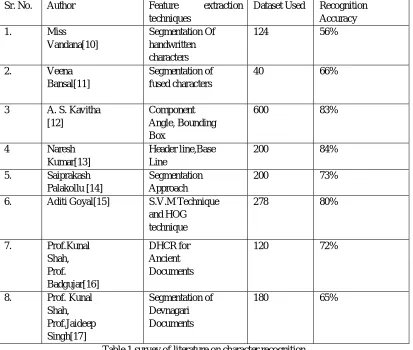
Sr. No. Author Feature extraction techniques
Dataset Used Recognition Accuracy
1. Miss
Vandana[10]
Segmentation Of handwritten characters
124 56%
2. Veena Bansal[11]
Segmentation of fused characters
40 66%
3 A. S. Kavitha [12]
Component Angle, Bounding Box
600 83%
4 Naresh
Kumar[13]
Header line,Base Line
200 84%
5. Saiprakash Palakollu [14]
Segmentation Approach
200 73%
6. Aditi Goyal[15] S.V.M Technique and HOG technique
278 80%
7. Prof.Kunal Shah, Prof. Badgujar[16] DHCR for Ancient Documents
120 72%
8. Prof. Kunal Shah, Prof.Jaideep Singh[17] Segmentation of Devnagari Documents
[image:3.595.94.507.176.526.2]180 65%
Table 1 survey of literature on character recognition
III. WORKING PRINCIPLE OF HOCR
Handwritten optical Character recognition is carried out into six phases which are image acquisition, pre-processing, segmentation, feature extraction, classification and post processing. The block diagram of the basic handwritten optical character recognition is shown in fig 1.
[image:3.595.180.417.606.735.2]A. Acquiring The Image
It is a process through which we produce a digital image from a paper envelope. This can be done using either a CCD camera, or a scanner etc.
B. Pre-Processing
This is the step performing before the major image processing task. In which we perform some basic tasks in order to render the resulting image more suitable for the job to follow. In this case it consists with enhancing the contrast, removing noise, or identifying regions. The obtained input image is pre-processed to remove noise from the image.
C. Segmentation
1) This is a process of subdividing an image into constituent parts, or isolating certain aspects of an image.
2) Finding lines, circles, or particular shapes in an image, in an aerial photograph, identifying cars, trees, buildings, or roads
D. Feature Extraction
Each stroke has some unique features. Such unique features of stroke are extracted and used for classification of characters. Different methods can be used to extract various features from a stroke. The feature can be of different types like shape based, intensity based, and texture based . it is a method of capturing visual content of images for indexing and retrieval. which is used to denote a piece of information that is relevant for solving the computational task related to a certain application
We have used different structural and statistical features. These features are extracted from each stroke. The size of stroke and speed of stroke may vary from user to user that may lead to wrong feature extraction. Proposed features are a size and speed independent.[18].
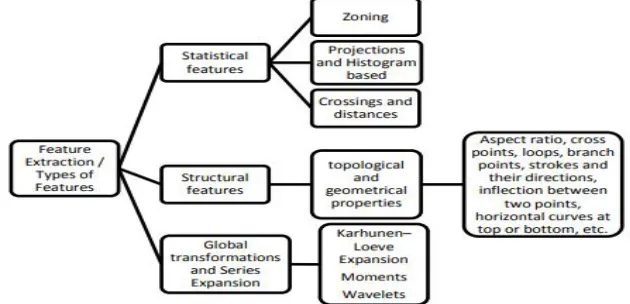
[image:4.595.126.441.419.571.2]We have specially focused on feature extraction and classification techniques. lack of consistency of handwriting with its high degree of variability and imprecision obtaining these features, is a difficult task. Feature extraction methods are categorised into three types of features shown in figure 2.
Figure 2 Feature extraction methods are categorised into three types of features.
Some other types of feature extraction techniques like Principle Component Analysis (PCA), Linear Discriminant Analysis (LDA), Chain Code(CC), Scale Invariant Feature Extraction (SIFT), zoning, Gradient based features, Histogram might be applied to extract the features of individual characters. These features are used to train the system.
values come at specific locations relative to each other. in which features are obtained by partitioning of image in Number part. of endpoints, End point existence in zone, Zone with zero foreground pixel value, Number of horizontal line and Number of vertical line are extracted from character[20]. There are several types of statistical feature extraction
i) Projection histograms, ii) crossings and distances, iii) n-tuples and Zoning
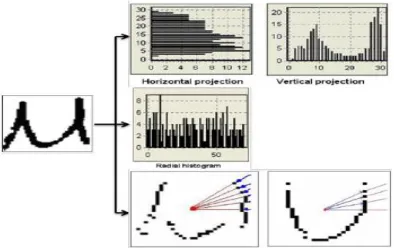
1. Projection Histograms: In this method character images, are 2-D signals, can be represented as 1-D signal. These features, although free from noise and deformation, depend on rotation. It also count the number of pixels in each column and row of a character image. Projection histograms can separate characters such as “x” and “y” shown in figure 3.
Figure 3 histogram of an image
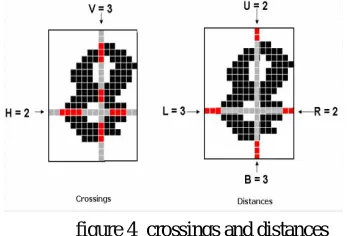
[image:5.595.197.372.366.484.2]2. Crossings And Distances: It is process of compute the number of adjustment,from background to foreground pixels along vertical and horizontal lines past by the character/numeral image. Distances In this method we calculate the distances of the first image pixel detected from the upper and lower boundaries, of the image, along vertical lines and from the left and right boundaries along horizontal lines shown in figure 4
figure 4 crossings and distances
[image:5.595.205.399.524.635.2]3. ZONING: The input character image is divided into N*M zones Features are extracted from each zone at local characteristics shown in figure 5.
Figure 5 Zooning techniques for feature extraction
Figure 6 Structural features of an image
These are the types of structural features
i) Horizontal and Vertical projection histograms ii) Radial histogram
iii) Radial out-in and radial in-out profiles iv) Horizontal and Vertical projection histograms
v) Radial histogram
vi) Radial out-in and radial in-out profile
vii) Horizontal and Vertical projection histograms viii) Radial histogram
ix) Radial out-in and radial in-out profile 1. Horizontal and vertical projection histogram 2. Radial Histogram
3. Radial out-in and radial in-out profile
Figure 7 Structural Method: Horizontal, vertical, radial, radial out-in and radial
c) Global Transformations And Moments
The Fourier Transform (FT) of the contour of the image is computed. Since the first n coefficients of the FT can be used in order to reconstruct the contour, then these n coefficients are considered to be a n-dimensional feature vector that represents the character image. The Fourier Transform (FT) of the contour of the image is computed. Since the first n coefficients of the FT can be used in order to reconstruct the contour, then these n coefficients are considered to be a n-dimesional feature vector that represents the character.[21]
Global transformation and series Expansion techniques can be classified into several methods : i) Fourier Transform
ii) Gabor Transform iii) Fourier Descriptor
iv) Wavelets v) Moments
[image:6.595.199.396.431.555.2]1. Fourier Transform: The Fourier transform is a process of representing an image as a sum of complex exponentials of varying magnitudes, frequencies, and phases. The Fourier transform plays a vital role in a broad range of image processing applications such as enhancement, analysis, restoration, and compression. If f(m,n) is a function of two discrete spatial variables m and n, then the two-dimensional Fourier transform of f(m,n) is defined by the relationship The variables ω1 and ω2 are frequency
variables and their units are radians per sample of image. F(ω1,ω2) is often called the frequency-domain depiction of f(m,n).
F(ω1,ω2) is a complex-valued function that is periodic both in ω1 and ω2, with period 2D, depicted in equ-1
(1)
2. Fourier Descriptors: Shape feature vector consists of the Fourier descriptors. After the boundary pixel set of an object was calculated. The method uses centroid distance function to compute shape signature from boundary pixels of a shape in a local space. Here this centroid distance function is the periodic function we consider and decompose into fourier series. A pair of shape signature and boundary pixel gray was used as a point in a feature vector. Fourier transform is used for shape signature to compute Fourier coefficients, and standardized pixel brightness is introduced into computational process of the Fourier coefficients so that shape features can be computed. The Fourier coefficients which are invariant to translation, scaling, rotation and change of start point are used as Fourier descriptors Note: Fourier series means decomposing a periodic function into sum of set of sine and cosine functions. The coefficients corresponding to are the fourier coefficients. If we want invariance to translation, do not use the DC-term, that is the first element in your resulting array of fourier coefficients f[0]. If we want invariance to scaling, make the comparison ratio-like, for example by dividing every Fourier coefficient by the DC-coefficient. f*[1]= f[1]/f[0] and so on. If we want invariance to the start point of your contour, only use absolute values of the resulting fourier coefficients. From these shape features are extracted. The method may also use complex coordinates and curvature function as shape signature.
3. Wavelets: Wavelets Transform represents a mathematical way used to study non-stationary signals. Therefore, its usefulness has been increasingly adapted over the last 10 years. It was employed in different fields such as communication technology, geophysics and image processing. The wavelet transform produces an appropriate basis for image handling because of its beneficial features. The benefits of the wavelet transform are: The ability to compact most of the signal’s energy into a few transformation coefficients, which is called “energy compaction” and the ability to acquire and represent effectively low frequency components (such as image backgrounds) as well as high frequency transients (such as image edges). Wavelet transform coefficients are energy, variance and waveform length. The features are extracted from these coefficients. The use of discrete wavelet transform (DWT) both for signal pre-processing and signal segments feature extraction as an alternative to the commonly used discrete Fourier transform (DFT). Feature vectors belonging to separate signal segments are then classified by a competitive neural network as one of the methods of cluster analysis and processing. By means of wavelet analysis, a matrix of data is obtained, where time and frequency domain information is present. Another waveform is ‘‘compressed’’ or ‘‘stretched’’ to obtain wavelets of different scales that are used along time comparing them with the original signal
4. Moments: Moment based features are very essential in describing shape of characters. It is observed that moment based features can become very effective if certain operations like normalization of character size and geometric operations are performed correctly using floating point arithmetic. we use the features drawn by invariants moment technique which is used to evaluate seven distributed parameter of a character image. The moment invariants (IMs) are well known to be invariant under translation, scaling, rotation and reflection. They are computation of the pixel distribution around the centre of gravity of the character and allow to capture the global character shape information. In the paper, the moment invariants are evaluated using central moments of the image function f(x,y) ) up to third order. Moments constitute an efficient feature extraction method (FEM) which generates high discriminative features, able to capture the particular characteristics of the described pattern. Among the several moment families introduced in the past, the orthogonal moments are the most popular moments widely used in many applications, owing to their orthogonality property[21].
(2) (3)
Figure 8.a Time domain Figure 8.b Frequency domain Gabor filter Gabor filter
IV. CONCLUSION AND FUTURE SCOPE
India is a nation in which various languages have been used as way of message passing between different people. In this paper, we have presented a survey on feature extraction for character recognition of Indian scripts. We have discussed various steps used for OCR character recognition and studies of different work is done on Indian languages. Thus, a feature extraction technique was developed for optical character recognition. It is found that the explained feature extraction technique has been used in several implementation. The use of these method is found to be effective and proves to be a robust method of feature extraction. The features are independent of each other and are based on global texture of the image, i.e. segmented character. Further studies on the applicability of these technique in handwritten character recognition is in progress.
REFERENCES
[1] Sukhpreet Kaur et. al. “ A survey on feature extraction and classification techniques for character recognition of Indian scripts” Research Cell : An International
Journal of Engineering Sciences, Issue June 2016 ISSN: 2229-6913 (Print), ISSN: 2320-0332 (Online)
[2] Neeraj Kumar et. al. “Offline Handwritten Gurmukhi Character Recognition: A Review “ International Journal of Software Engineering and Its Applications
Vol. 10, No. 5 (2016), pp. 77-86.
[3] N. VENKATA RAO et. al. “OPTICAL CHARACTER RECOGNITION TECHNIQUE ALGORITHMS” Journal of Theoretical and Applied Information
Technology 20th January 2016. Vol.83. No.2.
[4] Mehak Naz Mangoli et. al. “Optical Character Recognition for Cursive Handwriting” International Research Journal of Engineering and Technology (IRJET)
e-ISSN: 2395 -0056 Volume: 03 Issue: 05 | May-2016 www.irjet.net p-ISSN: 2395-0072.
[5] Ms. Vaishali G. Bhujade et.al. “A Technique for Segmentation of Handwritten Hindi Text” International Journal of Engineering Research & Technology
(IJERT) Vol. 3 Issue 2, February – 2014 ISSN: 2278-0181
[6] Deepu Kumar et. al. “Review On Optical Character Recognition for Off-line Devanagari Handwritten Characters & Challenges” International Journal of Scientific Research in Computer Science, Engineering and Information Technology 2018 IJSRCSEIT | Volume 3 | Issue 3 | ISSN : 2456-3307.
[7] Sonal Khare et. al. ““Handwritten Devanagari Character Recognition System: A Review” International Journal of Computer Applications (0975 – 8887) Volume 121 – No.9, July 2015
[8] Kunal Shah et. al.[8] proposed an article on A New Approach for Segmentation of Devnagari Characters GRA - GLOBAL RESEARCH ANALYSIS Volume
: 2 | Issue : 4 | April 2013 • ISSN No 2277 – 8160.
[9] Sudarshan Sawant “Handwritten character and word recognition using their geometrical features through neural networks” International Journal of Application or Innovation in Engineering & Management (IJAIEM)Volume 5, Issue 7, July 2016 ISSN 2319 – 4847
[10] Miss Vandana M.Ladwani ,Mrs Latish Malik “Novel Approach to Segmentation of Handwritten Devanagari Word”, Third International Conference on
Emerging Trends in Engineering and Technology.
[11] Veena Bansal and R. M. K. Sinha "Segmentation of fused characters and touching words"
[12] S. Kavitha, P. Shivakumara, G. Hemantha Kumar “Skewness and Nearest Neighbour based Approach for Historical Document Classification”, 2013
International Conference on Communication Systems and Network Technologies .
[13] Naresh Garg ,Lakhwinder Kaur ,M.K Jindal “A New Method for Line Segmentation of Handwritten Hind Text “, 2010 Seventh International Conference on
Information Technology.
[15] Aditi Goyal ,Kartikay Khandelwal ,Piyush Keshri" Optical Character Recognition for Handwritten Hindi Characters” , ,Stanford University , CS229 Machine Learning
[16] Kunal Shah, Prof. D. D. Badgujar, “DHCR for Ancient Documents: A review” – IEEE (ICT2013)
[17] Kunal Shah, Jaideep Singh “A new approach for segmentation of Devanagari Documents”- IJCA.
[18] V. A. Naik et. al. “Online Handwritten Gujarati Numeral Recognition Using Support Vector Machine” International Journal of Computer Sciences and Engineering Open Access Research Paper Vol.-6, Issue-9, Sept. 2018 E-ISSN: 2347-2693.
[19] Anuradha.K et. al. “Statistical Feature Extraction To Classify Oral Cancers” Journal of Global Research in Computer Science, 4 (2), February 2013, 8-12
[20] Purna Vithlani et. al. “Structural And Statistical Feature Extraction Methods For Character And Digit Recognition” International Journal of Computer Applications (0975 – 8887) Volume 120 – No.24, June 2015.
[21] Ashlin Deepa R.N et. al. “Feature Extraction Techniques for Recognition of Malayalam Handwritten Characters: Review” International Journal of Advanced
Trends in Computer Science and Engineering, Vol. 3 , No.1, Pages : 481– 485 (2014) Special Issue of ICETETS 2014 - Held on 24-25 February, 2014 in Malla Reddy Institute of Engineering and Technology, Secunderabad– 14, AP, India
[22] Vijay Prasad et. al. “ study on method of feature extraction for Handwritten Character Recognition” Indian Journal of Science and Technology
6(S3):174-178 · March 2013
[23] R.Ramanathan et. al. “Robust Feature Extraction Technique for Optical Character Recognition” 2009 International Conference on Advances in Computing, Control, and Telecommunication Technologies 978-0-7695-3915-7/09 2009 IEEE .2009.
AUTHORS PROFILE