Design and Development of a Compact Real Time
ECG Device
Abhiranjini B A1, Mr. Saurav Pratap Singh2, Mrs. Tabitha Janumala3 1,3
RV college of Engineering, Bangalore, India
2
DEBEL, DRDO, Bangalore, India
Abstract: Arrhythmia is the irregularity in normal heart rhythm which may lead to cardiovascular diseases like heart attack, blood pressure and stroke. Cardiac arrhythmia occurs in up to 86% of patients during anesthesia and surgery. So it is considerably important to detect these arrhythmia. In present work, Ventricular Tachycardia (VT), Atrial Fibrillation (AF), Left Bundle Branch Block (LBBB) and Right Bundle Branch Block (RBBB) have been displayed on CRO from the ECG device. The device is made compact by the use of surface mount device (SMD) technology. The developed device consists of hardware design with AD8232 for ECG extraction, with a gain of 100. Microcontroller to convert analog signal from AD8232 to digital form. Microcontroller is programmed using embedded C language in Atmel studio-7.0 version for ADC (Analog to Digital conversion) conversion, GPIO (General Purpose Input Output) and wireless Bluetooth transmission through UART communication. Bluetooth is used to transfer ECG data into the PC. The arrhythmia conditions were given from the ECG simulator to the developed device. The output was tapped from the developed ECG board and displayed on the CRO. The device has been tested for more than 20 arrhythmia conditions and it was able to display all the conditions on the CRO.
Keywords: Cardiac Arrhythmias, UART communication, Ventricular Tachycardia (VT), Atrial Fibrillation (AF), Bundle Branch Block.
I. INTRODUCTION
System Specification
Sampling frequency 250Hz
ADC resolution 12 bit
Gain 100
Cutoff frequency 0.5Hz – 40Hz
Operating voltage 3.3V
II. DESIGN AND IMPLEMENTATION
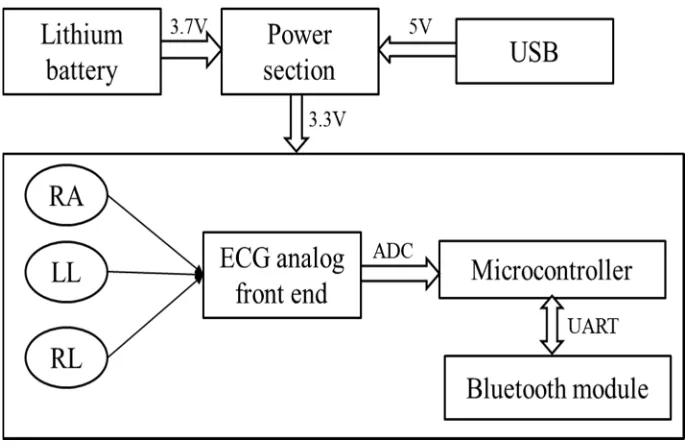
[image:2.612.152.497.217.440.2]The system design consists two parts, hardware and software design. The hardware design consists of AD8232 analog front end, microcontroller, Bluetooth module and power section. The hardware design block diagram is shown in the fig. 1.
Fig 1: Block diagram of hardware design
The software design includes programing microcontroller for GPIO (General Purposes Input and Output) configuration and ADC (analog to digital conversion) conversion. Serial port UART communication is used for communication between microcontroller and Bluetooth module HC-05.
A. Hardware Design
B. Software Design
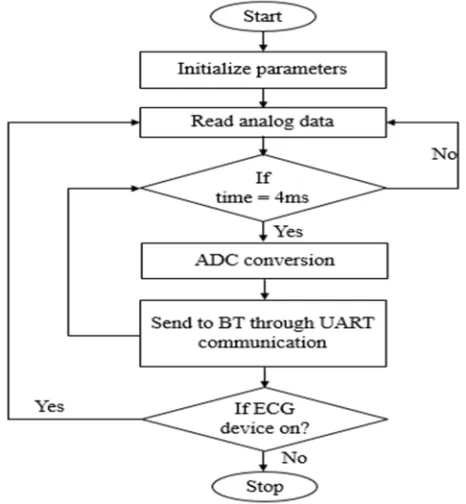
[image:3.612.212.445.128.380.2]The software design includes programming microcontroller using Embedded C language in Atmel studio 7 for GPIO configuration and ADC conversion.
Fig 2: Flowchart for embedded software of ECG device
The AD8232 has the shutdown low pin for shutdown control input and hence programming was done for GPIO pin of microcontroller to make the shutdown pin high so that ECG can be recorded on CRO display. The microcontroller is programmed for ADC conversion and the converted data is transferred to PC through Bluetooth, the flowchart for this is shown in fig 2. First the baudrate is set then the transmitter (TX) and the receiver (RX) pins are configure for UART communication. Initialization of analog pin is done for signal ended conversion by configuring positive pin as analog pin of microcontroller and the negative pin as ground. The ADC is enabled and it starts converting the data at desired sampling frequency. HC-05 is the Bluetooth (BT) module used and it has a range of 9 meters.
III. RESULTS AND DISCUSSION
Designed real time ECG device is shown in fig. 3 is of dimension 35×35mm on length and width respectively. The ECG electrodes were connected to the ECG simulator in lead II position (right arm, left leg and right leg). Analog data from AD8232 is converted to digital by SAMD21 microcontroller. The converted signal is transmitted through Bluetooth module and then displayed on PC.
[image:3.612.183.469.563.710.2]The data collected in PC is plotted using MATLAB. Each data was collected for around 10sec and the fig. 4(a) shows the 3sec data of normal ECG which was given from the ECG simulator and it is displayed on the CRO. Fig. 4(b) shows the 10sec data plotted using MATLAB in which all P, Q, R, S, & T wave is distinguishable.
[image:4.612.98.518.118.269.2](a) (b) Fig 4: Normal ECG given from simulator
The waveform acquired from a healthy subject is shown in fig. 5(a) and the respective MATLAB plot is shown in fig. 5(b). P, Q, R, S & T is easily identified even in the presence of noise in a healthy subject.
[image:4.612.119.500.537.688.2](a) (b)
Fig 5: Normal ECG from healthy subject
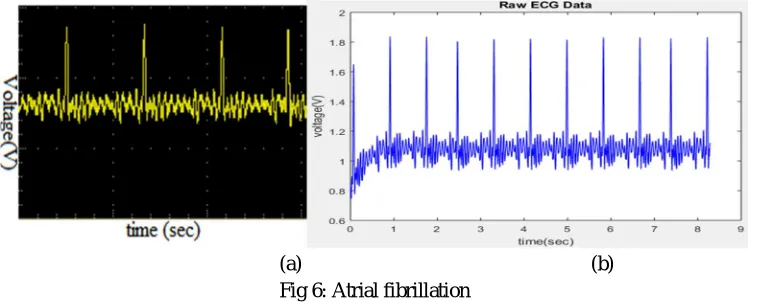
The fig. 6(a)-9(a) shows four different arrhythmia conditions which were given through ECG simulator and screenshot of CRO display were taken. The fig. 6(b)-9(b) shows the image of arrhythmia conditions plotted in MATLAB. Other than these four arrhythmia conditions it is tested on more than 20 arrhythmia and the output was plotted on the CRO. The results from CRO display and MATLAB is compared and found to be same.
(a) (b) Fig 6: Atrial fibrillation
(a) (b) Fig 7: Ventricular Tachycardia
The bundle branch blocks have prolonged QRS duration (0.12sec or more) as observed in fig. 8 and 9 and are associated with hypertension, valvular heart disease, heart failure and cardiomyopathy.
(a) (b) Fig 8: Left Bundle Branch Block
(a) (b) Fig 9: Right Bundle Branch Block
IV. CONCLUSION AND FUTURE WORK
REFERENCES [1] World health organization- www.searo.who.int
[2] Kam Cheong Wong, Michael Lang, “A Novel 12-Lead Electrocardiographic System for Home Use: Development and Usability Testing”, JMIR Mhealth Uhealth journal, 2018.
[3] Atrial fibrillation - mayoclinic.org
[4] Cardiac arrhythmias during anesthesia and surgery -ebme.co.uk
[5] Su, J., Dai, J., Guan, Z., SUN, Z., Ye, W., & Rajagopalan, C. “A Four-Lead Real Time Arrhythmia Analysis Algorithm”, IEEE conference on Computing in Cardiology Conference (CinC), IEEE,2017.
[6] Yan Lin, Mana Sriyudthsak “Design and Development of Standard 12-Lead ECG Data Acquisition and Monitoring System”, International Electrical Engineering Congress, Science Direct, 2016.
[7] Meng Shen, Shijing Xue, “Design and Implementation of Long-Term Single-Lead ECG Monitor”, Journal of Biosciences and Medicines, scientific research publishing, 2016.
[8] S. Suave Lobodzinski, Michael M. Laks,“New devices for very long-term ECG monitoring”, Cardiology Journal, NCBI,2012.
[9] Richard R. Fletcher and Sarang Kulkarni, “Clip-on Wireless Wearable Microwave Sensor for Ambulatory Cardiac Monitoring”, 32nd Annual International Conference of the IEEE EMBS, 2012.