Article
From Entropy Generation to Exergy Efficiency at
Varying Reference Environment Temperature: Case
Study of an Air Handling Unit
Giedrė Streckienė 1,*, Vytautas Martinaitis 1 and Juozas Bielskus 1
1 Department of Building Energetics, Vilnius Gediminas Technical University, Sauletekio ave. 11, LT-10223 Vilnius, Lithuania; [email protected] (G.S.); [email protected] (V.M.);
[email protected] (J.B.)
* Correspondence: [email protected]; Tel.: +370-5-251-2308
Abstract: The continuous energy transformation processes in heating, ventilation and air conditioning systems of buildings are responsible for 36% of global final energy consumption. Tighter thermal insulation requirements for buildings have significantly reduced heat transfer losses. Unfortunately, this has little effect on energy demand for ventilation. On the basis of the First and the Second Law of Thermodynamics, the concepts of entropy and exergy are applied to the analysis of ventilation air handling unit (AHU) with a heat pump in this paper. This study aims to develop a consistent approach for this purpose, taking into account the variations of reference temperature and temperatures of working fluids. An analytical investigation on entropy generation and exergy analysis are used, when exergy is determined by calculating coenthalpies and evaluating exergy flows and their directions. The results show that each component of the AHU has its individual character of generated entropy, destroyed exergy and exergy efficiency variation. However, the evaporator of heat pump and fans have unabated quantities of exergy destruction. The exergy efficiency of AHU decreases from 45-55% to 12-15% when outdoor air temperature is within the range of –30°C…+10°C, respectively. This helps to determine conditions and components of improving the exergy efficiency of the AHU at variable real-world local climate conditions. The presented methodological approach could be used in the dynamic modelling software and contribute to a wider application of the Second Law of Thermodynamics in practice.
Keywords: HVAC; air handling unit; energy efficiency; exergy efficiency; produced entropy; variable reference temperature; coenthalpy
1. Introduction
Buildings are one of the largest global energy consumers, using about 36% of final energy and
responsible for nearly 40% of energy-related CO2 emissions [1]. Continuous energy transformations
take place in heating, ventilation and air conditioning (HVAC) systems and devices thereof. Tighter thermal insulation requirements for buildings have significantly reduced heat transfer losses through the building envelope. However, in order to ensure adequate air quality in buildings, ventilation systems are becoming more and more important, leading to an increased need to improve and more thoroughly analyze such systems.
When analyzing HVAC systems, we can distinguish two large general groups of energy transformers: the first – fans, pumps, compressors that transform electrical energy into kinetic, potential and, via the losses in these processes, into thermal energy of fluids. The other group is heat exchangers. These energy transformers are usually integrated into the ventilation air handling unit (AHU). In modern AHUs, heat exchanger and heat pump are devices connected in terms of such energy transformation processes. In order to improve the efficiency of energy analysis of such various devices and the processes taking place therein, thermodynamic analysis is usually used along with
the methods applied therein, such as exergy analysis, entropy generation minimization, thermo-economics [2].
Thermodynamic analysis applied in scientific research that involves the first and second laws of thermodynamics (FLT and SLT) allows to assess the performed processes in terms of quantity and quality. When applying the SLT, several values that define degradation of energy are encountered, for example, entropy and exergy [3,4], and, more rarely, entransy [5–7]. These indicators allow to demonstrate the true potential of a thermal system in terms of performance, therefore they become important when analyzing and comparing energy systems that use various types of energy [8]. However, applying each aforementioned value in practice leads to difficulties. Since entropy is the measure of disorder and unavailability of a system as well as an extensive state quantity, it can sometimes be difficult to interpret and understand since it cannot be directly measured [9]. In addition to this, exergy analysis and its indicators are not extensively used in the building industry, designing energy efficiency of buildings or energy certification [10], [11].
Exergy is understood as a part of energy that can be used for work relative to the reference state (or dead state) condition. It can also be defined as the maximum net useful work obtained from the available energy on the basis of the thermodynamic efficiency of Carnot cycle operating between the temperature of the systems and the reference environmental temperature [12]. Thus exergy can be equated to available energy [13], [14]. Therefore, it combines FLT and SLT through a reference environment [15]. In this case it is necessary to assess the characteristics and change of the surrounding environment, because the obtained exergy results are the function of the selected reference environment [16–18]. Thus, when analyzing the processes of heat and work transformation in engineering systems of buildings, the issues surrounding the change of the reference conditions are relevant [19]. It should especially be taken into account when the analyzed processes take place at near environmental temperatures. Processes that take place in AHUs have these exact characteristics [20]. However, when performing exergy research, different authors interpret environmental conditions differently, sparking scientific discussion [15]. In some cases, reference parameters are variables [20–22], and in others they are constant, e.g., the average reference temperature and pressure [23]. It is also noted that the use of design or mean outdoor temperatures for exergy analysis may lead to significant uncertainties [21]. When assessing the energy system of a building in a selected timeframe in terms of exergy, e.g., ventilation AHU, it is noted that the maximum energy consumption occurs only at a specific reference temperature [22], [24] and does not necessary correspond with design temperature for energy calculations.
When linking entropy to the definition of exergy, it is known that entropy generation correlates with exergy destruction [6], [25,26] as exergy destructions measure the real inefficiency of the system [27]. Exergy analysis also often assesses the entropy portion by including irreversibility [14]. The definitions of entropy and exergy and the links between them are provided in [6], [12], [14], [28].
One of the main indicators used in exergy analysis that demonstrates system performance is exergy efficiency. This indicator shows the irreversibility level that occurs during the process. Low exergy efficiency shows improper use of the energy sources [29] and could be used to select and design HVAC systems [11]. However, the use of this thermodynamic indicator still causes a lot of discussion and there exists several definitions of it [29–31].
Both exergy analysis and entropy generation analysis allow to determine the most efficient process [14], [18]. The authors usually choose exergy analysis in order to compare and find the more efficient, better energy conversion process or system [10], [32–34]. The thermodynamic or exergy analysis in terms of building systems is usually applied for systems analysis: building envelope, HVAC systems [29], [35] or components, e.g. heat exchangers [4], [20], [36], [37], energy storage technologies, renewable and non-renewable energy sources [23], [38], design optimization and control [39]. The carried out research of the IEA (International Energy Agency) lists recommendations and guidelines for designing low exergy buildings [17], [40], research focused on such systems has been published in [21], [41].
determine its designing procedure and sizing devices [42]. However, this optimization will not always lead to the optimal value of the design objective. In addition to this, it has been determined that “there is no direct monotonic relation between the minimum entropy generation rate and the best transfer performance of heat exchangers” [25]. Exergy analysis may not always be aimed at exergy destruction minimization, but instead be focused on the inlet and/or outlet exergy minimization [16], and the highest exergy efficiency of the system.
The abundance of research in this field shows the benefits of this area of thermodynamics. It also shows a real need to evaluate the practical application of low-exergy systems [23]. Considering previous studies, it is obvious that the methods used for exergy analysis of energy transformation technologies, first and foremost – the methods used to determine exergy efficiency, should be improved in order to increase the consistency and universality of the methodology. The assumptions should be linked to the limitations of principles of thermodynamics and the inherent characteristics of exergy. In addition to this, proper attention should be paid to the evaluation of reference environment. Such methodology (calculation procedure, algorithms) improves the potential of applying exergy analysis in the practical research of building microclimate systems. Consistent analysis of processes taking place therein lays down the foundation for preparing the methodology of thermodynamic (exergy) analysis aimed at assessing momentary and seasonal efficiency of air handling units and other HVAC systems, taking into account varying reference environment temperatures [24], [43].
This paper presents the thermodynamic analysis of an air handling unit (integrated heat recovery unit and heat pump) of a modern HVAC system. The Coefficient of Performance (COP), the produced entropy, destroyed exergy and exergy efficiency are selected as the main indicators for the analysis. The transformation processes that take place in the separate components (heat exchangers) of the unit at varying reference temperatures are analyzed in detail. The novelty of this study is demonstrated by analyzing the ventilation AHU using the developed methodology in a certain logical sequence. The presented logic of the solution can be integrated in dynamic modelling software by analyzing the transformative processes that take place not only in air handling units, but also in other HVAC systems.
2. Air handling unit as a thermodynamic system
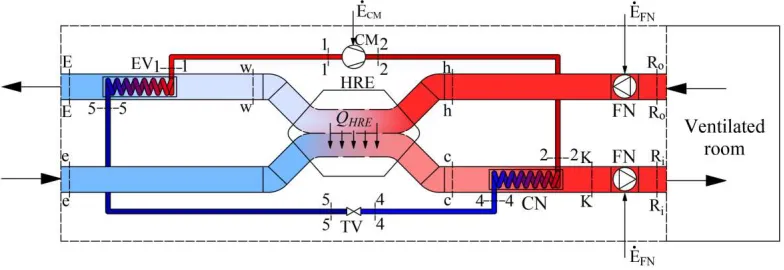
The scheme of a modern air-handling unit (AHU) of a HVAC system is shown in Figure 1. Working fluids linked within energy transformation processes that take place in the AHU are the air that is necessary for ventilation and refrigerant/Freon. The latter device consists of a condenser (CN) and an evaporator (EV), which are connected by a compressor (CM) and a throttle valve (TV) to operate in the reverse cycle.
The AHU prepares the required amount of air MV (for this paper a constant value was selected)
of temperature TR required for ventilation, when the reference temperature is Te. In this case the AHU
should provide fresh air required to ventilate the room with a specific heat flow:
( )
AHU V pa R e
Q M c T T (1)
One of the peculiarities is that this heat flow changes corresponding with the reference temperature which depends on the local climate conditions. Therefore, the results of the thermodynamic analysis depend on the reference environment in a specific location which the calculation method should reflect. This paper presents only the equations required for the exergy analysis of this AHU and concise commentary thereof.
AHU (Figure 1) consists of a heat recovery exchanger (HRE), heat pump (HP) and two fans (FN). The process of air preparation can be shortly described as follows. The amount of air required for ventilation MV at temperature TR is supplied to and exhausted from the ventilated room. The
outdoor air at temperature TR reaches the HRE where it warms up from Te to Tc. Then in the HP
condenser this air is warmed up to temperature TK and then slightly warms up in the supply fan (FN)
and, having reached temperature TRi, is supplied to the room. The air exhausted from the room at
temperature TRo, having warmed up to Th, in the HRE gives its heat to the supplied air and its
temperature drops to Tw. Then in the HP evaporator the air continues to give away its heat by cooling
to TE and is exhausted.
A process more linked to the HP could be defined as follows. The HP operates on the reverse cycle of Freon compression-expansion. This device warms up the outside air until it reaches the required temperature in the condenser (CN) and FN, having slightly warmed up the air, supplies it to the rooms. In the evaporator (EV) the cooling fluid evaporates due to the relatively high temperature of the exhaust air Tw.
At the level of the FLT, the energy transformation in heat exchangers is assessed using the heat transfer equation from the hotter working fluid h to the cooler fluid c:
ln h
c m
Q AU T (2)
and the heat balance equation:
1 2 2 1
( ) ( )
h
c c pc c c h ph h h
Q M c T T M c T T (3)
As the AHU heat exchangers we have a heat recovery exchanger, evaporator and condenser. Their schemes are shown in Figure 2 along with the corresponding energy balance equations, expressed in enthalpies:
Figure 2. Schemes of energy calculations for components of the AHU, energy balances thereof. Mf – the mass flow rate of Freon (kg / s); MV – the mass flow rate of the air used for ventilation (kg / s); hi – enthalpy (kJ / kg).
( )
V h w V c e
M h h M h h
(4a)
1 5
( )
f V E w
M h h M h h
(4b)
2 4
( )
f V K c
Heat transfer processes that take place in the CN and EV of the heat pump occur when states of air and Freon change. Each of these heat exchangers has its own specifics. There are different working fluids in the evaporator and the condenser, Freon and air. The change of the state of Freon is depicted in Figure 3. If Freon in the evaporator receives heat from the air (the temperature of the air is higher), then in the condenser the air receives heat from Freon (the temperature of the air is lower). For the most part of the process the state of Freon changes in accordance with the isotherm: Tf5–Tf1 in the
evaporator and Tf3–Tf4 in the condenser.
Figure 3. Temperature variation in the condenser (CN) and the evaporator (EV) of the heat pump. Specific numeric values correspond with the numeric case study analyzed below.
The smaller part of the heat flow in the condenser is transferred as the state of the overheated vapor of Freon changes, i.e. as its temperature drops from Tf2 to Tf3. Te, along with the reference
temperature, is always below the temperatures of the working fluids in the condenser. The problem of the varying reference temperature discussed below is not relevant to it. Meanwhile Te in the
evaporator in the majority of engineering solutions for the AHU is between the temperatures of the Freon and air. As a result, in this case the interpretation of directions of exergy flows should be given appropriate attention.
HRE is a specific heat exchanger. In it, heat exchange takes place between the air flows of the same mass flow rates: the removed air warms up the replacing, supplied air. In the engineering practice, the efficiency of the HRE is then calculated using equations:
1 2 1 1
h h
T
h c
T T
T T
(5a)or
2 1 1 1
c c
T
h c
T T
T T
(5b)If, in AHU technological systems, the air supplied to the HRE is often at outdoor temperature
h w T h e
T T
T T
(6a) or c e T h eT T
T T
(6b)The following AHU performance indicators were selected for this paper: coefficient of
performance (COP) and exergy efficiency ηex. AHU performance does not go beyond the FTL and, by
essence, corresponds with the definition of the COP of a heat pump that considers the equivalence of electricity and exergy and is widely used in engineering practice:
AHU AHUAHU
Q
COP
E
(7)where
AHU
E is the flow of exergy given outside of the boundaries of the AHU as a
thermodynamic system both in the form of work and heat. It can be used by the fans, compressor and additional heaters or coolers not shown in the scheme that use external working fluids or electricity. This COP is slightly different from the COP of AHUs that use only electricity as their denominators that have been becoming more and more popular in the engineering practice. While it does constitute net exergy flow, other possible energy inputs (cooling, heat) should be considered on the basis of their thermodynamic value (exergy).
Exergy efficiency, discussed below, is another AHU performance indicator. In the most general case (for the entire AHU or its components) it would be the ratio of exergy that leaves (results from) the analyzing system E to the exergy that this system is supplied with, E:
ex E E
or ex 1 Lhc
E
(8)
where Lhc is exergy destroyed in the process.
Exergy is a thermodynamic property, dependent on the state of the analyzed system and its surrounding environment, the so-called reference environment or, for thermal systems – reference temperature (RT). Determining exergy efficiency becomes complicated when RT varies and could be below, above or equal to the operating temperature of the working fluids, which is exactly the case for the AHU.
3. The specifics of exergy analysis in HVAC processes
In sections below we will discuss several specific questions: the variation of the direction of exergy flows of a stationary heat transfer process and the variation of the exergy efficiency of such process that changes the RT. Two approaches to determining the amount of produced energy in a heat exchanger that transfers heat in a stationary manner are compared below.
3.1. Produced entropy calculation approaches for heat exchangers
Heat exchangers in AHUs are important energy transformers. Figure 4 shows schemes of counter-current heat exchangers where the process of heat transfer is defined in two ways. The picture on the left (a) shows entropies of flows S M s i i, in this case the produced entropy is
determined by using:
, 1 1 2 2
h
c irr h c h c
S S S S S
(a) (b)
Figure 4. State parameters for determining produced entropy in a counter-current heat exchanger.
In the second case the process (b) is defined by the transferred heat flow and the input and output temperatures of working fluids. The expression of entropy in the heat transfer process is
/
q
dS
Q T. The produced entropy is expressed as the difference between the average entropy ofthe cooler working fluid and average entropy of the hotter working fluid:
,
1 2 1 2
1 1
2 2
h h h h
h c c c c
c irr
c c h h
Q Q Q Q
S
T T T T
(10)
In the condenser this value would be determined by adding the values of the cooling of overheated Freon vapor and Freon condensation. The results can be linked to the exergy analysis to find the destroyed exergy, which is generally expressed as follows:
0
h
c e irr
L T S (11)
Having combined these equations, the destroyed exergy in the process in case (b) can be
expressed using the Carnot factor values 1 e
Ci i T T
in the following manner:
1 2
2 1
1 δ 1 δ
h c
h e h e h
c h c c c
h c
h c
T T
L E E Q Q
T T
(12)
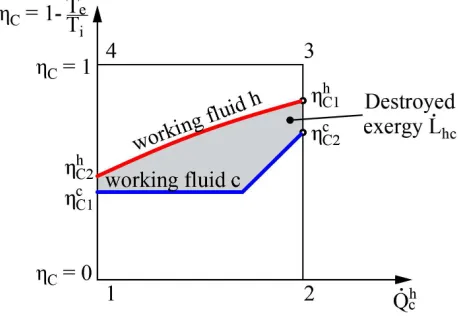
Graphical interpretation of this expression is shown in Figure 5.
Figure 5. Graphical representation of destroyed exergy Lhcf(Ci,Qch) in the heat transfer process in the heat exchanger.
the value ηC = 0 is in terms of other ηCi (e.g. between the values of hot and cold working fluids),
destroyed exergy that defines this process is still the area between these two curves (see Figure 5). The method to determine the destroyed exergy depends on the available state parameters. In the first case problems might arise due to the difference of reference states of entropies for various working fluids. On the basis of the obtained indicator for destroyed energy it is convenient to compare devices of similar efficiency. However, there is no universal performance indicator available in this case. In order to determine exergy efficiency ηex, along with Sirr or Lhc at least the exergy
flow that is supplied to the system should be known.
The case for AHU is special because the varying RT has a significant impact on the procedures
of exergy analysis. It is obvious that when RT changes, produced entropy Sirr does not change;
therefore, the results of the analysis that only indicate produced entropy become limited. As demonstrated below, even when the rate and direction of the heat flow is stable, when the RT changes, the exergy flow also changes in terms of its rate and direction.
3.2. Exergy efficiency of stationary heat transfer process at varying RT
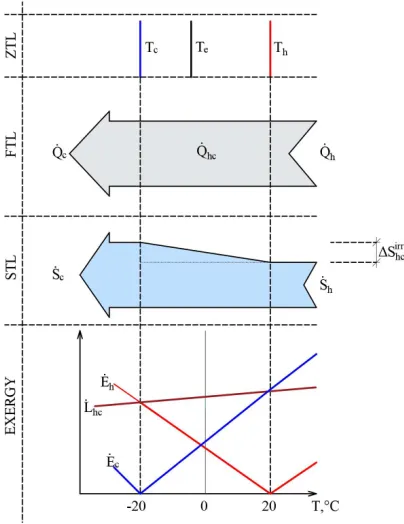
The authors have published papers on the impact of the varying RT on the direction of the exergy flow when the heat flow is stable [20], [44]. Here we have a stationary heat transfer process that is caused by stable temperatures Th = 20°C and Tc = –20°C. The selected temperatures are close to the
natural environment. The process is shown in Figure 6 from the point of view of the Zero Law of Thermodynamics (ZLT), the FLT, the SLT and exergy.
Figure 6. Heat transfer process from the positions of the ZLT, FLT, SLT and exergy when reference temperatures are close to the temperatures of heat sources.
It should be noted that the heat transfer process itself is not related to outdoor air temperature, i.e. Tc ≠ Te or Th ≠ Te. In addition to this, in the cases of the ZTL, the FTL and the STL Te is not a
parameter that affects the process indicators. In terms of the FTL there is a stable heat flow
h c
Q const, while in terms of the STL – h .
c irr
S const
The RT, i.e. outdoor air temperature Te, here
members on Te, is shown in the portion of the figure that is dedicated to exergy. Based on equation
(11), the destroyed exergy is linearly linked to h c irr
S
and in all cases, Lhc 0 . Within the
temperature range Th Te Tc exergy flows formed by both temperatures are given to the system
h
E
and Ec
, which are denoted with a superscript index “+”. There is no resulting exergy flow that
leaves the system here. We have a case of E E Lh c hc
. This interpretation shows how in a stationary
heat transfer process, formed by temperatures Th and Tc, the direction of exergy flows depends on the
position of Tewith respect to these temperatures. In other words, both exergy flows that characterize
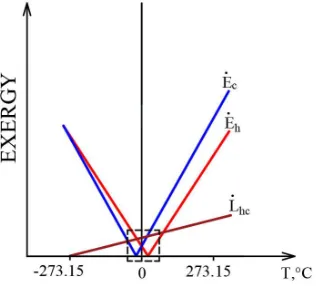
the heat transfer process are always directed at reference temperature and follow it as it changes. This case, having expanded it to conditions that are marginal in terms of thermodynamics from
Te = 0 K to Te >> Th, is shown in Figure 7. Exergy flow data, shown in Figure 6, is denoted by a dashed
line. When Te equals any of these temperatures (Te = Th or Te = Tc), then the corresponding exergy
equals 0. Destroyed exergy is proportional to Te and always above 0.
Figure 7. The members of the exergy balance of the heat transfer process in a wide range of Te.
An important attribute of the thermodynamic process in exergy analysis is the thermodynamic (exergy) efficiency of that process (equation 8). The nature of the change of this indicator for the heat
transfer process (when Th = 20°C and Tc = –20°C) in the thermodynamic system shown in Figure 6,
within the reference temperature range 30°C ≥ Te≥ –30°C, is shown in Figure 8 (a).
(a) (b)
Figure 8. Thermodynamic (exergy) efficiency of the heat transfer process between temperatures Th = 20°C, Tc= –20°C at a varying reference environment: (a) 30°C ≥ Te ≥ –30°C; (b) from Te = 0 K to higher values.
generally not symmetrical with respect to 0°C (the average value of Th= 20°C and Tc=–20°C). The
maximum value always corresponds with Te = 0 K. The minimum value ηex = 0 is always within the
range between Te = Th and Te = Tc, which, in this case, is (Th=20°C, Tc = –20°C).
Case E Ehc (the intersection of exergy flows in Figure 6), quantitatively, is not symmetrical
in terms of temperatures (i.e. does not equal 0°C in this case) and is the so-called harmonic mean
,
2 h c
h c e E E
h c
T T T
T T
, different for each combination of these temperatures. In the numeric case analyzed
herein it equals –1.46°C.
The presented numeric case of the heat transfer process shows that such interpretation of the direction of an exergy flow corresponds with the fundamental axioms of thermodynamic (exergy) analysis. First of all, exergy losses are always L 0 and when Si const they are proportional
to Te. In addition to this, the exergy efficiency of a system and a process taking place therein is
0ex1. Therefore, the thermal exergy flow moves from the thermal source to the environment.
The solution of an element developed hereby can be reliably used in the thermodynamic (exergy) analysis of the energy transformation chain of HVAC systems.
3.2. Features of exergy analysis of heat exchangers in the AHU
Cases discussed above occur in HVAC systems and determining exergy efficiency becomes problematic when RT varies and could be below, above or equal to the operating temperature of the working fluids. Figure 9 shows a sequence of RT positions for a heat exchanger that operates in a stationary mode (i.e. different temperatures of working fluids do not change their values; instead, RT positions change with respect to them).
Figure 9. Possible positions of temperatures of working fluids and outdoor air with respect to each other in heat exchangers of the AHU.
In a real exergy analysis task of HVAC, the variation of the RT has its own behavior over time (depends on the momentary climate conditions) which can affect the temperatures of working fluids as well. The usual sequence of exergy assessment and calculation, even at a varying RT, is acceptable without the specific properties for cases (a) and (e). In these cases, the numeric value of RT equals, is above or below the temperatures of any working fluid. However, in order to move to a thorough analysis of processes at a varying Te, an algorithm is required to solve the separate cases shown here
(e.g. (b), (c) and (d)).
thermodynamic system shown in Figure 1; however, the HRE is a very important component to the general performance of the AHU. When performing the analysis of AHU components, a methodology for the thermodynamic analysis of the HRE at a varying RT when its values cross the temperatures of working fluids was prepared. Paper [44] proposes a solution using the Carnot factor while in [20], [45] coenthalpies were applied. In addition to this, the methodology for the HRE for determining universal and several functional exergy efficiencies was developed in [45]. In order to avoid repeated publication of the same material, the authors only reference the papers that present the aforementioned methods. Only a succinct definition of coenthalpy is presented. According to Borel [46,47], in exergy analysis that combines the FLT and the SLT, coenthalpy is the potential of exergy flow (and, at the same time, the state parameter). The coenthalpy of state i of the working fluid
(its mass flow) (derivative status parameter from enthalpy h c Ti p i and entropy
273.15i
i p
T s c ln ) at reference temperature Te is calculated using equation:
( )
273.15i
i i e i p i e
T
k h T s c T T ln (13)
Reference coenthalpy ke that corresponds with the reference temperature (RT) Te is determined
as follows:
2
(1 )
73.15e e e p
T
k T c ln (14)
Then the compared exergy flows i, conventionally used (calculated and analyzed) in exergy analysis, are:
( )i i e i e e i e
e k k h h T s s (15)
As the process shifts from state "1" to state "2", it is defined by the difference between potentials (coenthalpies) of the exergy flow:
12 1 2 1 2 e 1 2
e k k h h T s s
or
E12M k12
1k2
K1K2 (16)Accordingly, for energy balance equations in Figure 2, exergy equations on the basis of coenthalpies for heat exchangers in the AHU are expressed as follows:
HRE:
( )
V h w V c e HRE
M k k M k k L (17a)
Evaporator:
1 5
( )
f V E w EV
M k k M k k L (17b)
Condenser:
2 4
( )
f V K c KN
M k k M k k L (17c)
An analogous balance equation for the entire AHU: 2
V e V Ro CM FN V Ri V E AHU
M k M k E E M k M k L (18)
4. Case study – results and discussion
The stable air flow rate of the analyzed AHU is 560 m3/h and power input for fans (supply and
exhaust) is 2 × 77 W. The efficiency of the HRE is 70%, the isentropic efficiency of the HP compressor is 0.8, and the power consumption efficiency of the fan is 0.82. Environment (as well as reference) temperature range is Te = –30…+10°C while the room air temperature is 22°C. Freon is 410a, isotherm
in the evaporator is TEVizot Tf5Tf1= –30°C, isotherm in the condenser is TKNizot Tf3Tf4= 30°C
(Figure 3.).
An integral chart of the variation of working fluids (air and Freon) of the AHU in the heat exchangers is shown in Figure 10. The depicted temperatures are within the range that is typical of processes of real-world ventilation and HP used for such ventilation. To the right of 0.0 on the x-axis the thermal input of the AHU is shown which is created by the HRE and the condenser. To the left of 0.0 the thermal input of the evaporator that it receives from the exhausted air is shown.
Figure 10. The variation of air and Freon temperature in the heat exchangers of the AHU when Te= -20°C.
The selection of the size of the AHU and Te = –20°C does not have a numeric significance in terms
of the discussed issues of exergy analysis from the methodical point of view. The warming up of air in fans has been assessed in the calculations but is not reflected in the chart directly due to relatively low numeric value.
Figure 11 shows the temperature values of the same AHU in the heat exchangers at outdoor air
temperature Te = –30°C and 10°C. Not only the positions of temperatures of the working fluid with
respect to each other change, but also the heat flow transferred within them, which is shown on the x-axis at different scales.
The aforementioned Carnot and coenthalpy methods [44, 45] were not used together for the same numeric case which will be performed herein. The cases of variations of the Carnot factor in these three temperature cases (Te = –30°C, –20°C and 10°C) are shown in Figure 12.
It is observed that the Carnot factor is 0 in all cases for the outdoor air that enters the HRE. It equals 0 for the evaporator as when TEVizot Te= –30 ºC. The area between the Carnot lines within the
(a) (b)
Figure 11. Temperatures in the heat exchangers and heat flows therein at outdoor air temperatures of –30°C and +10°C.
(a) (b)
(c)
Figure 13 shows the same temperature cases by expressing the states of heat exchangers in coenthalpies. It should be noted that in the exergy analysis of the HRE [20,45], the hot and cool working fluids of the heat exchanger are the air with the same mass flow rate, thus the results of the analysis are interpreted directly on the basis of the variation of the coenthalpies of the working fluid. When the HRE, EV and CN are assessed in an integral manner, this advantage disappears.
(a) (b)
(c)
Figure 13. Coenthalpies and heat flows in heat exchangers at outdoor air temperatures of (a) –30°C; (b) –20°C and (c) +10°C.
Based on our selection, we have an air handling unit with a stable mass flow rate MV, however,
the mass flow rate of the heat pump (i.e. the same for the evaporator and the condenser) depends on
Te. In addition to this, the reference state parameters for the thermodynamic state parameters
(enthalpy and entropy) of these different working fluids are autonomous. In this stage, air coenthalpies have been chosen for graphical representation while the Freon coenthalpies have been reduced at a ratio of M Mf/ V.
The exergy balance equation for the condenser (Equation 17c) in this case would be
M M k M M k k k lf/V
2 f/V
4
K c
CN.with an exergy flow. If the coenthalpy increases in the direction of the flow of the working fluid, it means that the system supplies the heat exchanger with an exergy flow. A typical case in an evaporator at –30°C is when the coenthalpy does not change due to TEVizotTe remaining for the
entirety of the process.
By using applied analysis of the AHU, Figure 14 depicts the change of the produced entropy in the range of Te = –30°C …+10°C. These results have been obtained by using equations (9) and (10).
(a) (b)
Figure 14. Entropy produced in AHU components Sirr at different reference temperatures (a).
Chart (b) shows an extract from the lower part of chart (a), using equations (9) and (10).
As observed in the comparison of the results of condenser (CN) and evaporator (EV) within the range of temperatures typical of HVAC depicted in Figure 14 (b), there is no significant difference between these results. The results are analogous for other components of the AHU which shows that when using dynamic modelling algorithms, the method that is more suitable in terms of the available data can be chosen.
Figure 15 shows the destroyed exergy in several components of the AHU. Considering the operation of the AHU under real-world conditions (in a wide range of outdoor air temperatures), the decreasing values of destroyed exergy of the HRE and CN, yet not decreasing values of destroyed exergy of the EV and FNs as the outdoor air temperature increases should be noted. Therein lies the potential of improving the general indicators of the thermodynamic efficiency of AHUs.
Figure 15. Destroyed exergy L in the AHU components HRE, EV, CN and FNs at different
On the basis of the previously described methodical foundation we can obtain AHU indicators
relevant to HVAC design that are the focus of dynamic modelling, such as COPAHU (Equation 7) or
exergy efficiency ηex (Equation 8). The dependence of these indicators on outdoor air temperature
(RT) is depicted in Figure 16. It also illustrates the aforementioned statement that the effectiveness of the HRE (Equations 5 and 6) has an important role regarding AHU performance indicators. For this purpose, two cases are presented: when εT equals 70% and 80%.
Higher εT allows to achieve better AHU performance indicators, especially at lower reference
temperature values. It can be noted that exergy efficiency of the HRE remains nearly stable (in both cases of εT) due to the fact that it is supplied with the air at reference temperature. The exergy
efficiency of the entire device responds more to the reference temperature by dropping several times in the analyzed range (from –30°C to +10°C). It occurs mostly due to destroyed exergy in the evaporator and fan being almost independent of the reference temperature (see Figure 15). Additional calculations show that without the HRE, the performance coefficient of AHU would practically correspond with the HP and in this numeric case would be almost 3.
Figure 16. Dependence of COP and exergy efficiency of AHU on reference temperature.
We hereby list the aforementioned specifics of processes in HVAC devices. First of all, the parameters of working fluids change and depend on the constantly changing outdoor air temperature Te, which, in terms of exergy analysis, is reference temperature. In a specific location the
variation of temperature is typical of that location only. The assessment and choice of solutions in terms of engineering and economy depends on a longer period, seasonal processes and indicators of device performance that can be only revealed by employing dynamic process modelling. One of its main components is exergy analysis. The peculiarities of processes in AHUs are listed and demonstrated therein. The reflection of these specifics in dynamic modelling algorithms enhances the application of exergy analysis in the assessment and choice of HVAC systems.
5. Conclusions
and universal approach to the change of the direction of thermal exergy flows and poses the objective of preparing algorithms that represent such approach unambiguously.
The performed case study of air handling unit has shown that all these issues were discussed, expressed in an analytical manner and a logical sequence for performing the exergy analysis of this device was proposed and realized. It should be developed and applied to other HVAC systems.
The main methodical conclusions of the paper are the following:
1. Two exergy flows that characterize the transferred heat flow formed by two temperatures are
always directed at the reference temperature and correspond with its change. Such interpretation of the direction of exergy as the reference temperature changes corresponds with the fundamental axioms of thermodynamic (exergy) analysis:
a. exergy losses L 0 when irr
S const
are always proportional to Te;
b. the exergy efficiency of a system and the process taking place therein is 0ex1.
2. Even though there are two ways to determine the entropy produced during the heat transfer
process (on the basis of entropy balance and Carnot factor), in order to determine the exergy efficiency of this process at least one of the two exergy flows has to be known.
3. As the temperature change in heat exchangers is nearly rectilinear, i.e. when temperature changes are not significant, both Carnot factor and methods based on coenthalpies can be used for exergy analysis. The decision depends on the information available.
The main conclusions with regards to the numeric case are the following:
1. Process parameters in the AHU and its HP components as well as performance indicators thereof
change within the range of change of RT. There is a trend that as the RT increases, most of the indicators drop. However, to each component there a specific nature of variation of the produced entropy, destroyed exergy and exergy efficiency.
2. With regards to RT, heat pump evaporator and fans are distinguished by a constantly non-decreasing destroyed exergy indicator. Here exergy analysis shows the potential of improving general thermodynamic efficiency indicators of AHUs.
3. Even without being an indicator for AHU performance comparison, entropy generation shows
the distribution of process irreversibility in components as well as the specifics of changes in processes. It also allows to verify intermediate results of exergy analysis.
4. Within the selected rather wide range of RT change the AHU coefficient of performance remains
quite high and drops 30% to 40% when RTs are higher. Absolute values are highly dependent on the effectiveness of the heat recovery exchanger.
5. Exergy efficiency of AHU in this range of RT of –30°C …+10°C drops from 45–55% to 12–15%
even though the exergy efficiency of the HRE basically does not change. The main reason for this is the aforementioned stable (essentially independent of the RT) value of the destroyed exergy for evaporator and fans.
The issues analyzed in the paper, the demonstrated specifics of processes in AHU and the solution thereof in the case study show that using these methods for dynamic modelling algorithms enhances the application of exergy analysis in the assessment of HVAC systems and the choice of such systems.
Author Contributions: V. Martinaitis and G. Streckienė designed the research, carried out theoretical analysis and wrote the article. J. Bielskus analyzed and tested results, also made visualization. All authors have read approved the final manuscript.
Funding: This research received no external funding.
Nomenclature
Abbreviations
AHU Air Handling Unit
CM Compressor
CN Condenser
COP Coefficient of Performance
EV Evaporator
FLT First Law of Thermodynamics
FN Fan
HP Heat Pump
HRE Heat Recovery Exchanger
HVAC Heating, Ventilation and Air Conditioning
RT Reference Temperature
SLT Second Law of Thermodynamics
TV Throttle valve
ZLT Zero Law of Thermodynamics
Variables
A surface area (m2)
cp specific heat capacity (kJ / kg K)
e specific exergy (kJ / kg)
E exergy flow rate (kW)
h enthalpy (kJ / kg)
k coenthalpy (kJ / kg)
l specific destroyed exergy (kJ / kg)
L destroyed exergy (kW)
M mass flow rate (kg / s)
Q heat transfer flow rate (kW)
s specific entropy (kJ / kg K)
S entropy (kW / K)
T temperature (K)
U overall heat transfer coefficient (W / m K)
T
effectiveness of heat recovery exchanger (–)
C
Carnot factor (–)
ηex exergy efficiency (–)
Subscripts
a air
AHU air handling unit
c cooler fluid
e state of reference environment
f Freon / refrigerant
h hotter fluid
irr produced / irreversible
R room
V ventilation
1 in
Superscripts
h hotter fluid
q heat transfer
+ to the system
– out of the system
References
1. IEA and the United Nations Environment Programme. Global status report 2018; Towards a zero-emission, efficient and resilient buildings and construction sector. 2018.
2. Bejan, A. Thermodynamics today. Energy2018, 160, 1208–1219.
3. Wang, L.S. The Second Law: From Carnot to Thomson-Clausius, to the Theory of Exergy, and to the Entropy-Growth Potential Principle. Entropy 2017, 19, 57.
4. Kim, K.H.; Kim, K.; Ko, H.J. Entropy and Exergy Analysis of a Heat Recovery Vapor Generator for Ammonia-Water Mixtures. Entropy 2014, 16, 2056–2070.
5. Zhu, Y.; Hu, Z.; Zhou, Y.; Jiang, L.; Yu, L. Applicability of entropy, entransy and exergy analyses to the optimization of the Organic Rankine Cycle. Energy Conv. Manag.2014, 88, 267–276.
6. Wu, J.; Guo, Z.Y. Entropy and Its Correlations with Other Related Quantities. Entropy2014, 16, 1089–1100. 7. Zhang, L.; Liu, X.; Jiang, Y. Application of entransy in the analysis of HVAC systems in buildings. Energy
2013, 53, 332-342.
8. Qureshi, B.A.; Zubair, S.M. Application of exergy analysis to various psychrometric processes. Int. J. En.
Research 2003, 27, 1079–1094.
9. Martínez-Berumen, H.A.; López-Torres, G.C.; Romo-Rojas, L. Developing a Method to Evaluate Entropy in Organizational Systems. Procedia Comp. Sci.2014, 28, 389–397.
10. Gonçalves, P.; Gaspar, A.R.; Gameiro da Silva, M. Comparative energy and exergy performance of heating options in buildings under different climatic conditions. Energy Build.2013, 61, 288–297.
11. Kilkis, B.I. An Exergy Aware Optimization and Control Algorithm for Sustainable Buildings. Int. J. Green Energy 2004, 1, 65–77.
12. Palazzo, P. Thermal and mechanical aspect of entropy-exergy relationship. Int. J. Energy Environ. Eng.2012, 3, 1–10.
13. Gaggioli, R.A. Proposed 2nd Law of Thermodynamics: An assertive statement. Energy2018, 157, 503–515. 14. Lucia, U. Entropy and exergy in irreversible renewable energy systems. Renew. Sustain. Energy Rev.2013,
20, 559–564.
15. Bonetti, V. Dynamic exergy analysis for the built environment: fixed or variable reference? in Proc. of the
9th Exergy, Energy and Environment Symposium. May 14-17, 2017, Split, Croatia, 2017, 924–939.
16. Baldi, M.G.; Leoncini, L. Effect of reference state characteristics on the thermal exergy analysis of a building.
Energy Procedia2015, 83, 177–186.
17. Hepbasli, A. Low exergy (LowEx) heating and cooling systems for sustainable buildings and societies.
Renew. Sustain. Energy Rev. 2012, 16, 73–104.
18. Gaudreau, K.; Fraser, R.A.; Murphy, S. The Characteristics of the Exergy Reference Environment and Its Implications for Sustainability-Based Decision-Making. Energies2012, 5, 2197–2213.
19. Pons, M. On the Reference State for Exergy when Ambient Temperature Fluctuates. Int.J. Thermodyn.2009, 12, 113–121.
20. Martinaitis, V.; Streckienė, G.; Biekša, D.; Šiupšinskas, G.; Bielskus, J. Functional exergy efficiency of an air heat recovery exchanger under varying environmental temperature. Int. J. Exergy2018, 25, 93–116. 21. Angelotti, A.; Caputo, P. The exergy approach for the evaluation of heating and cooling technologies; first
results comparing steady state and dynamic simulations. in Proceedings of Palenc, Crete, Greece, 27-29 Sept., 2007, 59–64.
22. Misevičiūtė, V.; Valančius, K.; Motuzienė, V.; Rynkun, G. Analysis of exergy demand for air heating of an air handling unit. Energy Effic.2017, 10, 989–998.
23. Sangi, R.; Müller, D. Exergy-based approaches for performance evaluation of building energy systems. Sustain. Cities Soc. 2016, 25, 25–32.
24. Streckiene, G.; Martinaitis, V.; Bielskus, J. Analysis of seasonal exergy efficiency of an air handling unit.
25. Cheng, X.T.; Liang, X.G. Role of entropy generation minimization in thermal optimization. Chinese Phys. B 2017, 26, 12505-1–120505-7.
26. Palazzo, P. A Method to Derive the Definition of Generalized Entropy from Generalized Exergy for Any State in Many-Particle Systems. Entropy 2015, 17, 2025–2038.
27. Mehdizadeh-Fard, M.; Pourfayaz, F. A simple method for estimating the irreversibly in heat exchanger networks. Energy 2018, 144, 633–646.
28. Dincer, I.; Cengel, A. Energy, Entropy and Exergy Concepts and Their Roles in Thermal Engineering. Entropy 2001, 3, 116–149.
29. Marletta, L. Air Conditioning Systems from a 2nd Law Perspective. Entropy 2010,12, 859–877.
30. Marmolejo-Correa, D.; Gundersen, T. A comparison of exergy efficiency definitions with focus on low temperature processes. Energy2012, 44, 477–489.
31. Ardabili, F.S.; Najafi, B.; Ghaebi, H.; Shamshirband, S.; Mostafaeipour, A. A novel enhanced exergy method in analyzing HVAC system using soft computing approaches: A case study on mushroom growing hall. J.
Build. Eng. 2017, 13, 309–318.
32. Li, R.; Oaka, R.; Shukuya, M. Theoretical analysis on ground source heat pump and air source heat pump systems by the concepts of cool and warm exergy. Energy Build. 2014, 75, 447–455.
33. Morosuk, T.; Tsatsaronis, G. Splitting physical exergy: Theory and application. Energy2019, 167, 698–707. 34. Du, Z.; Jin, X.; Fan, B. Evaluation of operation and control in HVAC (heating, ventilation and air
conditioning) system using exergy analysis method. Energy 2015, 89, 372–381.
35. Yildiz, A.; Güngör, A. Energy and exergy analyses of space heating in buildings. Appl. Energy2009, 86, 1939–1948.
36. Ahmed, S.E.; Ahmed, A.; Ibrahim, E.Z.; Ibrahim, M.M.; Essa, M.A. Heat transfer performance evaluation in circular tubes via internal repeated ribs with entropy and exergy analysis. Appl. Therm. Eng. 2018, 144, 1056–1070.
37. Wang, C.; Liu, M.; Zhao, Y.; Wang, Z.; Yan, J. Thermodynamics analysis on a heat exchanger unit during the transient processes based on the second law. Energy2018, 165, 622–633.
38. Hepbasli, A. A key review on exergetic analysis and assessment of renewable energy resources for a sustainable future. Renew. Sustain. Energy Rev. 2008, 12, 593–661.
39. Razmara, M.; Maasoumy, M.; Shahbakhti, Robinett III, R.D. Optimal exergy control of building HVAC system. Appl. Energy2015, 156, 555–565.
40. IEA ECBCS Annex 49. Low Exergy Systems for High-Performance Buildings and Communities. 2011, Stuttgart, Germany.
41. Meggers, F.; Ritter, V.; Gof, P.; Baetschmann, M.; Leibundgut, H. Low exergy building systems implementation. Energy 2012, 41, 48–55.
42. Giannetti, N.; Rocchetti, A.; Saito, K.; Yamaguchi, S. Entropy parameters for desiccant wheel design. Appl.
Therm. Eng. 2015, 75, 826–838.
43. Martinaitis, V.; Streckiene, G.; Bagdanavicius, A.; Bielskus, J. A comparative thermodynamic analysis of air handling units at variable reference temperature. Appl. Therm. Eng.2018, 143, 386–395.
44. Martinaitis, V.; Streckiene, G. Concerning exergy efficiency evaluation of heat recovery exchangers for air handling units. Int. J. Exergy2016, 20, 381–404.
45. Martinaitis, V.; Streckienė, G.; Biekša, D.; Bielskus, J. The exergy efficiency assessment of heat recovery exchanger for air handling units, using a state property – Coenthalpy. Appl. Therm. Eng.2016, 108, 388–397. 46. Borel, L. Thermodynamique et énergétique. Presses polytechniques romandes, Lausanne, 1984.