Interfacial Reactions between the Sn-9Zn
Solder and Au/Ni/SUS304 Multi-layer
Substrate
*Yee-Wen Yen
1, Chien-Chung Jao
2, Kuo-Sing Chao
1, Shu-Mei Fu
Abstract—Sn-9Zn lead-free solder reacted with the Au/Ni/SUS304 multi-layer substrate at 240, 255 and 270oC for 1 to 5 hours is investigated in this study. Only the flat intermetallic compound (IMC) was observed at the interface and this was likely the Ni5Zn21 phase. After
a long reaction time, the IMC thickness for each couple increased. The linear relationship between the IMC thickness and the square root of the reaction time was found for the Sn-9Zn//Ni/SUS304 reaction couple. This result revealed that the IMC growth mechanism in each reaction couple was diffusion controlled. The growth-rate constant of the Ni5Zn21 phase increased
with the increase in reaction temperature and its activation energy was 112.5 KJ/mol.
Index Terms—Sn-9Zn lead-free solder, Au/Ni/SUS304 multi-layer substrate, intermetallic compound, diffusion controlled, activation energy
1:Yee-Wen Yen is a associate professor in Department of Materials Science and Engineering, National Taiwan University of Science and Technology, Taipei 10672, Taiwan, R.O.C (corresponding author: Tel: +886-2-27376659; fax: +886-2-27301265;e-mail:
2:Chien-Chung Jao is a former Ph. D. student of Prof. Yen and he is a associate professor in Department of Chemical and Materials Engineering, Ta Hwa Institute of Technology, Hsinchu 30703, Taiwan, R.O.C (e-mail: [email protected])
3:Kuo-Sing Chao is a former graduate student of Prof. Yen and he is with Department of Materials Science and Engineering, National Taiwan University of Science and Technology, Taipei 10672, Taiwan, R.O.C (e-mail: [email protected])
4: Shu-Mei Fu is a graduate student of Prof. Yen and she is with Department of Materials Science and Engineering, National Taiwan University of Science and Technology, Taipei 10672, Taiwan, R.O.C (e-mail: [email protected])
I. INTRODUCTION
Because lead (Pb) is harmful to the environment and human health, the European Union (EU) promulgated directives restricting the use of Pb in electronic products. Lead-free solders have become an important issue and have almost entirely replaced Sn-Pb solders in the electronic package industry. Due to its relatively low liquidus temperature (198.5°C), the Sn-9Zn alloy is the most suitable lead-free solder candidate for replacing the traditional eutectic Sn-37Pb solder [1,2].
Due to the low reaction rate between nickel (Ni) and solder, a Ni layer has been widely electroplated onto the metallic pad surface as a diffusion barrier material [3, 4]. A gold (Au) layer as a surface finishing on the metallic pad has good wettability between the solder and substrate, and the anti-oxidation property for a substrate during the soldering process. It is usually coated onto the Ni layer surface to form the under bump metallization (UBM) structure in the ball grid array (BGA) and flip chip (FC) bonding technique [5-7]. Stainless steel has good anti-corrosive property and suitable coefficient of thermal expansion (CTE) compatibility between the solder and Si. It is usually used as lead-frame materials in the electronic component.
was increased when the reaction time was increased [9]. A considerable amount of studies investigated the interfacial reactions between lead-free solders and various substrate materials [1-12]. However, the relevant literature seldom reported on the lead-free solder/Au/Ni/SUS304 reaction systems [9, 12]. To ensure the reliability of Sn-9Sn/substrate joints, a clearer understanding of the interfacial phenomena in the Sn-9Zn/Au/Ni/SUS304 systems is necessary. The purpose of this study is to investigate the interfacial reactions between Sn-9Zn eutectic alloy and Au/Ni/SUS304 multi-layer substrate at different temperatures for various reaction times.
II. EXPERIMENTAL PROCEDURES
Commercial eutectic Sn-9wt%Zn (Sn-9Zn) alloy was used in this study. A SUS304 stainless steel plate was electroplated with Au (88 nm)/Ni (1.6 μm) multi-layer (provided by Foxconn Technology). Afterward, the electroplated steel plate was cut into a 15.0 mm × 5.0 mm sample as the reaction substrate. The cleaned steel plate was dipped into a rosin mildly activated (RMA) flux to prepare a liquid/solid reaction couple. The samples were placed in a tube furnace at 240, 255, and 270oC for various durations.
After the reaction, the sample tube was removed from the furnace and quenched in icy water. The reaction couple interface was first examined metallographically. An optical microscope (OM) and scanning electron microscope (SEM) were used to examine the surface morphology. If the intermetallic compounds (IMCs) were formed at the solder/substrate interface, a SEM with energy dispersion X-ray spectrometer (EDS) and electron probe micro analyzer (EPMA) were used to determine the IMC compositions. The IMC thickness was measured using image analysis software attached to the OM. The IMC region was selected to measure the area. This area was divided by the linear length of this region. More than five different regions were measured to obtain the average thickness.
III. RESULTS AND DISCUSSION
3.1 Intermetallic compound layers in the Sn-9Zn /Au/Ni/SUS304 couples
Figure 1(a) shows the backscattered electron image (BEI) micrograph of the Sn-9Zn alloy reacting with the Au/Ni/SUS304 multi-layer at 240°C for 1 hour. One flat IMC layer of the composition of Sn-81.3 at.% Zn-16.7 at.% Ni-1.3 at.% Fe was found at the interface. According to the
Ni-Zn binary or Sn-Zn-Ni ternary phase diagrams [13, 14], it was likely to be the Ni5Zn21 phase with a minor solubility of Sn and Fe. Instead of the expected Ni-Sn binary IMCs, the Ni-Zn IMC was formed at the interface of the Sn-9Zn/Au/Ni/SUS304 couple. The reason is that the Zn atoms easily segregate toward the substrate. The Zn atoms then react with the Ni layer to form the Ni5Zn21 phase.
If the reaction time was extended to 5 hours, as shown in Fig. 1(b), the surface morphology at the Sn-9Zn/Au/Ni/SUS304 joint was similar to Fig. 1(a). A flat IMC layer can be observed that is the Ni5Zn21 phase. This was the same result of Liu’s study on the Sn-9Zn/Ni system [8].
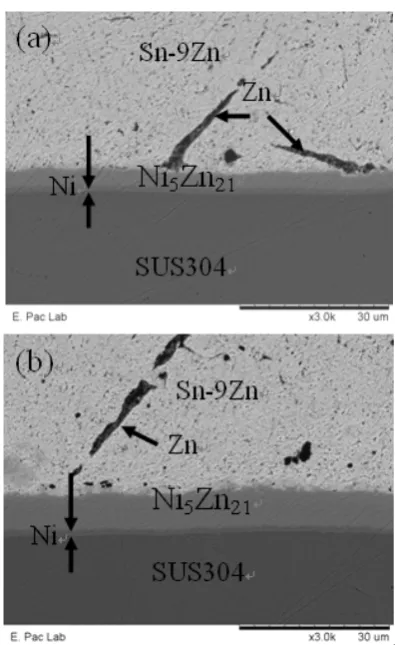
When the reaction temperature was increased to 255 and 270oC, the same results were found in the Sn-9Zn/Au/Ni/SUS304 couples for various durations. Figures 2 shows the surface morphology of the Sn-9Zn/Au/Ni/SUS304 couples reacted at 270oC for (a) 1 and (b) 5 hours. One IMC layer can be observed in Figs. 2 and this IMC layer was the Ni5Zn21 phase. These results indicate that an increase in the reaction time or temperature would not influence the IMC formation. Only the Ni5Zn21 phase was formed at the Sn-9Zn/Au/Ni/ SUS304 interface.
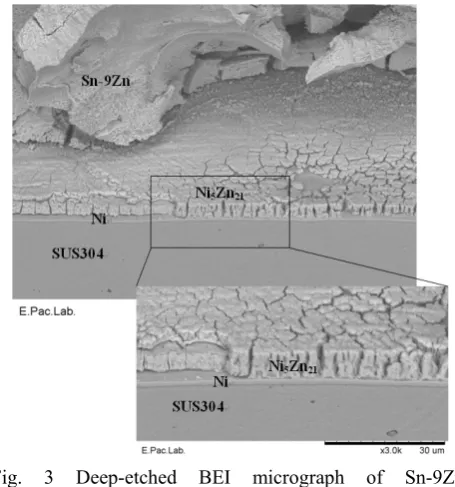
[image:2.595.329.527.391.714.2]For a clearer observation of the IMC microstructure, the SZ/Au/Ni/SUS304 couple was treated with etching solution, to remove the Sn-9Zn solder. Figure 3 shows the BEI deep-etched micrographs of the SZ/Au/Ni /SUS304 couple reacted at 270oC for 4 hours. In Fig. 3, one IMC layer, the Ni5Zn21 phase, is observed.
3.2 Interfacial reaction mechanism
The microstructure and composition of the interface were determined using an EPMA. Figure 4 shows the EPMA line-scan compositional profile between the Sn-9Zn alloy and Au/Ni/SUS304 multi-layer substrate. During the interfacial reaction process, the Au layer of the metallic pad was completely dissolved into the molten solder.
However, the Ni layer of the metallic pad was still observed, it had not yet been consumed thoroughly during this process. The Ni layer probably acted as a diffusion barrier to prevent Fe and Cr atoms from diffusing into the solder. Because the Zn atoms easily segregate and aggregate into the interface and the Gibbs formation energy of the Ni-Zn IMCs was lower than that of the Ni-Sn IMCs, the Ni5Zn21 phase, instead of the expected the Ni-Sn IMCs, was formed at the interface in all Sn-9Zn/Au/Ni/SUS304 couples. According to Figs. 1 and 2, the remaining Ni layer became thinner as the reaction time and temperature were increased.
3.3 Kinetics of the interfacial reaction
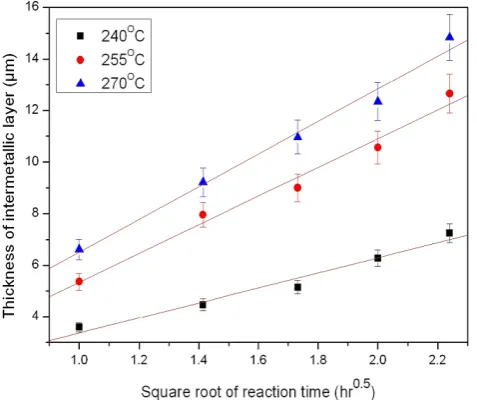
The thickness of the IMC layer increases when the reaction time and temperature increase. Figure 5 is the IMC thickness v.s. the square root of the various reaction times for the Sn-9Zn alloy reacted with Au/Ni/SUS304 multi-layer substrate at 240, 255, and 270°C. A linear relationship exists between the IMC thickness and the square root of the reaction time at a specific temperature. Their growth rates can be described using the parabolic law. This result indicates that the IMC growth mechanism is diffusion- controlled.
The linear relationship between the IMC thickness and the square root of the reaction time is described by x =kt1/2. From the Arrhenius equation, k =ko exp(-Q/RT), the
growth-rate constant (k) and the activation energy (Q) can be determined and are shown in Table 1. The IMC growth rate constants are 2.50×10⁻¹⁵, 8.58×10⁻¹⁵, and 11.1×10⁻¹⁵ m2/s at 240, 255, and 270oC, respectively. The activation energy of Sn-9Zn/ Au/Ni/SUS304 is 112.5 KJ /mol. Table 1 reveals that increasing the reaction temperature accelerates
the reaction rate between the Sn-9Zn alloy reacted with the Au/Ni/SUS304 multi-layer substrate.
[image:3.595.332.525.121.449.2]
Fig. 2 BEI micrographs of the Sn-9Zn/Au /Ni/SUS304 couple reacted at 270°C for (a) 1 and (b) 5 hours.
[image:3.595.313.541.493.737.2]Fig. 4 EPMA line-scan compositional profile of the Sn-9Zn/Au/Ni/SUS304 couple reacted at 270oC for 4 hours.
Fig. 5 IMC thickness vs. the square root of reaction time at 240, 255, and 270oC.
Table 1 Growth-rate constant (k)and the activation energy (Q) for the Sn-9Zn /Au/Ni/SUS304 couple reacted at various temperatures.
Reaction
temperature IMC
Groeth-Rate constant
(m2/s)
Activation energy (KJ/mole) 240 oC Ni
5Zn21 2.50×10⁻¹⁵
112.5 255 oC Ni
5Zn21 8.58×10⁻¹⁵ 270 oC Ni
5Zn21 11.1×10⁻¹⁵
IV. CONCLUSIONS
Interfacial reactions between Sn-9Zn lead-free solder and the Au/Ni/SUS304 multi-layer substrate were investigated in this study. Only the Ni5Zn21 phase was formed at the interface for all couples. The IMC thickness in all couples was increased, when the reaction time and temperatures were increased. The IMC growth-rate constants were increased as the reaction temperatures were increased. The IMC growth mechanism in the Sn-9Zn/Au /Ni/SUS304 system is diffusion-controlled. The activation energy for this couple is 112.5 KJ/mol.
ACKNOWLEDGEMENT
The authors acknowledge the financial support of the National Science Council of Taiwan, Republic of China (NSC 99-2628-E-011 -009-) and wish to thank Mr. Kao who works in NTU for carrying out EPMA analysis and Mr. Laiw who works in NTUST for carrying out FE-SEM analysis.
REFERENCE
[1] K. S. Kim, J. M. Yang, C. H. Yu, I. O. Jung, and H. H. Kim: Analysis on interfacial reactions between Sn-Zn solders and the Au/Ni electrolytic-plated Cu pad, Journal of Alloys and Compounds, 379 (2004)
314.
[2] J. M. Song, P. C. Liu, C. L. Shih, and K. L. Lin: Role of Ag in the formation of interfacial intermetallic phases in Sn-Zn soldering. Journal of Electronic Materials, 34 (2005) 1249.
[3] C. E. Ho, Y. W. Lin, S. C. Yang, C. R. Kao, and D. S. Jiang: The effect of limited Cu supply on the soldering reactions between SnAgCu and Ni, Journal of Electronic Materials, 35 (2006) 1017.
[4] W. H. Tao, C. Chen, C. E. Ho, W. T. Chen, and C. R. Kao: Selective interfacial reaction between Ni and Eutectic BiSn lead-free solder Chemistry of Materials,
13 (2001) 1151.
[5] C. M. Liu, C. E. Ho, W. T. Chen, and C. R. Kao: Reflow soldering and isothermal solid-state aging of Sn-Ag eutectic solder on Au/Ni surface finish, Journal of Electronic Materials, 30 (2001) 1152.
[6] C. E. Ho, L. C. Shiau, and C. R. Kao: Inhibiting the formation of (Au1-xNix)Sn4 and reducing the consumption of Ni metallization in solder joints, Journal of Electronic Materials, 31 (2002) 1264.
[image:4.595.48.288.697.785.2][8] Y. W. Yen and W. K. Liou: Interfacial reactions between Sn-9Zn lead-free solder and Ni substrate, Journal of Materials Research, 22 (2007) 2662.
[9] Y. W. Yen, C. Y. Lee, M. H. Kuo, K. S. Chao, K. D. Chen: Interfacial reactions between Lead-free solders and the multilayer Au/Ni/SUS304SS substrate, International Journal of Materials Research, 100
(2009) 672.
[10] W. K. Liou, Y. W. Yen, and K. D. Chen: Interfacial reactions between Sn-9Zn + Cu lead-free solders and the Au substrate, Journal of Alloys and Compounds,
479 (2009) 225.
[11] W. K. Liou, Y. W. Yen, and C. C. Jao: Interfacial Reactions of Sn-9Zn-xCu (x = 1, 4, 7, 10) Solders with Ni Substrates, Journal of Electronic Materials,
38 (2009) 2222.
[12] S. K. Lin, K. D. Chen, H. Chen, W. K. Liou, and Y. W. Yen: Abnormal spalling phenomena in the Sn-0.7Cu/Au/Ni/SUS304 interfacial reactions, Journal of Materials Research , 25 (2010) 2278.
[13] T. B. Massalski, Binary Alloy Phase Diagrams-CD-ROM, Materials Park, OH: ASM International (1996).