Improved Error Control Techniques for Data
Transmission
Steven Robert Marple
Submitted for the degree of
Doctor of Philosophy.
University of Lancaster.
Contents
Acknowledgements xii
Declaration xiii
Symbols and Abbreviations xv
Abstract xix
1 Introduction 1
2 Background 6
2.1 Block Codes . . . 7
2.1.1 Linear Block Codes . . . 7
2.1.2 Syndrome Vector . . . 11
2.1.3 The Singleton Bound . . . 12
2.1.4 Array Codes . . . 12
2.1.5 Generalised Array Codes . . . 16
2.1.6 Cyclic codes . . . 16
2.1.7 Bose-Chaudhuri-Hocquenghem Codes . . . 20
CONTENTS ii
2.1.8 Reed-Solomon Codes . . . 22
2.2 Convolutional Codes . . . 24
2.2.1 Overview . . . 24
2.2.2 General Properties . . . 24
2.3 Concatenated Codes . . . 25
2.3.1 Overview . . . 25
2.3.2 General Properties of Concatenated Codes . . . 27
2.4 Trellises . . . 27
2.4.1 Introduction . . . 27
2.4.2 Definitions . . . 28
2.4.3 Properties . . . 31
2.5 Channel Models . . . 32
2.5.1 Discrete Memoryless Channel . . . 32
2.5.2 Binary Symmetric Channel . . . 33
2.5.3 Binary Symmetric Erasure Channel . . . 34
2.5.4 Additive White Gaussian Noise Channel . . . 35
2.5.5 Quantised AWGN Channel . . . 36
3 Algebraic Decoding of Reed-Solomon Codes 37 3.1 Introduction . . . 38
3.2 The Key Equation . . . 40
3.2.1 Syndrome Calculation . . . 40
CONTENTS iii
3.2.3 Error-evaluator Polynomial . . . 42
3.2.4 Locating the Errors . . . 44
3.2.5 Calculation of the Error Values . . . 45
3.3 Euclidean Decoding . . . 47
3.3.1 Euclid’s Algorithm . . . 47
3.3.2 Extended Version of Euclid’s Algorithm . . . 48
3.3.3 Euclid’s Algorithm for Solving the Key Equation . . . 50
3.4 Berlekamp-Massey Decoding . . . 57
3.4.1 Introduction . . . 57
3.4.2 The Berlekamp-Massey decoding algorithm . . . 59
3.5 High-speed Step-by-step Decoding . . . 63
3.5.1 Introduction . . . 63
3.5.2 Calculating the Error Weight . . . 64
3.5.3 Calculating the Syndrome Values . . . 66
3.5.4 The Algorithm . . . 69
4 Trellis Decoding 73 4.1 Trellis Construction Methods . . . 74
4.1.1 Introduction . . . 74
4.1.2 Shannon Product of Trellises . . . 75
4.1.3 Syndrome Trellises . . . 77
4.1.4 Coset Trellises . . . 87
CONTENTS iv
4.2.1 Introduction . . . 91
4.2.2 Viterbi Decoding . . . 94
4.2.3 Two-stage Trellis Decoding . . . 100
4.2.4 Two-stage Decoding of Reed-Muller Codes . . . 101
4.2.5 Two-stage Decoding of Reed-Solomon Codes . . . 103
4.3 ‘Soft’ Galois Field Arithmetic . . . 112
4.4 Discussion . . . 114
5 Improved Decoding of Concatenated Codes 115 5.1 Concatenated Codes . . . 116
5.1.1 Introduction . . . 116
5.1.2 Calculation of the Log Likelihood Metrics . . . 118
5.2 Soft Output Viterbi Algorithm . . . 126
5.2.1 Introduction . . . 126
5.2.2 Differences Between the Standard and Soft-Output Viterbi Al-gorithms . . . 126
5.2.3 SOVA and Non-binary Trellises . . . 133
5.3 Reed-Solomon Product Codes . . . 134
5.3.1 Introduction . . . 134
5.3.2 Creation of Systematic Trellises Using GAC Construction . . 135
5.3.3 Cascade Decoding . . . 137
CONTENTS v
5.3.6 Alternative Decoding Strategies . . . 142
5.3.7 Alternating Row-Column Decoding Using SOVA . . . 143
5.3.8 Iterative Decoding of Product Codes . . . 146
6 Results and Computer Simulations 148 6.1 Decoding Complexity Measurements . . . 149
6.1.1 Implementation Overview . . . 149
6.1.2 Algebraic Decoding Complexity Measurements . . . 150
6.2 Trellis Decoding Complexity . . . 152
6.2.1 Introduction . . . 152
6.2.2 Complexity of the Viterbi Algorithm . . . 153
6.2.3 Complexity of SOVA . . . 157
6.3 A Comparison of Algebraic Decoders . . . 161
6.3.1 Error-correction Performance . . . 161
6.3.2 Decoding Complexity . . . 161
6.4 Two-Stage Decoding . . . 169
6.4.1 Decoder Performance . . . 169
6.4.2 Decoder Complexity . . . 171
6.5 SOVA Applied to the Meteosat II Satellite System . . . 182
6.5.1 Introduction . . . 182
6.5.2 Simulated System Details . . . 183
6.5.3 Simulation Results . . . 187
CONTENTS vi
6.6 RS Product Code Decoding . . . 194
6.6.1 The Transmission Channel . . . 194
6.6.2 Comparison of Cascade Decoding Algorithms . . . 195
6.6.3 Comparison of Alternating Row-Column Algorithms . . . 198
6.6.4 Results on Iterative Decoding of Product Codes . . . 200
7 Conclusions and Further Work 202 7.1 Original Contributions . . . 203
7.2 Decoding Complexity . . . 204
7.2.1 Shared Labels and Trellis Complexity . . . 205
7.3 High-speed Step-by-step Decoding . . . 206
7.4 Two-stage Decoding . . . 206
7.5 Comparison of Decoders for Concatenated Codes . . . 207
7.6 Iterative Decoding of Product Codes . . . 209
References 212
Citation Index 223
List of Figures
2.1 Array code. . . 13
2.2 Encoder for (2;1;3) convolutional code. . . 24
2.3 Concatenated coding example. . . 26
2.4 Trellis for RM(8;4;4) with definitions. . . 30
2.5 Binary symmetric channel model. . . 33
2.6 Binary symmetric erasure channel model. . . 35
4.1 Component Syndrome Trellises for RS(7;5;3). . . 83
4.2 Syndrome trellis for RS(7;5;3). . . 85
4.3 A trellis isomorphic to the RS(7;5;3) syndrome trellis. . . 86
4.4 Component Coset trellises for RS(7;3;5). . . 92
4.5 Coset trellis For RS(7;3;5). . . 93
4.6 A discrete symmetric channel model. . . 96
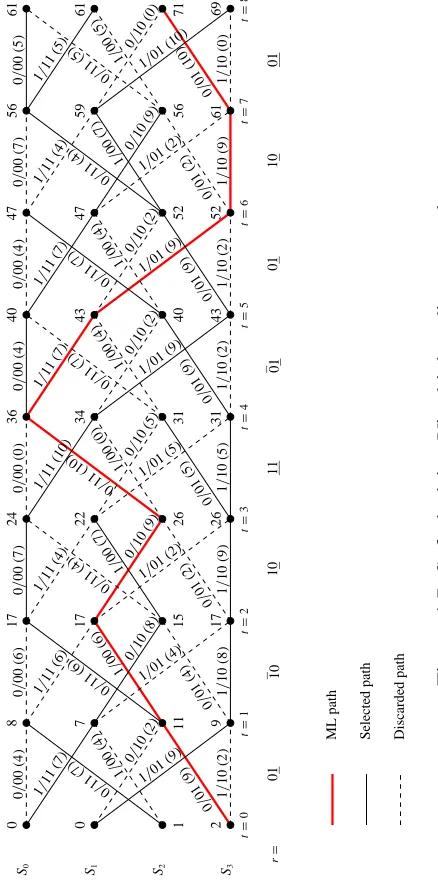
4.7 Soft-decision Viterbi decoding example. . . 97
4.8 Flowchart of the Viterbi decoding algorithm. . . 99
4.9 Trellis for RM(8;4;4). . . 104
5.1 Signalling values with PDFs for Eb=N0 = 3 dB superimposed. . . 121
LIST OF FIGURES viii
5.2 Scaled LL metrics for coherently-demodulated BPSK. . . 124
5.3 Variation of LL metrics for a BPSK channel . . . 125
5.4 Example trellis with metric differences for traceback SOVA. . . 127
5.5 Flowchart of the soft output Viterbi decoding algorithm. . . 130
5.6 Soft-decision Viterbi decoding example with soft outputs. . . 132
5.7 Cascade decoding algorithm for product code. . . 138
5.8 Alternating row/column decoding example. . . 145
6.1 Calculating the state metric. . . 155
6.2 Algebraic decoding performance for RS(7;5;3). . . 162
6.3 Algebraic decoding complexity for RS(7;5;3). . . 170
6.4 Two-stage decoding of RS(7;3;5), with HD choice of subtrellis. . . . 175
6.5 Two-stage decoding of RS(7;3;5), with SD choice of subtrellis. . . . 176
6.6 Two-stage decoding of RS(7;5;3), with HD choice of subtrellis. . . . 177
6.7 Two-stage decoding of RS(7;5;3), with SD choice of subtrellis. . . . 178
6.8 Subset of RS(7;5;3) trellis for u2 =0;u3 =0. . . 179
6.9 Subset of RS(7;5;3) trellis for u2 =1;u3 =2. . . 180
6.10 Subsets of RS(7;5;3) trellis for u2 =f0;1g, u3 =f0;2g. . . 181
6.11 One section of the (2;1;7) convolutional code trellis. . . 186
LIST OF FIGURES ix
6.16 Comparison of alternating row-column decoding algorithms. . . 199
6.17 Iterative alternating row-column decoding. . . 201
List of Tables
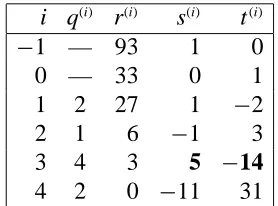
3.1 Solution to Example 3.1. . . 48
3.2 Solution to Example 3.2. . . 50
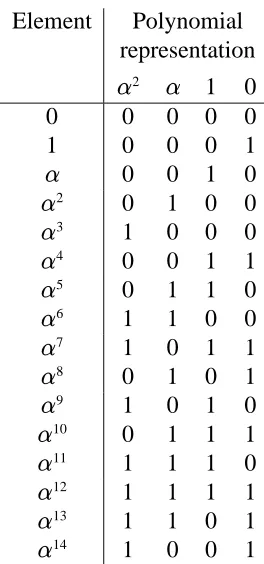
3.3 Galois field elements for GF(16). . . 53
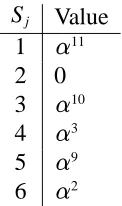
3.4 Syndrome values. . . 54
3.5 Solution of the Key Equation using Euclid’s algorithm. . . 56
3.6 Solution of the Key Equation using BM algorithm. . . 62
3.7 High-speed step-by-step decoding of RS(15;9;7). . . 72
4.1 Channel metrics for the Viterbi decoding example. . . 95
4.2 Symbol predictors for Two-stage decoding of RS(7;3;5). . . 110
4.3 Symbol predictor results. . . 112
4.4 Soft GF arithmetic for GF(4). . . 113
5.1 Transition probabilities and LL metrics for a BPSK channel. . . 123
5.2 Sample codewords of the non-systematic RS(7;5;3) trellis. . . 136
5.3 Sample codewords of the systematic RS(7;5;3) trellis. . . 136
6.1 Relative complexity of algebraic operations (for a DSP32C). . . 152
LIST OF TABLES xi
6.2 Comparison of VA and SOVA decoding complexity for RS(7;3;5). . . 160
6.3 Comparison of VA and SOVA decoding complexity for RS(7;5;3). . . 160
6.4 Complexity for decoding RS(7;3;5). . . 164
6.5 Complexity for decoding RS(7;5;3). . . 165
6.6 Complexity for decoding RS(63;55;9). . . 166
6.7 Complexity for decoding RS(255;223;33). . . 167
6.8 Complexity versus subtrellises decoded for TSD of RS(7;3;5). . . 173
6.9 Complexity versus subtrellises decoded for TSD of RS(7;5;3). . . 174
6.10 Specifications of simulated Meteosat II system. . . 183
6.11 Additional coding gain achieved through use of SOVA. . . 188
6.12 Complexity for VA decoding of the convolutional (2;1;7) code. . . . 193
6.13 Complexity for SOVA decoding of the convolutional (2;1;7) code. . . 193
6.14 Comparison of decoding complexity for the Meteosat II concatenated coding scheme. . . 193
6.15 Binary to GF(8) mapping for LL metrics. . . 194
Acknowledgements
I would like to take this opportunity to thank my supervisor, Professor B. Honary,
for his guidance, support and encouragement. Without this help I could not have
completed this work.
I would also like to thank my colleagues, both past and present, in the
Communi-cations Research Centre, Department of CommuniCommuni-cations, Lancaster University.
Finally, I would like to thank my parents and Judith for their support.
Declaration
This Thesis and the work described in it are my own, except where stated otherwise.
The work was carried out at the University of Lancaster between January 1994 and
December 1999. No part of this Thesis has been submitted for the award of a higher
degree, either at the University of Lancaster or elsewhere. Some parts of this Thesis
have appeared in publications, which are listed below and in the References.
B. Honary, G. Markarian, and S. Marple. Trellis decoding of block codes:
Practical approach. In ICCT ’96, volume 1, pages 525–527, Beijing,
China, May 1996.
Relevant Thesis sections: 4.1.2, 4.1.4, 4.2.5, 4.3, 6.1.2, 6.2, and 6.4.
B. Honary, G. Markarian, and S. R. Marple. Trellis decoding of the
Reed-Solomon codes: Practical approach. In 3rd International Symposium on
Communication Theory and Applications, pages 12–16, Ambleside, UK,
July 1995.
Relevant Thesis sections: 4.1.2, 4.1.4, 4.2.5, 4.3, and 6.4.
DECLARATION xiv
B. Honary, G. Markarian, and S. R. Marple. Two-stage trellis decoding of
RS codes based on the Shannon product. In Proceedings of the 1996
In-ternational Symposium on Information Theory and Its Applications, pages
282–285, Victoria, BC, Canada, September 1996.
Relevant Thesis sections: 4.1.2, 4.1.4, 4.2.5, 4.3, 6.1.2, 6.2 and 6.4.
B. Honary, G. Markarian, and S. R. Marple. Trellis decoding of the
Reed-Solomon codes: A practical approach. In B. Honary, M. Darnell,
and P. G. Farrell, editors, Communications Coding and Signal Processing,
Communications Systems Techniques and Applications Series, pages 133–
147. John Wiley & Sons, New York, London, Sydney, 1997. ISBN
0 86380 221 4.
Relevant Thesis sections: 4.1.2, 4.1.4, 4.2.5, 4.3, 6.1.2, 6.2, and 6.4.
B. Honary and S. R. Marple. Investigation of sequence segment keying
(SSK) and its application in CDMA systems. In ITEC 96, Leeds, UK,
April 1996.
Symbols and Abbreviations
ARC alternating row-column [decoding]
AWGN additive white Gaussian noise
B branch profile
BCH Bose-Chaudhuri-Hocquenghem
BCH(n;k;d) BCH code with given parameters
BCJR Bahl-Cocke-Jelinek-Raviv [trellis]
BER bit error rate
BM Berlekamp-Massey [decoding]
BPSK binary phase shift keying
BSC binary symmetric channel
C code
CCSDS Consultative Committee on Space Data Systems
CPU central processing unit
d minimum distance
DMC discrete memoryless channel
e error vector
SYMBOLS AND ABBREVIATIONS xvi
e error symbol
e(x) error polynomial
Eb bit energy
ESA European Space Agency
FSK frequency shift keying
FSR feedback shift-register
G generator matrix
g(x) generator polynomial
GAC generalised array code
GF Galois field
H parity-check matrix
HD hard decision
HDMLD hard decision maximum-likelihood decoding
HSSBS high-speed step-by-step [decoding]
K constraint length of a convolutional code
k number of information symbols in block code
L label profile
LL log likelihood
MAP maximum a posteriori
MDS maximum distance separable
ML maximum-likelihood
N state profile
SYMBOLS AND ABBREVIATIONS xvii
N0 noise spectral density
NASA National Aeronautics and Space Administration
Pb probability of bit error
PDF probability density function
PM probability of block error
Ps probability of symbol error
q alphabet size used by a code
QPSK quaternary phase-shift keying
r received codeword vector
r received codeword symbol
r degree of generator polynomial
r(x) received codeword polynomial
RM Reed-Muller
RM(n;k;d) Reed-Muller code with given parameters
RS Reed-Solomon
RS(n;k;d) Reed-Solomon code with given parameters
S syndrome vector
S(x) syndrome polynomial
SD soft decision
SDMLD soft decision maximum-likelihood decoding
SNR signal to noise ratio
SOVA soft-output Viterbi algorithm
SYMBOLS AND ABBREVIATIONS xviii
t maximum number of correctable errors
TSD two-stage decoding
u dataword vector
u dataword symbol
u(x) dataword polynomial
v codeword vector
v codeword symbol
v(x) codeword polynomial
VA Viterbi algorithm
primitive element of Galois field
discrepancy
complexity
(x) error-locator polynomial
(x) correction polynomial for(x)
number of correctable errors
(x) error-evaluator polynomial
Abstract
Error control coding is frequently used to minimise the errors which occur naturally in
the transmission and storage of digital data. Many methods for decoding such codes
already exist. The choice falls mainly into two areas: hard-decision algebraic
decod-ing, a computationally-efficient method, and soft-decision combinatorial decoddecod-ing,
which although more complex offers better error-correction.
The work presented in this Thesis is intended to provide practical decoding
algo-rithms which can be implemented in real systems.
Soft-decision maximum-likelihood decoding of Reed-Solomon codes can be
ob-tained by using the Viterbi algorithm over a suitable trellis. Two-stage decoding of
Reed-Solomon codes is presented. It is an algorithm by which near-optimum
perfor-mance may be achieved with a complexity lower than the Viterbi algorithm.
The soft-output Viterbi algorithm (SOVA) has been investigated as a means of
providing soft-decision information for subsequent decoders. Considerations of how
to apply SOVA to multi-level codes are given. The use of SOVA in a satellite downlink
channel is discussed. The results of a computer simulation, which showed a 1:8 dB
improvement in coding gain for only a 20% increase in decoding complexity, are
ABSTRACT xx
presented.
SOVA was also used to improve the decoding performance when applied to an RS
product code. Several different decoding methods were evaluated, including cascade
decoding, and a method where the row and columns were decoded alternately.
A complexity measurement was developed which allows accurate comparisons of
decoding complexity for trellis-based and algebraic decoders. With this technique the
decoding complexity of all the algorithms implemented are compared. Also included
Chapter 1
Introduction
Chapter 1
Introduction
The twentieth century has seen an explosion in the use and availability of
commu-nication systems. They are now placed in and on many devices which were not even
invented one hundred years ago. Such widespread use has placed high demands on
engineers. Mobile telephones are expected to operate for long periods and with clear
reception. Digital television and weather images from space are expected to be clear of
speckles. Music from compact discs must be free of clicks and pops which frequently
troubled the vinyl records which they are now quickly replacing. As the storage size of
computer memories and disks increase the access times plummet. As these
technolo-gies are reliant upon computer hardware, which is still following Moore’s ‘law’,1 the
rapid increase in technology looks set to continue. The uniting factor in all of these
diverse applications is that they use error control coding to protect valuable digital
data and enhance the service they provide.
1Moore, founder of Intel, suggested that the number of transistors on integrated circuits for
comput-ers doubles approximately every 18–24 months [Moore, 1965].
CHAPTER 1. INTRODUCTION 3
In its early days error control coding could only be afforded by the ‘super-rich’—
the military and organisations such as NASA. Even so, the codes used then (often
Reed-Muller codes) are considered by today’s standards as weak and simple to decode.
Today, error control coding is widespread and cheap. Probably most popular are the
Reed-Solomon codes. They are, however, a two-edged sword; providing greater error
protection but are also many orders of magnitude more difficult to decode. Although
efficient hard-decision RS decoders exist the holy grail is an efficient soft-decision
algorithm, which will provide optimum performance with simplicity.
The twenty-first century will surely see an increase in the use of error control
coding as current technologies are miniaturised further, and new ones invented. Thus
the demand for fast and efficient decoding algorithms will only increase. This Thesis
presents new work which is aimed at both improving upon hard-decision decoding
performance while reducing complexity from the soft-decision case.
Chapter two introduces the background topics used in this work. Included are
the theory and important properties of linear and cyclic block codes. Attributes of
convolutional codes are discussed. The concept of concatenated codes and important
definitions regarding trellis diagrams and trellis decoding are introduced. The channel
models used in the computer simulations are also described.
Algebraic decoding of RS codes is examined in Chapter three. The
Berlekamp-Massey, Euclidean and high-speed step-by-step algorithms are explained, both
math-ematically and with the aid of examples. Chapter four details trellis construction
tech-niques, for both syndrome (BCJR/Wolf) and coset trellises. The Viterbi algorithm is
low-CHAPTER 1. INTRODUCTION 4
complexity, near-optimum decoding algorithm, two-stage decoding, is presented and
a worked example given.
In Chapter five concatenated decoding is used as a means of combining good
er-ror control performance with low complexity. The soft-output Viterbi algorithm is
demonstrated as a method by which the outer decoder is able to perform better by
taking advantage of soft-decision information. The Viterbi decoding example shown
in Chapter four is extended to give a clear demonstration of how SOVA operates. The
application of SOVA over non-binary trellises is discussed. Product codes may be
thought of as a form of concatenated coding. Various algorithms for decoding product
codes are described, and the application of SOVA to each is considered.
Chapter six presents results on both decoding complexity and performance. As
this Thesis includes both algebraic and combinatorial (trellis) decoders a unified
prac-tical method, by which all the decoders implemented may be compared, was sought.
How this was achieved is explained. Results of all the simulated systems are given,
including a weather satellite image distribution system. Trellis decoding complexity
for the Viterbi algorithm was analysed in a mathematical manner, applicable to all
linear codes (and also separable non-linear codes). Also, the analysis is expanded
for the soft-output Viterbi algorithm. Following this, decoding complexity for all the
simulated codes is given, using the same set of benchmarks. Decoding performance
is not forgotten, and Chapter six also includes decoding performance curves for all
the decoding algorithms demonstrated. Where possible the same channel model was
used.
decod-CHAPTER 1. INTRODUCTION 5
ing complexity allows comparisons to be made regarding the complexity of the various
systems. Where appropriate, comparisons of the decoding performance are also made.
The improved performance of the weather satellite image distribution system is
dis-cussed, and commercial benefits of increased coding gain are highlighted. Finally, the
References, and for the benefit of the reader, a citation index and general index are
Chapter 2
Background
Chapter 2
Background
2.1
Block Codes
2.1.1
Linear Block Codes
In a block code the message symbols are sectioned into blocks of fixed length, k,
before being passed to the encoder. The input block or dataword contains k data
symbols over an alphabet of size q. The encoder output is a codeword containing n
code symbols, also over an alphabet of size q. For the case q=2 the code is described
as binary. Block codes may be divided into two categories, linear block codes and
non-linear block codes. Only linear block codes are considered.
For a useful code the datawords u must form a one-to-one mapping with the set
of qkpossible input sequences. For an (n
;k) linear codeC the codewords v must form
a k-dimensional subspace of the n-dimensional codespace over the field GF(q) [Lin
and Costello, 1983, p. 52], i.e., the dimension of the code is k. Since the codewords
2.1. BLOCK CODES 8
are restricted to a k-dimensional subspace of the codespace the linear sum of any two
codewords is also restricted to the k-dimensional subspace and must therefore also be
a codeword.
The Generator Matrix
For a codeC there exists k linearly independent codewords g
0; g
1; ::: ; g
k 1 so that
every codeword v inC is a linear combination of these codewords, i.e.,
v=u0g
0+u1g
1+:::+uk 1g
k 1 (2.1)
where (u0; u1; :::; uk 1) are symbols in the input sequence u represented by elements
in GF(q). The k linearly independent codewords can be arranged as rows in a kn
matrix: G= 2 6 6 6 6 6 6 6 6 6 4 g0 g1 .. .
gk 1
3 7 7 7 7 7 7 7 7 7 5 = 2 6 6 6 6 6 6 6 6 6 4
g0;0 g0;1
::: g0 ;n 1
g1;0 g1;1
::: g1 ;n 1
..
. ... . .. ...
gk 1;0 gk 1;1
::: gk 1 ;n 1
2.1. BLOCK CODES 9
where gi=(gi ;0
; gi ;1
; ::: ; gi
;n 1) and k
=0; 1; ::: ; k. A dataword u can be mapped
to its corresponding codeword v by [Lin and Costello, 1983, p. 53]
v=uG
=(uo; u1; :::; uk 1) 2
6 6 6 6 6 6 6 6 6 4
g0
g1
.. .
gk 1
3
7 7 7 7 7 7 7 7 7 5
(2.3)
=u0g
0+u1g
1+:::+uk 1g
k 1
From (2.3) it can be seen that the matrix G generates codewords ofC given a
data-word, and is known as the generator matrix. If the encoding procedure of a linear
block code preserves the input sequence u within the output sequence of v the code
is systematic. Systematic codes enable simplifications to the decoding algorithm, and
are especially important for array codes. This useful property can be identified in the
generator matrix, if k consecutive columns of G form the kk identity matrix the
2.1. BLOCK CODES 10
can always be arranged to reduced-echelon form
G= 2
6 6 6 6 6 6 6 6 6 6 6 6 6 4
1 0 0 ::: 0
0 1 0 ::: 0
0 0 1 0
..
. ... . ..
0 0 0 1
P
3
7 7 7 7 7 7 7 7 7 7 7 7 7 5
(2.4)
where P represents the parity checks. An important point to note is that every valid
codeword is a multiple of the generator matrix. The importance of this will become
apparent when the decoding of a received codeword which contains errors is
consid-ered.
The Parity-check Matrix
It is useful to be able to express the code in a manner which highlights the parity
checks. For a kn generator matrix G there is an (n k)n parity-check matrix, H.
The relationship of the parity-check matrix to the generator matrix, G, is given by
GHT
=0 (2.5)
where HT is the transpose of H and 0 is an all-zeros matrix. For any codeword, v in
the code the parity checks sum to zero and thus
vHT
2.1. BLOCK CODES 11
2.1.2
Syndrome Vector
Consider the case of the parity checks when the received codeword, r, is in error. The
parity check values, or syndromes, are non-zero. The syndrome vector, S, is defined
by
S=rH
T
where S=[S1; S2; ::: ; S2t℄
(2.7)
For the case when the received codeword is correct (i.e., rv) Equation 2.7 reduces
to Equation 2.6. However, when the received codeword is in error r is given by r =
v+e, where e is the error vector. Substituting into Equation 2.7 gives
S=rH
T
=(v+e)H
T
=vH
T
+eH
T
=eH
T
(2.8)
since vHT
= 0 (Equation 2.6). From Equation (2.8) it is clear that the syndrome is
dependent only upon the error pattern, e, and not the transmitted codeword, v.
There is a one-to-one mapping from correctable error patterns to the syndromes.
For simple codes error correction can be achieved by a table lookup of the syndromes
and a GF(q) subtraction of the corresponding error value. This method is not practical
for useful codes as the table size is too large to store (e.g., for RS(255;223;33) the
table would contain 25632 1
=1:1610
2.1. BLOCK CODES 12
2.1.3
The Singleton Bound
The Singleton bound [Singleton, 1964] provides an upper limit on the minimum
dis-tance, dmin, between codewords in a linear block code. It thus provides an important
goal good codes should attain. Codes which satisfy the Singleton bound with equality
are termed maximum distance separable. The bound is given by
dmin n k+1 (2.9)
2.1.4
Array Codes
Array codes were introduced by Elias [Elias, 1954]. They are constructed from
lin-ear component codes in two or more dimensions. The simplest array code is a
two-dimensional code with an (n1;k1;d1) vertical code, C1, and an (n2;k2;d2) horizontal
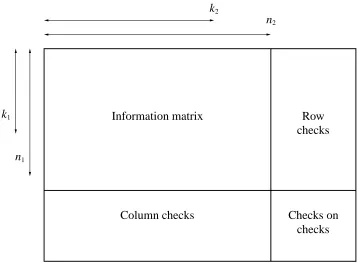
code, C2. The resulting code, C, is an (n1n2;k1k2;d1d2) code (Figure 2.1). The term
product code is sometimes applied to array codes; the two terms are interchangeable.
General Properties of Array Codes
Theorem 2.1 The minimum weight for the product of two codes is the product of the
minimum weights of the codes.
Proof 2.1 [Elias, 1954]. The minimum weights of the component codes,C1andC2are
2.1. BLOCK CODES 13
k1
k2
n1
n2
Information matrix Row
checks
checks
[image:35.595.130.489.129.392.2]Column checks Checks on
Figure 2.1: Array code.
elements, and each row containing a non-zero element must have at least d2non-zero
elements. Therefore if the product code C contains any non-zero elements it must
contain at least d1 non-zero rows and d2non-zero columns. The minimum number of
non-zero elements is therefore d1d2 and thus the minimum weight ofC is d1d2.
Encoding and decoding are greatly simplified when the component codes are
sys-tematic. For a two-dimensional product code with systematic component codes the
generator matrix can be shown to be the Kronecker product (denoted by ) of the
generator matrices [Slepian, 1960]. For the case when the component codes are single
parity-check codes (i.e., k1 = n1 1, k2 = n2 1) the generator matrix reduces to
2.1. BLOCK CODES 14
dimensions are possible. As both row and column codes are linear it is not important
whether the row or column encoding is performed first, the checks-on-checks will be
identical in either case [Peterson and Weldon, 1972, p. 132]. Similarly, the decoding
order is not important.
If serial transmission of the codeword symbols is assumed (which is the normal
case) the two-dimensional codeword, v
v= 2 6 6 6 6 6 6 6 6 6 4
v0;0 v0;1
::: v0 ;n2 1
v1;0 v1;1
::: v1 ;n2 1
..
. ... . .. ...
vn1 1;0 vn1 1;1
::: vn
1 1;n2 1 3 7 7 7 7 7 7 7 7 7 5 (2.10)
must be converted to a one-dimensional vector before transmission over the channel.
The mapping of vi;j where 0
i < n1 and 0 j < k2 to vl where 0 l < n1n2 1
may be accomplished by a number of methods. The canonical ordering is achieved
by choosing i and j as the quotient and remainder when l is divided by n2[Berlekamp,
1968, p. 338]. Canonical ordering gives the array
v= 2 6 6 6 6 6 6 6 6 6 4
v0 v1 ::: vn
2 1
vn2 vn2+1
::: v2n
2 1
..
. ... . .. ...
v(n1 1)n2 v(n1 1)n2+1
::: vn 1 3 7 7 7 7 7 7 7 7 7 5 (2.11)
For the case when n1 and n2 are relatively prime there is (by the Chinese remainder
2.1. BLOCK CODES 15
l i mod n2 and l j mod n1 [Burton and Weldon, 1965]. This mapping of i and j
to l is known as cyclic ordering. The reasoning behind the name is clearly seen from
the example below where n1 =3 and n2 =5
v= 2
6 6 6 6 6 4
v0 v6 v12 v3 v9
v10 v1 v7 v13 v4
v5 v11 v2 v8 v14
3
7 7 7 7 7 5
(2.12)
If C1 andC2 are cyclic codes and n1 and n2 are relatively prime then the product
C =C1C2 is also cyclic, however not all cyclic codes are array codes [MacWilliams
and Sloane, 1978, p. 570].
Decoding Array Codes
Many decoding algorithms for array codes exist, both algebraic and trellis-oriented.
The simplest method for decoding a canonically-ordered array code is to cascade
de-code the component de-codes one at a time, decoding the row de-code,C2, and then the
col-umn codeC1. Particularly for memoryless channels, the cascade decoding algorithm
is inefficient. There exist error patterns for which the code is capable of correcting but
the algorithm fails to correct. If the minimum distances, d1 and d2, of the component
codes are odd then there are error patterns of weight (d1 +1)(d2 +1)=4 which are
incorrectly decoded, although the code is capable of correcting errors up to weight
2.1. BLOCK CODES 16
2.1.5
Generalised Array Codes
As the name suggests GACs are a generalisation of the array codes introduced by
Elias. Unlike standard array codes GACs may have different component codes along
a given dimension, with the restriction of the code length being invariant. The total
number of code symbols is given by n = n1n2, where n1 and n2 are the number of
rows and columns, respectively. The total number of information symbols is given by
k= P
n1
i=1
kp, where kp is the number of information symbols in p-th row [Honary and
Markarian, 1997, p. 11].
The technique provides a simple design procedure for constructing many
differ-ent block codes, BCH, Hamming, Golay, RM etc. [Honary and Markarian, 1993a,b;
Honary et al., 1995a]. It is important as it allows minimal trellises to be designed in a
straightforward manner.
2.1.6
Cyclic codes
Cyclic codes are an important subclass of linear block codes, not only because many
prominent codes are cyclic e.g., BCH, RS, but also because they are used in the
con-struction of other error-correcting codes e.g., Kerdock and Preparata codes. The
inher-ent algebraic structure of cyclic codes allows the formation of many practical
decod-ing methods; Euclidean (Section 3.3), Berlekamp-Massey (Section 3.4), step-by-step
2.1. BLOCK CODES 17
General Properties of Cyclic Codes
A code C is cyclic if it is linear and every cyclic shift of every codeword v is also a
codeword. i.e., if (v0; v1; :::; vn 1) is a codeword in C then (vn 1; v0; :::; vn 2)
is also a codeword in C [MacWilliams and Sloane, 1978, p. 188]. Cyclic codes are
commonly defined in terms of polynomials, where the coefficients of the polynomial
are the symbols in v. The notation v(x) will be used to denote a code polynomial. The
relationship between a codeword v and the polynomial is
v=(v0; v1; :::; vn 1) (2.13)
v(x)=v0+v1x+v2x
2
+:::+vn 1x
n 1
(2.14)
It can be seen that the maximum degree of v(x) is n 1. Algebraically, v(x) is defined
to be a polynomial modulo Xn 1. This leads to the important identity
xn
1 (2.15)
From (2.15) it can be shown that a multiplication of v(x) by x is a cyclic shift
x:v(x)=
=
v0x+v1x
2
+v2x
3
+::: +vn 2x
n 1
+vn 1x
n
vn 1+v0x+v1x
2
+v2x
3
+::: +vn 2x
n 1
(2.16)
It can be shown [Wicker, 1994, p. 101; Wilson, 1996, pp. 443–444] that there
2.1. BLOCK CODES 18
a product of the generator polynomial
v(x)=u(x) g(x) (2.17)
where u(x) is a polynomial of degree k 1 or less and is known as the message
polynomial. Equation (2.17) indicates a method by which a message polynomial, u(x),
can be encoded to its corresponding codeword polynomial. An alternative approach
is based on matrices. It is shown in equation (2.2) that a generator matrix can be
constructed from k linearly independent codewords. Since the generator polynomial
is itself a codeword polynomial (corresponding to the case u(x)=1) the k codewords
can be arranged as k cyclic shifts of g(x).
G= 2 6 6 6 6 6 6 6 6 6 6 6 6 4 g(x) xg(x) x2g(x)
.. .
xk 1
g(x) 3 7 7 7 7 7 7 7 7 7 7 7 7 5 = 2 6 6 6 6 6 6 6 6 6 6 6 6 4
g0 g1 ::: gr 0 ::: 0 0
0 g0 g1 ::: gr 0 ::: 0
. .. ... . ..
0 ::: 0 g0 g1 ::: gr 0
0 0 ::: 0 g0 g1 ::: gr
3 7 7 7 7 7 7 7 7 7 7 7 7 5 (2.18)
The encoding procedure given in (2.17) does not produce a systematic codeword.
Normally, systematic codewords are preferred as they simplify the decoding
proce-dure. The normal method by which systematic codewords are generated is [Michelson
and Levesque, 1985, p. 133]
v(x)=
xn k
u(x) mod g(x)
+x
n k
2.1. BLOCK CODES 19
It can be seen that this does result in a valid codeword, the remainder when v(x) is
divided by g(x) is zero, and the maximum degree of v(x) is n 1.
Syndrome Polynomial
For cyclic codes (e.g., BCH and RS) the calculation of the syndromes can be
per-formed more efficiently by using the cyclic properties of the code. Though the
syn-drome vector can be calculated by S = rH
T (2.7) this calculation can also be
per-formed as
S(x)=
r(x) g(x)
=r(x) mod g(x)
(2.20)
where S(x)=S1+S2x+S3x
2
+:::+S2tx
2t 1
(2.21)
where S(x) is the syndrome polynomial. Thus the syndrome polynomial may be
de-fined as the remainder when an erroneous codeword is divided by the generator
poly-nomial, g(x). The proof is given in [Peterson and Weldon, 1972, p. 231]. For the
case of the received codeword being equal to the transmitted codeword, v(x), the
syn-drome polynomial is zero since valid codewords are exactly divisible by the generator
polynomial (2.17).
It can be shown that the syndrome polynomial is dependent upon the error
2.1. BLOCK CODES 20
into (2.20)
S(x)=r(x) mod g(x)
=[v(x)+e(x)℄mod g(x)
=v(x) mod g(x)+e(x) mod g(x)
=e(x) mod g(x)
(2.22)
since v(x) mod g(x)=0 (from (2.17)).
2.1.7
Bose-Chaudhuri-Hocquenghem Codes
Bose-Chaudhuri-Hocquenghem codes were discovered independently by
Hocqueng-hem [HocquengHocqueng-hem, 1959] in 1959 and Bose and Chaudhuri [Bose and
Ray-Chaudhuri, 1960a,b] in 1960. BCH codes are a generalisation of the cyclic Hamming
codes for correcting multiple errors. Peterson [Peterson, 1960] proved that BCH codes
are cyclic. Gorenstein and Zierler [Gorenstein and Zierler, 1961] generalised the BCH
codes for non-binary alphabets of size pm. Their wide choice of block lengths, code
rates and symbol alphabets, coupled with efficient decoding algorithms, has made
BCH codes a popular choice for many communication systems.
General Properties of BCH Codes
When constructing an arbitrary cyclic code there is no guarantee of the minimum
distance of the code produced [Wicker, 1994, p. 176]. It is necessary to conduct a
2.1. BLOCK CODES 21
and thus the minimum distance of the code. For BCH codes this procedure is not
required, the BCH bound places lower limit on the minimum distance of the code. An
understanding of these codes requires a knowledge of finite field arithmetic [McEliece,
1987].
Theorem 2.2 The BCH Bound [Wicker, 1994]
Let C be a q-ary (n;k) cyclic code with generator polynomial g(x). Let m be the
multiplicative order of q mod n. (GF(qm) is thus the smallest extension field of GF(q)
which contains a primitive n-th root of unity.) Let be a primitive n-th root of unity.
Select g(x) to be a minimal-degree polynomial in GF(q)[x℄, where GF(q)[x℄
de-notes the collection of all polynomials a0+a1x+a2x
2
++x
n of arbitrary degree
with coefficientsfaigin the finite field GF(q) [Wicker, 1994, p. 40], such that
g(
b
)=g(
b+1
)=g(
b+2
)==g(
b+Æ 2
)=0 (2.23)
for some integers b 0 and Æ 1. The roots of the generator polynomial g(x) are
Æ 1 consecutive powers of . The codeC defined by g(x) has minimum distance
d Æ.
Proof of Theorem 2.2 can be found in [MacWilliams and Sloane, 1978; Peterson and
Weldon, 1972; Wicker, 1994]. The BCH bound can be used to produce a BCH code
with a given design distance. However, since the weight distributions of most BCH
codes are not known the actual minimum distance may be greater than the design
2.1. BLOCK CODES 22
Generator Polynomial
The generator polynomial for a BCH code has 2t roots, which are consecutive powers
of (from Theorem 2.2). Therefore
g(x)=
2t 1
Y
i=0
(x
b+i
) (2.24)
For the case when b=1 the code is termed narrow sense [MacWilliams and Sloane,
1978, p. 203].
2.1.8
Reed-Solomon Codes
Reed-Solomon codes were discovered by Reed and Solomon in 1960 and are a
spe-cial subclass of non-binary BCH codes [Reed and Solomon, 1960]. RS codes exhibit
additional properties to BCH codes which make them very much more powerful than
BCH codes. Their powerful error-correcting abilities have made them possibly the
most important codes. RS codes are multi-level, therefore log2q binary bits are
com-monly mapped to one RS symbol. This process provides some burst-error correction.
They have many and widespread applications which include the compact disc, satellite
communications and digital video broadcasting.
General Properties of RS Codes
Reed-Solomon codes are cyclic and so profit from the many useful characteristics
cyclic codes offer. They are normally generated in systematic form using (2.19).
2.1. BLOCK CODES 23
Proof 2.2 LetC be an (n;k) RS code. The Singleton bound (Section 2.1.3) gives an
upper bound of d n k+1 to all (n;k) codes. The BCH bound provides a lower
bound. The generator polynomial g(x) is of degree n k, so it contains n k =
Æ 1 consecutive powers of a primitive n-th root of unity. Therefore d n k+1.
Combining these two results gives
d =n k+1 (2.25)
Theorem 2.3 and its proof are important for two reasons. Firstly it shows that RS
codes can be designed such that their designed minimum distance is always the actual
minimum distance (unlike BCH codes). Secondly, RS codes satisfy the Singleton
bound with equality, so they are maximum distance separable.
Theorem 2.4 RS codes are invertible.
A code is said to be invertible if any k symbols can be used as information symbols
in a systematic representation. This follows from the MDS property, proof is given
2.2. CONVOLUTIONAL CODES 24
2.2
Convolutional Codes
2.2.1
Overview
The name convolutional code was coined by Elias [Elias, 1955] to describe a code
which is the output sequence of a linear mapping of an input sequence with a
discrete-time, finite-alphabet convolution of the input and encoder’s impulse response [Wilson,
1996, p. 551]. Such codes are sometimes termed trellis codes, but this name is
mis-leading because block codes may also be represented by trellises. The concept of
encoding an input sequence without segmenting it is very different to that used by
block codes (Section 2.1).
Input bit
First code symbol
Output branch word
Second code symbol
Figure 2.2: Encoder for (2;1;3) convolutional code.
2.2.2
General Properties
A convolutional code over GF(q) is usually described by the parameters (n;k;K),
where k is the number of q-ary symbols (simultaneously) input to the decoder and n
2.3. CONCATENATED CODES 25
block code, the rate is given by n=k. The constraint length of the code, K, is defined as
the number of consecutive symbols in the output stream affected by any input symbol.
It is also the memory of the code.
2.3
Concatenated Codes
2.3.1
Overview
Concatenated coding was introduced in 1966 by Forney [Forney, 1966]. It is a
pow-erful technique for creating error-correcting codes by combining two (or more) codes
sequentially. The primary reason for using concatenated codes is to achieve a low
error rate with an overall implementation complexity which is less than that which
would be required by a single decoding operation [Sklar, 1988, p. 365]. Figure 2.3
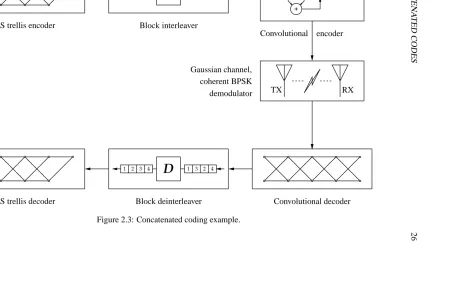
shows a concatenated coding scheme. The data stream is first encoded with the outer
code (in this case an RS block code). The output of the outer code is then re-encoded
with the inner code, (here a convolutional code) before transmission. At the receiver
the decoding order must be reversed, and so the inner code is decoded first. Any errors
from the output of the inner decoder are likely to appear as bursts, hence it is usual
to include an interleaver and de-interleaver between the inner and outer codes. The
purpose of the interleaver is to rearrange the symbols so that errors do not occur in
bursts but are spread through several outer codewords to allow correct decoding.
Convolutional codes are a natural choice for the inner code. With a suitable
Vit-erbi decoder SD information can be used for maximum performance. RS codes are
2
.3
.
C
O
N
C
A
T
E
N
A
T
E
D
C
O
D
E
S
2
6
1 2 3 4
I
1 3 2 41 2 3 4
D
1 3 2 4RS trellis encoder Block interleaver
Convolutional encoder
Gaussian channel, coherent BPSK demodulator
RS trellis decoder Block deinterleaver Convolutional decoder
[image:48.595.126.717.123.461.2]TX RX
2.4. TRELLISES 27
binary convolutional code the burst-error performance of the RS code helps minimise
errors. There are, however, many possible configurations for a concatenated coding
scheme and flexibility is one of its many advantages. For example the compact disc
coding system uses a concatenated system based upon RS(32;28;5) and RS(28;24;5)
shortened RS codes.
2.3.2
General Properties of Concatenated Codes
The rate of a concatenated code is the product of the rates of its component codes.
Consider a concatenated codeC with an (n1;k1;d1) inner code C1 and an (n2;k2;d2)
outer codeC2. An input sequence of k1k2symbols is passed to the outer encoder. The
output is k1n2 symbols. This new block is sent to the inner decoder which results in
n1n2output symbols. The rate is thus
k1k2
n1n2.
The minimum distance of a concatenated code is d1d2 [Lin and Costello, 1983,
p. 279].
The proof is the same as for an array code, see Proof 2.1.
2.4
Trellises
2.4.1
Introduction
A trellis diagram (commonly called a trellis) is an acyclic edge-labelled directed
graph [Muder, 1988], with one start point (the root) and one end point (the goal).
2.4. TRELLISES 28
be viewed as a two-dimensional representation of the qk codewords through the
n-dimensional codespace. To enable an accurate description of the properties of a trellis
it is first necessary to introduce some common definitions.
2.4.2
Definitions
Nodes of the graph represent possible encoder states, Si;t, where i is the state number
and t is the time index. The nodes are decomposed into a union of disjoint subsets,
called vertices or levels. The levels are numerated 0; 1; ::: ; Nc(Nc n+1) and the
t-th level consists of Nt nodes, (S1;t) ; (S2
;t)
; ::: ; (SN
t;t).
Between states in adjacent levels, Si;t and Sj;t+1, there may be directed branches
(also called edges), B(Si;t !Sj
;t+1), which indicate possible changes in state. Branches
are only permitted to connect adjacent levels. The set of branches between level t 1
and t is called the t-th depth. In some texts the set of branches at a given depth is
termed a stage [Wicker, 1994, p. 292]. To prevent confusion (e.g., with “two-stage
decoding”) such terminology is avoided in this work. Associated with every branch is
a label denoting the output (or code) symbol(s) given when that branch is taken, and
a branch metric, Bm, which indicates the likelihood of a given branch being selected.
For certain trellises an additional input (or data) label may exist. Its purpose is to allow
the same trellis structure to be used for both encoding and decoding operations. The
code label is a lt-dimensional vector of q-ary symbols, (l1; l2; :::; lt). The code label
associated with the branch B(Si;t !Sj
;t+1) is denoted by L(Si;t ;Sj
;t+1).
Using the notation introduced above the root can be more precisely defined as S1;0,
2.4. TRELLISES 29
by P(Si ;t
! Sj ;t+1
! Sk ;t+2
! ::: ! Sz
;t+Æ). The term partial path is sometimes
used to denote a sequence of branches for which decoding is incomplete, thus the
sequence starts from the root but does not reach the goal. For certain codes (generally
convolutional codes) it is necessary to truncate the trellis to lessen decoding delay.
Frequently these trellises are shown with multiple roots and goals (see Figure 4.7
for an example). Though this does not strictly match the definition of a trellis, the
truncated section is often considered to be a trellis in its own right.
A trellis is called a code trellis of the code C if there is a one-to-one mapping
between the codewords of the code C and all paths between S1
;0 and S1;Nc (i.e., all P(S1
;0
!:::!S1 ;Nc)).
LetN(t ) =[N0; N1; :::; NN
c℄be the state profile of the trellis T andB(t ) =[B1;
B2; ::: ; BN
c℄be the branch profile, whereNi is the number of states at the i-th level
andBj is the number of branches at the j-th depth [Forney and Trott, 1993; Honary
and Markarian, 1997, p. 161]. LetL(t ) = [L1; L2; :::; LN
c℄be the label size profile
of the trellis whereLj is the number of symbols used for labelling the j-th depth.
Figure 2.4 shows a trellis for the (7;4;3) Hamming code annotated with the
2
.4
.
T
R
E
L
L
IS
E
S
3
0
branch label path (bold)
goal root
branch
state
level:
depth:
0
1
1
2
2
3
3
4 4 00=00
10
=
11
01
=
01
11
=
10
0=00
0=00
0=00
0=00
1=11
1=11
0=01 0=01
0=01
0=01
1=10
1=10
=00
=
11
=
01
=
10
2.4. TRELLISES 31
this trellis are
N(t )=[N0;N1;N2;N3;N4℄
=[1;4;4;4;1℄
(2.26)
B(t )=[B1;B2;B3;B4℄
=[4;8;8;4℄
(2.27)
L(t )=[L1;L2;L3;L4℄
=[2;2;2;1℄
(2.28)
2.4.3
Properties
Proper A trellis where all the branches (edges) leaving any state (vertex) have distinct
labels. Unless otherwise stated all references to a trellis will imply a proper
trellis.
Observable A trellis with a one-to-one mapping between all codewords of the codeC
and all paths between S1;0 and S1;Nc (i.e., all P(S1
;0
!:::!S1 ;Nc)).
Since an unobservable trellis contains more than one path through the trellis
for at least one codeword this may cause difficulties for encoders and for
sub-optimum decoders operating with a reduced-search Viterbi algorithm, or similar
methods.
Minimal trellis Many definitions of a minimal trellis exist due to varying
2.5. CHANNEL MODELS 32
Muder [Muder, 1988]. The trellis T is a minimal trellis of the codeCif for every
other trellis T0
ofC,Ni N 0
i [Honary and Markarian, 1997, p. 61].
State-Oriented form The trellis state number is directly correlated with the encoder
state.
2.5
Channel Models
2.5.1
Discrete Memoryless Channel
A discrete memoryless channel features discrete input and output alphabets. The set
of conditional probabilities relating the output to the input is given by p( jji) where i
(1 i M) is a modulator M-ary input symbol and j (1 j q) is a demodulator
q-ary output symbol. Thus p( jji) is the probability of receiving j if i was transmitted.
The output symbol depends only on the input symbol, not on the existencre of any
previous errors (hence the channel has no memory). For an input sequence U = u1;
u2; ::: ; uN the conditional probability of the output sequence Z = z1; z2; :::; zN
is [Sklar, 1988, p. 261]
p(ZjU)=
N
Y
m=1
2.5. CHANNEL MODELS 33
2.5.2
Binary Symmetric Channel
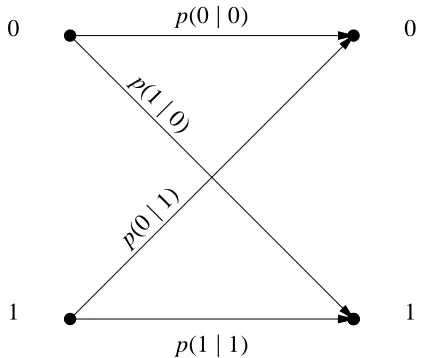
A binary symmetric channel is a special case of the discrete memoryless channel. The
input alphabet size is 2, containing the binary elements “0” and “1”. In addition, the
conditional probabilities are symmetric:
p(0j1) = p(1j0) = p (2.30)
p(0j0) = p(1j1) =1 p (2.31)
The channel transition probabilities (2.30, 2.31) give the probability that a
trans-mitted symbol is received incorrectly. The demodulator makes no attempt to indicate
how well a symbol is received, it merely outputs a “0” or “1”. This type of output is
termed hard decision.
p(0j0)
p(0
j
1)
p(1 j
0)
p(1j1)
0 0
[image:55.595.204.415.456.635.2]1 1
Figure 2.5: Binary symmetric channel model.
error-2.5. CHANNEL MODELS 34
correcting code operating over a BSC can be obtained by considering the probability
that>t symbol errors occur [Lin and Costello, 1983]
PM
n
X
i=t+1
n i
Ps i
(1 Ps) n i
(2.32)
2.5.3
Binary Symmetric Erasure Channel
The binary symmetric erasure channel may be viewed as a special case of the DMC,
or as an extension of the BSC. Like the BSC the input alphabet size is 2, containing
the binary elements. However the output alphabet size is increased to 3, and contains
“0”, “1” and an erasure (denoted by “?”). For times when the demodulator is not able
to clearly identify a “0” or “1” it may signal its uncertainty by outputting an erasure.
The decoder is then aware that the symbol is unreliable. The symmetric conditional
probabilities are
p(0j1)= p(1j0)= p (2.33)
p(0j?)= p(1j?)=q (2.34)
2.5. CHANNEL MODELS 35
p(0j0)
p(0 j?)
p(0 j
0)
p(1
j
0)
p(1j?)
p(1j1)
0 0
1 1
?
Figure 2.6: Binary symmetric erasure channel model.
2.5.4
Additive White Gaussian Noise Channel
In many cases channels are not discrete but feature a continuous output alphabet over
the range ( 1!+1). An AWGN channel is an example of such a case. The output
is the input with broadband Gaussian noise added. The channel contains no memory
(as defined in Section 2.5.1). This type of channel is an accurate channel model of
many communication systems, such as satellite, deep-space and line-of-sight links.
White Gaussian noise is a random process, with a zero mean and a Gaussian PDF
with variance
2. The power spectral density is flat over all frequencies (
1 f
+1). The channel corrupts the transmitted signal with noise. The probability density
function, y, of the noise value, x, is Gaussian and in the frequency domain the noise is
wideband (or white).
y=
1
p
2
exp
(
1 2
x
2
)
2.5. CHANNEL MODELS 36
2.5.5
Quantised AWGN Channel
While channels with continuous output alphabets are a natural phenomenon they are
impossible to use with SD decoding (due to requiring infinite precision to store the
soft value). AWGN channels are frequently ‘approximated’ to a channel with a fixed
number of noise values. Such a channel is termed a quantised additive white Gaussian
noise channel. Like the standard AWGN channel it contains no memory. The
quan-tised AWGN channel is discussed further in Section 5.1.2, where the relative merits
(or metrics) of each quantisation level are calculated and their variation with Eb=N0for
Chapter 3
Algebraic Decoding of Reed-Solomon
Codes
Chapter 3
Algebraic Decoding of Reed-Solomon
Codes
3.1
Introduction
While RS codes are constructed by a few well-defined methods (Section 2.1.8) a large
variety of decoding methods have been proposed. An important distinction is between
those which are algebraic and those which are combinatorial in origin. Algebraic
de-coders attempt to correct errors and/or erasures by (algebraically) solving an equation
to find the lowest weight error word. The fundamental method by which most RS
al-gebraic decoders operate is by attempting to solve the key equation. However, not all
algorithms use this approach, notable exceptions being Peterson’s direct method
[Pe-terson, 1960] and Massey’s step-by-step algorithm [Massey, 1965]. In contrast to
algebraic decoders, combinatorial decoders operate on more probabilistic methods to
3.1. INTRODUCTION 39
find the codeword which most closely matches the received word. Whilst many
alge-braic decoders can be adapted for error-and-erasures decoding it is true to say that they
are unable to make maximum use of soft-decision information in the way that
combi-natorial decoders can. Most combicombi-natorial decoding algorithms are trellis-based (e.g.,
the Fano algorithm and the Viterbi algorithm). Combinatorial decoders are discussed
in Chapter 4.
Some important algebraic decoding algorithms include Euclidean decoding, based
on Euclid’s algorithm and the Berlekamp-Massey algorithm. In 1967 Berlekamp
in-troduced an iterative method for decoding binary BCH codes [Berlekamp, 1967]. In
Peterson’s method the decoding complexity is proportional to the square of the errors
corrected while for Berlekamp’s algorithm the decoding complexity increases linearly
with the number of errors corrected [Wicker, 1994, p. 211]. Thus Berlekamp’s
al-gorithm is much more suited for decoding long block codes where many errors may
be corrected. In 1969 Massey described a “shift-register” synthesis of the Berlekamp
algorithm [Massey, 1969]. The algorithm is now commonly called the
Berlekamp-Massey algorithm in joint commemoration of their findings. In 1975 Sugiyama et al.
showed how Euclid’s algorithm, for finding the greatest common divisor of two
inte-gers or polynomials, can be used to solve the key equation and decode BCH and RS
codes [Sugiyama et al., 1975].
This Chapter begins with a discussion of the key equation (Section 3.2). The
syn-drome, error-locator and error-evaluator polynomials are defined. A method by which
the error values can be calculated is given, along with its proof. Euclidean decoding
3.2. THE KEY EQUATION 40
Berlekamp-Massey algorithm. The same decoding example is repeated for the case of
BM decoding. Finally, high-speed step-by-step decoding is shown. Again, the same
decoding example is used to illustrate the algorithm. All the algorithms are described
using the same form of the key equation, and have been generalised for the case when
the BCH sense is not narrow (Section 2.1.7).
3.2
The Key Equation
3.2.1
Syndrome Calculation
Many common algebraic decoding algorithms for parity-check block codes start by
testing if the syndromes (Section 2.1.2) of the received codeword are non-zero (i.e., if
the parity checks fail). If the syndrome vector or polynomial is non-zero the received
codeword is in error and error-correction is begun.
Let the received codeword be represented by the polynomial r(x) = r0 +r1x+
::: +rn 1x
n 1. Let the error word corrupting the received word be represented by
the polynomial e(x) = e0 +e1x+:::+en 1x
n 1. The syndrome values1 S
j, ( j = 1;
2; ::: ; 2t ) is the value of the received polynomial evaluated at the 2t roots used to
define the RS (or BCH) code [Wilson, 1996, p. 471]. Thus, for a narrow sense BCH
code (b= 1) the j-th syndrome is calculated by substituting
j for x in r(x). For the
3.2. THE KEY EQUATION 41
more general case
Sj =r(
j+b 1
)
=
n 1
X
i=0
(ri)(
j+b 1
)i
=
n 1
X
i=0
(vi+ei)(
j+b 1
)i
=
n 1
X
i=0
(ei)
i( j+b 1)
where j=1; 2; ::: ; 2t
(3.1)
3.2.2
Error-locator Polynomial
Let the received codeword contain ( t ) correctable errors. Let the locations of
the errors be given by time indices i1; i2; :::; i
. For each symbol in error define an
error-locator, Xisuch that
Xi=
i
(3.2)
Noting that only symbols received in error contribute to the syndrome values it is
possible to rewrite (3.1) in terms of the error-locators
Sj = X
l=1
eilX ( j+b 1)
l (3.3)
The error-locator polynomial,(x), is defined as a polynomial whose inverse roots
3.2. THE KEY EQUATION 42
the roots of(x).
(x) 4 =
Y
i=1
(1 Xix) (3.4)
From (3.4) it can be seen that deg(x) = , and that for no errors ( = 0) then
(x) = 0. For binary codes it is sufficient to find the location of an error, since the
error value is always 1. However for RS and other multi-level codes it is necessary
to find the value of each error in addition to the location of each error. It is therefore
necessary to define an additional polynomial to find the value of the error(s).
3.2.3
Error-evaluator Polynomial
The error-evaluator polynomial is a polynomial which when evaluated at an error
lo-cation gives the value of the error. It is defined as follows.2 The syndrome polynomial
is an infinite degree polynomial, however only the first 2t coefficients of x are known
1+S(x)=1+
1 X
j=1
Sjx j
=1+ 1 X
j=1 X
l=1
eilX ( j+b 1)
l
!
xj
=1+ X
l=1
eil
1 X
j=1
X( j+b 1)
l x
j
(3.5)
The summation
P 1
j=1
X( j+b 1)
l x
j can be simplified to a rational expression by noting it
is a geometric series of the form a+ar
1
+ar
2
+:::, for which the simplified form is
2This is similar to [Wicker, 1994, p. 221], but has been generalised for the case when b