Quantum Discord Determines the Interferometric Power of Quantum States
Davide Girolami,1,2,8 Alexandre M. Souza,3 Vittorio Giovannetti,4 Tommaso Tufarelli,5 Jefferson G. Filgueiras,6Roberto S. Sarthour,3 Diogo O. Soares-Pinto,7 Ivan S. Oliveira,3 and Gerardo Adesso1,*
1
School of Mathematical Sciences, The University of Nottingham, University Park, Nottingham NG7 2RD, United Kingdom
2
Department of Electrical and Computer Engineering, National University of Singapore, 4 Engineering Drive 3, 117583 Singapore, Singapore
3
Centro Brasileiro de Pesquisas Físicas, Rua Dr. Xavier Sigaud 150, Rio de Janeiro, 22290-180 Rio de Janeiro, Brazil
4NEST, Scuola Normale Superiore and Istituto Nanoscienze-CNR, Piazza dei Cavalieri 7, I-56126 Pisa, Italy 5
QOLS, Blackett Laboratory, Imperial College London, London SW7 2BW, United Kingdom
6Fakultät Physik, Technische Universität Dortmund, 44221 Dortmund, Germany 7
Instituto de Física de São Carlos, Universidade de São Paulo, P.O. Box 369, São Carlos, 13560-970 São Paulo, Brazil
8Department of Physics, Clarendon Laboratory, University of Oxford, Parks Road, Oxford OX1 3PU, United Kingdom
(Received 11 February 2014; published 27 May 2014)
Quantum metrology exploits quantum mechanical laws to improve the precision in estimating technologically relevant parameters such as phase, frequency, or magnetic fields. Probe states are usually tailored to the particular dynamics whose parameters are being estimated. Here we consider a novel framework where quantum estimation is performed in an interferometric configuration, using bipartite probe states prepared when only the spectrum of the generating Hamiltonian is known. We introduce a figure of merit for the scheme, given by the worst-case precision over all suitable Hamiltonians, and prove that it amounts exactly to a computable measure of discord-type quantum correlations for the input probe. We complement our theoretical results with a metrology experiment, realized in a highly controllable room-temperature nuclear magnetic resonance setup, which provides a proof-of-concept demonstration for the usefulness of discord in sensing applications. Discordant probes are shown to guarantee a nonzero phase sensitivity for all the chosen generating Hamiltonians, while classically correlated probes are unable to accomplish the estimation in a worst-case setting. This work establishes a rigorous and direct operational interpretation for general quantum correlations, shedding light on their potential for quantum technology.
DOI:10.1103/PhysRevLett.112.210401 PACS numbers: 03.65.Ud, 03.65.Wj, 03.67.Mn, 06.20.-f
All quantitative sciences benefit from the spectacular developments in high-accuracy devices, such as atomic clocks, gravitational wave detectors, and navigation sen-sors. Quantum metrology studies how to harness quantum mechanics to gain precision in estimating quantities not amenable to direct observation[1–5]. The phase estimation paradigm with measurement schemes based on an inter-ferometric setup[6]encompasses a broad and relevant class of metrology problems, which can be conveniently cast in terms of an input-output scheme[1]. An input probe state
ρAB enters a two-arm channel, in which the reference
subsystemBis unaffected while subsystemAundergoes a local unitary evolution, so that the output density matrix can be written as ρφAB ¼ ðUA⊗IBÞρABðUA⊗IBÞ†, with
UA¼e−iφHA, whereφis the parameter we wish to estimate
and HA is the local Hamiltonian generating the unitary
dynamics. Information on φ is then recovered through an estimator function φ~ constructed upon possibly joint measurements of suitable dependent observables per-formed on the output ρφAB. For any input state ρAB and generatorHA, the maximum achievable precision is
deter-mined theoretically by the quantum Cramér-Rao bound[3]. Given repetitive interrogations viaνidentical copies ofρAB, this fundamental relation sets a lower limit to the mean
square error Varρφ
ABðφ~Þthat measures the statistical distance betweenφ~ andφ, Varρφ
ABðφ~Þ≥½νFðρAB;HAÞ
−1, whereFis
the quantum Fisher information (QFI)[7], which quantifies how much information about φ is encoded in ρφAB. The inequality is asymptotically tight asν→∞, provided the most informative quantum measurement is carried out at the output stage. Using this quantity as a figure of merit for independent and identically distributed trials, and under the assumption of complete prior knowledge ofHA, then “coherence” [8] in the eigenbasis of HA is the essential
resource for the estimation[2]; as maximal coherence in a known basis can be reached by a superposition state of subsystemA only, there is no need for a correlated (e.g., entangled) subsystemB at all in this conventional case.
We show that the introduction of correlations is instead unavoidable when the assumption of full prior knowledge ofHAis dropped. More precisely, we identify, in correlations
commonly referred to as“quantum discord”betweenAand B[9,10], the necessary and sufficient resources rendering physical states able to store phase information in a unitary dynamics, independently of the specific Hamiltonian that generates it. Quantum discord is an indicator of quantum-ness of correlations in a composite system, usually revealed
via the state disturbance induced by local measurements [9–12]; recent results suggest that discord might enable quantum advantages in specific computation or communi-cation settings[13–19]. In this Letter a general quantitative equivalence between discord-type correlations and the guaranteed precision in quantum estimation is established theoretically, and is observed experimentally in a liquid-state nuclear magnetic resonance (NMR) proof-of-concept implementation[20,21].
Theory.—An experimenter Alice, assisted by her partner Bob, has to determine, as precisely as possible, an unknown parameterφintroduced by a“black box”device. The black box implements the transformation UA¼e−iφHA and is
controlled by a referee Charlie, see Fig.1. Initially, only the spectrum of the generatorHA is publicly known, and it is
assumed to be nondegenerate. For instance, the experi-menters might be asked to monitor a remote (uncooper-ative) target whose interaction with the probing signals is partially incognito[22]. Alice and Bob prepareνcopies of a bipartite (generally mixed) probe stateρABof their choice. Charlie then distributes ν identical copies of the black box, and Alice sends each of her subsystems through one iteration of the box. After the transformations, Charlie reveals the Hamiltonian HA used in the box, prompting
Alice and Bob to perform the best possible joint measure-ment on the transformed stateðρφABÞ⊗ν in order to estimate
φ [23]. Eventually, the experimenters infer a probability distribution associated to an optimal estimator φ~ for φ saturating the Cramér-Rao bound (for ν≫1), so that the corresponding QFI determines exactly the estimation pre-cision. For a given input probe state, a relevant figure of merit for this protocol is then given by the worst-case QFI over all possible black box settings,
PAðρ ABÞ ¼
1 4minHA
FðρAB;HAÞ; (1)
where the minimum is intended over all Hamiltonians with given spectrum (see also[27]), and we inserted a normali-zation factor1=4for convenience. We shall refer toPAðρ
ABÞ
as the“interferometric power”(IP) of the input stateρAB, since it naturally quantifies the guaranteed sensitivity that such a state allows in an interferometric configuration (Fig.1).
We prove that the quantity in Eq.(1)is a rigorous measure of discord-type quantum correlations of an arbitrary bipar-tite stateρAB(see Supplemental Material[27]). If (and only if) the probe state is uncorrelated or only classically
correlated, i.e., Alice and Bob prepare a density matrix
ρAB diagonal with respect to a local basis onA[11,13,17],
then no precision in the estimation is guaranteed; indeed, in this case there is always a particularly adverse choice forHA,
such that½ρAB; HA⊗IB ¼0 and no information aboutφ
can be imprinted on the state, resulting in a vanishing IP. Conversely, the degree of discord-type correlations of the stateρABnot only guarantees but also directly quantifies, via Eq. (1), its usefulness as a resource for estimation of a parameter φ, regardless of the generator HA of a given
spectral class. For generic mixed probesρAB, this is true even in the absence of entanglement.
Remarkably, we can obtain a closed formula for the IP of an arbitrary quantum state of a bipartite system when subsystemAis a qubit. Deferring the proof to[27], this reads
PAðρ
ABÞ ¼ςmin½M (2)
whereςmin½Mis the smallest eigenvalue of the3×3matrix
Mof elements
Mm;n ¼
1 2
X
i;l∶qiþql≠0
ðqi−qlÞ2
qiþql
×hψijσmA⊗IBjψlihψljσnA⊗IBjψii
with fqi;jψiig being, respectively, the eigenvalues and
eigenvectors of ρAB, ρAB¼Piqijψiihψij. This renders PAðρ
ABÞan operationalandcomputable indicator of general
nonclassical correlations for practical purposes.
Experiment.—We report an experimental implementation of black box estimation in a room temperature liquid-state NMR setting[20,21]. Here, quantum states are encoded in the spin configurations of magnetic nuclei of a13C-labeled chloroform (CHCl3) sample diluted ind6acetone. The1H and13C nuclear spins realize qubitsAandB, respectively; the statesρABare engineerable as pseudopure states[26,28] by controlling the deviation matrix from a fully thermal ensemble[21]. A highly reliable implementation of unitary phase shifts can be obtained by means of radio frequency (rf) pulses. Referring to[27]for further details of the sample preparation and implementation, we now discuss the plan (Fig.2) and the results (Fig.3) of the experiment.
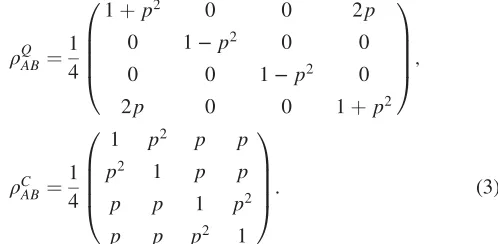
We compare two scenarios, where Alice and Bob prepare input probe statesρAB either with or without discord. The chosen families of states are, respectively[25,29,30],
ρQ AB ¼
1 4
0 B B B @
1þp2 0 0 2p
0 1−p2 0 0
0 0 1−p2 0
2p 0 0 1þp2
1 C C C A;
ρC AB ¼
1 4
0 B B B @
1 p2 p p
p2 1 p p
p p 1 p2
p p p2 1
1 C C C
A: (3)
Both classes of states have the same purity, given by Tr½ðρQ;CABÞ2 ¼ ð1=4Þð1þp2Þ2, where 0≤p≤1. This
Bob Alice
Charlie
[image:2.612.310.559.575.697.2]allows us to focus on the role of initial correlations for the subsequent estimation, at tunable common degree of mixedness mimicking realistic environmental conditions. While the statesρC
ABare classically correlated for all values
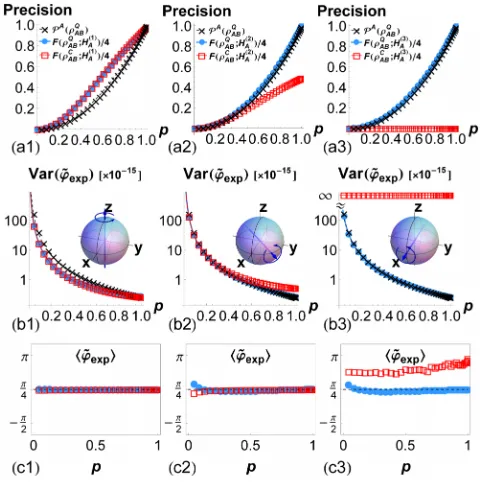
ofp, the statesρQABhave discord increasing monotonically withp >0. The probes are prepared by applying a chain of control operations to the initial Gibbs state (Fig. 2). We perform a full tomographical reconstruction of each input state to validate the quality of our state preparation, obtaining a mean fidelity of ð99.70.2Þ% with the theoretical density matrices of Eq. (3) [27]. In the case ofρQAB, we measure the degree of discord-type correlations in the probes by evaluating the closed formula(2)for the IP on the tomographically reconstructed input density matri-ces; this is displayed as black crosses in the top panel of Fig. 3 and is found in excellent agreement with the theoretical expectation PAðρQ
ABÞ ¼p2.
Then, for each fixed input probe, and denoting by φ0 the true value of the unknown parameterφto be estimated by Alice and Bob (which we set to φ0¼π=4 in the
experiments without any loss of generality), we implement three different choices of Charlie’s black box transforma-tionUðAkÞ ¼e−iφ0HðAkÞ ⊗IB. These are given byHð1Þ
A ¼σzA,
HðA2Þ¼ ðσxAþσyAÞ= ffiffiffi
2
p
, and HðA3Þ¼σxA, and are
engi-neered by applying, respectively, the pulse sequences FIG. 2 (color online). Experimental scheme for black box
parameter estimation with NMR. The protocol is divided in three steps: probe state preparation (leftmost frame, yellow), black box transformation (middle frame, red), and optimal measurement (rightmost frame, green). Starting from a thermal equilibrium distribution, we initialize the two-qubit system in a pseudopure state of the form ρ¼ ½ð1−ϵÞ=4IþϵρAB, with ϵ∼10−5 and ρAB¼ j00ih00jAB. This is done by applying the pulse sequence
ðπ=2Þx→UJð1=4JÞ→ðπ=2Þy→UJð1=4JÞ→ðπ=2Þ−x→Gz→
ðπ=4Þy→UJð1=2JÞ→ðπ=6Þx→Gz, whereðθÞαis a rotation of
each qubit by an angleθin the directionα,UJðτÞis a free evolution under the scalar interaction between the spins for a timeτ, andGzis a pulsed field gradient (which dephases all the spins along thez
axis). We then proceed to prepare two types of probe states: the classically correlated onesρCAB(a), and the discordant onesρQAB(b), defined in Eq.(3). We first apply rf pulses, with a flip angleθ, followed by a pulsed field gradientGz; this allows us to tune the purity parameterp¼cosθ, by varyingθbetween 0° and 90° in steps of 2.5°. The subsequent circuits differ for each type of state: forρC
AB(a), aCNOTgate followed by Hadamard gatesHon both qubitsAandBare implemented, while forρQAB(b), theCNOTis followed by a HadamardHon qubitAonly and by a secondCNOT.
FIG. 3 (color online). Experimental results. Each column corresponds to a different black box settingHðAkÞ,k¼1, 2, 3, generating aφrotation on qubitAaround a Bloch sphere direction
n
!ðkÞ; the set directions are depicted in the insets of row (b). Empty
red squares refer to data from classical probesρC
AB, filled blue circles refer to data from discordant probesρQAB; error bars, due to small pulse imperfections in state preparation and tomography [27], are smaller than the size of the points. The lines refer to theoretical predictions. Both families of states depend on a purity parameterp, experimentally tuned by a flip angle (see Fig.2). The top row (a) shows the precision achieved by each probe in estimatingφfor the different settings: the respective QFIs (divided by 4) as obtained from the output measured data are plotted and compared with the IP PAðρQ
ABÞ of the discordant states (black crosses) measured from initial state tomography. The theoretical predictions are:FthðρQAB;HðA1ÞÞ¼FthðρCAB;HðA1ÞÞ¼8p2=
ð1þp2Þ, FthðρQAB;H
ð2Þ
A Þ ¼4p2, FthðρCAB;H
ð2Þ
A Þ¼4p2=ð1þp2Þ,
FthðρQAB;H
ð3Þ
A Þ ¼4p2, FthðρCAB;H
ð3Þ
A Þ ¼0, and PAðρ Q ABÞ ¼p2. The middle row (b) depicts the measured variances of the optimal estimatorsφ~expover the ensemble ofν≈1015molecules, together
with the theoretical predictions corresponding to the saturation of the quantum Cramér-Rao bound. The upper bound limiting the estimation uncertainty for the discordant states is shown as well, given by4½νPAðρQ
ABÞ−1as calculated from the input states (crosses). The bottom row (c) depicts the inferred mean value of the optimal estimatorhφ~expifor the various settings. Both classical
[image:3.612.317.557.46.288.2] [image:3.612.56.293.48.220.2]UðA1Þ¼ ðπ=2Þx→ðπ=2Þ−y→ðπ=2Þ−x,UAð2Þ ¼ ðπ=2Þxþy, and
UðA3Þ¼ ðπ=2Þx. A theoretical analysis asserts that the chosen settings encompass the best (setting k¼1) and worst (setting k¼3) case scenarios for both types of probes, while the settingk¼2is an intermediate case[27]. For each input state and black box setting, we carry out the corresponding optimal measurement strategy for the estimation ofφ. This is given by projections on the eigenbasis
fjλjig(j¼1;…;4) of the symmetric logarithmic derivative
(SLD) Lφ¼Pjljjλjihλjj, an operator satisfying∂φρφAB¼
ð1=2ÞðρφABLφþLφρ
φ
ABÞ[7]. The QFI is then given by[31]
FðρAB;HAÞ ¼Tr½ρφABL2φ
¼4 X
i<l∶qiþql≠0
ðqi−qlÞ2
ðqiþqlÞ
jhψijðHA⊗IBÞjψlij2;
wherefqi;jψiigare the eigenvalues and eigenvectors ofρAB
as before. We implement a readout procedure based on a global rotation into the eigenbasis of the SLD, depicted as VC;Qk in Fig. 2, followed by a pulsed field gradient Gz to perform an ensemble measurement of the expectation values dj¼ hλjjρφABjλji averaged over ν≈1015 effectively
inde-pendent probes [25,27]. These are read from the main diagonal of the output density matrices, circumventing the need for complete state tomography. The measurement basis is selected by a simulated adaptive procedure and the measured ensemble datadexpj are reported in[27].
To accomplish the estimation, we need a statistical esti-mator forφ. Denoting by (k,s) an instance of the experiment (with k¼1, 2, 3 referring to the black box setting, and s¼C,Qreferring to the input probes), an optimal estimator forφwhich asymptotically saturates the quantum Cramér-Rao bound can be formally constructed as[31,32]
~
φðk;sÞ¼φ
0Iþ ðLðφk;s0 ÞÞ=½
ffiffiffi ν
p
Fðρs AB;H
ðkÞ
A Þ; (4)
such thathφ~ðk;sÞi ¼φ0and Varðφ~ðk;sÞÞ ¼ ½νFðρsAB;H ðkÞ A Þ−1,
becausehLðφk;s0 Þi ¼0by definition. However, the estimator in Eq.(4)requires the knowledge of the true value φ0 of the unknown parameter, which cannot be obtained by iterative procedures in our setup. We then infer directly the ensemble mean and variance of the optimal estimator from the available data, namely, the measured valuesdexpj ðk;sÞ and the knowl-edge of the input probe states ρs
AB prepared (and
recon-structed) by Alice and Bob, the setting k disclosed by Charlie, and the design eigenvalueslj of the SLD, which
are independent ofφ.
First, we infer the expected value of the optimal estimator ~
φðk;sÞ by means of a statistical least-squares processing.
We derive theoretical model expressions for the measured datadexpj ðk;sÞ defined by
dthjðk;sÞðφÞ¼hλφ0ðk;sÞ
j jðe−iφH
ðkÞ A ⊗IBÞρs
ABðeiφH
ðkÞ
A ⊗IBÞjλφ0ðk;sÞ
j i;
and we calculate the value ofφ that minimizes the least-squares function Υðk;sÞðφÞ ¼P4
j¼1½d thðk;sÞ j ðφÞ−d
expðk;sÞ
j
2
(equivalent to maximizing the log-likelihood assuming that eachdjis Gaussian distributed over the ensemble). For each
setting (k,s), the value of φ that solves the least-squares problem is chosen as the expected value hφ~ðexpk;sÞi of our
estimator. These values are plotted in row (c) of Fig.3. One can appreciate the agreement with the true valueφ0¼π=4 of the unknown phase shift for all settings but the patho-logical one (C, 3). In the latter case, the estimation is completely unreliable because the classical probes commute with the corresponding Hamiltonian generator, thus failing the estimation task.
Next, by expanding the SLD in its eigenbasis (see Table SI in[27]), we obtain the experimental QFIs measured from our data,FexpðρsAB;H
ðkÞ A Þ ¼ hðL
ðk;sÞ
φ0 Þ2i ¼
P jðl
ðk;sÞ j Þ2d
expðk;sÞ
j .
These are plotted (normalized by a factor1=4) for the various settings in row (a) of Fig.3, together with the lower bound given by the IP ofρQAB. We remark that the QFIs are obtained from the output estimation data, while the IP is measured on the input probe states. In both cases an excellent agreement with theoretical expectations is retrieved for all settings. Notice how in casesk¼2, 3 the quantum probes achieve a QFI that saturates the lower bound given by the IP. Notice also that fork¼3the classical states yield strictly zero QFI, aslðj3;CÞ¼0∀j.
Finally, we infer the variance of the optimal estimator over the spin ensemble. This is obtained by replacingφ0Iwith
hφ~ðk;sÞ
exp iIin Eq.(4)and calculating Varðφ~
ðk;sÞ
exp Þby expanding
it in terms of the design weight valueslðjk;sÞand the measured
datadexpj ðk;sÞ; namely, Varðφ~ ðk;sÞ exp Þ ¼ f½
P jðl
ðk;sÞ j Þ2d
expðk;sÞ
j −
ðPjlðjk;sÞd expðk;sÞ
j Þ2g=fν½FexpðρsAB;H ðkÞ
A Þ2g. The resulting
variances Varðφ~ðexpk;sÞÞof our metrology experiment are then
plotted in row (b) of Fig. 3. The obtained quantities are in neat agreement with the inverse relation Varðφ~ðexpk;sÞÞ≈
½νFexpðρsAB;H ðkÞ
A Þ−1, which allows us to conclude that the
implemented estimator with experimentally determined mean hφ~ðexpk;sÞi and variance Varðφ~ðexpk;sÞÞ, constructed from
our ensemble data, saturates the quantum Cramér-Rao bound: this confirms that an optimal detection strategy was carried out in all settings. Overall, this clearly shows that discord-type quantum correlations, which establish a priori the guaranteed precision for any bipartite probe state via the quantifierPA, are the key resource for black box
estimation experiment, where the high controllability on state preparation and gate implementation allowed us to retain the hypothesis of unitary dynamics, and to verify the saturation of the Cramér-Rao bound for optimal estimation. Our results suggest that in highly disordered settings, e.g., NMR systems, and under adverse conditions, quantum correlations even without entanglement can be a promising resource for realizing quantum technology.
We acknowledge discussions with S. Benjamin, T. Bonagamba, T. Bromley, M. Cianciaruso, L. Correa, L. Davidovich, E. deAzevedo, B. Escher, E. Gauger, M. Genoni, M. Guta, S. Huelga, M. S. Kim, M. Lang, B. Lovett, K. Macieszak, K. Modi, J. Morton, M. Paris, M. Piani, R. Serra, and M. Tsang. This work was supported by the Singapore National Research Foundation under NRF Grant No. NRF-NRFF2011-07, the Foundational Questions Institute (FQXI), the University of Nottingham [EPSRC Research Development Fund Grant No. PP-0313/36], the Italian Ministry of University and Research [FIRB-IDEAS Grant No. RBID08B3FM], the Qatar National Research Fund [NPRP 4-426 554-1-084], the Brazilian funding agencies CAPES [Pesquisador Visitante Especial-Grant No. 108/2012], CNPq [PDE Grant No. 236749/2012-9], and FAPERJ, and the Brazilian National Institute of Science and Technology of Quantum Information (INCT/IQ).
*
[1] V. Giovannetti, S. Lloyd, and L. Maccone,Phys. Rev. Lett.
96, 010401 (2006).
[2] V. Giovannetti, S. Lloyd, and L. Maccone,Nat. Photonics5, 222 (2011).
[3] C. W. Helstrom,Quantum Detection and Estimation Theory (Academic Press, New York, 1976).
[4] S. F. Huelga, C. Macchiavello, T. Pellizzari, A. K. Ekert, M. B. Plenio, and J. I. Cirac,Phys. Rev. Lett.79, 3865 (1997). [5] B. M. Escher, R. L. de Matos Filho, and L. Davidovich,Nat.
Phys.7, 406 (2011).
[6] C. M. Caves, Phys. Rev. D23, 1693 (1981).
[7] S. L. Braunstein and C. M. Caves,Phys. Rev. Lett.72, 3439 (1994).
[8] T. Baumgratz, M. Cramer, and M. B. Plenio,arXiv:1311.0275 [Phys. Rev. Lett. (to be published)].
[9] H. Ollivier and W. H. Zurek,Phys. Rev. Lett. 88, 017901 (2001).
[10] L. Henderson and V. Vedral,J. Phys. A.34, 6899 (2001). [11] M. Piani, S. Gharibian, G. Adesso, J. Calsamiglia, P. Horodecki, and A. Winter, Phys. Rev. Lett. 106, 220403 (2011).
[12] A. Streltsov, H. Kampermann, and D. Bruss, Phys. Rev. Lett.106, 160401 (2011).
[13] K. Modi, A. Brodutch, H. Cable, T. Paterek, and V. Vedral, Rev. Mod. Phys.84, 1655 (2012).
[14] A. Datta, A. Shaji, and C. M. Caves,Phys. Rev. Lett.100, 050502 (2008).
[15] M. Gu, H. M. Chrzanowski, S. M. Assad, T. Symul, K. Modi, T. C. Ralph, V. Vedral, and P. K. Lam,Nat. Phys. 8, 671 (2012).
[16] B. Dakićet al.,Nat. Phys.8, 666 (2012).
[17] D. Girolami, T. Tufarelli, and G. Adesso,Phys. Rev. Lett.
110, 240402 (2013).
[18] M. de Almeida, M. Gu, A. Fedrizzi, M. A. Broome, T. C. Ralph, and A. White,Phys. Rev. A89, 042323 (2014). [19] S. Pirandola,arXiv:1309.2446.
[20] R. R. Ernst, G. Bodenhausen, and A. Wokaum,Principles of Nuclear Magnetic Resonance in One and Two Dimensions (Oxford University Press, New York, 1987).
[21] I. S. Oliveira, T. J. Bonagamba, R. S. Sarthour, J. C. C. Freitas, and E. R. deAzevedo,NMR Quantum Information Processing(Elsevier, New York, 2007).
[22] S. Lloyd,Science321, 1463 (2008).
[23] This setting is very natural for implementations such as NMR, where measurements on an ensemble ofνprobes are taken collectively, rather than iteratively[24–26].
[24] J. A. Jones, S. D. Karlen, J. Fitzsimons, A. Ardavan, S. C. Benjamin, G. A. D. Briggs, and J. J. L. Morton, Science
324, 1166 (2009).
[25] M. Schaffry, E. M. Gauger, J. J. L. Morton, J. Fitzsimons, S. C. Benjamin, and B. W. Lovett,Phys. Rev. A82, 042114 (2010).
[26] D. G. Cory, A. F. Fahmy, and T. F. Havel,Proc. Natl. Acad. Sci. U.S.A.94, 1634 (1997).
[27] See Supplemental Material at http://link.aps.org/ supplemental/10.1103/PhysRevLett.112.210401for technical proofs and additional experimental details. The Supplemental Material document contains additional Refs. [33–45]. [28] N. A. Gershenfeld and I. L. Chuang,Science275, 350 (1997). [29] S. Simmons, J. A. Jones, S. D. Karlen, A. Ardavan, and
J. J. L. Morton,Phys. Rev. A82, 022330 (2010).
[30] K. Modi, H. Cable, M. Williamson, and V. Vedral,Phys. Rev. X 1, 021022 (2011).
[31] M. G. A. Paris,Int. J. Quantum. Inform.07, 125 (2009). [32] Here and in the following, the averages are intended to be
calculated on the transformed statesρφABs after the black box. [33] S. Luo,Phys. Rev. Lett.91, 180403 (2003).
[34] E. P. Wigner and M. M. Yanase, Proc. Natl. Acad. Sci. U.S.A.49, 910 (1963).
[35] B. Aaronson, R. Lo Franco, and G. Adesso,Phys. Rev. A
88, 012120 (2013).
[36] A. Abragam,The Principles of Nuclear Magnetism(Oxford University Press, New York, 1978).
[37] L. M. K. Vandersypen and I. L. Chuang,Rev. Mod. Phys.
76, 1037 (2005).
[38] N. A. Gershenfeld and I. L. Chuang,Science275, 350 (1997). [39] S. L. Braunstein, C. M. Caves, R. Jozsa, N. Linden, S. Popescu, and R. Schack,Phys. Rev. Lett.83, 1054 (1999). [40] N. Linden and S. Popescu, Phys. Rev. Lett. 87, 047901
(2001).
[41] J. A. Jones, Prog. Nucl. Magn. Reson. Spectrosc. 59, 91 (2011).
[42] M. A. Nielsen and I. L. Chuang, Quantum Computation and Quantum Information (Cambridge University Press, Cambridge, England, 2000).
[43] I. L. Chuang, N. Gershenfeld, M. Kubinec, and D. Leung, Proc. R. Soc. A 454447 (1998).
[44] G. M. Leskowitz and L. J. Mueller,Phys. Rev. A69, 052302 (2004).