FORWARD MODELING OF STANDING SLOW MODES IN FLARING CORONAL LOOPS
D. Yuan1,2, T. Van Doorsselaere1, D. Banerjee3, and P. Antolin4
1
Centre for mathematical Plasma Astrophysics, Department of Mathematics, KU Leuven, Celestijnenlaan 200B bus 2400, B-3001 Leuven, Belgium;[email protected]
2
Key Laboratory of Solar Activity, National Astronomical Observatories, Chinese Academy of Sciences, Beijing, 100012, China 3
Indian Institute of Astrophysics, II Block, Koramangala, Bangalore 560 034, India 4
National Astronomical Observatory of Japan, 2-21-1 Osawa, Mitaka, Tokyo 181-8588, Japan Received 2015 March 3; accepted 2015 May 22; published 2015 July 2
ABSTRACT
Standing slow-mode waves in hotflaring loops are exclusively observed in spectrometers and are used to diagnose the magnetic field strength and temperature of the loop structure. Owing to the lack of spatial information, the longitudinal mode cannot be effectively identified. In this study, we simulate standing slow-mode waves inflaring loops and compare the synthesized line emission properties with Solar Ultraviolet Measurements of Emitted Radiation spectrographic andSolar Dynamics Observatory/Atmospheric Imaging Assembly imaging observations. Wefind that the emission intensity and line width oscillations are a quarter period out of phase with Doppler shift velocity in both time and spatial domain, which can be used to identify a standing slow-mode wave from spectroscopic observations. However, the longitudinal overtones could only be measured with the assistance of imagers. We find emission intensity asymmetry in the positive and negative modulations;this is because the contribution function pertaining to the atomic emission process responds differently to positive and negative temperature variations. One may detect half periodicity close to the loop apex, where emission intensity modulation is relatively small. The line-of-sight projection affects the observation of Doppler shift significantly. A more accurate estimate of the amplitude of velocity perturbation is obtained by de-projecting the Doppler shift by a factor of 1–2θ/π rather than the traditionally used cosq. If a loop is heated to the hotter wing, the intensity modulation could be overwhelmed by background emission, while the Doppler shift velocity could still be detected to a certain extent.
Key words:magnetohydrodynamics (MHD)– Sun: atmosphere– Sun: corona– Sun: oscillations–waves
1. INTRODUCTION
Magnetohydrodynamic(MHD)waves are believed to play a significant role in the formation and dynamics of the solar atmosphere. They may contribute significantly to coronal heating (see reviews by Klimchuk 2006; Taroyan & Erdé-lyi2009; Parnell & De Moortel2012; Arregui2015)and solar wind acceleration (see, e.g., Ofman 2010; van der Holst et al.2014). During the past decade, a number of MHD wave modes of coronal loops were detected with modern instru-ments, e.g., standing and propagating fast kink mode
(Aschwanden et al. 1999; Nakariakov et al. 1999; Williams et al.2002; Van Doorsselaere et al.2008), fast sausage modes
(Asai et al. 2001; Melnikov et al. 2005), and standing and propagating slow mode(De Moortel et al.2000,2002a,2002b; Wang et al. 2003a, 2003b, 2009a, 2009b; Yuan & Nakar-iakov2012; Krishna Prasad et al.2014).
MHD wave theory in structured plasma forms a solid basis for a wave-based plasma diagnostic technique—MHD coronal seismology(see Nakariakov & Verwichte2005; De Moortel & Nakariakov 2012, for recent reviews). MHD seismology was successfully applied in estimating the coronal magnetic
field (Nakariakov & Ofman 2001), transverse loop structuring
(Aschwanden et al. 2003), Alfvén transit times (Arregui et al.2007), polytropic index(Van Doorsselaere et al. 2011b), thermal conduction coefficient(Van Doorsselaere et al.2011b), the magnetic topology of sunspots (Jess et al. 2013; Yuan et al. 2014a,2014b), and the magnetic structure of large-scale streamers (Chen et al. 2010, 2011). It could also be used to determine the coronal density scale height(Andries et al.2005), to quantify the expansion factor of the coronal loops (Verth
et al. 2008), and to probe the characteristic spatial scale of randomly structured plasmas(Yuan et al.2015).
The slow sausage mode was initially theorized by Edwin & Roberts (1983). It is a compressive mode characterized by axisymmetric longitudinal displacement of the plasmafluid. Gas pressure is the main restoring force. In a low-βplasma, this mode does not cause significant contraction or expansion of the loop crosssection, nor a displacement of the loop axis. Standing slow modes are frequently observed as oscillations in the plasma emission intensity and Doppler shift velocity in hot flaring coronal loops (>6 MK;see review by Wang 2011). They are exclusively detected in the hot emission lines, i.e., FeXIX and FeXXIlines as recorded by the Solar Ultraviolet Measurements of Emitted Radiation(SUMER)spectrograph on board Solar and Heliospheric Observatory (SOHO; Wang et al. 2002, 2003a,
2003b), and SXVand CaXIXlines observed by the Bragg Crystal
Spectrometer on board Yohkoh(Mariska 2006). Only recently, the Solar Dynamics Observatory (SDO)/Atmospheric Imaging Assembly (AIA) imager observed, in the 131 Å bandpass, multiple reflections of a propagating slow wave in a hot coronal loop(Kumar et al.2013). A slow compressive mode is found to be launched by repetitive magnetic reconnections occurring at one of the footpoints(Kumar et al.2015).
Quasi-periodic pulsations in solar and stellar flares are thought to be caused by MHD waves (Nakariakov & Melnikov 2009; Anfinogentov et al. 2013). Oscillations with periods at tens of minutes are ascribed to modulations by slow-mode MHD waves (Van Doorsselaere et al. 2011a), while short-period (sub-minute) oscillations are suggested to be modulated by fast-mode waves(Van Doorsselaere et al.2011a; Kupriyanova et al.2013). Recently, Kim et al.(2012)detected
oscillations during an M1.6 flare with the Nobeyama Radioheliograph and the 335 Å extreme-ultraviolet (EUV) channel of SDO/AIA. The intensities in radio and EUV emissions oscillate with a period of about 13.8 minutes and are damped with a decay time of about 25 minutes. Kim et al.
(2012) interpreted the detected 10-minutetimescale oscilla-tions as standing slow magnetoacoustic waves. SUMER-like oscillations, but with shorter periodicities, are detected in soft X-ray emissions(Ning2014).
The standing slow-mode wave oscillates with a period of about 10 minutes and with a velocity amplitude of a few tens of kilometers per second (Wang et al. 2003a; Wang 2011). Significant oscillation is normally detected at the loop apex and becomes absent at the footpoints (Wang et al.2007). This is consistent with a scenario in which an antinode in the density perturbation of the fundamental standing slow mode is located at the loop apex (Wang et al. 2007). This kind of wave is damped within a few oscillation cycles, which are believed to be caused mainly by thermal conduction in hot flaring loops
(Ofman & Wang2002; Selwa et al.2005).
The fundamental standing slow mode of a hot loop appears to be triggered by asymmetric heating at one footpoint and is rapidly established within one wave cycle (Wang et al.2005). Pressure pulses launched close to a footpoint cannot excite a fundamental slow mode fast enough to compensate the strong damping (Selwa et al. 2005). Taroyan et al. (2005) showed analytically that the fundamental slow mode of a 6 MKloop could rapidly be excited by a single impulsive heating with a timescale that matches the loop period. Forward modeling using a simple one-dimensional hydrodynamic model was performed to distinguish the propagating and standing slow waves in both cool and hot loops(Taroyan et al.2007; Taroyan & Bradshaw 2008). They also reported that Doppler shift variation is a more reliable observable to detect a slow wave, while intensity modulation would be phase-shifted by heating
(Taroyan et al. 2007) or contaminated by the background plasma emission (Taroyan & Bradshaw2008).
MHD seismology with the standing slow mode was applied successfully to estimate the magnetic field strength and the time-dependent plasma temperature of a coronal loop (Wang et al. 2007). The application of MHD seismology relies on several nontrivial factors, e.g., the analytical model, mode identification, line-of-sight(LOS)effect, and plasma emission. Forward modeling was attempted to help interpretthe observations correctly. Cooper et al. (2003a, 2003b) investi-gated the LOS effect on imaging observation of the emission intensity variation of fast kink and sausage modeand explained the intensity perturbations of fast wave trains observed by the Solar Eclipse Coronal Imaging System instrument (Williams et al.2001,2002). Gruszecki et al.(2012)performed a three-dimensional numerical simulation of the fast sausage mode of a plasma cylinder and investigated the geometric effect of simple LOS integration. Antolin & Van Doorsselaere (2013) and Antolin et al.(2014)developed advanced models and included atomic emission effects, using the CHIANTI atomic database
(Dere et al.1997). They found that the LOS effect and spatial resolution could significantly affect the intensity modulation and spectral characteristics of the fast sausage mode. Reznikova et al. (2014, 2015) used the same model and further investigated the gyrosynchrotron emission intensity variation using the fast gyrosynchrotron codes (Fleishman & Kuznetsov 2010). The radio emission intensity of the fast
sausage mode oscillates in phase for all frequencies, while for certain LOS angles, the optically thick and thin radio emissions are antiphase. It opposes previous findings of Mossessian & Fleishman(2012), which did not consider the inhomogeneity of the emitting source along the LOS. Kuznetsov et al.(2015)
used a semi-torus model to forward model the gyrosynchrotron radio emission of both propagating and standing slow modes in a curved magnetic structure.
In this study, we perform forward modeling of standing slow modes of hot flaring coronal loops and predict their spectro-scopic and imaging observational signatures. We use the slow-wave model in hot coronal loops(>6 MK;see Section 2)and utilize the CHIANTI v7.1 atomic database(Dere et al. 1997; Landi et al. 2013) to synthesize plasma emission in the SUMER FeXIX line and SDO/AIA 094 Å bandpass (see Section 3). Then the results and conclusions are summarized in Sections4and5, respectively.
2. MODEL
2.1. Standing Slow Mode
In this study, we only consider a standing slow mode in a simple plasma cylinder embedded in a uniform plasma. The magneticfield is parallel to the axis of the plasma cylinder(i.e., z-axis),B0 =B0zˆ. The equilibrium magnetic fieldB0, plasma
densityr0, and temperature T0are the piecewise functions of
ther-axis:
B T B T r a
B T r a
, , , , :
, , : , (1)
0 0 0
i i i
e e e
r r
r
=ìíïï
îïï >
⩽
whereais the radius of the loop. Hereafter, we use subscripts
“i”and“e”to differentiate the internal and external equilibrium values of the loop system.
Effects of plasma stratification and loop curvature are ignored. We focus on observational features caused by optically thin plasma emission, LOS integration, and instru-ment response function. We limit our study to the axisymmetric modem=0 (sausage mode;see Edwin & Roberts1983).
The linearized ideal MHD equations(see, e.g., Ruderman & Erdélyi 2009) give the perturbed quantities on top of the magnetostatic equilibrium:
(
)
· , (2)
1 0x
r = - r
(
B)
b(
b)
Bt P
1
· · , (3)
0 1 1 0
0 2
2 T1
0
x r
m

¶ = - + éë + ùû
(
)
b1= ´ x´B0 , (4)
(
)
p1-Cs2r1=x· Cs2r0- p0 , (5)
where x is the Lagrangian displacement vector;p0 is the
equilibrium plasma pressure;r1, p1, and b1 are the perturbed
plasma density, pressure, and magnetic field, respectively;
b B
PT1=p1+ 1 · 0 m0 is the perturbed total pressure;andm0
is the magnetic permeability in free space. We define the key characteristic speeds to describe the loop system:Cs= gp0 r0,
CA=B0 m r0 0, andCT =C CA s CA2+Cs2 are the
acous-tic, Alfvén, and tube speeds, respectively (Edwin & Roberts 1983); ws=C ks , wA=C kA , andwT=C kT are the
respectively, wherek=pn L0 is the longitudinal wavenumber,
n is the longitudinal mode number,L0is the length of the loop,
andg=5 3is the adiabatic index.
Equations(2)–(5)are solved in cylindrical coordinates(r,f,z) with the boundary condition atr=a, where the radial displacement
r
x and the total pressure are kept in balance. In the case of the standing slow mode withm=0, we Fourier-analyze the perturbed quantities by assuming PT1=A( )cos(r wt)cos( )kz , whereAis the amplitude of the perturbed total pressureandis defined as
(
C C)(
)
d
dt . (6)
2 0 s 2 A 2 2 T 2 w
r w w
=
+ - ¢
Here ¢ is the relevant “” in Antolin & Van Doorsselaere
(2013). We use acos( )kz longitudinal profile in total pressure perturbation, so the density (temperature) nodes are fixed at footpoints, while the longitudinal velocity perturbation follows a profile ofsin( )kz and thus has a node at the loop apex for the fundamental mode. A key derivation is that
(
)(
)
P
C C
· . (7)
2 T1
0 s2 A2 2 T2
x w
r w w
=
-+
-The perturbed total pressure must satisfy
d P
dr
dP
rdr rP 0, (8)
2 T1 2 T1 2 T1 k + - =
where r2 ( )( )k
( )( ) 2 s 2 2 A 2 2
s2 A2 T2 2
k = w w w w
w w w w
-
-+ - is a modified radial wavenumber and has the dimensionality of wavenumber k. Equation (8)
holds for both internal and external plasmas, where all quantities are piecewise functions ofr(Figure1). Equation(8)
gives
(
)
J r r a
K r r a
:
( ) : . (9)
r r 0 i 0 e k k
=ìíïï
îïï >
⩽
By matching the boundary conditions, we obtain the dispersion relation for the fast and slow sausage body mode (Edwin & Roberts 1983; re 0
2
k > and ri 0
2
k < , and hence we redefine
ri ri
2
k = -k
∣ ∣ )
(
)
(
)
(
)
(
)
K a K a J a J a ( )( ) , (10)
r r
r
r r
r
e
e Ae2 2
0 e
0 e
i
i Ai2 2
0 i
0 i
k
r w w
k k
k
r w w
k k -¢ = -¢
whereJ0is the zeroth-order Bessel function of thefirst kind and
K0is the zeroth-order modified Bessel functions of the second
kind;J0¢andK0¢are the corresponding derivatives with respect tokrr. The perturbed thermodynamic quantities, which affect plasma emission, are the velocity vectorv= ¶ ¶x t, the plasma densityρ, and the temperatureT:
(
)
vr Ad dr sin( t)cos( ),kz (11)
0 2
A2
w
r w w w
=
-
(
)
v A C k
V
t kz
sin( )sin( ), (12)
z T
2
0 A2 2 T2
w
r w w w
=
-
vf=0, (13)
(
) (
)
A
C C
t kz
cos( )cos( ), (14)
1
s2 A2
2
2 T2
r w
w w w
=
+
-
(
) (
)
T A T
C C
t kz
( 1)
cos( )cos( ), (15)
1
0
0 s2 A2
2 2 T2 g r w
w w w
=
-+
-
whereT0is the equilibrium plasma temperature. The
thermo-dynamic variables are related by the equation of state for fully ionized hydrogen p=2kBrT mp, where r=r0+r1, T=T0+T1, kB is the Boltzmann constant, andmp is
proton mass.
Equations(8)–(15)holdfor both the fast and slow sausage mode. The solution depends on whether the equations are solved in the Alfvén[wAi,wAe] or acoustic [wTi,wsi]
frequency range (Sakurai et al. 1991). We note that v vr zµ
( 2 ) ( )
T2 2 A2
w -w w -w . Therefore, in the Alfvén frequency range, v vr z1, it corresponds to the fast sausage mode
(Antolin & Van Doorsselaere 2013; Reznikova et al.2014),while in the acoustic frequency range,v vr z1, this corresponds to the slow sausage mode(see, e.g., Moreels & Van Doorsselaere2013), which is the topic of this study.
2.2. Hot Flaring Coronal Loop
Hot coronal loops are complex and highly dynamic structures heated to 2–30 MK by flares (see a review by Reale 2014). A coronal loop may have unresolved fine structures (Priest et al. 2002; Van Doorsselaere et al. 2014)
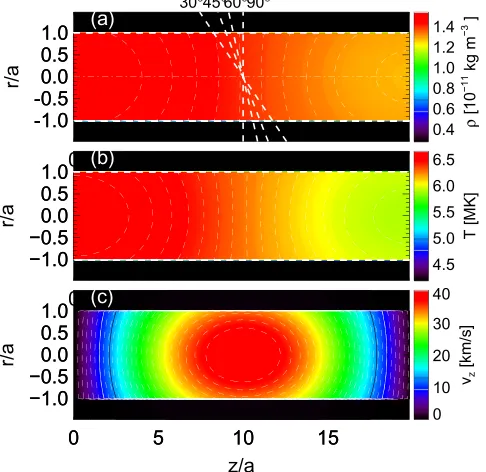
[image:3.612.49.292.55.291.2]or multiplestrands (Antolin & Rouppe van der Voort 2012; Peter et al. 2013; Antolin et al. 2014, 2015; Scullion et al.2014). Heating/cooling(see, e.g., Klimchuk2006; Hood et al. 2009) and the associated flows (see Winebarger et al.2002)are usually detected at the footpoints of the loops. Figure 1. Snapshots of(a)r( , )r z,(b)T r z( , ), and(c)v r zz( , )att=P0 8.
MHD wave theory(see, e.g., Edwin & Roberts1983; Sakurai et al. 1991; Goossens et al. 2011) normally assumes that a quiescent loop is in equilibrium with the ambient plasma, and therefore the heating and cooling timescales should be sufficiently longer than the MHD timescales (in order of minutes in the case of slow modes). If a loop is subject to active heating or cooling, the Wentzel–Kramers–Brillouin
(WKB) approximation can be used (similar to Ruderman
2011a,2011b).
In this study, we are only concerned with the observational features of established standing slow modes;even if the WKB approximation is violated, i.e., the MHD slow-mode timescale is on the same order of the heating or cooling timescale, the result could still be used to identify a standing slow wave based on stepwisely defined quasi-equilibriums. We set up a hot and dense
flaring coronal loop with typical parameters that are observed by SUMER (Wang 2011). Our loop measures L0=100 Mm in length anda =5 Mm in radius. The loop isfilled with plasma with a density r0=1.4 · 10-11kg m-3 (the electron density ne0=8.5 · 10 cm9 -3) and a temperature ofTi=6.4 MK. The
internal magnetic field is fixed at Bi=40 G. We choose a density ratio ofr ri e=5, a temperature ratioT Ti e=1.5, and a
magnetic field strength ratio B Bi e=0.91. The ratios of the plasma parameters are set in the typical range offlaring coronal loops. Changes in these ratios will not significantly affect the results, since in a slow mode the longitudinal perturbations are strictly confined within the plasma cylinder and are more than four orders of magnitude stronger than the perturbations to the ambient plasma. In this setup, the internal and external plasmas are typical coronal fluids with plasma beta of bi=0.23 and
0.026
e
b = , respectively. The acoustic speeds are
Csi=420 km s-1andCse=340 km s-1, while the Alfvén
speeds areCAi=950 km s-1andCAe=2300 km s-1(Table1).
These speeds are typical values observed in the solar corona(see, e.g., Aschwanden2005). We also investigate the slow modes in hot loops atTi=8.8, 12, 15, 20 MK(see Table1)and explore how the properties would deviate from the case of the 6.4 MK loop. The total pressure perturbation is kept unchanged;the amplitude of perturbed density, temperature, and velocity will vary according to the equilibrium temperature (Table 1). However, the ampltiude of the perturbed quantities will not affect the overall result, since in linearized MHD wave modes they are scalable. In the following text, we refer to the case of slow wave in the 6.4 MK loop by default, and other cases are specified as otherwise in Section4.3.
Forn=1(the fundamental longitudinal mode),ka=0.157 is in the long-wavelength limit. We use Ai =0.01so that the velocity perturbation is about 57 km s-1 and the density perturbation is about 12% of the equilibrium value. For n =2(3), we use Ai =0.02(0.04). The velocity and density perturbation are about 41(48) km s-1 and 9(11)% of the equilibrium value, respectively (Table 1). These amplitude values are chosen to agree with the observed Doppler shift velocities in Wang (2011). By solving the dispersion relation Equation(10), we obtained the periodsP0=520, 260, 170 s for then =1, 2, 3modes, respectively.
Starting from the equilibrium loop model, we construct a discrete standing slow-wave model as specified by Equations
(11)–(15). The simulation domain ranges are[0, 1.5 ],a [0, 2 ]p, and[0,L0] for r-, ϕ-, and z-axes, with grid cells of 150´180´300, respectively. Figure1illustrates a snapshot
of theρ,T, andvzdistribution att=P0 8forthe n=1 mode.
An antinode in terms of density perturbation is present at z=L0 2; this is in agreement with SUMER observations that Doppler shift oscillations are usually effectively detected at the loop apex rather than the loop footpoints(Wang et al.2007). The density and temperature perturbations are in phase and are a quarter period out of phase, with respect to both time and space, with the longitudinal velocity. We note that the density/temperature and velocity perturbations are in phase for propagating slow waves (Sakurai et al. 2002; Wang et al. 2009b); therefore, a mix of propagating and standing wave would lead to the detection of a rather complex phase lag
(Wang et al.2009a). In this study, we focus on purely standing slow MHD waves to obtain guidelines for observations.
3. METHODS
3.1. Spectroscopic Modeling
We are concerned with synthesizing the EUV emission intensityIl0(ergs cm 2s 1sr )1
- - - of a specific spectral line
0
l for optically thin plasma along the LOS(Dere et al. 1997),
(
)
I A G n T n dl
4 , , (16)
b
e e
2 0= p
ò
0l l
whereAbis the abundance of the emitting element relative to
hydrogen, G (ergs cm s )3 1 0
l - is the contribution function that
contains the terms relative to atomic physics, anddl is an infinitesimal element length along the LOS.
To calculate the integrated emission intensity in Equa-tion(16), we generate a look-up table for the FeXIX λ1118.1 line using the CHIANTI v7.1 atomic database (Dere et al. 1997; Landi et al. 2013). The look-up table is sampled at a uniform mesh of size 200 × 200 grid points at
n
log e(cm )-3 Î[8, 11] and logT(K)Î[6.2, 7.7]. We used the CHIANTI collisional ionization equilibrium file chian-ti_v7.ioneqand coronal abundanceSun_coronal_2012_ sch-melz.abund(also see Antolin & Van Doorsselaere2013).5The choices of ionization and abundance files do not affect our results at all, since we are only concerned with the relative intensity perturbation and Doppler shift caused by the MHD waves.
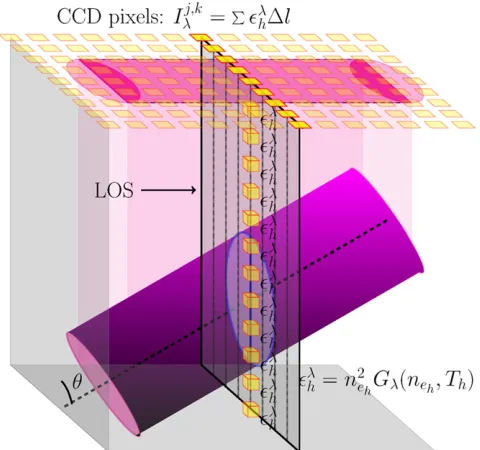
Figure2 illustrates the forward modeling method and how the LOS integration (Equation (16))is implemented numeri-cally. For each grid point, the emissivity 0 G ne2
0 =
l l
is
calculated and is spread to a Gaussian spectrum with the width determined by the thermal broadening of the spectral line. The spectrum covered in this study is centered at 1118.1 Å with a range of0.5 Å(130 km s-1). This is an FeXIXEUV line, in
which most spectroscopic observations on standing slow wave were performed (see Wang 2011). We used 60 wavelength values to sample the spectrum. This corresponds to a spectral resolution ofD =l 16.7 mÅ or DvD=4.5 km s-1, which is sufficient to resolve the spectrum. Then along the LOS, the emission wavelength of the elementary plasmafluid is modified by the velocity perturbation caused by the wave and is rebinned into the discrete spectrum. By assuming a Gaussian distribution for the integrated spectrum, we obtain the emission intensityIl0 and Doppler shift velocityvD.
5 The source of the forward modeling code(FoMo)is available athttps://
We perform the calculations for LOS angles 30 , 45 , 60
q= , and 90, respectively. The projected planeofsky has a mesh grid of Nx´Nz =45´300 sinq, so that the synthesized LOS emission plane has a pixel size of 0.33´0.33 Mm2 (Figure2).
3.2. Imaging Modeling
To synthesize the observational features of SDO/AIA channels, we calculated the AIA temperature response function Ka( ,ne T)(DN cm s )5 -1 for bandpassα(Boerner et al.2012):
(
)
(
)
K ne,T G ,n ,T R ( )d , (17)
0 e
ò
l l l=
a a
¥
where R ( )(DN cm sr photon )l 2 1
a - is the
instrument-wave-length response function. This is the product of the solid angle occupied by a unit surface(0″. 6 × 0″. 6)relative to the telescope and the value calculated with the aia_get_resp.pro. G( ,l ne,T)(photon cm s3 -1sr )-1 is the contribution function calculated with the isothermal.pro routine in CHIANTI (see Del Zanna et al.2011). Then thefluxF( )(DN s )x 1
a - at pixelx
is integrated along the LOS,
(
)
x
F ( ) K n ,T n dl. (18)
l e e
2
ò
=
[image:5.612.52.567.72.429.2]a a
Table 1
Parameters of the Loop Systems and the Standing Slow Modes
Loops Ti=6.4 MK Ti=8.8 MK Ti=12 MK Ti=15 MK Ti=20 MK
L0(Mm) 100 100 100 100 100
a(Mm) 5.0 5.0 5.0 5.0 5.0
Bi(G) 40.0 40.0 40.0 40.0 40.0
Be(G) 43.8 45.3 47.0 48.7 51.6
(10 kg m )
i 11 3
r - - 1.4 1.4 1.4 1.4 1.4
nei(10 cm )9 -3 8.5 8.5 8.5 8.5 8.5
i e
r r 5.0 5.0 5.0 5.0 5.0
Ti(10 K)6 6.4 8.8 12.0 15.0 20.0
T Ti e 1.5 1.5 1.5 1.5 2.0
i
b 0.23 0.32 0.44 0.55 0.74
e
b 0.026 0.034 0.043 0.050 0.044
Csi(km s )-1 420 490 570 640 740
VAi(km s )-1 950 950 950 950 950
CTi(km s )-1 380 440 490 530 580
Cse(km s )-1 340 400 470 520 530
VAe(km s )-1 2300 2400 2500 2600 2700
CTe(km s )-1 340 400 460 510 520
n=1,A=0.01
vz0(km s )-1
a 57 47 38 31 28
1 0
i
r r 0.12 0.08 0.06 0.04 0.03
T10 Ti 0.08 0.06 0.04 0.03 0.02
n=2,A=0.02
vz0(km s )-1 41 L L L L
1 0
i
r r 0.09 L L L L
T10 Ti 0.06 L L L L
n=3,A=0.04
vz0(km s )-1 48 L L L L
1 0
i
r r 0.11 L L L L
T10 Ti 0.07 L L L L
Note.
a
[image:5.612.50.290.466.691.2]The superscript 0 here and hereafter denotes the amplitude of the perturbed quantities in Equations(11)–(15), excluding the spatial and temporal terms.
Equation (18) is solved using the same algorithm as Equation (16) (Figure 2);however, the intensity is obtained by summing up the contributing emissions in all effective wavelengths (Equation (17)) rather than spreading into a spectrum (see Section 3.1). A look-up table for each AIA bandpass is sampled at a uniform mesh of size 200 × 200 grid points atlogne(cm )-3 Î[8, 11]and logT(K)Î[4, 8].
We synthesized the AIA 94 Å channel that would image our
flaring loops (>6.4 MK). The resultant pixel size is kept uniform at 0″. 6 × 0″. 6;therefore, we choose a mesh grid of Nx´Nz=35´230 sinqfor output and perform the calcula-tions for LOS anglesq=30 , 45 , 60 , and90, respectively. Point-spread functions (PSFs;see Antolin & Van Doorsse-laere 2013; Poduval et al. 2013) would only have marginal effect at the edges and the cylinder boundaries. Moreover, we use long-wavelength limits, and the plasma motions are predominantly longitudinal;thus, PSF effect is neglected in this study.
4. RESULTS
In this section, we divide the results into two categories that observers mainly use to detect standing slow mode in a coronal loop. As we use linearization of the MHD wave model and perform geometric integration by modeling the atomic emis-sions, the results could be scaled to the range of interests. In the following subsections, we present a typical observation mode of a spectrograph or imager and study other effects that may affect the observations.
4.1. Spectroscopic Observations
4.1.1. Typical Observation
Wefirst mimic a sit-and-stare campaign of a spectrograph, e.g., SUMER. The slit is ideally placed to fully cover the
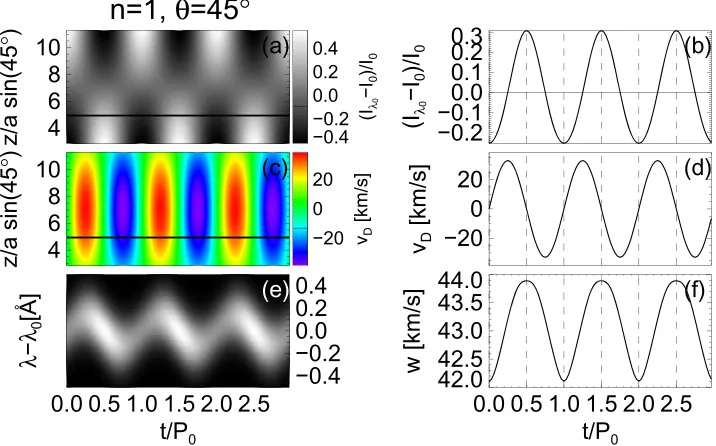
central line of our loop with a viewing angle of 45°. Figure3
presents typical observables of a spectrograph. The intensity perturbation (Figure 3(a)) has a larger value at the loop footpoints than at the loop apex, while the Doppler shift vD (Figure 3(c)) shows an opposite spatial pattern: it has a maximum at the loop apex. This is in agreement with the standing slow-wave model (see Section 2.2), in which the longitudinal velocity and density are phase-shifted in space by a quarter wavelength. Time series(Figures3(b)and(d))taken at a position off the loop apex and footpoints show a typical observation, which could be directly compared with Figure 2 in Wang (2011): the intensity perturbation oscillates with a quarter period out of phase in time with the Doppler shiftvD.
We also show that intensity variations are in phase with line width w oscillations (Figures 3(b) and(f)). Figure 3(e) illustrates a typical spectrum that would be observed in a sit-and-stare mode: the spectral line is Doppler-shifted by the standing slow wave and is also broadened by the perturbed velocity and temperature along LOS. Spectral observations at a slit position could provide the first signal of an MHD wave. The line width variation is not reported so far by any observations;its temporal variation and phase relations with other observables could be used to identify the wave mode. This may be due to the low amplitude of the line width oscillation (about1 km s-1);thus, it is beyond the detection capability of current instruments.
When the viewing angle is normal to the loop, i.e., 90
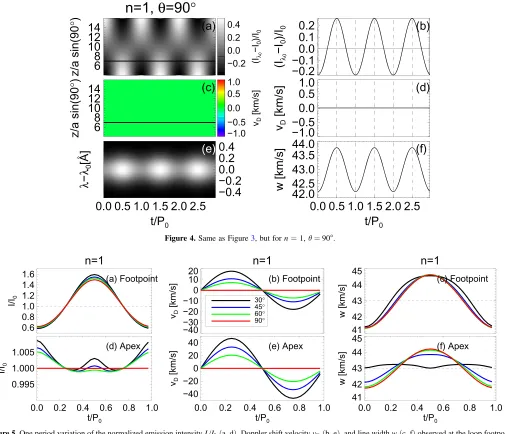
(Figure4), the intensity and line width broadening modulation are still significant and are in phase with each other. However, the Doppler shiftvDoscillation becomes below noise level and
is not detectable. If a slit is placed over the loop apex
(antinode), then the intensity and line width modulation will be very small.
A measure of goodness-of-fitc2 to a Gaussian spectrum is
[image:6.612.128.486.54.277.2]combination of multiple-temperature spectral components could approximate a single Gaussian spectrum. For the standing slow mode, the plasma motions are predominately longitudinal, so plasma advections across the cylinder boundary are negligible. Therefore, the spectra rarely deviate from a Gaussian shape. In our study, the c2 measures at the
order of 10−4. This means that the Gaussian profiles are in accord with the spectra or the error variance has been overestimated. The latter is true in our case, since we do not have error bars associated with the spectra and unity is used as error variance.
4.1.2. LOS Effect
Figure5presents the two extreme cases at the loop apex and footpoints.6 At the footpoints, the intensity and line width
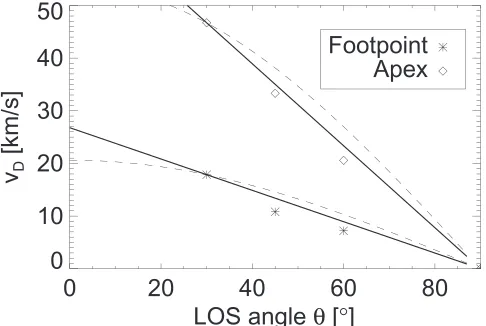
variations do not change significantly with varying LOS angles;this is because the wavelength ofn =1 standing slow mode is significantly longer than the loop radius. Thus, rays of any LOS angle are less likely to traverse both the node and antinode. This is contrary to the short-wavelength case for the fast sausage mode(Antolin & Van Doorsselaere2013). In the short-wavelength limit, LOS rays would traverse more fine structures along both radial and longitudinal directions; ther-efore, the intensity and line width modulations are more complicated. However, in our case, the modulation of Doppler shift is significantly affected by LOS angles, since the longitudinal velocity dominates the perturbation. In a rough approximation, the amplitude of Doppler shift could be linearly de-projected by a factor of1 -q 90or 1–2θ/π , rather than cosq (Figure6). Acosqde-projection could overestimate the velocity perturbation by a factor of more than 10%. This empirical formula could be used in observations. The reason for the deviation from simple geometric projection is that each
[image:7.612.56.561.51.485.2]fluid element is projected bycosq, while the overall Doppler-shifted spectrum including the contribution of allfluid elements Figure 4.Same as Figure3, but forn=1,θ=90°.
Figure 5.One period variation of the normalized emission intensityI I0(a, d), Doppler shift velocityvD(b, e), and line widthw(c, f)observed at the loop footpoint
and apex forthe n=1 mode.
6
We truncated2 sin 30a =4aoff the loop ends, where rays with an LOS angle of30would traverse only part of the loop crosssection and will contain an edge effect; therefore, we refer to the positions of z=4 ,a L0– 4a as
[image:7.612.123.495.58.324.2]along LOS does not necessarily follow the same trend. This result will affect the estimate of realistic longitudinal velocity perturbation with a two-dimensional observation and the associated wave energy budget. The LOS effect may also lead to incorrect longitudinal mode identification(see, e.g., Antolin & Verwichte2011).
The Doppler shift modulation exhibits similar patterns owing to LOS variation at both the apex and footpoints(Figures5(b) and(e)). Intriguingly, we found that positive modulation of the intensity is overwhelmingly in excess over negative modula-tions at every LOS angle(Figures3,4, and5(a)). This effect may halve the periodicity at regions where the intensity modulation is relatively weak, e.g., at the apex(Figure4(d)). This is not introduced by asymmetry in the geometry or the distribution of electron density ne or plasma temperature T.
Figures 7 presents the contribution function of the FeXIXλ1118.1 line; the plus sign indicates the loop para-meters.Gl0( ,ne T)varies less than 1% with the electron density neat high temperatures, but strongly peaks in temperature. In
our case, positive temperature modulation leads to larger increase inGl0 than the same amount of negative temperature modulation would do;therefore, we have excess intensity enhancement when temperature increases. This was also found, although not mentioned, in the case of intensity variation in the 193 Å bandpass (Antolin & Van Doorsselaere 2013). In contrast, this effect is missing in the 171 Å bandpass, as the contribution function G171has an almost equal gradient with
respect to T in the temperature of interest;see Figure 6 in Antolin & Van Doorsselaere (2013). This effect leads to a halving of periodicity in intensity and line width, especially in small LOS angles. It would become more significant for a loop with a temperature such that G2 T2
0
¶ l ¶ reach extreme values.
In such conditions, this effect would spread to broader spatial regions and larger LOS angles. We also notice that this effect would lead the asymmetry in emission intensity modulation
(Figure 5(a)); however, it is highly likely to be neglected or removed by the data processing technique, e.g., detrending, running difference.
4.1.3. Longitudinal Overtones
We perform sit-and-stare mode observations for n = 2, 3 modes as well (figures are not shown here). In spectroscopic
observations, only a small segment of the spatial distribution of emission intensity and Doppler shift along a loop is normally measured. Without spatial information, it is not possible to judge the longitudinal mode number. However, with imaging observations, longitudinal overtones may be observed(see the next section).
4.2. Imaging Observation
In imaging observations, the spatial distribution of the emission intensity is obtained. One could easily follow the spatiotemporal variation of a loop oscillation using the time– distance method (see, e.g., Yuan & Nakariakov 2012). Figure8(a)shows the baseline-ratio difference plot of n =1 mode along the loop. The intensity perturbation is more significant at the loop footpoints than the loop apex. By changing the viewing angle, the intensity modulation changes slightly, but the overall spatiotemporal pattern remains unchanged. This is in agreement with the spectroscopic model;see discussions in Section 4.1. The time–distance plot along a loop could reveal the nodal structures of the longitudinal overtones (Figures 8(b) and(c)). By comparing the amplitude variation along the loop, one could measure the longitudinal mode numbernand hence the wavelength of the slow mode2L n0 .
4.3. Observing Standing Slow Mode in Hot Loops with Different Temperatures
So far, we haveonly studied a6.4 MK loop with a fixed density and temperature ratio. As long as the background emission is insignificant compared to loop emission, the current result remains valid. However, if a coronal loop is heated to the hotter wing(Ti>8.8 MK)ofGl0(Figure7), the background
emission could become stronger than the loop itself. In such cases, the observed Doppler shift and intensity modulation would be rather different. The free parameters are the loop temperature, density, and the temperature and density ratio. It is not practical to iterate all possible combinations, so we only present possible scenarios of how to understand a standing slow mode properly. We vary the loop temperature, while keeping other free parameters unchanged. Several loop models are set up at the various temperatures where the SUMER
λ1118.1 responses are signficant(see Table 1).
[image:8.612.48.291.52.215.2]Figure 9 illustrates snapshots of the relative intensity, Doppler velocity, and line width of standing slow modes Figure 6.Doppler shift velocity amplitude as a function of LOS viewing angle
at the footpoint(asterisks)and apex(diamonds). The dashed and solid lines represent the trend ofcosqand(1-q90)dependence, respectively.
[image:8.612.322.566.54.193.2]Figure 8.Baseline ratio time–distance plot of AIA 94 Å emission intensity along the central axis of the loop for modes(a)n=1,(b)n=2, and(c)n=3.
[image:9.612.123.490.324.693.2]observed in loops at Ti=6.4, 8.8, 12, 15, and 20 MK, respectively. The snapshots are taken att=P0 8at a viewing angle of q=45 (other viewing angles give similar results;therefore, they are not shown). At the cooler wing of
λ1118.1, positive temperature modulation would enhance the intensity, while at the hotter wing, the opposite would occur. The intensity modulation becomes relatively small, as the ambient plasma emission intensity becomes significant or stronger than the loop itself(e.g.,Ti=20 MK).
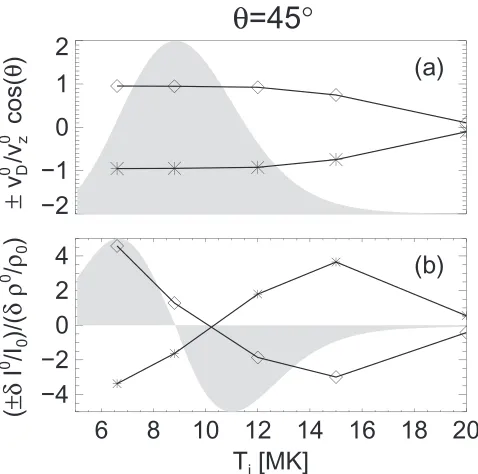
Figure 10(b) shows the normalized relative intensity modulation( I0 I ) ( )
0 0
d dr r , which is usually assumed to be 2 (Wang et al. 2009b), at the loop footpoint against loop temperature. It illustrates how the sign of¶Gl0( )T ¶T would modulate the intensity variation and causes the asymmetry effect (see discussions in Section 4.1.2). We found that
I I
(d 0 0) (dr r0)could be considerably larger than 2, and that it is only close to 2 at regions where∣¶Gl0( )T ¶T∣is relatively small. At extremely hot loops (20 MK), the normalized intensity modulation could even approach zero.
On the other hand, the Doppler shift velocity of standing slow moderemains detectable for most loop temperatures. However, the normalized amplitudevD (vz cos )
0 0 q at the loop
apex (it is symmetric for both positive and negative motions) deviates more and more from unity for loops at higher temperatures(Figure10(a)). This does not mean that the wave energy is undetected. It is still buried in the line width
(Figure9, right column)or the skewness of the spectra, which are not measured in this study.
5. CONCLUSION
In this paper, we performed forward modeling to predict the observational features of standing slow modes in hot coronal loops. By considering the geometrical and instrumental effects, we measure the plasma emission intensity, Doppler shift, line width, and spectrum modification caused by the standing slow mode.
We found that the Doppler shift velocity is significantly affected by the LOS effect;it could become undetectable at aviewing angle of q=90. We found that a linear de-projection by the LOS angle is more accurate than thecosq de-projection as traditionally used in Wang(2011). The emission intensity perturbation is normally a quarter period out of phase with the Doppler shift velocity variation, in both time and space. This effect has been used to identify the standing slow wave mode. Positive temperature variation introduces more emission intensity enhancement than the same amount of negative temperature variation would reduce it, because
G 0 T T0
¶ l ¶ ∣ + is significantly larger than ¶Gl0 ¶T∣T0-, i.e.,
G T T
2 2
0 0
¶ l ¶ ∣ reaches positive extremes. This effect could lead
to the halving of the periodicity in intensity and line width at the loop apex. Half periodicity could be also reached if the
G 0 T T0 G 0 T T0
¶ l ¶ ∣ - ¶ l ¶ ∣ +, which could be only found at the hotter wing ofGl0, meaning that the loop has to be heated to a few tens of MK in megaflares. This second-order effect in the contribution function could also lead to asymmetry in the emission intensity modulation.
Spectroscopic observations with a sit-and-stare mode alone are not able to resolve longitudinal overtones along the loop, owing to the lack of spatial information. With EUV imagers, the longitudinal overtones could be resolved by investigating the spatial distribution of the emission intensity modulation. A good way of studying standing slow modes is to use joint observations of spectrographs and imagers.
The Doppler shift oscillation of a standing slow wave strongly depends on the viewing angle;for those observations with LOS angles close to 90, we may not detect Doppler shifts. For loops on the solar disk, a sit-and-stare campaign of spectrographic observation is favored to be placed slightly off the loop apex, because there is a higher probability that the viewing angle would be close to 90. For spectrographic observations off-limb, most loops’apexes are well exposed for observation at good viewing angles.
The emission contribution function plays a signficant role in determining the observational features of a standing slow wave. It may cause asymmetric intensity modulation for positive and negative temperature perturbations. This effect could be the opposite for loops at the cooler and hotter wings of theλ1118.1 line. The normalized relative intensity modulation
I I
( 0 ) ( )
0 0
[image:10.612.49.288.50.287.2]d dr r would be 2 only for the loops close to the peak response temperature of the λ1118.1 line. The Doppler shift velocity could be significantly smaller than the plasma velocity, if the background plasma emission becomes more significant or stronger than the loop emission. For loops at the hotter wing of a spectral line, the intensity modulation could be small, and one will only observe the Doppler shift. It may lead to a false interpretation of the result, e.g., in the case of a propagating fast wave(Tomczyk et al.2007; Van Doorsselaere et al.2008).
Figure 10.For loops at different temperatures, (a)presents the normalized Doppler velocity at a viewing angle ofq=45at loop apexes;(b)shows the normalized relative intensity modulation at the loop footpoint, where
I0 I0 (It 0 It P04) It P04
d = = - = = and -dI0 I0=(It=P02-It=P04) It=P04. The shaded areas illustrate the scaled (a)Gl0( )T and (b)¶Gl0( )T ¶Tat
Imaging observations are subject to more variability, e.g., loop curvatures, plasma stratification, and ambiguity of the loop footpoints. The amplitude variation along a loop is sufficient to identify the longitudinal overtones (Figure 8). Normallythe n=1 mode could be well identified even if the footpoints are hard tofind. However, then>1overtones have shorter wavelength and the nodes close to the footpoints are less reliably measured;therefore, it poses some challenges to identify ann>1overtone.
From the observables, we could attempt to perform MHD seismology(Wang et al. 2007). For the input parameters, we allocate 10% uncertainties to period P0and loop length L0,
while we keep the perturbations of density and temperatures as the uncertainties. So we have loop lengthL0=10010 Mm, density r0=(1.40.2) · 10-11kg m-3, and temperature T0=(6.30.5) MK, and then we estimate the magneticfield strength B0=(40.66.2) G inside the loop. If we compare the result to the real input 40 G, the main uncertainty is in the estimation of the parameters, while the assumption that
L P C
2 0 0 T only results in about 1.5% of the uncertainty. In
the long-wavelength limit, this assumption remains valid and causes small uncertainties in MHD seismology. However, one has to be cautious in using this relation;if the wavelength is much shorter or the plasma β is not small, the associated relative error could be estimated by(1+gbi 2)0.5-1.
The research was supported by an Odysseus grant of the FWO Vlaanderen, the IAP P7/08 CHARM (Belspo), the Topping-Up grant Cor-Seis and the GOA-2015-014 (KU Leuven), and the Open Research Program KLSA201312 of Key Laboratory of Solar Activity of National Astronomical Observatories of China (D.Y.). CHIANTI is a collaborative project involving George Mason University, the University of Michigan(USA), and the University of Cambridge(UK).
REFERENCES
Andries, J., Arregui, I., & Goossens, M. 2005,ApJL,624, L57
Anfinogentov, S., Nakariakov, V. M., Mathioudakis, M., Van Doorsselaere, T., & Kowalski, A. F. 2013,ApJ,773, 156
Antolin, P., & Rouppe van der Voort, L. 2012,ApJ,745, 152
Antolin, P., & Van Doorsselaere, T. 2013,A&A,555, A74
Antolin, P., & Verwichte, E. 2011,ApJ,736, 121
Antolin, P., Vissers, G., Pereira, T. M. D., Rouppe van der Voort, L., & Scullion, E. 2015,ApJ,806, 81
Antolin, P., Yokoyama, T., & van Doorsselaere, T. 2014,ApJL,787, L22
Arregui, I. 2015, RSPTA, 373, 2042
Arregui, I., Andries, J., van Doorsselaere, T., Goossens, M., & Poedts, S. 2007, A&A,463, 333
Asai, A., Shimojo, M., Isobe, H., et al. 2001,ApJL,562, L103
Aschwanden, M. J. 2005, Physics of the Solar Corona: An Introduction with Problems and Solutions(2nd ed.; Berlin: Springer-Verlag)
Aschwanden, M. J., Fletcher, L., Schrijver, C. J., & Alexander, D. 1999,ApJ,
520, 880
Aschwanden, M. J., Nightingale, R. W., Andries, J., Goossens, M., & Van Doorsselaere, T. 2003,ApJ,598, 1375
Boerner, P., Edwards, C., Lemen, J., et al. 2012, SoPh,275, 41
Chen, Y., Feng, S. W., Li, B., et al. 2011,ApJ,728, 147
Chen, Y., Song, H. Q., Li, B., et al. 2010,ApJ,714, 644
Cooper, F. C., Nakariakov, V. M., & Tsiklauri, D. 2003a,A&A,397, 765
Cooper, F. C., Nakariakov, V. M., & Williams, D. R. 2003b,A&A,409, 325
De Moortel, I., Hood, A. W., Ireland, J., & Walsh, R. W. 2002a, SoPh,209, 89
De Moortel, I., Ireland, J., & Walsh, R. W. 2000, A&A,355, L23
De Moortel, I., Ireland, J., Walsh, R. W., & Hood, A. W. 2002b, SoPh,209, 61
De Moortel, I., & Nakariakov, V. M. 2012,RSPTA,370, 3193
Del Zanna, G., O’Dwyer, B., & Mason, H. E. 2011,A&A,535, A46
Dere, K. P., Landi, E., Mason, H. E., Monsignori Fossi, B. C., & Young, P. R. 1997, A&AS,125, 149
Edwin, P. M., & Roberts, B. 1983, SoPh,88, 179
Fleishman, G. D., & Kuznetsov, A. A. 2010,ApJ,721, 1127
Goossens, M., Erdélyi, R., & Ruderman, M. S. 2011, SSRv,158, 289
Gruszecki, M., Nakariakov, V. M., & Van Doorsselaere, T. 2012, A&A,
543, A12
Hood, A. W., Browning, P. K., & van der Linden, R. A. M. 2009,A&A,
506, 913
Jess, D. B., Reznikova, V. E., van Doorsselaere, T., Keys, P. H., & Mackay, D. H. 2013,ApJ,779, 168
Kim, S., Nakariakov, V. M., & Shibasaki, K. 2012,ApJL,756, L36
Klimchuk, J. A. 2006, SoPh,234, 41
Krishna Prasad, S., Banerjee, D., & Van Doorsselaere, T. 2014,ApJ,789, 118
Kumar, P., Innes, D. E., & Inhester, B. 2013,ApJL,779, L7
Kumar, P., Nakariakov, V. M., & Cho, K.-S. 2015,ApJ,804, 4
Kupriyanova, E. G., Melnikov, V. F., & Shibasaki, K. 2013, SoPh,284, 559
Kuznetsov, A. A., van Doorsselaere, T., & Reznikova, V. E. 2015,SoPh,
290, 1173
Landi, E., Young, P. R., Dere, K. P., Del Zanna, G., & Mason, H. E. 2013, ApJ,763, 86
Mariska, J. T. 2006,ApJ,639, 484
Melnikov, V. F., Reznikova, V. E., Shibasaki, K., & Nakariakov, V. M. 2005, A&A,439, 727
Moreels, M. G., & Van Doorsselaere, T. 2013,A&A,551, A137
Mossessian, G., & Fleishman, G. D. 2012,ApJ,748, 140
Nakariakov, V. M., & Melnikov, V. F. 2009, SSRv,149, 119
Nakariakov, V. M., & Ofman, L. 2001,A&A,372, L53
Nakariakov, V. M., Ofman, L., Deluca, E. E., Roberts, B., & Davila, J. M. 1999,Sci,285, 862
Nakariakov, V. M., & Verwichte, E. 2005, LRSP,2, 3
Ning, Z. 2014, SoPh,289, 1239
Ofman, L. 2010, LRSP,7, 4
Ofman, L., & Wang, T. 2002,ApJL,580, L85
Parnell, C. E., & De Moortel, I. 2012,RSPTA,370, 3217
Peter, H., Bingert, S., Klimchuk, J. A., et al. 2013,A&A,556, A104
Poduval, B., DeForest, C. E., Schmelz, J. T., & Pathak, S. 2013,ApJ,765, 144
Priest, E. R., Heyvaerts, J. F., & Title, A. M. 2002,ApJ,576, 533
Reale, F. 2014, LRSP,11, 4
Reznikova, V. E., Antolin, P., & van Doorsselaere, T. 2014,ApJ,785, 86
Reznikova, V. E., van Doorsselaere, T., & Kuznetsov, A. A. 2015,A&A,
575, A47
Ruderman, M. S. 2011a,A&A,534, A78
Ruderman, M. S. 2011b, SoPh,271, 41
Ruderman, M. S., & Erdélyi, R. 2009, SSRv,149, 199
Sakurai, T., Goossens, M., & Hollweg, J. V. 1991, SoPh,133, 227
Sakurai, T., Ichimoto, K., Raju, K. P., & Singh, J. 2002, SoPh,209, 265
Scullion, E., Rouppe van der Voort, L., Wedemeyer, S., & Antolin, P. 2014, ApJ,797, 36
Selwa, M., Murawski, K., & Solanki, S. K. 2005,A&A,436, 701
Taroyan, Y., & Bradshaw, S. 2008,A&A,481, 247
Taroyan, Y., & Erdélyi, R. 2009, SSRv,149, 229
Taroyan, Y., Erdélyi, R., Doyle, J. G., & Bradshaw, S. J. 2005,A&A,438, 713
Taroyan, Y., Erdélyi, R., Wang, T. J., & Bradshaw, S. J. 2007, ApJL,
659, L173
Tomczyk, S., McIntosh, S. W., Keil, S. L., et al. 2007,Sci,317, 1192
van der Holst, B., Sokolov, I. V., Meng, X., et al. 2014,ApJ,782, 81
Van Doorsselaere, T., de Groof, A., Zender, J., Berghmans, D., & Goossens, M. 2011a,ApJ,740, 90
Van Doorsselaere, T., Gijsen, S. E., Andries, J., & Verth, G. 2014, ApJ,
795, 18
Van Doorsselaere, T., Nakariakov, V. M., & Verwichte, E. 2008, ApJL,
676, L73
Van Doorsselaere, T., Wardle, N., del Zanna, G., et al. 2011b,ApJL,727, L32
Verth, G., Erdélyi, R., & Jess, D. B. 2008,ApJL,687, L45
Wang, T. 2011, SSRv,158, 397
Wang, T., Innes, D. E., & Qiu, J. 2007,ApJ,656, 598
Wang, T., Solanki, S. K., Curdt, W., Innes, D. E., & Dammasch, I. E. 2002, ApJL,574, L101
Wang, T. J., Ofman, L., & Davila, J. M. 2009a,ApJ,696, 1448
Wang, T. J., Ofman, L., Davila, J. M., & Mariska, J. T. 2009b,A&A,503, L25
Wang, T. J., Solanki, S. K., Curdt, W., et al. 2003a,A&A,406, 1105
Wang, T. J., Solanki, S. K., Innes, D. E., & Curdt, W. 2005,A&A,435, 753
Wang, T. J., Solanki, S. K., Innes, D. E., Curdt, W., & Marsch, E. 2003b, A&A,402, L17
Williams, D. R., Mathioudakis, M., Gallagher, P. T., et al. 2002,MNRAS,
336, 747
Winebarger, A. R., Warren, H., van Ballegooijen, A., DeLuca, E. E., & Golub, L. 2002,ApJL,567, L89
Yuan, D., & Nakariakov, V. M. 2012,A&A,543, A9
Yuan, D., Nakariakov, V. M., Huang, Z., et al. 2014a,ApJ,792, 41
Yuan, D., Pascoe, D. J., Nakariakov, V. M., Li, B., & Keppens, R. 2015,ApJ,
799, 221
Yuan, D., Sych, R., Reznikova, V. E., & Nakariakov, V. M. 2014b,A&A,