Performance Analysis of a Threshold-Based Relay
Sele
c
tion Algorithm in Wireless Networks
Hao Niu, Taiyi Zhang, Li Sun
Department of Information and Communication Engineering, Xi’an Jiaotong University, Xi’an, China E-mail: nhfly86@gmail.com
Received December 21, 2009; revisedFebruary 1, 2010; accepted March 1, 2010
Abstract
Relay selection is an effective method to realize the cooperative diversity gain in wireless networks. In this paper, we study a threshold-based single relay selection algorithm. A reasonable threshold value is set at each relay node, and the first relay with the instantaneous channel gain larger than the threshold will be se-lected to cooperate with the source. The exact and closed form expression for its outage probability is de-rived over independent, non-identically distributed (i.n.i.d) Rayleigh channels. The complexity of the algo-rithm is also analyzed in detail. Simulation results are presented to verify our theoretical analysis.
Keywords:Relay Selection, Outage Probability, Threshold, Wireless Networks
1. Introduction
User cooperation is a promising technique to improve the performance of wireless networks [1-3]. One possible approach to realize cooperative diversity is to use dis-tributed space-time coding (DSTC) among participating nodes [4]. However, the design of such code is difficult in practice and is still an open area of research.
Aiming at these problems, Bletsas et al. introduced a novel scheme called opportunistic relaying in [5], where only the “best” relay among all available candi-dates is selected to cooperate with the source. Analysis in [5,6] proved that this method can provide the same diversity-and-multiplexing tradeoff (DMT) as DSTC. However, as pointed in [5], a distributed relay selection may lead to packet collision which is a cause to fail the procedure, and the centralized approach requires a large number of channel estimations, which is energy- inefficient and not practical for resource-constrained networks.
In order to overcome the above-mentioned drawbacks, Hwang and Ko proposed a sub-optimal relay selection algorithm in [7], where a pre-determined threshold is set both at the relay and the destination, and the first relay with equivalent channel gain larger than the threshold is selected. This algorithm can significantly reduce the im-plementation complexity and power consumptions
com-pared with the conventional opportunistic relaying algo-rithm. However, reference [7] didn’t present the exact outage probability formula of the algorithm.
In this paper, we follow the basic ideas of [7] while some detailed analyses are presented. The main contribu-tion of our work is that we derive the exact closed form expression for the outage probability of the algorithm over independent, non-identically distributed (i.n.i.d) Rayleigh channels. We will show that this algorithm can achieve the same diversity order as opportunistic relay-ing, while its complexity in terms of the amount of channel estimations can be reduced obviously.
2. System Model and Basic Assumptions
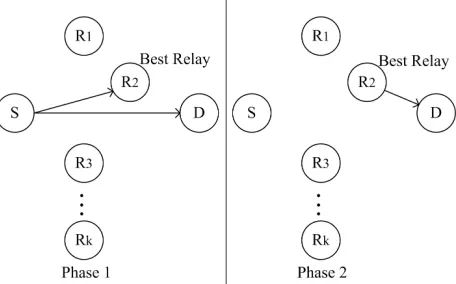
We consider a half-duplex dual-hop communication sys-tem as shown in Figure 1, where there are a source ( ), a destination ( ) and K relay nodes ( , ).
S }
D Rk k{1,...,K
h
1 1
( )
1
( )
( ) 1
1
(1 ),
Pr{ }
(1 ) ( 1) (
si id
i
skj k dj j n si id
K
i
th K
th i n
i
e t
outage
e e e
1 1 1 1 2 1
1
( ) ( )
1 0 1 ... 1
1 ... 1
...
),
si id si id
n
n i
i
K i
th i n k k i
k k i k k k
e th
(1)signal to the destination using decode-and-forward (DF) protocol [1].
For each link, the channel is assumed to be block flat fading (quasi-static), which remains constant during one frame and varies independently from frame to frame (In our system, one frame is comprised of two phases). The channel gain, i.e., the squared channel strength, between the source and the destination, the source and the kth relay, and the kth relay and the destination are repre-sented by gsd, gsk and gkd, respectively (k{1,..., }K ). The channel coefficients are modeled as zero-mean, in-dependent, circularly-symmetric complex Gaussian ran-dom variables, so gsd, gsk and gkd obey exponential distributions and notations sd, sk and kd are in-troduced to denote their distribution parameters.
In the following analysis, we consider two communi-cation scenarios. For Scenario I, the direct link between the source and the destination doesn’t exist, i.e., the source communicates with the destination only via re-laying. For Scenario II, the source can communicate with the destination directly, and the destination combines the two received signals coming from the source and the best relay with a maximal ratio combiner (MRC).
3. Review of the Threshold-Based Relay
Selection Algorithm
[image:2.595.59.287.548.690.2]The relay selection procedure is activated before every source transmission, the operation of the algorithm was described in [7] and we summarize it as follows.
Figure 1. The block diagram of the half-duplex dual-hop system.
Step 1: Initialize k = 0.
Step 2: Set k ←k + 1, if k = K + 1, go to Step 4. Step 3: If the instantaneous channel gain of the kth re-lay is larger than the predetermined threshold value, i.e.
min{gsk,gkd}th
g
, relay k is selected as the best relay and the algorithm terminates: , otherwise go to Step 2.
*
k k
Step 4: Evaluate and
select node as the best relay.
* argmax{min{ , }}
sk kd
k
k g
*
k
In the algorithm above, th is the predetermined thresh-old value and denotes the “best” relay. Note that we use the minimum of the channel gains between the links and to describe the channel quality at relay k, which is consistent with the state-ments in [6,7].
*
k
Sk kD
4. Research of the Threshold-Based Relay
Selection Algorithm for Scenario I
4.1. Outage Probability of the Algorithm
Theorem 1: Denoting the required spectral efficiency by R and the average transmit signal-to-noise by SNR, the outage probability of the threshold-based algorithm can be expressed by (1), where (22R1) / SNR.
Proof: Communication through the “best” relay fails due to outage when either of the two hops (from the source to the best relay and from the best relay to destination) fails. Thus the outage probability can be expressed as [8]:
* *
Pr(outage) Pr{min{ gsk , }gk d } (2) For each i, letting gi represent the minimum of gsi and gid, i.e., gi min{gsi, }gid , we can see that the probability in (2) depends on the statistical property of
*
k
g .
Recall that the algorithm selects the first relay with the instantaneous channel gain larger than the threshold as the best relay, and if no such relay exists, the best relay is selected as the opportunistic relaying method does, so we have to consider two cases to calculate the probability.
By using the fact that the minimum of two independ-ent exponindepend-ential random variables with parameter si and id is again an exponential random variable with parameter siid, the probability of case 1 can be cal-culated as
{1,2,..., }
( )
1
Pr{ 1} Pr{ max {min{ , }} } (1 si id )
si id
i K
K
th
i
case g g th
e
(3)For case 1, is the relay node with the largest chan-nel gain and the outage probability conditioned on case 1 is given by
* k * ( ) 1 ( ) 1
Pr{ | 1} Pr{ | 1}
1, (1 ) , (1 ) si id si id k K i K th i
Outage case g case
th e th e
(4)Case 2: At least one relay has the channel gain lager than th.
This case is the complementary event of case 1 and its probability is given in (5).
( )
1
Pr{ 2} 1 (1 si id )
K
th
i
case e
(5)For case 2, is the first relay with channel gain la-ger than the threshold and the corresponding outage probability formula is expressed as
* k * * 1 1 1 1
Pr{ & }
Pr{ }
Pr{ | 2}
Pr{ 2} Pr{ 2}
Pr{ ,..., , , }
Pr{ 2}
K
i
k i
K
i i i
i
k i g
g Outage case
case case
g th g th g th g
case
(6) So the outage probability conditioned on case 2 is given in (7).1
( ) ( )
1 1
( )
1
0, <
,
( (1 )) ( )
Pr{ | 2}
1 (1 )
sj jd si id
si id
i K
th y
si id
i j th
K th i th e e Outage case e
th dy 1 i K i n (7)Finally, the outage probability of the algorithm can be evaluated, using total probability formula, as
2 1
Pr{ } Pr{ }Pr{ | }
i
Outage case i Outage case i
(8)Substituting (3), (4), (5), (7) into (8) and with the help of the following multinomial expansion [9], (1) can be obtained. However, we omit the details of this procedure due to the limitation of space.
1 1
1 2
0 1 ...
1 1 1 ... ... ( ) i n n K K
K K n
i i k k
n k k K
i i
k k K
k k k
x y x
y
(9)4.2. Discussion on the Results
The result in (1) may be attractive because it indicates that the threshold-based relay selection algorithm can achieve the same outage probability as opportunistic re-laying in [6] when a suitable threshold value is deter-mined, despite its simplicity.
Intuitively, to select the threshold value equal to , called outage threshold, is a simple but reasonable
choice. Note that depends only on the required spec-tral efficiency and average transmit signal-to-noise ratio, so th need not to be updated frequently during the com-munication procedure, which reduces the complexity of the algorithm obviously.
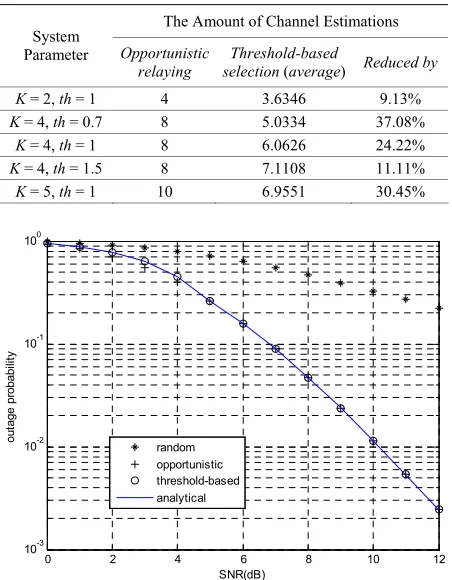
Computer simulations are carried out to validate the ana-lytical expressions. In Figure 2, we compare the outage probability of the threshold-based scheme to that of oppor-tunistic relaying [5] over the channel described in Section 2. To see the differences of the two algorithms clearly, we only give the results for low SNR regimes. In this simula-tion, we assume the nodes of the whole network are dis-tributed in a 1 × 1 rectangular coordinate system. The source node is located at (0,0) and the destination node at (1,1), K = 4 relay nodes are generated randomly and the mean of the fading coefficient between node i and j is de-termined by the distance dij between them, i.e.
1/ij dij
, where the path loss exponent is set to be
2
there is a performance loss if SNR < 5 dB, i.e., th . These observations are consistent with the results in (1).
Figure 2 also shows the outage probability for random selection method. It is noticeable that random selection incurs a substantial penalty loss. This is due to the fact that selecting the “best” relay randomly removes poten-tial selection diversity benefits.
Now we consider the complexity of the threshold- based algorithm in terms of the amount of channel esti-mations and compare it with that of opportunistic relay-ing method in [5,6]. The opportunistic relayrelay-ing needs the 2K number of channel estimations, while the average number of channel estimations of threshold- based method can be evaluated by (10)1.
( )
1
2 ( (1 si id ))
K
th e
i
N K e
1
( ) ( )
1 1
2 ( (1 sj jd )) si id
i K
th th
i j
e e
i (10) [image:4.595.60.286.389.679.2]It is not hard to achieve the closed form expression of (10) but this may be not helpful to analyze. Instead, we use numerical calculations to give some intuitive results in Table 1, where we set sk = 1, kd = 0.7 (k{1, 2,..., }K ) for convenience.
Table 1. Complexity comparison.
The Amount of Channel Estimations System
Parameter Opportunistic relaying
Threshold-based
selection (average) Reduced by
K = 2, th = 1 4 3.6346 9.13%
K = 4, th = 0.7 8 5.0334 37.08%
K = 4, th = 1 8 6.0626 24.22%
K = 4, th = 1.5 8 7.1108 11.11%
K = 5, th = 1 10 6.9551 30.45%
0 2 4 6 8 10 12
10-3 10-2 10-1 100
SNR(dB)
out
age
p
rob
ab
ili
ty
random opportunistic threshold-based analytical
Figure 2. The outage probabilities of random selection, op-portunistic relaying, and threshold-based algorithm with-out the direct link.
0 2 4 6 8 10 12 14 16
10-5 10-4 10-3 10-2 10-1 100
SNR(dB)
out
age p
rob
abi
lit
y
opportunistic threshold-based analytical
K=2
K=4 K=3
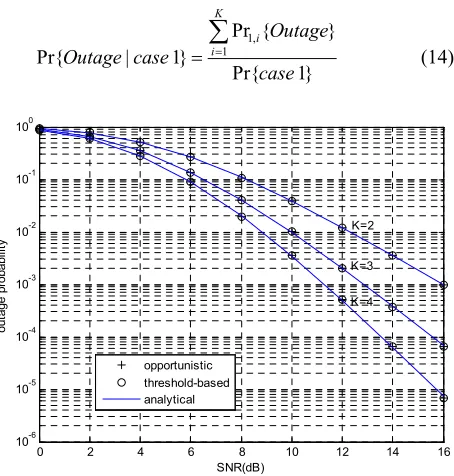
Figure 3. The outage probabilities of opportunistic relaying and threshold-based algorithm without the direct link.
From the results above we can conclude that the threshold-based relay selection algorithm is especially attractive in large networks. Besides that, the lower the threshold value is, the less the number of channel estima-tions is. However, reducing the threshold will incur a performance loss. Therefore, considering both the per-formance and complexity, we select the optimal thresh-old value th equal to . In Figure 3, we compare the outage probability of the threshold-based scheme to that of the opportunistic relaying [5] with th = .
5. Research of the Threshold-Based Relay
Selection Algorithm for Scenario II
In this section, we investigate the performance of the algorithm for Scenario II. The channel gain between the source and the destination is denoted by g. For simplicity, we set th = .
Similar to Section 4, we consider two cases and calcu-late the outage probability as follows.
Case 1: The channel gains of all relays are below the threshold, i.e.,
{1,2,..., }max {min{ si, }}id
i K g g th. The prob-ability of this case can be represented by
{1,2,..., }
( )
1
Pr{ 1} Pr{ max {min{ , }} } (1 si id )
si id
i K
K
th
i
case g g th
e
(11)In this case, is the relay node with the largest channel gain and the outage event happens if either of
he three situations takes place,
* k
t
1In fact, the actual amount is less than this, however, we use (10) for
1 1 1 2 1, 1 1 ( ( ) ( )) 1 1 1 ... 1 1
Pr { }
Pr{ } Pr{ }Pr{ | }
( )(1 )
( 1) [ ( 1)
( ) ( )
K
sd skj k dj si id j n n j j K i i i th th
K n si id
K k k K
sk k d si id
j n
Outage
Outage case i Outage case i
e e
1 11 2 1
1 1 1 1 0 ... ... ( ) ( ( ) ) 1 1 ( 1) ( ) n K K K
si sd j n skj k dj id
j j
K K i n
k k K
k k k i
th th
id K
sk k d id
j n e e
1 1 ( ) ( ( ) ( )) 1 1 ( 1)] ( ) ( ) Ksi sd j n skj k dj id sd
j j
th th
id K
sk k d id sd
j n e e
(16)Case 2: At least one relay has the channel gain lager than th. In this case, the outage probability is obviously zero. That is to say,
* * * * * * * *
( ) & &
( ) &
( ) & ( )
sk sk k d
sk k d
sk k d k d
a g th g g g th
b th g g g th
c g th g g g th
(12)
Pr{Outage case| 2}0 (15)
After some calculations, the outage probability is
given by (13). Finally, the outage probability of the algorithm is
ex-pressed by (16). * * * * * * * * * * * * 1, ( ) 0 1 ( )
Pr { }
( (1 ))[ (1
+ ( )(1 )
+ (1 )]
sj jd sk k d sd
k d sk sk sd
k d sk sd
k K
th x x x th
sk j
j k
x x th th
k d
x th th x
k d
Outage
e e e
e e e e
e e e dx
) e (13)In Figure 4, we compare the outage probability of the threshold-based scheme to that of opportunistic relaying [5] with th =
for Scenario II, the simulation condi-tions are the same as that for Figure 2. Simulation results also validate our analytical conclusions.6. Conclusions
In this paper, we have studied a threshold-based single relay selection algorithm for wireless networks. The ana-lytical closed form expressions of its outage probability are derived. Through computer simulations we analyze the performances of the algorithm. The results show that this method can achieve the same outage probability as that of opportunistic relaying with a suitable threshold, while its complexity is obviously reduced.
Using total probability formula, the outage probability conditioned on case 1 can be expressed as
1, 1
Pr { }
Pr{ | 1}
Pr{ 1} K i i Outage Outage case case
(14)0 2 4 6 8 10 12 14 16
10-6 10-5 10-4 10-3 10-2 10-1 100 SNR(dB) ou ta ge p ro ba bilit y opportunistic threshold-based analytical K=2 K=4 K=3
7
. References
[1] J. N. Laneman, D. N. C. Tse and G. W. Wornell, “Cooperative Diversity in Wireless Networks: Efficient Protocols and Outage Behavior,” IEEE Transactions on Information Theory, Vol. 50, No. 12, December 2004, pp. 3062-3080.
[2] K. J. R. Liu, A. K. Sadek, W. Su and A. Kwasinski, “Cooperative Communications and Networking,” Cam- bridge University Press, Cambridge, 2008.
[image:5.595.60.287.453.691.2][3] S. Chen, W. Wang and X. Zhang, “Performance Analysis of Multiuser Diversity in Cooperative Multi-relay Networks under Rayleigh-Fading Channels,” IEEE Transactions on Wireless Communications, Vol. 8, No. 7, July 2009, pp. 3415-3419.
Figure 4. The outage probabilities of opportunistic relaying
sity in Wireless Networks,” IEEE Transactions on Information Theory, Vol. 49, No. 10, October 2003, pp. 2415-2525.
[5] A. Bletsas, A. Khisti, D. P. Reed and A. Lippman, “A Simple Cooperative Diversity Method Based on Network Path Selection,” IEEE Journal on Selected Areas in Communications, Vol. 24, No. 3, March 2006, pp. 659-672.
[6] A. Bletsas, H. Shin and M. Z. Win, “Cooperative Commu- nications with Outage-Optimal Opportunistic Relaying,” IEEE Transactions on Wireless Communi- cations, Vol. 6, No. 9, September 2007, pp. 3450-3460.
[7] K.-S. Hwang and Y.-C. Ko, “An Efficient Relay Selection Algorithm for Cooperative Networks,” 2007 IEEE 66th Vehicular Technology Conference, Baltimore, 30 Sep- tember-3 October 2007, pp. 81-85.
[8] A. Bletsas, “Intelligent Antenna Sharing in Cooperative Diversity Wireless Networks,” Ph.D. Dissertation, Massa- chusetts Institute of Technology, Cambridge, 2005. [9] F. Xu, C. M. Lau, Q. F. Zhou and D. W. Yue, “Outage