doi:10.4236/psych.2010.11008 Published Online April 2010 (http://www.SciRP.org/journal/psych)
The Impact of Emotional Intelligence on Nursing:
An Overview
José María Augusto Landa, Esther López-Zafra
Department of Social Psychology University of Jaén, Jaén, Spain. Email: [email protected]
Received January 10th, 2010; revised February 3rd, 2010; accepted February 4th, 2010.
ABSTRACT
In this paper we focus on the role that Emotional Intelligence has on nursing. We pay attention to both students and professionals and the role emotional intelligence has on emotional self-concept and burnout. Our studies with nursing students yield positive relations between the Clarity and Emotional Repair components of Perceived Emotional Intelli-gence and all scales of the self-concept scale. On the other hand, nursing professionals that have clear feelings about their emotions and situations that occur, and are capable of dealing with those emotions, have lower levels of stress in their work. Also, those nurses who show a high ability to curtail their negative emotional states and prolong positive emotional states show higher levels of overall health than those individuals who have trouble regulating their emotions. Our results imply that the emotional and cognitive dimensions have to be taken into account in future training pro-grams for nursing professionals and students
Keywords: Emotional Intelligence, Emotional Self-Concept, Burnout, Occupational stressors, Health, Nursing
1. Introduction
The role of emotions in the formation of nursing profes-sionals has been scarcely studied. However, our results show that emotions play an important role in a profession that requires not only technical expertise but also psy-chologically oriented care, knowledge about the self and emotions in nursing would be crucial to further deve- lopment and growth of the profession. Thus, in this paper we focus both on students that are preparing themselves to be future nursing professionals and nursing profes-sionals that face everyday a stressful context where they work.
2. Nursing Students and the Role of
Emotional Intelligence in the Formation of
Future Professionals
Self-concept is closely associated with the acceptance of one-self, and that its welfare or its opposite constitutes two poles in which the self is always present. For a profession that requires not only technical expertise but also psychologically oriented care, knowledge about the self in nursing would be crucial to further development and growth of the profession [1].
Mayer and Salovey propose the Emotional Intelligence (EI) concept [2]. This is a scientific approach that has
im-prove thinking.
These four skills are linked, so that an appropriate emotional regulation needs an adequate emotional com-prehension and an adequate emotional comcom-prehension requires an appropriate emotional perception. But the opposite is not always true. There are subjects with high capacity of emotional awareness but lack of emotional understanding and emotional regulation.
Why could emotional intelligence be an important factor in nursing? Studies have shown that an emotional intelligent nurse is an individual who can work in har-mony with his/her thoughts and feelings [5]. The im-portance of the development of empathy (as an aspect of emotional competence) appears as a central factor in many nursing theories [6,7]. Some studies have shown that emotional intelligence allows nurses to develop therapeutically relationships to meet patients and their families and to better manage stress [8,9]. Also, studies using TMMS have contributed to evidence of the rela-tionship between its components (Attention, Clarity and Repair) in several areas of research in the field of nursing. Clarity and Emotional Repair have been shown as protectors against stress, burnout and of improved job satisfaction and health among nurses [10-12]. Furthermore, Emotional repair has been shown as an emotional predictor of social support and mental health in nursing students [13], and nurses with high clarity and emotional repair show less anxiety when faced with death [14].
Studies that have related self-concept and/or self-esteem with emotional intelligence, using TMMS among university students, have found that PEI was associated with actual higher levels of happiness, higher levels of previous happiness, higher levels of positive affect, higher scores in life satisfaction and high self-esteem [15]. Likewise, individuals who show high levels of Clarity and Emotional regulation show high levels of self-esteem, an important index of mental health [16]. A study carried out by Fernández-Berrocal, Alcaide, Extremera & Pizarro [17] among secondary-school students found that emotional regulation was positively related to emotional self-esteem and negatively related to anxiety and depression.
The self is a body of knowledge that people have about their own characteristics. The sense of continuity and location of oneself seem to be universal in all cultures [18]. The self has been described as an attitude that the subject has about him/herself; this implies that we have to take into account other elements that allow us to un-derstand terms associated with the self. The attitude tends to be composed of three components: cognitive, emo-tional and behavioural. The cognitive component refers to the mental representation of the object; the cognitive component therefore would be the self. The affective or evaluative component relates to the emotional response associated with the cognitive component, and therefore would be self-esteem (the overall assessment that a
per-son makes about him/herself). The behavioural compo-nent or intention to act has to do with what we think and feel we would like to do with the object; in this case we refer to self-behaviour.
From a psychosocial approach of nursing and mental health, self-concept, self-esteem and personal identity are essential elements of self-knowledge, a basic requirement in any profession that is relationally based and that also emphasizes the importance of self-care as a requirement for care [19]. Those nurses with a healthy self-concept influence patient care in a positive direction, and those nurses with a poor self-concept affect patient care nega-tively [20]. Several studies carried out in the field of nursing have suggested that the self has a critical impact on other important variables such as job satisfaction, stress, burnout and attribution [21-23].
Furthermore, Arthur and Randle’s [24] study, which analyzes studies on the self from 1992 to 2006, found that the self- concept of nursing students was influenced by the way in which they were handled by professional nurses in various clinical areas. This hierarchy of having power over someone or something became an integral part of their self. Quantitative data found by Roid and Fitts [25] using the Tennessee Scale of Self-concept corroborate qualitative findings showing a deterioration in self-nursing students.
Other studies have related nursing students’ self-concept behaviour to tobacco consumption and messages about the consumption of tobacco, showing that individuals with high self-concept who smoke tend to respond in a defensive way to anti-tobacco messages [26]. Moreover, Horneffer [27] found that the dimensions of self-concept correlated with health behaviours and responses to pro-mote health information.
field of nursing. Moreover, our results show that the group labelled as “low self-concept” are those who give a greater emphasis to internal and emotional states, which may sometimes be a disadvantage for effective develop- ment of nursing work. In sum, it would be advisable to include specific components of Emotional Intelligence in the training curriculum of these future professional nurses, in order to train in the near future competent professionals in the use and management of emotional states [28].
Increasingly, our students of nursing and physiotherapy reach higher education with a serious deficiency in the skills required during the academic year, the uptake and implementation of clinical practice, and their incorporation into the world of work. Moreover, the adaptation of degree programs to make them suitable for the framework of the European Higher Education Area means rethinking these degrees from a dual perspective. On the one hand, the EHEA will soon require our students to develop a set of core competencies in order to be competitive in the labor market. In addition, teachers are inevitably required to adapt their programs and contents to the introduction of these skills both in the curriculum of the students and in the proposal and performance of training programs that promote the development of such skills. In some univer- sities, as for example the University of Málaga (Spain), students are trained in competencies such as Emotional Intelligence. Previous studies have performed training programs of social skills with nursing students[29], but there are no studies about training other competencies with these students. Thus, it is essential to create mate-rials totally adapted to the needs of these students, es-pecially in their clinical training. Our research team is deeply involved in creating these materials dealing with the skills of emotional intelligence in order to enhance attention to emotions, clarity and emotional repair, to promote social and emotional support of male and fe-male future nurses, and to provide training in commu-nication with non-experts in the field and interpersonal skills in general.
3. Nursing Professionals and the Impact of
Emotional Intelligence on Burnout
Research into stress at work has found that individuals who have direct contact with patients, clients, users or students, develop over a longer or shorter period of time the so-called Burnout Syndrome. This syndrome refers to the fact that a professional may be overwhelmed by the situation they are suffering (in family, social or working context) and that their capacity for adaptation has been exceeded.
The concept of Burnout was firstly mentioned by Herbert Freudenberger [30] to describe the physical and mental state that he observed among young volunteers working in a detox clinic. A year later many of them felt
exhausted, were easily irritated, had developed a cynical attitude towards their patients and tended to avoid them. Afterwards, Maslach used the term in psychological sci-ence in 1977 at a convention of the APA [31]. Since then the term has been used to describe the burnout experi- enced by workers in human services (education, health, and public administration). At the present time it is pos-sibly one of the most used concepts in hospitals, schools and businesses.
Maslach and Jackson conceptualize burnout as a tridimensional syndrome that is developed in professionals whose work targets are people [32]. They add three characteristic dimensions: 1) Emotional Exhaustion; 2) Depersonalization and 3) Personal Accomplishment.
Emotional Exhaustion (EE) is characterized by the pro- gressive tiredness, fatigue or loss of energy that may be evident in physical, mental or combined aspects. It implies an exhaustion of energy, the experience of being emo- tionally exhausted due to daily and continued contact with individuals whose work deal with (patients, students).
Depersonalization refers to the development of feelings, attitudes, and negative responses (both distant and cold) to other people, especially to the beneficiaries of their work. This depersonalization is followed by an increase in irritability and a decline in motivation. Workers view the patients in a dehumanized way, due to affective hardening, blaming them for their problems (e.g. the pa-tient deserves the illness, the student the failure, the prisoner his conviction…). Lack of Personal Accom- plishment (PA) is manifested by negative answers to him/her-self and to work. There is a tendency for profes- sionals to be negatively assessed and this negativity affects especially their performance at work and the rela- tionship with the people they serve.
While the burnout syndrome arises as a response to chronic stress at work, it is noteworthy that it is a result of an ongoing process in which coping strategies, often used by the subject, fail. Coping strategies serve as me- diating variables between the perceived stress and its consequences, and when they fail, the problem continues. This syndrome can have very negative results for both the individual who suffers it and for the organization in which they perform a professional role. For the individual it may affect their physical and/or mental health, resulting in psychosomatic disorders (e.g., cardio disorders, head- aches, gastritis, ulcers, insomnia, dizziness or even states of anxiety, depression, and alcoholism). However, although all these stressors are general for all nurses, some people are affected more than others, showing major consequences of this stress. An individual skill that would help to better understand why certain subjects are more susceptible to the negative consequences of stress than others is Emo-tional Intelligence.
enced by health professionals, especially nurses. Nursing is, by nature, a profession subject to high degrees of stress, partly due to the specific nature of tasks and those under their care. If we add the lack of autonomy of these professionals in their work, the lack of clarity of some tasks, the high pressure that they face and the lack of support from superiors, these professionals are a “per- fect target” for the burnout syndrome in their work. Au- thors such as Cherniss or Stevens and O’Neil suggest that nursing professionals have no realistic expectations about the service they work for and the incongruity between their expectations and reality influences the stress they experience [33,34]. Also, Maslach and Jackson indicate that healthcare professionals are asked to engage inten-sively with people who usually are in a problematic situa-tion in which they show feelings such as frustrasitua-tion, fear and despair. In these cases, the resulting tension can have an effect of emotional exhaustion and the emotional re-sponse is not itself a variable of burnout, but the defini-tion of the phenomenon [32].
Several studies [35-37] found that nursing professionals are the group most prone to stress in their work, with the negative consequences that this entails for their health. Among the main causes of stress among nurses are con-tact with suffering and death, conflicts with peers, lack of preparedness to deal with the emotional needs of patients and their families, uncertainty about the effectiveness of treatment, tiredness and fatigue, fear of incurring negli-gence or inability, and night work.
In Florida, Stechmiller and Yarandi carried out research at nine hospitals on stress, job satisfaction and burnout among nurses in charge of more critical care [38]. They found that the responsibility of the profession, dealing with other people at work, problems of health, satisfaction with the amount of work, job security, psychological resistance and job satisfaction had a significant effect on emotional exhaustion, which is a component of burnout. The study by Parker and Kulik found that the levels of employment support and job stress were significant factors in predicting burnout [39]. The highest levels of exhaustion were in close relationship with a poor appraisal of the work done by the same person or the supervisor, with a greater number of working days lost due to sick leave and with a greater number of absences for mental health reasons. Along the same lines, the study by Collins examined the relationship between job stress, resistant personality and burnout in nurses at hospital [40]. The results they found were that to promote resis-tance through training programs for nurses could be useful in dealing with stress and could reduce the burnout that occurs in the environment of health services [41]. A study carried out by Avalos Gimenez and Molina using the Maslach Burnout Inventory found that between 27% and 39% of the nurses had scores indicative of burnout in one of the three subscales. Likewise, their results
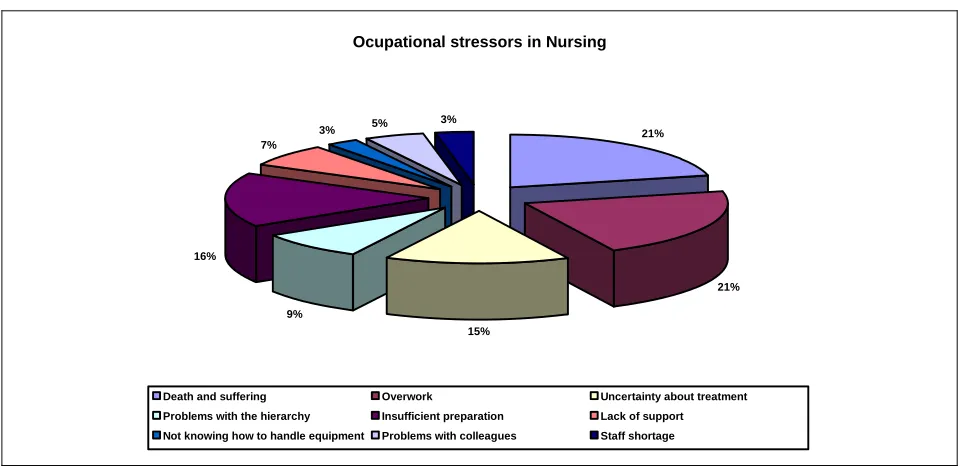
indi-cated a greater deterioration among the nurses who worked in in-patient and general services, and lower in surgical nurses. The study by Albaladejo, Villanueva Ortega, Anastasio, Calle and Dominguez [42]with 622 nurses found that the majority of participants had symptoms of burnout, and that the most affected were young people with only a few years of service, working in emergency departments or in oncology. The study conducted by Augusto-Landa, López-Zafra, Berrios-Martos and Aguilar- Luzón [43]using The Nursing Stress Scale with a sample of nurses showed that the largest occupational stressors among nurses were workload, death and suffering, fol-lowed by insufficient training, uncertainty regarding treatment, problems with hierarchy and lack of support. Other incidents that in other professions can be more stressful but that in nursing were minor stressors, were problems between the nursing staff, the concern to move temporarily to other services owing to lack of staff and not knowing well how to operate and manage specialized machine.
The effects of stress in nursing practice lead to absen- teeism [44], somatic diseases [45], coronary artery dis-ease, and alcoholism [9]. With regard to the working timetable, it is important to note that the constant changes of time in this work have an influence on bio-logical rhythms, disrupting the sleep-wake cycle and pace, and affecting the social relationships of the sub-ject [46]. We also must take into account the impor-tance of socio-demographic and labor variables. Some studies [47] have stressed the relationship between demographic variables and work with the appearance of responses to different stressors.
Among the demographic variables, some studies [48-50] found that single people or people without family responsibilities were more prone to the appearance of burnout syndrome than people who were married or in a stable relationship. In terms of labor variables, the assignment of unit or service, and the possibility of the worker to choose and to be comfortable in that unit have been considered one of the most important indicators of job satisfaction [51].
We now have a large body of research related to work environments that have analyzed the role of emotional intelligence related to welfare, health and stress manage-ment. Ciarrochi, Deane and Anderson found that emotional intelligence had a moderating role in the relationship stress-psychological health [52], such that subjects with high Emotional Intelligence are better predisposed to cope with environmental demands than subjects with a low score in this variable.
Ocupational stressors in Nursing
21%
21%
15% 9%
16% 7%
3% 5% 3%
Death and suffering Overwork Uncertainty about treatment Problems with the hierarchy Insufficient preparation Lack of support Not knowing how to handle equipment Problems with colleagues Staff shortage
[image:5.595.56.541.81.314.2]Source: Adapted from Augusto-Landa, López-Zafra, Berrios-Martos & Aguilar-Luzón (2008)
Figure 1. Percentage of occupational stressors in a nursing sample
burnout stems from social interaction between those who offer their services and those who receive them, the proper management of the emotions arising from such interactions is a key factor in explaining why some indi- viduals are more resistant to appearance of the syndrome than others. This approach has led to the fact that, in the prevention and treatment of burnout, acquires special relevance the concept of emotional intelligence as pre- dictor of quality that can predict success in setbacks that may arise in such professions. From this, we can deduce that a nurse is an emotionally intelligent person who can work in harmony with their thoughts and feelings [5]. The importance of the development of empathy (as an aspect of emotional competence) appears as a central factor in many nursing theories [6,7]. A recent study performed by Aguilar-Luzón and Augusto Landa inves-tigated the relationship of the PEI and personality traits as predictors of empathy in nursing students, and found that emotional attention and repair were predictors of involvement empathy (one dimension of the IRI) [54]. Specifically, high scores in emotional repair predict the tendency of individuals to experience feelings of com-passion and concern for others, that is, the meta-cognition of their emotions would act as a basis in the understanding of the emotions of others. Thus, it is possible for people with a good understanding of their emotions to extrapolate this ability to the interpersonal field. In this sense, people who give excessive attention to their emotions would perform the same process when it comes to addressing the feelings of others. This would explain the positive relationships between their own and others’ emotional attention.
anxiety and neuroticism. Regarding the components of PEI, we found that an adequate attention to feelings, high clarity and emotional regulation are predictors of good mental health. A more thorough examination of the hier- archical regression analysis conducted on the criterion variable revealed that PEI influenced burnout in different ways. Firstly, a direct influence was found in the percentage of variance accounted for by each dimension (emotional exhaustion: 9%; depersonalization: 10% personal ful-fillment: 41%), but there was also an indirect influence through the scale of affect, as the analysis showed that PEI factors influence the tendency to suppress negative affect and enhance positive affect, and in turn this trend accounts for part of the variance of the dimensions of burnout. We also note that the probability of burnout is lower in subjects who score high in emotional clarity or comprehension and emotional repair.
Along the same lines, but with nursing students, the study performed by Montes-Berges and Augusto-Landa analyzed the role of PEI in relation to social support, coping strategies and mental health [13]. The results showed that clarity and emotional regulation were outlined as predictors of social support of the subjects, and emotional regulation also appeared as the only predictor of mental health. These studies are consistent with the findings of Tsaousis and Nikolaou who found that high levels of emotional intelligence were good predictors of physical and psychological health [57].
Similarly, the study carried out by Augusto-Landa et al. analyzed the role that PEI has on occupational stress (measured by the Nursing Stress Scale) and health (measured by the SF-36 questionnaire) in nursing profe- ssionals [43]. Their results showed that those nursing professionals with high clarity and emotional regulation reported lower levels of stress, but those with high emotional attention reported higher levels of stress. Emotional regulation is shown as an important variable in the dimensions of health measures through the health questionnaire SF-36. Individuals with high emotional regulation showed better levels of health in its various dimensions than those subjects with low emotional regu-lation.
Similar results have been found in nursing students by Augusto-Landa and Montes-Berges [58], showing that emotional regulation appeared as the main predictor of the variance in different dimensions of the health ques- tionnaire SF-36 (Vitality, Mental Health, Social Func- tioning and General Health) and somatic symptoms. Data from the above-mentioned studies suggest that emotional intelligence could be a personal ability of nursing staff that leads to a better perception of subjective well-being, self-efficacy and self-evaluation at work and helps to maintain high levels of dedication to work. Thus, a recent study by Augusto-Landa & Montes-Berges analyzed the role of PEI on the quality of life and dimensions of psy-
chological well-being in a sample of 85 nurses [59]. Analysis of variance results showed that emotional regu-lation (high vs. low) had an effect on life satisfaction and psychological well-being, confirming the importance of this factor in quality of life and the dimensions of psy-chological well-being. These data allow us to extend and corroborate those found in this type of samples.
4. Conclusions
In summary, we show the role that emotional intelligence has as a modulator variable of stress and as an important variable in nurses’ health. We have analyzed the differ- ential role played by the three components (Attention, Clarity and regulation) of PEI. In general, the characte- ristic pattern is that people with higher levels of psycho- logical adaptation and lower levels of stress and burnout are those characterized by moderate to low scores in emotional attention and high scores in the other two dimensions of TMMS (emotional Clarity and Repair). It is important to summarize the importance of the dimen- sions of TMMS and their role in individual well-being as well as its influence on the different criteria that we have discussed throughout the chapter. Emotional attention is a dimension whose ends are usually characterized by emotional imbalance. Individuals who usually pay attention to emotions are characterized by monitoring at all times the progress of their moods in an effort to try to under-stand, which is not always productive to the subject, es-pecially when this high level of attention is not accom-panied by the discrimination of the causes, reasons and consequences. The real danger for these people is that they could develop an emotional spiral that leads to a ruminative process outside their control, rather than alle- viating their mood, and this would perpetuate a negative state of mood.
This hypothesis endorses the findings that show that high emotional attention is associated with high levels of stress, lower job satisfaction and low self-concept in nursing professionals [10,42]. In terms of the clarity fac-tor, the evidence shows that individuals who easily iden-tify their specific emotions during stressful situations spend less time dealing with their emotional reactions. In addition, they invest fewer cognitive resources, which allow them to evaluate alternatives for action, to keep their thoughts on other tasks or to perform more adaptive coping strategies. In fact, high scores in emotional clarity were associated with different dimensions of overall health and greater adaptation to stressful situations at work [10,43], greater life satisfaction [59] and positive coping strategies [13].
monstrated the importance of expectations in capacity to regulate emotional and protective factors in our mental health and wellbeing [60].
The findings provided by research involve a range of evidence about cognitive and emotional factors related to the occurrence of burnout and emotional imbalance that must be taken into account in future training programs aimed at the prevention and monitoring of work stress both in students and nurses.
For all these reasons, we think that the training of emotional intelligence in professionals, not only in nurs-ing professionals but also in nursnurs-ing students, is neces-sary to prevent occupational stress and its impact on health. In current Higher education, which emphasizes a high profile development of interpersonal skills, training in the dimension of emotional intelligence is essential.
REFERENCES
[1] L. Cowin, “Measuring Nurses’ Self-Concept,” Western Journal of Nursing Research, Vol.23, No. 3, 2001, pp. 313-325.
[2] J. D. Mayer, P. Salovey and D. Caruso, “Models of Emo-tional Intelligence,” Second Edition, In: Sternberg, R.J. Ed., Handbook of Intelligence, Cambridge, New York, 2000, pp. 396-420.
[3] J. D. Mayer and P. Salovey, “Qué es la Inteligencia Emocional?” In: Mestre, J.M., Navas and Fernández- Berrocal, P. (Coords.), Manual de Inteligencia Emocional, Pirámide, Madrid, 2007, pp. 25-45.
[4] P. Salovey, J. D. Mayer, S. Goldman, C. Turvey and T. Palfai, “Emotional Attention, Clarity and Repair: Explor-ing Emotional Intelligence UsExplor-ing the Trait Meta-Mood Scale,” In: Pennebaker, J.W. Ed., Emotion, Disclosure and Health, American Psychological Association, Wash-ington, D.C., 1995, pp. 125-154.
[5] D. Freshwater and T. Stickley, “The Heart of the Art: Emotional Intelligence and Nursering Education,” Nursering Inquiry, Vol. 11, No. 2, 2004, pp. 91-98.
[6] M. Parker, “Aesthetic Ways in Day to Day Nursering,” In: Freshwater, D. Ed., Therapeutic Nursering, Sage, London, 2002, pp. 100-120.
[7] P. A. Parker and J. A. Kulik, “Burnout, Self a Supervi-sor-Rated Job Performance and Absenteeism among Nurses,” Journal of Behavioral Medicine, Vol. 18, No. 6, 1995, pp. 581-599.
[8] C. Cadman and J. Brewer, “Emotional Intelligence: A Vital Prerequisite for Recruitment in Nursering,” Journal of Nursering Management, Vol. 9, 2001, pp. 321-324.
[9] A. M. Calvalheiro, D. F. Moura Junior and A. C. Lopes, “Stress in Nurses Working in Intensive Care Units,” Re-vista Latino-Americana de Enfermagem, Vol. 16, No. 1, 2008, pp. 29-35.
[10] J. M. Augusto-Landa, M. P. Berrios-Martos, E. López-Zafra and M. C. Aguilar-Luzón, “Relación Entre Burnout e Inteligencia Emocional y su Impacto en Salud
Mental, Bienestar y Satisfacción Laboral en Profesionales de Enfermería,” Ansiedad y Estrés, Vol. 12, 2006, pp. 479-493.
[11] J. M. Augusto-Landa, E. López-Zafra, M. P. Berrios- Martos and M. C. Aguilar-Luzón, “The Relationship Be-tween Emotional Intelligence, Occupational Stress and Health in Nurses: A Questionnaire Survey,” International Journal of Nursing Studies, Vol. 45, 2008, pp. 888-901. [12] E. Lindop, “A Comparative Study of Stress between Pre
and Post Project 2000 Students,” Journal of Advanced Nursing, Vol.29, 1999, pp. 967-973.
[13] S. Moore, S. Lindquist and B. Katz, “Home Health Nurses: Stress, Self-Esteem, Social Intimacy and Job Sat-isfaction,” Home Care Provider, Vol. 2, 1997, pp. 135- 139.
[14] A. Aradilla, J. Tomas-Sabato and J. Limonero, “Emo-tional Intelligence and Death Anxiety in Nursing Stu-dents,” Abstracts Book of I International Congress on Emotional Intelligence, Malaga, September 19-20, 2007, pp. 19-21.
[15] D. Goleman, “Emotional Intelligence,” New York: Bantam, 1995.
[16] J. Sanz, F. Silva and M. D. Avia, “La Evaluación de Personalidad Desde el Modelo de Los, Cinco Grandes: El Inventario de Cinco—Factores NEO (NEO-FFI) de Costa y McGrae,” In Silva, F.F., Avances en Evaluación Psicológica, Promolibro, Valencia, 1999, pp. 169-235. [17] P. Fernández-Berrocal, R. Alcaide, N. Extremera and D.
A. Pizarro “The Role of Emotional Intelligence in Anxi-ety and Depression among Adolescents,” Individual Dif-ferences Research, Vol. 4, 2006, pp. 16-27.
[18] B. Montes-Berges and J. M. Augusto, “Exploring the Relationship Between Perceived Emotional Intelligence, Coping, Social Support a Mental Health in Nursing Stu-dents,” Journal of Psychiatric and Mental Health Nursing, Vol.14, 2007, pp. 163-171.
[19] A. Komblit and Mendes-Diz, “El Burnout en el Personal de Enfermería de Unidades de Cuidados Intensivos,” Estudios del Trabajo, Vol.16, 1998, pp. 1- 25.
[20] E. P. Anderson, “The Perceptions of Student Nurses and Their Perceptions of Professional Nursing during their Nurse Training Programme,” Journal of Advanced Nurs-ing, Vol.18, No. 5, 1993, pp. 808-815.
[21] S. H. Hamaideh, M. T. Mrayyan, R. Mudallal, G. I. Faouri and N. A. Khasawneh, “Jordanian Nurses’ job Stressors and Social Support,” International Nursing Re-view, Vol.55, No. 1, 2008, pp. 40-47.
[22] K. Horneffer, “Students’ Self-Concepts: Implications for Promoting Self-Care within the Nursing Curriculum,” Journal of Nursing Education, Vol.45, No. 8, 2006, pp. 311-316.
[23] M. Newman, “Health as Expanding Consciousness,” Jones and Bartlett, Boston 1994.
[25] P. y Salovey and J. D. Mayer, “Emotional Intelligence,” Imagination, Cognitionand Personality, Vol. 9, 1990, pp. 185-211.
[26] M. A. Freeman, E. V. Hennessy and D. M. Marzullo, “Defensive Evaluation of Antismoking Messages among College-Age Smokers: The Role of Possible Selves,” Health Psychology, Vol. 20, 2001, pp. 424-433.
[27] N.Humpel and P. Caputi, “Exploring the Relationship between Work Stress, Years of Experience and Emotional Competency Using a Simple of Australian Mental Health Nurses,” Journal of Psychiatric and Mental Health Nurs-ing, Vol.8, 2001, pp. 39-403.
[28] J. M. Augusto-Landa, M. C. Aguilar, M. F. Salguero and E. López-Zafra, “El Papel de la Inteligencia Emocional Percibida Sobre la Autoeficacia General y Competencia Percibida,” In P. Fernández-Berrocal (coord.), Avances en el Estudio de la Inteligencia Emocional, Fundación Marcelino Botín, Santander, 2009,pp. 18-189.
[29] C. Maslach, “Burned-Out,” Human Behavior, Vol. 5, No. 9, 1976, pp. 16-22.
[30] J. Garanto, “Las Actitudes Hacia sí Mismo y su Medi- ción,” EU, Temas de Psicología nº 7, Barcelona, 1984.
[31] C. Maslach and S. E. Jackson, “The Measurement of Experienced Burnout,” Journal of Occupational Behavior, Vol.2, 1981, pp. 99-113.
[32] J. D. y Mayer and P. Salovey, “What is Emotional Intel-ligence?” In Salovey, P., Sluyter, y D., Eds., “Emotional Development and Emotional Intelligence: Implications for Educators, Basic Books, New York, 1997, pp. 3-31.
[33] C. Cherniss, “Profesional Burnout in Human Service Organizations,” Praeger Publishers, New York, 1980.
[34] J. F. Thayer, L. A. Rossy, E. Ruiz-Padial and B. H. John-sen, “Gender Differences in the Relaionship between Emocional Regulation and Depressive Symptons,” Cog-nitive Therapy and Research, Vol.27, 2003, pp. 349-364.
[35] S. Cottrell, “Occupational Stress and Job Satisfaction in Mental Health Nursering: Focused Interventions through Evidence Based Assessment,” Journal of Psychiatric and Mental Health Nursering, Vol.8, 2001, pp. 157-164.
[36] E. Demeuroti, A. D. Brakker and W. B. Schauferi, “A Model of Burnout and Life Satisfaction amongst Nurses,” Journal Advanced Nursing, Vol. 32, No. 2, 2000, pp. 24-38.
[37] R. Kalish, “La Vejez: Perspectivas Sobre el Desarrollo Humano,” Pirámide, Madrid, 1983.
[38] G. Stevens and P. O’Neill, “Expectation and Burnout in the Developmental Disabilities Field,” American Journal of Community Psychology, Vol.11, 1983, pp. 615-627.
[39] H. Peplau, “Interpersonal Relations in Nursering,” Mac-millan, London, 1992.
[40] M. A. Collins, “The Relations of Work Stress, Hardiness and Burnout among Full-Time Hospital Staff Nurses,” Journal for Nurses in Staff Development, Vol.12 No. 2, 1996, pp. 71-75.
[41] F. Avalos, I. Giménez and J. M. Molina, “Burnout en Enfermería de Atención Hospitalaria,” Enfermería Clíni-
ca, Vol. 15, No. 5, 2005, pp. 275-282.
[42] R. Albaladejo, R. Villanueva, P. Ortega, P. Astasio, M. E. Cale and V. Domínguez, “Burnout Sindrome among Nursing Staff at a Hospital in Madrid,” Revista Española de Salud Pública, Vol.78, 2004, pp. 505-516.
[43] J. M. Augusto-Landa, E. López-Zafra, M. C. Aguilar- Luzón and M. F. Salguero de Ugarte, “Predictive Validity of Perceived Emotional Intelligence on Nursing Students’ Self-Concept,” Nurse Education Today, Vol. 29, 2009, pp. 801-808.
[44] R. C. Wylie, “The Self-Concept, Vol. II: Theory and Re-search on Selected Topics,” University of Nebraska Press, London, 1979.
[45] S. J. Marchago, “Programa de Actividades Para el Desarrollo de la Autoestima,” Escuela Española, Madrid, Vol. 2, 1997.
[46] D. F. Polit and B. P. Hungler, “Investigación Científica en Ciencias de la Salud: Principios y Métodos,” 6ª Edicción, McGraw-Hill Interamericana, México, 2000.
[47] S. Harter, “Issues in the Assessment of the Self-Concept of Children and Adolescents,” In Greca, A.M. Ed., Through the Eyes of the Child: Obtaining Self-Reports from Children and Adolescents, Allyn and Bacon, Boston, 1990, pp. 292-325.
[48] M. M. Durán, A. Rodríguez and L. Fernández, “Pre- valencia del Síndrome del Quemado y Estudio de Fac- tores Relacionados en las Enfermeras del CHUVI (Com- plexo Hospitalario Universitario de Vigo),” Enfermeria Global, Vol. 8, 2006, pp. 1-18.
[49] C. Maslach and S. E. Jackson, “Burnout Research in the Social Services: A Critique,” Journal of Social Service Research, Vol.10, 1986, pp. 95-105.
[50] R. L. Simpson and A. J. Keegan, “How Connected are You? Employing Emotional Intelligence in a High Tech World,” Nursering Administration Quaterly, Vol.26, No. 2, 2002, pp. 80-86.
[51] Y. M. Chen, S. H. Chen, C. Y. Tsai and L. Y. Lo, “Role Stress and Job Satisfaction for Nurse Specialists,” Jour-nal of Advanced Nursing, Vol.59, No. 5, 2007, pp. 497- 509.
[52] J. Ciarrochi, F. Deane and S. Anderson, “Emotional Intel-ligence Moderates the Relationship between Stress and Mental Health,” Personality and Individual Differences, Vol.28, 2002, pp. 539-561.
[53] N. Extremera, P. Fernández-Berrocal, and A. Duran, “Emotional Intelligence and Burnout in Teachers,” Encu- entros en Psicología Social, Vol. 1, 2003, pp. 260-265.
[54] M. C. Aguilar-Luzón and J. M. Augusto-Landa, “Rela- ción Entre Inteligencia Emocional Percibida, Personali- dad y Capacidad Empática en Estudiantes de Enferme- ría,” Psicología Conductual, Vol. 17, No. 2, 2009, pp. 351-364.
[55] J. K. Stechmiller and H. N. Yarandi, “Predictors of Burn- out in Critical Care Nurses,” Heart-Ling, Vol. 22, No. 6, 1993, pp. 534-541.
Nursing, Vol.29, 1999, pp. 967-973.
[57] H. H. Wheeler and R. Riding, “Occupational Stress in General Nurses and Midwives,” British Journal of Nurs-ing, Vol.3, No. 52, 1994.
[58] J. M. Augusto-Landa and B. Montes-Berges, “Perceived Emotional Intelligence, Health and Somatic Sympto- matology in Nursing Students,” Individual Differences Research, 2008, pp. 197-211.
[59] J. M. Augusto-Landa and B. Montes-Berges, (submitted) “Inteligencia Emocional Percibida e Intensidad Afectiva Como Predictores de la Satisfacción Vital y el Bienestar Psicológico,” Un Estudio con Profesionales de Enfermería.