Original citation:
Awan, Sajjad Zahoor, Footitt, Steven and Finch-Savage, William E. (2018) Interaction of
maternal environment and allelic differences in seed vigour genes determines seed
performance in Brassica oleracea. Plant Journal, 94 (6). pp. 1098-1108.
Permanent WRAP URL:
http://wrap.warwick.ac.uk/101207
Copyright and reuse:
The Warwick Research Archive Portal (WRAP) makes this work of researchers of the
University of Warwick available open access under the following conditions.
This article is made available under the Creative Commons Attribution 4.0 International
license (CC BY 4.0) and may be reused according to the conditions of the license. For more
details see:
http://creativecommons.org/licenses/by/4.0/
A note on versions:
The version presented in WRAP is the published version, or, version of record, and may be
cited as it appears here.
Interaction of maternal environment and allelic differences in
seed vigour genes determines seed performance in
Brassica
oleracea
Sajjad Awan, Steven Footitt and William E. Finch-Savage*
School of Life Sciences, University of Warwick, Wellesbourne Campus, Warwickshire CV35 9EF, UK
Received 24 January 2018; revised 22 March 2018; accepted 27 March 2018; published online 16 April 2018. *For correspondence (e-mail [email protected]).
SUMMARY
Seed vigour is a key trait essential for the production of sustainable and profitable crops. The genetic basis of variation in seed vigour has recently been determined inBrassica oleracea, but the relative importance of the interaction with parental environment is unknown. We produced seeds under a range of maternal envi-ronments, including global warming scenarios. Lines were compared that had the same genetic back-ground, but different alleles (for high and low vigour) at the quantitative trait loci responsible for determining seed vigour by altering abscisic acid (ABA) content and sensitivity. We found a consistent effect of beneficial alleles across production environments; however, environmental stress during production also had a large impact that enhanced the genetic difference in seed performance, measured as germination speed, resistance to controlled deterioration and induction of secondary dormancy. Environmental interac-tion with allelic differences in key genes that determine ABA content and sensitivity develops a continuity in performance from rapid germination through to failure to complete germination, and increasing depths of seed dormancy. The genetic–environmental interaction revealed provides a robust mechanism of bet-hed-ging to minimize environmental risk during subsequent germination, and this could have facilitated the rapid change in seed behaviour (reduced dormancy and rapid germination) observed during crop domestica-tion.
Keywords: abscisic acid,Brassica oleracea, dormancy, germination, global warming, maternal environment, seed, vigour.
INTRODUCTION
Predictable, uniform seedling establishment is essential for the production of crops that are both sustainable and prof-itable. Seed dormancy and vigour directly influence germi-nation performance, a key contributor to this predictability. Dormancyper se(the lack of germination in generally per-missible conditions) was minimized during domestication, and therefore is not a consistent practical problem for many crop species (Finch-Savage and Bassel, 2016). Never-theless, non-optimal seed production environments can induce dormancy in several crops (Fenner, 1991). In con-trast, low seed vigour (slow and unpredictable seed perfor-mance) greatly influences not only the number of seedlings that emerge, but also the timing and uniformity of seedling emergence in all crops. However, it is not clear whether a clear boundary exists between seed vigour and dormancy at physiological maturity (Hilhorst and Toorop, 1997; Finch-Savage and Bassel, 2016). Whatever the cause, suboptimal seed performance has a major impact upon
many aspects of crop production that determine cost effec-tiveness and the crop inputs required, and there are also many direct crop-specific influences on marketable yield (Finch-Savage, 1995).
Low seed vigour can result from seed deterioration and damage of many kinds, and this has great commercial sig-nificance. Consequently, this aspect of seed vigour has been widely researched and seed technologies have been developed to deal with it (e.g. Dornbos, 1995; Hampton, 2002); however, there are also inherent differences in the initial vigour of the seed before it begins to deteriorate, but knowledge of the genetic, molecular and physiological basis of these differences is limited. Brassica oleraceais the closest relative to the model species Arabidopsis, and the genomic resources available in both species were used to develop a genetic and molecular understanding of seed-vigour differences inB. oleraceacrops (Betteyet al., 2000; Finch-Savage et al., 2010; Morris et al., 2016). There are
also detailed studies on the effect of the parental environ-ment in Arabidopsis genotypes (e.g. Joosen et al., 2012; He et al., 2014); however, the relative contribution of genetic and environmental factors to seed performance in B. oleraceaand other crops is relatively unstudied, and is therefore the focus of this work.B. oleraceais an excellent model on which to study the effect of maternal environ-ment; unlike Arabidopsis, it has a determinate inflores-cence and pollination (using blowflies), and subsequent seed development is relatively uniform and complete within the inflorescence. Consequently, a number of prob-lems with this type of study are minimized, e.g. different ages of mature seeds at harvest having different levels of after-ripening and different levels of deterioration between seeds following physiological maturity. To further limit variation between experimental runs, identical procedures for seed harvest and handling were used to minimize dete-rioration after physiological maturity.
Field establishment and modelling studies have identi-fied key features a crop seed must possess to establish well across a wide range of seedbed conditions, and that are therefore key elements of seed vigour (reviewed by Finch-Savage, 2004; Finch-Savage & Bassel, 2016). This work demonstrated that stress avoidance through rapid germination and post-germination growth has a selective advantage over stress tolerance alone. When sown into moisture, rapid germination allows the seed/seedling to progress without interruption as the seedbed deteriorates or dries (Finch-Savage et al., 2010). Rapid germination is also positively related to seedling normality and subse-quent growth both within (Finch-Savage, 1986) and between seed lots (ISTA, 2015). Rapid germination is there-fore a key phenotype of vigorous seeds that differs with genetic background (e.g. inBrassicaspecies, Hodgkin and Hegarty, 1978; Kinget al., 1986; Betteyet al., 2000; Morris et al., 2016).
InB. oleraceathe quantitative trait loci (QTLs) responsi-ble for performance differences at harvest are known (Bet-tey et al., 2000; Morris et al., 2016). Furthermore, the identification of genes underlying the two principle QTLs enabled a mechanism to be proposed (Morriset al., 2016). Two contrasting lines have emerged that encapsulate this genetic difference: a slow-germinating doubled haploid parental line A12DHd and a chromosome substitution line AGSL101 (Rae et al., 1999). The latter has introgressions from a fast-germinating doubled haploid parental line GD33DH at the two seed-performance QTLs in the A12DHd background; GD33 alleles at these QTLs enhance seed per-formance resulting in more rapid germination and seedling emergence in the field (Morris et al., 2016). To better understand how seed vigour is determined, we investi-gated the impact of the seed production environment in these two lines including realistic global warming scenar-ios. The two principle factors in the maternal environment
are temperature and water stress (Fenner, 1991; Copeland and McDonald, 1995, 2001; Donohue, 2009), both of which may be altered with climate change.
There is a considerable appreciation of the importance of the seed production environment in commercial crop seed production, with seeds normally produced in benign climates that tend to be dry in the late season to facilitate harvest and to minimize seed-borne diseases (Copeland and McDonald, 2001). These conditions impact upon seed size and composition, but there is surprisingly little detailed experimental analysis of its impact on subse-quent seed performance in vegetable crops. There is detailed work in the literature concerning the effect of maternal environment on subsequent seed dormancy in Arabidopsis and other wild species (Donohueet al., 2007; Springthorpe and Penfield, 2015; He et al., 2014; Finch-Savage and Footitt, 2017; Huanget al., 2018), and some similar effects have been observed in crops (Fenner, 1991). However, domestication has altered the response of crop seeds to both the maternal and post-sowing envi-ronment (Finch-Savage and Bassel, 2016), and further work is therefore required to understand crop seed perfor-mance, in particular as these environments will be impacted by climate change.
RESULTS
To study the impact of maternal environment, seeds were produced on a number of occasions between 2001 and 2014 from plants grown in glasshouses and a polyethylene tunnel. Many factors other than genotype and production environment influence the subsequent performance of seeds. We therefore sought to minimize these other vari-ables so that their effects were not confounded with those of the genotypes and production environment. For exam-ple, for consistency seeds of the same seed lot (stored with 8% moisture content at20°C in sealed foil containers) for each of the two genotypes were used on all occasions to produce plants. Plants were grown in glasshouses of the same construction, and the inflorescence of each plant was isolated in mesh plastic bags containing an excess of blow-flies so that pollination was consistent and not limited. On all occasions, the same protocols and criteria were used for seed harvest, drying, cleaning, grading, seed equilibra-tion to relative humidity (RH) and, where appropriate, stor-age. Seeds less than 1.60 mm in diameter were removed during cleaning as they were underdeveloped or abnormal, and would not produce a seedling.
Gene–environment interaction: the genetic effect of the
SOG1andRABA1QTLs on germination speed is
consistent and repeatable, but the maternal environment determines the extent of the differences between lines
those years (2013 and 2014) different levels of water stress were also applied during seed development and matura-tion (Table S1). Plants were grown at different times of the year, in 2013 and 2014 the glasshouses were fitted with air conditioning and set temperatures were more accurately maintained. In other years, vented glasshouses were used and therefore mean temperature during seed production was likely to be greater in the summer than in the spring, because of the greater thermal gain from sunlight, despite similar settings. Light intensities and day lengths also dif-fered, although supplementary lighting ensured that the day length was never less than 16 h. In total, the two selected genotypes (AGSL101 and A12DHd) were subjected to 17 different production regimes.
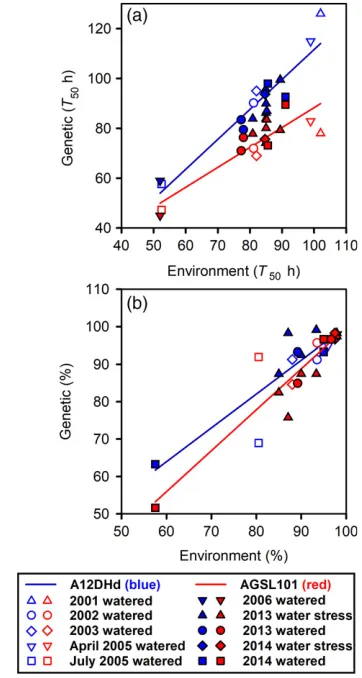
Speed of germination. Seeds of AGSL101 germinated sig-nificantly faster (with a lower time to 50% germination completion,T50) than seeds from the A12DHd parent, and
this result was consistent in all production environments (Figure 1a); however, the prevailing production environ-ment greatly influencedT50in both lines, with an increase
of up to twofold across the environments. A principal com-ponent analysis shows that 70% of the variability was linked to the genetic effect (the two lines grouped sepa-rately in the first dimension) and 30% was linked to the effect of the environment. We illustrate this in Figure 1, which is a standard gene–environment plot where the mean T50 at 15°C of each line (genetic mean) is plotted
against the mean of the two lines (environment mean) to indicate the relative impact of the environment on each line. This approach shows that the difference between the two genotypes was greater in more stressful environments that produced relatively slower germinating seeds. In Fig-ure 1 this effect is enhanced by the outlying points in July 2005 and 2006 (harvested in June) that had comparatively low T50 values. The reason for these low values is not
known in detail, but in both cases the seeds matured dur-ing relatively hot and sunny periods in a glasshouse with-out air conditioning, so that temperatures would be higher than the set temperature. Regressions fitted without these outliers still showed the same divergence between geno-types. In both genotypes, the T50 values tended to be
greatest from seeds harvested in spring rather than seeds harvested in summer (higher temperature and light levels) in the absence of air conditioning. This effect was illus-trated clearly in 2005, when the germination speed of seeds harvested in April and July differed significantly (P<0.001), and were also among the slowest (environ-ment mean 98 h) and fastest (environ(environ-ment mean 52 h) ger-minating seed productions, respectively. In these experiments water stress (2013 and 2014) did not have a consistent effect on germination speed, and there were no significant correlations between T50 and the percentage
germination or seed weight.
Percentage germination. In the majority of production runs, germination from both genotypes was greater than 90%; however, there were occasions when the percentage germination was lower (Figure 1b). Seeds were assumed to be dormant rather than dead, as seeds remained solid and cream coloured in cut tests conducted at the end of the germination experiments. In contrast, dead seeds rapidly became infected and soft.
[image:4.595.320.501.81.420.2]Seed yield and size. The genes present in theSOG1and RABA1QTLs have pleiotropic effects both in seed quality-related traits and other traits; however, the largely similar background genetic complement of the two lines resulted in no consistent and significant differences in seed yield per occasion, although yield differed greatly between produc-tion runs (Figure 2a). Interestingly, in addiproduc-tion to their Figure 1. Genetic and maternal environment effects on seed performance.
(a) Time to 50% germination completion (T50) and (b) percentage
germina-tion of seed of A12DHd and AGSL101 produced in different years and envi-ronments. In both 2013 and 2014 different environments were used, and in 2005 there were two production runs to give harvests in both spring and summer. Linear regression lines fitted to A12DHd and AGSL101 were signif-icant (P<0.001), withR2
values of 0.88887 and 0.77976 forT50, and 0.7912
impact on speed of germination, GD33 alleles in AGSL101 also consistently conferred larger seed size than seeds of A12DHd across a range of production runs (Figure 2b). Con-sistent with lines producing the same yield, AGSL101 plants produced fewer seeds than A12DHd plants. There was no consistent effect of water stress on either yield or seed size.
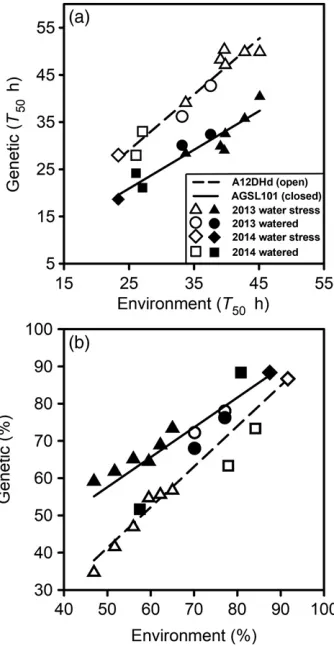
Different estimates of seed quality. There is some dis-agreement over the merits of different measures of seed quality (Finch-Savage and Bassel, 2016). We therefore compared three measures used in commerce: speed of germination at 15°C; germination after controlled deterio-ration (CD); and germination at 20°C following 10 days of incubation at 5°C to induce secondary dormancy (SD). All three measurements were made on seeds produced in 11 different environments in 2013 and 2014 (Figure 3; Table S1). The overall quality of these seeds was high and
consequently the 10 days of incubation at 5°C did not induce sufficient secondary dormancy to reduce the per-centage germination. However, sufficient secondary dor-mancy was induced to slow germination and thereforeT50
is shown for this treatment. We found significant (P<0.01) differences in all three estimates of seed quality between A12DHd and AGSL101 lines, consistently indicating that the seeds from AGSL101 were of higher quality (Figures 1 and 3). However, we found no significant correlation between the three seed quality measures across these environments suggesting that these measures assessed distinct aspects of seed quality.
Lower percentage germination resulted from primary dormancy
[image:5.595.97.266.80.421.2]After-ripening removed small differences in percentage germination, but the relative difference in T50 between Figure 2. Genetic and maternal environment effect on (a) seed yield (g per
plant) and (b) mean seed size (mg).
The yield and the seed size for A12DHd and AGSL101 lines were recorded in 2013 and 2014 from 11 production environments with different tempera-tures and watering regimes (Table S1). Regression lines fitted to A12DHd
and AGSL101 were significant (P<0.001), withR2
values of 0.95253 and 0.95373 for yield, and 0.89772 and 0.93206 for seed weight, respectively. Each value is the mean of three replicates.
Figure 3. Genetic and maternal environmental effects on seed performance indicated by controlled deterioration and the induction of secondary dor-mancy.
Seeds of A12DHd and AGSL101 were (a) subjected to 10 days at 5°C in the
dark to induce secondary dormancy (SD), then germinated at 20°C in the light,
and (b) incubated for 7.5 days in the dark at 45°C and 83% relative humidity
for controlled deterioration (CD), then germinated at 15°C. Regression lines
[image:5.595.349.516.81.404.2]genotypes remained. In the work presented above, the percentage germination, although reasonably high (ap-proximately 90%) at harvest, was in many cases lower than required in commercial practice. Cut tests indicated non-germinating seeds were primary dormant rather than dead. Following a separate production run in 2008, the per-centage germination was 87 and 93% for A12DHd and AGSL101, respectively, immediately after harvest under the germination conditions used (15°C in both light and dark). In both cases, most seeds that failed to complete germination were found to be dormant, as they subse-quently completed germination following dry after-ripen-ing (AR; Table 1). The percentage germination significantly (P<0.01) increased after only 4 days of dry storage at 20°C (AR), with dormancy removed by 32 days of storage. Dry storage also significantly (P<0.01) reducedT50in both
genotypes, but the relative difference inT50between them
(AGSL101/A12DHd=0.79 and 0.80 after 4 and 32 days, respectively) did not change.
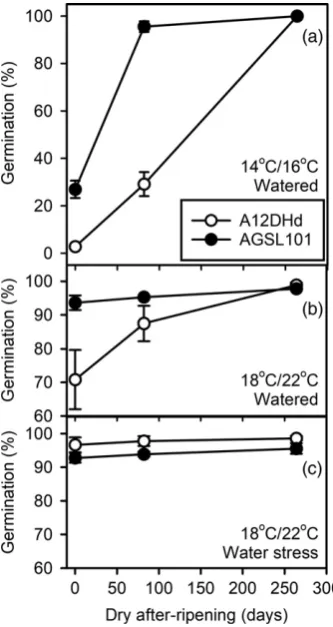
Low temperature during seed maturation induces primary dormancy. On a number of the production runs reported above the percentage germination was below 90%, in par-ticular in seeds harvested in spring rather than summer. This indicated increased primary dormancy, which could have been the result of lower temperature and/or the influ-ence of different light conditions during seed production. We therefore compared seed production in two tempera-ture regimes at the same time of year in adjacent glass-house compartments of identical construction and light settings, but with different temperature regimes (16/14 and 22/18°C, grown under conditions of 16-h light/8-h dark). There was a significant (P<0.001) effect of both genotype and production environment on the initial depth of dor-mancy and the rate of dordor-mancy loss during AR (Figure 4). The depth of dormancy was greater and the loss of dor-mancy slower in seeds of A12DHd than in seeds of AGSL101. The lower temperature regime induced greater dormancy than the higher temperature regime. In the higher temperature regime, the percentage germination
was reduced because of dormancy in A12DHd, but not in AGSL101. Furthermore, this effect was absent when water-ing was limited durwater-ing seed maturation.
The impact of global warming scenarios
[image:6.595.48.527.638.721.2]Seed germination performance. To investigate further the impact of temperature and water stress, and the implica-tions of global warming during seed development and maturation, we grew plants along a unique thermogradient tunnel (Wurret al., 1996; Huanget al., 2018). This exposed plants to scenarios of predicted mean temperature increases from the present time (ambient) to a mean tem-perature increase of 3.7°C (as expected in 2080; UK Climate Projections, 2014) at the production location (West Mid-lands, UK). The tunnel provides realistic seasonal and diur-nal temperature fluctuations, but with a gradient of simulated global warming depending on the position at which the plant is grown in the tunnel. We therefore adjusted the tunnel to a gradient from ambient to approxi-mately+4°C. Plants were grown and seeds were harvested at three positions along the tunnel: ambient, middle (ap-proximately+2°C) and warm (approximately+4°C). In prac-tice the temperature differences were less, with the recorded mean temperatures during seed development of 17.9, 19.2 and 20.5°C at the ambient middle and warm positions, respectively (Figure S1; Table S2). Nevertheless, we observed significant effects (P<0.001) with both seed production temperature and seed germination temperature (Figure 5). In general, seeds from AGSL101 had a higher percentage of germination than seeds of A12DHd at lower germination temperatures. There was a higher germination percentage at all germination temperatures in seeds pro-duced at the warm end of the tunnel, compared with the other two tunnel positions. Seeds produced at the ambient end of the tunnel had the lowest percentage germination and therefore the highest dormancy. The percentage of germination significantly (P<0.001) increased with germi-nation temperature in seeds produced at all three posi-tions, showing that seeds exhibited low-temperature thermodormancy. In keeping with this result, the
Table 1The effect of after-ripening on seeds of A12DHd and AGSL101 following harvest in April 2008.Germination of seeds at 15°C imme-diatley following harvest in April 2008, and then after 4 and 32 days of storage in the dark in a sealed container with seed equilibrated to approximately 30% relative humidity. Germination was recorded over 10 days with watering, and by this time the percentage of germina-tion had not increased for at least 3 days. Seeds were then transferred onto a Fluridone and GA4/7solution, and germination was recorded
again after a further 7 days (values in parenthesis). There was no significant difference in germination in the light or in the dark, and there-fore values for dark germination only are presented. Values are means of three replicatesstandard errors. NR, not recorded
Harvest 4 days 32 days
T50(h) % T50(h) % T50(h) %
A12DHd NR 87.23.8
(99.60.4)
72.91.7 91.23.5
(99.50.4)
56.02.0 97.21.0
(99.20.8)
AGSL101 NR 92.82.6
(97.20.9)
57.43.4 94.01.0
(98.00.5)
44.71.3 96.81.5
germination of seeds from both genotypes was signifi-cantly (P<0.01) higher in seeds produced in the water-stressed environment, indicating that primary dormancy was lower. Furthermore, germination was significantly (P<0.01) delayed by the induction of secondary dormancy in both genotypes (Figure S2). In seeds from A12DHd, the induction of secondary dormancy significantly (P<0.01) reduced the percentage of germination, but only when seeds were produced under ambient conditions. However, in seeds produced under water stress the delay in germina-tion resulting from secondary dormancy was reduced, and there was no reduction in percentage germination. There-fore, in this experiment water stress during seed matura-tion reduced both primary dormancy and the inducmatura-tion of secondary dormancy.
Seed yield. In general, the seed yield was significantly (P<0.05) greater at ambient temperature than at the high-est temperature (Table 2); however, there was a significant
(P<0.05) interaction in which the yield was adversely affected by water stress at all three positions in the tunnel in A12DHd, but the reverse was true at the two lower tem-perature positions for AGSL101.
DISCUSSION
InB. oleraceaa two-component mechanism was identified that regulates the level of the germination-inhibiting hor-mone abscisic acid (ABA) via the expression of BoCYP707A2(ABA catabolising gene) at theRABA1locus, and the sensitivity to ABA viaBoLCVIG1andBoLCVIG2at theSOG1 locus. This mechanism determined the robust-ness of seeds to germination environments. However, the impact of the production environment was not known, so we investigated this in two lines that differed only by alle-les at these loci conferring either lower (A12 allealle-les in A12DHd) or higher (GD33 alleles in line AGSL101) vigour. We show here that the impact of these alleles on germina-tion speed is consistent in seeds produced across a range of environments. Furthermore, these positive GD33 alleles, selected because of their effect on germination speed, have pleiotropic affects. This is consistent with the co-loca-tion of QTLs related to different seed quality and plant characteristics reported in Arabidopsis (Clerkxet al., 2004; Joosen et al., 2012). Here, AGSL101 plants that produce higher vigour seed also consistently flowered earlier than those of A12DHd. For example, AGSL101 plants sown in the glasshouse on 29 March 2013 had a mean flowering date of 17 May 2013, 6 days earlier than those of A12Dhd sown at the same time. The GD33 alleles also confer greater seed size and resistance to negative impacts from the seed production environment. For example, the induc-tion of both primary dormancy (producinduc-tion environment) and secondary dormancy (germination environment) was significantly less in AGSL101 carrying the GD33 alleles than in A12DHd. Thus, seeds with positive alleles at these two loci are likely to have increased stress tolerance in both the seed production and seed germination ments. Increased tolerance in seed germination environ-ments was confirmed by backcrossing these GD33 alleles into different parental lines (Finch-Savageet al., 2013).
[image:7.595.96.263.81.395.2]The effect of the production environment was similar in the two genotypes, but negative impacts of the environ-ment were relatively greater in A12DHd. In more stressful environments (e.g. low temperature) there was greater induction of low-temperature primary thermodormancy during seed production, but also an enhanced induction of secondary dormancy in the germination environment of A12DHd seeds. Dormancy was reduced by dry (water-stressed) conditions during seed maturation in the high light summer environment used in the thermogradient tun-nel. In a review, Fenner (1991) concluded that lower dor-mancy is generally associated with higher temperatures and shorter days, and that this effect is probably the result Figure 4. The impact of low temperature during seed production on seed
performance.
Seeds of A12DHd and AGSL101 were produced in two temperature regimes: (a) 14–16°C; and (b, c) 18–22°C. (c) Germination rates for plants grown under the higher temperature regime with water stress. Treatments
were applied following seed set. Germination was recorded at 15°C. Each
value is the mean of three replicatesSEs. Where no SE is visible it is
of changes in the quantity, mobility or activity of growth substances like ABA. This is supported by earlier work in Hordeum vulgare (barley), where ABA concentrations in the grain reduced more sharply during development at higher temperatures (Goldbach and Michael, 1976). In the model Arabidopsis, low maternal temperature impacts the level of ABA present in the seed by influencing the expres-sion of the ABA catabolizing geneAtCYP707A2: i.e. low temperatures during seed development increased the levels of ABA (Kendallet al., 2011). Ali-Rachediet al.(2004)
report a ratio of 3:1 in ABA content between imbibed dor-mant and non-dordor-mant AR seeds of Arabidopsis Cvi, and point out that a similar ratio is reported for a number of other species. As reported above, a homologue of AtCYP707A2 was identified in the closely related crop B. oleraceaas underlying theRABA1QTL effect, in which A12 alleles can result in up to 10-fold greater ABA levels than GD33 alleles (Morris et al., 2016). However, as the SOG1locus independently determines ABA sensitivity, nei-ther line is necessarily dormant. InB. oleracea, ABA levels at harvest decrease during imbibition in both genotypes, as reported for the other species; however, unlike the dor-mant Arabidopsis there is no subsequent ABA synthesis under non-stressful conditions to establish and maintain dormancy (Morriset al., 2016).
[image:8.595.134.442.81.381.2]We show that B. oleracea primary dormancy resulted from reduced temperature in the production environment (2015 glasshouse and the thermogradient tunnel experi-ments), rather than day length or light levels, as the mean temperature differed within each experiment presented, but day length and light levels did not. This is in agree-ment with Donohue (2007), who suggests that it is temper-ature not day length that affects the dormancy level in Arabidopsis, with a cool maternal environment increasing Figure 5. Percentage germination along a thermogradient table from 4 to 28°C.
Seeds of (a, b) AGSL101 and (c, d) A12DHd were produced at three positions along a thermogradient tunnel: ambient; middle (approximately+2°C); and warm
(ap-proximately+4°C). (a, c) Plants grown under well-watered conditions; (b, d) plants subjected to water stress during seed maturation. Seeds were then germinated
at a range of temperatures along a thermogradient table. Each value is the mean of three replicatesSEs. Where no SE is visible it is smaller than the symbol.
Table 2Seed yield (g plant1) in the thermogradient tunnel. Seeds of A12DHd and AGSL101 were produced at three positions along a thermogradient tunnel (ambient, approximately+2°C and approximately+4°C) in well-watered conditions and subjected to water stress following seed set. Values are meansSEs from three replicates
Genotype Water Ambient +2°C +4°C
A12DHd Watered 4.371.603 3.651.286 4.101.065 A12DHd Water
stress
3.320.851 2.151.149 2.811.261
AGSL101 Watered 4.111.323 3.631.039 3.691.453 AGSL101 Water
stress
[image:8.595.48.277.505.590.2]dormancy. More recent reports support this result in Ara-bidopsis (Donohue, 2009; Chiang et al., 2011; Kendall et al., 2011; Kendall and Penfield, 2012; He et al., 2014; Huanget al., 2014, 2018); however, the effect of dry condi-tions (water stress) during maturation that reduced dor-mancy in the thermogradient tunnel experiment was not consistent with glasshouse experiments. He et al. (2014) report that low light intensity can increase seed dormancy in Arabidopsis. It is therefore likely that under the glass-house conditions in spring (low light levels), this effect may offset the dormancy reduction from water stress, but this is unlikely in summer glasshouse and thermogradient tunnel (high light level) conditions.
Batlla and Benech-Arnold (2015) developed a threshold-based framework for understanding the impact of tempera-ture on seed dormancy and germination. The model demonstrates that in a seed lot with dormancy there is a distribution of lower temperature limits (base thresholds) within the seed population, below which that particular fraction will not complete germination. The thermogradi-ent table data presthermogradi-ented here for B. oleracea (Figure 5), and presented elsewhere for the summer annual Ara-bidopis ecotype Bur (Footitt et al., 2013), show a wide range of temperatures that prevent different fractions of the population from completing germination (i.e. a wide range of base thresholds). Therefore, even in a single genotype from a single production environment, a wide distribution of base thresholds (dormancy states) exists and this has important implications for the determination of seed dormancy/germination behaviour. This is consis-tent with the variability in seed germination times resulting from an intrinsic noise-generating mechanism recently modelled by Topham et al. (2017). Moreover, thresholds can shift in response to diverse conditions (Allen et al., 2007). Using seeds produced along the thermogradient tunnel, we demonstrate that there is an impact of relatively small changes in temperature during seed development on the induction of dormancy, resulting in different distribu-tions of base thresholds in the seed populadistribu-tions produced (Figure 5). Thus, small changes in mean temperature resulting from global warming may have significant effects on subsequent germination behaviour. We also demon-strate a genetic component that further alters the distribu-tions of the lower temperature limits. In the context of climate change, these effects have implications for bet-hedging and species fitness that have been discussed else-where by Donohueet al.(2015).
We also show that AR reduced the primary low-tempera-ture thermodormancy induced inB. oleraceato enable ger-mination completion at progressively lower temperatures and to increase germination speed at any given tempera-ture. However, AR did not remove the genetically deter-mined relative difference in germination speed between A12DHd and AGSL101. This difference is likely to arise
from sensitivity to ABA, controlled bySOG1, and not from the level of ABA, determined byRABA1. AR can have a dif-ferent effect on ABA content in difdif-ferent species: in Ara-bidopsis AR reduces ABA (Ali-Rachediet al., 2004; Kushiro et al., 2004), but less so than in Nicotiana plumbaginifolia (Grappinet al., 2000), whereas ABA is not reduced at all in Helianthus (sunflower) and barley (Bianco et al., 1994; Wanget al., 1995). In the absence of AR, seeds of all these species synthesize ABA upon imbibition to establish and maintain dormancy. Jacobsen et al. (2002) show that in barley ABA levels in non-dormant embryos decrease through degradation to phaseic acid, whereas dormant embryos synthesize ABA during imbibition. As mentioned above, in non-dormant and low-dormancy B. oleracea there was no synthesis of ABA during imbibition (Morris et al., 2016), but this may occur if secondary dormancy is induced by stress during imbibition.
Is seed vigour part of a dormancy continuum?
and Bentsink, 2015; Huoet al., 2016; Nee et al., 2017), but inB. oleracea this was not found to be the case and the sensitivity is determined by BoLCVIG1 and BoLCVIG2 genes at theSOG1locus (Morriset al., 2016).
A dormancy continuum determined by ABA and sensitiv-ity resulting from the genetic–environmental interaction reported here provides a robust mechanism of bet-hedging to spread the environmental risk of germination in the vari-able soil environment. Furthermore, it is a mechanism that could have brought about the rapid change in seed beha-viour during selection through domestication (reduced dor-mancy and rapid germination at maturity). This selection produced seeds that are dormant during development to prevent vivipary, but are non-dormant (or respond rapidly to AR) to facilitate rapid germination in agriculture. Despite this selectionB. oleracearetains the ability to have both primary and secondary dormancy induced under conditions that they are not regularly exposed to, and therefore are less likely to have been part of selection during domestication.
EXPERIMENTAL PROCEDURES
The impact of temperature and soil moisture on seed production and subsequent seed quality was investigated in twoB. oleracea genotypes. A doubled haploid Chinese kale (var. alboglabra, A12DHd; Bohuonet al., 1998) was compared with a chromosome substitution line (AGSL101; Raeet al., 1999). This line (AGSL101) has an A12 background and contained introgressions from a dou-bled haploid Calabrese line (var. italic, GD33DH). A12DHd had genetically slower germination than AGSL101, which inherited faster germination from the GD33 introgressions at the QTLs
SOG1andRABA1(Morriset al., 2016).
Plant culture and seed production in glasshouses
Bulk seeds were produced from both lines on a number of runs over a total of 15 years in the same style of glasshouse and size of compartment. In 2013 and 2014, different environments (tempera-ture, water stress) were compared; in other years plants were well watered in a single temperature regime (Table S1). Furthermore, in 2013 and 2014 the glasshouse had air conditioning fitted and therefore more closely maintained the desired temperature in hot sunny weather. In earlier years glasshouses were cooled by vent-ing and shadvent-ing. In all experiments, a minimum of 12 replicate plants per line/treatment were laid out in a randomized block design in the glasshouse, and unless they were grown under water-stress treatment, plants were regularly watered throughout to avoid water stress. In 2013 and 2014, two plants were produced in each 4-L pot containing 2.5 kg of sieved John Innes No. 2 com-post (ICL Speciaiity Fertilisers, http://icl-sf.com); for sowings in previous years single plants were grown in pots of 15 cm in diam-eter containing peat-based compost (Levingtons M2, ICL Special-ity Fertilisers. http://icl-sf.com). In 2013 and 2014 the air-conditioned glasshouses during seed development were set to either 22°C during the day and 18°C during the night or 31°C dur-ing the day and 25°C during the night. During seed development in previous years the vented glasshouses were set at 16–18°C dur-ing the day and at 10–15°C during the night, but temperatures would have been higher on sunny days as there was no cooling. In a further experiment in 2015, seeds were also produced at 22°C during the day and 18°C during the night, and at 16°C during the
day and 14°C during the night, with single plants grown in pots of 15 cm in diameter containing compost (JI No. 2). This latter exper-iment was conducted earlier in the year when ambient tempera-tures were lower than the glasshouse, and therefore set temperatures were maintained.
On all production runs the minimum day period was 16 h. Sup-plementary lighting (400 W high-pressure sodium lamps; Osram Ltd, https://www.osram.co.uk) was supplied when the light inten-sity fell below 300 wm2 during those 16 h; in summer, natural daylight extended beyond 16 h at this latitude (52°12034″). Plants were watered with nutrient solution (with N:P:K ratios of 2:1:4; Vitax, http://www.vitax.co.uk) every fortnight from 6 weeks after germination, then weekly throughout flowering and seed set. Plants were self-pollinated by enclosing the inflorescences in per-forated polyethylene bags containing blowflies before the flowers opened. Pollination was therefore complete and uniform on all plants. The siliques were dried completely on the plant within the polyethylene bags before harvest. Seeds were then cleaned, equi-librated at 15% RH and 15°C, and then graded. Seeds less than 1.60 mm in diameter were not included in experiments as these seeds were mostly underdeveloped or abnormal. Seeds were then sealed and stored at 20°C to minimize physiological change before performing germination experiments.
Water stress treatment. In these experiments plants were grown in JI No. 2, a loam-based compost selected for its consis-tent water-holding characteristics that facilitated the establishment of water-stress treatments. Pots (4-L volume) containing two plants as described above were weighed as water was withheld and measurements of leaf-water potential were made using a dewpoint hygrometer (model L-5 1 with the HR33T microvolt-meter; Wescor Inc., http://water.wescor.com). The average pot weight was determined when the leaf-water potential reached
1.0 or 1.5 MPa. In the seed production experiment plants remained well watered until the seed moisture content was between 70 and 75%, and then water stress was applied. This point was determined by the repeated gravimetric determination of seeds harvested from extra plants kept for this purpose. To achieve a constant stress level, plant/pot weight was maintained at the level determined above by the addition of appropriate small volumes of water following regular weighing. In a further ‘termi-nal drought’ treatment, watering stopped when the seed moisture content reached 60%. In preliminary experiments, stomatal con-ductance and photosynthesis were measured at several stages of growth using a steady-state diffusion Porometer (Model Sc-1; Decagon Devices, https://www.decagon.com) and an infrared gas analyser (IRGA) model CIRAS-2 (PP Systems, http://ppsystems.c om), respectively. These experiments showed that the treatments applied resulted in significant stress to the plant. For example, at
1.0 MPa there were significant (P<0.05) reductions of approxi-mately 50% in stomatal conductance, and an approxiapproxi-mately 40% reduction in the rate of photosynthesis, in both genotypes from the well-watered plant values of approximately 160 mmol m2s1 and 8lmol m2s1, respectively.
Seed production under global warming scenarios using a thermogradient tunnel
et al., 1996; Huang et al., 2018). A projected median emissions scenario for the local experimental area used in this work (West Midlands, UK) indicates an increase in the summer mean temper-ature of 3.7°C by 2080 (UK Climate Projections, 2014; http://ukcli mateprojections.metoffice.gov.uk/). We therefore set up the tunnel to have a gradient of mean temperature from ambient to+4°C. The ambient air temperature was constantly monitored outside of the tunnel. Reacting to this, an electronic climate control system operated fans that generated opposing warmed and ambient air flows to establish and maintain a temperature gradient from ambient at one end of the tunnel toapproximatelyambient+4°C at the other end (Figure S1). The air temperature was monitored continuously along the tunnel.
To avoid confounding effects of temperature on the timing of flowering and on seed maturation, plants were first grown in the middle of the tunnel (approximately ambient+2°C). At flowering, plants were transferred and grown to seed harvest at three loca-tions along the tunnel: ambient end, approximately +2°C and approximately +4°C. At each location there were three replicate pots, each containing two plants for each line that were either well watered or water stressed to1 MPa when the seed moisture content was 70–75%, as described above. At each position plants were laid out in a randomized block. Seed harvest and handling was as described for the glasshouse experiments.
Seed germination
For germination experiments, seeds were incubated at 15 or 20°C on two layers of Whatman 3MM chromatography paper (http://ca mlab.co.uk) moistened with sterile distilled H2O in 7 cm910 cm
plastic boxes (The Stewart Company, http://stewartcompany.co. uk).
Secondary dormancy measurement using a seed quality test (F. Lanfermeijer, pers. comm.). Seeds were placed on the moistened filter papers as described above and incubated at 5°C for 10 days in the dark. This exposure to low temperature tends to induce secondary dormancy in poorer quality seeds (F. Lanfer-meijer, pers. comm.). After 10 days, germination was recorded and ungerminated seeds were transferred to 20°C under constant light. Germination was then recorded for at least 10 days. When no more germination was observed, seed viability was determined as above on 100lMGA/50lMFluridone in 1.7 mMcitric acid/3.3 mMK2HPO4
at pH 5.0 for a further 3 days. Fluridone was dissolved in dimethyl sulfoxide (DMSO) and GA4/7was initially dissolved in potassium
hydroxide (KOH), and then diluted. The final concentration of these chemicals used for dissolving had no significant influence on ger-mination in preliminary studies.
Controlled deterioration test. Three replicates of 40 seeds from each genotype were incubated over a saturated potassium chloride solution for 7.5 days in the dark at 45°C to equilibrate at 83% RH. Seeds were then equilibrated at 55% RH at 20°C for 24 h, followed by dry sterilization using chlorine gas for 3 h (3 ml con-centrated HCL was added to 100 ml household bleach in a 250-ml beaker held in a desiccator). These seeds were germinated at 15°C as described above. Seeds failing to germinate were incubated on GA/Fluridone solution as described above.
Statistical analysis
Data were subjected to analysis of variance using GENSTAT(VSN International, 2012). Percentage data were arcsine-transformed before analysis. Means were compared using least significant
difference (LSD) atP<0.05. Germination data were analysed as percentage germination and time to 50% germination (T50) of
viable seeds in the population.
ACKNOWLEDGEMENTS
We thank A.J. Hambidge for technical support and acknowledge financial support from the Department for the Environment, Food and Rural Affairs, UK grant 113711SFV, and the EU FP7-KBBE grant 311480 EcoSeed.
CONFLICT OF INTEREST
The authors declare no conflicts of interest.
SUPPORTING INFORMATION
Additional Supporting Information may be found in the online ver-sion of this article.
Figure S1.Average daily temperatures at different locations in the thermogradient tunnel during seed development in 2014. Figure S2. Cumulative germination curves following secondary dormancy-inducing treatment of A12DHd and AGSL101 seeds pro-duced in a thermogradient tunnel.
Table S1.Details of seed production experiments.
Table S2.Air temperature experienced pre- and post-flowering by
Brassica oleraceaplants in the thermogradient tunnel.
REFERENCES
Ali-Rachedi, S., Bouinot, D., Wagner, M.-H., Bonnety, M., Sotta, B., Grappin, P. and Jullien, M.(2004) Changes in endogenous abscisic acid levels dur-ing dormancy release and maintenance of mature seeds: studies with
the Cape verdi Islands ecotype, the dormant model ofArabidopsis
thali-ana.Planta,219, 479–488.
Allen, P.S., Benech-Arnold, R.L., Batlla, D. and Bradford, K.J.(2007)
Model-ing of seed dormancy. InSeed Development, Dormancy and
Germina-tion (Bradford, K. J. and Nonogaki, H., eds). Oxford, UK: Blackwell
Publishing, pp. 72–112.
Baskin, J.M. and Baskin, C.C.(2004) A classification system for seed dor-mancy.Seed Sci. Res.14, 1–16.
Batlla, D. and Benech-Arnold, R.L.(2015) A framework for the interpretation of temperature effects on dormancy and germination in seed
popula-tions showing dormancy.Seed Sci. Res.25, 147–158.
Bettey, M., Finch-Savage, W.E., King, G.J. and Lynn, J.R.(2000) Quantitative genetic analysis of seed vigour and pre-emergence seedling growth traits inBrassica oleraceaL.New Phytol.148, 277–286.
Bianco, J., Garello, G. and Le Page-Degivry, M.T.(1994) Release of dor-mancy in sunflower embryos by dry storage: involvement of gibberellins and abscisic acid.Seed Sci. Res.4, 57–62.
Bohuon, E.J.R., Ramsay, L.D., Craft, J.A., Arthur, A.E., Marshall, D.F., Lydi-ate, D.J. and Kearsey, M.J.(1998) The association of flowering time
quantitative trait loci with duplicated regions and candidate loci in
Bras-sica oleracea.Genetics,150, 393–401.
Chiang, G.C., Bartsch, M., Barua, D., Nakabayashi, K., Debieu, M., Kron-holm, I., Koornneef, M., Soppe, W.J., Donohue, K. and De Meaux, J. (2011) DOG1 expression is predicted by the seed-maturation
environ-ment and contributes to geographical variation in germination in
Ara-bidopsis thaliana.Mol. Ecol.20, 3336–3349.
Clerkx, E.J., El-Lithy, M.E., Vierling, E., Ruys, G.J., Blankestijn-De Vries, H., Groot, S.P., Vreugdenhil, D. and Koornneef, M.(2004) Analysis of natural allelic variation of Arabidopsis seed germination and seed longevity traits between the accessions Landsberg erecta and Shakdara, using a
new recombinant inbred line population.Plant Physiol.135, 432–443.
Copeland, L.O. and McDonald, M.B.(1995)Principles and Practices of Seed Production. New York: Chapman and Hall.
Copeland, L.O. and McDonald, M.B.(2001)Principles of Seed Science and Technology, 4th edn. Massachusetts: Kluwer Academic Publishers. Dekkers, B.J.W. and Bentsink, L.(2015) Regulation of seed dormancy by
Donohue, K., Heschel, M.S., Butler, C.M., Barua, D.B., Sharrock, R.A., White-lam, G.C. and Chaing, G.C.K.(2007) Diversification of phytochrome con-tributes to germination as a function of seed-maturation environments.
New Phytol.177, 367–379.
Donohue, K.(2009) Completing the cycle: maternal effects as the missing link in plant life histories.Philos. Trans. R Soc. Lond. Biol. Sci.364, 1059–
1074.
Donohue, K., Burghardt, L.T., Runcie, D., Bradford, K.J. and Schmitt, J. (2015) Applying developmental threshold models to evolutionary ecol-ogy.Trends Ecol. Evol.30, 66–77.
Dornbos, D.L.(1995) Production environment and seed quality. In Seed Quality: Basic Mechanisms and Agricultural Implications(Basra, A. S.,
ed). New York: Haworth Press, pp. 119–145.
Fenner, M.(1991) The effects of the parent environment on seed germinabil-ity.Seed Sci. Res.1, 75–84.
Finch-Savage, W.E.(1986) A study of the relationship between seedling
characters and rate of germination within a seed lot.Ann. Appl. Biol.
108, 441–444.
Finch-Savage, W.E.(1995) Influence of seed quality on crop establishment,
growth and yield. InSeed Quality: Basic Mechanisms and Agricultural
Implications(Basra, A. S., ed). New York: Haworth Press, pp. 361–384. Finch-Savage, W.E.(2004) The use of population-based threshold models to
describe and predict the effects of seedbed environment on germination
and seedling emergence of crops. In Handbook of Seed Physiology:
Applications to Agriculture(Benech-Arnold, R. L. and Sanchez, R. A.,
eds). New York: Haworth Press, pp. 51–96.
Finch-Savage, W.E. and Bassel, G.(2016) Seed vigour and crop
establish-ment: extending performance beyond adaptation.J. Exp. Bot.67, 567–
591.
Finch-Savage, W.E. and Footitt, S.(2017) Seed dormancy cycling and the regulation of dormancy mechanisms to time germination in variable field environments.J. Exp. Bot.68, 843–856.
Finch-Savage, W.E. and Leubner-Metzger, G.(2006) Seed dormancy and the control of germination.New Phytol.171, 501–523.
Finch-Savage, W.E., Clay, H.A., Lynn, J. and Morris, K.(2010) Towards a genetic understanding of seed vigour in small-seeded vegetable crops using natural variation inBrassica oleracea.Plant Sci.179, 582–589. Finch-Savage, W.E., Morris, K., Barker, G., Bruggink, T. and van den
Wijn-gaard, P.(2013) Modulation of seed vigour. Patent Application Publica-tion Number WO 2013127809 A1.
Footitt, S., Huang, Z., Clay, H.A., Mead, A. and Finch-Savage, W.E.(2013) Temperature, light and nitrate sensing coordinate Arabidopsis seed
dor-mancy cycling, resulting in winter and summar annual phenotypes.Plant
J.74, 1003–1015.
Goldbach, H. and Michael, G.(1976) Abscisic acid content of barley grains
during ripening as affected by temperature and variety.Crop Sci.16,
797–799.
Gordon, A.G.(1973) The rate of germination. InSeed Ecology. (Heydecker,
W., ed.). London: Butterworths, pp. 391–409.
Grappin, P., Bouinot, D., Sotta, B., Miginiac, E. and Jullien, M.(2000)
Con-trol of seed dormancy in Nicotiana plumbaginifolia: post-imbibition
abscisic acid synthesis imposes dormancy maintenance. Planta, 210,
279–285.
Hampton, J.G.(2002) What is seed quality?Seed Sci. Technol.30, 1–10. He, H., Vidigal, D.S., Snoek, L.B., Schnabel, S., Nijveen, H., Hilhorst, H.W.M.
and Bentsink, L.(2014) Interaction between parental environment and
genotype affects plant and seed performance in Arabidopsis.J. Exp. Bot.
65, 6603–6615.
Hilhorst, H.W.M. and Toorop, P.(1997) Review on dormancy, germinability
and germination in crop and weed seeds.Adv. Agron.61, 111–165.
Hodgkin, T. and Hegarty, T.W.(1978) Genetically determined variation in
seed germination and field emergence ofBrassica oleracea.Ann. Appl.
Biol.88, 407–413.
Huang, Z., Footitt, S. and Finch-Savage, W.E.(2014) The effect of
tempera-ture on reproduction in the summer and winter annualArabidopsis
thali-anaecotypes Bur and Cvi.Ann. Bot.113, 921–929.
Huang, Z., Footitt, S., Tang, A. and Finch-Savage, W.E.(2018) Predicted glo-bal warming scenarios impact on the mother plant to alter seed
dor-mancy and germination behaviour in Arabidopsis.Plant Cell Environ.41,
187–197.
Huo, H., Wei, S. and Bradford, K.J. (2016) DELAY OF GERMINATION1 (DOG1) regulates both seed dormancy and flowering time through
microRNA pathways.Proc. Natl Acad. Sci. USA,113, E2199–E2206.
ISTA. (2015)International Rules for Seed Testing. Basserdorf: International
Seed Testing Association (ISTA).
Jacobsen, J.V., Pearce, D.W., Poole, A.T., Pharis, R.P. and Mander, L.N. (2002) Abscisic acid, phaseic acid and gibberellin contents associated
with dormancy and germination in barlet.Physiol. Plant.115, 428–441.
Joosen, R.V.L., Arends, D., Yang, L., Willems, L.A.J., Ligterink, W., Jansen, R.C. and Hilhorst, H.W.M.(2012) Visualizing the genetic landscape of
Arabidopsis seed performance.Plant Physiol.158, 570–589.
Kendall, S.L., Hellwege, A., Marriot, P., Whalley, C., Graham, I.A. and Pen-field, S.(2011) Induction of dormancy in arabidopsis summer annuals requires parallel regulation of DOG1 and hormone metabolism by low temperature and CBF transcription factors.Plant Cell,23, 2568–2580. Kendall, S. and Penfield, S.(2012) Maternal and zygotic temperature
sig-nalling in the control of seed dormancy and germination.Seed Sci. Res.
22, S23–S29.
King, J.R., Kondra, Z.P. and Thiagarajah, M.R.(1986) Selection for fast
ger-mination in rapeseed (Brassica napusL.) andB. campestrisL.Euphytica,
35, 835–842.
Koornneef, M., Habhart, C.J., Hilhorst, H.W.M. and Karssen, C.M.(1989)In
vivoinhibition of seed development and reserve protein accumulation in
recombinants of abscisic acid biosynthesis and responsiveness mutants inArabidopsis thaliana.Plant Phsyiol.90, 463–469.
Kushiro, T., Okamoto, M., Nakabayashi, K., Yamagishi, K., Kitamura, S., Asami, T., Hirai, N., Koshiba, T., Kamiya, Y. and Nambara, E.(2004) The
Arabidopsiscytochrome P450 CYP707A encodes ABA 80-hydroxylases:
key enzymes in ABA catabolism.EMBO J.23, 1647–1656.
Morris, K., Barker, G.C., Walley, P.G., Lyn, J.R. and Finch-Savage, W.E. (2016) Trait to gene analysis reveals that allelic variation in three genes
determines seed vigour.New Phytol.212, 964–976.
Nee, G., Kramer, K., Nakabayashi, K., Yuan, B., Xiang, Y., Miatton, E., Finke-meier, I. and Soppe, W. J.(2017) DELAY OF GERMINATION1 requires PP2C phosphatases of the ABA signalling pathway to control seed
dor-mancy.Nature,8, 72. https://doi.org/10.1038/s41467-017-00113-6
Rae, A.M., Howell, E.C. and Kearsey, M.J.(1999) More QTL for flowering time revealed by substitution lines inBrassica oleracea.Heredity,83, 586–596. Springthorpe, V. and Penfield, S.(2015) Flowering time and seed dormancy
control use external coincidence to generate life history strategy.Elife,4, e05557.
Topham, A.T., Taylor, R.E., Yan, D., Nambara, E., Johnston, I.J. and Bassel,
G.W.(2017) Temperature variability is integrated by a spatially
embed-ded decision-making center to break dormancy in Arabidopsis seeds.
Proc. Acad. Natl Sci. USA,114, 6629–6634.
UK Climate Projections. (2014) UKCP09 User Interface, http://ukclimatepro jections.metoffice.gov.uk/22340
VSN International. (2012)GenStat for Windows 15th Edition. Hemel Hemp-stead: VSN International.
Wang, M., Heimovaara-Dijkstra, S. and Van Duijn, B.(1995) Modulation of germination of embryos isolated from dormant and non-dormant barley
grains by manipulation of endogenous abscisic acid.Planta,195, 586–
592.