© 2019, IRJET | Impact Factor value: 7.211 | ISO 9001:2008 Certified Journal | Page 989
Experimental Study on Strength Assessment of Fly Ash based
Geopolymer Matrix
S. Sharmila
1, S.K. Maniarasan
2, S. Venkatachalam
31
PG Student, Department of Civil Engineering, Kongu Engineering College, Erode, Tamil Nadu, India
2,3
Assistant Professor, Department of Civil Engineering, Kongu Engineering College, Erode, Tamil Nadu, India
---***---Abstract -
Geopolymer concrete plays an important role in construction for reduction of CO₂ emission due to use of Portland cement. In this paper, the experimental study was conducted on geopolymer matrix made with GGBS and fly ash at different proportions as a replacement of cement. The influence of ground granulated blast furnace slag with fly ash on the performance of geopolymer matrix was investigated. The fly ash and GGBS act as binders whereas the combination of sodium hydroxide and sodium silicate as activators. Alkaline liquid to fly ash ratio was fixed as 0.35 and the concentration of NaOH was fixed as 12M. Thespecimens were subjected to oven curing at 80℃. The setting time of geopolymer pastes improved significantly when GGBS was
incorporated in the mix as a binder. Results show that the appropriate addition of blast furnace slag can improve the strength related properties. The increment in the percentage of GGBS resulted in greater compressive strength. The micro structural analysis is carried out to understand the geopolymeric matrix composition and its bonding.
Keords
:
Fly Ash, GGBS, Geopolymer, Microstructure.
1. INTRODUCTION
The use of Portland cement in the construction industry leads to major problems due to emission of carbon-dioxide which requires alternative precautions thus, development of non- cementitious has reached a good level of research and application. The binders used here were the waste materials and by-products that are disposed to landfill stations. (1)
Geopolymer is one of the promising techniques to reduce the green house gas emissions with the use of eco-friendly alternative binders. The components of geopolymer binders are silica-alumina rich source and the activators utilized were sodium hydroxide and sodium silicate. Thus, alkaline solutions are used to formation of polymeric bonds (Si-O-Al-O). The industrial by-products such fly ash and blast furnace slag. (3) Fly ash is considered as one of the most Pozzolanic by-product material which can be used in construction industry. The use of fly ash and blast furnace slag for the development of geopolymer concrete leads to the sustainable concrete. (2) The alkali activating technique in geopolymer has new approach for extended use of several by-products. These include ground granulated blast furnace slag and fly ash.(4) Geopolymerization is a chemical process that changes vitreous structures into well compacted cementitious composites. It is demonstrated that NaOH plays a vital role in strengthening the fly ash based geopolymer concrete. (6)
Geopolymerization process activates the alumina and silica content presents in the waste materials with alkaline solution and result in three-dimensional amorphous polymeric chains. (9) The specimen made which involves geopolymerization shows equivalent appearance and mechanical properties compared with specimen made by Portland cement. (7)The problems associated with fly ash based geopolymer concrete involves it requires high curing temperature to attain maximum strength related properties. (13) The compressive strength of geopolymer concrete will be increased by increasing in concentration of sodium hydroxide solution.(8)
The temperature used for heat curing is above the ambient temperature and in the range of 60-100℃ for 24 to 48 hours and then, it will be left under room temperature for
Table 1: Chemical composition of fly ash
Components SiO₂ Al₂O₃ Fe₂O₃ CaO MgO TiO₂ SO₃ LOI
Fly ash 65.6 28.0 3.0 1.0 1.0 0.5 0.25 0.29
© 2019, IRJET | Impact Factor value: 7.211 | ISO 9001:2008 Certified Journal | Page 990
Table 2: Physical properties of fly ashProperties Value
Finesses modulus (passing through 45μm) 7.86
Specific gravity 2.30
Table 3: Chemical composition of GGBS
further handling. The availability of the calcium source will shorten the setting time of geopolymer paste. (10) Therefore, increase in calcium content was achieved by addition of granulated blast furnace slag. (12)
2. MATERIALS SPECIFICATIONS
Low calcium fly ash (class F) was used as source material for producing geopolymer binder. The fly ash used in the study is obtained from Mettur thermal power plant. The physical properties and chemical composition of fly ash was given in Table 1 and Table 2. Ground granulated blast furnace slag was also used as the base material. It was added in different proportions to the mix to enhance the early age properties of concrete. Table 3 shows the properties of GGBS. Hence, these two waste by-products were used as binder materials along with alkaline liquids.
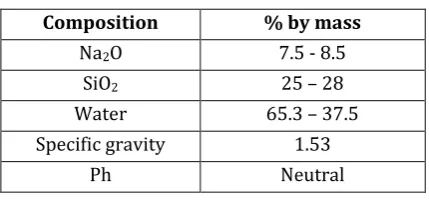
[image:2.595.191.406.441.542.2]The combination of sodium hydroxide and sodium silicate was chosen as alkaline solution to activate the source material. The sodium hydroxide solids in pellets with 98% purity were mixed with water to make solution having concentration of sodium hydroxide as 12 M. locally available M-sand with specific gravity of 2.6 and fineness modulus of was used as fine aggregate for preparing geopolymer matrix. The properties of sodium hydroxide and sodium silicate are shown in Table 4 and Table 5.
Table 4: Properties of Sodium Silicate
Composition % by mass
Na2O 7.5 - 8.5
SiO2 25 – 28
Water 65.3 – 37.5
Specific gravity 1.53
Ph Neutral
Table 5: Properties of sodium hydroxide
Flakes size Specific gravity Purity
3 mm 2.13 98%
3. EXPERIMENTAL INVESTIGATION
1.1 Molarity Calculation
Sodium hydroxide solution with a concentration of 12M consisted of 12x40 = 480 grams of NaOH solids (in flake or pellet form) per liter of the solution, where 40 is the molecular weight of NaOH. Therefore, 40 grams of NaOH pellets were dissolved in water as per required concentration.
1.2 Mix Proportion and Specimen Preparation
The alkali activator solution was prepared by mixing 12 molar NaOH with Na₂SiO₃ solution with Na₂SiO₃ to NaOH ratio of 1:2.5. The activator to binder ratio was kept at 0.35 for all the mixes. The mix proportions of mixes are given in Table 4. Dry fly ash and blast furnace slag were M-sand to binder ratio of 2.75 for about 4 minutes to blend the source material and sand uniformly.
Components SiO₂ Al₂O₃ Fe₂O₃ CaO MgO TiO₂ SO₃ LOI
© 2019, IRJET | Impact Factor value: 7.211 | ISO 9001:2008 Certified Journal | Page 991
The sand binder ratio was constant for all the specimens. The alkali activator solution was then gradually added to the mix simultaneously with water to improve workability and homogeneity of the mortar. [image:3.595.29.560.681.793.2]The mortar specimens were cast in mould of 100 mm cube steel moulds in three layers, and each layer will be compacted. All samples were covered and kept in oven for heat curing at the temperature of 80℃ for about 24 hours.
Table 6: Specimen labeling
Table 7: Mix proportions
Flyash (Kg/m³)
GGBS
(Kg/m³) (Kg/m³)Sand (g/m³)NaOH Na₂SiO₃ (g/m³)
M1 400 0 1237.5 50 125
M2 320 80 1237.5 50 125
M3 240 160 1237.5 50 125
M4 160 240 1237.5 50 125
M5 80 320 1237.5 50 125
M6 0 400 1237.5 50 125
4. DISCUSSION ON RESULTS
The experiments were carried out by geopolymer matrix with varying proportions of fly ash and GGBS for alkaline solution to fly ash ratio as 0.35, keeping the other mix design variables as constant. The results of various proportions under compressive
strength were discussed here.
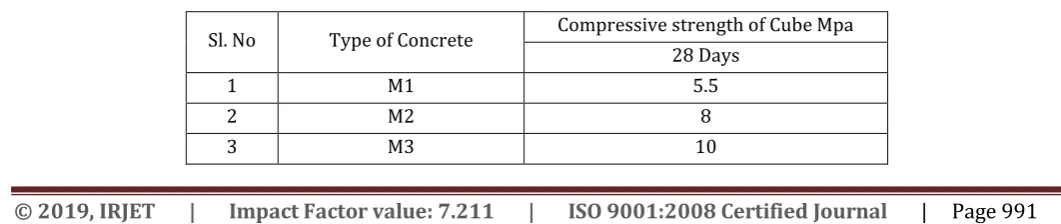
It is found that, at the age of 28 days, compressive strength of mortar mix (M1) was 5.5 N/mm2 and M4 mix with (40% fly ash + 60% GGBS) was 15.45 N/mm2 and mortar mix M6 having (100% GGBS) was 16.65 N/mm2 respectively. Maximum compressive strength (21.35 N/mm2) is observed for geopolymer mortar with (20% fly ash + 80% GGBS) as full replacement of cement.
5. STRENGTH RELATED PROPERTIES
The strength related tests such as compressive strength was conducted. The compressive strength was conducted at 28 days. The strength test has been used to find out the optimum mix on the test specimens having fly ash and GGBS at varying proportions.
Table7. Compressive strength
Mix Percentage Replacement Of Cement
M1 100% Fly ash + 0% GGBS
M2 80% Fly ash + 20% GGBS
M3 60% Fly ash + 40% GGBS
M4 40% Fly ash + 60% GGBS
M5 20% Fly ash + 80% GGBS
M6 0% Fly ash + 100% GGBS
Sl. No Type of Concrete Compressive strength of Cube Mpa 28 Days
1 M1 5.5
2 M2 8
© 2019, IRJET | Impact Factor value: 7.211 | ISO 9001:2008 Certified Journal | Page 992
5.1 Compressive strengthFig.1 shows the compressive strength of the geopolymer specimens. The high initial strength might be due to low SiO₂/Al₂O₃ in this geopolymeric system. The strength of fly ash based geopolymer mortar increased considerably to 21.35 Mpa for specimen (M1) cured at 80℃. The high compressive strength of geopolymer mortar cured at 80℃ could be related to the more connectivity between fine aggregates and gel having highly cross-linking geopolymer. This indicates that the temperature plays an important role in formation and densification of gel. The compressive strength increase of geopolymer mortar depends on the bonding strength of the interfacial zone between paste and aggregate.
6. CONCLUSIONS
Based on the obtained data, it concludes that the proportions of binders were highly influencing the strength of the specimen. The specimen with 100% replacement of cement with fly ash has minimum strength.
The compressive strength of specimen made with 40% fly ash + 60 % GGBS and specimen having 100% GGBS was 15.45 N/mm² and 16.65 N/mm². The maximum strength of the specimen, 21.35 N/mm² was attained at geopolymer matrix having 80% GGBS + 20% fly ash. The compressive strength of low calcium fly ash based geopolymer cured at 80℃ attains maximum strength.
REFERENCE
[1] Ajay Kumar Singh, “Strength and durability test of fly ash based geopolymer concrete,” Int. Journal of Engineering
Research and Application, Vol.6, No 8, pp: 139-142, 2016.
[2] Albitar.M, Mohamed Ali.M.S, Visintin.P and Drechsler.M, “Durability evaluation of geopolymer concretes’, Construction
and building materials, Vol.136, pp: 374-385, 2017.
[3] Aradhana Mehta and Kuldeep kumar, “strength and durability characteristics of fly ash and slag based geopolymer concrete,” International Journal of Civil Engineering and Technology, Vol.7, No 5, pp: 305-314, 2016.
[4] Bhalchandra.S.A and Bhosle.A.Y, “properties of glass fiber reinforced geopolymer concrete,” International Journal of
Modern Engineering Research, Vol. 3, No 4, pp: 2007-2010, 2013.
[5] Faiz Uddin Ahmed shaikh, “Mechanical and durability properties of fly ash geopolymer concrete containing recycled
coarse aggregates,” International Journal of Built Environment, Vol.5, pp: 277-287, 2016.
[6] Gunasekara.M.P.C.M, David.W.Law, Sujeeva Setunge, “A comparative study of durability characteristics and
microstructure of five different fly ash based geopolymer concretes.”
[7] Habert.G et al, “An environmental evaluation of geopolymer based concrete production: reviewing current research
trends’, Journal of Cleaner Production, Vol.19, pp: 1229-1238, 2011.
[8] MukhalladM.Almashhadani, Orhan Canpolat., Yurdakul Aycormez, Mucteba Uysal, Savas Erdem, (2018), “Mechanical and micro structural characterization of fiber reinforced fly ash based geopolymer composites,” 2018.
4 M4 15.45
5 M5 21.35
© 2019, IRJET | Impact Factor value: 7.211 | ISO 9001:2008 Certified Journal | Page 993
[9] Parveen., Dhirendra Singhal, Talha Junai.M, Bharat Bhushan Jindal and Ankur Mehda, “mechanical and
micro-structural properties of fly ash based geopolymer concrete incorporating alccofine at ambient curing,” Construction and building materials,Vol.180,pp:298-307, 2018.
[10] Thamer Alomayri “Effect of glass microfiber addition on the mechanical performances of fly ash-based geopolymer composites,” Journal of Asian Ceramic Societies, Vol.5, pp: 334-340, 2017.
[11] Turner.L.K and Collins.F. G, “Carbon dioxide equivalent (CO2-e) emissions: A comparison between geopolymer and
OPC cement concrete,” Construction and Building Materials, Vol.43, pp: 125-130, 2013.
[12] Vijai.K, Kumutha.R and Vishnuram.B.G, “properties of glass fiber reinforced geopolymer concrete composites’, Asian
Journal of Civil Engineering (Building And Housing),Vol.13,No 4, pp:511-520,2012.
[13] Turner.L. K and Collins.F. G, “Carbon dioxide equivalent (CO2-e) emissions: A comparison between geopolymer and