warwick.ac.uk/lib-publications
Original citation:
Debattista, Kurt (2018) Application-specific tone mapping via genetic
programming. Computer Graphics Forum, 37 (1). pp. 439-450. doi:
10.1111/cgf.13307
Permanent WRAP URL:
http://wrap.warwick.ac.uk/94204
Copyright and reuse:
The Warwick Research Archive Portal (WRAP) makes this work by researchers of the
University of Warwick available open access under the following conditions. Copyright ©
and all moral rights to the version of the paper presented here belong to the individual
author(s) and/or other copyright owners. To the extent reasonable and practicable the
material made available in WRAP has been checked for eligibility before being made
available.
Copies of full items can be used for personal research or study, educational, or not-for profit
purposes without prior permission or charge. Provided that the authors, title and full
bibliographic details are credited, a hyperlink and/or URL is given for the original metadata
page and the content is not changed in any way.
Publisher’s statement:
"This is the peer reviewed version of the following article: Debattista, Kurt (2018)
Application-specific tone mapping via genetic programming. Computer Graphics Forum, 37 (1). pp.
439-450. which has been published in final form at https://doi.org/10.1111/cgf.13307 This article
may be used for non-commercial purposes in accordance with Wiley Terms and Conditions for
Self-Archiving."
A note on versions:
The version presented here may differ from the published version or, version of record, if
you wish to cite this item you are advised to consult the publisher’s version. Please see the
‘permanent WRAP URL’ above for details on accessing the published version and note that
access may require a subscription.
Volume 0(1981),Number 0 pp. 1–12 COMPUTER GRAPHICSforum
Application-Specific Tone Mapping via Genetic Programming
K. Debattista
WMG, University of Warwick, UK [email protected]
Abstract
High dynamic range (HDR) imagery permits the manipulation of real-world data distinct from the limitations of the traditional, low dynamic range (LDR), content. The process of retargetting HDR content to traditional LDR imagery via tone mapping operators (TMOs) is useful for visualising HDR content on traditional displays, sup-porting backwards-compatible HDR compression and, more recently, is being frequently used for input into a wide variety of computer vision applications. This work presents the automatic generation of TMOs for specific applications via the evolutionary computing method of genetic programming (GP). A straightforward, generic GP method that generates TMOs for a given fitness function and HDR content is presented. Its efficacy is demon-strated in the context of three applications: visualisation of HDR content on LDR displays, feature mapping and compression. For these applications, results show good performance for the generated TMOs when compared to traditional methods. Furthermore, they demonstrate that the method is generalisable and could be used across various applications that require TMOs but for which dedicated successful TMOs have not yet been discovered.
Categories and Subject Descriptors(according to ACM CCS): I.4.0 [Image Processing and Computer Vision]: General—Image processing software
1. Introduction
High dynamic range (HDR) imaging permits the capture, manipulation and display of real-world lighting [BADC11]. HDR content differs from its low/standard dynamic range (LDR) equivalent due to its ability to store real-world val-ues represented as floating point data as opposed to the sin-gle byte per channel approach of traditional imagery. While HDR displays are becoming more common the majority of displays do not support HDR and this will not change in the immediate future [CD17]. In such cases the HDR data needs to be converted into content suitable for LDR displays. This problem is generally tackled by a group of techniques called tone mapping operators (TMOs) which convert the HDR sig-nal into an LDR one. Furthermore, recent years have seen a rise in the use of HDR data for computer vision appli-cations [PCZ∗16] to deal with harsher lighting conditions, which may require the use of software that is LDR specific, hence a conversion from HDR to LDR is still required.
A large number of TMOs do already exist but they are typ-ically generic and made primarily for users to visualise HDR content on LDR displays. Certain applications could benefit from tone mapped data that is designed explicitly for that application. For example, Mai et al. [MMM∗11] designed a
TMO which was optimised for compression of HDR con-tent. Yet, this is one of the few cases of such designs. De-signing TMOs for particular applications may be time con-suming and the costs may outweigh the benefits if significant research is required for a particular application. In this work the process of identifying an application-specific tone map-per suitable for a task is automated by the use of genetic programming (GP) [Koz92]. GP is a method that generates programs (or functions) by adapting them over generations in an evolutionary computing environment based on a fitness function corresponding to the problem being solved.
This work makes use of GP for solving the tone mapping problem across various domains. The main contribution of this work is to show that GP can be practical for application-specific problems that require TMOs. A generic tone map-ping GP model is developed and is used to create new TMOs for applications. Three general applications are shown in or-der to demonstrate the potential of this approach: traditional tone mapping for visaulisation of HDR content on LDR dis-plays, tone mapping for feature detection and tone mapping for backwards-compatible HDR compression. Results, pre-sented for each of the methods are comparable with state-of-the-art methods and can be used for similar problems.
Fol-c
lowing this GP framework, it should be possible to generate new TMOs for problems not presented here, or with differ-ent goals than those shown in these applications.
2. Background and Related Work
This section presents related work in tone mapping for vari-ous applications, provides some background on GPs and re-lated work in that domain.
2.1. Tone Mapping
There is a significant amount of literature on TMOs par-ticularly in the case of generic TMOs developed for vi-sualising HDR content on traditional displays [BADC11]. Broadly, the methods could be divided into two categories global and local TMOs. The global TMOs apply a function to the entire image, typically based on global characteristics of the image, while local TMOs modify individual pixels or neighbourhoods based on local statistics. Global operators include a number of linear and logarithmic methods, bright-ness reproduction [TR93], the Schlick method [Sch94] and the adaptive logarithmic TMO of Drago et al. [DMAC03]. The local operators include the spatial non-uniform scaling [CHS∗93] and the photographic tone reproduction operator (PTRO) [RSSF02]. Mantiuk and Siedel [MS08] present an alternative TMO method that can generically model TMOs and successfully replicates many traditional TMOs. Mantiuk and Siedel’s method is related to the work presented here as it explores a broad search space of TMOs, however, it is more specific to replicating traditional methods while the GP method proposed is a framework for generating new TMOs for diverse applications. Ma et al. [MYZW15] presented a framework for optimising TMOs based on the metric TMQI-II presented in the same work.
A number of recent publications have explored and evalu-ated TMOs in feature mapping applications. They have, gen-erally, adopted a similar approach, consisting of the evalu-ation of key-point detection across various TMO methods. Rana et al. [RVD15,RVD16] present the use of key-point detection using both SURF and Harris detectors. Pˇribyl et al. [PCZ∗16] also presented a similar method with further TMOs tested and other detection methods. Kontogianni et al. [KSGD15] analysed the performance of TMOs on SIFT, SURF, and ORB. Suma et al. [SSS∗16] produced a sim-ilar evaluation with the focus on architectural reconstruc-tions. Furthermore, the use of TMOs has been used di-rectly within computer vision applications such as facial recognition [PMPP14,KBPE15], facial expression recogni-tion [IDC16] and tracking [ASGD15].
TMOs are also used for HDR compression for backwards-compatible HDR compression methods which maintain two streams, a tone mapped stream that is viewable on tradi-tional displays and a residual stream. In the Ward and Sim-mons’ [WS04] and Mantiuk et al.’s [MEMS06] HDR
com-pression methods the TMO that generates the backwards compatible stream is user defined; however the performance of different TMOs on the resultant compression is important and was evaluated for both methods. Mai et al. [MMM∗11] designed a TMO specifically for optimising HDR compres-sion. They presented a framework whereby a piecewise lin-ear tone curve was optimised for better compression results and performed better than traditional TMOs.
2.2. Genetic Programming
GP [Koz92] is an evolutionary computing method closely re-lated and developed from genetic algorithms that represents the genotype as computer programs or functions instead of the traditional encoding strings used in genetic algorithms. Such methods provide solutions to problems using the nat-ural selection concept of evolving generations, whereby off-spring are generated from the healthiest individuals in the environment. The healthiest individuals are selected based on a fitness function which evaluates the performance of the individual at solving the problem proposed. GP permits the exploration of a significant number of solutions to a given problem by generating and evolving programs for the task at hand based on a defined grammar that dictates program construction. In a given generation individual programs are tested for their performance and the healthiest ones are used to generate the next population via a series of evolutionary inspired operators such as crossover and mutation.
GPs have frequently been used for image classification and pattern matching problems; Espejo et al. [EVH10] present a comprehensive overview. They have also been fre-quently used for generating features too, for example for fa-cial expression recognition [YB06] or epileptic EEG classi-fication [GRD∗11]. GPs have also been used for image com-pression [NB96] and video compression [KLTN02]. Within computer graphics there have been a few applications of GPs. Kensler and Shirley [KS06] used them to generate faster ray triangle intersection operators for use in ray trac-ing computations. Sitthi-Amorn et al. [SAMWL11] used GP for the automatic simplification of procedural shaders. Sim-ilarly, Brady et al. [BLPW14] made use of GP to gener-ate new analytical BRDFs which compared favourably with state-of-the-art methods. Kán et al. [KDK17] presented a GP for finding new Monte Carlo noise filters.
3. Method
The proposed GP method is intended to automatically gen-erate TMOs that can solve problems such as those outlined in Section2.1. TMOs are typically based on a function that takes as input real-world valued data to produce display adapted LDR data:
<node> ::= <operation>|<terminal> <operation> ::= <unaryOp>|<binaryOp> <unaryOp> ::= <unaryFn>(<node>)
<binaryOp> ::= <node><binaryFn><node>
<unaryFn> ::= log|log2|log10|sin|cos|tan|asin|acos|atan|exp|sqrt
<binaryFn> ::= +|-| × |/|^
<terminal> ::= Lw(x)|<constant>|<global>
<constant> ::= rand(−5. . .5)|1|2|3
<global> ::= Lmax|Lmean|Lmedian|LharMean|Lmean(log10)|Lexp(mean(log))
Figure 1:Application-specific TMO grammar.
whereLw corresponds to the HDR content,Ld to the tone mapped LDR results and f(.)is the TMO. For global oper-ators f(.)is a function applied equally to all content in the original HDR image. The goal of the GP presented in this section is to identify a suitable TMOf(.)for a given appli-cation.
Algorithm 1Genetic Programming overview
1: generation←0
2: p←generateInitialPopulation()
3: repeat
4: f←getFitness(p)
5: p←generateNextPopulation(p,f)
6: generation←generation+1;
7: untilgeneration=maxGenerations
3.1. Overview
GP follows a general structure, shown in Algorithm 1. A population is initially created (line 2), its fitness is computed (line 4), individuals are selected based on their fitness and a new population is generated from the previous based on the selected individuals (line 5). This cycle is run across a given number of generations (line 7).
In this work a multi-island model in which each island runs the cycle from Algorithm 1 independently on sub-populations and migrates individuals at given intervals is used. In a multi-island model each island progresses in par-allel thus developing semi-independent populations concur-rently permitting faster computation through computational parallelism. Such semi-independent populations permit au-tonomous development, potentially reducing the stagnation of similar high fitness individuals that could lead to being stuck in local optima, while providing cross-fertilisation via migration [CHMR87]. A star island migration method was employed as it was found to produce good results compared to other migration methods [AGC12]. The star island model migrates the best individuals to a given island at chosen in-tervals.
The goal of this GP is to discover an application-specific
function f(.)from Equation1. f(.)is allowed to be gener-ated via the GP based on the grammar presented in Figure
1. Frequently used arithmetic and geometric terms are used. The<globals>correspond to commonly used global com-putations in TMOs, many of them can be generated automat-ically but some are popular enough to warrant separate inclu-sion.Lmax,Lmean,Lmedian,LharMeancorrespond to the maxi-mum, mean, median and harmonic mean of the input image.
Lmean(log10)is computed as 1
N∑log10(x)andLexp(mean(log))as exp(N1∑log(x)).
3.2. Population Creation
Populations of individuals are initially created randomly without any code blocks, from existing TMOs or data from previous runs. This is done to maintain the simplicity of the method and has provided good results. The method em-ployed for creation is based on the grow method [PLMK08] whereby trees are allowed to be grown randomly and ter-minate at any depth up to a given fixed depth at which a terminal must be chosen.
3.3. Fitness Function and Selection
The fitness function describes the performance of a given in-dividual for a particular task. In this case it calculates the per-formance of the generated TMO on a particular set of HDR images. This section presents the overall GP method that can be applied to identify TMOs for specific applications. The main application specific aspect depends on an application-dependent fitness function; the different fitness functions for particular applications will be discussed in Section4. The rest of the GP method assumes that this function is given and nothing else needs to be modified.
^
(a) Original: log2(Lw(x))
Lmean 2
+ (0.86×Lmax)
-
(b) NR:( log2(Lw(x))
Lmean
−2) + (0.86×Lmax)
-
(c) ST:Lmax−ExpLogMean(Lw(x)) + (0.86×Lmax)
^
(d) Hoist: log2(Lw(x))
[image:5.595.124.497.88.433.2]Lmean 2
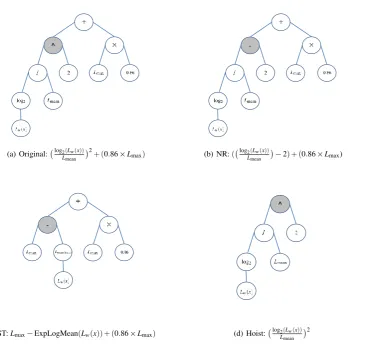
Figure 2:An illustration of the different mutation strategies. The grey node in (a) is the one chosen to be mutated. (b) (Node Replacement mutation - NR) shows how the<binaryOp>^ is replaced by−but no other nodes are affected (note the equation can now be simplified but is left in its entirety to be more legible). (c) (Subtree mutation - ST) shows how the entire subtree is substituted (again this can be simplified but is maintained intact). (d) (Hoist mutation) shows how the subtree now constitutes the entire function.
When evaluating the function a number of considerations are made. All pixels in the image are run through the same function. Initially, the HDR content has a small delta added to it to avoid values of 0. The resulting data is tidied up due to the possible complexities of the operations. Once the func-tion is run, the data is clamped at[0,1), the imaginary com-ponent of complex data is discarded and finally the image is gamma corrected and quantised to[0,255]to conform with traditional LDR imagery.
3.4. Generating the Next Population
This section outlines the specific operations used to generate the next population from the previous. Details of the pro-portions of a new population generated by any one of these operations are given in Section4.1.1.
Elite: a selection of the top individuals is chosen and copied directly to the new generation. Unlike mutation and crossover, the choice of the elite individuals is not based on fitness proportionate selection but on the overall fitness.
Mutation:Mutation uses fitness proportionate selection to choose an individual. Once the individual is chosen it is mutated. Mutation is based on a mutation rate tested as the nodes are traversed. Three forms of traditional mutation methods are adopted, see Figure2:
<global>. All elements in the subtree of the node re-main unchanged. This mutation permits small but poten-tially meaningful changes to the fitness of an individual.
/
(a) First individual: log2(Lw(x))
Lmean 2
+ (0.86×Lmax)
atan
sqrt
(b) Second individual:Lmean(log10)3.24 ×atan( √
Lw(x))
1.96
atan
sqrt
[image:6.595.95.258.134.623.2](c) Result: atan(pLw(x))2+ (0.86×Lmax)
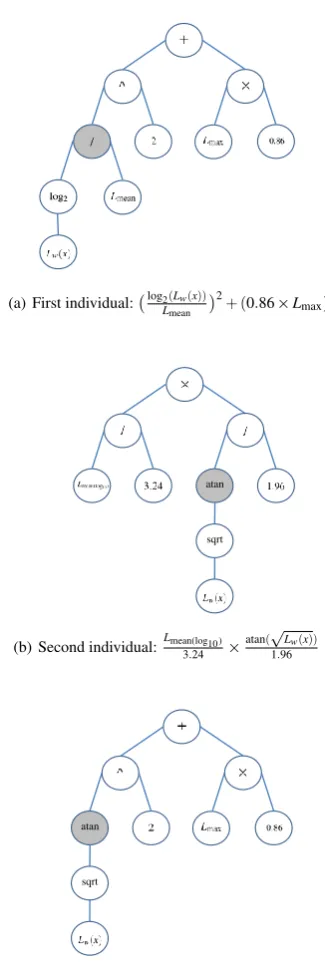
Figure 3:An illustration of cross over. The grey node in (a) and (b) are chosen for cross over. The subtree in (b) is crossed over to the subtree in (a) resulting in a new individ-ual (c).
Subtree mutation: A node is chosen at random and the en-tire subtree with this node as its root is replaced with a new subtree, created following the same rules based on population creation.
Hoist mutation: A subtree of the individual becomes the root. This mutation helps reduce possible bloat if aspects of an individual’s function are not contributing much to the computation. This function is equivalent to a crossover of an individual’s root with one of its own subtrees.
If the mutation fails, i.e., no random node was chosen, a new individual is created from scratch to permit the addition of new individuals to the population.
Crossover:For crossover two individuals are chosen by fit-ness proportionate selection and used to generate a single new individual. The subtree of one individual is then re-placed by the subtree of the other, see Figure3. The choice of which subtrees crossover depends on the crossover rate, analogous to the mutation rate, that selects subtrees from the two chosen individuals. Failed crossovers, that did not chose subtrees are replaced by new individuals.
A simplification function is also run once every genera-tion to ensure that subtrees that do not contain<globals>
orLw(x)are resolved immediately.
4. Applications
This section introduces three applications to which the method is applied to demonstrate the potential of identifying distinct solutions adapted for various problems. These are traditional tone mapping, feature matching with key point detection and HDR image compression. The section com-mences with some implementation details and settings used across the three applications.
4.1. Applying GPs for Application Specific Tone Mapping
For each application two broad types of runs can be exe-cuted, and this is how these applications are presented. A generic run that is exposed to a number of images (or im-age pairs) and produces a general function for that particular application and a second individual run that produces func-tions for each image (or image pair) seen. For the generic run only a small subset of the content used in the application is used in the GP run. The individual run effectively results in a TMO particularly optimised for the given content. In an ideal situation all content is run through its own individual GP run; however, this comes at an extra computational cost which the generic run alleviates.
4.1.1. Overall Settings
are the loading of data and the fitness function calculation. In terms of the implementation these are passed as function pointers to the GP. Data loading is run upon initialisation and the fitness function is run once for each generation. If a TMO for a new application needed to be generated it would suffice to create these two functions. For the generic and individual runs the only difference is in the data presented and the the total number of generations.
The sub-populations on each island consist of 250 individ-uals. In the population creation phase the depth of the func-tion trees are limited to 10. After each generafunc-tion the top 2% of individuals are considered elite and are maintained and the rest of the 98% are split evenly between mutation and crossover based on the fitness proportionate selection method as discussed previously. The mutation rate was set to 0.25 per node for all mutations. Similarly, the crossover rate was set to 0.25.
As mentioned above, a multi-island model using star is-land migration is adopted. Four isis-lands are run over 100 generations for the generic case and 25 for the individual case. These numbers are chosen to compromise between per-formance and the ability to traverse and refine a significant search space. Migrations occur every five generations, fol-lowing Brady et al. [BLPW14]. The three best methods from each island were migrated to the first island during these mi-gration occurrences. The first island ran an additional five generations after the final migration for a total of 105 mi-grations for the generic and 30 for the individual runs. The winner was the best method in terms of fitness to be located on the first island.
4.1.2. Implementation, Comparisons and Evaluations
The method was implemented and tested in Matlab using functionality from the HDR toolbox [BADC11]. The win-ning GP TMOs are compared with a number of TMOs. The Photographic Tone Reproduction Operator [RSSF02], in both its local (PTRO) and global (PTRO-global) incarna-tions was chosen as this method frequently performs well against other methods in subjective evaluations [LCTS05]. The Drago [DMAC03] (Drago), Shclick [Sch94] (Schlick) and Fattal [FLW02] (Fattal) methods are chosen as they have been frequently evaluated in feature mapping meth-ods; the Drago TMO has been known to perform well in some studies [RVD15,SSS∗16], and the Fattal TMO well for others [PCZ∗16]. The HDR Toolbox [BADC11] imple-mentations of the above TMOs are employed. The optimal method [DBRS∗15] (optimal) is also used as it is conceptu-ally similar to the automatic exposure performed by cam-eras, and produces good results for feature matching and compression. Finally, the compression-specific tone mapper by Mai et al. [MMM∗11] (Mai) is employed for the com-pression application. This has been implemented in Matlab for the purposes of comparison and implements the opti-misation aspect of the method only, without the distortion
component; however, this should be sufficient to provide an overview of the best performance when JPEG is not used (this is not used for the proposed GP method either when generating results). Details of the application-specific evalu-ation method used are outlined in the individual applicevalu-ation sections below. Default values were maintained for all meth-ods used.
4.2. Traditional Tone Mapping
In this section the performance of the method to generate a traditional TMO used for visualisation of HDR content on LDR displays is tested.
4.2.1. Overview
A large number of TMOs exist that perform the general tone mapping task of converting an HDR image for viewing on a traditional display device. There have been a significant number of studies that compared across them [BADC11]. While this work was not designed to challenge such meth-ods, as further validation of the system a TMO resulting from a GP run is compared with traditional TMOs.
4.2.2. GP Method
The fitness function adopted for this test was TMQI [YW13] a metric designed for comparing images generated by TMOs with the original HDR content, although other metrics such as TMQI-II [MYZW15] could also have bene used. Such metrics make the evaluation of such methods pos-sible. The data used during the GP run were six images downscaled to half their original resolution. These images were obtained from the subset of 36 images taken from the Fairchild database used in perceptual studies of dynamic range [HDVD16]. This database of images were chosen be-cause of their availability and bebe-cause they had been selected as they broadly cover the HDR range in the afore-mentioned study. The six images used in the GP generic run are shown in Figure4. The winning run was:
arctan(arctan
0.1411×Lw(x)
Lexp(mean(log))
). (2)
The individual run was also conducted for each the six im-ages in Figure4.
4.2.3. Results and Evaluation
To ensure running the method is practical, results comparing the proposed method with state-of-the-art methods are based on the full set of 36 HDR images at HD resolution used in the perceptual study [HDVD16]. They are further augmented for this test by the 19 left eye images from the set of images used for the feature mapping application discussed below and the Stanford Memorial Chapel image for a total of 56 images.
Figure 4:The images used in the traditional tone mapping and compression GP runs. Images tone mapped using Equation2.
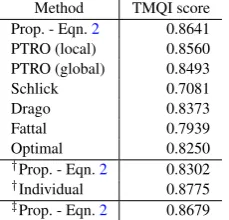
Method TMQI score Prop. - Eqn.2 0.8641 PTRO (local) 0.8560 PTRO (global) 0.8493 Schlick 0.7081
Drago 0.8373
Fattal 0.7939
Optimal 0.8250
†Prop. - Eqn.2 0.8302 †Individual 0.8775 ‡Prop. - Eqn.2 0.8679
Table 1:TMO comparison for humans using the TMQI met-ric for comparing. Mean results across 56 images are pre-sented.†results for six images in Figure4only.‡results for the remaining 50 images not used in the GP run.
PTRO operator, which frequently performs well in subjec-tive evaluations of tone mappers, follows closely in second place. The global version follows with the other methods fol-lowing behind. The table also shows results for images not used in the GP run and results can be broadly seen to be the same. The results for the individual run are averaged over the six images and demonstrate an improvement over the winning method for the six images tested. Figure6shows results of different TMOs against those generated by the GP runs for two images.
4.3. Featuring Mapping
As the ability to generate HDR images becomes more widespread the use of HDR for computer vision applica-tions is bound to increase. Many such applicaapplica-tions, for ex-ample those built in hardware, may expect LDR images as input, hence it is not uncommon to use tone mappers to convert the HDR images for input into such systems. In the following the GP is applied to feature matching, as it is one of the base steps of many vision methods,
follow-ing the overall methodology described in recent publica-tions [KSGD15,RVD16,SSS∗16].
4.3.1. Overview
The method for evaluating feature mapping follows the evaluation of certain key-point detectors across traditional TMOs [PCZ13,RVD15]. In particular Rana et al. [RVD15] is followed in the choice of the two key-point detection meth-ods chosen, however, any other method could have been adopted and used for the fitness function and for evaluation. The first feature mapping method tested is the Harris cor-ner and edge detector [HS88] and the second the SURF blob detector method [BTVG06].
Both feature matching methods are evaluated based on two metrics. The first is the straightforward metric consisting of the number of features detected|F|across a pair of im-ages. While this is useful it is not always ideal, hence other metrics such as the repeatability rate (RR) are frequently em-ployed as an alternative measure [SMB00]. RR is computed as min|(Fni|,nk) whereniand nk are the number of points de-tected in imagesIiandIkand|F|is the number of features matched as above. RR has also been adopted for similar tests in previous evaluation studies [RVD15,SSS∗16]. Figure7
shows the matching for two superimposed image pairs from the set used for the GP run in Figure5.
4.3.2. GP Method
Four GPs were run with four distinct fitness functions cor-responding to the two feature mapping methods (Harris, SURF) and the two metrics (|F|, RR). The distinction be-tween the Harris and SURF runs was based on only the use of the detection function without and further differences be-tween the two methods. If any other detector were used it would suffice to just change this part of the fitness function.
[image:8.595.122.237.263.373.2]Figure 5:The images used in the GP run for feature mapping. The left image for each stereo pair is shown.
(a) Eqn.2 (b) Individual (c) PTRO (local) (d) Drago (e) Optimal
(f) Eqn.2 (g) Individual (h) PTRO (global) (i) Fattal (j) Schlick
Figure 6:Comparison of various TMO outputs.
comprehension, hence TMQI was also adopted to ensure hu-man viewable images. This was weighted by five times in the fitness calculation compared to the TMQI error based on empirical evidence from pre-study runs. For RR, straight adoption of the metric would favour TMOs that would result in very small numbers of features detected. To avoid this, the fitness function for RR included the|F|and TMQI weight-ing as in the|F| only case, with RR weighted by 1.5 for similar reasons discussed above.
The fitness function was run on five pairs of stereo HDR images, see Figure5. These were chosen from the overall stereo HDR data set of nineteen stereo HDR pairs used by Selmanovic et al. [SDBRC12]. The first five pairs in the data set where arbitrarily chosen for GP fitness computation; however, evaluation was conducted on the entire set of nine-teen (see below).
The four winning TMOs are presented below. The pro-posed TMO for Harris feature matching RR was:
Ld(x) =arctan(3.249034×Lw(x)). (3)
The proposed TMO for Harris using|F|was:
Ld(x) =
Lw(x)
Lmean
. (4)
The discovered method for RR for SURF was:
Ld(x) =Lw(x)2+ (1.968137×Lw(x)) +Lexp(mean(log)). (5)
Finally, the method identified for producing the largest
num-ber of SURF features|F|was:
Ld(x) =
Lw(x)
eLmean(log10). (6)
For the individual run all four GP runs were run separately for each of the image pairs shown in Figure5.
4.3.3. Evaluation and Results
For evaluation purposes the results are presented to evaluate the four GP runs and resulting TMOs with traditional TMOs. These tests are run over the entire nineteen pairs and results are presented from the full set.
The results for Harris for RR and|F|are presented in Ta-ble2. Similarly, the results for SURF are presented in Table
3(note that the SURF results include results for Equation7
introduced below). As shown all the proposed methods per-form very well for the metric they were generated for and outperform all other methods except for Fattal outperform-ing Equation5for RR in the SURF results. It is worth not-ing that the use of weightnot-ing|F|for the RR metric across both Harris and Surf means that the proposed RR methods Equation3and Equation5produce reasonably large|F|, the Harris one is only second after the dedicated method and the SURF one third. For SURF, the winning Fattal method has a relatively low|F|which contributes to the high RR. Another GP RR run with a double weighting for RR compared to|F|
was run for SURF with all other settings kept the same. The resultant method:
[image:9.595.75.527.170.305.2]Figure 7:Feature matching using keypoint detection via SURF.
Method RR |F|
Prop. - Eqn.3 0.3798 322.26 Prop. - Eqn.4 0.3453 353.74 PTRO (local) 0.3327 168.73 PTRO (global) 0.3579 255.11 Schlick 0.3268 236.16 Drago 0.3664 236.15 Fattal 0.3725 200.37 Optimal 0.3757 145.21
†Prop. - Eqn.3 0.3925 114.40 †Prop. - Eqn.4 0.3226 152.80
Individual RR 0.4654 81.40 Individual|F| 0.3088 238.60
[image:10.595.113.246.217.367.2]‡Prop. - Eqn.3 0.3753 396.50 ‡Prop. - Eqn.4 0.3542 428.64
Table 2:TMO comparison for feature matching using Har-ris. Mean results across 19 image pairs are shown.†results for six image pairs shown in Figure5only.‡results for the remaining 14 image pairs never seen during the GP run.
all other methods for RR, but as with Fattal has a low|F|. The results of the individual runs are again positive and, as expected, outperform the more generic methods for the four metrics tested.
4.4. Compression
Due to the size of HDR data representations, compression of HDR content remains an important application in HDR re-search. In order to encourage adoption, several methods use a backwards compatible approach whereby two streams of the content are maintained, one for viewing on standard dis-plays/viewers and a second stream to augment the first for displaying HDR content directly. The first stream makes use of TMOs to generate the content; however, such tone curves are not generated for compression efficiency with the excep-tion of the work of Mai et al. [MMM∗11], and even in this work the optimisation was conducted per scenario. In this application GP is used to generate a TMO which optimises for the quality of the compressed content.
Method RR |F|
Prop. - Eqn.5 0.5877 414.00 Prop. - Eqn.6 0.5606 624.32 Prop. - Eqn.7 0.6245 209.06 PTRO (local) 0.5667 396.58 PTRO (global) 0.5684 390.74 Schlick 0.5569 491.00 Drago 0.5660 386.00 Fattal 0.5988 209.95 Optimal 0.5855 365.11
†Prop. - Eqn.5 0.5552 287.80 †Prop. - Eqn.6 0.5070 400.80 †Prop. - Eqn.7 0.5645 163.80
Individual RR 0.6889 147.00 Individual|F| 0.4816 912.20
‡Prop. - Eqn.5 0.5993 459.07 ‡Prop. - Eqn.6 0.5800 704.35 ‡Prop. - Eqn.7 0.6459 225.21
Table 3:TMO comparison for feature matching using SURF. Mean results across 19 image pairs are shown.†results for six image pairs shown in Figure5only.‡results for the re-maining 14 image pairs never seen during the GP run.
4.4.1. Overview
[image:10.595.352.484.218.397.2]4.4.2. GP Method
The calculation of the fitness function was based on the methodology followed by Mukherjee et al. [MDBR∗16]. In this test the evaluation the TMO and ratio images were first computed using the generated function and then quantized to 8-bit values. They were then de-quantized and the HDR image was reconstructed. The original HDR image was then compared with the reconstructed one using the PU-PSNR metric [AMS08] which correlated very highly with subjec-tive data in HDR compression comparisons [MDBR∗16]. The GP method was generated using the same six images used for traditional tone mapping shown in Figure4. The resultant winner from this run was:
Ld(x) =
r
Lw(x)×sin(arctan( 0.846
Lmax
)). (8)
As with the traditional tone mapping an individual run which optimises for the compression of given content is conducted. Six GP runs were also conducted for each of the images in Figure4resulting in six distinct functions.
4.4.3. Evaluation and Results
As with the other applications, the evaluation compares the winning method against other commonly used TMOs. The comparison is based on the 56 full sized HDR images used for the first application in order to verify real-world adapt-ability. The method is tested against the other methods, firstly without any JPEG compression (NC), effectively eval-uating the performance of the tone curve as was conducted for the fitness training. Furthermore, results are shown for JPEG compression at quality levels 100, 75, 50 and 25 were 100 is the highest quality and 25 is the lowest qual-ity. Around 75 corresponds to a general default value. For the JPEG tests the ratio image was resized to halve the size and then resized back when expanded.
Results, are shown in Table4. For the no JPEG compres-sion (NC) case a large improvement for Equation8is seen compared to the generic TMOs. This is in part expected as the method was designed to optimise for this value albeit over a much smaller sample. The results for JPEG compres-sion show a similar trend with the proposed function out-performing all others except in the case of Optimal for the quality settings of 100. The Mai method performs well too as expected. The proposed method also produced relatively small sized images for each of the JPEG cases with aver-age values of 1,212KB, 190KB, 126KB and 84KB for the quality settings of 100, 75, 50 and 25 respectively. The aver-age size across all methods were 1,346KB, 226KB, 150KB, 100KB for quality settings of 100, 75, 50, 25 respectively . Note, this method was not designed for this but it is reported to show that improved performance did not necessarily arise at the cost of increase file sizes.
Results for individual runs once again demonstrate an im-provement in the results for the images tested.
Method PU-PSNR score
NC 100 75 50 25
Prop. - Eqn.8 71.34 55.11 50.99 49.13 46.95 PTRO (local) 59.07 52.88 49.79 48.21 46.11 PTRO (global) 62.40 54.25 49.36 47.67 46.29 Schlick 53.53 48.29 46.36 45.08 43.46 Drago 63.47 52.65 49.53 47.99 46.13 Fattal 68.01 51.60 49.15 47.78 46.00 Optimal 62.28 55.89 50.46 48.73 46.52 Mai 69.44 54.08 50.38 48.52 46.16
[image:11.595.311.527.80.212.2]†Prop. - Eqn.8 68.95 56.01 51.64 49.72 47.24 †Individual 71.98 57.01 51.67 49.75 47.44 ‡Prop. - Eqn.8 71.56 55.14 51.04 49.18 47.01
Table 4:TMO comparison for compression using the PU-PSNR metric. Mean results across 56 images are shown. NC stands for no JPEG compression, the numbers 100 . . . 25 in-dicate the level of JPEG compression used.†results for six images in Figure4only.‡results for the remaining 50 im-ages not used in the GP run.
5. Discussion, Limitations and Conclusions
GP methods and their implementations can be relatively complex with the number of parameters and design choices required to be made being significant. In this work, purpose-fully, a straightforward GP method was used such that it is generalisable across a number of applications. In this re-spect, this work set out to demonstrate the viability of ap-plying GP to the tone mapping problem. It demonstrated that GP is a useful method for generating TMOs that have the ability to perform well for given problems. This char-acteristic makes this method suitable for those applications where a detailed manual investigation into tone mapping so-lutions may be unjustified or can be used as a starting point for further investigation. The applications for which it has been used performed well compared to the state of the art, however it is not claimed that, for example, the TMO devel-oped from Equation2should be used instead of the already established standard methods - it has just performed better under this given metric. The main contribution of this work lies in its flexibility to adapt to different applications and produce results for applications which have not seen signifi-cant contributions in research such as methods for computer vision. Furthermore, it enables per-image (or general con-tent) TMO solutions for a given proposed application. Fi-nally, compared to other optimisation methods the resultant function is instantly legible.
required to better quantify general trends in specific applica-tions.
5.1. Future Work
The results of the individual runs demonstrate the potential of the method for content-specific runs, generating the best solutions for given applications for particular content. Fur-thermore, these are also more desirable as global runs may provide a solution that is incompatible with data it was not trained on. While attractive, this comes at the cost of perfor-mance, and individual runs are not much slower than a full run. Future work will investigate optimisations to the meth-ods to try and identify whether a reasonable cost-benefit per-formance for individual runs can be achieved.
Currently, only global functions are produced, however, grammars could be adapted to account for local operations also. Local operations could be added via the inclusion a variable to<terminal>in the grammar, see Figure1, that operates on a local area. This could be expressed as a con-volution, not dissimilar to those used in convolutional neural networks [LBBH98]. The convolutions themselves can be modified across generations using evolutionary methods that modify kernel weights, size and strides, using the same oper-ations for generating the next generation as those presented in Section3.4.<local>could also be added to the grammar to provide local detail similar to what the current<global>
accomplishes but within a local neighbourhood. While the current method’s straightforward approach was a conscious design decision, it remains to be seen whether more complex designs such as the one described above yield better results for certain applications.
One current trend is the use of temporal TMOs [EMU17] this further increase in complexity becomes a challenge for GPs due to the amount of data required, in order to run the GPs, potentially entire animations need to be passed to the GP and for large populations this can be prohibitive. Further-more, there are few efficient evaluation metrics for dynamic TMOs rendering the process more complicated. Hopefully, this work will encourage further exploration of the topic that could render GPs for dynamic TMOs a useful research en-deavor.
Acknowledgements
Debattista is partially supported by a Royal Society Indus-trial Fellowship (IF130053). Many thanks to Tom Bashford-Rogers for fruitful discussions on the topic.
References
[AGC12] ANDALON-GARCIAI. R., CHAVOYAA.: Performance comparison of three topologies of the island model of a parallel genetic algorithm implementation on a cluster platform. In Elec-trical Communications and Computers (CONIELECOMP), 2012 22nd International Conference on(2012), IEEE, pp. 1–6.3
[AMR∗15] ARTUSIA., MANTIUKR., RICHTERT., HANHART
P., KORSHUNOVP., AGOSTINELLIM., TENA., EBRAHIMIT.: Overview and evaluation of the JPEG-XT HDR image compres-sion standard. Journal of Real-Time Image Processing(2015), 1–16.9
[AMS08] AYDINT., MANTIUKR., SEIDELH.-P.: Extending quality metrics to full luminance range images. InElectronic Imaging 2008(2008), International Society for Optics and Pho-tonics, pp. 68060B–68060B.10
[ASGD15] AGRAFIOTIS P., STATHOPOULOU E. K., GEOR
-GOPOULOSA., DOULAMISA. D.: HDR Imaging for
Enchanc-ing People Detection and TrackEnchanc-ing in Indoor Environments. In
VISAPP (2)(2015), pp. 623–630.2
[BADC11] BANTERLE F., ARTUSI A., DEBATTISTA K.,
CHALMERSA.:Advanced high dynamic range imaging: theory
and practice. CRC press, 2011.1,2,6
[BLPW14] BRADYA., LAWRENCEJ., PEERSP., WEIMERW.: genbrdf: Discovering new analytic brdfs with genetic program-ming.ACM Transactions on Graphics (TOG) 33, 4 (2014), 114.
2,6
[BTVG06] BAY H., TUYTELAARST., VAN GOOL L.: Surf: Speeded up robust features. InEuropean conference on computer vision(2006), Springer, pp. 404–417.7
[CD17] CHALMERS A., DEBATTISTA K.: HDR video past, present and future: A perspective. Elsevier Im-age Communication 54, October (May 2017), 49–55. http://dx.doi.org/10.1016/j.image.2017.02.003.1,10
[CHMR87] COHOON J. P., HEGDE S. U., MARTIN W. N.,
RICHARDSD.: Punctuated equilibria: a parallel genetic
algo-rithm. InGenetic algorithms and their applications: proceedings of the second International Conference on Genetic Algorithms: July 28-31, 1987 at the Massachusetts Institute of Technology, Cambridge, MA(1987), Hillsdale, NJ: L. Erlhaum Associates, 1987.3
[CHS∗93] CHIUK., HERFM., SHIRLEYP., SWAMYS., WANG
C., ZIMMERMANK.: Spatially nonuniform scaling functions for high contrast images. InProceedings of Graphics Interface 93(San Francisco, CA, USA, May 1993), Morgan Kaufmann Publishers Inc., pp. 245–253.2
[DBRS∗15] DEBATTISTA K., BASHFORD-ROGERS T., SEL
-MANOVI ´C E., MUKHERJEE R., CHALMERSA.: Optimal
ex-posure compression for high dynamic range content. The Visual Computer 31, 6-8 (2015), 1089–1099.6
[DMAC03] DRAGO F., MYSZKOWSKI K., ANNEN T., CHIBA
N.: Adaptive logarithmic mapping for displaying high contrast scenes.Computer Graphics Forum 22, 3 (2003), 419–426.2,6
[EMU17] EILERTSENG., MANTIUKR., UNGERJ.: A compar-ative review of tone-mapping algorithms for high dynamic range video.STAR 36, 2 (2017).11
[EVH10] ESPEJOP. G., VENTURAS., HERRERAF.: A survey on the application of genetic programming to classification.IEEE Transactions on Systems, Man and Cybernetics, Part C: Applica-tions and Reviews 40, 2 (2010), 121–144.2
[FLW02] FATTALR., LISCHINSKID., WERMANM.: Gradient domain high dynamic range compression. InACM Transactions on Graphics (TOG)(2002), vol. 21, ACM, pp. 249–256.6
[GRD∗11] GUO L., RIVERO D., DORADO J., MUNTEANU
C. R., PAZOSA.: Automatic feature extraction using genetic programming: An application to epileptic eeg classification. Ex-pert Systems with Applications 38, 8 (2011), 10425–10436.2
[HDVD16] HULUSI ´CV., DEBATTISTAK., VALENZISEG., DU
-FAUXF.: A model of perceived dynamic range for hdr images.
[HS88] HARRISC., STEPHENSM.: A combined corner and edge detector. InAlvey vision conference(1988), vol. 15, Citeseer, pp. 10–5244.7
[IDC16] IGEE. O., DEBATTISTAK., CHALMERSA.: Towards hdr based facial expression recognition under complex lighting. InProceedings of the 33rd Computer Graphics International
(2016), ACM, pp. 49–52.2
[KBPE15] KORSHUNOV P., BERNARDO M. V., PINHEIRO
A. M., EBRAHIMIT.: Impact of tone-mapping algorithms on subjective and objective face recognition in HDR images. In Pro-ceedings of the Fourth International Workshop on Crowdsourc-ing for Multimedia(2015), ACM, pp. 39–44.2
[KDK17] KÃAN˛ P., DAVLETALIYEVM., KAUFMANNH.: Dis-covering New Monte Carlo Noise Filters with Genetic Program-ming. InEG 2017 - Short Papers(2017), Peytavie A., Bosch C., (Eds.), The Eurographics Association.2
[KLTN02] KRANTZ T., LINDBERG O., THORBURN G.,
NORDIN P.: Programmatic compression of natural video.
GECCO Late Breaking Papers 2(2002), 301–307.2
[Koz92] KOZAJ. R.:Genetic programming: on the programming of computers by means of natural selection, vol. 1. MIT press, 1992.1,2
[KS06] KENSLERA., SHIRLEYP.: Optimizing ray-triangle inter-section via automated search. InInteractive Ray Tracing 2006, IEEE Symposium on(2006), IEEE, pp. 33–38.2
[KSGD15] KONTOGIANNI G., STATHOPOULOU E., GEOR
-GOPOULOSA., DOULAMISA.: Hdr imaging for feature
detec-tion on detailed architectural scenes.The International Archives of Photogrammetry, Remote Sensing and Spatial Information Sci-ences 40, 5 (2015), 325.2,7
[LBBH98] LECUNY., BOTTOUL., BENGIOY., HAFFNERP.: Gradient-based learning applied to document recognition. Pro-ceedings of the IEEE 86, 11 (1998), 2278–2324.11
[LCTS05] LEDDAP., CHALMERSA., TROSCIANKOT., SEET
-ZENH.: Evaluation of tone mapping operators using a high dy-namic range display. InSIGGRAPH ’05: ACM SIGGRAPH 2005 Papers(New York, NY, USA, 2005), ACM, pp. 640–648.6
[LK08] LEEC., KIMC.-S.: Rate-distortion optimized compres-sion of high dynamic range videos. In16th European Signal Processing Conference (EUSIPCO 2008)(2008), pp. 461–464.9
[MDBR∗16] MUKHERJEE R., DEBATTISTA K., BASHFORD
-ROGERST., VANGORPP., MANTIUKR. K., BESSAM., WA
-TERFIELDB., CHALMERSA.: Objective and subjective
evalua-tion of high dynamic range video compression. Signal Process-ing: Image Communication 47(2016), 426–437.10
[MEMS06] MANTIUK R., EFREMOV A., MYSZKOWSKI K.,
SEIDELH.-P.: Backward compatible high dynamic range mpeg
video compression. ACM Trans. Graph. 25, 3 (2006), 713–723.
2,9
[MMM∗11] MAIZ., MANSOURH., MANTIUKR., NASIOPOU
-LOSP., WARDR., HEIDRICHW.: Optimizing a tone curve for backward-compatible high dynamic range image and video com-pression. IEEE transactions on image processing 20, 6 (2011), 1558–1571.1,2,6,9
[MS08] MANTIUKR., SEIDELH.-P.: Modeling a generic tone-mapping operator.Computer Graphics Forum 27, 2 (April 2008), 699–708.2
[MYZW15] MAK., YEGANEHH., ZENGK., WANGZ.: High dynamic range image compression by optimizing tone mapped image quality index. IEEE Transactions on Image Processing 24, 10 (2015), 3086–3097.2,6
[NB96] NORDINP., BANZHAFW.: Programmatic compression of images and sound. InProceedings of the 1st annual conference on genetic programming(1996), MIT Press, pp. 345–350.2
[PCZ13] PRIBYLˇ B., CHALMERSA., ZEM ˇCÍKP.: Feature point detection under extreme lighting conditions. InProceedings of the 28th Spring Conference on Computer Graphics (2013), ACM, pp. 143–150.7
[PCZ∗16] PRIBYLˇ B., CHALMERSA., ZEM ˇCÍKP., HOOBER
-MANL., ˇCADÍKM.: Evaluation of feature point detection in high dynamic range imagery. Journal of Visual Communication and Image Representation 38(2016), 141–160.1,2,6
[PLMK08] POLIR., LANGDONW. B., MCPHEEN. F., KOZA
J. R.:A field guide to genetic programming. Lulu. com, 2008.3
[PMPP14] PEREIRA M., MORENO J.-C., PROENÇAH., PIN
-HEIROA. M.: Automatic face recognition in hdr imaging. In
SPIE Photonics Europe(2014), International Society for Optics and Photonics, pp. 913804–913804.2
[RSSF02] REINHARDE., STARKM., SHIRLEYP., FERWERDA
J.: Photographic tone reproduction for digital images. ACM Trans. Graph. 21, 3 (2002), 267–276.2,6
[RVD15] RANAA., VALENZISEG., DUFAUXF.: Evaluation of feature detection in hdr based imaging under changes in illumi-nation conditions. InMultimedia (ISM), 2015 IEEE International Symposium on(2015), IEEE, pp. 289–294.2,6,7
[RVD16] RANAA., VALENZISEG., DUFAUX F.: Optimizing tone mapping operators for keypoint detection under illumination changes. In2016 IEEE Workshop on Multimedia Signal Process-ing (MMSP 2016)(2016).2,7
[SAMWL11] SITTHI-AMORN P., MODLY N., WEIMER W.,
LAWRENCEJ.: Genetic programming for shader simplification.
ACM Transactions on Graphics (TOG) 30, 6 (2011), 152.2
[Sch94] SCHLICKC.: Quantization techniques for visualization of high dynamic range pictures. InProceeding of the Fifth Eu-rographics Workshop on Rendering(June 1994), pp. 7–18. 2,
6
[SDBRC12] SELMANOVIC E., DEBATTISTA K., BASHFORD
-ROGERST., CHALMERSA.: Backwards compatible jpeg
stereo-scopic high dynamic range imaging. InTPCG(2012), pp. 1–8.
8
[SMB00] SCHMIDC., MOHRR., BAUCKHAGEC.: Evaluation of interest point detectors. International Journal of computer vision 37, 2 (2000), 151–172.7
[SSS∗16] SUMA R., STAVROPOULOU G., STATHOPOULOU
E. K.,VANGOOLL., GEORGOPOULOSA., CHALMERS A.: Evaluation of the effectiveness of hdr tone-mapping operators for photogrammetric applications.Virtual Archaeology Review 7, 15 (2016), 54–66.2,6,7
[TR93] TUMBLINJ., RUSHMEIERH.: Tone reproduction for re-alistic images.IEEE Comput. Graph. Appl. 13, 6 (1993), 42–48.
2
[WS04] WARD G., SIMMONS M.: Subband encoding of high dynamic range imagery. InAPGV ’04: Proceedings of the 1st Symposium on Applied Perception in Graphics and Visualization
(New York, NY, USA, 2004), ACM Press, pp. 83–90.2,9
[YB06] YUJ., BHANU B.: Evolutionary feature synthesis for facial expression recognition.Pattern Recognition Letters 27, 11 (2006), 1289–1298.2