A Study of Students’ Conceptions of Networked Learning in a
Developing Country Setting
Tan Thinh Nguyen, BSc (Hons), MSc & MBA
October, 2016.
This thesis is submitted in partial fulfilment of the requirements for the degree of Doctor of Philosophy.
ii
A Study of Students’ Conceptions of Networked Learning in a
Developing Country Setting
Tan Thinh Nguyen, BSc (Hons), MSc & MBA
This thesis results entirely from my own work and has not been offered previously for any other degree or diploma.
iv
Tan Thinh Nguyen, BSc (Hons), MSc & MBA
A Study of Students’ Conceptions of Networked Learning in a Developing Country Doctor of Philosophy, October, 2016
Declaration
I hereby declare that except where specific reference is made to the work of others, the contents of this dissertation are original and have not been submitted in whole or in part for consideration for any other degree or qualification in this, or any other University. This dissertation is the result of my own work and includes nothing which is the outcome of work done in collaboration, except where specifically indicated in the text.
v
Tan Thinh Nguyen, BSc (Hons), MSc & MBA
A Study of Students’ Conceptions of Networked Learning in a Developing Country Doctor of Philosophy, October, 2016
Abstract
Institutional initiatives to foster networked learning practices, based on ‘Western’ models, are increasingly prominent in developing countries; yet, to date, very little research has explored campus-based students’ conceptions or experiences of those initiatives. This study investigates students’ conceptions of networked learning in a particular developing country setting: Can Tho University, Vietnam. The study started from the conviction that we should not assume that aspects of networked learning will be conceived by the students there in the same ways as in the countries where the models were developed.
The study adopted a phenomenographic research approach to elicit and describe the qualitatively varied ways in which undergraduate students experienced and perceived four different (though related) phenomena that are associated with networked learning in the literature and promoted within institutional initiatives. Those four phenomena relate, in turn, to: a) learning in relation to others and resources; b) the roles of technology in mediating learning through connections; c) cooperation with others in learning; and d) working together towards a common goal.
Data were gathered through semi-structured interviews and analysed according to Dahlgren and Fallsberg’s (1991) seven-stage cycle of data analysis in phenomenography, so as to elaborate the range of ways in which the phenomena of study were perceived across the sample of participants. The findings of the study are presented as outcome spaces, representing the variation in conception of each phenomenon.
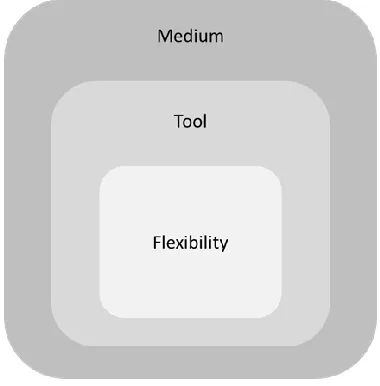
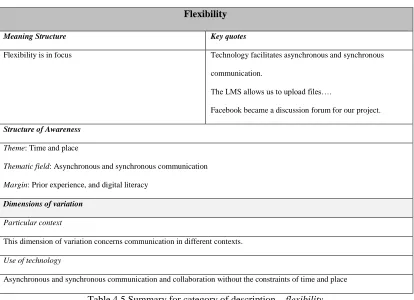
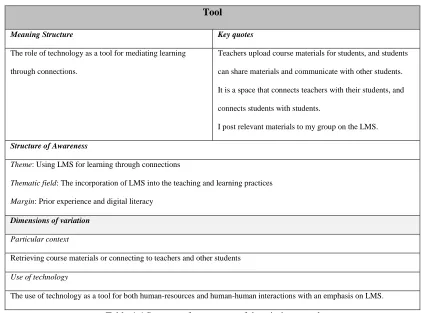
With regard to learning in relation to others and resources, three categories of description were identified: resource access, knowledge transmission and knowledge construction. Regarding the roles of technology in mediating learning through connections, three categories emerged: flexibility, tool and medium. These categories are argued to demonstrate a conceptual variation in the perceived extent and sophistication of the technological mediation occurring. Concerning cooperation with others in learning, the analysis of the data led to the emergence of three categories. These categories identified that cooperation in learning was perceived as group work,
vi In addition, qualitative differences in students’ accounts on their conceptions of working together towards a common goal were constituted by three issues related to benefits of working together towards a common goal (diversity awareness, increased understanding and increased performance) and three issues related to challenges of working together towards a common goal (technological availability, interpersonal differences and unproductive learning).
The significance of the study derives from how it provides insight into how undergraduate students experience and perceive ‘networked learning’ in developing country contexts where learners typically have rather different values and educational histories than in the ‘West’. For example, the students in this study perceived networked learning as partially an act of knowledge transmission from teacher to students, contrary to the Western literature, where the dominant conception invokes an image of students’ active involvement in knowledge construction. On the other hand, students also experienced networked learning as making-meaning-through-connections, which is reasonably consistent with findings from studies of Western settings.
It is hoped that the findings will provide new insights of value to practitioners and educators seeking to design or integrate the networked learning concept into the curriculum in higher education in the developing world; and, at a higher level of granularity, empirical knowledge of use to educators and policy makers who wish to promote more student-centred learning approaches such as networked learning in the developing world.
vii
Table of Contents
Table of Contents ... vii
Acknowledgements ... xi
List of abbreviations ... xii
List of Figures ... xiii
List of Tables ... xiv
Chapter 1 Introduction ... 1
1.1 Introduction ... 1
1.2 Background to the Study ... 4
1.3 Aims of the Study ... 7
1.4 Context of the Study ... 9
1.5 Significance of the Study ... 11
1.6 Structure of the Thesis ... 13
Chapter 2 Literature Review ... 15
2.1 Introduction ... 15
2.2 Learning ... 18
2.2.1 Defining Learning ... 18
2.2.2 Conceptions of Learning ... 21
2.2.3 Networked Learning ... 23
2.3 Conceptualising Networked Learning ... 26
2.3.1 Active Learning ... 26
2.3.2 Constructivism ... 27
2.3.3 Collaborative and Cooperative Learning ... 28
2.4 Learning with ICT in Developing Country Contexts ... 32
2.4.1 Introduction... 32
2.4.2 Integration of ICT into Higher Education ... 33
2.4.3 Empirical Research into Networked Learning ... 39
2.5 Conclusion ... 51
Chapter 3 Methodology ... 56
3.1 Introduction ... 56
3.2 Determining a Research Approach ... 56
3.3 Phenomenography ... 59
3.3.1 Overview ... 59
3.3.2 Focus of Phenomenography ... 64
3.3.3 Outcomes of Phenomenographic Research ... 68
viii
3.4.1 Overall Approach ... 69
3.4.2 Participants ... 69
3.4.3 Ethical Considerations ... 73
3.4.4 Data Collection ... 74
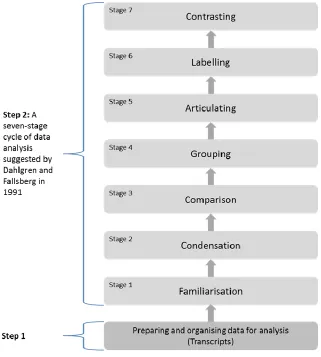
3.4.5 Data Analysis ... 80
3.5 Validity and Reliability ... 91
3.6 Conclusion ... 96
Chapter 4 Findings ... 100
4.1 Introduction ... 100
4.2 Learning through Relations ... 105
4.2.1 Overview of the Findings ... 105
4.2.2 Resource Access ... 107
4.2.3 Knowledge Transmission ... 113
4.2.4 Knowledge Construction ... 117
4.2.5 Conclusion ... 122
4.3 Roles of Technology in Mediating Learning through Connections ... 123
4.3.1 Overview of the Findings ... 123
4.3.2 Flexibility ... 125
4.3.3 Tool ... 129
4.3.4 Medium ... 133
4.3.5 Conclusion ... 137
4.4 Cooperation in Learning ... 138
4.4.1 Overview of the Findings ... 138
4.4.2 Group Work ... 140
4.4.3 Exploratory Learning ... 145
4.4.4 Directing Learning ... 149
4.4.5 Conclusion ... 154
4.5 Working towards a Common Goal ... 155
4.5.1 Overview of the Findings ... 155
4.5.2 Technologically-Mediated Cooperation ... 157
4.5.3 Interpersonal Cooperation ... 161
4.5.4 Relationship between ‘Personal’ and ‘Common’ Goals ... 166
4.5.5 Conclusion ... 174
4.6 Conclusion ... 175
Chapter 5 Discussion ... 183
5.1 Introduction ... 183
5.2 Learning through Relations ... 187
ix
5.2.2 Resource Access ... 188
5.2.3 Knowledge Transmission ... 190
5.2.4 Knowledge Construction ... 191
5.3 Roles of Technology in Mediating Learning through Connections ... 193
5.3.1 Overview ... 193
5.3.2 Flexibility ... 194
5.3.3 Tool ... 195
5.3.4 Medium ... 197
5.4 Cooperation in Learning ... 198
5.4.1 Overview ... 198
5.4.2 Group Work ... 200
5.4.3 Exploratory Learning ... 201
5.4.4 Directing Learning ... 203
5.5 Working towards a Common Goal ... 205
5.5.1 Overview ... 205
5.5.2 Technologically-Mediated Cooperation ... 205
5.5.3 Interpersonal Cooperation ... 208
5.5.4 Relationship between ‘Personal’ and ‘Common’ Goals ... 210
5.6 Summary of Findings ... 213
5.7 Conclusion ... 223
Chapter 6 Conclusion ... 225
6.1 Introduction ... 225
6.2 Reflecting on the Study ... 225
6.3 Contributions ... 235
6.4 Recommendations ... 237
6.5 Limitations of the Study ... 242
6.6 Future Research Directions ... 243
References ... 245
Appendix A Participant Consent Form ... 265
Appendix B Participant Information Sheet ... 266
xi
Acknowledgements
The completion of this thesis would not have been possible without the support of many people. My deepest gratitude and thanks to my supervisor, Dr Brett Bligh, for his unwavering understanding, support, patience, and faith. I would like to thank him for all the time and efforts he has invested in advising me to complete this thesis, and for his endless enthusiasm to help me through the many difficulties and joys of the thesis process. Without him I would not have got this far.
I must also express gratitude to all the teachers and professors who have provided me with their energy and expertise during the long PhD journey at Lancaster University. Special thanks to Professor Don Passey in the Department of Educational Research at Lancaster University for inspiring me to carry out this research.
To Professor Paul Ashwin and Dr Velda McCune. Thank you very much for providing me with valuable and actionable feedback.
Thanks also to the administration team, especially to Alice Jesmont for her generous support to PhD students at the Department of Educational Research.
This research would not have succeeded without the help of all students who generously gave their time to participate.
xii
List of abbreviations
Blended Learning: Learning that is facilitated by the effective combination of
different models of teaching, styles of learning and modes of delivery including with
technologies.
Developing world: the developing world encompasses developing countries.
Developed world: the developed world encompasses developed countries.
Epistemology: The branch of philosophy dealing with knowledge and its justification
Formal Learning: Learning that takes place within a teacher-student relationship,
such as in a school or educational institute, and which implies the design and delivery
of learning programs.
ICT: Information and Communication Technologies
Informal Learning: Learning that occurs through the experience of day-to-day
situations and is often unintentional learning
JITOL: The European-funded Framework 3 DELTA project, Just-in-time IT-based
Open Learning
LMS: Learning Management System
Network: A group of unspecified relationships among entities of which the nature
itself is undetermined.
xiii
List of Figures
Figure 3.1 Phenomenography in relation to other qualitative research approaches .... 63
Figure 3.2 Graphical representation of a conception ... 65
Figure 3.3 An illustration the difference between the first-order and the second-order perspective ... 67
Figure 3.4 Data analysis ... 83
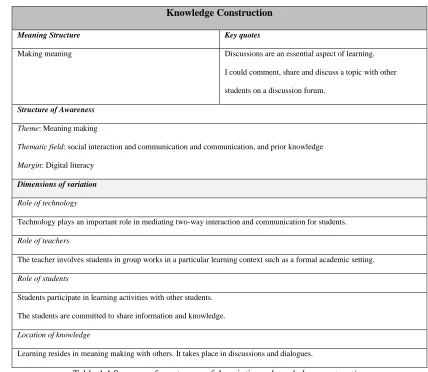
Figure 3.5 Example of a structure of awareness ... 88
Figure 3.6 Structure of awareness ... 93
Figure 4.1 Outcome space – Learning through Relations ... 106
Figure 4.2 Structure of awareness for resource access ... 110
Figure 4.3 Structure of awareness for knowledge transmission... 115
Figure 4.4 Structure of awareness for knowledge construction ... 120
Figure 4.5 Outcome space – Roles of Technology in Mediating Learning through Connections ... 124
Figure 4.6 Structure of awareness for flexibility ... 127
Figure 4.7 Structure of awareness for tool ... 131
Figure 4.8 Structure of awareness for medium ... 135
Figure 4.9 Outcome space – Cooperation in Learning ... 139
Figure 4.10 Structure of awareness for group work... 141
Figure 4.11 Structure of awareness for exploratory learning ... 146
Figure 4.12 Structure of awareness for directing learning ... 151
Figure 4.13 Outcome space – Working towards a Common Goal ... 156
Figure 4.14 Structure of awareness for technologically-mediated cooperation ... 159
Figure 4.15 Structure of awareness for interpersonal cooperation ... 164
Figure 4.16 Structure of awareness for relationship between ‘personal’ and ‘common’ goals ... 170
Figure 4.17 Overall outcome space for the phenomenon of networked learning ... 178
Figure 5.1 Internet penetration ... 206
xiv
List of Tables
Table 2.1 Initial search result ... 16
Table 2.2 Summary of empirical research into networked learning ... 48
Table 3.1 Participants’ profiles ... 73
Table 3.2 Example of condensation ... 86
Table 3.3 Example of dimensions of variation ... 89
Table 3.4 Example of labelling categories ... 89
Table 4.1 Summary of the findings ... 105
Table 4.2 Summary for category of description – resource access ... 113
Table 4.3 Summary for category of description – knowledge transmission ... 117
Table 4.4 Summary for category of description – knowledge construction ... 122
Table 4.5 Summary for category of description – flexibility ... 128
Table 4.6 Summary for category of description – tool ... 132
Table 4.7 Summary for category of description – medium ... 137
Table 4.8 Summary for category of description – group work ... 145
Table 4.9 Summary for category of description – exploratory learning ... 149
Table 4.10 Summary for category of description – directing learning ... 154
Table 4.11 Summary for category of description – technologically-mediated cooperation ... 161
Table 4.12 Summary for category of description – interpersonal cooperation... 166
Table 4.13 Summary for category of description – relationship between ‘personal’ and ‘common’ goals ... 174
Table 4.14 Learning through relations – student-student focus ... 181
Table 5.1 Overview of all the categories of description ... 185
Table 5.2 Differences between Cutajar’s study and present study ... 220
Table 5.3 Conceptions – similarities and differences between Cutajar’s study and present study ... 220
1
Chapter 1 Introduction
1.1 Introduction
In today’s society technology is developing fast. New Information and Communication
Technologies (ICT) continue to transform the way in which students learn and teachers
teach. The role of ICT in learning has evolved rapidly over the last several years. This
has been due to the increasing availability and capabilities of ICT to support learning
and teaching. Oliver (2003) stated, “Information and communication technologies
(ICT) have become commonplace entities in all aspects of life”.
In developing countries, the advances of ICT have generated enormous opportunities
for transforming the educational system (UNESCO, 2011, 2014). The use and adoption
of ICT to support teaching and learning has appeared to be centralised in terms of
catalysts for educational transformations. According to UNESCO (2014), “ICT in
education has a multiplier effect throughout the education system, by enhancing
learning and providing students with new sets of skills; by reaching students with poor
or no access (especially those in rural and remote regions); by facilitating and
improving the training of teachers; and by minimising costs associated with the delivery
of traditional instruction” (p. 6).
Higher education is one sector where ICT has had a major impact on student learning
(see Jones, 2012b). The emergence of ‘networked learning’, for example, has been
associated with exciting and innovative approaches to learning that have brought to
light the importance of technology in mediating learning and in fostering ‘connections’
2 East Asian setting to further understand how ICT is being used in learning through
connections in higher education contexts.
As the author will discuss in more detail below, the term ‘networked learning’ has
several meanings: as a theoretical lens emphasising ‘connections’, ‘active learning’ and
joint forms ‘knowledge construction’; as a programme design framework for
practitioners emphasising ‘authentic’ learning goals and ‘democratic’ forms of course
organisation; as a pedagogic approach emphasizing collaboration; and so on. According
to Beaty et al. (2010), ‘networked learning’ can be seen as a “pedagogy of inquiry” and
one suited for the twenty-first century (as cited in McConnell, Hodgson &
Dirckinck-Holmfeld, 2012, p. 11). Goodyear, Banks, Hodgson and McConnell (2004) have argued
that “networked learning is an area which has both practical and theoretical importance.
It is a rapidly growing area of educational practice, particularly in higher education and
the corporate sector” (p. 1). Networked Learning is seen as important because it raises
issues around how people and resources can be brought together in learning through the
use of ICT.
Currently, several scholarly publications about networked learning are available in the
literature. Those include several books, e.g., Advances in Research on Networked
Learning (Goodyear, Banks, Hodgson & McConnell, 2004); Exploring the Theory,
Pedagogy and Practice of Networked Learning (Dirckinck-Holmfeld, Hodgson &
McConnell, 2012); Networked Learning: An Educational Paradigm for the Age of
Digital Networks (Jones, 2015), as well as various theses and dissertations published in
various higher education institutions around the world (e.g., in Australia, Denmark,
Netherlands, Sweden and UK). There is also a large pool of journal articles and
3 (http://www.networkedlearningconference.org.uk/), which has the specific purpose of
offering a unique opportunity to “participate in a forum for the critical examination and
analysis of research in networked learning – particularly in Higher Education and
lifelong learning”.
However, much research on networked learning has been conducted in Western
countries (e.g., Goodyear, 2001; Byrne, et al., 2002; Goodyear et al., 2004; Jones et al.
2006; Jones & Dirckinck-Holmfeld, 2009; McConnell et al., 2010, Hodgson et al. 2012;
Cutajar, 2014). Very little research has been carried out in developing countries (Shah
& Hodgson, 2014). This is important because, as will be documented in Chapter 2,
attempts to foster networked learning practices are increasingly prominent in
developing countries. We should not assume that those attempts will be conceived by
the students there in the same ways as in the countries where the models were
developed.
The purpose of this study is, therefore, to add to the body of research in this area by
exploring students’ conceptions of institutional initiatives that in effect attempt to
support ‘networked learning’ in a particular developing country setting. It is well known
that the theory of networked learning is concerned with a particular learning model in
which learners use ICT to establish connections and relationships with others and
resources. This study will scrutinise how learners in a particular developing country
context experience attempts to implement those practices.
The rest of this chapter is structured as follows. The next section provides a description
of the background to the present study. This leads to precise statements of the aims of
the study, the research questions and an overview of the study as a whole in Section
4 focus on higher education in Vietnamese contexts in Section 1.4. Finally, this chapter
presents the significance of this study in Section 1.5 and outlines the structure of the
thesis in Section 1.6.
1.2 Background to the Study
An interest in networked learning has often been manifest as an attempt to study how
theoretical models are applied in practical cases (e.g. Darby, 2002; Goodyear et al.,
2004; Jones, 2015). Networked learning itself provides a theoretical framework to study
learning through connections mediated by ICT (Jones & Dirckinck-Holmfeld, 2009).
Goodyear et al. (2004) and Jones (2015) have regarded networked learning as a
particular field of research that is broadly based on the assumption that human-human
and human-resources interactions constitute the most important components in
learning. Hodgson, McConnell and Dirckinck-Holmfeld (2012) state that networked
learning is concerned with “the development of a learning culture, in which the
members’ value supporting each other: no one individual is responsible for knowing
everything” (p. 295). In other words, networked learning is based on a learning model
characterised by relationships, usually called ‘connections’. In that model, students not
only utilise ICT tools to interact with learning resources, but more importantly, they
interact with people, including each other (McConnell et al., 2012). Human-human
interaction can be between student and teacher or among students. For example,
networked learning can take place in the context of blogs in which students share their
emerging concerns with others (Newbegin & Webster, 2012).
Within the context of higher education, networked learning provides teachers and
students a new means of facilitating learning through connections mediated by ICT
5 roles of technological tools. By ‘cooperation in learning’ is meant an aim to create
opportunities for ‘cooperation’ (to be more closely defined later) and participation in a
community to emerge. That issue is regarded as crucial. Goodyear et al. (2004) stated,
“There is no point to networked learning if you do not value learning through
co-operation, collaboration, dialog, and/or participation in a community” (p. 2).
Furthermore, networked learning models also position as essential the exploration of
the technological aspects of networked learning, in order to understand whether and
how ICT can play a role in the creation of connections; for example, how ICT can be
used to support interaction. The present study, therefore, not only considered
cooperation in learning in the context of networked learning but also focussed on the
use of ICT in mediating connections, because human cooperation and ICT mediated
interaction are two mutually dependent cornerstones in the concept of networked
learning (Goodyear et al., 2004). Hodgson and Zenios (2003) stressed the impact and
importance of ICT in networked learning as follows:
“The advances of computer-based communications and the capabilities of the
Internet have enabled networked learning to become a central theme within
educational theory and practice” (p.405).
Rodesiler and Trip (2012) also stated that the intended role of ICT in networked
learning is “to bring individuals together to share insights, to make connections where
there were none before, and to enhance the learning experience for all parties.” (p. 186).
Furthermore, in exploring the role of technology in the context of networked learning,
it was impossible to overlook the importance of Learning Management Systems
(LMSs), sometimes called the Virtual Learning Environment (VLE). LMSs are the
6 learning initiatives (e.g., Bates & Sangra, 2011; Escobar-Rodriguez & Monge-Lozano,
2012). Often used to house a repository of materials (‘resources’), uses of LMSs can
also focus on the building and maintenance of the university’s online communities
(Williams & Olaniran, 2012).
With the use of LMS, the teaching content and learning materials can be put online,
which makes it possible to combine online and offline activities – by enabling students
to communicate and interact with each other, as well as accessing learning resources
‘anywhere’ (e.g., Watson & Watson, 2007; Williams & Olaniran, 2012). Part of the
reason why an LMS is often seen as impacting on networked learning is because it
serves as the institutional venue for online learning environments. As Dias and Diniz
(2012) contend, “Learning management systems (LMSs) in higher education
institutions (HEIs) provide the potential for rich learning environments built on social
constructivist theories under the concept of blended (b-) learning” (p. 38).
However, how those environments are used and experienced varies considerably
between different contexts. Learning in different contexts may have different impacts
on students’ experiences and conceptions of ‘networked learning’, much as it does on
conceptions of ‘learning’ more generally. For example, Marton, Dall'Alba and Beaty
(1993) noted that research in different contexts is likely to reveal different conceptions
of learning. Much research has shown differences in Western and Eastern conceptions
of learning in higher education contexts. Those differences have been conceptualised
in terms of teaching and learning preferences (Littrell, 2006; Utsumi & Doan, 2009;
London, 2011), students’ autonomous learning ability (Rajaram & Bordia, 2011, 2013;
7 technological barriers (Peeraer & Petegem, 2011b) and academic freedom (Vallely &
Wilkinson, 2008).
For these reasons, the author was interested to investigate how ‘networked learning’
was conceived by learners in a particular developing country context. It was a goal of
the present study to examine students’ conceptions of networked learning in a particular
developing country in South East Asia.
1.3 Aims of the Study
This study aims to describe how undergraduate students experience, understand and
perceive aspects of networked learning in a particular developing country setting. The
study primarily focuses on how undergraduate students perceive their experience of
learning in relation to others and resources, the roles of technology in mediating
learning through connections, cooperation with others in learning, and working together
towards a common goal. The phenomenographic approach that is used focuses on
mapping the collective variation in student perceptions with regard to four defined
‘phenomena’ discussed in the networked learning literature.
The study was guided by the following main research question:
What is the extent of variation in how undergraduate students collectively
experience networked learning phenomena when they are introduced in a
higher education institution in a developing country?
In particular, the study aims to examine variation in collective experience of four
particular phenomena, which, as the earlier overview has highlighted, are central, to
8 relations (with resources, tutors and students); b) the roles of technology in mediating
learning through connections; c) cooperation with others in learning; and d) working
together towards a common goal.
To address the four particular phenomena above, four research sub-questions were
coined. Those sub-questions are intended to move the research focus gradually from
very generic phenomena associated with networked learning towards more specific
issues highlighted as important in the literature. The ordering reflects a concern, both
during discussions with participants and when presenting the analysis, to address
specific concerns within the literature without allowing those to prejudge the
perceptions of wider phenomena. The research sub-questions were as follows:
1. What is the extent of variation in students’ collective experience of learning through
relations? (This question focuses on perceptions of a broad, foundational
networked learning concept: the importance of forming relations, or ‘ties’, with
peers, tutors and resources. The importance of both strong and weaker ties is
recognised, where some ties might actually be rarely or intermittently used in
practice.)
2. What is the extent of variation in students’ collective experience of the roles of
technology in mediating learning through connections? (This question focuses on
the integration of technologies into educational practices, which the networked
learning literature characterises as having consequences such as strengthening or
weakening particular relational ties or allowing for ties to be established that would
not otherwise have occurred.)
3. What is the extent of variation in students’ collective experience of cooperation with
9
use ties to work with others, typically in ways mediated by technology. The notion
of ‘working with others’ means what the networked learning literature calls
‘cooperative learning’, a general concept that encompasses all forms of group work
and consultation with others oriented towards learning goals.)
4. What is the extent of variation in students’ collective experience of working together
towards a common goal? (This question focuses on perceptions of a networked
learning concept with a specialised and exclusive technical definition:
collaborative learning, which means more than cooperation and involves
participants together defining the goals of their activity and producing joint
products as an outcome of that activity, within particularly strong pedagogical
ties.)
1.4 Context of the Study
The context for the study is Can Tho University (CTU) in Vietnam. CTU is a large
public multidisciplinary university in Vietnam. CTU was founded in 1966 and is one
of the country’s leading universities, with a good reputation in teaching and research,
and strong links with the cultural, scientific and technical centres of Vietnam. Under
Decision 1269/CP-KG dated 6 September, 2004 and Vietnamese government decree
6004/QD-BGDDT dated September 21, 2007, CTU is a ‘major’ Vietnamese research
university located in the Mekong Delta in Vietnam and is one of the 14 national ‘key’
universities in Vietnam.
CTU has over 2,000 teaching and supporting staff members and offers Bachelor’s,
Master’s and PhD degree programmes. As of 2016, CTU has more than 57,000
10 A range of learning technologies is available at CTU to support learning and teaching
both in classrooms and online. CTU’s LMS is a web-based learning system, which is
internally branded E-learning (https://lms.ctu.edu.vn/dokeos/index.php and
http://ctc.ctu.edu.vn/?option=com_content&view=article&layout=edit&id=547). This
is based on Dokeos, which is an open-source LMS. E-learning’s features include
content and course management, student interactions, a self-assessment tool, course
participant tracking features, and virtual learning spaces for group learning (Tran, 2011;
Thach, 2016). Course materials are digitised and organised in the LMS. The LMS also
serves as an online learning portal not only for CTU’s teachers and students, but also
for people in the wider Mekong Delta region (Tran, 2010).
For a readership external to CTU, repeated references to ‘e-learning’ as a general trend
in educational systems and E- Learning as a specific institutional platform has the
potential to cause confusion. Therefore, throughout the rest of this thesis, the author
refers to the university’s LMS as the LMS in order to simplify the terminology.
Cooperation in learning activities mandated at CTU are those familiar from the
networked learning models – they include studying course materials together and joint
problem solving in group-based projects (CTU, 2014; Decision 2035/ DHCT-DT;
Decision 3324/QD-DHCT; Tran, 2011). In the project-based group work, students are
expected to work together around a project. All group members are responsible for
achieving the project objectives, because the group-based project work is typically
completed by examination or written report; both group and individual exams are used
(CTU, 2014; Tran, 2011), for example in the module ‘Sustainable development’
(http://cenres.ctu.edu.vn/decuong/MT319.pdf). Cooperation and networking are, of
11 But the most important tool from the vantage point of institutional planning, provision
and support is the university’s LMS.
In the present study, it was the student’s experiences and conceptions of networked
learning that were of interest. Initially, the author was interested to investigate a wide
range of phenomena, which are often discussed by staff and managers at CTU:
Ways in which networked learning is being used by teachers and students in
education.
Using technology for communication and information exchanges between student
and teacher, and between student and student.
Participating in discussion and dialogue.
Accessing and retrieving materials.
Cooperation in learning through engagement in cooperative activities.
Opportunities where students are able to connect to others anywhere on the
Internet.
1.5 Significance of the Study
A review of the literature (see Chapter 2) reveals that there is remarkably little research
on how students experience and perceive networked learning in the developing world.
That fact has been recognised before. For example, at the Ninth International
Conference on Networked Learning in Edinburgh in 2014, Shah and Hodgson (2014)
pointed out that:
While research is available that explores teachers’ use of learning technology
12 teachers’ use of learning technology within non-western contexts. Currently we
know little about higher education within developing contexts in terms of the
prevailing pedagogical understandings and practices, the use of learning
technology, and the contexts within which these practices are embedded. (p.
271)
The present study contributes to better understanding those educational uses of
technology in non-Western contexts by focusing on how students experience those
uses. With a central focus on the idea of students’ conceptions of networked learning
in a particular developing country setting, the significant of this study is therefore based
on the following pillars:
This research is concerned with the theory and the practice of networked
learning. The study would add to the body of knowledge on networked learning.
An emerging body of research is seeking to understand students’ conceptions of
networked learning in the developing world (e.g., Shah & Hodgson, 2014).
Different contexts may lead to different conceptions with respect to the
characteristics of educational systems, cultural aspects and approaches to teaching
and learning. This study makes a significant contribution to understand in what
ways students’ conceptions of networked learning in a developing country context
are similar to and different from how those issues are discussed in the literature,
which has mostly considered the issue from a Western vantage point.
The importance of research on ICT support for learning in developing countries is
also strongly supported in recent research (e.g., Purushothaman, 2013; Zander &
Georgsen, 2013). This study is the first attempt to study students’ conceptions of
13 discussion about different forms of ICT support provision in non-Western
contexts.
Studies on students’ conception of learning are one of the core research areas in
the field of educational research (e.g., Gracio, Chaleta & Ramalho, 2002; Bowden
& Marton, 2004), to which the present study would be significant. According to
Marton and Booth (1997), students may have qualitatively different conceptions
in different contexts. Therefore, the outcomes of this study could add to the body
of knowledge of how and what students in a particular developing country
experience, understand and perceive learning in relation to other students, teachers
and resources.
To summarise, the findings obtained from this study would help to uncover students’
conceptions of networked learning in a particular developing country setting. Educators
may need to understand how students experience and perceive key aspects of networked
learning when designing and implementing it in higher education in similar contexts.
1.6 Structure of the Thesis
This thesis is structured into six chapters. This chapter has provided an introduction to
the present study – describing the background, context, aims and significance of the
study.
Chapter 2 reviews and discusses relevant academic literature, so as to establish a
conceptual framework for the present study, and highlight gaps in previous research to
which this work is oriented.
Chapter 3 presents the research methodology used for this study. It covers issues such
14 study, how this study has been designed with a focus on how data were collected and
analysed as well as a justification for sampling procedure and ethical considerations.
This chapter also identifies and discusses a range of issues relevant to
phenomenography – how it guides the focus of the project, the second-order perspective
of phenomenography, and what the outcomes of phenomenographic research are and
how they will be presented here.
Chapter 4 details the results of this study. The chapter is organised by the four research
sub-questions. It describes the qualitatively different ways in which students
experienced four aspects of networked learning: learning through relations with
resources, tutors and students; the roles of technology in mediating learning through
connections; cooperation with others in learning; and working together towards a
common goal. A summary of the key findings of each aspect is graphically presented
in an outcome space in hierarchical order that illustrates the logical relationships among
the categories of description. This chapter ends with a conclusion section that
summarises the findings of the present phenomenographic study in order to address the
main research question.
Chapter 5 provides a critical discussion of the findings based on the findings described
in Chapter 4.
The final chapter of the thesis (Chapter 6) draws the conclusions and provides an
overview of the contributions of the study. The study’s recommendations, limitations
15
Chapter 2 Literature Review
2.1 Introduction
The aim of this literature review is to provide a critical summary of the findings that
have already been published by other authors and to establish a conceptual framework
for the study. The literature review therefore synthesised the literature in the field of
networked learning and students’ conceptions of networked learning, with a particular
focus on networked learning in developing country contexts. The literature does not
answer the research questions. To answer the research questions, an extensive search
and review of the existing relevant literature was carried out. The search terms that
referred to networked learning, approaches to learning, collaboration in learning,
cooperation in learning, collaborative learning, cooperative learning, students’
conceptions, the use of technology in education, the use of technology for education,
working together, benefits and challenges of learning together, networked learning in
developing countries were used in order to ensure relevance and applicability in the
literature search.
The review covered relevant literature published from the 1970s when the concept of
conceptions of learning took off, but focussed on more recent work carried out since
2000. The search covered therefore a fairly new literature. The main literature sources
include:
Journal articles and conference papers
Books and published studies
16 To identify potentially relevant literature, the author has used the following main tools
that cover relevant books, published articles and online resources:
One Search tool at Lancaster University library – the institution where the author
registered for his doctoral studies
One Search tool at Technical University of Denmark (DTU Library) – the
institution where the author is a guest PhD student at the time of writing.
One Search tool from the central library in Denmark (https://bibliotek.dk/da).
Google scholar
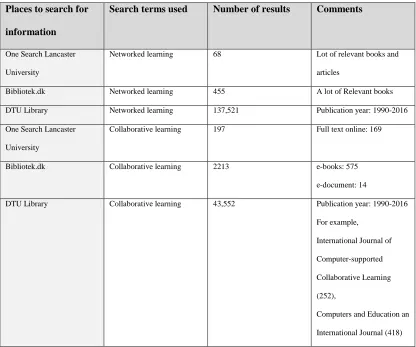
An example of the initial search results is presented in Table 2.1.
Places to search for
information
Search terms used Number of results Comments
One Search Lancaster
University
Networked learning 68 Lot of relevant books and
articles
Bibliotek.dk Networked learning 455 A lot of Relevant books
DTU Library Networked learning 137,521 Publication year: 1990-2016
One Search Lancaster
University
Collaborative learning 197 Full text online: 169
Bibliotek.dk Collaborative learning 2213 e-books: 575
e-document: 14
DTU Library Collaborative learning 43,552 Publication year: 1990-2016
For example,
International Journal of
Computer-supported
Collaborative Learning
(252),
Computers and Education an
[image:30.594.108.524.348.695.2]International Journal (418)
17 As can be seen from the table above, the search terms networked learning and
collaborative learning generated a lot of results; for example, they generated 68 and 197
results respectively from One Search tool at Lancaster University. The researcher
narrowed it down by reviewing the abstract for each of those results. All results that
were relevant for the purposes of the present study were reviewed and analysed in more
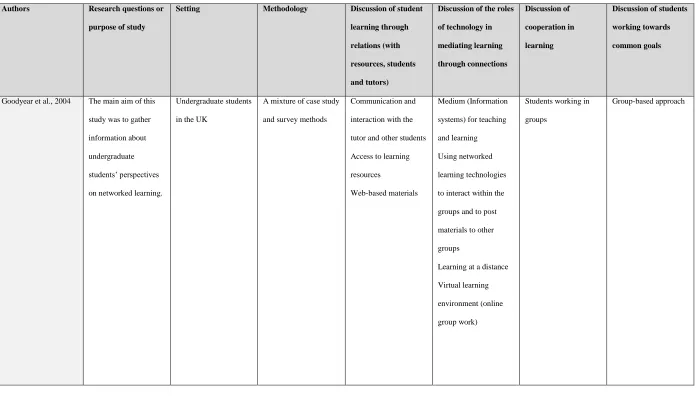
detail. The journal articles, for example, were analysed so as to concentrate on the
research focus, the research context, the research methodology and the research
outcomes. In order to provide a context for the present study, this chapter is divided
into sections.
In Section 2.2, the review seeks to clarify how the term ‘learning’ is conceptualised in
the literature and how the term is to be defined in this study. Given the diversity of
definitions of learning in different contexts, it is therefore concerned, in turn, with
defining learning, conceptions of learning and networked learning. Conceptions of
learning are important to understand students’ conceptions of networked learning,
whereas networked learning is the context in which this study is situated and to which
body this study makes the contribution.
In Section 2.3, the concepts of networked learning are examined, with a particular focus
on the conceptual underpinnings of active learning, constructivism, and collaborative
and cooperative learning. Issues around active learning, constructivism, and
collaborative and cooperative learning are discussed in order to present a clear picture
of key aspects of networked learning.
Section 2.4 focuses on how networked learning practices have been studied, researched
and adopted in developing country contexts. More specifically, the section takes a fresh
18 into networked learning in different contexts, in order to understand their implications
in the developing world.
Finally, the chapter is concluded by summarising the literature review and looking at
important considerations for the present study.
2.2 Learning
2.2.1 Defining Learning
Although there is no one, clear, and universal definition of learning, many definitions
of learning involve common elements: the acquisition of knowledge, skills, strategies,
beliefs, attitudes and behaviours through study or experience (Price, 2004; Ertmer &
Newby, 2013). The nature of that ‘experience’ has been problematised differently by
different authors. For example, according to Ormrod (1995) and Illeris (2000), “In
psychology and education, a common definition of learning is a process that brings
together cognitive, emotional, and environmental influences and experiences for
acquiring, enhancing, or making changes in one's knowledge, skills, values, and world
views” (as cited in Miniaoui & Kaur, 2014, p. 21, emphasis added). Other theorists,
researchers and educational practitioners have specified the nature of what learning
‘changes’ in numerous ways. Goodyear and Carvalho (2014), for example, have
defined learning as a sustained change in behaviour as a result of experience.
Based on the definition of learning by Shuell in 1986, Schunk (1991) quoted, “Learning
is an enduring change in behaviour, or in the capacity to behave in a given fashion,
which results from practice or other forms of experience” (as cited in Price, 2004, p.
19 The situation whereby different definitions of learning seem similar but not identical
has led to various attempts at categorisation or differentiation. For example, Schunk
(1991) sets out to distinguish between different conceptions of learning by posing the
following five questions:
How does learning occur?
What factors influence learning?
What is the role of memory?
How does transfer occur? and
What types of learning are best explained by the theory? (as cited in Ertmer &
Newby, 2013, p. 46).
As such, learning is a general term whose definition tends to vary depending on the
context in which it is applied. From the networked learning perspective, the learning
theory is based on a social theory of learning in which learning is viewed as a process.
With regard to Schunk’s question about how learning occurs, the networked learning
conception posits a process where “knowledge emerges or is constructed in relational
dialogue or collaborative interaction – knowledge is not a property but a social
construction/way of knowing from our experience of the world” (Hodgson, McConnell
& Dirckinck-Holmfeld, 2012, p. 293). Clearly, with regard to Schunk’s third question,
regarding knowledge in this way serves to relatively downplay cognitive views of
memory in favour of knowledge’s social distribution.
For many theorists, researchers and practitioners (e.g., Vygotsky, 1978; Collins, Brown
& Newman, 1987; Rogoff, 1990; Hung & Nichani, 2001), social activities such as
20 learning occurs. Those social activities are therefore a likely source of the ‘factors’
influencing learning (in Schunk’s second question). Hung and Nichani (2001), for
example, consider learning is not an isolated activity. Instead, it is a social process. It
is about change and can take place everywhere, both in formal and informal settings.
This view of learning places an emphasis on the student’s ability to learn in relation to
others. According to Reynolds, Caley and Mason (2002), such learning is deeply
affected by the context in which it occurs. Duffy and Jonassen (1992) stated,
“Interaction and collaboration is a major enabler of the knowledge construction
paradigm (as cited in Miniaoui & Kaur, 2014, p. 21). Other authors such as Reynolds,
Caley and Masson (2002), and Ryberg, Buus and Georgsen (2012) have emphasised
that social interactions have the potential to foster the interaction through which
learning is occurring. Reynolds, et al. (2002) stated, “Participation in both informal and
formal communities serves to negotiate purpose in work activities; shared vision,
identity and meaning among the group may follow” (p. 27). In this sense, social
interactions are considered as important aspects of learning which emphasises how
meanings and understanding emerge through social processes (Vygotsky, 1978). In this
sense, to return to Schunk’s fourth question, the transfer of learning between situations
and people occurs through this constant negotiation, sharing and interaction.
In summary, learning does not have any one commonly accepted definition. Different
authors have used different terms when defining learning. One main reason behind the
diversity of definitions of learning is the context in which learning takes place. In
keeping with the definitions discussed above, the researcher defines learning as a
process of change (in knowledge, values, skills, world views, practices and behaviours)
21 To answer the last of Schunk’s questions – about particular ‘types’ of learning – it is
necessary to consider some more particular conceptions of learning, and to
problematise further the nature of the attendant interactions.
2.2.2 Conceptions of Learning
A number of studies of conceptions of learning have been carried out in educational
research. The most influential works on conceptions of learning have been that of Säljö
(1979a) and Marton, Dall’Alba and Beaty (1993). Through a phenomenographic study
of a group of 90 Swedish adult learners, Säljö (1979a) found that there were a variety
of ways in which different students viewed or perceived their own learning. He
identified five different conceptions of learning as follows:
Learning as the increase of knowledge;
Learning as memorising;
Learning as the acquisition of facts, procedures, etc., which can be retained and/or
utilised in practice;
Learning as the abstraction of meaning; and
Learning as an interpretative process aimed at the understanding of reality.
Using data gathered from 29 students enrolled on the Social Science Foundation Course
of the Open University in 1980, Marton, Dall’Alba and Beaty (1993) found six
conceptions of learning in which the first five conceptions showed similarities with
Säljö’s (1979a) work, and a sixth conception described learning as changing as a
person. These six conceptions are classified into two groups which are correlated with
two qualitatively different approaches to learning: surface and deep approaches. A first
22
increasing one’s knowledge, memorising and reproducing, and applying. These three
categories share the fact that learning is viewed as primarily reproducing knowledge in
existing forms (Bowden & Marton, 2004).
On the other hand, a second group, which consists of three categories: learning
understanding, seeing something in a different way, and changing as a person,
emphasises “the meaning of what is learnt” (Bowden & Marton, 2004, pp.68-71).
These latter three categories more closely mirror a focus on the construction and
negotiation of knowledge and practices that the author emphasised in the previous
section.
To summarise, students who hold the first three conceptions tend to adopt surface
approaches to learning. That is to say, the first three conceptions “reflect a lower-level,
quantitative view of learning” (Marshall, Summers & Woolnough, 1999, p. 292). On
the other hand, students who hold the last three conceptions are likely to adopt deep
approaches to learning. In other words, the last three conceptions “reflect a higher-level,
qualitative view of learning as an active process of seeking meaning, leading to some
kind of transformation in one’s view of things, or of the self” (Marshall et al., 1999, p.
292). It seems clear that the definitions of ‘learning’ emphasised in the literature on
networked and collaborative learning are more reflective of the ‘deep’ than the ‘surface’
conceptions of learning.
Importantly, a variety of conceptions of learning has shed light on the relationship
between conception of and approach to learning. Different people will not perceive
learning in the same way; rather, their approaches to learning are closely related to their
conceptions of learning (e.g., Säljö’s, 1979a; Marshall et al., 1999; Bowden & Marton,
23
context in which it takes place. Eklund-Myrskog (1998), in a phenomenographic study
on students’ conceptions of learning in different educational contexts, reported that
conceptions of learning are to a considerable extent contextually dependent.
2.2.3 Networked Learning
The first definition of networked learning was presented by a research group at Centre
for Studies in Advanced Learning Technology (CSALT) at Lancaster University in the
Joint Information Systems Committee (JISC) project “Networked Learning in Higher
Education” in 1999 as follows:
“Networked learning is learning in which information and communications
technology (ICT) is used to promote connections: between one learner and other
learners, between learners and tutors; between a learning community and its
learning resources” (as cited in Goodyear et al., 2004, p.1; McConnell, et al.,
2012, p. 6).
This definition emerged from a series of projects and initiatives in the late 1980s and
1990s on the research into networked learning in higher education (McConnell et al.,
2012). What differentiates networked learning from other forms of learning supported
by technology is the greater attention to human-human interaction and the interaction
with digital materials and resources through computer-mediated communication
(Goodyear et al., 2004).
Networked learning has brought to light the importance of technology in mediating
interactions – between learners and tutors, among learners, and between learners and
resources. These interactions can be synchronous, asynchronous or both. According to
24 principle be through text, voice, graphics, video, shared workspaces, or combinations
of these forms” (p. 2). Hodgson et al. (2012) further stressed the importance of
technology in networked learning as follows:
With ICT support, networked learning has developed from being an isolated and
uncoordinated endeavour of individual technology interested teachers and
students to become an institutional commitment. If there is no institutional and
managerial commitment, the network for learning is not likely to have many
nodes or stretch across an institution. (p. 299)
This comment resonates with the emphasis on the LMS in this project; as described in
Chapter 1, it is the LMS that is the primary institutional commitment to networked
learning provision at Can Tho University – as for many other universities.
Significantly, although the use of technology to mediate connections is an integral and
important aspect of networked learning, it is not the technology itself that determines
learning, learning design or the learning process (Hodgson et al., 2012). It is generally
recognised that the connections are more important than the resources in the definition:
subsequent work tracing the development of the definition of networked learning since
the JITOL project confirms that fostering of connections between people (among
students and between teachers and students) in a community is a pre-requisite for saying
that networked learning is occurring at all, while the importance of learning resources
varies across contexts (e.g., McConnell et al., 2012). Goodyear et al. (2004) argued this
point as follows:
Some of the richest examples of networked learning involve interaction with
25 is not a sufficient characteristic to define networked learning. Human-human
interaction through computer-mediated communication or CMC, is an essential
part of networked learning. (p. 2)
To summarise, the above definition emphasises the importance of connections and the
use of ICT in the learning process. It also emphasises an important role for ICT –
considered as a means to link different aspects of networked learning together. As
Ryberg et al. (2012) stated, “Learning is not confined to the individual mind or the
individual learner. Rather, learning and knowledge construction is located in the
connections and interactions between learners, teachers and resources, and seen as
emerging from critical dialogues and enquiries” (p. 45). In networked learning,
learning takes place in connections with others and learning resources. According to
Jones, Ferreday and Hodgson (2008),
Networked learning focuses on the connections between learners, learners and
tutors and between learners and the resources they make use of in their learning.
This approach to learning suggests a relational view in which learning takes
place in relation to others and also in relation to an array of learning resources.
(p.90)
Additionally, the definition of networked learning encompasses “theoretical
assumptions about learning and how to design for learning” (Ryberg et al., 2012), but
it does not privilege a particular pedagogical model (Jones, 2009). Indeed, a range of
practices can be said to constitute ‘networked learning’. To better illustrate what does
and does not ‘count’ as networked learning, it is necessary to consider some of the
26 The review of the literature found that a variety of learning theories and learning
approaches – such as active learning, constructivism, and collaborative and
cooperative learning – perform an important role to explain learning within networked
learning environments. These learning theories and learning approaches will be
described in more detail in the following section.
2.3 Conceptualising Networked Learning
2.3.1 Active Learning
Networked learning demands learning to be ‘active’ and to focus on the construction of
knowledge through social interaction and collaboration (e.g., Harasim, Hiltz, Teles &
Turoff, 1995; Jones, 2015). The term ‘active learning’ refers to modes of instruction
that involve students in learning activities – such as investigational work, problem
solving, group work, collaborative learning and experimental learning (Anthony,
1996). A core element of active learning is that the primary responsibility for learning
is placed on the student and not on the teacher. Active learning is thus perceived as a
radical change from traditional instructional methods. It refers to a student-centred
approach in which the student actively participates and engages in learning activities to
construct knowledge (Prince, 2004). According to Bonwell and Eison (1991),
Students must do more than just listen: They must read, write, discuss, or be
engaged in solving problems. Most important, to be actively involved, students
must engage in such higher-order thinking tasks as analysis, synthesis, and
evaluation. Within this context, it is proposed that strategies promoting active
learning be defined as instructional activities involving students in doing things
27 Moreover, Chickering and Gamson (1987) suggested seven principles of active
learning in undergraduate education as follows:
Encourages contact between students and faculty
Develops reciprocity and cooperation among students
Encourages pro-active participation
Gives prompt feedback
Emphasises time on task
Communicates high expectations
Respect diverse talents and ways of learning
Applying these principles to the range of activities mandated at Can Tho University,
the following learning activities were considered relevant in the context of the present
study: work in groups, collaboration and cooperation, working together, interaction
between teachers and students, sharing information, discussion and dialogue.
2.3.2 Constructivism
Constructivist learning refers to the learning activities, “in which learners construct new
ideas or concepts on the basis of their existing knowledge and experience” (Bruner,
1966, as cited in Trentin, 2010, p. 24). In this sense, constructivism appears to be
important for understanding how people learn in networked learning environments,
because it appropriately reflects the meaning of networked learning activities; for
example, learning through social interaction in which meaning is negotiated. As Jones
(2015) argued, “The most important inheritance from constructivism in networked
learning is the situation of learning in social practice and in the interactions between
28 constructivism are that knowledge is created by people, either as individuals or as part
of groups, through experiencing the world and reflecting upon those experiences”
(Jones, 2015, pp. 52-53).
From a constructivist perspective, it is useful if learners are urged to be actively
involved in their own learning process, in order to construct a meaning from their own
experiences (Phye, 1997); while ‘knowledge’ is the desired outcome of their learning
process and is itself constructed. Brooks (1999) described this point such as: “As long
as there were people asking each other questions, we have had constructivist
classrooms. Constructivism, the study of learning, is about how we all make sense of
our world, and that really hasn’t changed” (as cited in Beirne & Velsor, 2012, p. 16).
In the context of the present study, constructivism offers insight into understanding
interactions between teachers and students, and between students and students within
networked learning environments due to its assumptions regarding “the idea that
individuals construct their understanding of the world as a product of their actions on
the world” (Mascolo, 2009, p. 4). The same institutional activities are highlighted as
important as for active learning – but constructivism additionally draws attention to the
importance of understanding how people construct meaning within, and about, those
activities. That construction of meaning is a key focus of the phenomenographic
approach used in this study.
2.3.3 Collaborative and Cooperative Learning
The literature argues that the emergence of networked learning has brought ‘new’
approaches to learning. These approaches strive to create a profound shift in how
29 of directly ‘social’ learning (collaborative learning and cooperative learning) are
emphasised within networked learning activities due to the fundamental focus within
networked learning on human-human connection (e.g., Jones & Steeples, 2002;
Hodgson et al., 2012). According to Jones and Steeples (2002), collaborative learning
and cooperative learning both imply a more ‘active’ role for the learner (see Section
2.3.1 for a discussion of what ‘active’ means). Furthermore, the adoption of these
modes of learning can create an environment that can bring learners together to network
and construct knowledge through social interactions; for example, “learning emerges
from relational dialogue with and/or through others in learning communities” (Hodgson
& Watland, 2004, p. 126). There are, therefore, obvious parallels with constructivist
thinking (Section 2.3.2). Valkanos (2008) has stated, “The purpose of collaboration is
to combine expertise and resources in order to meet the needs of all learners. What is
expected from collaboration is supportive interactive group learning, shared
understanding, social construction of knowledge and acquisition of competences” (p.
388).
Other researchers (McConnell, 2000; Zenios & Goodyear, 2008; Hodgson et al., 2012;
McConnell et al., 2012; Raffaghelli & Richieri, 2012) have also argued that
collaboration provides a powerful form of social interactions to networked learning.
The term ‘collaboration’ is, therefore, sometimes used within the literature simply so
as to emphasise the importance of active and social knowledge construction. For
example, McConnell (1999) explains the importance of collaboration to a learning
approach in networked learning environments as follows:
Many terms are emerging to describe the use of electronic communication and