Complete Syntactic Analysis Based on Multi-level Chunking
ZhiPeng Jiang
and
Yu Zhao
and
Yi Guan
and
Chao Li
and
Sheng Li
School of Computer Science and Technology,
Harbin Institute of Technology,
150001, Harbin, China
[email protected]
;
[email protected]
[email protected]
;
[email protected]
[email protected]
Abstract
This paper describes a complete syntactic analysis system based on multi-level chunking. On the basis of the correct se-quences of Chinese words provided by CLP2010, the system firstly has a Part-of-speech (POS) tagging with Conditional Random Fields (CRFs), and then does the base chunking and complex chunking with Maximum Entropy (ME), and finally gene-rates a complete syntactic analysis tree. The system took part in the Complete Sen-tence Parsing Track of the Task 2 Chinese Parsing in CLP2010, achieved the F-1 measure of 63.25% on the overall analysis, ranked the sixth; POS accuracy rate of 89.62%, ranked the third.
1
Introduction
Chunk is a group of adjacent words which belong to the same s-projection set in a sentence, whose syntactic structure is actually a tree(Abney, 1991), but apart from the root node, all other nodes are leaf nodes. Complete syntactic analysis requires a series of analyzing processes, eventually to get a full parsing tree. Parsing by chunks is proved to be feasible (Abney, 1994).
The concept of chunking was first proposed by Abney in 1991, who defined chunks in terms of major heads, and parsed by chunks in 1994 (Ab-ney, 1994). An additional chunk tag set {B, I, O} was added to chunking (Ramshaw and Marcus, 1995), which limited dependencies between ele-ments in a chunk, changed chunking into a ques-tion of sequenced tags, to promote the
develop-ment of chunking. Chunking algorithm was ex-tended to the bottom-up parser, which is trained and tested on the Wall Street Journal (WSJ) part of the Penn Treebank (Marcus, Santorini and Mar-cinkiewicz 1993), and achieved a performance of 80.49% F-measure, the results show that it per-formed better than a standard probabilistic con-text-free grammar, and can improve performance by adding the information of parent node (Sang, 2000).
On Chinese parsing, Maximum Entropy Model was first used to have a POS tagging and chunking, and then a full parsing tree was generated (Fung, 2004), training and testing in the Penn Chinese Treebank, which achieved 79.56% F-measure. The parsing process was divided into POS tagging, base chunking and complex chunking, having a POS tagging and chunking on a given sentence, and then looping the process of complex chunking up to identify the root node (Li and Zhou, 2009). This parsing method is the basis of this paper. In addition, we have the existing Chinese chunking system in laboratory, which ranked first in Task 2: Chinese Base Chunking of CIPS-ParsEval-2009, so we try to apply chunking to complete syntactic analysis in CLP2010, to achieve better results.
2
POS Tagging Based on CRFs
2.1 Conditional Random Fields
X is a random variable over data sequences to be labeled, and Y is a random variable over corres-ponding label sequences. All components Yi of Y
are assumed to range over a finite label alphabet. For example, X might range over natural language sentences and Y range over part-of-speech tags of those sentences, a finite label alphabet is the set of possible part-of-speech tags (Lafferty and McCal-lum and Pereira, 2001).CRFs is represented by the local feature vector f and the corresponding weight vector, f is divided into the state feature s (y, x, i) and transfer feature t (y, y', x, i), where y and y' are possible POS tags, x is the current input sentence, i is the position of current term (Jiang and Guan and Wang, 2006). Formalized as follows:
s (y, x, i) = s (yi, x, i) (1)
1, , ,
1
, ,
0
1
i i
t y
y x i
i
t y x i
i
(2)By the local feature of the formula (1) and (2), the global features of x and y:
,
, ,
i
F y x
f y x i
(3)At this point of (X, Y), the conditional probabil-ity distribution of CRFs:
|
exp
F Y X
,
p Y X
Z
X
(4)where
exp
,
y
Z
x
F y x
is afac-tor for normalizing. For the input sentence x, the best sequence of POS tagging:
arg max |
y
y p y x
2.2 Feature Template Selection
We use the template as a baseline which is taken by Yang (2009) in CIPS-ParsEval-2009, directly testing the performance, whose accuracy was 93.52%. On this basis, we adjust the feature tem-plate through the experiment, and improve the tagging accuracy of unknown words by introduc-ing rules, in the same corpus for trainintroduc-ing and test-ing, accuracy is to 93.89%. Adjusted feature tem-plate is shown in Table 1, in which the term pre is the first character in current word, suf is the last character of current word, num is the number of characters of current word, pos-1 is the tagging
re-sults of the previous word.
Table 1: feature template feature template
w2,w1,w0,w-1,w-2,w+1w0,w0w-1,pre0, pre0w0,suf0,
w0suf0,num,pos-1
2.3 Empirical Results and Analysis
We divide the training data provided by CLP2010 into five folds, the first four of which are train cor-pus, the last one is test corcor-pus, on which we use the CRF++ toolkit for training and testing. Tag-ging results with different features are shown in table 2.
Table 2: tagging results with different features
Model Explain Accuracy
CRF baseline 93.52%
CRF1 add w-1, pos-1 93.58%
CRF2 add num 93.66%
CRF3 add num, w-1, pos-1 93.68%
CRF4 add num, rules 93.80% CRF5 add num, w-1, pos-1, rules 93.89%
Tagging results show that the number of charac-ter and POS information can be added to improve the accuracy of tagging, but in CLP2010, the tag-ging accuracy is only 89.62%, on the one hand it may be caused by differences of corpus, on the other hand it may be due to that we don’t use all the features of CRFs but remove the features which appear one time in order to reduce the train-ing time.
3
Multi-level Chunking Based on ME
3.1 Maximum Entropy Models and Maxi-mum Entropy Markov Models
Maximum entropy model is mainly used to esti-mate the unknown probability distribution whose entropy is the maximum under some existing con-ditions. Suppose h is the observations of context, t is tag, the conditional probability p (t | h) can be expressed as:
exp( ( , ))
( | )
( ) i
i i t h
P t h
Z h
f
where fi is the feature of model, ( ) exp( i ( , ))
i
t i
Z h
f
t h is a factor fornor-malizing. iis weigh of feature fi, training is the
process of seeking the value of i.
function P t t( |i i1, )h in binary Maximum entropy
Markov model, P t t( |i i1, )h is turned to p t h( | ) to
be solved by adding features which can express previously tagging information (Li and Sun and Guan, 2009).
3.2 Base Chunking
Following the method of multi-level chunking, we first do the base chunking on the sentences which are through the POS tagging, then loop the process of complex chunking until they can’t be merged. We use the existing Chinese base chunking system to do base chunking in laboratory, which marks boundaries and composition information of chunk with MEMM, and achieved 93.196% F-measure in Task 2: Chinese Base Chunking of CIPS-ParsEval -2009. The input and output of base chunking are as follows:
Input:中国/nS 传统/a 医学/n 是/v 中华/nR 民
族/n 在/p 长期/n 的/uJDE 医疗/n 、/wD 生活/n
实践/vN 中/f ,/wP 不断/d 积累/v ,/wP 反复/d
总结/v 而/c 逐渐/d 形成/v 的/uJDE 具有/v 独特 /a 理论/n 风格/n 的/uJDE 医学/n 体系/n 。/wE Output:中国/nS [np 传统/a 医学/n ] 是/v [np 中
华/nR 民族/n ] 在/p 长期/n 的/uJDE [np 医疗 /n 、/wD 生活/n ] 实践/vN 中/f ,/wP [vp 不断 /d 积累/v ] ,/wP [vp 反复/d 总结/v ] 而/c [vp
逐渐/d 形成/v ] 的/uJDE 具有/v [np 独特/a 理论 /n ] 风格/n 的/uJDE [np 医学/n 体系/n ] 。/wE
3.3 Complex Chunking
We take the sentences which are through POS tag-ging and base chunking as input, using Li’s tag-ging method and feature template. Categories of complex chunk include xx_Start, xx_Middle, xx_End and Other, where xx is a category of arbi-trary chunk. The process of complex chunking is shown as follows:
Step 1: input the sentences which are through POS tagging and base chunking, for example:
中国/nS [np 传统/a 医学/n ] 的/uJDE [np 发生 /vN 发展/vN ] 及/c [np 学术/n 特点/n ] Step 2: if there are some category tags in the sen-tence, then turn a series of tags to brackets, for instance, if continuous cells are marked as xx_Start, xx_Middle, ..., xx_Middle, xx_End, then the combination of continuous cells is a complex chunk xx;
Step 3: determine the head words with the set of rules, and compress the sentence:
中国/nS [np 医学/n ] 的/uJDE [np 发展/vN ] 及 /c [np 特点/n ]
Step 4: if the sentence can be merged, mark the sentence with ME, then return step 2, else the analysis process ends:
中国/nS@np_Start [np 医学/n ]@np_End 的 /uJDE@Other [np 发 展/vN ]@np_Start 及 /c@np_Middle [np 特点/n ]@np_End
At last, the output is:
[np [np 中国/nS [np 传统/a 医学/n ] ] 的/uJDE [np [np 发生/vN 发展/vN ] 及/c [np 学术/n 特
点/n ] ] ]
Following the above method, we first use the Viterbi decoding, but in the decoding process we encountered two problems:
1. Similar to the label xx_Start, whose back is only xx_Middle or xx_End, so the probability of xx_Start label turning to Other is 0, But, if only using ME to predict, the probability may not be 0. 2. Viterbi decoding can’t solve that all the labels of predicted results are Other, if all labels are Other, they can’t be merged, this result doesn’t make sense.
Solution:
For the first question, we add the initial transfer matrix and the end transfer matrix in decoding process, that is, the corresponding xx_Middle or xx_End of xx_Start is seted to 1 in the transfer matrix, the others are marked as 0, matrix multip-lication is taken during the state transition. It can effectively avoid errors caused by probability to improve accuracy.
To rule out the second question, we use heuris-tic search approach to decode, and exclude all Other labels with the above matrix. In addition, we defined another ME classifier to do some pruning in the decoding process, the features of ME clas-sifier are POS, the head word, the POS of head word. The pseudo-code of Heuristic search is: While searching priority queue is not empty
Take the node with the greatest priority in the queue;
If the node’s depth = length of the chunking results
Searching is over, reverse the search-ing path to get searchsearch-ing results; Else
Compute the probability of all candi-date children nodes according to the current probability;
Record searching path;
Press it into the priority queue;
ques-tion mark) at the end of the sentence can be added to implement a complete sentence (zj) (Zhou, 2004), we carried out a separate deal with this sit-uation, directly add punctuation at the end of the sentence, to form a sentence.
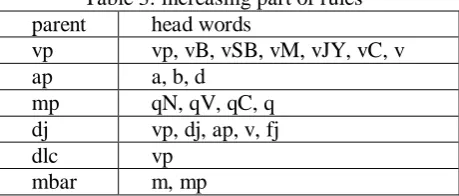
[image:4.595.66.296.254.352.2]In training data provided by CLP2010 in sub-task: Complete Sentence Parsing, the head words aren’t marked. We can’t use the statistical method to determine the head words, but only by rules. We take Li’s rule set as baseline, but the rule set was used to supplement the statistical methods, so some head words don’t appear in the rule set, re-sulting in many head words are marked as NULL, for this situation, we add some rules through expe-riment, Table 3 lists some additional rules.
Table 3: increasing part of rules parent head words
vp vp, vB, vSB, vM, vJY, vC, v ap a, b, d
mp qN, qV, qC, q dj vp, dj, ap, v, fj
dlc vp
mbar m, mp
3.4 Empirical Results and Analysis
We take the corpus which are through correct POS tagging and base chunking for training and testing, it is divided into five folds, the first four as train-ing corpus, the last one as testtrain-ing corpus, ustrain-ing the existing ME toolkit to train and test model in la-boratory. Table 4 shows the results on Viterbi de-coding and Heuristic Search method, where head words are determined by rules.
Table 4: results with different decoding Decoding Accuracy Recall Fmeasure Viterbi 84.87% 84.47% 84.67% Heuristic
Search
85.62% 85.19% 85.40%
[image:4.595.65.295.630.699.2]The system participated in the Complete Sen-tence Parsing of CLP2010, results are shown in Table 5 below. Because we can’t determine the head words by statistical method on the corpus provided by CLP2010, resulting in the accuracy decreasing, creating a great impact on results.
Table 5: the track results Training
mode
Model use F-measure POS Accuracy
Closed Single 63.25% 89.62%
4
Conclusions
In this paper, we use CRFs to have a POS tagging, and increase the tagging accuracy by adjusting the feature template; multi-level chunking is applied
to complete syntactic analysis, we do the base chunking with MEMM to recognize boundaries and components, and make the complex chunking with ME to generate a full parsing tree; on decod-ing, we add transfer matrix to improve perfor-mance, and remove some features with a ME clas-sifier to reduce training time.
As the training data are temporarily changed, our system’s training on the Event Description Sub-sentence Analysis of CLP2010 isn’t com-pleted, and head words are marked in the training corpus of this task, so our next step will be to complete training and testing of this task, compare the existing evaluation results, and use ME clas-sifier to determine head words, analyze impact of head words on system. On the POS tagging, we will retain all features to train and compare tag-ging results.
Acknowledgement
We would like to thank XingJun Xu and BenYang Li for their valuable advice to our work in Com-plete Sentence Parsing of CLP2010. We also thank JunHui Li, XiaoRui Yang and HaiLong Cao for paving the way for our work.
References
S. Abney (1991) Parsing by Chunks. Kluwer Academic Publishers, Dordrecht, 257-278
Lance A. Ramshaw, Mitchell P. Marcus (1995) Text Chunking Using Transformation-Based Learning. In Proceeding of the Third ACL Workshop on Very Large Corpora, USA, 87-88
Erik F. Tjong Kim Sang (2001) Transforming a Chunk-er to a ParsChunk-er. Computational Linguistics in the Netherlands 2000, 6-8
YongSheng Yang, BenFeng Chen (2004) A Maximum-Entropy Chinese Parser Augmented by Transforma-tion-Based Learning. ACM Transactions on Asian Language Information Processing, 4-8
John Lafferty, Andrew McCallum, and Fernando Perei-ra (2001) Conditional Random Fields: Probabilistic Models for Segmenting and Labeling Sequence Data. Proceedings of the Eighteenth International Confe-rence on Machine Learning, 282-289
Junhui Li, Guodong Zhou (2009) Soochow University Report for the 1st China Workshop on Syntactic Parsing. CIPS-ParsEval-2009, 5-8
Xiaorui Yang, Bingquan Liu, Chengjie Sun, and Lei Lin (2009) InsunPOS: a CRF-based POS Tagging System. CIPS-ParsEval-2009, 4-6
A. McCallum, D. Freitag, and F. Pereira (2000) Maxi-mum Entropy Markov Models for Information Ex-traction and Segmentation. Proceedings of ICML-2000, Stanford University, USA, 591-598
Chao Li, Jian Sun, Yi Guan, Xingjun Xu, Lei Hou, and Sheng Li (2009) Chinese Chunking With Maximum Entropy Models. CIPS-ParsEval-2009, 2-4