SeeDev Binary Event Extraction using SVMs and a Rich Feature Set
Nagesh C. Panyam, Gitansh Khirbat,
Karin Verspoor, Trevor Cohn and Kotagiri Ramamohanarao Department of Computing and Information Systems,
The University of Melbourne, Australia
{npanyam, gkhirbat}@student.unimelb.edu.au
{karin.verspoor, t.cohn, kotagiri}@unimelb.edu.au
Abstract
This paper describes the system details and results of the participation of the team from the University of Melbourne in the SeeDev binary event extraction of BioNLP-Shared Task 2016. This task addresses the extraction of genetic and molecular mechanisms that regulate plant seed development from the natural lan-guage text of the published literature. In our submission, we developed a system1 using a support vector machine classifier with linear kernel powered by a rich set of features. Our system achieved an F1-score of36.4%.
1 Introduction
One of the biggest research challenges faced by the agricultural industry is to understand the molecular network underlying the regulation of seed development. Different tissues involving complex genetics and various environmental fac-tors are responsible for the healthy development of a seed. A large body of research literature is available containing this knowledge. The SeeDev binary relation extraction subtask of the BioNLP Shared Task 2016 (Chaix et al., 2016) focuses on extracting relations or events that involve two bio-logical entities as expressed in full-text publication articles. The task represents an important contri-bution to the broader problem of biomedical rela-tion extracrela-tion.
Similar to previous BioNLP shared tasks in 2009 and 2011 (Kim et al., 2009; Kim et al., 2011), this task focuses on molecular informa-tion extracinforma-tion. The task organisers provided para-graphs from manually selected full text publica-tions on seed development ofArabidopsis thaliana
1Source: https://github.com/unimelbbionlp/BioNLPST2016/
annotated with mentions of biological entities like
proteins andgenes, and binary relations like Ex-ists In Genotype and Occurs In Genotype. The participants are asked to extract binary relations between entities in a given paragraph.
Several approaches have been proposed to ex-tract biological events from text (Ohta et al., 2011; Liu et al., 2013). Broadly, these ap-proaches can be categorized into two main groups, namely rule-based and machine learning (ML) based approaches. Rule-based approaches con-sist of a set of rules that are manually defined or semi-automatically inferred from the training data (Abacha and Zweigenbaum, 2011). To ex-tract events from text, first event triggers are de-tected using a dictionary, then the defined rules are applied over rich representations such as depen-dency parse trees, to extract the event arguments. On the other hand, ML-based approaches (Miwa et al., 2010) are characterized by learning algo-rithms such as classification to extract event argu-ments. Further, they employ various features com-puted from the textual or syntactic properties of the input text.
This article explains our SeeDev binary relation extraction system in detail. We describe the rich feature set and classifier setup employed by our system that helped achieve the second best F1-score of36.4%in the shared task.
2 Approach
The seedev task involves extraction of22different binary events over16entity types. Entity mentions within a sentence and the events between them are provided in the gold standard annotations. In the rest of the article, we refer to an event with two entity arguments as simply a binary relation.
We treat relation identification as a supervised classification problem and created 22 separate
classifiers denoted asC1, C2, . . . , C22, specific to relations r1, r2, . . . , r22, respectively. This de-sign choice was motivated by two important as-pects, namely vocabulary and relation type signa-ture. We describe them below:
Vocabulary According to the annotation guide-lines document, it is clear that different re-lations are expressed using different vocabu-lary. For example, “encode” is in the vo-cabulary of “Transcribes Or Translates To” and “phosphorylate” is in the vocabulary of “Regula-tion Of Molecule Activity”. We hypothesize that treating the vocabulary as a set of trigger words for its corresponding relation would be beneficial. Therefore, we built22separate classifiers for each relation type, with vocabulary as a relation spe-cific feature. Given an entity pair(ea, eb), we test it with the classifierCi to detect if the relationri holds betweeneaandeb.
Relation type signature Relations are associ-ated with entity type argument signatures, which specify the list of allowed entity types for each argument position. For example, the event “Pro-tein Complex Composition” requires the first en-tity argument to be one of these four enen-tity types
{“Protein”, “Protein Family”, “Protein Complex”, “Protein Domain”} and the second argument to be “Protein Complex”. Alternately, relation argu-ment signatures can be used as a filter that spec-ifies the list of invalid relations between an entity pair. We can use this knowledge to prune the train-ing sets of classifierCiof invalid entity pairs. Re-lation type signatures overlap but are not identi-cal. Therefore, training set ofCi is different from training set ofCj, j 6=i.
2.1 Training
The steps involved in training the aforementioned classifiers are described below.
1. Extract all pairs of candidates(ea, eb)that co-occur within a sentence from training doc-uments to form a triple t = (ea, eb, label). Ifea and eb are known to be related by the typerc, from the relation annotations, we set
label = rc. If they are not related, we set
label=NR.NRis a special label to denote no relation.
2. Add the triplet= (ea, eb, label)to the train-ing set ofCi, if(ea, eb)satisifies the type sig-nature for relationri, i∈[1,22].
We now have classifier specific training sets, which are sets of triples t = (ea, eb, label). To train the classifier, we regard these triples as train-ing examples of class typelabeland a feature vec-tor constructed for the entity pair (ea, eb), as ex-plained in section 2.4.
2.2 Testing
During the test phase, we generate candidate entity pairs from sentences in the test documents. We look up into the relation argument signatures to identify the list of possible relation types for this entity pair. For each such relation typeri, we test the candidate with the classifierCi. The entity pair (ea, eb)is considered to have the relation typeriif the predicted label from the classifierCi isri. A consequence of the above approach is that we may predict multiple relation types for a single entity pair in a sentence. This is a limitation of our sys-tem, as it is unlikely for a sentence to express mul-tiple relationships between an entity pair.
2.3 Classifier details
The classifiersCi, i∈[1,22]are trained as multi-class multi-classifiers. Note that the training set of each classifier Ci may include examples of the form (ea, eb, label), label = rj andj 6= i, for the rea-son that(ea, eb)satisfies the type signature forri. Therefore, at test time a classifierCi may classify an entity pair(ea, eb) asrj, j 6= i. But we note thatri is the dominant class for the classifier Ci and other relation types rj are often under repre-sented during its training. Therefore, we discard predictionsrj fromCi whenj6=i. For the entity pair(ea, eb)to be included in the final set of pre-dicted relations with the type ri, we require that the classifierCilabel it asri.
We experimented with classifiers from Scikit (Pedregosa et al., 2011). For each re-lation type, we selected a classifier type between linear kernel SVMs and Multinomial Naive Bayes. This choice was based on performance over development data. We combine the devel-opment dataset with training dataset and use it all for training. No parameter tuning was performed.
2.4 Feature Engineering
we used the toolset from Stanford CoreNLP (Man-ning et al., 2014). These features are described in detail below.
1. Stop word removal: For some relations (“Has Sequence Identical To”, “Is Function-ally Equivalent To”,“Regulates Accumula-tion” and “Regulates Expression” ) we found that it is beneficial to remove stop words from the sentence.
2. Bag of words: Include all words in the sen-tence as features, prefixed with “pre”,“mid” or “post” based on their location with refer-ence to entity mentions in the sentrefer-ence. 3. Part of Speech (POS): Concatenated
se-quence of POS tags were extracted separately for words before, after and in the middle of entity mentions in the sentence.
4. Entity features: Entity descriptions and entity types were extracted as features.
5. Dependency path features: We compute the shortest path between the entities in the de-pendency graph of the sentence and then find the neighboring nodes of the entity mentions along the shortest path. The text (lemma) and POS tags of these neighbors are included as features.
6. Trigger words: For each relation, we desig-nate a few special terms as trigger words and flag their presence as a feature. Trigger words were mainly arrived at by examining the an-notation guidelines of the task and a few rep-resentative examples.
7. Patterns: A common pattern in text docu-ments is to specify equivalent representations using parenthesis. We find if the two entities are expressed in such a way and include it as a special feature for the relations “Is Function-ally Equivalent To” and “Regulates Develop-ment Phase”.
3 Evaluation
The SeeDev-Binary task objective is to extract all related entity pairs at the document level. The met-rics are the standard Precision (P), Recall(R) and F1-score (2P R
P+R).
3.1 Dataset
The SeeDev-Binary (Chaix et al., 2016) task pro-vides a corpus of20full articles on seed develop-ment ofArabidopsis thaliana, that have been man-ually selected by domain experts. This corpus
con-sists of a total of7,082entities and3,575binary relations and is partitioned into training, develop-ment and test datasets. Gold standard entity and relation annotations are provided for training and development data and for test data only entity an-notations have been released. The given set of16 entity types are categorized into7different entity groups and22different relation types are defined. Pre-defined event signatures constrain the types of entity arguments for each relation.
3.2 Results
In the development mode, we used the training dataset for training the relation specific classifiers and predicted the relations over the development dataset. Finally, we trained our classifiers with the full training and development data together. With this system, the predicted relations over the test dataset was submitted to the task. Performance re-sults over the test dataset was made available by the task organizers at the conclusion of the event. These results are detailed in Table 3.2.
4 Discussion
We note that the final relation extraction per-formance is quite low (36.4%), suggesting that SeeDev-Binary event extraction is a challenging problem. Further, for many event types our sys-tem was unable to identify any relation mentions. It is not clear as to why our methods are not ef-fective for these relation types, but it is likely that scarcity of training data is the problem. We ob-served that our system performed poorly on rela-tion types that have < 100 training samples and has generally succeeded on the rest. It is likely that for these sparsely represented relation types, alter-nate techniques such as rule based methods might be more successful.
We attempted a few alternate techniques and de-scribe the findings from these approaches below.
4.1 Alternate approaches
Event
type Clasifierused Metrics on Development data Metrics on Test dataF1 Recall Prec. F1 Recall Prec.
Binds To SVM 0.269 0.291 0.250 0.262 0.250 0.276
Composes Primary Structure NB 0.482 0.466 0.500 NA 0 0
Composes Protein Complex NB NA 0 0 0.500 0.667 0.400
Exists At Stage NB NA 0 0 NA 0 0
Exists In Genotype SVM 0.248 0.222 0.281 0.354 0.315 0.404
Has Sequence Identical To SVM 0.336 0.800 0.213 NA 0 0
Interacts With SVM 0.245 0.218 0.280 0.286 0.241 0.351
Is Functionally Equivalent To SVM 0.238 0.256 0.222 NA 0 0
Is Involved In Process SVM NA 0 0 NA 0 0
Is Localized In SVM 0.431 0.468 0.400 0.388 0.435 0.351
Is Member Of Family SVM 0.389 0.545 0.303 0.417 0.523 0.346
Is Protein Domain Of SVM 0.111 0.068 0.285 0.295 0.419 0.228
Occurs During NB NA 0 0 NA 0 0
Occurs In Genotype SVM NA 0 0 NA 0 0
Regulates Accumulation SVM 0.444 0.344 0.625 0.316 0.188 1 Regulates Development Phase SVM 0.380 0.338 0.434 0.376 0.442 0.327 Regulates Expression SVM 0.486 0.477 0.495 0.386 0.471 0.327
Regulates Process NB 0.420 0.513 0.355 0.400 0.394 0.406
Regulates Tissue Development NB NA 0 0 NA 0 0
Regulates Molecule Activity NB NA 0 0 NA 0 0
Transcribes Or Translates To NB 0.100 0.076 0.142 NA 0 0
Is Linked To SVM NA 0 0 NA 0 0
[image:4.595.72.523.61.418.2]All Relations - 0.354 0.360 0.348 0.364 0.386 0.34
Table 1: Results for relation extraction. NB is Multinomial Naive Bayes. Prec is Precision.
one of the 22 relation types. We observed poor performance for the first stage filter and a drop in overall performance.
2. Binary classifiers: We attempted training the classifiers Ci, i ∈ [1,22] as binary classi-fiers, by modifying the triples(ea, eb, rj) to (ea, eb,+)ifj ==iand(ea, eb,−)ifj6=i. At test time, positive predictions from Ci were inferred as relations ri. We observed that this approach of combining many sub-classes into one negative class reduced preci-sion and hence overall performance.
3. Co-occurrence: A simple approach to rela-tion extracrela-tion is to consider all event pairs that occur within a sentence as related. We tried using this cooccurrence strategy for re-lation types for which SVM or Naive Bayes classifiers did not work effectively. We aban-doned this strategy as we observed that the overall F1 score reduced over the develop-ment dataset, even as the recall at the relation level improved.
4. Kernel methods: We experimented with the shortest dependency path kernel (Bunescu and Mooney, 2005) and the subset tree ker-nels (Moschitti, 2006) for classification with SVMs. However their performance was quite low (F1 score<0.20). It is likely that small training set sizes and multiple entity pairs in most sentences affect the performance of these kernel methods.
True
relation type NR BT CP EG HS IW IF IL IM IP RA RD RE RPPredicted relation type TO
NR NA 21 5 46 43 15 32 33 67 5 6 26 54 157 6
BT 14 7 0 0 0 3 0 0 0 0 0 0 0 0 0
CP 7 0 7 0 1 0 0 0 0 0 0 0 0 0 0
EG 63 0 0 18 0 0 0 0 0 0 0 0 0 0 0
HS 1 0 1 0 16 0 3 0 0 0 0 0 0 0 0
IW 23 0 0 0 0 7 0 0 1 0 0 0 0 0 0
IF 14 0 1 0 14 0 10 0 1 0 0 0 0 0 0
IL 25 0 0 0 0 0 0 22 0 0 0 0 0 0 0
IM 25 0 0 0 1 0 0 0 30 0 0 0 0 0 0
IP 27 0 0 0 0 0 0 0 0 2 0 0 0 0 0
RA 19 0 0 0 0 0 0 0 0 0 10 0 0 0 0
RD 39 0 0 0 0 0 0 0 0 0 0 20 0 0 0
RE 57 0 0 0 0 0 0 0 0 0 0 0 53 0 0
RP 86 0 0 0 0 0 0 0 0 0 0 0 0 92 0
[image:5.595.74.526.58.303.2]TO 12 0 0 0 0 0 0 0 0 0 0 0 0 0 1
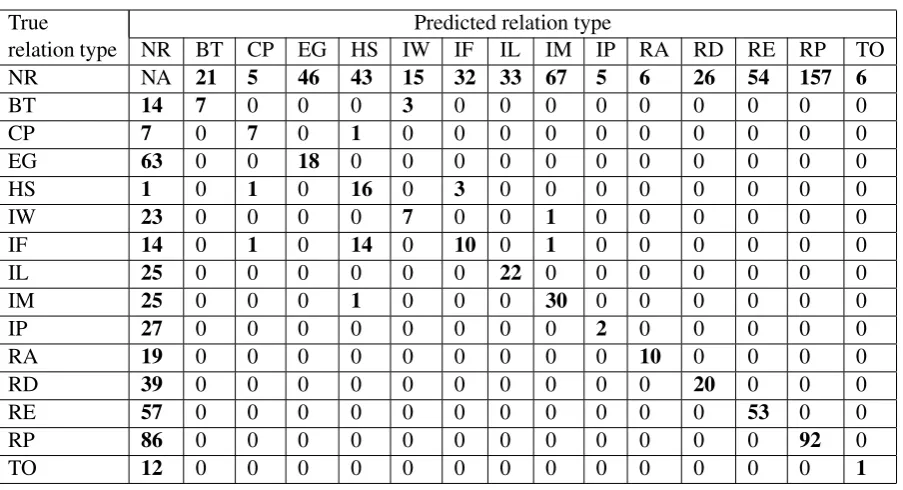
Table 2: Confusion matrix for evaluation over development data using our multiclass classifiers. Rows and columns represent the relations Not Related(NR), Binds To(BT) , Composes Primary Structure(CP) , Exists In Genotype(EG) , Has Sequence Identical To(HS) , Interacts With(IW) , Is Functionally Equiv-alent To(IF) , Is Localized In(IL) , Is Member Of Family(IM) , Is Protein Domain Of(IP) , Regulates Accumulation(RA) , Regulates Development Phase(RD) , Regulates Expression(RE) , Regulates Pro-cess(RP) and Transcribes Or Translates To(TO).
4.2 Error analysis
In Table 4.2 we show the confusion matrix for16 classifiers of our system, when evaluated over the development dataset. The remaining6 classifiers were left out as they have0predictions and are dis-cussed separately in Section 4.2.1. The entries of the confusion matrixCM[i, j]are the number of test examples whose true type isiand its predicted label isj. From the confusion matrix we see that the primary source of errors is in predicting a re-lation where there is none or vice versa. Amongst the related entity pairs, the classifier for “Has Se-quence Identical To” makes the most errors when the input examples are of type “Is Functionally Equivalent To”. Adding more discriminatory fea-tures or keywords to discriminate between these two classes is likely to improve performance. Bet-ter handling of unrelated entity pairs is likely to be achieved with more syntactic or dependency parse related features, that specifically target the entity mentions in the sentence.
4.2.1 Unsuccessful classifiers
In Table 3.2, the F-score for some of the relation types has been recorded as not available(“NA”) as our classifiers failed to predict any relations.
Studying the confusion matrix at the classifier level confirms that the classifier did not have enough evidence to detect a relation in many cases. Also, for most of these unsuccessful relation types we observed that the primary class type is under-represented in their training set. For example, the training sets for the classifier for “Exists At Stage” has3Xmore examples of type “Regulates Devel-opment Phase” than examples of type “Exists At Stage”. Better ways of handling class imbalance may improve performance.
5 Conclusion
References
Asma Ben Abacha and Pierre Zweigenbaum. 2011. Automatic extraction of semantic relations between medical entities: a rule based approach. Journal of biomedical semantics, 2(5):1.
Razvan C. Bunescu and Raymond J. Mooney. 2005. A shortest path dependency kernel for relation
ex-traction. InProceedings of the Conference on
Hu-man Language Technology and Empirical Methods in Natural Language Processing, HLT ’05, pages 724–731, Stroudsburg, PA, USA. Association for Computational Linguistics.
Estelle Chaix, Bertrand Dubreucq, Abdelhak Fatihi, Dialekti Valsamou, Robert Bossy, Mouhamadou Ba, Louise Delger, Pierre Zweigenbaum, Philippe Bessires, Loc Lepiniec, and Claire Ndellec. 2016. Overview of the regulatory network of plant seed development (seedev) task at the bionlp shared task
2016. In Proceedings of the 4th BioNLP Shared
Task workshop, Berlin, Germany, August. Associ-ation for ComputAssoci-ational Linguistics.
Jin-Dong Kim, Tomoko Ohta, Sampo Pyysalo, Yoshi-nobu Kano, and Jun’ichi Tsujii. 2009. Overview of bionlp’09 shared task on event extraction. In
Proceedings of the Workshop on Current Trends in Biomedical Natural Language Processing: Shared
Task, BioNLP ’09, pages 1–9, Stroudsburg, PA,
USA. Association for Computational Linguistics. Jin-Dong Kim, Sampo Pyysalo, Tomoko Ohta, Robert
Bossy, Ngan Nguyen, and Jun’ichi Tsujii. 2011.
Overview of bionlp shared task 2011. In
Proceed-ings of the BioNLP Shared Task 2011 Workshop, BioNLP Shared Task ’11, pages 1–6, Stroudsburg, PA, USA. Association for Computational Linguis-tics.
Haibin Liu, Karin Verspoor, Donald C Comeau, An-drew MacKinlay, and W John Wilbur. 2013. Gen-eralizing an approximate subgraph matching-based system to extract events in molecular biology and
cancer genetics. In Proceedings of the BioNLP
Shared Task 2013 Workshop, pages 76–85.
Christopher D. Manning, Mihai Surdeanu, John Bauer, Jenny Finkel, Steven J. Bethard, and David Mc-Closky. 2014. The Stanford CoreNLP natural lan-guage processing toolkit. InAssociation for Compu-tational Linguistics (ACL) System Demonstrations, pages 55–60.
Makoto Miwa, Rune Sætre, Jin-Dong Kim, and Jun’ichi Tsujii. 2010. Event extraction with com-plex event classification using rich features. Jour-nal of bioinformatics and computatioJour-nal biology, 8(01):131–146.
Alessandro Moschitti. 2006. Making tree kernels prac-tical for natural language learning.
Tomoko Ohta, Sampo Pyysalo, Makoto Miwa, and Jun’ichi Tsujii. 2011. Event extraction for dna
methylation. Journal of Biomedical Semantics,
2(5):1–15.
F. Pedregosa, G. Varoquaux, A. Gramfort, V. Michel, B. Thirion, O. Grisel, M. Blondel, P. Pretten-hofer, R. Weiss, V. Dubourg, J. Vanderplas, A. Pas-sos, D. Cournapeau, M. Brucher, M. Perrot, and E. Duchesnay. 2011. Scikit-learn: Machine
learn-ing in Python. Journal of Machine Learning