2206
ADAPTIVE NOISE CANCELLERS FOR CARDIAC SIGNAL
ENHANCEMENT FOR IOT BASED HEALTH CARE
SYSTEMS
1MD NIZAMUDDIN SALMAN, 2P TRINATHA RAO, 3MD ZIA UR RAHMAN 1
Department of Electronics and Communication Engineering, Aurora’s Technological and Research Institute, Uppal, Hyderabad, Telangana, India.
2
Department of Electronics and Communication Engineering, GITAM University, Hyderabad, Telangana, India.
3
Department of Electronics and Communication Engineering, K. L. University, Green Fields, Vaddeswaram, Guntur- 522502, Andhra Pradesh, India. E-mail: [email protected], [email protected], [email protected]
ABSTRACT
Cardiac Signals (CS) are affected with various artifacts during the acquisition and transmission. So these artifacts must be removed before presenting it to a doctor. In the proposed paper Normalized Median Least Mean Square (NMLMS) algorithm is being introduced for elimination of Power Line Interference (PLI), Baseline Wander (BW), Muscle artifacts (MA) and Electrode Motion (EM) from CS. The NMLMS has many advantages over the other conventional algorithms, i.e., it tends to reject single occurrence of large spikes of noise which otherwise introduces impulsive errors. Computational complexity can be reduced by the combination of sign algorithms with the NMLMS algorithm, which results in three new different algorithms. Based on the above algorithms, various Adaptive Noise Cancellers (ANC’s) have been developed to eliminate BW, MA and EM from the CS. The above mentioned algorithms have applied to real CS obtained from the MIT-BIH database. The simulation results confirm that the NSRMLMS algorithm is better than the conventional LMS algorithms in terms of Signal to Noise Ration Improvement (SNRI), Excessive Mean Square Error (EMSE) and Misadjustment (MSD). From the simulation results it is clear that NSRMLMS achieves the highest SNRI than the conventional LMS algorithms. The values are as follows: 11.2748dB, 9.4715dB, 10.6917dB and 10.7076 dB. These are the average values in terms of SNRI for PLI, BW, MA and EM respectively. Due to the reduced computational complexity these algorithms are usefull for Internt of Things (IOT) based remote health care monitoring systems.
Key Words: Adaptive Algorithms, Adaptive Noise Cancellers, Artifacts, Cardiac Signal, health care systems.
1. INTRODUCTION
Generally the CS is affected by various types of artifacts, the most common are PLI, BW, MA and EM. In telecardiology during the transmission,
[image:1.612.120.492.592.704.2]channel noise is also added to the CS. But such type of artifacts will affect the morphology of the signal. So to remove these artifacts is a very important task
2207 before it is presented to a doctor for diagnosis. Many artifact removal techniques are presented in the literature [1] - [10]. The adaptive form of filtering has found to be one of the best because of adjustable taps which in turn drives the EMSE towards zero. In the proposed paper, we are introducing a new ANC, which uses Normalized Median Least Mean Square (NMLMS) to filter CS. The main advantage of NMLMS it tends to reject single occurrence of large spikes of noise which otherwise introduces impulsive errors [11]. Furthermore to reduce the computational complexity, the sign algorithms are combined with NMLMS algorithm. Thus the Multiplication and Accumulation Multiplications and Accumulations (MAC) operations can be reduced. This results in Normalised Sign Regressor Median Least Mean Square algorithm (NSRMLMS), Normalized Sign Median Least Mean Square algorithm (NSMLMS) and Normalised Sign Sign Median Least Mean Square algorithm (NSSMLMS) respectively. A similar approach is used by Rahman et.al. in [12, 13] to increase the convergence rate. The applying Signum function also helps to mitigate the problem of increase in filter taps which arise in case of high data rate transmission. These type of less computational complex algorithms and assosciated health care systems are more attractive in modern IOT based remote health care monitoring systems.
Adaptive Noise Cancellers (ANC’s) are discussed in the second section and simulation results are discussed in the third section. In the third section the artifact cancellation techniques are presented using various algorihms. Finally we end up with the conlusion section. Inthe current work we have used adaptive algorithm based Adaptive Artifact Cancellers. The limitation of this proposed model is a reference signal is required.
2. ADAPTIVE NOISE CANCELLERS (ANC’s)
Let mL, e
and
µ be the terms representing the median function over a filter length of L, error signal, step size of an adaptive filter as shown in the Figure 1 and let N be the noise adding from the channel. If we consider N= [N1 N2 N3….NM]T as the L length tap matrix and then the output of the filter would be NTe. Now the error signal generated by adding both the output of the filter and the desired signal, upon minimization will result in tap update equation written as:. 1
It is necessary to consider here the work of N.V. Thakor et.al in [14]. Where the cardiac signal is filtered with LMS based ANC. The issues to be considered in selecting the reference were addressed in this work. It is possible to provide the reference as either signal or noise, but in our case we have chosen the noise as reference. It is considered to be correlated with the actual noise which is corrupting the signal. In the sequential iterations the taps gets adjusted, thus the signal gets alleviated by minimizing the noise. LMS is simpler to implement and computationally easy, but it diverges when the signal is at low SNRI. Divergence is also a serious issue as it decides the suitableness of the algorithm in the real time environment and it depends on signal power. Normalization helps to minimize the limitations in the LMS algorithm. Many normalization algorithms exist in the literature. The fundamental equation for normalization can be taken as
2
The normalization is done with respect to the signal power and a small constant called leakage factor. It is used to avoid the stability problem if the signal power reaches null. Similarly proportionate normalized LMS (PNLMS) is analyzed in [15]. The idea behind the Median based type ANC is the performance of the LMS algorithm and its derivatives significantly. This gets degraded when subjected to input signals that are corrupted by impulsive noise, sometimes this leads to instability. Smoothing the noisy gradient components using a nonlinear filter is a good remedy for this problem. In order to minimize computational complexity, we combine this NMLMS with the three simplified sign algorithms.
The three sign algorithms are: Sign Regressor algorithm, Sign algorithm and Sign Sign algorithm. Therefore, with the combination of sign algorithms with NMLMS, we obtain a new set of algorithms: NSRMLMS, NSMLMS and NSSMLMS. Thus the weight update recurssions are given by the following equations.
3
4
2208 3. SIMULATION RESULTS
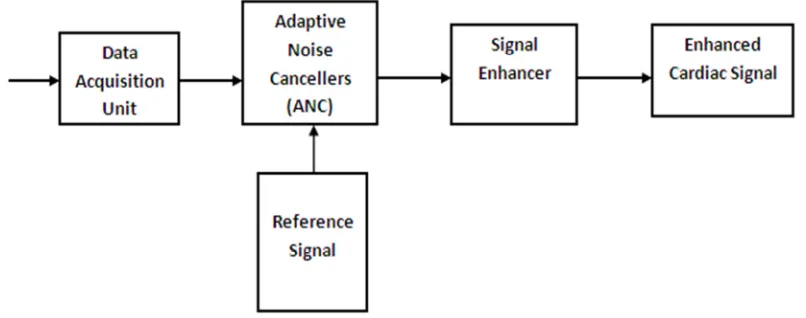
To evaluate the performance of proposed ANCs we have used the real CS obtained from the MIT-BIH arrhythmia database [16]. The performance of the proposed ANC’s is evaluated by using the following set of algorithms: LMS, MLMS, NMLMS, NSRMLMS, NSMLMS and NSSMLMS. The average values of SNRI, EMSE and MSD are calculated for the above mentioned algorithms. Records from data 101 - data105 are used for this purpose and are 10mv in amplitude. These artifacts were obtained from 47 subjects who were in the age between 23 and 89. The step size is fixed at 0.1 and the noise variance of 0.01 is taken. All the artifacts, i.e., PLI, BW, MA and EM are taken from the MIT-BIH database [17]. The artifact database was generated with the help of eighteen test subjects who were healthy and have not shown any cardiac abnormalities. In addition a random noise with a variance of 0.001 is also added. In Figure 2, the simulation model is shown. CS is first recorded using a data acquistiotn unit. Then the CS is passed through adaptive filter with a reference signal. Finally the artifact free CS is presented on the display.
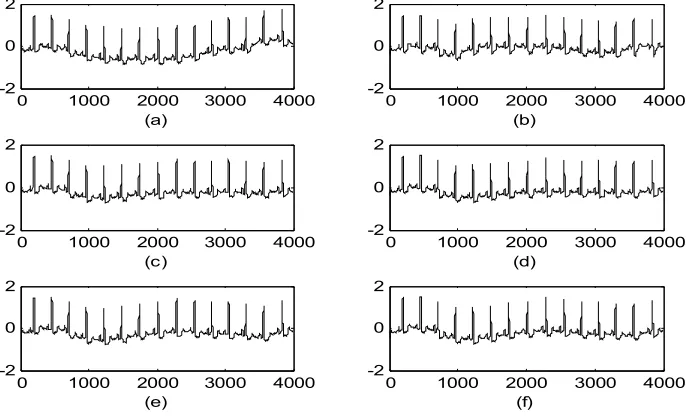
3.1 Power Line Interference (PLI) Cancellation: As the name suggests, this noise is basically arisen because of the electric power. Generally CS is corrupted by PLI during the data acquisition. So cancellation of this artifact is the important task. In this paper PLI artifact is taken from the MIT-BIH database, which is given as a reference signal. The signal corrupted with the PLI artifact is given as the desired signal. The filtering performance of
the various ANCs is presented in Figure 3. The simulation results corresponding to data 101 are shown in this section. Among the algorithms considered NSRMLMS gets 11.2356 dB with “L” number of reduced MACs due to sign regressor operation. Where as, conventional LMS achieves SNRI of 8.8067 dB only during artifact removal process. Similar order of performance is achieved with reference to EMSE and MSD.
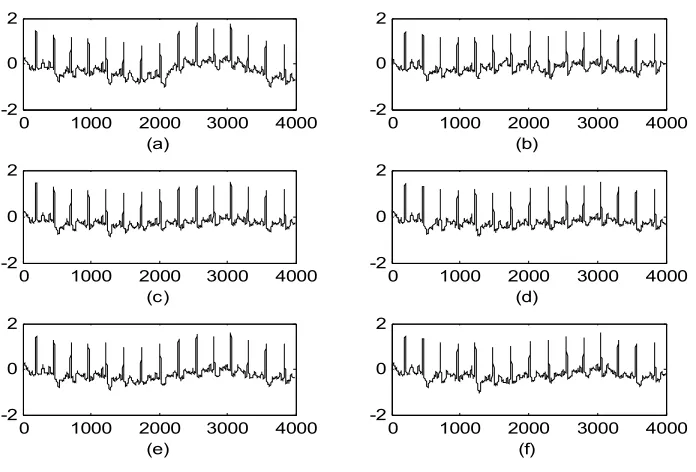
3.2 Base Line Wander (BW) Cancellation: The BW noise taken from the MIT-BIH database is given as the reference signal. The filtering performance of the various ANCs is presented in Figure 4. The simulation results corresponding to data 101 are shown in this section. Among the algorithms considered NSRMLMS gets 9.3572 dB with “L” number of reduced MACs due to sign regressor operation. Where, as conventional LMS achieves SNRI of 4.1985 dB only during artifact removal process. Similar order of performance is achieved with reference to EMSE and MSD.
3.3 Muscle Artifact (MA) Cancellation:
[image:3.612.104.507.532.691.2]The MA artifact taken from the MIT-BIH database is given as a reference signal. The signal corrupted with the MA artifact is given as the desired signal. The filtering performance of the various ANCs is presented in Figure 5. The simulation results corresponding to data 101 are shown in this section. Among the algorithms considered NSRLMS gets 10.7631dB with “L” number of reduced MACs due to sign regressor operation. Where, as conventional LMS achieves SNRI of 3.6415 dB only during artifact removal process. Similar order of performance is achieved with reference to EMSE and MSD.
2209 3.4 Electrode Motion (EM) Cancellation:
In this experiment MA artifact taken from the MIT-BIH database is given as a reference signal. The signal corrupted with the MA artifact is given as the desired signal. The filtering performance of the various ANCs is presented in Figure 6. The simulation results corresponding to data 101 are shown in this section. Among the algorithms
[image:4.612.131.471.224.413.2]considered NSRMLMS gets 10.4778 dB with “L” number of reduced MACs due to sign regressor operation. Where as, conventional LMS achieves SNRI of 4.4419 dB only during artifact removal process. Thus the proposed NSRMLMS algorithm is better than the conventional algorithm in terms of the computational complexity. A similar order of performance is achieved with reference to EMSE and MSD.
Figure 3: PLI Filtering results: a) Filtering with LMS, b) Filtering with MLMS, c) Filtering with NMLMS, d) Filtering with NSRMLMS, e) Filtering with NSMLMS, f) Filtering with NSSMLMS.
Figure 4: BW Filtering results: a) Filtering with LMS, b) Filtering with MLMS, c) Filtering with NMLMS, d) Filtering with NSRMLMS, e) Filtering with NSMLMS, f) Filtering with NSSMLMS.
0 1000 2000 3000 4000 -2
0 2
(a)
0 1000 2000 3000 4000 -2
0 2
(b)
0 1000 2000 3000 4000 -2
0 2
(c)
0 1000 2000 3000 4000 -2
0 2
(d)
0 1000 2000 3000 4000 -2
0 2
(e)
0 1000 2000 3000 4000 -2
0 2
(f)
0 1000 2000 3000 4000 -2
0 2
(a)
0 1000 2000 3000 4000 -2
0 2
(b)
0 1000 2000 3000 4000 -2
0 2
(c)
0 1000 2000 3000 4000 -2
0 2
(d)
0 1000 2000 3000 4000 -2
0 2
(e)
0 1000 2000 3000 4000 -2
0 2
[image:4.612.134.477.480.688.2]2210
Figure 5: MA Filtering results: a) Filtering with LMS, b) Filtering with MLMS, c) Filtering with NMLMS, d) Filtering with NSRMLMS, e) Filtering with NSMLMS, f) Filtering with NSSMLMS.
Figure 6: EM Filtering results: a) Filtering with LMS, b) Filtering with MLMS, c) Filtering with NMLMS, d) Filtering with NSRMLMS, e) Filtering with NSMLMS, f) Filtering with NSSMLMS.
0 1000 2000 3000 4000
-2 0 2
(a)
0 1000 2000 3000 4000
-2 0 2
(b)
0 1000 2000 3000 4000
-2 0 2
(c)
0 1000 2000 3000 4000
-2 0 2
(d)
0 1000 2000 3000 4000
-2 0 2
(e)
0 1000 2000 3000 4000
-2 0 2
(f)
0 1000 2000 3000 4000
-2 0 2
(a)
0 1000 2000 3000 4000
-2 0 2
(b)
0 1000 2000 3000 4000
-2 0 2
(c)
0 1000 2000 3000 4000
-2 0 2
(d)
0 1000 2000 3000 4000
-2 0 2
(e)
0 1000 2000 3000 4000
-2 0 2
[image:5.612.139.487.418.654.2]2211
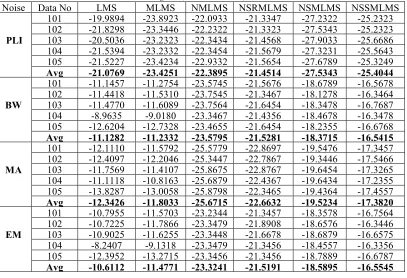
Table 1: Performance Contrast of Various Algorithms in Terms of SNRI for the Removal of Artifacts from Cardiac Signals (all values in dBs)
Noise Data No LMS MLMS NMLMS NSRMLMS NSMLMS NSSMLMS
PLI
101 8.8067 9.3452 17.5534 11.2356 13.2567 15.6857 102 7.7763 9.7754 17.9086 11.0945 13.3837 15.3534 103 9.1878 9.5221 17.2367 11.1290 13.9403 15.4643 104 8.5084 9.5577 17.0932 11.5693 13.4594 15.6709 105 9.0063 9.0923 17.0154 11.3456 13.4535 15.2323 Avg 8.6571 9.4585 17.3614 11.2748 13.4987 15.4813
BW
101 4.1985 2.3247 10.4673 9.3572 7.1180 5.3587 102 4.2598 3.7849 10.1233 9.1299 7.9087 5.9821
103 4.7682 2.7808 10.3344 9.5690 7.6754 5.0943
104 4.8275 2.8411 10.7865 9.9695 7.9653 5.7839
105 4.6124 3.5038 10.9908 9.3323 7.7183 5.0320
Avg 4.5332 3.0470 10.5404 9.4715 7.6771 5.4502
MA
101 3.6415 3.4635 12.6754 10.7631 8.8657 6.7869 102 3.7605 4.9736 12.4782 10.0956 8.8657 6.7657
103 3.9652 3.4621 12.9087 10.6543 8.8659 6.4694
104 4.0395 5.7719 12.4532 10.9786 8.8239 6.8558
105 4.0008 4.8636 12.9763 10.9673 8.9785 6.9876
Avg 3.8815 4.5069 12.6983 10.6917 8.8799 6.7730
EM
101 4.4419 4.3705 12.4546 10.4778 8.8928 6.5656 102 4.6511 4.2589 12.6015 10.7564 8.5767 6.6545
103 4.8438 3.3894 12.7687 10.6577 8.7553 6.6575
104 4.6617 3.9291 12.3466 10.8675 8.6774 6.5645
105 4.7782 3.8203 12.7889 10.7787 8.6574 6.7786
Avg 4.6753 3.9536 12.5920 10.7076 8.7119 6.6641
Table 2: Performance Contrast of Various Algorithms in Terms of EMSE for the Removal of Artifacts from Cardiac Signals (all values in dBs)
Noise Data No LMS MLMS NMLMS NSRMLMS NSMLMS NSSMLMS
PLI
101 -19.9894 -23.8923 -22.0933 -21.3347 -27.2322 -25.2323 102 -21.8298 -23.3446 -22.2322 -21.3323 -27.5343 -25.2323 103 -20.5036 -23.2323 -22.3434 -21.4568 -27.9033 -25.6686 104 -21.5394 -23.2332 -22.3454 -21.5679 -27.3231 -25.5643 105 -21.5227 -23.4234 -22.9332 -21.5654 -27.6789 -25.3249 Avg -21.0769 -23.4251 -22.3895 -21.4514 -27.5343 -25.4044
BW
101 -11.1457 -11.2754 -23.5745 -21.5676 -18.6789 -16.5678 102 -11.4418 -11.5310 -23.7545 -21.3467 -18.1278 -16.3464 103 -11.4770 -11.6089 -23.7564 -21.6454 -18.3478 -16.7687 104 -8.9635 -9.0180 -23.3467 -21.4356 -18.4678 -16.3478 105 -12.6204 -12.7328 -23.4655 -21.6454 -18.2355 -16.6768 Avg -11.1282 -11.2332 -23.5795 -21.5281 -18.3715 -16.5415
MA
101 -12.1110 -11.5792 -25.5779 -22.8697 -19.5476 -17.3457 102 -12.4097 -12.2046 -25.3447 -22.7867 -19.3446 -17.5466 103 -11.7569 -11.4107 -25.8675 -22.8767 -19.6454 -17.3265 104 -11.1118 -10.8163 -25.6879 -22.4367 -19.6434 -17.2355 105 -13.8287 -13.0058 -25.8798 -22.3465 -19.4364 -17.4557 Avg -12.3426 -11.8033 -25.6715 -22.6632 -19.5234 -17.3820
EM
[image:6.612.106.513.426.704.2]2212
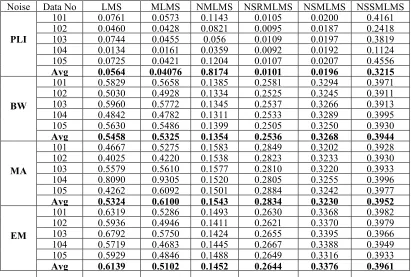
Table 3: Performance Contrast of Various Algorithms in Terms of MSD for the Removal of Artifacts from Cardiac Signals (all values in dBs)
Noise Data No LMS MLMS NMLMS NSRMLMS NSMLMS NSSMLMS
PLI
101 0.0761 0.0573 0.1143 0.0105 0.0200 0.4161
102 0.0460 0.0428 0.0821 0.0095 0.0187 0.2418
103 0.0744 0.0455 0.056 0.0109 0.0197 0.3819
104 0.0134 0.0161 0.0359 0.0092 0.0192 0.1124
105 0.0725 0.0421 0.1204 0.0107 0.0207 0.4556
Avg 0.0564 0.04076 0.8174 0.0101 0.0196 0.3215
BW
101 0.5829 0.5658 0.1385 0.2581 0.3294 0.3971
102 0.5030 0.4928 0.1334 0.2525 0.3245 0.3911
103 0.5960 0.5772 0.1345 0.2537 0.3266 0.3913
104 0.4842 0.4782 0.1311 0.2533 0.3289 0.3995
105 0.5630 0.5486 0.1399 0.2505 0.3250 0.3930
Avg 0.5458 0.5325 0.1354 0.2536 0.3268 0.3944
MA
101 0.4667 0.5275 0.1583 0.2849 0.3202 0.3928
102 0.4025 0.4220 0.1538 0.2823 0.3233 0.3930
103 0.5579 0.5610 0.1577 0.2810 0.3220 0.3933
104 0.8090 0.9305 0.1520 0.2805 0.3255 0.3996
105 0.4262 0.6092 0.1501 0.2884 0.3242 0.3977
Avg 0.5324 0.6100 0.1543 0.2834 0.3230 0.3952
EM
101 0.6319 0.5286 0.1493 0.2630 0.3368 0.3982
102 0.5936 0.4946 0.1411 0.2621 0.3370 0.3979
103 0.6792 0.5750 0.1424 0.2655 0.3395 0.3966
104 0.5719 0.4683 0.1445 0.2667 0.3388 0.3949
105 0.5929 0.4846 0.1488 0.2649 0.3316 0.3933
Avg 0.6139 0.5102 0.1452 0.2644 0.3376 0.3961
In the above tables performance measeures of various algorithms in terms of SNRI, EMSE and MSD for the removal of artifacts are measured. MATLAB is the tool used to evaluate the experimentation results. The data sets 101 to 105 are considered as the input data samples. Based on the average values, the best algorithm can be identified. In Table 1, the performance of the LMS, MLMS, NMLMS and its sign variants are evalutated in terms of SNRI for the removal of artifacts from the CS. Similarly in Table 2 and Table 3 the performance of same algorithms are evaluated in terms of EMSE and MSD for the removal of artifacts from CS. Based on the simulation results and the tables it is found that the NSRMLMS algorithms is most suitable for IOT based remote healthcare applications.
4. CONCLUSION
In the proposed work, the removal of BW, MA and EM from CS is presented with the help of the median based type of adaptive algorithms. The normalization and sign based versions of MLMS are implemented to improve the suitability of the algorithm to use in real time. The MIT-BIH arrhythmia database is used to test the performance of the proposed noise cancellers. The SNRI, EMSE and MSD are considered as performance measures
to evaluate the performance of the proposed implementations. Among various algorithms, NSRMLMS is found to be first in the list with reference to various performance measures. Next, the NSMLMS is found to be second in the list with reference to SNRI, EMSE, MSD and convergence, but it reduces “L” MACs in the normalization with respect to data vector. Finally, NSSMLMS is found to be third in the list with reference to SNRI, EMSE, MSD and convergence. But it reduces “L” MACs due to normalization and other “L” MACs due to sign operation. However, in practical health care monitoring devices NSRMLMS is well suited because of its reduced number of MACs even though it is slightly inferior than NSMLMS.
REFERENCES
[1]. Sibasankar Padhy, L. N. Sharma, S. Dandapat, " Multilead ECG data compression using SVD in multiresolution domain", Biomedical signal processing and control, 2016, pp. 10-18. [2]. Md N. Salman, P. Trinatha Rao, and Md Zia
Ur Rahman. "Efficient and Low Complexity Noise Cancellers for Cardiac Signal Enhancement using Proportionate Adaptive Algorithms", Indian Journal of Science and
[image:7.612.101.512.115.391.2]2213 [3]. A.R Verma, Y.Singh, “Adaptive Tunable
Notch Filter for ECG Signal Enhancement",
Procedia Computer Science, 2015, pp.332-337.
[4]. Dragos Daniel Taralunga, Ilinca Gussi, Rodica Strungaru, "Fetal ECG enhancement: Adaptive power line interference", Biomedical signal processing and control, 2015, pp.77-84. [5]. Md.Abdul Awal, Sheikh Shanawaz Mostafa,
Mohiuddin Ahmad, Mohd Abdur Rashid, " An adaptive level dependent wavelet thresholding for ECG denoising", Biocybernetics and Biomedical Engineering., 2014,
http://dx.doi.org/10.1016/j.bbe.2014.03.002. [6]. Santosh Kumar Yadav, Rohit Sinha, Prabin
Kumar Bora, "Electrocardiogram signal denoising using non-local wavelet transform domain filtering", IET Signal Processing, doi: 10.1049/iet-spr.2014.0005.
[7]. Sakshi Agrawal, Anubha Gupta, " Fractal and EMD based removal of baseline wander and power line interference from ECG signals", Computers in biology and medicine,2013, PP.1889-1899.
[8]. Evangelos B. Mazomenos, Dwaipayan Biswas, Amit Acharyya, Taihai Chen, Koushik Maharatna, James Rosengarten, John Morgan, and Nick Curzen, " A Low-Complexity ECG Feature Extraction Algorithm for Mobile Healthcare Applications", IEEE Journal of Biomedical and Health Informatics, 2013, vol. 17, no. 2, pp.459-469.
[9]. Sarita Mishra, Debasmit Das, Roshan Kumar, and Parasuraman Sumathi, " A Power-Line Interference Canceler Based on Sliding DFT Phase Locking Scheme for ECG Signals", IEEE Transactions on Instrumentation and measurement, 2015, vol. 64, no. 1, pp.132-142. [10].Md. N. Salman, P. Trinatha Rao, Md Zia ur Rahman, “Cardiac Signal Enhancement using Normalised Variable step algorithm for remote healthcare monitoring systems”, Int. J. of Medical Engineering & Informatics, Inderscience, 2017, Vol. 9, No. 2, pp. 145 - 161.
[11].Williamson, G. A., Clarkson P.M, Sethares W A, “Performance Characteristics of the median adaptive filter”, IEEE Transactions on
Acoustics, Speech and Signal Processing, vol-
ASSP-41. no. 2, pp. 667-680, Apr. 1993. [12].Md.Zia Ur Rahman, G.V.S.Karthik,
S.Y.Fathima, A.Lay-Ekuakille," An efficient cardiac signal enhancement using time– frequency realization of leaky adaptive noise
cancellers for remote health monitoring systems", Measurements, 2013, pp.3815-3835.
[13].Md.Zia Ur Rahman, Rafi Ahamed Shaik, D.V.Rama Koti Reddy, "Efficient and Simplified Adaptive Noise Cancellers for ECG Sensor Based Remote Health Monitoring", IEEE Sensors Journal, vol. 12, no. 3, 2012, pp.566-573.
[14].Nitish V. Thakor., Yi-Sheng Zhu, "Applications of Adaptive Filtering to ECG Analysis: Noise cancellation and arrhythmia Detection", IEEE Transactions on Biomedical Engineering, 1991, 38(8), p: 785-794.
[15].Rajib Lochan Das and Mrityunjoy Chakraborty, "On Convergence of Proportionate-Type Normalized Least Mean Square Algorithms", IEEE Transactions on Circuits and Systems—ii: Express Briefs, vol. 62, no. 5, 2015, pp. 491-495.
[16].Physio Net, The Massachusetts Institute of Technology - Boston's Beth Israel Hospital (MIT-BIH) Arrhythmia Database, Available:
http://www.physionet.org/physiobank/databas e/mitdb/ (Online).
[17].The MIT-BIH Normal Sinus Rhythm
Database Availableat http://www.physionet.org/physiobank/databas