Constructing an Annotated Corpus for Protest Event Mining
Peter Makarov† Jasmine Lorenzini∗ Hanspeter Kriesi∗ †Institute of Computational Linguistics, University of Zurich, Switzerland ∗Department of Political and Social Sciences, European University Institute, Italy
[email protected] {jasmine.lorenzini,hanspeter.kriesi}@eui.eu
Abstract
We present a corpus for protest event min-ing that combines token-level annotation with the event schema and ontology of entities and events from protest research in the social sci-ences. The dataset uses newswire reports from the English Gigaword corpus. The token-level annotation is inspired by annotation standards for event extraction, in particular that of the Automated Content Extraction 2005 corpus (Walker et al., 2006). Domain experts perform the entire annotation task. We report competi-tive intercoder agreement results.
1 Introduction
Social scientists rely on event data to quantitatively study the behavior of political actors. Public protest (demonstrations, industrial strikes, petition cam-paigns, political and symbolic violence) accounts for a large part of events involving sub-state actors. Protest event data are central to the study of protest mobilization, political instability, and social move-ments (Hutter, 2014; Koopmans and Rucht, 2002).
To advance the machine coding1 of protest data,
we have been building a manually annotated corpus of protest events. Our protest event coding follows guidelines adapted from successful manual coding projects. All coding decisions are supported by careful token-level annotation inspired by annota-tion standards for event extracannota-tion. Both event cod-1We use the social science termcodingto refer to informa-tion extracinforma-tion. Automated extracinforma-tion ismachine coding, man-ual extraction ishuman coding. Event coding happens at the document level. We use the linguistic termtoken-level annota-tionto refer to attaching metadata to tokens in the document.
ing and token-level annotation are performed by do-main experts. We find that dodo-main experts without specialist linguistic knowledge can be trained well to follow token-level annotation rules and deliver suf-ficient annotation quality.
Contentious politics scholars often need more fine-grained information on protest events than can be delivered by available event coding software. Our event schema includes issues—the claims and grievances of protest actors—and the number of protesters. We also code protest events that are not the main topic of the report. This is often desirable (Kriesi et al., 1995), although event coding systems would not always code them by design.
We code newswire reports from the widely used English Gigaword corpus and will release all anno-tations.2
2 Related Work
2.1 Machine coding of events
The machine coding of political event data from newswire text goes back to early 1990s and has been first applied to the study of international relations and conflicts (Gerner et al., 1994; Schrodt and Hall, 2006). Many widely used systems—e.g. TABARI
(O’Brien, 2010) /PETRARCH3,VRA-Reader4(King
and Lowe, 2003)—have relied on pattern matching with large dictionaries of hand-crafted patterns. A system scans a news lead attempting to match an event, source and target actors—thereby extracting who did what to whom; the date of the event is taken
2https://github.com/peter-makarov/apea_
corpus
3https://github.com/openeventdata/petrarch
4http://vranet.com
to be the date of publication. Common ontologies
CAMEO(Gerner et al., 2002) andIDEA(Bond et al.,
2003) define dozens of event types and hundreds of actors. Proprietary event coder BBN ACCENT,
which uses statistical entity and relation extrac-tion and co-reference resoluextrac-tion, considerably out-performs a pattern matching-based coder (Boschee et al., 2013; Boschee et al., 2015). O’Connor et al. (2013) present an unsupervised Bayesian coder, which models the gradual change in the types of events between actors.
Pattern-matching coders have been found to pre-dict event types on a par with trained human coders (King and Lowe, 2003) and sufficiently accurate for near real-time event monitoring (O’Brien, 2010). That event coding is hard and coding instructions are often not rigorous enough manifests itself in low intercoder reliability (Schrodt, 2012). Boschee et al. (2015) report an intercoder agreement of F1 45% for two human coders coding 1,000 news reports using only the top event types of theCAMEOontology.
2.2 Machine coding of protest events
Pattern matching-based systems have been em-ployed to assist humans in coding protest events (Imig and Tarrow, 2001; Francisco, 1996). Some (Maher and Peterson, 2008) use only machine-coded protest events. More recently, statistical learning has been applied to the coding of protest events. Hanna (2014) trains a supervised learning system leverag-ing the events hand-coded by the Dynamics of Col-lective Action5project (Earl et al., 2004). Nardulli et
al. (2015) employ a human-in-the-loop coding sys-tem that learns from human supervision.
2.3 Corpora annotated with protest events
A major benchmark for event mining is the Auto-mated Content Extraction (ACE) 2005 Multilingual
Training Corpus (Walker et al., 2006). The cor-pus, distributed by the Linguistic Data Consortium, comes with token-level annotations of entities, re-lations, and events. Its event ontology includes the
CONFLICTevent type. Its sub-typeATTACKoverlaps
with violent protest; the other sub-type, DEMON -STRATE, is close to our understanding of
demon-strative protest. Some important protest event types
5http://web.stanford.edu/group/
collectiveaction
e.g. petition campaign, industrial strike, symbolic protest, are not included. Unlike our project, the tar-gets ofATTACKevents are annotated (but not the
tar-gets ofDEMONSTRATEevents). Issues and the
num-ber of participants are not annotated.
Of some interest is the corpus of Latin American terrorism6used in the Message Understanding
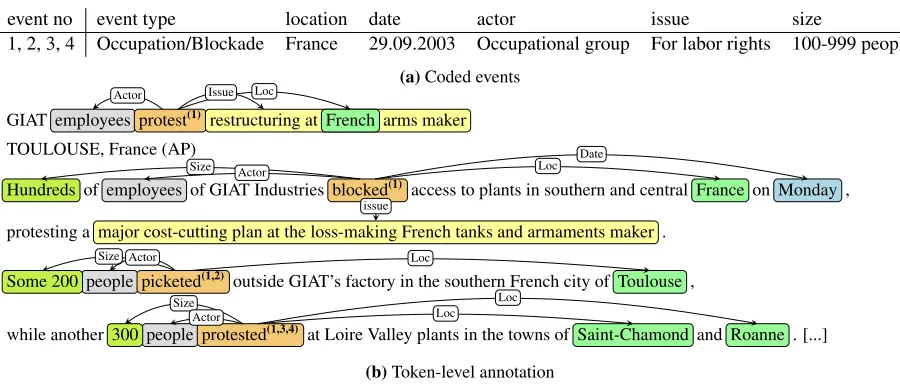
Con-ference evaluations 3 and 4 (Chinchor et al., 1993). It comes with a highly complex event schema that includes detailed information on the actor, human and physical targets, and distinguishes several types of terrorist acts. The corpus predates information extraction by statistical learning from annotated text and thus does not contain token-level annotation.7 3 Annotated Corpus of Protest Events The main motivation for this work has been the con-nection of event coding, which is performed at the level of the document, to token-level annotation. In that respect, we follow the trend towards annotating for social science tasks at below the document level (Card et al., 2015; ˇZukov-Gregoriˇc et al., 2016). Un-like these projects, we have chosen to train domain experts to perform careful token-level annotation. The downside of having coders annotate in a linguis-tically unconstrained manner—an approach some-times advocated for annotation tasks performed by domain experts (Stubbs, 2013)—is that the resulting annotation requires extensive standardization. This is challenging in the case of a complex task like ours. The overall coding procedure is thus twofold. The coders perform traditional event coding, which in-volves the identification of protest events and clas-sification of their attributes (type, actors, etc.). In parallel, the coders carry out token-level annotation, which we motivate as a means of supporting coding decisions with the help of text. The coder connects the two by linking coded events to their mentions in the text. Figure 1 shows sample annotation.
All our coders are doctoral students in political science. All are non-native English speakers with a high command of English. One project leader is a trained linguist.
6http://www-nlpir.nist.gov/related_
projects/muc/muc_data/muc34.tar.gz
event no event type location date actor issue size
1, 2, 3, 4 Occupation/Blockade France 29.09.2003 Occupational group For labor rights 100-999 people
(a)Coded events
GIAT employees protest(1) restructuring at French arms maker Actor Issue Loc
TOULOUSE, France (AP)
Hundreds of employees of GIAT Industries blocked(1) access to plants in southern and central France on Monday ,
Size Actor Loc Date
protesting a major cost-cutting plan at the loss-making French tanks and armaments maker .
issue
Some 200 people picketed(1,2) outside GIAT’s factory in the southern French city of Toulouse ,
Size Actor Loc
while another 300 people protested(1,3,4) at Loire Valley plants in the towns of Saint-Chamond and Roanne . [...] Size
Actor Loc
Loc
[image:3.612.76.526.57.249.2](b)Token-level annotation
Figure 1:An annotation example.(1a)coded events. The coder has identified four protest events—all of the same structure. Event one is a campaign event, the other events are the episode events of event one (e.g. “protested” refers to two episode events, which are differentiated based on the two distinct city-level locations). (1b)in-text annotations. Event mentions are in orange. In the superscript are the indices of the coded events that an event mention refers to. In the annotation interface, the coder draws links from event mentions to the mentions of event attributes (actor, location, date, etc.).
3.1 Event schema and ontology
A protest event has an event type, a date range, a country, a number of participants, a set of actor types, and a set of issue types. We distinguish ten protest event types, twenty-six issues, and twelve actor types. The types are organized hierarchically. We have not used a large ontology of entities and events that one typically finds in event coding. Our aim has been to ensure that each type occurs suffi-ciently often and the reliability of coding does not suffer due to codebook complexity.
The choice and definition of the types reflect our primary interest in European protest. Having ex-amined a sample of recent European protest events coded using a larger codebook, we have selected some frequent actor types and issues and reworked the event ontology. For example, all specific issues now come with the stance on the issue fixed:against cultural liberalism,for regionalism, etc.
We code only asserted specific past and currently unfolding events—in contrast to theACE2005
cor-pus8 and despite the practice of coding planned
fu-ture events in manual coding work.
8Yet, much like the lighter-weight DEFT ERE (Entities, Re-lations, Events) annotation standard (Aguilar et al., 2014).
3.2 Token-level annotation
In devising token-level annotation guidelines, we have relied on the ACE English Annotation
Guide-lines for Events and Entities9 (Doddington et al.,
2004). We have borrowed many ideas, e.g. the an-notation of event mentions largely as one-word trig-gers, which we have found to work well in practice. TheACE guidelines are written for annotators with
a background in linguistics, not domain experts. We have found that it is often possible to convey more or less the same idea in less technical language, e.g. simplifying present-participle in the nominal pre-modifier positiontoparticiple modifying a noun, and by providing extensive examples.
Not all ACE rules could be adapted in this way.
We do not distinguish between heads and multi-word extents, but rather annotate the one which ap-pears easier for a given attribute. For example, we annotate collective actors (“postal workers”, “left-wing protesters”) as head nouns only and not full noun phrases, which would be more in line with the
ACE guidelines but is challenging even for trained
linguists. On the other hand, issue annotations are predominantly multi-word expressions.
The linking of coded events to token-level anno-tation is at the core of our approach. To consolidate
9https://www.ldc.upenn.edu/
the information about an event scattered across mul-tiple sentences, we would need an annotated event co-reference. Yet, annotating event co-reference (as well as non-strict identity relations) is hard (Hovy et al., 2013). In the annotation interface, the coders ex-plicitly link coded events to event mentions that refer to them, and many events can be linked to the same event mention. Thus, unlike the ACE2005 corpus,
we do not explicitly define the co-reference relation between event mentions, but read it off the explicit references. We do not annotate entity co-reference.
3.3 Workflow
We code newswire texts by the Agence France Press (AFP) and the Associated Press World (APW) of the
English Gigaword Third Edition Corpus (Graff et al., 2007). We sample from two-month periods in the 2000s. For a given period, we select all docu-ments that mention a European location in the date-line and are found protest-relevant by a classifier that we have trained, for a related project, on newswire stories including AFP and APW. For each month
and agency, we randomly sample forty documents of which a project leader picks ten to twenty doc-uments for coding. In this way, we typically get groups of documents from various dates, each group covering the same story.
Each document gets coded by at least two coders. A project leader performs adjudication. We estimate that coding one document takes an average of fifteen minutes. Our budget allows for coding up to 300 documents. In the first rounds of coding, we have not used any pre-annotation.
3.4 Intercoder reliability
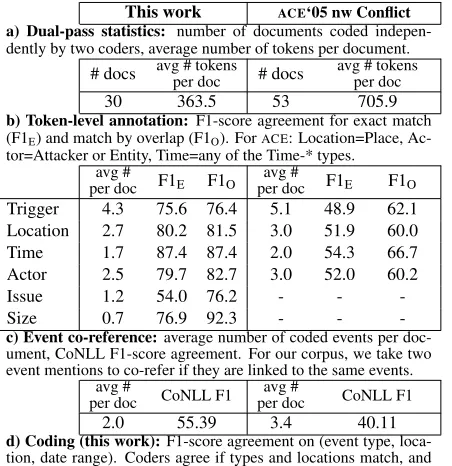
We achieve competitive intercoder agreement for the first batch of documents (Table 1). During the cod-ing of this batch, the coders received general feed-back on token-level annotation (Table 1b), which partly explains the high agreement. For reference, we show the agreement achieved by theACEcoders
on newswire documents annotated with events of typeCONFLICT. Crucially, theACE documents are
almost twice as long on average, which drags down agreement. While the agreement on coded events is expectedly low, our coders agree substantially on coding subsets of event attributes (Table 1d).
This work ACE‘05 nw Conflict
a) Dual-pass statistics: number of documents coded indepen-dently by two coders, average number of tokens per document.
# docs avg # tokensper doc # docs avg # tokensper doc
30 363.5 53 705.9
b) Token-level annotation:F1-score agreement for exact match (F1E) and match by overlap (F1O). ForACE: Location=Place,
Ac-tor=Attacker or Entity, Time=any of the Time-* types. avg #
per doc F1E F1O per docavg # F1E F1O
Trigger 4.3 75.6 76.4 5.1 48.9 62.1 Location 2.7 80.2 81.5 3.0 51.9 60.0 Time 1.7 87.4 87.4 2.0 54.3 66.7 Actor 2.5 79.7 82.7 3.0 52.0 60.2
Issue 1.2 54.0 76.2 - -
-Size 0.7 76.9 92.3 - -
-c) Event co-reference:average number of coded events per doc-ument, CoNLL F1-score agreement. For our corpus, we take two event mentions to co-refer if they are linked to the same events.
avg #
per doc CoNLL F1 per docavg # CoNLL F1
2.0 55.39 3.4 40.11
d) Coding (this work):F1-score agreement on (event type, loca-tion, date range). Coders agree if types and locations match, and date ranges overlap. F1-score agreement on event attributes given that two events agree on type, location, date range as described. Event type / Loc / Date F1 58.2
avg # unique F1 given type/ labels per doc loc/date match
Actors 0.82 78.1
Issues 0.83 78.1
[image:4.612.316.542.60.293.2]Size 0.55 93.2
Table 1: Intercoder agreement for two coders. For reference, we show agreement scores for theACEcoders on theACE2005 newswire reports annotated for events by both coders s.t. at least one report of each pair hasCONFLICTevents. We only consider specific asserted past/present events and their arguments.
4 Conclusion and Future Work
We have presented our work on a corpus of protest events, which combines event coding with care-ful token-level annotation. The corpus comes with coded issues and numbers of participants. Overall, we observe substantial intercoder agreement.
Little work has been done on the evaluation of event coders (Boschee et al., 2013),10 and none
on widely available data despite interest (Schrodt, 2016). We would encourage the use of our corpus as an evaluation benchmark. That would require map-ping our ontology of events and entities toCAMEO
categories.
As we often code groups of documents covering the same sets of events (Section 3.3), the corpus could be extended to include cross-document event co-reference annotations.
Acknowledgments
We would like to thank Swen Hutter, Elisa Volpi, Joldon Kutmanaliev, Chiara Milan, Daniel Schulz, and the two anonymous reviewers. This work has been supported by European Research Council Grant No. 338875.
References
[Aguilar et al.2014] Jacqueline Aguilar, Charley Beller, Paul McNamee, Benjamin Van Durme, Stephanie Strassel, Zhiyi Song, and Joe Ellis. 2014. A compari-son of the events and relations across ACE, ERE, TAC-KBP, and FrameNet annotation standards. In Pro-ceedings of the Second Workshop on EVENTS: Def-inition, Detection, Coreference, and Representation, pages 45–53.
[Bond et al.2003] Doug Bond, Joe Bond, Churl Oh, J Craig Jenkins, and Charles Lewis Taylor. 2003. Inte-grated data for events analysis (IDEA): An event typol-ogy for automated events data development. Journal of Peace Research, 40(6):733–745.
[Boschee et al.2013] Elizabeth Boschee, Premkumar Natarajan, and Ralph Weischedel. 2013. Automatic extraction of events from open source text for pre-dictive forecasting. In Handbook of Computational Approaches to Counterterrorism, pages 51–67. Springer.
[Boschee et al.2015] Elizabeth Boschee, Jennifer Lauten-schlager, Sean O’Brien, Steve Shellman, James Starz, and Michael Ward. 2015. BBN ACCENT Event Coding Evaluation.updated v01.pdf (ICEWS Coded Event Data). http://dx.doi.org/10.7910/ DVN/28075.
[Card et al.2015] Dallas Card, Amber E Boydstun, Justin H Gross, Philip Resnik, and Noah A Smith. 2015. The media frames corpus: Annotations of frames across issues. InACL, volume 2, pages 438– 444.
[Chinchor et al.1993] Nancy Chinchor, David D Lewis, and Lynette Hirschman. 1993. Evaluating message understanding systems: an analysis of the third mes-sage understanding conference (muc-3). Computa-tional linguistics, 19(3):409–449.
[Doddington et al.2004] George R Doddington, Alexis Mitchell, Mark A Przybocki, Lance A Ramshaw, Stephanie Strassel, and Ralph M Weischedel. 2004. The Automatic Content Extraction (ACE) Program-Tasks, Data, and Evaluation. In LREC, volume 2, page 1.
[Earl et al.2004] Jennifer Earl, Andrew Martin, John D McCarthy, and Sarah A Soule. 2004. The use of
news-paper data in the study of collective action. Annual review of Sociology, pages 65–80.
[Francisco1996] Ronald A Francisco. 1996. Coercion and protest: An empirical test in two democratic states.
American Journal of Political Science, pages 1179– 1204.
[Gerner et al.1994] Deborah J Gerner, Philip A Schrodt, Ronald A Francisco, and Judith L Weddle. 1994. Ma-chine coding of event data using regional and interna-tional sources. International Studies Quarterly, pages 91–119.
[Gerner et al.2002] Deborah J Gerner, Philip A Schrodt, Om¨ur Yilmaz, and Rajaa Abu-Jabr. 2002. Conflict and mediation event observations (CAMEO): A new event data framework for the analysis of foreign policy interactions. International Studies Association, New Orleans.
[Graff et al.2007] David Graff, Linguistic Data Consor-tium, et al. 2007. English Gigaword Third Edition LDC2007T07. Linguistic Data Consortium.
[Hanna2014] Alex Hanna. 2014. Developing a system for the automated coding of protest event data. Avail-able at SSRN: http://ssrn.com/abstract= 2425232 or http://dx.doi.org/10.2139/ ssrn.2425232.
[Hovy et al.2013] Eduard Hovy, Teruko Mitamura, Fe-lisa Verdejo, Jun Araki, and Andrew Philpot. 2013. Events are not simple: Identity, non-identity, and quasi-identity. InNAACL HLT, volume 2013, page 21. [Hutter2014] Swen Hutter. 2014. Protest event analy-sis and its offspring. In Donatella Della Porta, edi-tor,Methodological practices in social movement re-search. Oxford University Press.
[Imig and Tarrow2001] Doug Imig and Sidney Tarrow. 2001. Mapping the Europeanization of contention: ev-idence from a quantitative data analysis. Contentious Europeans: Protest and politics in an emerging polity, pages 27–49.
[King and Lowe2003] Gary King and Will Lowe. 2003. An automated information extraction tool for interna-tional conflict data with performance as good as hu-man coders: A rare events evaluation design. Interna-tional Organization, 57(03):617–642.
[Koopmans and Rucht2002] Ruud Koopmans and Dieter Rucht. 2002. Protest event analysis. Methods of so-cial movement research, 16:231–59.
[Kriesi et al.1995] Hanspeter Kriesi, Ruud Koopmans, Jan Willem Duyvendak, and Marco G Giugni. 1995.
New social movements in Western Europe: A compar-ative analysis, volume 5. U of Minnesota Press. [Maher and Peterson2008] Thomas V Maher and
and repression. International Journal of Sociology, 38(3):52–81.
[Nardulli et al.2015] Peter F Nardulli, Scott L Althaus, and Matthew Hayes. 2015. A progressive supervised-learning approach to generating rich civil strife data.
Sociological Methodology.
[O’Brien2010] Sean P O’Brien. 2010. Crisis early warn-ing and decision support: Contemporary approaches and thoughts on future research. International Studies Review, 12(1):87–104.
[O’Connor et al.2013] Brendan O’Connor, Brandon M Stewart, and Noah A Smith. 2013. Learning to ex-tract international relations from political context. In
ACL (1), pages 1094–1104.
[Schrodt and Hall2006] Philip A Schrodt and Blake Hall. 2006. Twenty years of the Kansas event data system project.The political methodologist, 14(1):2–8. [Schrodt2012] Philip A Schrodt. 2012. Precedents,
progress, and prospects in political event data. Inter-national Interactions, 38(4):546–569.
[Schrodt2016] Philip A Schrodt. 2016. Comparison metrics for large scale political event data sets. http://www.polmeth.wustl.edu/files/ polmeth/schrodtepsa15eventdata.pdf. [Stubbs2013] Amber C Stubbs. 2013. A Methodology
for Using Professional Knowledge in Corpus. Ph.D. thesis, Brandeis University.
[ ˇZukov-Gregoriˇc et al.2016] Andrej ˇZukov-Gregoriˇc, Bartal Veyhe, and Zhiyuan Luo. 2016. IBC-C: A dataset for armed conflict event analysis. InACL. [Walker et al.2006] Christopher Walker, Stephanie
Strassel, Julie Medero, and Kazuaki Maeda. 2006. ACE 2005 multilingual training corpus. Linguistic Data Consortium, Philadelphia.