THE INVESTIGATION OF PRIMARY AND SECONDARY MODIFIERS IN THE EXTRACTION AND SEPARATION OF NEUTRAL
AND IONIC PHARMACEUTICAL COMPOUNDS WITH PURE AND MODIFIED CARBON DIOXIDE
Phyllis R. Eckard
Dissertation submitted to the Faculty of the Virginia Polytechnic Institute and State University in partial fulfillment of the requirements for the degree of
DOCTOR OF PHILOSOPHY IN
CHEMISTRY
Larry T. Taylor, Chairman Neal Castagnoli, Jr.
James O. Glanville Gary L. Long Harold M. McNair
Gregory C. Slack
February 20, 1998 Blacksburg, Virginia
Keywords: Supercritical, Extraction, Chromatography, Pharmaceuticals, Trapping
THE INVESTIGATION OF PRIMARY AND SECONDARY MODIFIERS IN THE EXTRACTION AND SEPARATION OF NEUTRAL
AND IONIC PHARMACEUTICAL COMPOUNDS WITH PURE AND MODIFIED CARBON DIOXIDE
Phyllis R. Eckard
(ABSTRACT)
A successful supercritical fluid extraction method includes removal of the analyte from the matrix into the bulk fluid as well as trapping or concentration of the analyte prior to analysis. In the first phase of this research, the trapping capacities of three solid-phase traps (glass beads, 50/50 (w/w) glass beads/octadecylsilica), 50/50 (w/w) Porapak Q®/glass beads) were determined as a function of trap composition for a mixture of components varying in polarity and volatility. The Porapak Q®/glass beads mixture was found to be the most successful solid-phase investigated exhibiting the highest trapping capacity. The use of the Porapak Q®/glass beads as a solid-phase trap was investigated in later extraction studies in this dissertation.
The extraction of ionic compounds with carbon dioxide may be difficult due to the high polarity of the compounds. In the third phase of this research, the addition of ion-pairing additives to the matrix in hopes of forming an ion-pair complex of reduced analyte polarity was investigated. Therefore, a screening study consisting of a fractional-factorial design was performed in order to identify the factors which contribute most to the
recovery of an anionic species, triphenylphosphinetrisulfonate (TPPTS), from a spiked-sand surface employing supercritical fluid extraction with carbon dioxide. The
experimental parameters investigated were: type of ion-pairing additive (i.e.
tetralkylammonium hydrogen sulfates) and its concentration, carbon dioxide density, extraction temperature, static extraction time, CO2 mass used, liquid CO2 flow rate, and
the volume of methanol spiked into the matrix prior to extraction. Of the eight factors investigated, four factors were identified as significantly affecting the recovery of the anionic species. They were: 1) ion-pairing reagent added to the spiked sand surface and its concentration; 2) static extraction time; and 3) volume of methanol present in the extraction vessel. The experimental parameters and settings identified as influential by the statistical approach were later shown in concert to yield 100% recovery of TPPTS from the spiked-sand.
In the fourth phase, the extraction of a cationic species, pseudoephedrine
hydrochloride, from spiked-sand and Suphedrine tablets, with pure and methanol-modified CO2 was examined. Once the extraction was shown to feasible, several strategies were
compared in terms of their effectiveness in enhancing the analyte’s extractability. The first strategy involved the addition of ion-pairing additives. Several sodium salts of
spiked-sand were shown to comparable in the presence of a methanol/water solution, a tetrabutylammonium hydroxide in methanol solution, and a methanol solution with 1-heptanesulfonic acid, sodium salt. Next the extraction of pseudoephedrine hydrochloride from Suphedrine tablets was performed with pure and modified CO2. Similar to the
sand-spike studies, the effect of the addition of the ion-pairing reagent and other in-cell
modifiers were examined. Once again, the recoveries obtained when the matrix was in the presence of a methanol/water mixture and a methanol solution containing
1-heptanesulfonic acid, sodium salt were similar. Finally, the identity of the extracted analyte was determined via IR analyses, and it was shown that pseudoephedrine hydrochloride was indeed extractable from the tablets with in-line modified CO2 in the
absence of any in-cell modifier.
This dissertation is dedicated to the memory of my mother and grandfather,
ACKNOWLEDGMENTS
There are many people that I would like to thank for their influence and guidance. First, I would like to acknowledge my mother, for instilling in me many qualities including perseverance, faith, and hope. Although you have been gone for such a long time, your love and your presence remain bright. I would also like to thank my uncle and aunt, Charles and Mary Williams, for their love and support, and my father for his belief in me and always keeping our discussions positive.
I would like to thank my advisor, Dr. Larry T. Taylor, for his guidance, patience, support, and for telling it the way it was when utmost needed. Next I would like to acknowledge my committee members, Dr. Harold M. McNair, Dr. Gary L. Long, Dr. James O. Glanville, Dr. Neil Castagnoli, Jr., and Dr. Gregory C. Slack. In particular, I must express my sincerest gratitude to Dr. Greg Slack for guiding me to Virginia Tech, and for being my mentor both here and at DuPont Merck. I would also like to show appreciation to past and present members of the Taylor Research Group especially Dr. Sheri Jordan, Dr. Thompson Strode, Dr. Michael Combs, Dr. Mehdi Ashraf-Khorassani, Peter Thompson, and Lori McDaniel for their friendship, help, and guidance. In addition, I must acknowledge Dr. Jane Keppel-Benson for helping me sort it all out, and for the loan of the pom-poms. Also, I must give thanks to Beth Bullock for her enduring
CREDITS
The author would like to thank the following persons and companies for their donations and technical assistance:
TABLE OF CONTENTS
Page
ACKNOWLEDGMENTS vi
CREDITS vii
LIST OF FIGURES xi
LIST OF SCHEMES xiv
LIST OF TABLES xv
I. INTRODUCTION 1
II. TRAPPING CAPACITIES OF THREE SOLID-PHASES FOR SUPERCRITICAL FLUID EXTRACTION WITH PURE
CARBON DIOXIDE
2.1 INTRODUCTION 5
2.2. EXPERIMENTAL 6
Extraction 6
Extract Analysis 10
2.3 RESULTS AND DISCUSSION 10
2.4 SUMMARY 16
III. INVESTIGATION OF PRIMARY AND SECONDARY MODIFIERS FOR THE SUBCRITICAL EXTRACTION OF LOVASTATIN FROM MEVACOR® TABLETS WITH CARBON DIOXIDE
3.1 INTRODUCTION 18
3.2 EXPERIMENTAL 21
Extract Analysis 21
Traditional Liquid Extraction 24
In-House Tablet Powder Mixture 24
MEVACOR® Tablet Crushing Method 25
3.3 RESULTS AND DISCUSSION 25
Phase A - Effect of Methanol-Modifier Concentration 25
Phase B - Effect of Additive Composition 29
Phase C - Effect of Additive Concentration 32
3.4 SUMMARY 42
IV. INVESTIGATION OF ION-PAIRING ADDITIVES FOR THE SUPERCRITICAL FLUID EXTRACTION OF
TRIPHENYLPHOSPHINETRISULFONATE, SODIUM SALT
4.1 INTRODUCTION 43
4.2 EXPERIMENTAL 47
Instrumentation 47
Reagents 47
Extraction Conditions and General Procedure 48
Extraction Trapping Conditions 51
Extract Analysis 51
Chromatographic Conditions 52
4.3 RESULTS AND DISCUSSION 52
4.4 SUMMARY 62
V. MODIFIER AND ADDITIVE EFFECTS IN THE
SUPERCRITICAL FLUID EXTRACTION OF PSEUDOEPHEDRINE HYDROCHLORIDE FROM SPIKED-SAND AND
SUPHEDRINE TABLETS
5.1 INTRODUCTION 63
5.2 EXPERIMENTAL 70
Extract Analysis 74
Extract Trapping 74
Procedure - Phase I 75
Procedure - Phases II-III 75
Procedure - Phase IV 76
5.3 RESULTS AND DISCUSSION 79
Phase I - Feasibility Studies 81
SFE Method Development 81
Ion-Pair/SFE Optimization 85
Phase II - Investigation of Ion-Pairing Reagent 90 Composition and Concentration on the SFE
of Pseudoephedrine From A Spiked-Sand Surface
Phase III - Effect of Various In-Cell Modifiers on 93 the SFE of Pseudoephedrine From A Spiked-Sand Surface
Phase IV - Extraction Of Suphedrine Tablets 98
100% CO2 99
10% Methanol-Modified CO2 102
10% (1% H2O) Methanol-Modified CO2 104
5.4 SUMMARY 112
VI. METHOD DEVELOPMENT FOR THE SEPARATION OF
PHOSPHOLIPIDS BY SUBCRITICAL FLUID CHROMATOGRAPHY
6.1 INTRODUCTION 115
6.2 EXPERIMENTAL 120
6.3 RESULTS AND DISCUSSION 121
Effect of Stationary Phase 121
Effect of Modifier Additive 122
Effect of Modifier Additive Concentration 127
Effect of Modifier Ramp Rate 129
Effect of Pressure 129
Comparison of the Reproducibility of Two ELSDs 129
6.4 SUMMARY 137
VII. CONCLUSIONS 138
LIST OF FIGURES
Figure Description Page
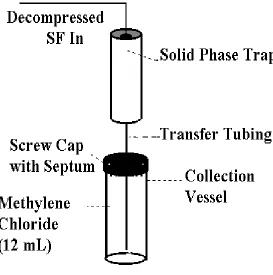
2.1 Tandem solid phase/liquid trap 9
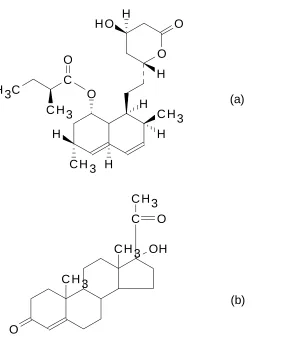
3.1 Chemical Structures for Lovastatin (a) and 23
17α-Hydroxyprogesterone (b)
3.2 Effect of Methanol-Modifier Concentration on Lovastatin 28 Recoveries (n=3) From In-House Prepared Tablet Powder Mixture
3.3 Effect of Additive Type on Lovastatin Recoveries (n=3) 30 From In-House Prepared Tablet Powder Mixture
3.4 Effect of Methanol-Modifier Concentration on Lovastatin 33 Recoveries (n=3) From In-House Prepared Tablet Powder Mixture
3.5 Subcritical Fluid Extraction (n=1) of Lovastatin From 35 MEVACOR® Tablets at Various Additive/Modifier
Concentrations
3.6 Subcritical Fluid Extraction (n=1) of Lovastatin From 36 MEVACOR® Tablets at Various Modifier Concentrations With and Without IPA
3.7 Subcritical Fluid Extraction (n=1) of Lovastatin From 37 MEVACOR® Tablets at Various Modifier Concentrations With and Without IPA
4.1 Chemical Structure of Triphenylphosphinetrisulfonate, 53 Sodium Salt
4.2 Average Percent Recovery (n=3) TPPTS vs Methods 55
Investigated
Figure Description Page
5.1 Chemical Structure of Pseudoephedrine Hydrochloride 64
5.2 Average Percent Recoveries (n=3) of Pseudoephedrine 86 and Pseudoephedrine with 1-Heptanesulfonic Acid,
Sodium Salt from a Non-Dried Drug Spiked-Sand Surface
5.3 Average Percent Recoveries (n=3) of Pseudoephedrine 88 and Pseudoephedrine with 1-Heptanesulfonic Acid,
Sodium Salt from a Dried Drug Spiked-Sand Surface
5.4 Average Percent Recoveries (n=3) of Pseudoephedrine 91 with and without Various Ion-Pairing Additives at
Various Concentrations from a Drug Spiked-Sand Surface
5.5 Average Percent Recoveries (n=3) of Pseudoephedrine 95 with Various Modifiers and Ion-Pairing Additives from a Drug Spiked-Sand Surface
5.6 Average Percent Recoveries (n=3) of Pseudoephedrine 97 from a Drug Spiked-Sand Surface. Effect of Addition
of Acid and Base.
5.7 Average Percent Recovery (n=3) of Pseudoephedrine 101 from Suphedrine Tablets as a Function of In-Cell Modifier Composition with Pure CO2
5.8 Average Percent Recovery (n=3) of Pseudoephedrine 103 from Suphedrine Tablets as a Function of In-Cell Modifier Composition with 10% Methanol-Modified CO2
5.9 Average Percent Recovery (n=3) of Pseudoephedrine 105 from Suphedrine Tablets as a Function of In-Cell Modifier Composition with 10% (1% H2O) Methanol-Modified CO2
5.10 Infrared Spectrum of Pseudoephedrine Hydrochloride 109 Standard
Figure Description Page
5.12 Infrared Spectrum of a Suphedrine Tablet Extract With 111 10% (1% H2O) Methanol-Modified CO2
6.1 Chemical Structures of Phospholipids Investigated 119
6.2 Chromatogram A of 5 phospholipids 123
6.3 Chromatogram B of 3 phospholipids 125
6.4 Chromatogram C of 3 phospholipids 126
6.5 Chromatogram D of 5 phospholipids 128
6.6 Chromatogram E of 5 phospholipids 130
6.7 Chromatogram F of 5 phospholipids 131
LIST OF SCHEMES
Scheme Description Page
5.1 Phase I General Experimental Scheme 69
5.2 Phase II General Experimental Scheme 71
5.3 Phase III General Experimental Scheme 72
LIST OF TABLES
Table Description Page
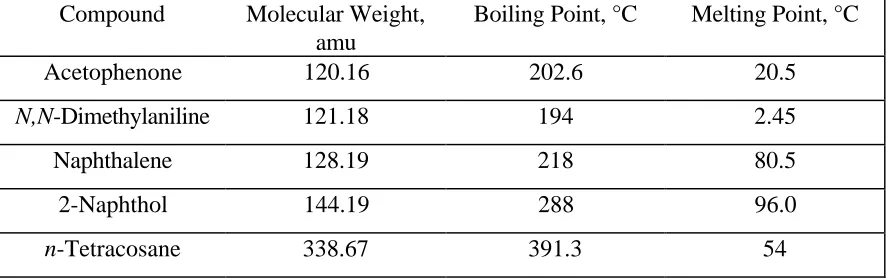
2.1 Molecular weights, boiling points, and melting points 7 of compounds investigated
2.2 Analyte percent recovery for the 50/50 (w/w) 12
octadecylsilica/glass beads trap (1.0 g)
2.3 Analyte percent recovery for the 100% glass beads 14
trap (1.5 g)
2.4 Analyte percent recovery for the 50/50 (w/w) 15
Porapak Q®/glass beads trap (0.8 g)
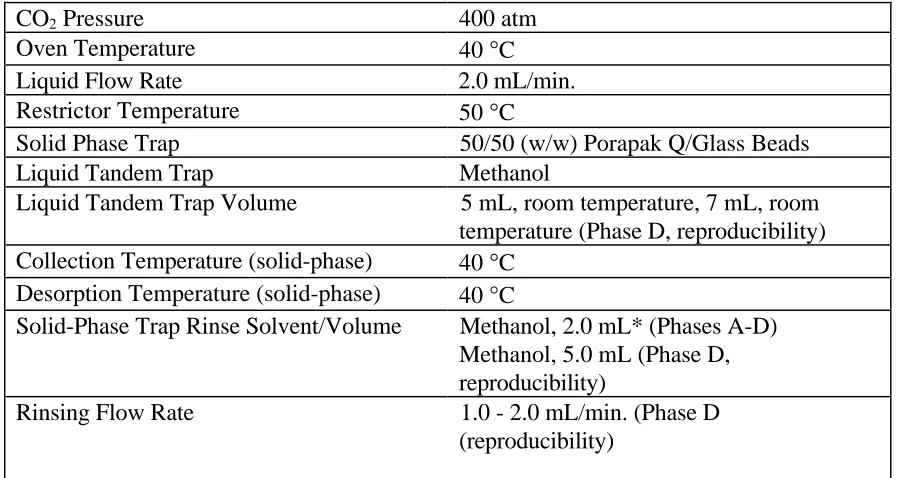
3.1 Extraction and Trapping Conditions Used for Phases A-D 22
3.2 In-house Prepared Tablet Powder Mixture Uniformity 26 With Liquid Extraction Method
3.3 SFE of MEVACOR® Tablets as a Function of 38
Methanol-Modifier Percentage and Addition of Isopropylamine
3.4 SFE Reproducibility for Lovastatin (10 mg) from 40
MEVACOR® Tablets with 15 % (1.0% (v/v) IPA) Methanol-Modified CO2
3.5 Traditional Liquid Extraction and SFE Solvent Use, 41
Steps, and Time Comparisons
4.1 High/Low Extraction Parameters Investigated 49
4.2 Parameters Used for Fractional-Factorial Experiments 50
4.3 Least Square Coefficients, Reduced Fit, 57
Response Percent Recovery
5.1 Phase I - Conditions for Ion-Pair/Supercritical Fluid 77 Extraction Screening Study With Pure CO2
Table Description Page
5.3 Extraction Conditions and CO2 Profile Used in Phase IV 80
6.1 Various Chromatographic Peak Parameters 133
CHAPTER I
INTRODUCTION
In 1822, Baron Cagniard de la Tour first observed the appearance of a
supercritical phase by observing the disappearance of two distinct gas and liquid phases into one visual phase by increasing the temperature of a material in a closed glass container. 1 This early discovery marks the first notation of a supercritical fluid.
A supercritical fluid (SF) is defined as any substance that is above its critical pressure and temperature. The critical pressure is the highest pressure at which a liquid can be converted into a gas by an increase in temperature, while the critical temperature is the highest temperature at which a gas can be converted into a liquid by an increase in pressure. Therefore in the critical region there is only one phase, and this phase possesses both gas and liquid-like properties. The solvating power of the supercritical fluid can be influenced by a change in pressure or temperature. While in the supercritical state, at constant pressure, the solvating power of the fluid decreases with increasing temperature. Likewise, at constant temperature, the solvating power of the fluid increases with
increasing pressure. This solvating power can be maximized by changing the density of the SF by manipulating both temperature and pressure. This property allows one to adjust the density so as to solubilize certain types of compounds in a selective fashion. For example, low polarity analytes may be solubilized at low densities and more polar analytes at higher densities.
Supercritical fluids make ideal extraction solvents and chromatographic mobile phases because of their high mass transport properties. As compared to normal liquids, SFs exhibit higher diffusivities, lower viscosities, and near zero surface tension. These gas-like properties allow fast mass transfer into and out of complex matrices. Also when
1
used as mobile phases, the lowered viscosity, as compared to high performance liquid chromatographic (HPLC) mobile phases, allows the use of higher flow rates, due to a decreased pressure drop along the length of the column. This may allow separations to be achieved in significantly less time than with normal liquids without a large loss in
efficiency.
The most commonly used supercritical fluid as an extraction solvent and mobile phase is carbon dioxide (CO2). It is relatively inert, non-flammable, non-toxic, is readily
attainable in high purity, has easily accessible critical parameters (Pc = 72.9 atm,
Tc = 31 °C), and is considered environmentally friendly. Also CO2 is a gas under ambient
conditions. Its use as an extraction solvent and mobile phase may be advantageous. For extraction purposes, it is possible that no solvent concentration following the extraction and prior to analysis will be needed, in direct contrast to most liquid-liquid and liquid-solid extractions. During chromatography, little waste disposal is needed since the gas can be vented directly into the atmosphere.
Carbon dioxide is a non-polar fluid, and its solvating power is comparable to liquid hexane. 2 For these reasons, CO2 has been used primarily in the analysis of nonpolar to
relatively polar compounds. In order to overcome this limitation, a modifier, consisting of small volumes of organic solvents such as methanol, may be added directly to the fluid or matrix, or a more polar fluid such as ammonia may be used. Ammonia is rarely used due to its toxicity, reactivity, and extreme critical parameters (Pc = 111 atm, Tc = 132 °C). For
this reason, many have used modified CO2.
Modifiers generally serve two functions: a) increase the solvating power of the SF and b) facilitate the disruption of analyte-matrix interactions. The addition of a modifier to either the SF or to the matrix prior to SFE may not be sufficient for the extraction and separation of multifunctional, highly polar, and ionic/ionizable mixtures such as many pharmaceuticals. A secondary modifier (i.e. additive) may be added to the primary
2
modifier to achieve successful analyte extraction or separation. The additives typically consist of organic acids, bases, and ion-pairing reagents, and may be added directly to the primary modifier or to the matrix.
Since it is expected that the extraction or the separation of pharmaceutical compounds may be difficult because of low analyte solubility in the supercritical fluid or severe matrix interaction, the extraction or chromatographic conditions may be improved by several means. Several strategies are reported in this dissertation including: ion-exchange, ion-suppression, and ion-pairing. Ion-exchange refers to the displacement of an acidic, a basic, or an ionic species from highly active matrix sites or stationary phase with a “stronger” modifier. Ion-suppression involves charge neutralization by the addition of an appropriate acid or base, while ion-pairing represents the electrostatic interaction of two species of opposite charge with one another to form an ion-pair-analyte complex.
For an extraction method to be deemed successful, both the removal of the analyte from the matrix and the trapping or concentration of the analyte prior to analysis must be optimized. There are generally three-types of off-line trapping systems used today. They include: 1) analyte precipitation onto a cryogenically cooled inert material such as glass beads, 2) analyte precipitation onto a solid-phase sorbent such as octadecyl silica, and 3) analyte collection into a liquid solvent. The main drawback of using liquid collection is that relatively low flow rates of approximately 1 mL/min. (liquid CO2) or 500 mL/min.
(decompressed gas) must be used because of possible solvent evaporation and violent bubbling which may lead to analyte loss. On the other hand with solid-phase trapping, higher flow rates may be used, and the need for preconcentration of the collected extract prior to analysis may be reduced. One of the major drawbacks of solid-phase trapping is the capacity of the solid-phase or the amount of analyte that the solid-phase can retain before analyte breakthrough occurs.
Chapter II, the trapping capacities of three solid-phases as a function of analyte polarity and volatility with CO2 as an extraction fluid will be determined. In Chapter III, the effect
of acidic, basic, and neutral secondary modifiers (i.e. additives) in the extraction of lovastatin from MEVACOR® tablets will be investigated. In Chapter IV, the extraction of an anionic compound, triphenylphosphinetrisulfonate, from spiked-sand with CO2 aided
CHAPTER II
TRAPPING CAPACITIES OF THREE SOLID-PHASES FOR
SUPERCRITICAL FLUID EXTRACTION WITH PURE CARBON DIOXIDE
2.1 INTRODUCTION
A successful off-line supercritical fluid extraction experiment may be divided into two main processes. First, if we assume that the analyte is soluble in the supercritical fluid and the interaction between the analyte and matrix can be overcome, the analyte is
removed from its matrix. Second, upon removal of the analyte from its matrix, the analyte is trapped or concentrated prior to analysis. Currently there are three main trapping systems commonly used today. The first and second involve the concentration of the analyte onto a solid surface. This solid surface is either a solid sorbent such as the
chromatographic bonded phase octadecyl silica or an inert solid substrate such as stainless steel balls. The third trapping system commonly involves the collection of the analyte directly into a liquid solvent such as methanol. There have been numerous reports illustrating the importance of the solid-phase or liquid-phase composition, trapping temperature, flow rate, and the supercritical fluid composition (unmodified versus modified) on trapping. 1-15
1
L.J. Mulcahey, J.L. Hedrick, L.T. Taylor, Anal. Chem., 63 (1993) 2225.
2
L.J. Mulcahey, L.T. Taylor, Anal. Chem., 64 (1992) 2352.
3
B.W. Wright, C.W. Wright, R.W. Gale, R.D. Smith, Anal. Chem., 59 (1987) 38.
4
P.G. Thompson, L.T. Taylor, J. High Resolut. Chromatogr., 17 (1994) 759.
5
P. Sandra, F. David, E. Stottmeister, J. High Resolut. Chromatogr., 13 (1990) 284.
6
W.N. Moore, L.T. Taylor, Anal. Chem., 67 (1995) 2030.
7
W. J. Yoo and L.T. Taylor, 5th International Symposium on SFE/SFC, Baltimore, MD, January, 1994.
8
H.M. McNair, J.O. Frazier, Amer. Lab., 23 (1991) #11, 24D.
9
C.A. Thomson, D.J. Chesney, J. Chromatogr., 543 (1991) 187.
10
N.L. Porter, J.A. Swanson, R.B. Nielson, A.R. Rynaski, E.R. Campbell, M. Saunders, B.J. Murphy, B.E. Richter, J. Chromatogr. Sci., 30 (1992) 367.
11
As SFE gains popularity and becomes a common industrial sample preparation technique, the optimization of the extraction and trapping parameters will continue to play an important role. If solid-phase trapping is to be used successfully on the preparative scale, it is important to determine the amount of solid-phase that is needed to retain all extracted analyte. This Chapter outlines the experimental determination of the trapping capacity of three solid-phases. A test mixture consisting of five different chemical classes which varied in polarity and volatility was spiked onto sand and extracted under identical conditions at three different spike masses. Table 2.1 lists the analytes investigated as well as their corresponding molecular weights, boiling points, and melting points. 16 A tandem liquid trap was used to retain any analyte exiting from the solid-phase trap. Percent recoveries for the solid-phase rinses and tandem liquid traps at all spike masses are reported. Analyte breakthrough as a function of trap composition will be compared and discussed.
2.2 EXPERIMENTAL
Extraction
Extractions were performed on the Isco/Suprex Prepmaster (Lincoln, NE).
Carbon dioxide (SFE/SFC grade) with helium headspace was donated by Air Products and Chemicals Co. (Allentown, PA).
12
J.M. Levy, R.M. Ravey, R.K. Houck, M. Ashraf-Khorassani, Fresenius J. Anal. Chem., 344 (1992) 577.
13
J.M. Levy, R.K. Houck, Amer. Lab., 25 (1993) #4, 36L.
14
D.J. Miller, S.B. Hawthorne, M.E. McNally, Anal. Chem., 65 (1993) 1038.
15
P.G. Thompson, L.T. Taylor, B.E. Richter, N.L. Porter, J.L. Ezzel, J. High Resolut. Chromatogr., 16 (1993) 713.
16
Table 2.1. Molecular weights, boiling points, and melting points of compounds
investigated*
Compound Molecular Weight,
amu
Boiling Point, °C Melting Point, °C
Acetophenone 120.16 202.6 20.5
N,N-Dimethylaniline 121.18 194 2.45
Naphthalene 128.19 218 80.5
2-Naphthol 144.19 288 96.0
n-Tetracosane 338.67 391.3 54
A polarity test mixture consisting of acetophenone, N,N-dimethylaniline, naphthalene, 2-naphthol, and n-tetracosane (C24) was prepared in methylene chloride.
Approximately 5.4 grams of Ottawa Cement Testing sand (Fisher Scientific, Raleigh, NC) was placed in a 3.5 mL Keystone Scientific (Bellefonte, PA) extraction vessel. The test mixture was spiked onto the sand and extracted at three different total spike masses: 2.5 mg, 10.0 mg, and 20.0 mg or 0.5 mg, 2.0 mg, and 4.0 mg per component.
The three solid-phases investigated in this study were 80-100 mesh glass beads (Applied Science Laboratories, Inc., State College, PA), a 50/50 (w/w) mixture of 30 µm octadecyl silica (Keystone, Bellafonte, PA) and glass beads, and a 50/50 (w/w) mixture of 100-120 mesh Porapak Q® (Alltech, Deerfield, IL) and glass beads. Each solid-phase trap was prepared by filling the empty container provided by the vendor to approximately 90% with the appropriate phase(s). The glass beads trap contained approximately 1.5 g of glass beads, the 50/50 (w/w) octadecyl silica/glass beads trap contained approximately 0.5 g of octadecyl silica and 0.5 g of glass beads (total solid-phase mass of 1.0 g), and the 50/50 (w/w) Porapak Q®/glass beads trap contained approximately 0.4 g of Porapak Q® and 0.4 g of glass beads (total solid-phase mass of 0.8 g). A tandem liquid trap, Figure
2.1, consisting of 12 mL methylene chloride was employed to trap any unretained analytes
Extract Analysis
After completion of the extraction the solid-phase rinses and the tandem liquid trap were sonicated for 5 minutes to aid in the removal of any dissolved carbon dioxide. A 20,000 ppm pyrene internal standard (100 µL ) was then added to the solid-phase rinses and the tandem liquid trap, and a portion of each solution was transferred to GC vials for analysis. The purpose of adding internal standard to the trap rinse and tandem liquid trap was to ensure good quantitation in the case of variation in solid-phase trap rinse volumes or evaporation loss in the tandem liquid trap during the extraction. Values corresponding to 100% recovery were obtained by adding 100 µL of the appropriate test mixture
solution and 100 µL of internal standard to an empty collection vial and diluting to 5 mL with methylene chloride. Each solution corresponding to 100% recovery was run three times and the peak area ratios (peak area of analyte/peak area of internal standard) were averaged. Experimental percent recoveries were then calculated and reported.
A Hewlett Packard (Wilmington, DE) 5890 Series II GC equipped with a 7673 autosampler, a flame ionization detector, and a Vectra QS/20 Chemstation were used for all extract analyses. A DB-5 MS (5 % phenylmethylsiloxane) column (30 m long X 0.25 mm i.d.) with a film thickness of 0.25 µm was used. A 1 µL splittless injection was performed. The initial oven temperature was held at 50 °C for one minute and ramped to 140 °C at 15.0 °C/min., then ramped to 300 °C at 30.0 °C/min. and held for 3.0 min. The injector was maintained at 275 °C, and the flame ionization detector was maintained at 325 °C.
2.3 RESULTS AND DISCUSSION
therefore, a two step extraction was warranted which resulted in a long extraction time. The extraction was first performed at low densities to remove an initial amount of analyte followed by the second step at higher densities to remove the remaining analytes. The time needed to completely remove the analytes at the higher spike masses was 1.75 hours. Initially the trapping capacity at 1.0 mL/min and 4.0 mL/min. were to be determined; however, at a liquid flow rate of 4.0 mL/min (measured at the pump) complete loss of the tandem liquid trap solvent as well as restrictor plugging were observed. The flow rate was thus limited to 1.0 mL/min., resulting in an additional experimental difficulty.
With these restrictions, the trapping capacity or the total amount of analyte that is able to be retained on a solid-phase before significant breakthrough occurs has been examined for three different solid-phases. Table 2.2 lists the recoveries obtained for the solid-phase rinses and tandem liquid traps for the 50/50 (w/w) octadecyl silica/glass beads trap. Each entry represents the average of at least two replicates. The solid-phase
trapping capacity was shown to be a function of the chosen analyte. All test analytes showed quantitative recoveries of greater than 90% at the 2.5 mg total spike mass. At a total spike mass of 10.0 mg significant breakthrough from the solid-phase trap into the tandem liquid trap of a more volatile analyte, naphthalene, occurred; however, significant breakthrough of all other test analytes was not seen. Breakthrough or the appearance of analyte in the tandem liquid trap was seen for all analytes at the 20.0 mg total spike mass. Assuming that the trapping capacity of the glass beads is minimal at +5 °C, it would appear that the trapping capacity of octadecyl silica for all analytes except naphthalene was less than 4 mg/g of octadecylsilica. Since these five analytes were co-extracted, the trapping capacity might be higher if each analyte had been individually extracted. A lower solid-phase trap temperature may also lead to a greater net trapping capacity.
A glass beads trap was then investigated to better determine the role of the
Table 2.2. Analyte percent recovery for the 50/50 (w/w) octadecylsilica/glass beads trap
(1.0 g)
Solid-Phase Rinse** Total Spike Mass,
mg
Acetophenone Dimethylaniline Naphthalene 2-Naphthol n-Tetracosane
2.5 96.2 90.0 96.1 100.4 94.7
10.0 87.8 86.2 34.0 82.1 88.7
20.0 75.8 47.9 17.0 89.0 86.6
Tandem Liquid Trap*** Total Spike Mass,
mg
Acetophenone Dimethylaniline Naphthalene 2-Naphthol n-Tetracosane
2.5 ND* ND ND ND ND
10.0 ND ND 56.3 ND ND
20.0 22.0 40.1 75.6 0.3 9.3
Mass Balance**** Total Spike Mass,
mg
Acetophenone Dimethylaniline Naphthalene 2-Naphthol n-Tetracosane
2.5 96.2 90.0 96.1 100.4 94.7
10.0 87.8 86.2 90.3 82.1 88.7
20.0 97.8 88.0 92.6 89.3 95.9
* ND indicates none detected
** Percent of extracted analyte retained on the solid-phase material *** Percent of extracted analyte collected in tandem liquid trap **** Percent retained on solid-phase + tandem liquid trap
SFE Conditions: CO2 Pressure: 220 atm (step 1), 340 atm (step 2); Mass of CO2
Delivered: 39.8 g (step 1), 57.0 g (step 2); Oven Temperature: 35 °C; CO2 Liquid Flow
Rate: 1.0 mL/min.; Restrictor Temperature: 100 °C; Solid-phase Collection Temperature: 5 °C; Tandem Liquid Trap: 12 mL Methylene Chloride (room
temperature); Solid-Phase Desorption Temperature: 30 °C; Solid-Phase Rinse: 5 mL Methylene Chloride (2 times)
glass beads trap. Table 2.3 lists the recoveries for the solid-phase rinses and tandem liquid traps for the glass beads trap. Acetophenone, N,N-dimethylaniline, and naphthalene could not be successfully retained on the glass beads trap at any spike mass, indicating their retention on the octadecylsilica/glass beads phase was aided by their interaction with the octadecylsilica material. The less volatile analytes 2-naphthol and n-tetracosane were retained successfully on the glass beads trap showing quantitative recoveries of greater than 92% at all spike masses. The total trapping capacity of the glass beads trap for the three test analytes was therefore less than 0.5 mg/1.5 g under the extraction and trapping conditions chosen. For 2-naphthol and n-tetracosane, the glass beads function as well or better than the octadecylsilica/glass beads trap (e.g. > 2 mg/1.5 g of glass beads).
The Porapak Q®/glass beads trap was shown to be in general the most successful solid-phase exhibiting the best trapping capacity of all three solid sorbents investigated.
Table 2.4 lists the recoveries for the solid-phase rinse and tandem liquid trap at all spike
masses. Recoveries of greater than 88% on the solid-phase alone were seen for all test analytes at 0.5, 2.0, and 4.0 mg per analyte. Considering that the mass of Porapak Q® was 0.4 g in the trap, the trapping capacity for each analyte was at least 10 mg/g of Porapak Q®. Identical extraction and trapping conditions were used for all three solid-phases investigated. The appearance of test analytes in the tandem liquid trap after the Porapak Q®/glass beads at all spike masses was believed to be due to non-optimized trapping conditions rather than exceeding the solid-phase’s trapping capacity. Higher spike masses could not be performed due to extraction difficulties such as restrictor plugging.
The trapping of the five test analytes when employing 100% CO2 was shown to be
easily achieved at the lower spike masses; however, the addition of modifier may be
Table 2.3. Analyte percent recovery for the 100% glass beads trap (1.5 g)
Solid-Phase Rinse** Total Spike Mass,
mg
Acetophenone Dimethylaniline Naphthalene 2-Naphthol n-Tetracosane
2.5 2.5 1.4 3.1 92.1 93.5
10.0 1.7 1.0 4.6 94.2 98.6
20.0 4.3 3.1 19.9 92.5 93.7
Tandem Liquid Trap*** Total Spike Mass,
mg
Acetophenone Dimethylaniline Naphthalene 2-Naphthol n-Tetracosane
2.5 106.7 74.1 106.8 1.6 1.4
10.0 101.1 96.6 97.8 1.7 0.7
20.0 99.7 98.2 83.3 5.9 7.2
Mass Balance**** Total Spike Mass,
mg
Acetophenone Dimethylaniline Naphthalene 2-Naphthol n-Tetracosane
2.5 109.2 75.5 109.9 93.7 94.9
10.0 102.8 97.6 102.4 95.9 99.3
20.0 104.0 101.3 103.2 98.4 100.9
** Percent of extracted analyte retained on the solid-phase material *** Percent of extracted analyte collected in tandem liquid trap **** Percent retained on solid-phase + tandem liquid trap
SFE Conditions: CO2 Pressure: 220 atm (step 1), 340 atm (step 2); Mass of CO2
Delivered: 39.8 g (step 1), 57.0 g (step 2); Oven Temperature: 35 °C; CO2 Liquid Flow
Rate: 1.0 mL/min.; Restrictor Temperature: 100 °C; Solid-phase Collection Temperature: 5 °C; Tandem Liquid Trap: 12 mL Methylene Chloride (room
temperature); Solid-Phase Desorption Temperature: 30 °C; Solid-Phase Rinse: 5 mL Methylene Chloride (2 times)
Table 2.4. Analyte percent recovery for the 50/50 (w/w) Porapak Q®/glass beads trap
(0.8 g)
Solid Sorbent Rinse** Total Spike Mass,
mg
Acetophenone Dimethylaniline Naphthalene 2-Naphthol n-Tetracosane
2.5 96.5 95.8 97.8 102.3 88.6
10.0 93.8 93.7 97.2 89.3 90.7
20.0 89.8 90.2 93.7 95.4 90.5
Tandem Liquid Trap*** Total Spike Mass,
mg
Acetophenone Dimethylaniline Naphthalene 2-Naphthol n-Tetracosane
2.5 6.5 4.9 3.4 2.4 1.7
10.0 11.1 7.8 4.3 6.4 7.1
20.0 7.3 6.9 3.5 1.9 6.9
Mass Balance**** Total Spike Mass,
mg
Acetophenone Dimethylaniline Naphthalene 2-Naphthol n-Tetracosane
2.5 103.0 100.7 101.2 104.7 90.3
10.0 104.9 101.5 101.5 95.7 97.8
20.0 97.1 97.1 97.2 97.3 97.4
** Percent of extracted analyte retained on the solid-phase material
*** Percent of extracted analyte unretained on the solid-phase and collected into tandem liquid trap
**** Percent retained on solid-phase + tandem liquid trap
SFE Conditions: CO2 Pressure: 220 atm (step 1), 340 atm (step 2); Mass of CO2
Delivered: 39.8 g (step 1), 57.0 g (step 2); Oven Temperature: 35 °C; CO2 Liquid Flow
Rate: 1.0 mL/min.; Restrictor Temperature: 100 °C; Solid-phase Collection Temperature: 5 °C; Tandem Liquid Trap: 12 mL Methylene Chloride (room
temperature); Solid-Phase Desorption Temperature: 30 °C; Solid-Phase Rinse: 5 mL Methylene Chloride (2 times)
also be reoptimized with modified fluids although the protocols have not been set forth. Trapping capacity was determined to be a function of trap composition and is analyte dependent. Although high trap temperatures favor successful trapping when employing modified fluids, it is possible that the more volatile analytes will be lost from the solid-phase at elevated trapping temperatures, therefore decreasing the trapping capacity. If one lowers the trapping temperature to favor trapping of the more volatile analytes, loss of analyte may still result due to the mechanical rinsing of analyte off the solid-phase with the condensed modifier. It may be possible to increase the trapping capacity of the solid-phases by altering several parameters such as the trapping temperature and flow rate.
2.4 SUMMARY
The trapping capacities of three solid-phase traps consisting of either a 50/50 (w/w) mixture of octadecyl silica and glass beads, glass beads, or a 50/50 (w/w) mixture of Porapak Q® and glass beads for a mixture of components representing five different chemical classes were determined. It was seen that analyte breakthrough varied with trap and analyte composition. The trapping capacity for the octadecylsilica/glass beads trap was determined to be less than 8 mg/g of octadecylsilica for four analytes and less than 4 mg/g of octadecylsilica for naphthalene. The glass beads trap was less successful for the trapping of the three more volatile analytes resulting in a capacity of less than
CHAPTER III
INVESTIGATION OF PRIMARY AND SECONDARY MODIFIERS FOR THE SUBCRITICAL EXTRACTION OF LOVASTATIN FROM
MEVACOR® TABLETS WITH CARBON DIOXIDE
3.1 INTRODUCTION
Past studies in both super/subcritical fluid extraction (SFE) and chromatography (SFC) have primarily utilized carbon dioxide as the supercritical fluid (SF) because it is relatively inert, highly pure, nontoxic, exhibits readily attainable critical parameters (Tc=31
°C, Pc=71 atm), and has solvent power equivalent to common organic solvents such as
hexane. Super/subcritical carbon dioxide has been proven to be an efficient medium in the extraction of non-polar and moderately polar compounds; however, its solvating power may be insufficient for the extraction of highly polar compounds such as most
pharmaceuticals. As a result, the pharmaceutical industry has been reluctant to accept CO2 as an extraction fluid. This limitation may be overcome by either using a more polar
SF like ammonia, or by adding small amounts of polar organic solvents (i.e. modifiers) to carbon dioxide. A polar SF such as ammonia is rarely used due to its toxicity, reactivity, and extreme critical parameters (Tc=132 °C, Pc=111 atm). As a result, most
pharmaceutical applications have utilized modified carbon dioxide. 1-4
Modifiers generally serve two functions: a) increase the solvating power of the SF and b) facilitate the disruption of analyte-matrix interactions. 5 For instance, felodipine, an antihypertensive basic drug, was found to be soluble in 100% CO2; however, when
1
W.N. Moore, L.T. Taylor, Anal. Chem., 67 (1995) 2030.
2
N.N. Dulta, A.P. Baruah, P. Phukan, CEW, 26 (1991) 25.
3
A.L. Howard, M. Shah, P.I. Dominic, M.A. Brooks, J.T.B Strode, L.T. Taylor, J. Pharm. Sci., 83 (1994) 1537.
4
K.A. Larson, M.L. King, Biotech. Prog., 2 (1986) 73.
5
extracting a sustained-release tablet containing felodipine, only 60% was recovered with pure carbon dioxide under similar conditions. 3 To achieve quantitative extractions (97-103%), 8% (v/v) methanol-modified CO2 was needed apparently to disrupt analyte/matrix
interactions. Alternatively, the modifier may be more effectively used by introducing it directly to the matrix prior to extraction with CO2.
The addition of a modifier to either the SF or to the matrix prior to SFE may not be sufficient for the extraction of multifunctional, highly polar, and ionic compounds. A secondary modifier (i.e. additive) may be added to the primary modifier to achieve successful analyte extraction or separation. The additives typically consist of relatively strong organic acids or bases and are usually added directly to the primary modifier (0.1%-5% (v/v)) rather than to the fluid or matrix. 6 The general guideline for the use of additives in SFC and SFE is that acidic analytes require acidic additives and basic analytes require basic additives. Additives have been used recently to improve peak shape and enhance separation in supercritical fluid chromatography of polar compounds. 6-8 Berger and Deye have demonstrated that compounds containing more than two carboxylic acid groups on a benzene ring could not be eluted from a sulphonic acid column with less than 20% methanol-modified CO2; however when an additive such as citric acid was added to
methanol-modified CO2, benzene mono-, di-, and tricarboxylic acids could be separated
and eluted. 9 In this case, the citric acid was said to cover active sites (exposed silanols) on the stationary phase surface, thus retention of the highly polar carboxylic acids was greatly reduced. Additives have also found some use in SFE, specifically in the extraction of basic polar compounds. A mebeverine alcohol metabolite was successfully isolated from dog plasma onto a SPE cartridge and extracted from the cartridge with SFE using methanol-modified CO2 and isopropylamine. 10 Also, cocaine from human hair was
6
T.A. Berger, J.F. Deye, J. Chromatogr. Sci., 29 (1991) 26.
7
T.A. Berger, J.F. Deye, ACS Symp. Ser., 488 (1992) 132.
8
T.A. Berger, W.H. Wilson, J. Chromatogr. Sci., 31 (1993) 127.
9
T.A. Berger, J.F. Deye, J. Chromatogr. Sci., 29 (1991) 141.
10
extracted using CO2 modified with water and triethylamine. 11 In both cases, the basic
additive served as an ion-suppresser thus favoring the extraction of the free bases.
Therefore it was concluded that additives serve two main purposes including acting as ion-suppressers as well as reducing the activity of the stationary phase or matrix by covering active sites.
Although the solubility of an analyte may be high in the fluid, successful extraction of the analyte from a complicated matrix such as a tablet may be problematic due to large analyte/matrix interactions. It was, therefore, the objective of this study was to investigate the role of secondary modifiers (i.e. additives) for the extraction of a commonly used pharmaceutical compound from a complicated matrix such as a tablet. In this study, the analyte being extracted was neutral and contained no ionizable functionalities. Although it was expected that ion-suppression would not play a role in this study, it was of interest to examine the effect of additive type (acidic, basic, neutral) on its ability to cover active matrix sites and thus displace the polar analyte from the complicated tablet matrix.
The study was divided into four phases utilizing lovastatin, an
antihypercholesterolemic drug, (active ingredient in MEVACOR® tablets) as the prototype drug. Phase A determined the effect of methanol on the extractability of lovastatin from an in-house prepared tablet mixture. The role of additive type (acidic, basic, and neutral) was then investigated in Phase B. The effect of additive and modifier concentration was investigated in Phase C. Once an optimum additive concentration was chosen (Phase D), the usefulness of the additive with methanol versus methanol-modified CO2 alone in terms of overall extraction recovery and time needed to extract lovastatin
directly from commercially available MEVACOR® tablets was examined. Finally, the reproducibility of the optimum SFE method was demonstrated.
11
3.2 EXPERIMENTAL
All extractions were performed on the Isco Suprex Prepmaster (Lincoln, NE). Carbon dioxide (SFE/SFC grade) with helium headspace was donated by Air Products and Chemicals, Inc. (Allentown, PA). For all tablet extractions, either approximately 100 mg of in-house prepared tablet powder (Phases A-C) containing 10 mg of lovastatin (Merck Research Laboratories, West Point, PA) or a crushed MEVACOR® tablet (Phase D) containing 10 mg lovastatin was placed into an extraction vessel (5 mL volume (Phase A-B) or 3.5 mL volume (Phase C-D), Keystone Scientific, Bellefonte, PA) containing cotton balls. Cotton balls were used to reduce the dead volume of the vessel. The extraction and trapping conditions for this study are found in Table 3.1.
Extract Analysis
After the extraction, trapping, and recovery steps, approximately 0.4 mg of 17-α -hydroxyprogesterone (Figure 3.1) was added to the combined liquid trap/solid-phase trap rinses as an internal standard. The purpose of adding internal standard to the trap rinse and tandem liquid trap was to ensure good quantitation in case there were variations in solid-phase trap rinse volumes as well as evaporation losses in the tandem liquid trap during the extraction. A portion of each solution was then transferred to SFC vials for analysis.
A prototype of the Hewlett Packard Model G1205 SFC system (Little Falls, DE) was used for Phase A, B, and D (15% methanol-modified CO2 mixtures and
Table 3.1. Extraction and Trapping Conditions Used for Phases A-D
CO2 Pressure 400 atm
Oven Temperature 40 °C
Liquid Flow Rate 2.0 mL/min.
Restrictor Temperature 50 °C
Solid Phase Trap 50/50 (w/w) Porapak Q/Glass Beads
Liquid Tandem Trap Methanol
Liquid Tandem Trap Volume 5 mL, room temperature, 7 mL, room
temperature (Phase D, reproducibility) Collection Temperature (solid-phase) 40 °C
Desorption Temperature (solid-phase) 40 °C
Solid-Phase Trap Rinse Solvent/Volume Methanol, 2.0 mL* (Phases A-D) Methanol, 5.0 mL (Phase D, reproducibility)
Rinsing Flow Rate 1.0 - 2.0 mL/min. (Phase D
(reproducibility)
(b) (a)
C H 3
O
C H 3 OH C H 3 H
O O
O C O
C H 3 H 3C
H O
H H
H H
C H 3
H
C C H 3
[image:39.612.115.413.104.452.2]O
silica (4.6 mm i.d. X 25 cm, 3 µm particle diameter) column (Keystone Scientific, Bellefonte, PA) and a mobile phase consisting of 6% (v/v) (0.5% (v/v) trifluoroacetic acid) methanol-modified CO2 at a pressure of 230 bar and a liquid flow rate of 2.0
mL/min. The purpose of the trifluoroacetic acid was to eliminate peak tailing of a possible degradation product, hydroxy acid lovastatin. The peak shape of lovastatin was not affected by the addition of the acidic additive to the mobile phase. 12 The column was maintained at 45 °C. The injection solvent consisted of methanol at a volume of 5 µL. Detection was by UV at 230 nm. A UV flow cell maintained at room temperature with 10 µL volume was used.
Traditional Liquid Extraction
Approximately 100 mg of the in-house tablet powder mixture or a MEVACOR® tablet was placed into a 50 mL volumetric flask. Then, 10 mL of an acetic acid- sodium acetate buffer (pH=4.0) was added to the flask, and the solution was sonicated until the tablet powder/tablet was fully disintegrated (15 minutes). Next, 35 mL of acetonitrile was added to the flask, and the solution was sonicated for 20 minutes. After cooling to room temperature (30 minutes), the solution was diluted to 50 mL with acetonitrile. Analyses were performed by SFC on the resulting solutions.
In-House Tablet Powder Mixture
The in-house tablet powder mixture was prepared by mixing all the ingredients except for lovastatin in a round bottom flask. Lovastatin was then dissolved in methanol (50 mL) and added to the flask with stirring. The tablet mixture was refrigerated
overnight. The methanol was then removed by rotary evaporation. The concentration of
12
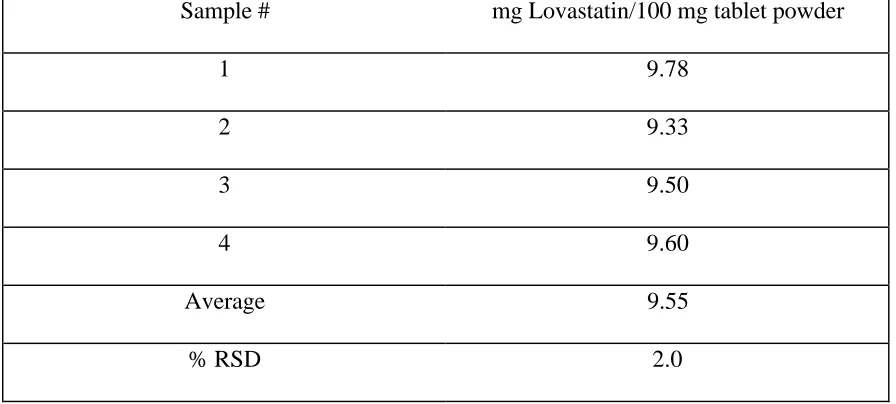
lovastatin in the in-house tablet powder mixture was 10 mg lovastatin/100 mg tablet powder. Four samples were taken to test uniformity of the tablet mixture (Table 3.2) using the traditional liquid extraction method, followed by SFC analysis.
MEVACOR® Tablet Crushing Method
Each commercially prepared MEVACOR® tablet (Merck Research Laboratories, West Point, PA) was placed on top of a piece of weighing paper which was loose in a mortar cup. A pestle was placed on top of the tablet, and pressure was applied until the tablet particles appeared evenly dispersed as a powder. The weighing paper was carefully removed and the complete crushed tablet was poured into the extraction vessel filled approximately 3/4 with a cotton ball. The weighing paper, mortar, and pestle were wiped clean with an additional small piece of cotton. This particular piece of cotton was then placed on top of the other cotton ball inside the extraction vessel. More cotton was added to fill approximately 90% of the vessel volume. The extraction vessel was then sealed.
3.3 RESULTS AND DISCUSSION
Phase A - Effect of Methanol-Modifier Concentration
Lovastatin, an antihypercholesterolemic drug (Figure 3.1), was chosen as the test analyte because it is relatively polar and exhibits marginal solubility (0.04 % (w/w) at 5000 psi, 40 °C) in 100% CO2. 4 Larson and King found that the solubility was dramatically
increased to 0.4% (w/w) with the incorporation of 5% (w/w) methanol-modified CO2
from a pre-mixed tank. The increased solubility of lovastatin in the methanol-modified CO2 versus pure CO2 was attributed to the ability of the dilute methanol to hydrogen bond
Table 3.2. In-house Prepared Tablet Powder Mixture Uniformity With Liquid Extraction
Method
Sample # mg Lovastatin/100 mg tablet powder
1 9.78
2 9.33
3 9.50
4 9.60
Average 9.55
% RSD 2.0
SFC Conditions Used for Tablet Powder Uniformity. Column: Hypersil® silica (4.6 mm i.d. X 25 cm, 3 µm particle diameter), Mobile Phase: 6% (v/v) (0.5% (v/v) trifluoroacetic acid) methanol-modified CO2; Pressure: 230 bar; Column Temperature: 45 °C; Liquid
Flow Rate: 2.0 mL/min; Injection solvent: methanol; Injection Volume: 5 µL; Detection: UV at 230 nm. UV Flow Cell Volume, Temperature: 10 µL, room temperature.
powder mixture with methanol-modified CO2. Experiments were designed in such a way
that an extraction profile could be constructed from the data (Figure 3.2) in order to examine the effect of methanol concentration and to investigate the extraction kinetics of lovastatin. A series of dynamic mini-extraction steps followed by trap rinsing and assay was employed. The tablet powder mixture was first allowed to equilibrate with the fluid for a certain period of time (static time) followed by continuous CO2 flow for an additional
period of time (dynamic time). The constructed extraction profiles consisted of several dynamic ministeps whereby the extraction was placed in static mode after a certain dynamic period, and the solid-phase trap was rinsed and assayed for percent recovery for that particular dynamic period. A tandem solid-phase/liquid trap was employed to ensure quantitative trapping recovery. Lovastatin recoveries were found to be low over the first forty minutes where only 58% was extractable with 1% (v/v) methanol-modified CO2, and
77% was extractable with 5% (v/v) methanol-modified CO2. When utilizing 1% and 5%
(v/v) methanol-modified CO2, the extraction profile suggested that most of the extractable
lovastatin was removed during the first 20 minutes of dynamic extraction. During this period, the extraction appeared to be dependent upon the solubility of the analyte in the methanol-modified CO2. After 20 minutes, the extraction process appeared to be limited
by the diffusion of the analyte from the matrix into the SF. 13 Quantitative recoveries from the in-house prepared tablet powder mixture of greater than 97% were, however, achieved with 10% (v/v) methanol-modified CO2 employing dynamic extraction mini-steps (Figure 3.2). Since trapping becomes more difficult with modifier concentrations greater than 2%,
it was of interest to determine if the addition of a secondary modifier could reduce the primary modifier concentration.
13
0 10 20 30 40 50 60 70 80 90 100
0 10 20 30 40
Dynamic Time (minutes)
Percent Recovery
[image:44.612.125.531.122.356.2]10 % (v/v) Methanol 5 % (v/v) Methanol 1 % (v/v) Methanol
Figure 3.2. Effect of Methanol-Modifier Concentration on Lovastatin Recoveries (n=3)
From In-House Prepared Tablet Powder Mixture
SFE Conditions. CO2 Pressure: 400 atm; Oven Temperature: 40 °C; Liquid Flow Rate:
2.0 mL/min.; Restrictor Temperature: 50 °C; Solid-Phase Trap: 50/50 (w/w) Porapak Q/Glass Beads; Liquid Tandem Trap: Methanol; Liquid Tandem Trap Volume: 5 mL; Collection Temperature (Solid-Phase): 40 °C, Desorption Temperature (Solid-Phase); 40 °C; Solid-Phase Rinse Solvent/Volume: Methanol, 2.0 mL, Solid-Phase Rinsing Flow Rate: 1.0 mL/min.; Initial Static Time: 3.0 min.; Dynamic Time: 40.0 min. (total of 5 dynamic mini-steps); Static Time During Trap Rinsing: 2.0 min. *Solid-phase trap rinsed directly into tandem liquid trap following each dynamic step.
Phase B - Effect of Additive Composition
After determining the effect of methanol on extraction efficiency, the role of the secondary modifier (i.e. additive) type was investigated. Methanol-modified CO2 (1%
(v/v))was chosen as the extraction fluid in Phase B due to the limited extractability of lovastatin under these conditions so that the apparent effect of each additive on the extractability could be ascertained. Each additive was introduced directly to the methanol as 1% (v/v). The total additive concentration introduced corresponds to 0.0001%. It can be seen in Figure 3.3 that isopropylamine was the only additive that significantly improved the extractability of lovastatin over time from the prepared tablet powder mixture. In fact, similar extraction recoveries utilizing all three additives (i.e. acid, neutral, base) were observed during the first 20 minutes of the extraction. During this time, the extraction was apparently governed simply by the solubility of the lovastatin in the 1% (v/v) methanol-modified CO2. The extractability of lovastatin, however, increased from 58%
with 1% (v/v) methanol-modified CO2 to 71% with 1% (v/v) (1% (v/v) isopropylamine)
methanol-modified CO2 after 40 minutes. T-tests were performed in order to statistically
compare the average extraction recoveries after 40 minutes of all three additives with methanol vs methanol-modified CO2 alone. With a 95% confidence interval, it was shown
that the extraction recoveries of lovastatin (e.g. after 40 minutes)
were statistically greater with the use of isopropylamine rather than with trifluoroacetic acid and tributylphosphate or no additive at all.
The increased extractability of lovastatin with the secondary modifier,
isopropylamine, after 40 minutes can not simply be explained by enhanced solubility, but by a combination of solubility and analyte displacement from the matrix. Excluding the active drug substance, common tablet ingredients include filling agents such as cellulose and starch as well as lubricants and coloring agents. Cellulose, for example, contains free methoxy and hydroxy acidic sites which contribute to the “activity” of the matrix.
0 10 20 30 40 50 60 70 80
0 10 20 30 40
Dynamic Time (minutes)
Percent Recovery
1% (v/v) (1% (v/v) Isopropylamine) Methanol
1% (v/v) (1% (v/v) Tributylphosphate) Methanol
1 % (v/v) Methanol
[image:46.612.130.533.130.346.2]1% (v/v) (1% (v/v) Trifluoroacetic acid) Methanol
Figure 3.3. Effect of Additive Type on Lovastatin Recoveries (n=3) From In-House
Prepared Tablet Powder Mixture
SFE Conditions. CO2 Pressure: 400 atm; Oven Temperature: 40 °C; Liquid Flow Rate:
2.0 mL/min.; Restrictor Temperature: 50 °C; Solid-Phase Trap: 50/50 (w/w) Porapak Q/Glass Beads; Liquid Tandem Trap: Methanol; Liquid Tandem Trap Volume: 5 mL; Collection Temperature (Solid-Phase): 40 °C, Desorption Temperature (Solid-Phase); 40 °C; Solid-Phase Rinse Solvent/Volume: Methanol, 2.0 mL, Solid-Phase Rinsing Flow Rate: 1.0 mL/min.; Initial Static Time: 3.0 min.; Dynamic Time: 40.0 min. (total of 5 dynamic mini-steps); Static Time During Trap Rinsing: 2.0 min. *Solid-phase trap rinsed directly into tandem liquid trap following each dynamic step
unshared pairs of electrons on the oxygen in the lactone ring, as well as its ability to accept protons. When treated with base, lactone rings are known to open up due to hydrolysis of the cyclic ester. Specifically, Larson et al. report the conversion of lovastatin in
fermentation broth to its hydroxyacid form when in the presence of 3% methanol-modified CO2 and t-butylamine (Equation 3.1). 4
(3.1)
CH3 H O O O C O CH3 H3 C HO H H H H CH3 H CH3 H O C O CH3 H3 C HO H H H H CH3 H O H O H O H + OH-Hydroxyacid lovastatin Lovastatin
Phase C - Effect of Additive Concentration
Since the lovastatin extraction recoveries from the tablet powder mixture were shown to be statistically greater with isopropylamine than the extraction recoveries achieved with the other additives and methanol-modified CO2 alone, the effect of
isopropylamine concentration at various methanol-modified CO2 concentrations was
investigated further in Phase C. Surprisingly, increased additive concentrations (0.5%, 1.0%, 2.0% (v/v) in 1% (v/v) methanol-modified CO2) at a constant modifier
concentration did not affect the extraction recoveries or the extraction rate. It was believed that all matrix acidic sites were occupied by isopropylamine at a concentration of 0.5% (v/v) in methanol; therefore increased additive concentrations would not further increase lovastatin extractability.
The usefulness of the isopropylamine additive at various methanol-modified CO2
concentrations can be also observed in Figure 3.4. T-tests were performed to compare the average extraction recoveries after 40 minutes with and without isopropylamine in 5% (v/v) methanol-modified CO2. With a 95% confidence interval, it was shown that the
extraction recoveries of lovastatin (e.g. after 40 minutes) were statistically greater when isopropylamine was used. Once again lovastatin extraction recoveries at various modifier concentrations were significantly enhanced with the presence of isopropylamine. Overall extraction recoveries over 40 minutes increased from 77% with 5% (v/v) methanol-modified to 86% with 5% (v/v) (1% (v/v) isopropylamine) methanol-methanol-modified CO2.
Phase D - Extraction of MEVACOR® Tablets
0 10 20 30 40 50 60 70 80 90 100
0 10 20 30 40
Dynamic Time (minutes)
Percent Recovery
5% (v/v) (1% (v/v) Isopropylamine) Methanol 5% (v/v) Methanol
[image:49.612.126.529.131.355.2]1% (v/v) (1% (v/v) Isopropylamine) Methanol 1% (v/v) Methanol
Figure 3.4. Effect of Methanol-Modifier Concentration on Lovastatin Recoveries (n=3)
From In-House Prepared Tablet Powder Mixture
SFE Conditions. CO2 Pressure: 400 atm; Oven Temperature: 40 °C; Liquid Flow Rate:
2.0 mL/min.; Restrictor Temperature: 50 °C; Solid-Phase Trap: 50/50 (w/w) Porapak Q/Glass Beads; Liquid Tandem Trap: Methanol; Liquid Tandem Trap Volume: 5 mL; Collection Temperature (Solid-Phase): 40 °C, Desorption Temperature (Solid-Phase); 40 °C; Solid-Phase Rinse Solvent/Volume: Methanol, 2.0 mL, Solid-Phase Rinsing Flow Rate: 1.0 mL/min.; Initial Static Time: 3.0 min.; Dynamic Time: 40.0 min. (total of 5 dynamic mini-steps); Static Time During Trap Rinsing: 2.0 min. *Solid-phase trap rinsed directly into tandem liquid trap following each dynamic step.
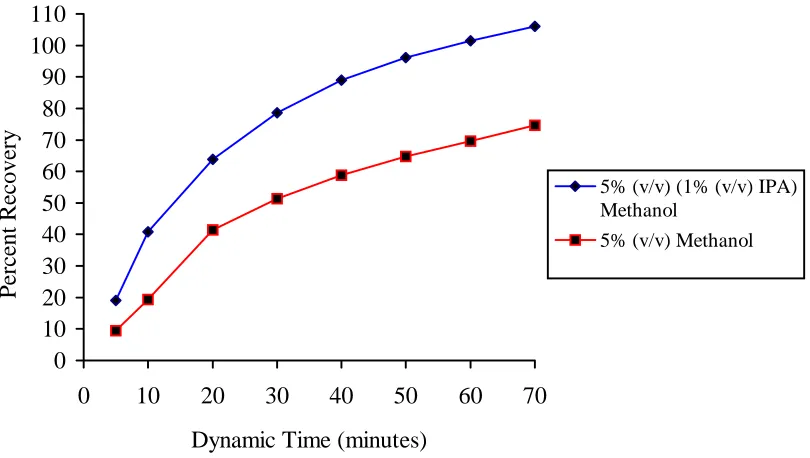
isopropylamine (Figure 3.5). Since the additive concentration in methanol had no statistical effect on recovery, 1% (v/v) isopropylamine was chosen. An overall recovery of only 84% was achieved with 5% (v/v) (1.0% (v/v) isopropylamine) methanol-modified CO2 within an extraction time of 40 minutes (dynamic); however, 106% was recovered
within 70 minutes (dynamic). A MEVACOR® tablet was also extracted with 5% methanol-modified CO2 (e.g. no isopropylamine) where only 74% was recovered within
70 minutes (dynamic). The advantages of the addition of isopropylamine as an additive when extracting from the MEVACOR® tablet were clearly shown.
Although quantitative lovastatin recoveries from MEVACOR® were achieved with 5% (v/v) methanol (1 % (v/v) isopropylamine), the time required for the extraction was 87 minutes (17 min. total static time, 70 min. total dynamic time). A dynamic extraction without trap rinsing between dynamic mini-steps as well as an extraction time of approximately 30 minutes was desired for the final optimized SFE method. Similar to the previous studies, extraction profiles consisting of alternating static/dynamic steps with trap rinsing in between each dynamic step were performed in order to compare overall extraction recoveries achieved and time needed versus the various modifier and additive percentages. A modifier percentage of 10% (v/v) methanol with and without
isopropylamine was then investigated (Figure 3.6). Overall extraction recoveries (n=1) of 95 and 88% were achieved with 10% methanol with and without isopropylamine
respectively, but the time needed was 50 minutes (6 dynamic mini-steps). Further attempts were made to increase the extraction recovery to 100% and to reduce the time needed to approximately 30 minutes. Therefore, 15% (v/v) methanol with and without isopropylamine was investigated (Figure 3.7). Once again an enhancement was observed when isopropylamine was employed where 102% and 91% with and without
0 10 20 30 40 50 60 70 80 90 100 110
0 10 20 30 40 50 60 70
Dynamic Time (minutes)
Percent Recovery
5% (v/v) (1% (v/v) IPA) Methanol
[image:51.612.130.535.126.355.2]5% (v/v) Methanol
Figure 3.5. Subcritical Fluid Extraction (n=1) of Lovastatin From MEVACOR® Tablets
at Various Additive/Modifier Concentrations
SFE Conditions. CO2 Pressure: 400 atm; Oven Temperature: 40 °C; Liquid Flow Rate:
2.0 mL/min.; Restrictor Temperature: 50 °C; Solid-Phase Trap: 50/50 (w/w) Porapak Q/Glass Beads; Liquid Tandem Trap: Methanol; Liquid Tandem Trap Volume: 5 mL; Collection Temperature (Solid-Phase): 40 °C, Desorption Temperature (Solid-Phase); 40 °C; Solid-Phase Rinse Solvent/Volume: Methanol, 2.0 mL, Solid-Phase Rinsing Flow Rate: 1.0 mL/min.; Static Time: 3.0 min.; Dynamic Time: 70.0 min. (total of 8 dynamic mini-steps); Static Time During Trap Rinsing: 2.0 min. *Solid-phase trap rinsed directly into tandem liquid trap following each dynamic step.
0 10 20 30 40 50 60 70 80 90 100 110 120
0 10 20 30 40 50
Dynamic Time (minutes)
Percent Recovery
10% (v/v) Methanol
[image:52.612.127.527.131.361.2]10% (v/v) (1% (v/v) IPA) Methanol
Figure 3.6. Subcritical Fluid Extraction (n=1) of Lovastatin From MEVACOR® Tablets
at Various Modifier Concentrations With and Without isopropylamine
SFE Conditions. CO2 Pressure: 400 atm; Oven Temperature: 40 °C; Liquid Flow Rate:
2.0 mL/min.; Restrictor Temperature: 50 °C; Solid-Phase Trap: 50/50 (w/w) Porapak Q/Glass Beads; Liquid Tandem Trap: Methanol; Liquid Tandem Trap Volume: 5 mL; Collection Temperature (Solid-Phase): 40 °C, Desorption Temperature (Solid-Phase); 40 °C; Solid-Phase Rinse Solvent/Volume: Methanol, 2.0 mL, Solid-Phase Rinsing Flow Rate: 1.0 mL/min.; Static Time: 3.0 min.; Dynamic Time: 50.0 min. (total of 6 dynamic mini-steps); Static Time During Trap Rinsing: 2.0 min. *Solid-phase trap rinsed directly into tandem liquid trap following each dynamic step.
0 10 20 30 40 50 60 70 80 90 100 110 120
0 5 10 15 20 25
Dynamic Time (minutes)
Percent Recovery
15% (v/v) Methanol
[image:53.612.126.534.135.363.2]15% (v/v) (1% (v/v) IPA) Methanol
Figure 3.7. Subcritical Fluid Extraction (n=1) of Lovastatin From MEVACOR® Tablets
at Various Modifier Concentrations With and Without isopropylamine
SFE Conditions. CO2 Pressure: 400 atm; Oven Temperature: 40 °C; Liquid Flow Rate:
2.0 mL/min.; Restrictor Temperature: 50 °C; Solid-Phase Trap: 50/50 (w/w) Porapak Q/Glass Beads; Liquid Tandem Trap: Methanol; Liquid Tandem Trap Volume: 5 mL; Collection Temperature (Solid-Phase): 40 °C, Desorption Temperature (Solid-Phase); 40 °C; Solid-Phase Rinse Solvent/Volume: Methanol, 2.0 mL, Solid-Phase Rinsing Flow Rate: 1.0 mL/min.; Static Time: 3.0 min.; Dynamic Time: 25.0 min. (total of 3 dynamic mini-steps); Static Time During Trap Rinsing: 2.0 min. *Solid-phase trap rinsed directly into tandem liquid trap following each dynamic step.
Table 3.3. SFE of MEVACOR® Tablets as a Function of Methanol-Modifier Percentage
and Addition of Isopropylamine
% Methanol-Modified
CO2
Dynamic Time (min.)
% Recovery no Isopropylamine
(n=1)
% Recovery
(1% (v/v) Isopropylamine in Methanol)
(n=1)
5% 70 84 106
10% 50 88 95
15% 25 91 102
SFE Conditions. CO2 Pressure: 400 atm; Oven Temperature: 40 °C; Liquid Flow Rate:
In the belief that an optimized method had been developed, 5 MEVACOR® tablets were then extracted with 15% (v/v) methanol with 1% (v/v) isopropylamine. The extraction method consisted of 3 dynamic mini-steps with a 2 minute static time added between each dynamic step to mimic trap rinsing as was used when constructing the previous extraction profiles. In this case, the solid-phase trap was not rinsed until the 35 min. extraction was completed. Average percent recoveries (n=5), standard deviations, and % RSDs are found in Table 3.4. It can be seen that 10 mg of lovastatin per tablet was fully recovered (99.5%) from the MEVACOR® tablets with a % RSD of 1.2% with 15 % (v/v) (1% (v/v) isopropylamine) methanol-modified CO2 within 35 minutes. As
Table 3.4. SFE Reproducibility for Lovastatin (10 mg) from MEVACOR® Tablets with
15 % (1.0% (v/v) isopropylamine) Methanol-Modified CO2
Tablet # Percent Recovery
1 98.4
2 101.0
3 98.7
4 98.7
5 100.5
Avg. Percent Recovery 99.5
RSD 1.2
SFE Conditions. CO2 Pressure: 400 atm; Oven Temperature: 40 °C; Liquid Flow Rate:
Table 3.5. Traditional Liquid Extraction and SFE Solvent Use, Steps, and Time
Comparisons
Traditional liquid extraction SFE
Volume of Solvent Used
95 mL acetonitrile/buffer 17.5 mL methanol total • 7.5 mL modifier
• 5 mL tandem-liquid trap • 5 mL solid-phase rinse
Mixing XXX none
Sonication XXX none
Cooling XXX none
Tablet Crushing none XXX
Extraction Time Including Sample Preparation
3.4 SUMMARY
The effect of primary and secondary modifiers (i.e. additives) on the subcritical fluid extraction of lovastatin from in-house prepared tablet powder mixtures and MEVACOR® tablets was investigated. Methanol-modifier percentage, additive type (acidic, basic, neutral) in methanol, and the effect of additive concentration on the extraction efficiency were examined. Extractability was shown to depend on modifier concentration and additive type. Isopropylamine was believed to be the most successful additive because of its ability to displace adsorbed lovastatin from the acidic tablet matrix sites, an effect not possible with methanol-modified CO2 alone. An optimized extraction
CHAPTER IV
INVESTIGATION OF ION-PAIRING ADDITIVES FOR THE SUPERCRITICAL FLUID EXTRACTION OF TRIPHENYLPHOSPHINETRISULFONATE, SODIUM SALT
4.1 INTRODUCTION
It was demonstrated in Chapter III that the extraction of a highly polar,
nonionizable pharmaceutical, lovastatin, from a complicated matrix (i.e. MEVACOR® tablets) was indeed feasible using subcritical fluid extraction. The effect of the addition of methanol to the carbon dioxide was examined, and it was shown that the recoveries could be enhanced due to a subsequent increase in the solvating power of the fluid. Although an enhancement was observed, a secondary modifier (i.e. additive), specifically
isopropylamine, was needed to possibly overcome significant analyte-matrix interactions. Due to the mildly basic characteristics of the drug, a stronger base was added to the fluid to facilitate displacement of the drug from any acidic sites on the tablet matrix. In this Chapter, the usefulness of other types of additives will be investigated for the extraction of an ionic compound.
As described previously, the use of SFE in the pharmaceutical field has been limited. Many pharmaceuticals are ionic/ionizable, water soluble, and highly polar. Due to the low dielectric constant (1.0 - 1.6) of supercritical CO2, ionic compounds are