Confidence-based Active Learning Methods for Machine Translation
Varvara Logacheva
University of Sheffield Sheffield, United Kingdom [email protected]
Lucia Specia
University of Sheffield Sheffield, United Kingdom [email protected]
Abstract
The paper presents experiments with ac-tive learning methods for the acquisition of training data in the context of machine translation. We propose a confidence-based method which is superior to the state-of-the-art method both in terms of quality and complexity. Additionally, we discovered that oracle selection tech-niques that use real quality scores lead to poor results, making the effectiveness of confidence-driven methods of active learn-ing for machine translation questionable.
1 Introduction
Active learning (AL) is a technique for the auto-matic selection of data which is most useful for model building. In the context of machine trans-lation (MT), AL is particularly important as the acquisition of data often has a high cost, i.e. new source texts need to be translated manually. Thus it is beneficial to select for manual translation sen-tences which can lead to better translation quality. The majority of AL methods for MT is based on the (dis)similarity of sentences with respect to the training data, with particular focus on domain adaptation. Eck et al. (2005) suggest a TF-IDF metric to choose sentences with words absent in the training corpus. Ambati et al. (2010) propose a metric of informativeness relying on unseen n-grams.
Bloodgood and CallisoBurch (2010) use n-gram frequency and coverage of the additional data as selection criteria. Their technique solic-its translations for phrases instead of entire sen-tences, which saves user effort and leads to quality improvements even if the initial dataset is already sizeable.
A recent trend is to select source sentences based on an estimate of the quality of their trans-lation by a baseline MT system. It is assumed
that if a sentence has been translated well with the existing data, it will not contribute to improving the translation quality. If however a sentence has been translated erroneously, it might have words or phrases that are absent or incorrectly repre-sented. Haffari et al. (2009) train a classifier to define the sentences to select. The classifier uses a set of features of the source sentences and their automatic translations: n-grams and phrases fre-quency, MT model score, etc. Ananthakrishnan et al. (2010) build a pairwise classifier that ranks sen-tences according to the proportion of n-grams they contain that can cause errors. For quality estima-tion, Banerjee et al. (2013) train language models of well and badly translated sentences. The use-fulness of a sentence is measured as the difference of its perplexities in these two language models.
In this research we also explore a quality-based AL technique. Compared to its predecessors, our method is based on a more complex and therefore potentially more reliable quality estimation frame-work. It uses wider range of features, which go beyond those used in previous work, covering in-formation from both source and target sentences.
Another important novel feature in our work is the addition of real post-editions to the MT train-ing data, as opposed to simulated post-editions (human reference translations) as in previous work on AL for MT. As we show in section 3.2, adding post-editions leads to superior translation quality improvements. Additionally, this is a suitable so-lution for “human in the loop” settings, as post-editing automatically translated sentences tends to be faster and easier than translation from scratch (Koehn and Haddow, 2009). Also, different from previous work, we do not focus on domain adapta-tion: our experiments involve only in-domain data. Compared to previous work on confidence-driven AL, our approach has led to better results, but these proved to be highly dependent on a sen-tence length bias. However, an oracle-based
tion using true quality scores has not been shown to perform well. This indicates that the usefulness of quality scores as AL selection criterion in the context of MT needs to be further investigated.
2 Active selection strategy
Our AL sentence selection strategy relies on qual-ity estimation (QE). QE is aimed at predicting the quality of a translated text (in this case, a sen-tence) without resorting to reference translations. It considers features of the source and machine translated texts, and an often small number (a few hundreds) of examples of translations labelled for quality by humans to train a machine learning al-gorithm to predict such quality labels for new data. We use the open source QE framework QuEst (Specia et al., 2013). In our settings it was trained to predict an HTER score (Snover et al., 2006) for each sentence, i.e., the edit distance between the automatic translation and its human post-edited version. QuEst can extract a wide range of fea-tures. In our experiments we use only the 17 so-called baseline features, which have been shown to perform well in evaluation campaigns (Bojar et al., 2013): number of tokens in sentences, av-erage token length, language model probabilities for source and target sentences, average number of translations per source word, percentage of higher and lower frequency n-grams in source sentence based on MT training corpus, number of punctua-tion marks in source and target sentences.
Similarly to Ananthakrishnan et al. (2010), we assume that the most useful sentences are those that lead to larger translation errors. However, instead of looking at the n-grams that caused er-rors — a very sparse indicator requiring signifi-cantly larger amounts of training data, we account for errors in a more general way: the (QuEst pre-dicted) percentage of edits (HTER) that would be necessary to transform the MT output into a cor-rect sentence.
3 Experiments and results
3.1 Datasets and MT settings
For the AL data selection experiment, two datasets are necessary: parallel sentences to train an ini-tial, baseline MT system, and an additional pool of parallel sentences to select from. Our goal was to study potential improvements in the base-line MT system in a realistic “human in the loop” scenario, where source sentences are translated by
the baseline system and post-edited by humans be-fore they are added to the system. As it has been shown in (Potet et al., 2012), post-editions tend to be closer to source sentences than freely created translations. One of our research questions was to investigate whether they would be more useful to improve MT quality.
We chose the biggest corpus with machine translations and post-editions available to date: the LIG French–English post-editions corpus (Potet et al., 2012). It contains 10,881 quadruples of the type: <source sentence, reference transla-tion, automatic translatransla-tion, post-edited automatic translation>. Out of these, we selected 9,000 as the pool to be added to be baseline MT system, and the remaining 1,881 to train the QE system for the experiments with AL. For QE training, we use the HTER scores between MT and its post-edited version as computed by the TERp tool.1
We use the Moses toolkit with standard set-tings2 to build the (baseline) statistical MT sys-tems. As training data, we use the French– English News Commentary corpus released by the WMT13 shared task (Bojar et al., 2013). For the AL experiments, the size of the pool of additional data (10,000) poses a limitation. To examine im-provements obtained by adding fractions of up to only 9,000 sentences, we took a small random sub-set of the WMT13 data for these experiments (Ta-ble 1). Although these figures may seem small, the settings are realistic for many language pairs and text domains where larger data sets are simply not available.
We should also note that all the data used in our experiments belongs to the same domain: the LIG SMT system which produced sentences for the post-editions corpus was trained on Europarl and News commentary datasets (Potet et al., 2010), but the post-edited sentences themselves were taken fromnewstest sets released for WMT shared tasks in different years. Our baseline system is trained on a fraction of thenewscommentary corpus. Fi-nally, we tune and test all our systems on WMT shared task news news datasets (those which do not overlap with the post-editions corpus).
1http://www.umiacs.umd.edu/˜snover/
terp/
2http://www.statmt.org/moses/?n=Moses.
Corpora Size (sentences)
Initial data (baseline MT system)
Training- subset of 10,000 News Commentary corpus
Tuning- WMT newstest-2012 3,000
Test- WMT newstest-2013 3,000 Additional data (AL data) Post-editions corpus: 10,881 -Training QEsystem 1,881
[image:3.595.74.289.61.219.2]-AL pool 9,000
Table 1: Datasets
3.2 Post-editions versus references
In order to compare the impact of post-editions and reference translations on MT quality, we added these two variants of translations to base-line MT systems of different sizes, including the entire News Commentary corpus. The figures for BLEU (Papineni et al., 2002) scores in Table 2 show that adding post-editions results in signifi-cantly better quality than adding the same number of reference translations3. This effect can be seen even when the additional data corresponds to only a small fraction of the training data.
In addition, it does not seem to matter which MT system produced the translations which were then post-edited in the post-edition corpus. Even if the output of a third-party system was used (as in our case), it improves the quality of machine trans-lations for unseen data. We assume that since post-editions tend to be closer to original sentences than free translations (Potet et al., 2012), they gener-ally help produce better source-target alignments, leading to the extraction of good quality phrases.
Baseline corpus Results (BLEU) (sentences) Baseline Ref PE
150,000 22.41 22.95 23.21 50,000 20.22 20.91 22.01 10,000 15.09 18.65 20.44 Table 2: Influence of post-edited and reference translations on MT quality. Ref: baseline system with added free references, PE: baseline system with added post-editions.
3These systems use the whole post-editions set (10,881 sentences) as opposed to 9,000-sentence subset which we use further in our AL experiments. Therefore the figures reported in this table are higher than those in subsequent sections.
3.3 AL settings
The experimental settings for all methods are as follows. First, a baseline MT system is trained. Then a batch of 1,000 sentences is selected from the data pool with an AL strategy, and the selected data is removed from the pool. The MT system is rebuilt using a concatenation of the initial training data and the new batch. The process is repeated until the pool is empty, with subsequent steps us-ing the MT system trained on the previous step as a baseline. The performance of each MT system is measured in terms of BLEU scores. We use the following AL strategies:
• QuEst: our method described in section 2.
• Random: random selection of sentences.
• HTER: oracle-based selection based on true HTER scores of sentences in the pool, instead of the QuEst estimated HTER scores.
• Ranking: AL strategy described in (Anan-thakrishnan et al., 2010) for comparison.
3.4 AL results
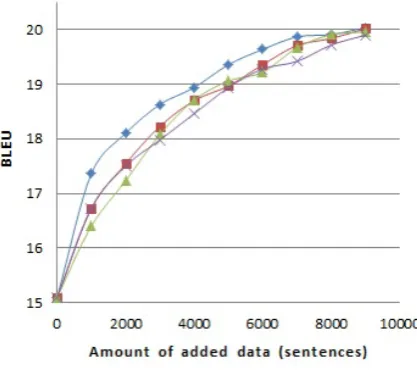
Our initial results in Figure 1 show that our selec-tion strategy (QuEst) consistently outperforms the
Randomselection baseline.
Figure 1: Performance of MT systems enhanced with data selected by different AL strategies
[image:3.595.311.520.456.641.2] [image:3.595.78.285.571.642.2]Compared toQuEst, we believe the lower figures of theRankingstrategy are due to the fact that the latter considers features of only one type (source n-grams), whereas QuEst uses a range of different features of the source and translation sentences.
Interestingly, the Oracle method under-performs our QE-based method, although we expected the use of real HTER scores to be more effective. In order to understand the reasons behind such behaviour, we examined the batches selected by QuEst and Oracle strategies more closely. We found that the distribution of sentence lengths in batches by the two strategies is very different (see Figure 2). While in batches selected by QuEst the average sentence length steadily decreases as more data is added, in Oracle
batches the average length was almost uniform for all batches, except the first one, which contains shorter sentences.
This is explained by HTER formulation: HTER is computed as the number of edits over the sen-tence length, and therefore in shorter sensen-tences ev-ery edit is given more weight. For example, the HTER score of a 5-word sentence with one error is 0.2, whereas a sentence of 20 words with the same single error has a score of 0.05. However, it is doubtful that the former sentence will be more useful for an MT system than the latter. Regarding the nature of length bias in the predictions done by
QuEstsystem, sentence length is used there as a feature, and longer sentences tend to be estimated as having higher HTER scores (i.e., lower transla-tion quality).
Therefore, sentences with the highest HTER may not actually be the most useful, which makes theOraclestrategy inferior toQuEst. Moreover, longer sentences chosen by our strategy simply provide more data, so their addition might be more useful even regardless of the amount of errors.
This seems to indicate that the success of our strategy might not be related to the quality of the translations only, but to their length. Another pos-sibility is that sentences selected byQuEstmight have more errors, which means that they can con-tribute more to the MT system.
3.5 Additional experiments
[image:4.595.307.524.63.236.2]In order to check the two hypotheses put forward in the previous section, we conduct two other sets of AL experiments: (i) a selection strategy that chooses longer sentences first (denoted asLength)
Figure 2: Number of words in batches selected by different AL strategies
and (ii) a selection strategy that chooses sentences with larger numbers of errors first (Errors).
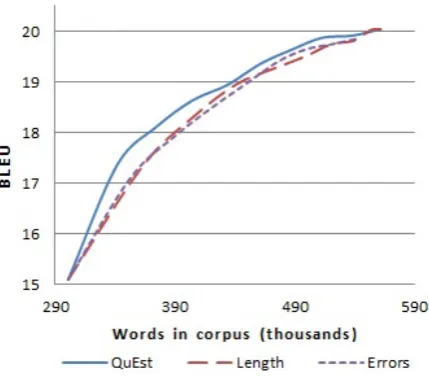
Figure 3 shows that a simple length-based strat-egy yields better results than any of the other tested strategies. Therefore, in cases when the corpus has sufficient variation in sentence length, length-based selection might perform at least as well as other more sophisticated criteria. The experiments with confidence-based selection de-scribed in (Ananthakrishnan et al., 2010) were free of this length bias, as sentences much longer or shorter than average were deliberately filtered out. Interestingly, results for theErrorsstrategy are slightly worse than those forQuEst, although the former is guaranteed to choose sentences with the largest number of errors and has even stronger length bias thanQuEst(see figure 2). Therefore, the reasons hypothesised to be behind the superi-ority ofQuEstoverOracle(longer sentences and larger number of errors) are actually not the only factors that influence the quality of an AL strategy.
3.6 Length-independent results
Figure 3: Comparison of our QuEst-based selec-tion with a length-based selecselec-tion
[image:5.595.309.524.62.250.2]Therefore, we would like to study the effec-tiveness of our strategy by isolating the sentence length bias. One option is to filter out long sen-tences, as it was done in (Ananthakrishnan et al., 2010). However, our pool is already too small. Therefore, we plot the performance improvements with respect to training data size in words, in-stead of sentences. As it was already noted by Bloodgood and Callison-Burch (2010), measuring the amount of added data in sentences can signifi-cantly contort the real annotation cost (the cost of acquisition of new translations). So we switch to length-independent representation.
Figure 4: Active learning quality plotted with re-spect to data size in words: QuEst vs Oracle
strategies.
Figure 4 shows that the Oracle strategy in
Figure 5: AL quality plotted with respect to data size in words: QuEst vs Length and Errors
strategies.
length-independent representation can still be seen to perform worse than both our strategy and ran-dom selection. Results of Length and Error
strategies (plotted separately in figure 5 for read-ability) are very close and both underperform our
QuEst-based strategy and random selection of data.
Here our experience echoes the results of (Mo-hit and Hwa, 2007), where the authors propose the idea ofdifficult to translate phrases. It is assumed that extending an MT system with phrases that can cause difficulties during translation is more effec-tive than simply adding new data and re-building the system. Due to the lack of time and human annotators, the authors extracted difficult phrases automatically using a set of features: alignment features, syntactic features, model score, etc. Con-versely, we had the human-generated information on what segments have been translated incorrectly. We assumed that the use of this knowledge as part of our AL strategy would give us an upper bound for our AL method results. However, it turned out that prediction based on multiple features is more reliable than precise information on quality, which accounts for only one aspect of data.
4 Conclusions
[image:5.595.73.288.502.689.2]success-ful mostly due to its tendency to rate long sen-tences as having lower quality. Consequently, the AL application that chooses the longest sentences is not less successful when selecting from corpora with large variation in sentence length. A length-independent representation of the results showed that an oracle selection is less effective than our quality-based strategy, which we believe to be due to the nature of corrections and small size of the post-edition corpus. In addition to that, another oracle selection based on the amount of errors and length-based selection show poor results when dis-played in length-independent mode.
We believe that the quality estimation strategy benefits from other features that reflect the useful-ness of a sentence better than its HTER score and the amount of user corrections. In future work we will examine the influence of individual features of the quality estimation model (such as language model scores) as active learning selection strategy.
References
Vamshi Ambati, Stephan Vogel, and Jaime Carbonell. 2010. Active Learning and Crowd-Sourcing for
Ma-chine Translation. LREC 2010: Proceedings of the
seventh international conference on Language Re-sources and Evaluation, 17-23 May 2010, Valletta, Malta, pages 2169–2174.
Sankaranarayanan Ananthakrishnan, Rohit Prasad, David Stallard, and Prem Natarajan. 2010. Dis-criminative Sample Selection for Statistical Machine
Translation. EMNLP-2010: Proceedings of the
2010 Conference on Empirical Methods in Natu-ral Language Processing, October 9-11, 2010, MIT, Massachusetts, USA, (October):626–635.
Pratyush Banerjee, Raphael Rubino, Johann Roturier, and Josef van Genabith. 2013. Quality Estimation-guided Data Selection for Domain Adaptation of SMT. MT Summit XIV: proceedings of the four-teenth Machine Translation Summit, September 2-6, 2013, Nice, France, pages 101–108.
Michael Bloodgood and Chris Callison-Burch. 2010. Bucking the Trend: Large-Scale Cost-Focused Ac-tive Learning for Statistical Machine Translation.
ACL 2010: the 48th Annual Meeting of the Associ-ation for ComputAssoci-ational Linguistics, Uppsala, Swe-den, July 11-16, 2010, pages 854–864.
Ondˇrej Bojar, Christian Buck, Chris Callison-Burch, Christian Federmann, Barry Haddow, Philipp Koehn, Christof Monz, Matt Post, Radu Soricut, and Lucia Specia. 2013. Findings of the 2013
Work-shop on Statistical Machine Translation. In
Pro-ceedings of the Eighth Workshop on Statistical Ma-chine Translation, pages 1–44, Sofia, Bulgaria, Au-gust. Association for Computational Linguistics.
Matthias Eck, Stephan Vogel, and Alex Waibel. 2005. Low Cost Portability for Statistical Machine Trans-lation based on N-gram Frequency and TF-IDF.
IWSLT 2005: Proceedings of the International Workshop on Spoken Language Translation. Octo-ber 24-25, 2005, Pittsburgh, PA.
Gholamreza Haffari, Maxim Roy, and Anoop Sarkar. 2009. Active learning for statistical phrase-based
machine translation. Proceedings of Human
Lan-guage Technologies: The 2009 Annual Conference of the North American Chapter of the Association for Computational Linguistics on - NAACL ’09. Philipp Koehn and Barry Haddow. 2009. Interactive
Assistance to Human Translators using Statistical
Machine Translation Methods. MT Summit XII:
pro-ceedings of the twelfth Machine Translation Sum-mit, August 26-30, 2009, Ottawa, Ontario, Canada, pages 73–80.
Behrang Mohit and Rebecca Hwa. 2007.
Localiza-tion of Difficult-to-Translate Phrases. ACL 2007:
proceedings of the Second Workshop on Statistical Machine Translation, June 23, 2007, Prague, Czech Republic, pages 248–255.
Kishore Papineni, Salim Roukos, Todd Ward, and Wei-jing Zhu. 2002. BLEU: a Method for Automatic
Evaluation of Machine Translation.ACL 2002: 40th
Annual Meeting of the Association for Computa-tional Linguistics, July 2002, Philadelphia, pages 311–318.
Marion Potet, Laurent Besacier, and Herv´e Blanchon. 2010. The LIG machine translation system for
WMT 2010. ACL 2010: Proceedings of the Joint
Fifth Workshop on Statistical Machine Translation and MetricsMATR, pages 161–166.
Marion Potet, Emmanuelle Esperanc¸a-Rodier, Laurent Besacier, and Herv´e Blanchon. 2012. Collection of a Large Database of French-English SMT Output
Corrections. LREC 2012: Eighth international
con-ference on Language Resources and Evaluation, 21-27 May 2012, Istanbul, Turkey, pages 4043–4048. Matthew Snover, Bonnie Dorr, Richard Schwartz,
Lin-nea Micciulla, and John Makhoul. 2006. A Study of Translation Edit Rate with Targeted Human
An-notation. AMTA 2006: Proceedings of the 7th
Con-ference of the Association for Machine Translation in the Americas, Visions for the Future of Machine Translation, August 8-12, 2006, Cambridge, Mas-sachusetts, USA, pages 223–231.
Lucia Specia, Kashif Shah, Jose G C de Souza, and Trevor Cohn. 2013. QuEst - A translation quality
estimation framework. ACL 2013: Annual