1
The support organisation:
A shared services approach
An explorative best practice study
of shared services
2
The support organisation:
A shared services approach
An explorative best practice study
of shared services
MSc in Business Administration
Koen Detert Oude Weme University of Twente
Thales Hengelo Version 2.0
3
Colophon
Author:
Koen Detert Oude WemeStudent Number:
S1504266E-mail:
[email protected]Phonenumber:
06- 38 70 87 66
Education:
Business AdministrationInstitute:
University of TwenteSchool of Management and Governance Enschede, the Netherlands
Company:
Thales GroupHengelo, the Netherlands
Project Reference:
Master ThesisDate:
10th of August
Version:
2.0Status:
Final VersionInternal Supervisors
1
stSupervisor:
Dr. Ir. Erwin Hofman
2
ndSupervisor
: Dr. Jeroen MeijerinkExternal Supervisor
Supervisor Thales Group
: Hans Koop4
Acknowledgements
This paper is the concluding piece of the master Business Administration. The paper is conducted between the 16th of February and the 10th of August and is written for Thales Netherlands B.V. Hengelo. Thales gave me the opportunity to investigate the facets and successful criteria of a shared service entity. During this period I focused on the theory around shared services and the platform theory. The final part of the master was very educative and informative. I have developed myself socially and professionally. It was a very interesting study due the topic and the interesting company Thales.
I would like to appoint my gratitude to several people who helped me finish this master thesis. Special thanks goes out to Hans Koop. Hans was my business coach, he steered and helped me using his critical view on the process and my work. Second I would like to thank the employees of Thales Hengelo for the very pleasant time, and especially the employees who where directly involved by accomplishing my research for their guidance and willingness to collaborate.
Finally I want to thank both supervisors from the University of Twente. First of all Erwin Hofman for his support, feedback and good directions during the process. Furthermore I want to thank Jeroen Meijerink for his support and feedback.
Kind Regards,
Koen Detert Oude Weme
5
Management Summary
Organisations should innovate their organisation setting on a continuant basis. Shared service designs are become more popular. Literature and big consultancy firms acknowledge the benefits of such shared service entities. Thales, as a big established firm is interested in the shared services concept and asked for a research. This explorative research focusses on the methods, motivations, actual benefits, best practices of shared services. Second, criteria that can determine which services can be shared are determined. A design needs to be carefully chosen, Hofman et al. (2011) states that a poorly designed shared service may result in lower service quality and even higher costs. The main research goal is “offer the group members who organise the support organisation recommendations design criteria to implement an efficient support organisation.” During this research an answer to the research question “What are the design criteria that exist in theory and companies that are comparable to Thales that will help make a shared services entity successful” will be answered. During this research results from theory and comparable companies are derived. In both the theoretical and practical research side interesting aspects came forward.
Many models show the effects and best practices of shared service organisations. During this research a profound theoretical framework is established to give insights in how shared services works and their effects. These effects are tested in several cases and practical knowledge from those cases are derived and formed as recommendations for Thales to consider while considering the implementation of a shared service entity. Mainly high-tech and comparable companies are researched during the intensive case study. The choice for those companies is because of the support this research will get because of the comparability with other companies. This research will show that the theoretical framework is also applicable on the high tech companies.
6
theoretical framework of this research can be considered as sound. Practical innovations and best practices derived from the cases can be held as guideline during the implementation and the maintaining of the shared service organisation.
7
Table of Contents
Colophon ... 3
Acknowledgements ... 4
Management Summary ... 5
Table of Contents ... 7
1. Introduction ... 9
2. Methodology ... 11
2.1. Clarification research question ... 11
2.2. Research method: Qualitative interview studies (best practice research) ... 12
2.3. Research design ... 14
2.4. Units of analysis and cases ... 15
2.5. Data collection ... 17
2.6. Data Analysis ... 19
3. Theoretical Framework ... 21
3.1. Methodology theoretical framework ... 21
3.2. Defining the concept of Shared Service Centers ... 22
3.3. Defining the concept of Project Management Office ... 25
3.4. Differences between Shared Service Centers and Project Management Offices. ... 30
3.5. Defining the concept of Shared services ... 31
3.6. Service Modularity and Service Platform Theory ... 43
4. Results of Multiple Cases ... 51
4.1. Methodology Results & Analysis ... 51
4.2. Fokker Technologies ... 52
4.3. Philips Healthcare ... 58
4.4. ASML ... 63
4.5. Defence... 70
4.6. Stork ... 75
4.7. DHV Royal Haskoning ... 80
8
4.9. VDL Enrichment Technologies ... 89
4.10. Combined case study results of PMOs ... 91
4.11. Combined case study results of SSCs ... 92
4.12. Combined case study results special cases ... 93
5. Cross Case Analysis ... 94
5.1. Analysing cases of PMO, SSC and special cases ... 94
5.2. PMO cases analysis: ... 95
5.3. SSC cases analysis: ... 96
5.4. Special cases analysis ... 96
5.5. Cross case analysis ... 97
6. Conclusions & Recommendations ... 99
6.1. Why do companies implement shared services? ... 99
6.2. Best practices / recommendations ... 102
6.3. Challenges / points of attention for Thales ... Error! Bookmark not defined. 6.4. Criteria to share or not to share ... 108
6.5. Thales specific analysis ... 109
6.6. Answer to the research question ... 110
7. Discussion, Limitations and Future Research ... 112
7.1. Discussion ... 112
7.2. Limitations ... 113
7.3. Future research ... 115
References ... 117
Appendixes ... 1245
Appendix I: Abbreviations ... 1245
9
1.
Introduction
Thales Hengelo is investigating to set up a support organisation. Thales Hengelo believes that several support activities (services) can be standardized over the domains to increase the efficiency, uniformity and continuity of the company and therefore be better prepared for growth. That can be done, for example in the form of a shared service center (SSC) or a Project Management Office (PMO) setting. Thales Hengelo gave me the opportunity to contribute to that investigation by doing research on several shared service entities at external companies. It is interesting for Thales to know criteria are influential in designing a shared service entity and what concepts and ideas are used in comparable companies that are effective. This project will add value to Thales because there will be more insights in the planned support organisation. Thales will have information about practical issues like pros and cons, recommendations on the design of the support organisation, providing insights in comparable companies. This is important, because the design needs to be carefully chosen, Hofman et al. (2011) states that a poorly designed shared service may result in lower service quality and even higher costs. According to Halman et al. 2003, this research can contribute to the literature because platform studies investigated only a narrow range of platform types. This research contributes by investigating different types of platform types, and especially service types (project support & finance) (Halman, et al., 2003). Second, according to Hofman & Meijerink (2015) it remains open to question which conditions determine the appropriate delivery mode. This research in service platforms (not only HRM) can contribute to a wider view on the platform theory with other than HRM services. According to Voss & Hsuan (2009), further research to service architectures is necessary and emergent.
Shared services is combining or consolidating services within a corporation (Schulz, et al., 2009). At this moment Thales Netherlands has four business units1 (BU’s), all those business units currently have their own support staff (primarily non-shared delivery mode). The support staff contract management, finance, resource planning, quality and configurations management are not shared through the BU’s. The objectives according to the theory of setting up a shared service entity are economies of scale, improved quality, continuity, improved learning, focus on core competences of the company, efficient use of IT, increase flexibility, increase automation and reduce the amount of new personnel and uniformity. (Bergeron, 2003; Janssen & Joha, 2006; Schulz, et al., 2009; Strikwerda, 2010)
10
A shared service center is a separate organisation within the firm and the SSC is focused on the internal customers (business units) of the company. Project management offices operate as specialized consulting firms inside a company (Ulrich, et al., 2008). Employees that first would have worked in just one business unit will be assigned to do activities in more business units in the SSC or PMO. The implementation of a PMO is often based on the call to improve project management effectiveness. Several studies notion that there is value in utilizing PMOs (Toney & Powers, 1997; Block & Frame, 1998). Ad hoc approach to project management can foster inefficiencies, while PMOs can lead to more continuity (Block & Frame, 1998).
Thales is interested in a theoretical part of what is important in a support organisation (shared service entity) and second, Thales wants to see a best practice study (several case studies) of how other companies use shared service centers or project management offices and what Thales can learn from it. Thales is particularly interested in the motivations, experienced advantages and disadvantages, success factors and pitfalls, use of performance indicators to control the shared service, lessons learned by implementation, location in the organisation, criteria that influence what activities can be standardized, choice of method and experiences and how to handle shadow staff (Ulrich, 1995). To summarise, Thales wants information about proven concepts (best practices), ideas and criteria. The research objective in this research can be defined as: “Offer the group members who organise the support organisation criteria to design and implement an efficient and effective support organisation. This can be done through making an inventory of the concepts and learning points from theory and the benchmark companies”. Therefore the research question is formulated as:
“What are the design criteria that exist in theory and companies that are comparable to Thales that will help make a shared services entity successful”
Sub-questions
- Why do companies implement shared services?
- What are best practices, criteria or aspects about the design of shared services that will contribute to an effective shared service entity?
11
2.
Methodology
In this chapter the methodology of this research is described. This chapter describes how the research is conducted.
- Paragraph 2.1: Clarification research question - Paragraph 2.2: Research Method
- Paragraph 2.3: Research Design
- Paragraph 2.4: Units of analysis and cases - Paragraph 2.5: Data collection methods - Paragraph 2.6: Data analysis
2.1.
Clarification research question
Two questions arise by analysing the research question and sub questions. ‘Criteria’ is very broad and can mean a lot of things, so what specific criteria will this research be measuring? Second, the success of a shared service center can be widely interpreted. A question arises when you interpreted the research question, when is a shared service successful?
The term ‘criteria’ is formulated as: “a standard of judgment or criticism; a rule or principle for evaluating or testing something.” (Dictionary, 2015) During this research the primary criteria that will be researched are the criteria deciding to share or not to share a service. Second, every shared service organisation will be judged according to the models of Hill (2004) and Schulz et al., (2009). These rules or principles in the shared service entities will contribute to the evaluation and comparability of the shared service entities
12
Table 2.1: Objectives Thales for implementing a shared service entity (derived from focus group)
A final view is the view of Thales on the desired outcomes. Thales sees the shared service entity as a success as the main drivers cost reduction, continuity and uniformity are reached. These success factors are in line with the success factors described for the SSC and the PMO. Therefore the measure of a successful shared service entity in this research will be efficiency, continuity and uniformity. These facets are operationalized as: Efficiency: Reduce workforce by combining departments over the domains, or increase value creation by increased learning. Uniformity: Working with uniform workflows and with the best practices of the domains will increase clarity towards employees. Second, uniformity will make use of the best practices and will increase learning and effectiveness. Continuity: Working within a support organisation will reduce constraints associated within a decentralised organisation. Constraints can operationalized as less dependencies, employees can cover for each other, improved sharing of knowledge, more job opportunities. Maintain or improve service quality: a logical fourth success factor is the mainlining or improving of service quality. This can be measured by customer satisfaction after implementation. ((Table 2.1.)
Conclusive, during this research the criteria to design a shared service entity are very important. Second, what criteria makes the shared service center successful. These criteria are mostly measured by the antecedents of the success factors (best practices).
2.2.
Research method: Qualitative interview studies (best practice research)
This research is an exploratory research. Robson, (2002, p. 59) describes the exploratory research as: “what is happening; to seek new insights; to ask questions and to assess phenomena in a new light.” According to Yin (2009) there are several methods of doing research. Often recommended studies are: the field experiment, panel study, case study, focus group, interviews and a survey. When choosing a method, there are 3 factors to deal with according to Yin (2009): 1) type of question, 2) the control an investigator has over actual behavioural events and, 3) the focus on contemporary as opposed to Criteria’s that measure success of a shared service
for Thales
Source
Efficiency (cost reduction) (Schulz, et al., 2009; Chandler, 1977; Eggers, et al., 2005; Pwc, 2008)
Continuity / Flexibility (Quinn, et al., 2000; Strikwerda, 2010; Pwc, 2008) Uniformity (Strikwerda, 2010; Janssen & Joha, 2006)
13
historical phenomena (Yin, 2009, p.11). This research looks like a multiple case study approach. However, to call it a case study it should observe the phenomena in his natural setting over a period of time (Yin, 2009). This implies interviews and observations over a span of time. This research does not have enough time to perform a case study in that particular context, but useful aspects and insights of the case study research are considered. During this research the choice is a semi-structured interview approach. The benefit of a semi-structured interview is that a researcher can collect a directed large amount of data from professionals.
Because of the small link with the case study approach, a case study is a research method that investigates contemporary phenomena, like the recently in popularity increasing PMOs or SSCs in their actual setting. This method is useful when the boundaries between the phenomena and the context are not the same or evident (Yin, 2009). A second argument for using multiple case studies is that this kind of research is very common in in organisational settings or phenomena (PMO & SSC) and is used in many similar situations to contribute to the knowledge of organisational phenomena. (Yin, 2009) It gives the researcher a more holistic and meaningful understanding of the real life events inside the PMO and SSC. In other words, the case study gives the opportunity to collect data and obtain real-life information about the setting and their contextual conditions (Yin, 2009). During these semi structured interviews in the eight cases these principles are handled.
14
The primary research method are the semi-structured interviews, second method is the best practice research. “The most precise definition of best practice research is the selective observation of a set of exemplars across different contexts in order to derive more generalizable principles and theories” (Overman & Boyd, 1994, p.69). Third, the applicable aspects of a case study are considered.
This research focuses primarily on the topic of shared services and thereby entities such as the shared service center and the project management office because of the interest of Thales in those areas. Thereby it considers the platform theory and service modularity as a basis for how to assess what service can be shared and what service cannot be shared. This study researches motivations, accomplishments, disadvantages, best practices and designs around shared services.
2.3.
Research design
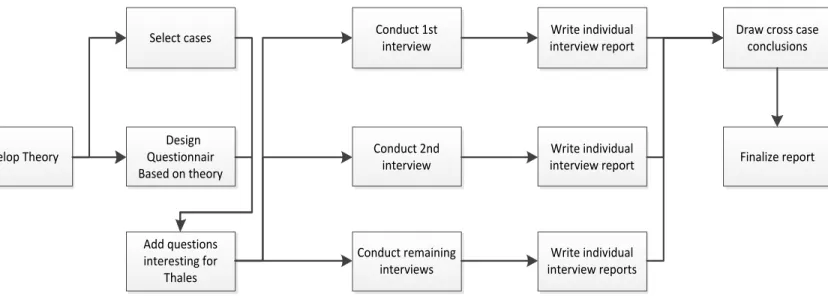
“A research design is the logic that links the data to be collected and the conclusions to be drawn to the initial question of the research” (Yin, 2009 p.40). As mentioned, the research inquiry is a multiple semi structured interview approach to elaborate on criteria and best practices. The advantage of semi structured interviews is that it benefits from the theoretical framework that is elaborated to guide the analysis. So, for this kind of research the theory should provide a strong guidance in determining the data that should be collected in the case studies (Yin, 2009). The first step is to study the theory intensively and make a theoretical or conceptual framework. This framework should be used in making the semi-structured interviews. Next to the theory, because this research is for Thales, specific questions that Thales is interested in are added to the analysis next to the interesting parts from the theory.
15
2.4.
Units of analysis and cases
Babbie (2010) describes the unit of analysis as: ‘the what or whom being studied (Babbie, 2010, p. 98).’ This study will use several interviews to derive information about common settings in shared service entities, where shared service centers and project management offices are the unit of analysis. Those two are chosen because of the specific interest of Thales in those organisational settings. The cases to be interviewed that will be selected to investigate should have the following characteristics: high tech, working with government), same (Dutch) working culture, is a customer of Thales, is also service orientated, project based organisations are preferable and preferably multinationals. The reasons the cases should comply to these criteria is the support the research will gain with the employees and managers in Thales. If results show that the best practices, motivations and criteria are a reason for the managers of Thales to implement a shared service entity they have a study that is done with comparing companies and therefore the support will go up. No other reason for choosing cases accordingly are there.
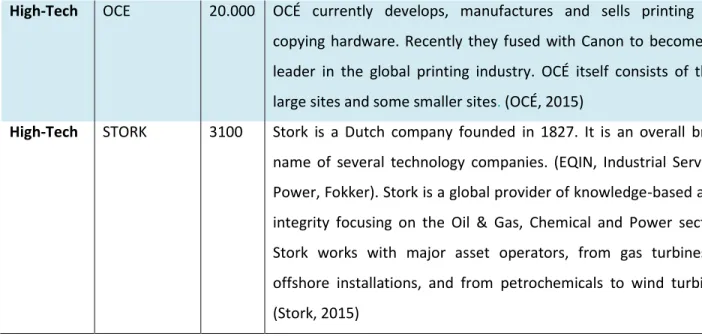
During this research multiple organisations are studied. Cases are selected through purposive (according to aforementioned criteria) sampling (Babbie, 2010). Probability sampling is not included in this research, because not all of the organisations are suitable for this research. This can have two reasons, some companies simply do not have a SSC or PMO and second, Thales was looking for comparable companies (High tech) so the results will be more appealing to the employees. In explorative research you might expect that the research studies a wide variety of cases in different settings. This research is purposely narrowed down to companies that have similarities with Thales, that is, high tech, working with governments, project based, international and focuses next to products also on the services. The cases selected are elaborated in table 2.1
Figure 1: Research design based on the book of Yin (2009, p.57) Develop Theory
Select cases
Design Questionnair Based on theory
Add questions interesting for Thales Conduct 1st interview Conduct 2nd interview Conduct remaining interviews Write individual interview report Write individual interview report Write individual interview reports
Draw cross case conclusions
16
Sector Name FTE Description
High-tech Philips Healthcare
37.000 Philips Healthcare (former Philips Medical Systems) is active in the diagnostic equipment market. The main focus of Philips Healthcare is to deliver the most technological advanced products to diagnose diseases. It is an international company, large amount of employees, delivers to governments and offers lots of services (Philips, 2015). .
High-Tech ASML 13.225 ASML is a Dutch company that was founded in 1984 and is currently the market leader in the photolithography systems for the semiconductor industry, (ASML, 2015)
High- Tech Fokker Technologies
4.950 Fokker Technologies is a global aerospace specialist that develops, designs and manufactures complexly engineered aircraft systems to aircraft manufacturers over the world Fokker has a Dutch culture, is comparable in size (4 Business units) and works with governments. (Fokker, 2015)
High-Tech VDL
Enrichment Technology
7.320 The VDL Group is an international industrial and manufacturing company. VDL produces semi-manufactured goods in the semiconductor industry, busses and other products. (VDL, 2015) High-Tech,
knowledge based.
DHV Royal Haskoning
7.000 DHV is an international engineering and project management consultancy. The company delivers services in the field of aviation, buildings, energy, industry, infrastructure, maritime, mining, transport, urban and rural planning and water. (DHVRoyalHaskoning, 2015)
Governme nt, client
17
2.5.
Data collection
One of the crucial parts of the research is the data collection. In this phase the empirical material / evidence will be collected. Yin (2009) determined several ways to accumulate information. Those ways are: archival records, interviews, direct observation, documentation, physical artefacts and participant observation. (Yin 2009, p.39). The main sources of information for the theoretical part of this research are the archival records and documentation for the theoretical part. Used techniques used for finding data are (Sonderen, 2002):
- Global orientation - Snowbal method - Systematic search
Theory
The book of Saunders et al. (2009) refers to Bell (2005), who identified the following genuine parameters that can be elaborated for this research.
- The language of this research will be English. However the semi-structured interviews will be done in Dutch for more understanding of both parties. Results will be converted into English.
- The subject area are primarily shared services in the organisational forms of the PMO / SSC, platform theory, modularity or any synonym of those terms. Other areas are discussed in the designated paragraphs. The choice for PMO and SSC and not the other delivery modes is because High-Tech OCE 20.000 OCÉ currently develops, manufactures and sells printing and
copying hardware. Recently they fused with Canon to become the leader in the global printing industry. OCÉ itself consists of three large sites and some smaller sites. (OCÉ, 2015)
High-Tech STORK 3100 Stork is a Dutch company founded in 1827. It is an overall brand name of several technology companies. (EQIN, Industrial Services, Power, Fokker). Stork is a global provider of knowledge-based asset integrity focusing on the Oil & Gas, Chemical and Power sectors. Stork works with major asset operators, from gas turbines to offshore installations, and from petrochemicals to wind turbines. (Stork, 2015)
18
of the view of Thales. Thales thinks the PMO entity and SSC entity are the most important for this research. The view of Thales about the entities: “A project management office is an entity that bundles support activities (services) for the projects, but can also be a bundling of support work for different business units, in fact a sort of shared service center for project support.” Thales is interested in these kinds of entities. Therefore the selection for only SSC and PMO is made.
- The business sector will be most of all High-Tech businesses with shared services. The choice for most of all high-tech businesses is to create more support from employees for the plan.
- This study aims to use recent literature. Exceptions will be made to relevant literature of authors that have many citing’s.
- Primary and secondary literature will be used during this research. Most used primary sources will be reports, theses of other students and white papers (Saunders, et al., 2009). Primary literature can best be found through Google, suggestions from supervisor and websites of businesses. The main secondary literature, the more scientific form of literature, that will be used are scientific journals and books (Saunders, et al., 2009). This literature can best be found through Web of science, Google Scholar, Scopus and the library of the University of Twente.
- According to Saunders et al, (2009) most researches use secondary literature. The strategy of this theoretical framework is to first locate secondary literature. If there is not enough depth in a concept, primary literature will be added. Primary literature, like white papers from well-known global firms (for example Pricewaterhousecoopers and Deloitte) will be used.
Keywords
Key words are the basic terms that describe your research question and objectives (Saunders, et al., 2009). This paragraph will identify some keywords. However, these keywords might not all be discussed in the literature review. This can be because of interrelations between the concepts or keywords. Also synonyms of words exist and those will be searched for too. Main keyword(s) is: shared services. Searching will primarily done in combination with one of the following terms: platform theory, service modularity, best practices, delivery modes, differentiation in needs, strength of coupling, benchmarks, high-tech, pitfalls, conditions, shared service centers and project management offices.
Semi-structured interviews
19
held with PMO directors, SSC directors, HRM directors and financial directors. To use their time as effectively as possible the questions will be made before the visit to the company. The benefit of semi structured interviews is that it will fulfil the need in case studies. The researcher gets the opportunity to get answers to the research and sub questions, but also the possibility to explore to new and interesting subjects that comes along during the interview. With a structured interview all questions are made before the interview, so it gives no opportunity to investigate special subjects that will arise. Open interviews on the other hand are too broad and the research could stray off subject to much (Yin, 2009; Saunders, et al., 2009). Based on this information the choice for semi-structured interviews is made. To capture as much information as possible, the interviews will be recorded by the research. Afterwards all the relevant information can be reheard, captured and transcribed as a written (word processed) account using the actual words (Saunders, et al., 2009). This gives more time to the researcher to collect as much information as possible and sometimes the way respondents are giving their answers may be useful, that will be captured as well. To save time, only the parts that are pertinent to the research are transcribed (Saunders, et al., 2009). Writing down information during the interview costs time, could be distracting and if the written information will be read afterwards, crucial information might be lost (Saunders, et al., 2009; Yin, 2009). To validate the given information, the collected data will be sent back to the interviewee for feedback and validation. The questionnaire is listed in appendix II.
2.6.
Data Analysis
The final part that will be included in the methodology is the data analysis. Data analysis is the final task of the research and probably one of the difficult ones. It consists of tabulating, categorising, testing, examining or on some way combining or recombining the gathered data. This should be done in such a way that conclusions can be drawn from the results. (Yin, 2009; Saunders, et al., 2009)
20
added because of new theory emerging from the processed data. Finally, after discussing every case on their own, a general table will be made with the specifics of all the cases.
The main processes of data structuring in this research will be summarising (condensation) and categorisation (grouping). Because of the research question and sub questions the summarising and categorising will be the most useful. The data is collected to a beforehand prepared structure and can be divided in several categories. The technique, structuring (ordering) is not necessary in this research, because there is no narrative or sequences way of explaining these organisational entities.
Finally, a cross case analysis is conducted on the gathered data. A common problem with case analysis is that people are notoriously poor processors of information. Conclusions are easily misguided. Common problems are:
- Conclusions are often based on just limited data. (Kahneman & Tversky, 1973) - Overly influenced by vividness (Nisbett & Ross, 1980)
- Only responses from elite respondents (Miles & Huberman , 1984) - Researchers drop disconfirming evidence (Nisbett & Ross, 1980)
Because of there reason a sound cross case analysis is needed. The idea behind a cross case analysis is to go beyond the initial impressions by using diverse lenses on the data. During this research the cross case analysis will investigate the similarities, differences and complementarities between cases and between Project Management Office and Shared Service Center. The tactic of cross case analysis will improve the likelihood of a reliable and accurate theory and therefore conclusions. (Eisenhardt, 1989)
21
3.
Theoretical Framework
This chapter gives background information on relevant topics that will be used in this research. The purpose of this chapter is to reflect the current literature available on this research topic. Several concepts will be elaborated and a theoretical framework will be formed.
3.1. Methodology theoretical framework
In this chapter the literature will be reviewed. According to Saunders (2009) the theoretical framework is normally written for two major reasons. The first, preliminary research helps to generate and refine the research ideas. These ideas can be used in order to investigate during the best practise study at several companies. Second, the critical review is part of a research project. A good literature review demonstrates awareness of the current state of knowledge in the field of research, its limitations and it’s wider context (Saunders, et al., 2009). This information will be useful to Thales, because it will update their awareness of the best practices, criteria, methods in shared services. The literature search is usually an early activity, but this search will continue during the project’s life. The process of gathering information can be seen as a upward spiral, from research question to final version of the framework. The following design aspects are elaborated during the theoretical framework: define parameters, keywords, conduct research, obtain literature, evaluate and record. (Saunders, et al., 2009) This framework uses the design aspects from Saunders et al (2009). First of all with the parameters, keywords and the further design of the framework. The conducted research, obtained literature, evaluation and recording is integrated in the designated paragraphs.
3.1.1. Design of theoretical framework
22
3.2.
Defining the concept of Shared Service Centers
- A definition of a shared service center
- The role and responsibility of a shared service center 3.2.1. A definition of a shared service center
There is a difference between shared services and shared service centers. The difference is that shared services can consist of many forms or theories. These forms are described in table 3.1. Shared service centers are a part of the general term shared services. During this research focus mostly will go out to the facets shared service center and project management offices (3.3.). These delivery modes of services are best fit to the research question of this paper (see also parameters in paragraph 2.5).
The best definition of a shared service center is written by the article of Schultz et al. (2009). This article focused on 185 papers, then excluded papers with non relevant content and remained with 9 clear results. Thereafter the article added relevant books with the most citations which leaves a total of 13 relevant sources. The aspects that are given in more then 50% of the sources where included in his definition. The overall definition: “A SSC is an organisational concept with the following attributes: (1) consolidation of processes within the group in order to reduce redundancies. (2) Delivers support processes as its core competency. (3) Is a separate organisational unit within the group. (4) Is aligned with external customers. (5) Cost cutting is a major driver for implementation. (6) Has a clear focus on internal customers. (7) Is operated like a business.” (Schultz, et al., 2009, p.6) These factors are important to delineate SSCs from other delivery forms like outsourcing (Schulz, et al., 2009).
3.2.2. The role and responsibility of a shared service center
23 Legal form
SSC comes in different forms. Most of these forms are added in table 3.2. Main difference is that a SSC can be legally independent (outsourcing or joint ventures) or they can be incorporated independent of their parent firm. In that case they are more of an intra-organisational form.
Form of co-ordination
There are two methods of coordinating service transaction between supply (SSC) and demand (BU). That is (1) through markets and (2) through hierarchies in which high-level management decisions regulate service transactions (Schulz, et al., 2009). In practice, there are a multitude of forms in between.
Servicecharges
There are different forms of charging for the services. (1) through budgets, (2) allocation, services are allocated through amount of use or other variables, (3) transfer pricing, costs per service plus profit. However with transfer pricing, provides no incentives to lower the costs of a SSC. Practically seen these SSCs are just as expensive as market driven SSCs.
External market
If a SSC has access to external markets, it may also serve third parties for profit. (Schulz, et al., 2009) Access can apply to particular services only or to an entire portfolio of a company. This may add to additional sales and has the opportunity to become more efficient in using employees. Other way, limiting or no access to external markets will increase focus on their own business units.
Contract forms
According to Schultz et al, (2009) there are three varieties of contract forms. (1) Intra-organisational ‘buyers’ may only obtain services from the internal SSC. (2) Contractual exchange, the internal SSC makes a ‘’first offer’’, if not acceptable the buyer may consider external sources. (3) Competition, ‘buyers’ can make its own offer based on knowledge of externals. With competition the ‘buyer’ decides if the internal provider wins the contract. (Schulz, et al., 2009)
Center concepts
24 Table 3.1: Criteria and characteristics of SSCs (Schultz et al, 2009, p.7)
satisfaction and adherence to agreed service levels. (3) Investment center, this form has a more strategic focus. This by creating pro-actively capabilities for new improved services. (4) profit centers, the SSC seeks to obtain knowledge from external markets and gain credibility for its internal clients and attain additional revenue.
Product portfolio
A SSC can cover a variety of processes (multi-functional SSC), or a single process (functional SSC).
The most common activities that are shared in a shared service center are: Finance, Human Resource Management, IT, Sales order processing, Customer Service and Technical Support. (Pwc, 2008; Schulz, et al., 2009; Strikwerda, 2010)
The white paper of the institute of management accountants (Anderson, 2000) gave more insights in the activities mostly shared in a shared service center. (Figure 3)
Criterion Typical Features of the shared service center
Legal form Intra company business unit Independent subsidiary Main Form of
Co-ordination
Mainly hierarchical Mixed co-ordination Primarily market orientated
Service Charges Overhead Allocation Transfer prices Market prices
External Market No access Limited access Free access
Contractual Form Contractual obligation Contractual exchange Competition Centre Concept Cost center Service center Investment center Profit center
Product Portfolio Functional SSC Multi Functional SSC
25
3.3.
Defining the concept of Project Management Office
This paragraph describes the project management office (PMO). The PMO entity is also a shared service. A project management office is also described as a center of excellence, center of expertise or competence center (Dai & Wells, 2004; Ward, 2000). The link between shared services and project management office (centers of excellence) is made by Ulrich (1995, p.16.) by stating: “shared services is both service center (SSC) and Centers of Excellence (PMO).” Which are both described in this research. Centers of Excellence often have multiple clients (business units) using their services (Ulrich, et al., 2008).This paragraph discusses the PMO in the following ways:
- A definition of project management offices.
- Project management offices discussed in secondary literature. - The role and responsibilities of a project management office 3.3.1. A definition of a project management office
26
3.3.2. The project management office discussed in secondary literature
Project management offices operate as specialized consulting firms inside a company (Ulrich, et al., 2008). Employees that first would have worked in just one business unit will be assigned to do activities to more business units in the PMO. The implementation of a PMO is often based on the call to improve project management effectiveness. Several studies notions that there is value in utilizing PMOs (Toney & Powers, 1997; Block & Frame, 1998). Ad hoc approach to project management can foster inefficiencies, while PMOs can lead to more continuity (Block & Frame, 1998). PMOs are organisational units that doing next to its own work, as a secondary objective, are trying to improve its knowledge and experience. The organisational unit have parts of several business units (sharing).
According to a recent survey based research by Hobbs & Audry (2007) on the organisational context and synchronic description has shown a wide variety in form and function of project management offices. Attempts to reduce this wide variety of models have failed. Further, research shows that in the majority of cases the PMOs have unstable structures and are continuingly reconfigured (Hobbs, et al., 2008). This continuingly reconfiguration can be seen as an on-going organisational process and as experimentation for organisations to search for an adequate structural arrangement. (Hobbs, et al., 2008) Half of the respondents in the survey based research by Hobbs & Audry (2007) states that they currently are not satisfied with the current organisational structure. Hobbs, et al. (2008) describes the motivations for implementing a PMO as a result of organisational tensions. The organisational tensions are: economic, political, customer relationship, standardization versus flexibility and controlling the project machine. If there is friction in one of these areas, a need for a PMO might arise. (Hobbs, et al., 2008)
The article of Dai & Wells (2004) adds to the benefits by elaborating on the possibilities to increase the effectiveness of the organisation by implementing a PMO. This can be done by: unburden project managers from administrative activities to increase their (more costly) effective time. Development of standards and methods to leverage best practices in order to ‘speak the same language’ through all departments. The main drivers to implement a PMO are described by Stanleigh (2006), he asked 750 organisations why they implemented a PMO, the primary drivers according to his research are:
- More successful projects (82%)
- Predictable, reusable PM tools, techniques and processes (74%) - Organisational improvements (66%)
27 3.3.3. Project management office role and responsibility
As stated before, a PMO can have a very diverse arsenal of activities (Aubry, et al., 2007).Singh et al, (2009) describes the roles as an improvement of project work within the organisation. A PMO uses established project knowledge management tools to prepare project planning. A PMO can provide operational support to different projects or business units (sharing) in the organisation. Dai & Wells (2004) describes six roles a PMO can fulfil.
- Developing and maintaining PM standards and methods - Developing and maintaining project historical archives - Providing project administrative support
- Providing human resource/staffing assistance - Providing PM consulting and mentoring
- Providing or arranging PM training (Dai & Wells, 2004)
Despite the main roles of a PMO it is absolutely not necessary true that all of the aforementioned roles are suitable for any organisation. This statement is backed up by the research of Aubry et al., (2007) by finding that all PMO differ a lot. Especially the providing administrative support and providing resource and staffing assistance gives away the shared service thought. The article of Dai & Wells (2004) states that these activities are non-core business and are shared in a lot of cases. In this study the working of those activities will be studied in three PMO’s (Fokker, Philips Healthcare and ASML)
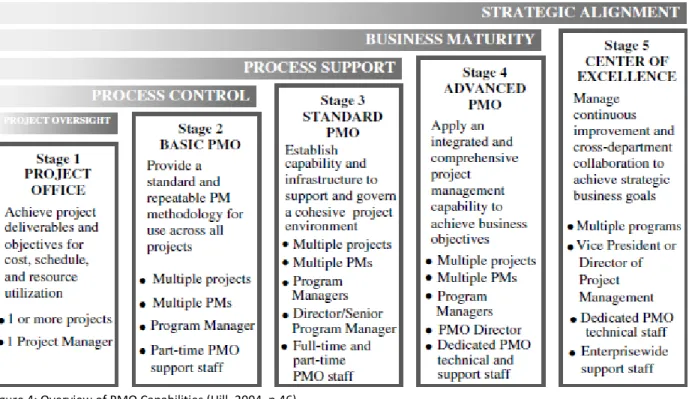
A much sited article of Hill (2004) describes several stages of PMO maturity. The PMO can be identified in a certain role. The five stages established by Hill (2004) are (Figure 4):
28
With this model this research can make comparisons between the PMOs that are investigated. If comparisons can be made, conclusions can be easier formed. Second, there was an extensive study of Pwc (2006) that localized organisational location, role and responsibilities on a different level as Hill (2004). The survey of Pwc (2006) was conducted with participation of 213 respondents and the participants were mostly senior managers and project managers. The results of the study according to the project management offices are given in figure 5.
29
Results from white papers show that the PMOs mostly are located at corporate level, the role is most of all just a single PMO (43%) and in fewer cases a portfolio management office (more than one process) and are performing mostly back-office activities (46%). The theory does not have any consensus about what particular activities fit in a PMO, in order to contribute to the literature questions will be asked about what activities are shared through the departments.
Engelberts (2009) gives some more insights in the practical activities that a PMO can do. According to Engelberts (2009) the following working areas can be covered by a PMO.
- Project planning - Project finance - Reporting - Change Control - Benefit management - Risk- and Issue management
- Communication and stakeholder management - Resource management
- Quality
- Knowledge management
- Document and configurations management.
30
3.4.
Differences between Shared Service Centers and Project Management Offices.
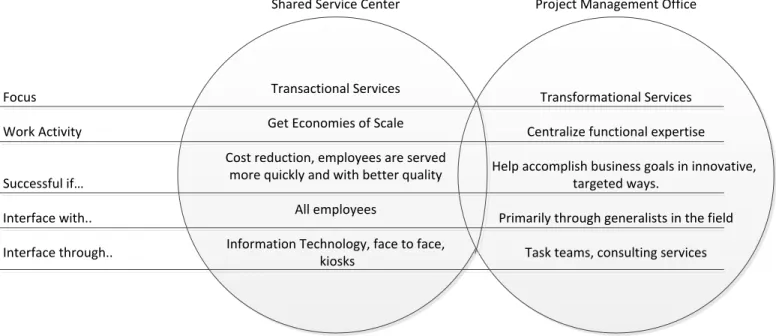
The choice for PMO and SSC and not the other delivery modes is because of the view of Thales. Thales thinks the PMO entity and SSC entity are the most important for this shared services research. The view of Thales about the entities: “A project management office is an entity that bundles support activities (services) for the projects, but can also be a bundling of support work for different business units, in fact a sort of shared service center for project support.” Thales is interested in these kinds of entities. Therefore the selection for only SSC and PMO is made. There are also differences between SSCs and PMOs. Ulrich (1995) states that project management offices centralise functional expertise so it can be allocated to businesses, have practices that transform the company (transformational services) and is considered successful if the practices help accomplish business goals in innovative and targeted ways. Shared service centers are often based on making transactional services more efficient and try to form economies of scale and reduce cost (Ulrich, 1995; Meijerink, 2015). Figure 6. Shows the differences between SSCs and PMOs.
Transactional Services
Get Economies of Scale
Cost reduction, employees are served more quickly and with better quality
All employees
Information Technology, face to face, kiosks
Transformational Services
Centralize functional expertise
Help accomplish business goals in innovative, targeted ways.
Primarily through generalists in the field
Task teams, consulting services Focus
Work Activity
Successful if…
Interface with..
Interface through..
Shared Service Center Project Management Office
31
3.5.
Defining the concept of Shared services
This paragraph is aimed to elaborate on the main topic of shared service. Services can be delivered in several modes, inter organisational, intra organisational and decentralised. This paragraph elaborates on the concepts of shared services and their benefits and downsides. This is done by elaborating:
- Shared services, a definition
- The different modes/forms of shared services
- The motivations and benefits of the shared delivery mode - Disadvantages and pitfalls of shared delivery mode
- What makes a shared delivery mode successful?
3.5.1. The definition of Shared services
Literature provides clear insights in the term shared services. One of the most cited articles about the general term of shared services is the article of Ulrich (1995) and the book of Bergeron (2002). Ulrich describes shared services as: “the combining or consolidating of services within a corporation” (Ulrich, 1995, p.14). The definition of Bergeron is: “Shared services is a collaborative strategy in which a subset of existing business functions are concentrated into a new, semi-autonomous business unit that has a management structure designed to promote efficiency, value generation, cost savings, and improved service for the internal customers of the parent corporation, like a business competing in the open market.” (Bergeron, 2002, p.3.)
3.5.2. The different modes/forms of shared services
32
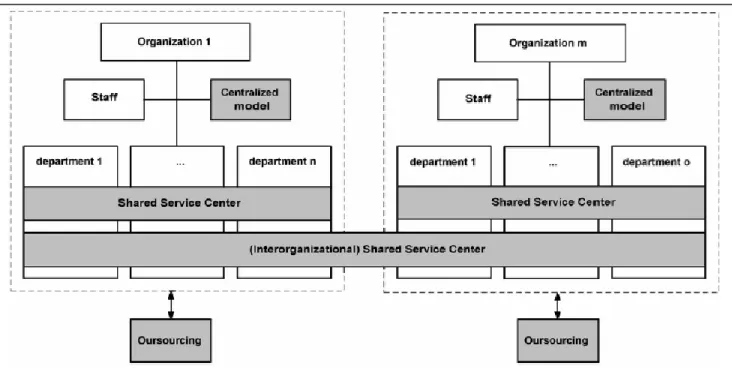
shared and reused between business units (shared delivery mode), and delivery channels that delivers solely to specific business units (non-shared delivery mode). Hofman & Meijerink (2015) organised delivery channels under the shared delivery mode and non-shared delivery mode. This model was extended by Rosink (2014), he divided shared delivery mode into inter-organisational (shared between different organisations) and intra-organisational (shared only within the holding) modes. Table 3.2. is based on the table by Rosink (2014) and further elaborated.
Figure 2: The place in the organisation of a SSC (Janssen & Joha, 2006, p.2.)
33
Table 3.2. (Rosink, 2014) shows ten organisational designs (delivery modes), and this literature review adds two factors: (1) Joint ventures: separate entities with two or more active firms as partners (Harrigan, 1986). (2) Outsourcing: Ulrich (1995) defines it as delegating activities to an external organisation. (3) Buyer-Supplier relationships: the transfer of activities from one partner to another, whereby coordination is ensured by the appropriate fit between the two partners’ contact points (Dekker, 2004; Rosink, 2014). (4/5) Shared Service Centers: Shared service centers can be intra-organisational and inter-intra-organisational, SSCs bundle activities into a semi autonomous business unit (Janssen & Joha, 2006; Deloitte, 2013; Ulrich, 1995). (6) Project Management Offices/Center of Excellence: combining distributed talent throughout a corporation into a shared service, then businesses use these resources to solve problems (Ulrich, 1995; Dai & Wells, 2004). (7) Corporate departments: Ulrich et al. (2008) describes it as embedding a single (like HR or finance) into a single department within the company. (8) Business partners: According to Ulrich (1995;2008), generalists that work with both line managers and leaders of several business units to align the practices with the business objectives. (9) The regional cluster approach, this model is based on a region-by-region basis. One SSC, for example might provide for the US, while another delivers for the UK (Pwc, 2008). (10) Embedded in business units: Activities that operate for a single business unit (activities are only for the business unit in which it is embedded) (Hofman & Meijerink, 2015)
Quote: Shared-services is a form of “internal outsourcing” that allows enterprises to achieve considerable cost benefits by utilizing a single group within the organisation to create and manage specific services.
Keith Swanson, CEO Fujitsu Shared delivery mode
(inter-organisational)
Shared delivery mode (intra organisational)
Non-shared delivery mode (decentralised)
(1) Joint ventures (5) Shared Service Center (10) Embedded in business units (2) Outsourcing (6) Project Management Office /
Center of Excellence (3) Integrative buyer-supplier
arrangements
(7) Corporate department
(4) Shared Service Center (8) Business partners
(9) The regional cluster approach
34
Above mentioned are the organisational desired designs and the different modes of service delivery modes. The in figure 7 given situation is the desired situation at Thales. The theory gives lots of designs. It will be interesting to see how companies organised their shared service entities (delivery mode). 3.5.3. The choice of delivery mode
The choice of delivery mode (shared or non-shared) can be based on several criteria. Common criteria are the differentiation in needs, degree of coupling, modularity and the types of services. These criteria can indicate if a service can be shared (the effect of sharing will indicate a total higher service value) or not be shared (the effect of sharing will result in a lower total service value). To go short, low differentiation in needs, low degree of coupling and transactional services are indicated to be good indicators to share services (indicates shared delivery mode). High differentiation in needs, high degree of coupling and transformational services are indicated to be less fit to share (indicates a non-shared deliver mode). These criteria are elaborated in section 3.6. and concluded in figure 17 (3.6.6.).
3.5.4. The motivations and benefits of the shared delivery mode
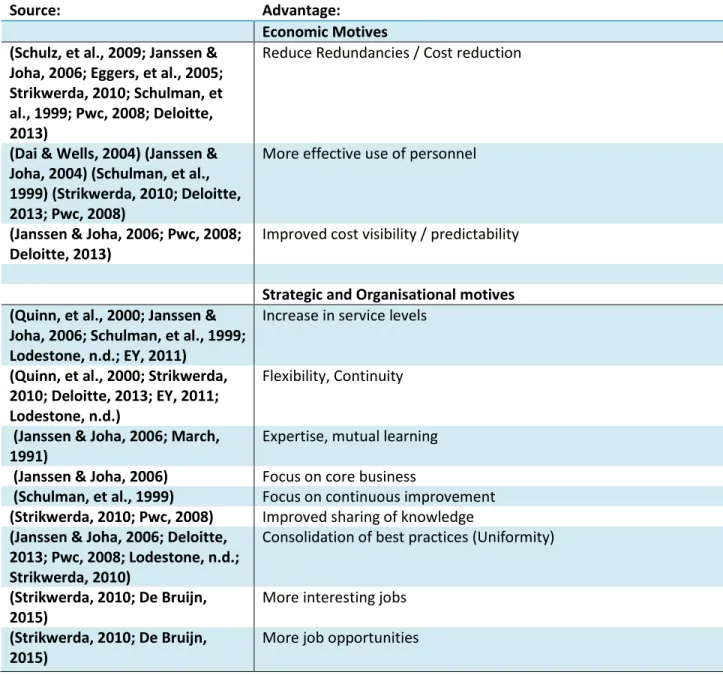
There are some compelling studies that describes the motivations and accomplished benefits. First of all the paper of Rosink (2014) gave an overview for the advantages of the shared delivery mode (which includes SSCs) in his critical literature review. He divided the benefits in terms of service costs and service quality, which was derived from the ideas of Robertson & Ulrich (1998). These authors described the benefits in terms of reduced costs and improved quality. These terms could indicate the service value. Zeithaml (1988, p.15) describes service value as the overall assessment of a service based on what is given (amount paid by the user to the seller) and what is received (quality of a service perceived by users). In other words, service value can be defined in monetary (fees and prices paid for services) and non-monetary costs (time & effort) (Hofman & Meijerink, 2015).
35
Source: Advantage:
Economic Motives (Schulz, et al., 2009; Janssen &
Joha, 2006; Eggers, et al., 2005; Strikwerda, 2010; Schulman, et al., 1999; Pwc, 2008; Deloitte, 2013)
Reduce Redundancies / Cost reduction
(Dai & Wells, 2004) (Janssen & Joha, 2004) (Schulman, et al., 1999) (Strikwerda, 2010; Deloitte, 2013; Pwc, 2008)
More effective use of personnel
(Janssen & Joha, 2006; Pwc, 2008; Deloitte, 2013)
Improved cost visibility / predictability
Strategic and Organisational motives (Quinn, et al., 2000; Janssen &
Joha, 2006; Schulman, et al., 1999; Lodestone, n.d.; EY, 2011)
Increase in service levels
(Quinn, et al., 2000; Strikwerda, 2010; Deloitte, 2013; EY, 2011; Lodestone, n.d.)
Flexibility, Continuity
(Janssen & Joha, 2006; March, 1991)
Expertise, mutual learning (Janssen & Joha, 2006) Focus on core business
(Schulman, et al., 1999) Focus on continuous improvement (Strikwerda, 2010; Pwc, 2008) Improved sharing of knowledge (Janssen & Joha, 2006; Deloitte,
2013; Pwc, 2008; Lodestone, n.d.; Strikwerda, 2010)
Consolidation of best practices (Uniformity)
(Strikwerda, 2010; De Bruijn, 2015)
More interesting jobs (Strikwerda, 2010; De Bruijn,
2015)
More job opportunities
36
costs” and the technical motive “higher service levels”, many studies suggest that lower costs and higher service levels can be achieved, but this study could not find that.
3.5.5. Disadvantages and pitfalls in the shared delivery mode
Next to the advantages, the disadvantages are very important. A few articles elaborated on the disadvantages of shared services. Many authors describe benefits of shared service (centers), less authors describes the pitfalls, disadvantages of the shared delivery z. This paragraph shows the disadvantages and pitfalls mentioned in several articles which were found by searching on shared services, shared service centers and project management offices in combination with disadvantages, pitfalls, downsides and negative effects. Because of the lack of articles discussing this particular subject, a white paper, which discusses this subject, is added. Several disadvantages and pitfalls are shared across most articles. The most mentioned disadvantages are consolidated in table 3.4.
Need to create performance indicators: To determine if your shared services are working, it is necessary to establish performance indicators in terms of customer service, efficiencies and costs. This should be done in terms of what is currently done and what the goal is. Politically unpopular, the loss of co-workers through downsizing, new working habits and different structures will have effect on the culture. This might lead to a drop of efficiency. Loss of control, managers of the business units have to give up parts of their control, which is negatively experienced by the employees. Higher costs, because there can be an increase in the communication overhead (Bergeron, 2003), shared service centers might create bureaucracy (Eggers, et al., 2005), functions might be graded higher (higher pay) or new functions are created (shadow staff (Ulrich, 1995)). During this research the disadvantages and pitfalls of implementing and using SSCs will be questioned during the semi-structured interviews. These findings will contribute to the research field by further elaborating and investigating the downsides of a SSC, which currently is not significantly discussed.
Source: Disadvantage:
(Bergeron, 2003) Culture shock / politically unpopular (Bergeron, 2003; Farndale, et al.,
2009; Pwc, 2008)
Unavailability of in-house expertise to run a shared service (Bergeron, 2003; Korsten, et al.,
2004; Eggers, et al., 2005; Ulrich, 1993)
Loss of control over activities
(Bergeron, 2003) Legal implications (Bergeron, 2003; Korsten, et al.,
2004; Farndale, et al., 2009)
37
3.5.6. Consolidating the advantages and disadvantages of shared delivery mode
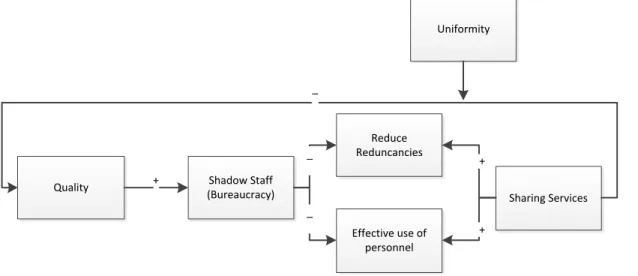
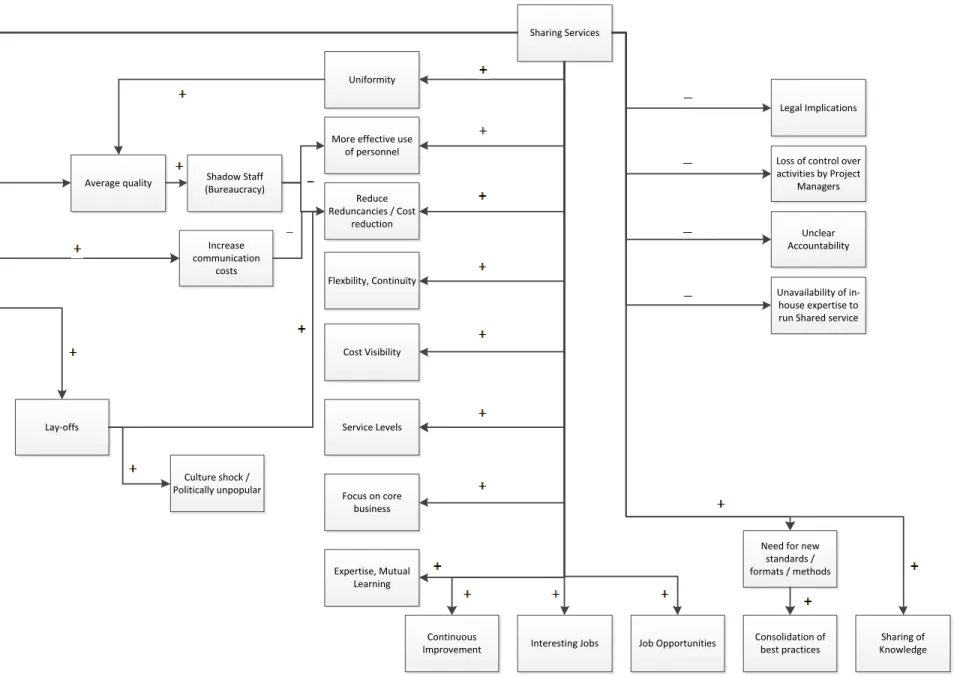
Figure 9b. gives an overview of all the advantages and downsides of sharing services according to the literature that is mentioned in tables 3.3 and 3.4. During this research the benefits and downsides of shared services will be investigated by several companies to find criteria what cause these benefits and / or downsides. Second, Thales is very interested in the effects of losing in depth knowledge or quality and is afraid that this will generate shadow staff. During this research that phenomenon will be addressed. Ulrich (1995) and Korsten et al., (2004) describes the shadow staff. The hypothesis of Thales is when the shared service entity delivers average quality to their clients. By logical thinking an increase in uniformity could mean that procedures and standards are more generalised and therefore be less applicable to specific business units, and therefore become ‘to average’. In such cases, the client (business unit) will re-hire the staff which went to the shared service entity. They will do that because the quality that the shared service entity delivers is not sufficient for the client and then they will rehire staff. That staff is called shadow staff (Ulrich, 1995). Shadow staff has a negative influence on costs (increase in personnel). This has a negative effect on the purposed reduction of redundancies and the effective use of personnel, while the sharing of services should have a positive influence on reduction of redundancies and effective use of personnel. (Ulrich, 1995) This might jeopardize the intended efficiency gain of Thales. (figure 9a.) Farndale, et al., 2009)
(Korsten, et al., 2004; Eggers, et al., 2005)
Inevitable consequences for personnel (lay-offs) (Korsten, et al., 2004; Ulrich,
1995; Eggers, et al., 2005)
Higher costs than before through bureaucracy, shadow staff (Farndale, et al., 2009) Inadequate average quality
(Ulrich, 1995) Accountability, who is responsible for the performance of the shared service entity?
Table 3.4.: Disadvantages of Shared Service Centers
Sharing Services Shadow Staff
(Bureaucracy) Quality
Effective use of personnel
Reduce Reduncancies _
+
_
_
+
+ Uniformity
38
Sharing Services
More effective use of personnel
Cost Visibility
Service Levels Flexbility, Continuïty
Expertise, Mutual Learning Focus on core
business
Continuous Improvement
Consolidation of best practices
Interesting Jobs Job Opportunities Sharing of Knowledge Reduce
Reduncancies / Cost reduction
Legal Implications
Need for new standards / formats / methods Increase
communication costs
Unavailability of in-house expertise to run Shared service Loss of control over activities by Project
Managers
Lay-offs
Culture shock / Politically unpopular
Shadow Staff (Bureaucracy) Average quality
Unclear Accountability Uniformity
39 3.5.7. What makes a shared delivery mode successful?
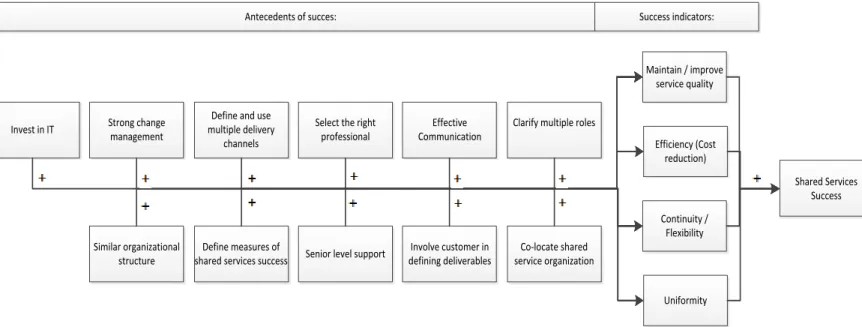
Interesting to see is that there are a very limited amount of (recent) scientific articles about best practices or key success factors in shared service centers. The article of Gould and Magdieli (2007) stated that more than 30% of U.S. Fortune 500 companies have implemented a shared service framework and are reporting cost savings up to 45%. To achieve the aforementioned benefits, key success factors are necessary, because a poorly designed shared service may result in lower quality and even higher costs (decrease in service value) Hofman et al. (2011). Because of the lack of recent articles to address this topic, the key success factors, an older article (Ulrich, 1995) and a research to key success factors of shared service centers in non-profit organisations are used (Burns & Yeaton, 2008). Success factors from white papers written by well known global firms are added because of the lack of information. As stated in paragraph 2.1. the operationalization of success in a shared service entity is cost efficiency, continuity, uniformity and service quality. It is hard to determine which antecedent contributes to what success factor. With logical sense the researcher tried to link the antecedents with the success indicators.
1) Involve customer in defining deliverables, when a shared service will be established, clearly involve the customer while defining the deliverables it becomes clear who the customer is, and what they want and most important, how you can the shared service deliver them value. (Ulrich, 1995; Pwc, 2008)
2) Select the right business professional / Strong project management skills. One of the most challenging jobs in a shared service entity is the business professional. This member should have competence in business issues. Capabilities this professional must have are: exceptional knowledge about brokering knowledge between the shared service and the business. The professional needs credibility with the business team so that their ideas will be valued. (Ulrich, 1995; Burns & Yeaton, 2008)
3) Define and use multiple channels of delivery. Channels of delivery in this section is operationalized in how the shared service gets his work done. Unlearn the traditional channels of delivery as fast as possible. Second, define the multiple channels of delivery, in a shared service organisation, multiple channels of delivery must be used to maintain a high level of excellence and quality for the business (Ulrich, 1995). Examples of channels of delivery are:
40 - Through outsourcing
4) Share information from customer to shared service and shared service to customer / effective communication. Multiple research participants of the study of Burns & Yeaton (2008) commented that it was extremely important to “communicate, communicate and communicate.” Poor communication creates negative conflict, causes needless rework (shadow staff). Sharing of information across the entire organisation builds a shared mindset. A shared mindset can decrease negative conflict. (Ulrich, 1995; Pwc, 2008)
5) Clarify multiple roles within the shared service organisation. The experience is that participants of shared services wants to find the comfort of the past rather than engage in something new. A success factor is to recognize several roles that will indicate the new course. Clarify that members of shared service organisations are professionals that do not create an enforce policy, but are actively combining and sharing knowledge. (Ulrich, 1995)
6) Co-locate members of the shared service organisation. Experiences from shared service organisations that not leaved their existing (not co-located) location and networked through telecommunications are that the physical proximity to their original business unit constrained their ability to serve the rest of the business units, users of other business units found them unresponsive. Co-locating their services in one entity brought a stronger message that these employees served all the business units. (Ulrich, 1995)
41
8) Define measures of shared services success (SLA’s / KPI’s). Ulrich (1995) suggests that three measures may be useful to define the effectiveness of the shared service entity and embed continuous improvement.. Customer value, costs and cycle time. Where customer value is associated with customer (business unit) satisfaction. This can be done by collecting data from employees and managers about the quality that is offered. Second, costs, the organisational setting can be measured in terms of productivity measures (headcount, budget, costs). Last, cycle time, the cycle time of services should decrease, service centers must find ways to deliver the services as quickly as possible and maintain quality. (Ulrich, 1995; Burns & Yeaton, 2008; Pwc, 2008)
9) Senior – level support. Many respondents in the study of Burns & Yeaton (2008) identified senior level support as a crucial factor in the success of the shared service organisation. The research identified several obstacles that can be dealt with if there is a senior level support employee involved. According to Kerzner (2004) it deals with:
- Employees who do not support the project.
- Employees who think that the project is only a trend or fad. Therefore, make clear that a shared service center is a long-term, strategic decision and not a short term cost cutting tactic. Success depends on long term benefits, make clear to employees that not only cost cutting was a strong incentive, but also their role in support globalization, improved customer service and better decision making are equally important (Pwc, 2008).
- Employees who do not understand that the entire chain or business in total will benefit. - Employees who do not understand the expectations of customers
- Employees who do not agree with the executives decisions. (Kerzhner, 2004; Burns & Yeaton, 2008)