University of Warwick institutional repository: http://go.warwick.ac.uk/wrap
This paper is made available online in accordance with
publisher policies. Please scroll down to view the document
itself. Please refer to the repository record for this item and our
policy information available from the repository home page for
further information.
To see the final version of this paper please visit the publisher’s website.
Access to the published version may require a subscription.
Author(s): D. R. Leadley , V. V. Andrievskii, I. B. Berkutov, Y. F.
Komnik, T. Hackbarth and O. A. Mironov
Article Title: Quantum Interference Effects in p-Si1−xGex Quantum
Wells
Year of publication: 2010
Link to published version:
http://dx.doi.org/ 10.1007/s10909-009-0120-8
(will be inserted by the editor)
D. R. Leadley1, V.V. Andrievskii2,
I.B. Berkutov2, Yu.F. Komnik2, T. Hackbarth3, O.A. Mironov4,5
Quantum Interference Effects in p-Si
1
−
x
Ge
x
Quantum Wells
1.05.2009
Abstract Quantum interference effects, such as weak localization and
electron-electron interaction (EEI), have been investigated in magnetic fields up to 11 T for hole gases in a set of Si1−xGexquantum wells with 0.13<x<0.95. The tem-perature dependence of the hole phase relaxation time has been extracted from the magneto-resistance between 35 mK and 10 K. The spin-orbit effects that can be described within the Rashba model were observed in low magnetic fields. A quadratic negative magneto-resistance was observed in strong magnetic fields, due to the EEI effect. The hole-phonon scattering time was determined from hole over-heating in a strong magnetic field.
Keywords quantum well, spin-orbit interaction, electron-phonon relaxation time PACS 72.20.Ht,72.20.My,73.23.-b
The kinetic properties of charge carriers in modulation-doped Si1−xGex quan-tum wells (QW) have been investigated at low temperatures. Holes in these QWs have extremely high mobility as a result of keeping impurity atoms out of the con-ducting channel; however, quantum interference effects such as weak localization (WL)1and electron-electron1interactions (EEI)2,3are still observed in QWs that are typical of systems with weak disorder. We will use the variation of resistance in a magnetic field to investigate these effects and by using Shubnikov-de Haas oscillations (SdHO) as a carrier “thermometer” estimate the electron-phonon re-laxation time.
1: Department of Physics, University of Warwick, Coventry CV4 7AL, UK
2: B.I. Verkin Institute for Low Temperature Physics and Engineering,61103, Kharkov, Ukraine 3: Daimler AG, Forschungszentrum Ulm , Wilhelm-Runge-Str. 11, 89081 Ulm, Germany 4: Warwick Seminano R&D Centre, Univ. of Warwick Science Park, Coventry CV4 7EZ, UK 5: ILHMF and Low Temperatures, P.O. Box 4714, 50-985 Wroclaw 47, Poland
E-mail: [email protected]
2
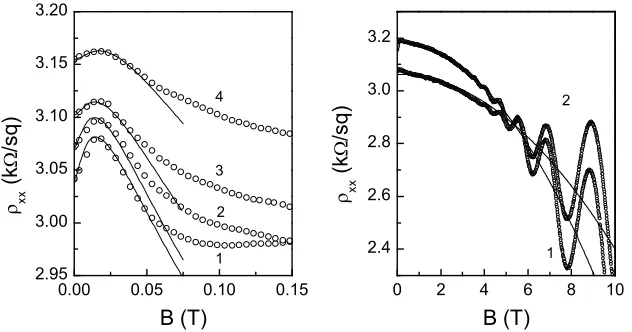
Fig. 1 (Left) Magneto-resistance of Sample I, Si0.87Ge0.13showing WL-related quantum
cor-rection to the conductivity at T=33 mK (1), 0.4 K (2), 0.6 K (3), 0.89 K(4). The solid lines are fits to the WL theory.4
Fig. 2 (Right) Separation of quadratic negative MR for sample III Si0.2Ge0.8(solid curves) at T = 0.34 K (1), T =3.6 K (2)
Sample description Four Si1−yGey/Si1−xGex/Si1−yGeyquantum well samples were grown by molecular beam epitaxy (MBE), with 10 nm biaxial compressively strained QWs and relaxed barriers of(x,y)=I:(0.13, 0), II:(0.36, 0), III:(0.80, 0.30), IV:(0.95, 0.63). In all the samples a∼20 nm thick spacer separated the QW from boron doping at ∼(2−3)×1018cm−3. The diagonal Rxx and off-diagonal Rxy components of the resistance tensor were measured on Hall bars in magnetic fields up to 11 T. The lowest measurement temperatures were 33 mK for Sample I and 335 mK for the others. The hole mobility was∼1×104cm−2V−1s−1at concen-trations of 2×10¹¹ (Si
0.87Ge0.13), 6×10¹¹ (Si0.64Ge0.36), 15×1011 (Si0.2Ge0.8) and 17×1011 cm−2(Si
0.05Ge0.95). These densities appear to scale linearly with the Ge fraction x in the QW, but this is probably a fortuitous result of the doping distribution in each sample since the depth of the QWs scale as x−y. The effective masses obtained from analysis of the temperature and magnetic field dependen-cies of the SdHOs were 0.24, 0.24, 0.16 and 0.156m0respectively. These masses clearly show a decrease as the band structure changes from predominantly Si-like to more Ge-like.
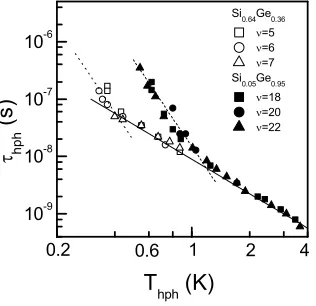
[image:3.612.77.393.47.213.2]Fig. 3 Temperature dependence of hole-phonon relaxation times found from the overheating
effect.νis the quantum number. Solid line is the dependenceτhph−1=0.9×10⁻⁹T2, dotted line isτhph−1=0.6×10⁻⁹T5, dashed line isτ−1
hph=1.5×10⁻⁹T5.
however, p=0.75 for x=0.8 and p=0.5 for x=0.95. Such exponents are absent from current theories of electron scattering and call for an explanation. The coefficient A for Samples (I, II III, IV) is (1.5, 1.0, 0.7, 0.23)×10−11. In addition to this WL, EEI effects contribute to the growth of resistance at lowering temperature and also manifest themselves as a quadratic negative MR in strong magnetic fields (see Fig.2). The equations for the EEI effect3contain a coupling constantλ, which can be extracted from the temperature dependence of the EEI-related quantum correc-tions asλ=0.15 and 0.22 for Samples III and IV respectively. The Fermi-liquid triplet coupling constant F0σ obtained through a comparison with the theory5is F0σ= -0.28, for Sample III, and -0.18 for Sample IV.
Spin-orbit effects The WL theory allows for strong (τso<τϕ), intermediate and weak (τso>τϕ) spin-orbit (SO) interactions. For strong SO, the MR is positive and saturates in the strong field limit, whereas the MR is negative for a weak SO inter-action. Whenτsoandτϕ are close, the MR curve has a maximum as seen in Fig. 1, which is evidence of SO effects that are described by the Rashba model6. The τso-values obtained are associated with spin relaxation via the Dyakonov - Perrel mechanism,7assuming that the spin-relaxation frequency is directly proportion to the relaxation time. The frequency of the SO processes can be determined from the squared spin-precession frequency, which is related to the spin induced band splittingΔ. For example,Δ =0.45 meV for Sample I.
4
common trend ofτeph=0.9×10⁻⁹T−2s is seen, which changes toτhph∝T−5at
T ∼1K for Sample IV and at T≤0.4K for the other samples. These dependen-cies agree with the theoretical predictions for 2D electron systems and describe processes with ‘partial inelasticity’ and small angle scattering.10
In summary, a series of Si1−xGexQWs have been investigated that all contain a 2D hole gas, but have different Ge alloy fractions in the well (13% - 95 %). Al-though some parameters (hole concentration and mobility) exhibit natural random scatter, a distinct trend has been observed toward a decrease in the hole effec-tive mass as the Ge fraction in the QW is increased. Similarly, for an unknown reason, the exponent in the temperature dependence of the phase relaxation rate τ−1
ϕ ∝ATpdecreases in this series from 1 to 0.5. However, the hole overheating investigation yields a single dependence for the hole-phonon relaxation rate of τ−1
hph=0.9×10⁻⁹ T2for all the samples. From analyzing the weak localization contribution to the conductivity the times of phase and SO relaxation have been found, but these appear not to be systematically related to the QW composition: in the Si0.64Ge0.36sampleτsoτϕcorresponding to a weak SO interaction, whereas τsoτϕin the other samples, which generates significant SO effects.
This investigation was made possible by applying strong magnetic fields, which enabled SdHOs to be recorded in the region of small quantum numbers. By this means we could investigate the behavior of the EEI-induced quantum correction in strong fields and find the hole-phonon relaxation time employing carrier over-heating.
References
1. P.W.Anderson, E.Abrahams, T.V.Ramakrishnan, Phys. Rev. Lett. 43, 718 (1979).
2. B.I. Altshuler and A.G. Aronov: Electron - Electron Interaction in Disordered Systems. Modern Problems in Condensed Matter Science. 10, A.L. Efros and M.P. Pollak (eds), Amsterdam, North-Holland, 1 (1985).
3. B.L. Altshuler, A.G. Aronov, M.E. Gershenson, and Yu.V. Sharvin, Sov. Sci. Rev. A9, Schur, Switzerland, Harwood Academic Publisher Gmbh, 223 (1987).
4. B.L. Altshuler, A.G. Aronov, A.I. Larkin, and D.E. Khmel’nitskii, Zh. Eksp. Teor. Fiz. 81, 768 (1981) [Sov. Phys. JETP 54, 411 (1981)].
5. I.V. Gornyi and A.D. Mirlin, Phys. Rev. Letters, 90, 076801 (2003)
6. Yu. A. Bychkov and E. I. Rashba, Pis’ma Zh. Eksp. Teor. Fiz. 46, 66 (1984) [JETP Lett. 39, 78 (1984)].
7. M. I. Dyakonov and V. I. Perrel. Zh. Eksp. Teor. Fiz. 60, 1954 (1971) [JETP
33, 1053 (1971)].
8. S. Hershfield and V. Ambegaokar, Phys. Rev. B 34, 2147 (1986).
9. D.R. Leadley, R.J. Nicholas, J.J. Harris and C.T. Foxon. Solid State Electron-ics 32, 1473 (1989)