University of Warwick institutional repository: http://go.warwick.ac.uk/wrap
This paper is made available online in accordance with
publisher policies. Please scroll down to view the document
itself. Please refer to the repository record for this item and our
policy information available from the repository home page for
further information.
To see the final version of this paper please visit the publisher’s website
.
Access to the published version may require a subscription.
Author(s): Jim Q. Smith, Paul E. Anderson, Silvia Liverani
Article Title: Separation measures and the geometry of Bayes factor
selection for classification
Year of publication: 2008
Link to published article:
Separation Measures and the Geometry of Bayes
Factor Selection for Classification
Jim Q. Smith†
Department of Statistics, University of Warwick, Coventry, UK, CV4 7AL
Paul E. Anderson
Systems Biology Centre and Department of Statistics, University of Warwick, UK
Silvia Liverani
Department of Statistics, University of Warwick, UK
Summary. Conjugacy assumptions are often used in Bayesian selection over a partition
be-cause they allow the otherwise unfeasibly large model space to be searched very quickly. The implications of such models can be analysed algebraically. In this paper we use the explicit forms of the associated Bayes factors to demonstrate that such methods can be unstable un-der common settings of the associated hyperparameters. We then prove that the regions of instability can be removed by setting the hyperparameters in an unconventional way. Under this family of assignments we prove that model selection is determined by an implicit sepa-ration measure: a function of the hyperparameters and the sufficient statistics of clusters in a given partition. We show that this family of separation measures has plausible properties. The proposed methodology is illustrated through the selection of clusters of longitudinal gene expression profiles.
Keywords: Bayes factors, classification, non-conjugate analyses, g-priors, clustering, sep-aration measures.
1. Introduction
When a model space is vast, it is often expedient to select a Bayesian model using conjugate priors; see for example Barry and Hartigan (1992) and Heard et al. (2006). The Bayes factors then have a simple algebraic form so the comparison of two models is then almost instantaneous. This makes search algorithms for models with high posterior probability in this huge partition space orders of magnitude faster than their numerical non-conjugate analogues.
In this paper we demonstrate that the explicit nature of this type of selection algorithm has another advantage. The properties and characteristics of the algorithm can be studied algebraically. In our particular case, its underlying geometry is linked with the well-studied behaviour of products of t-distributions; see for example O’Hagan and Le (1994), Chipman et al. (2001) and references therein. This enables us to explain not only how and why con-jugate Bayesian model selection can break down under default settings of hyperparameters, but also to show that most of these apparent anomalies are removed if the hyperparameters are calibrated to plausible pre-posterior predictions, within a particular subfamily of these conjugate models.
In the next section we briefly review the geometry of the types of products of t-densities which form the marginal likelihoods of this class. In section 3 we demonstrate how this geometry impinges on model selection based over partitions with particular emphasis on the methodology proposed in Heard et al. (2006). We illustrate how and why standard settings of hyperparameters can produce poor selection characteristics in section 4. In section 5 we derive explicit characterisations ensuring that Bayes factor selection prefers partitions that combine clusters when they are close with respect to a certain separation measure. In section 6 we illustrate these new settings in certain idealised contexts. In section 7 we examine properties of this implicit separation measure. This enable us to make a direct link between Bayes Factor selection and more conventional separation based clustering methods; see Chipman and Tibshirani (2006), Gordon (1999) and Hastie et al. (2001). We demonstrate that a partition,C1, is preferred to another,C2, (which is identical toC1except that two particular clusters inC1 are combined into one cluster inC2) if and only if the sufficient statistics of the two clusters inC1are different enough from one another in a certain, very natural, sense.
In a careful study of model selection over large spaces of linear models, Chipman et al. (2001) argue that hyperparameters should be set to make prior assumptions minimally influential. However, when selecting across a space of partition models, we argue that such a strategy is futile and all settings of hyperparameters have a different and strong effect on model selection over this domain. The analysis below allows us to adopt a proper Bayesian approach analogous to Garthwaite and Dickey (1992) which is straightforward in this domain. We demonstrate that it is straightforward to elicit values of hyperparameters within the class of proportional models so that they calibrate to pre-posterior predictions associated with the model space in a given context. It is also possible to demonstrate both analytically and numerically that these settings are robust to moderate misspecification. We begin the paper with some technical background.
2. A Simple Likelihood Ratio
2.1. Conjugate Bayesian estimation of profiles
Consider the Gaussian conjugate Bayesian regression model whereD= (Y1, . . . ,Yn) and Y = vec(D) satisfy
Y =Xβ+ε
whereβ= (β1, β2, . . . , βp)′ ∈Rp andε∼N(0, σ2I) is a vector of independent error terms with σ2 >0. Note thatY
i ∈ Rr fori = 1, . . . , n. The posterior Normal Inverse Gamma joint density of the parameters (β, σ2) denoted byN IG(0, V, a, b), is given by
p(β, σ2|y)∝(σ2)−(a
∗+p/2+1)
exp
−2σ12
(β−m∗)′(V∗)−1(β−m∗) + 2b∗
with
m∗ = (V−1+X′X)−1X′Y V∗ = (V−1+X′X)−1
γ = {Y′Y −(m∗)′(V∗)−1m∗
}
a∗ = a+rn/2 b∗ = b+γ/2
where a, b > 0 and V is a positive definite matrix. Throughout this paper we assume X is a known design matrix and that X′X is full rank. Note that X = 1
its marginal likelihood L(y), see for example page 240 of Denison et al. (2002) and pages 308–12 of O’Hagan and Forster (2004). Thus
L(y) =
1 π
nr/2 ba (b∗)a∗
|V∗
|1/2
|V|1/2 Γ (a∗)
Γ (a)
which can be written as
2 logL(y) = 2l(y) =K(V, a, b, n)−2a∗log(b+γ/2)
where
K(V, a, b, n) = 2 log 1 π
nr/2 ba|V
∗
|1/2
|V|1/2 Γ (a∗)
Γ (a) !
.
Because X′X is full rank the maximum likelihood estimateβb of the mean vector βis uniquely defined. Further,
γ=nσb2+βb′(V + (X′X)−1)−1βb
where bσ2 = (y−Xβ)b ′(y−Xβ)b /n and βb = (X′X)−1X′y are the maximum likelihood estimate ofβandσ2.
Note that, as pointed out by Heard et al. (2006) p. 19, this hierarchical structure has the useful property of modeling the time dependance of the vector of observations in each profileY. For example, the Fourier basis B we later use in a running example allows us to model any individual profile so that its predictive distribution is an arbitrary weakly stationary process (see West et al., 1997).
2.2. Comparing two regression profiles
Define the observation vector Y = (Y(1),Y(2))′, where Y(j) = (Y(j)
1 , . . . ,Y(j)nj)′. The components{y(j)i : 1≤i≤nj, j= 1,2}are profiles of a fixed lengthr≥pwith
Y(j)i =Bβj+ε (j) i
where ε(j)i ∼ N(0, σj2I), β = (β1,β2) and `
i,jε (j)
i |β with `
representing independence between random variables. Thus the profile vectors containing the longitudinal data on each unit,Y(j)i , each follow the same linear model with a design matrixB of rankp. Y
(j)
is a vector of lengthrnj, j= 1,2.
Let modelMsassume that the vectorsY(1),Y(2)are independent with (β1, σ21) `
(β2, σ22), where (βj, σ2j) is assumed to have the prior densityN IG(0, Vj, aj, bj). Then, with the ob-vious extension of the notation given above, its log marginal likelihoodls(y) is given by
2ls(y) = X j=1,2
K(Vj, aj, bj, nj)−2 X
j=1,2
a∗jlog(bj+γs(j)/2)
where
γs(j)=rnjσb2j+βb ′
j(Vj+n−j1(B′B)−1)−1βbj
and
b
βj =n−j1(B
Now, compare the modelMswith a modelMtthat assumes the vectorsY(1),Y(2)share the same parameter values. UnderMt, β1=β2 andσ12=σ22 where (β1, σ21) has the prior densityN IG(0, V , a, b). So the log marginal likelihoodlt(y) of this model satisfies
2lt(y) =K(V , a, b, n1+n2)−2a∗log(b+γt/2)
where
γt=r(n1+n2)σb2+βb ′
(V + (n1+n2)−1(B′B)−1)−1βb
b
σ2 is the standard maximum likelihood estimate of the variance of the combined sample,
b
β= (n1+n2)−1 2 X
j=1 njβbj
and
r(n1+n2)σb2= X
j=1,2
njrbσ2j+ n1n2 n1+n2
(βb1−βb2)′B′B(βb1−βb2)
We note that both models have a marginal likelihood which is a function of their hyperpa-rameters and the four familiar statistics{βbj,bσj2:j= 1,2}.
2.3. Bayesian MAP model selection
One popular method is Bayesian Maximum A Posteriori or MAP model selection (Bernardo and Smith, 1994). This simply chooses the model with the highest posterior probability. If the prior log odds for model Mt against model Ms are κ, then the distinct or separate vector modelMsis preferred to the combined vector modelMtwhen the posterior log odds are greater thanκ. This occurs whenls(y)−lt(y)> κor, equivalently,
Φ = log(u+βb′1C11βb1−2βb ′
1C12βb2+βb ′
2C22βb2)− X
j=1,2
ρjlog(uj+βb ′
jAjβbj)> κ′
where
A = (V + (n1+n2)−1(B′B)−1)−1
C11 = (n1+n2)−2n1((n1+n2)n2B′B+n1A) C22 = (n1+n2)−2n2((n1+n2)n1B′B+n2A) C12 = −(n1+n2)−2n1n2((n1+n2)B′B−A)
Aj = (Vj+nj−1(B′B)−1)−1 u = u1+u2+ 2(b−b1−b2) uj = 2bj+njrσb2j
ρj = a∗j/a∗
Note that the threshold
κ′=
2κ− X j=1,2
K(Vj, aj, bj, nj) +K(V , a, b, n1+n2) + 2(a−a1−a2) log 2
/2a∗
The function Φ can be further simplified by introducing some new notation. We setwj so that
w′jAjwj =wj′(Vj+n−j1(B
′B)−1)−1w j= 1
Further, we define zj = ||Qβbj||, where Q is any matrix satisfying Q′Q = Aj and let λ1=w′1C11w1, λ12=w1′C12w2, λ2=w′2C22w2.
We then preferMs toMt if and only if
Φ = log(u+λ1z21−2λ12z1z2+λ2z22)− X
j=1,2
ρjlog(uj+z2j)> κ′
Note that (z1, z2) are the distances of the two profiles from zero, each scaled by a factor reflecting the deviation from zero we expected a priori under the separating modelMs. The statisticsuj depend on the data only through bσj2. The statistic uis a linear function of u1 and u2 and so is a linear function of the two corresponding sums of squares, and λj corresponds to the distance from zero expected for the profileβbj under Mtrelative to that expected underMs.
2.4. Using g-priors for conjugate clustering
Employing a general form of covariance matrixV demands that the space of prior hyper-parameters is very large. For simplicity, transparency and to ensure invariance to linear transformations of bases, various authors (Chipman et al., 2001; Fernandez et al., 2001; Smith and Kohn, 1996; Zellner, 1986) have advocated the use of g-priors for prior covari-ance matrices.
In the given context, these priors would setV−1=gB′B, V−1
1 =g1B′B, V2−1=g2B′B for specified constants (g, g1, g2) associated with the combined cluster c and the smaller clustersc1 and c2.Here, g is a measure of noise-to-signal, so, in particular, the larger the value of g, the greater the shrinkage of the expected posterior profile towards zero. Let zj = (z1(j), z
(j) 2 , . . . , z
(j)
p )′ withj= 1,2, and
zj =
r n
jgj gj+njB
b βj
z1 and z2 are then the potential combined cluster posterior expected profiles of the two clusters, normalised by their posterior variance. After some algebra it can be shown that the parameters of Φ then simplify to
λ1= (g+n2)(g1+n1) (g+n1+n2)g1
, λ2= (g+n1)(g2+n2) (g+n1+n2)g2
, λ12=λ012cos(θ[z1,z2]),
where
λ012= s
n1n2(g1+n1)(g2+n2) (g+n1+n2)2g1g2
The parameterθ[z1,z2] is the angle between vectors (z1,z2) on a plane through zero con-taining the two rays (0,z1),(0,z2). So, this is a measure of the difference in the scaled shapes of the two profiles.
beliefs about the mean profile of a unit in that cluster.The prior information about each unit conditional on σ2 is implicitly assumed to be based on exactly the same sources as other units in its cluster. We call this thedependence setting. Note that in this case
1< λ1=λ2<1 +
min{n1, n2} g
An alternative protocol is sometimes applicable to, for example, gene expression data, where learning that a cluster of genes is large increases the chance that the cluster profile is close to zero: i.e. the cluster is not involved in regulation. A prior structure consistent with these beliefs — here called the independence model — assumes that the sources of information about the prior density of each single gene in a cluster are independent and of equal strength conditional onσ2. This implies thatg
j= ˘gnj andg= ˘g(n1+n2) so that
λ1= 1 + n2 ˘
g(n1+n2)
, λ2= 1 + n1 ˘
g(n1+n2)
, λ012= 1 ˘ g
r n
1n2 (n1+n2)2
.
3. Using Bayes Factors to Select Between Many Partition Models
3.1. A typical example of conjugate Bayesian model selection
MAP model selection is used routinely in many tree and cluster models. In order to show how the performance characteristics of such selection can be linked to the study of the function Φ, we next review Bayesian model selection as it applies to the clustering algorithm in Heard et al. (2006). There, thousands of longitudinal profiles of genes are collected into a partition C ∈ C whose sets are the clusters c ∈ C. Microarrays measure the level of
expression (a real number) for all of its genes over a sequence of times. In our running example there are 13 time points (Edwards et al., 2006).
The vector of profiles of the logged gene expressions,Yc, within each cluster are assumed to be exchangeable. Y(c)=Bβc+εc,εc∼N(0, σc2IrNc),
`
εc|β,β= vec(β1,β2, . . . ,βN), where Yc is a vector of length rnc, wherer is the length of the profile,nc is the number of gene profiles in clusterc andN the number of sets in the partitionC. Using analogous notation to that in section 2, we have that
Y(c)i =Bβc+ε (c) i
for 1 ≤i ≤ nc, where εi(c) ∼N(0, σ2cIr) and `
i,cε (c)
i |β, c ∈ C. The design matrix B is customised to the context. Thus a spline basis is employed in Heard et al. (2006), a Fourier basis is used in Anderson et al. (2006) and Edwards et al. (2006) and a wavelet basis is used in Ray and Mallick (2006). The profile vectors βc and variancesσ2
c of the different clustersc∈C are all assumed to be mutually independent of each other and to follow the conjugate distributions given in section 2. So, in particular, each cluster has an associated multivariate t-distribution with log marginal likelihoodlc(y). Furthermore, because of the assumed independencies between clusters in a given partition, the log marginal likelihood lC(y) of any partitionC is simply the sum of the marginal likelihoods of its components:
lC(y) =X c∈C
lc(y)
The log marginal likelihood of any partition can therefore be written down explicitly. Under MAP selection an optimal partitionC∗
∈Cwill be any partition such that, for allC∈C,
whereπ(C) is our prior probability that partitionCgenerated the data.
3.2. Exchangeability and cohesions
To preserve certain exchangeability properties for partition models, the following four as-sumptions are commonly made (Barry and Hartigan, 1992; Quintana and Ingelias, 2003).
(a) The prior parameters (Vc, ac, bc) of clusterc∈C depend onc but notC.
(b) The parameters (Vc, ac, bc) are a function of c only throughnc, the number of genes in c.
(c) The probabilities{π(C) :C∈C}satisfy
π(C)∝ Y
c∈C πc
where the proportionality constant is the sum of all these products ofcohesions, πc, overC∈C.
(d) The probabilityπc is allowed to depend onconly through its cardinalitync.
We call prior beliefs for clustering balanced if they are consistent with these four as-sumptions. Note that previous studies (Anderson et al., 2006; Edwards et al., 2006; Heard et al., 2006) make a stronger assumption than (b) that (Vc, ac, bc) are not a function ofnc. The default choice of Heard et al. (2006) is balanced and sets cohesions so that πc =nc!. The appropriate choice of parametric form of a family of balanced priors - which determines the prior distribution of cardinalities of the vector of clusters in a given partition -is clearly highly dependent on the science and purpose underlying the stat-istical analys-is. The default setting mentioned above tends to favour partitions with clusters of similar sizes, whilst Dirichlet prios tend to do reverse. However although this prior obviously influences which partition is optimal, all the instabilities we address in this paper apply whatever the choice of partition prior (see section 6). It is therefore possible to separate modeling issues associated with the three hyperparameters of each cluster from appropriate choices of balanced priors: an important issue but beyond the scope of this paper. Henceforth, when no confusion shall arise we will write (Vcj, acj, bcj, ncj) as (Vj, aj, bj, nj), j= 1,2.
3.3. Model search
When the number of units partitioned is large (for example in Anderson et al. (2006) we clustered over 22,000 genes), the partition space is huge. So, even being able to calculate the scores of single cluster partitions quickly is not enough to ensure that the scores of all the partitions in the vast partition spaceC can be evaluated. In practice it is therefore
often necessary to use an appropriate search algorithm to perform this optimisation task on a sensible subset of such partitions.
One useful feature of usinglC(y) for selection is that the difference between the scores of two partitions identical outside a given setcwill depend only on their relative scores over c. We call partitionsC+ andC− adjacent if the two partitions differ only on a setc
∈C+ wherec=c1∪c2withc1∩c2=∅,c1, c2∈C− so that{c1, c2} partitionc. Then
lC−(y) =lC+(y)−Ω[C−, C+]−logπ(C−) + logπ(C+)
where
andπ(C−), π(C+) are the prior probabilities ofC− andC+ respectively. The comparison of adjacent partitions when using balanced priors is therefore especially straightforward and is utilised in many search algorithms used in this context. For example, the improvement presented byC− (the model assuming the genes incare in two different groupsc
1 andc2) overC+(the model assuming all genes incare exchangeable) is measured by Φ
−κ′(n 1, n2) where
κ′ =2{logπc1(n1) + logπc2(n2)−logπc(n1+n2)}+K(n1) +K(n2)−K(n1+n2) 2a∗
Note that κ′ is a function of the two partitions only via a symmetry of the cardinalities (n1, n2) of the two potentially combined clusters. C− has a higher posterior probability than C+ if and only if Φ
−κ′(n
1, n2)> 0. Thus, any search algorithm that moves only between adjacent partitions, either merging or splitting two clusters depending on whether the function Φ is large enough to instigate a split relative to a splitting penalty κ′ (a function depending on cluster cardinalities within the relevant partitions but not on the data) is especially fast.
The most popular technique that uses adjacent moves to search a partition space is a greedy search algorithm called agglomerative hierarchical clustering (AHC) (Heard et al., 2006); a type of forward selection. This starts with each of the N gene profiles in N separate clusters with fixed values of the hyperparameters. A sequence of new partitions is then obtained by sequentially merging two clusters, thus decreasing the number of clusters by one. The two clusters chosen to be combined are the ones that increase the score (here the marginal likelihood of the partition) by the most (or reduce it by the least). Clusters are combined in this way until the trivial partition is reached, with one cluster containing allN genes. We have now calculated the marginal likelihood for a selection ofN promising partitions containing 1 toN clusters. Finally, we choose the partition in this sequence with the highest score: i.e. with the highest posterior probability over the partitions searched. Examples of other more elaborate search algorithms also using adjacent moves either in conjunction with a deterministic or stochastic search, are given in Anderson et al. (2006) and, in a slightly different context, Chipman et al. (1998, 2002).
For the remainder of the paper we will study the geometry of Φ(bσ2
1,σb22,βb1,bβ2) as a function of the sufficient statistics{βbj,bσj2:j = 1,2}in order to understand the behaviour of MAP model selection methods using AHC. However we note that the problems we identify with the consequent model selection also apply to more sophisticated local search algorithms that allow clusters to be split as well as combined.
4. Bayesian Model Selection over Partitions
4.1. Three weaknesses of uncalibrated Bayesian model selection
show how influential the selection of these hyperparameters is not only on the scale, but also on thenatureof discrepancies that drive the selection. So there is great advantage to choose (whenever possible) prior values for hyperparameters not only so that the features of the selection algorithm match contextual knowledge, but also so that selection characteristics of the method are plausible a priori. As we discuss below, if this is not done, the properties of the induced selection algorithm can be absurd.
Secondly, as emphasised in Denison et al. (2002), the function Φ is not translation invariant. We demonstrate below that the optimal choice of partition is typicallycritically
dependent on where we choose to set the prior mean vector of the profile — here we select zero. Hence unless, as in Edwards et al. (2006), there actually is a natural “preferred point”, we cannot recommend the use of these methods. Henceforth, we will assume, as is often the case in practice, that such a preferred point exists.
Thirdly, the assumption of conjugacy is usually an expedience and there are at least two questionable consequences. First, the tails of the conjugate marginal likelihoods are inverse polynomials. Although this helpfully limits the number of small clusters, it also finds ”optimal” partitions that often contain clusters that include outlying profiles. Second, these conjugate models imply that the prior mean and variance of the cluster profiles are quite highly dependent: for a careful discussion of this see O’Hagan and Forster (2004). One implication is that clusters observed to have an estimated profile very different from zero — our preferred point — will be allocated a high prior variance: a property which, if not recognised and adjusted for, can distort any search algorithm in ways discussed below.
4.2. Selection as a function of the magnitude of the mean profile
From the comments above we might suspect model selection to be disrupted by outliers. Consider the effects of increasing the magnitude of a cluster profile away from zero whilst holding all other statistics fixed. Fix z2, wj, bσ2j and nj for j = 1,2.. Then, provided 0< ρ1<1,
lim
|z1|→∞Φ(z1, z2) =∞
Thus, whatever the values of prior hyperparameters, as we increase the magnitude z1 of the profile of the first clusterc1(providedz1is large enough) our model will prefer to keep clustersc1 andc2separate, as we might hope.
However, iftwo outlying clusters (c1, c2) both have profiles (z1, z2) far from zero, then model selection can start to display strange properties. Ifz2=lzk1,lis fixed and|z1| →+∞, then Φ(z1, z2) diverges to−∞ ifρ1+kρ2 >1 and diverges to +∞ if ρ1+kρ2 <1. For example, Heard et al. (2006) recommend settinga=a1=a2. This implies that
ρ1+ρ2= 4a+n 2a+n >1
wheren=r(n1+n2) is the total number of observations associated with the two groups. In this case, by simultaneously increasing the magnitude of the two cluster profiles by the same amountz1=z2, we will eventually reach a magnitude where two clusters are combined
irrespective of how different the shapes of those clusters are: definitely not what we want to
happen. This occurs because, when combined into one cluster, these two outliers become one outlier and, a priori, one outlier is assumed more probable than two.
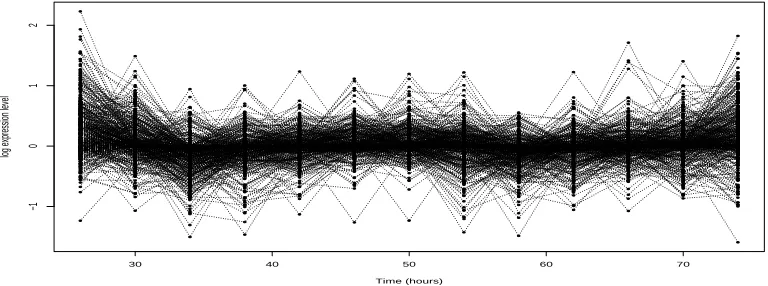
whose statistics are identical! The reason this unfortunate property is relatively rare in practice is that studies such as Heard et al. (2006) happen to suggest the use of a small value ofa. Therefore profiles have to be very different from zero before this phenomenon can be realised. However, this still happens even at the recommended settings of the parameters. In figure 1 we can see that genes with completely different profiles have been attracted into a cluster under an optimal MAP partition found under an AHC search. Note that when this phenomenon occurs early in an AHC search, the combined cluster can largely cancel out and then has the signature of the large variance cluster: something we term a junk cluster in Anderson et al. (2006). When such a cluster is formed under AHC it tends to act as an attractor to yet more disparate and biologically interesting clusters resulting in a cluster like the one depicted in figure 2.
30 40 50 60 70
−0.5
0.0
0.5
Time (hours)
[image:11.612.118.505.216.359.2]log expression level
Fig. 1. A cluster of 81 gene expression profiles from a early stage of the clustering performed in
Edwards et al. (2006) using the default hyperparameter settings. The two highlighted genes are clearly outliers that do not belong in this cluster. This is a result of the AHC and the default settings.
30 40 50 60 70
−1
0
1
2
Time (hours)
log expression level
Fig. 2. A cluster of 453 gene expression profiles from the same partition as figure 1. This so-called
junk cluster is a by-product of AHC and contains a broad variety of profile shapes. Note that in this context log expressions outside[−0.5,0.5]are considered to be potentially of biological interest.
[image:11.612.120.504.432.575.2]→ ∞ as |z1| → ∞. This gives rise to an even more problematic property. Whatever our settings of prior hyperparameters, two profiles sufficiently far from zero will always be put in separate clusters even when βb1 =βb2, bσ12 = bσ22 and n1 =n2, that is, even when these two clusters are identical in all respects! Note that the position of the prior mean (here the zero setting) is central to determining which profiles are outlying in the sense above.
Theonly case when the associated limit stays finite is whenρ1+ρ2= 1. Unless we set the hyperparameters to ensure this, on observing profiles far from zero the implications of the prior are unlikely to be faithful to contextual beliefs. Therefore, the Bayesian clustering algorithm will be prone to perform inappropriately, and combine profiles it was never meant to.
4.3. Models withρ1+ρ2= 1
By setting hyperparameters so thatρ1+ρ2= 1 the characteristics of the resulting merging criterion are much more compelling. The demand that ρ1+ρ2 = 1 is satisfied provided that the hyperparameters (a1, a2) of two clusters in a partition and the hyperparametera of the combined cluster in an adjacent partition satisfy
a1+a2=a
For balanced priors, this implies that we set the corresponding hyperparameterac = ˘anc, wherenc is the number of profiles in crather than requireac to be independent of cluster size as is the case in Heard et al. (2006). Our suggestion would make the prior coefficient of variation of the precision of a cluster proportional ton−c1/2. For example, in the context of gene clustering this would mean that ”genuine” clusters containing large numbers of gene profiles are expected to have smaller associated coefficients of variation in their precision. Thus we are a priori less certain about the value of the variance of big clusters: not an unreasonable assumption in this context. Note that under this settingρj =nj(n1+n2)−1, j= 1,2.
5. Bayes Factors and Measures of Separation
Under balanced priors, each clusterc in a partition has a set of sufficient statisticsx(c) = (n−1
c bβc,bσc2, nc). It is common (Denison et al., 2002) to interpret the function ∆ = Φ−κ′′as a measure of the separation between the combined clustersc1andc2in two adjacent partitions identical except onc1∪c2, whereκ′′= min Φ. We have seen above that this interpretation may well not be appropriate. Wheneverρ1+ρ26= 1, two clustersc1 and c2 with identical sufficient statistics can be arbitrarily more separated — i.e. have an arbitrarily higher value of ∆ — than two clusters that have very different sufficient statistics. In particular under
any search over the partition space, it is quite possible for two clusters with widely differing profiles to be combined in preference to two clusters with identical{βbj,bσ2
j :j= 1,2}. Although this phenomenon is much more dramatic whenρ1+ρ26= 1, the problem can still remain even when hyperparameters are set so as to ensureρ1+ρ2= 1. In this section we investigate to what extent, with appropriate parameter settings, ∆(x(c1),x(c2)) can be interpreted as a measure of separation between the clustersc1 andc2.
then a property that would normally be required of a separation measure is that for any two clustersc1andc2 that have identical characteristics, so thatx(c1) =x(c2), we have
∆(x(c1),x(c2)) = 0
At this point it is convenient to re-parametrise Φ. Let d = (z21 +z21)u−1 represent a normalised squared distance from zero of the two clusters, defineαj =d−1u−1z2j, j= 1,2 to be the corresponding relative squared distance from zero of the two clusters (so that in particular α1, α2 ≥ 0, α1+α2 = 1) and let vj = uju−1, j = 1,2 be approximately the relative sums of squares of the two clusters then
γ=λ1α1−2λ12√α1α2+λ2α2
and
Φ = log(1 +γd)−ρ1log(v1+α1d)−ρ2log(v2+α2d)
Definition 1. Define Φ(x(c1),x(c2)) as homogeneous if, whenever x(c1) = x(c2),
Φ(x(c1),x(c2)) = Φ0 is a function of (n1, n2)alone.
Under the family of separations above, a necessary and sufficient condition for Ψ(x(c1),x(c2)) to satisfy the property above is that Φ(x(c1),x(c2)) is homogeneous.
Theorem 1. IfΦ(x(c1),x(c2))is homogeneous and ag-prior is employed then for any
two identical clustersc1 andc2 such that ¯n= 2n1 wherec¯is the combined cluster,
¯
a= 2a1, ¯b= 2b1 and ¯g= 2g1.
Furthermore, if the three conditions above hold, thenΦ(x(c1),x(c2))will be homogeneous.
See Appendix A.1 for the proof. Note that the standard way of assigning a prior to a conjugate model is not homogeneous and so falls at the first hurdle. However, there is an obvious family of conjugate Bayesian models which is homogeneous.
Corollary 1. The proportional modelwhich setsac= ˘anc, bc= ˘bnc andgc= ˘gnc for
some values ˘a,˘b,g >˘ 0 is homogeneous.
For the proportional model,ρj =nj(n1+n2)−1, uj= (2˘b+rbσj2)nj andu=u1+u2so thatv1+v2= 1. Furthermore, let the value ofγwhen two profiles are identically oriented (so thatθ[z1,z2] = 0) beγ0. Then under the proportional model
γ0= 1 + (√ρ2α1−√ρ1α2)2g˘−1
We can now derive some important properties of proportional clustering (see Appendix A.2 for the proof).
Theorem 2. Under proportional clustering, for all possible values ofx1(c1),x2(c2),
Φ(x1(c1),x2(c2))≥I(ρ)
Corollary 2. For any fixed (unordered) pair n= (n1, n2)
∆n(x(c1),x(c2)) = ∆ (1)
n (x(c1),x(c2)) + ∆ (2)
n (x(c1),x(c2)) = Φ(x1(c1),x2(c2)) +κ ′′(n)
whereκ′′(n) =
−I(ρ)−κ′ is a separation measure. That is,
(a) For all pairs(x(c1),x(c2))
∆n(x(c1),x(c2))≥0
with equality if and only if x(c1) =x(c2)
(b) For all pairs (x(c1),x(c2))
∆n(x(c1),x(c2)) = ∆n(x(c2),x(c1))
See Appendix A.3 for the proof of Corollary 2. So a sufficient and almost necessary condition for MAP selection to behave in a way that combines clusters in partitions with ”close” statistics is that the hyperparameters are set as a proportional model. For most other settings, and in particular those advocated by other authors as defaults, this is not the case. It is interesting to note that to ensure consistency in different contexts various authors have suggested introducing a dependency of the parametergon sample size. However, this suggested dependency demands that the prior variance of the proportional model decreases in the cluster sizenwhereas here it increases. This is not too disturbing for our applications. The natural type of consistency we might require here is associated with the length of profile — a function of the experimental design — not the number of genes of certain types which is determined by the technology of the gene chip and thus fixed. Note that with the hyperparameter settings recommended here, consistency is automatic under increasing profile length.
6. Comparison for Two Simple Simulation Studies
In order to illustrate the characteristics of cluster inference under the conventional settings of the hyperparameters as described by Heard et al. (2006) and our proportional setting, we have simulated from scenarios where the desired characteristics of the clustering algorithm are fairly transparent.
6.1. Outliers and junk clusters
First consider clustering just 7 points (profiles of length 1) simulated from 3 clusters of sizes n1= 2,n2= 4 andn3= 1. The two points in the first cluster are drawn from a distribution with a large negative mean expression−s, the points in the second cluster drawn have zero mean expression and the point in the fourth cluster has large expressions. So the means of the 7 points cluster into the partitionA={(−s,−s),(0,0,0,0),(s)}. In our notation
Y(j)=Bβj+ε(j)
whereβ= (β1,β2,β3) = (−s,0, s)′,B= 1 andε(j)
∼N(0,0.05) forj = 1,2,3 and we set s= 1,000.
To compare the proportional scaling method with that of Heard et al. (2006) for simplic-ity we have subsequently set ˘g=g,a˘=a,˘b=b, so that the algorithms exactly correspond at the beginning. For comparability we use the same default prior as Heard et al. (2006) over the partition space.
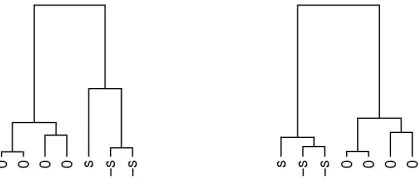
[image:15.612.207.417.230.320.2]We now compare the performance of the clustering algorithm by Heard et al. (2006) for different values of the prior parameters to ours in figure 4. A typical dendrogram of the combination under the conventional setting and default partition priors is given in figure 3 together with another dendrogram which is often produced by the algorithm by Heard et al. (2006). Note that, in the second dendrogram in figure 3, as anticipated in section 4.2, the first cluster combines the three outliers at an early step, a combination that under AHC can never be retrieved. Such unhelpful properties obviously depend on the setting of the hyperparameters.
Fig. 3. Two of the dendrograms produced by AHC using the algorithm with proportional parameters
and the algorithm by Heard et al. (2006).
Obviously the precise combination reflected in such dendrograms depends on how the values of the hyperparameters are chosen. So in figure 4 we have determined which values of the simulated data sets correctly identified the true simulated partition for the conventional and our settings of hyperparameter (identified as above) and default choice of prior by Heard et al. (2006) over the partition space. Notice that our method appears much more stable to misspecification of these three hyperparameters. The values used areg= ˘g−1
∈[1,10], a= ˘a∈[0.01,1] and b= ˘b∈[0.01,1].
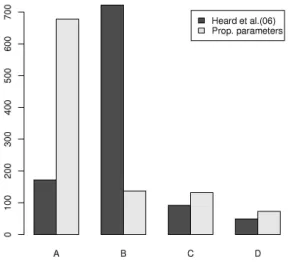
Finally in figure 5 we compare the number of times during the simulations the partitions A, B, the ‘large variance’ partition C ={(−s,−s,0,0,0,0, s)}and all other partitions D are chosen as optimal. Notice that the broad effect here is for the vast proportion of partitions misclassified as B under conventional clustering to be properly clustered as A under proportional clustering.
6.2. Merging of complementary profiles
Fig. 4. Result of the clustering algorithm by Heard et al. (2006) and our algorithm for different values
[image:16.612.245.391.290.421.2]of the prior parameters. Each dot corresponds to a combination of values of the prior parameters which generated the desired partitionAof our dataset.
Fig. 5. When different prior parameters are used, the algorithms produce different partitions of our
dataset. The plot above shows the counts of each partition produced by the algorithm by Heard et al. (2006) and the algorithm with proportional parameters.
Thus consider the dataset formed by the following three clusters
Y(1)k = Bβ(1)+εk k= 1
Y(2)k = Bβ(2)+εk k= 2, . . . ,6 (1)
Y(3)k = −Bβ(1)+εk k= 7
whereεk ∼N(0,1) fork= 1, . . . ,7 andBis the Fourier design matrix as in Anderson et al. (2006).
Fig. 6. Data simulated as in model (1). The amplitude of the curves is variable and depends on the
value ofσ2.
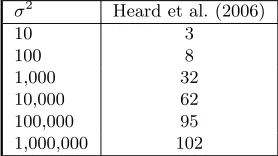
[ht]Table 1. The table shows the number of times (out of 432) that genes in cluster 1 and 3 are combined together at the first stepof the curves increases.
σ2 Heard et al. (2006)
10 3
100 8
1,000 32
10,000 62
100,000 95
1,000,000 102
The worst case scenario happens when the observations in clusters 1 and 3 are com-bined together at the first iteration of the algorithm. When this happens under AHC the algorithm can never identify the desired partition, which therefore will not be identified no matter which priors we are using on the partitions. Consider the results in 6.2. The prior parameters used wereg = ˘g ∈[1,1000],a= ˘a∈[0.01,1] andb= ˘b∈[0.01,1]. Again it is easy to see how our new settings improve on the original in this circumstance, particularly when expressions are large.
Whilst these examples illustrate the promise of the new method, we have not demon-strated that this algorithm consistently combines clusters in an appropriate way. In the next section the explicit algebraic form of our selection mechanism allows us to demon-strateanalytically that this is so albeit with one important caveat.
7. Separation of Models: Separation of Statistics
7.1. Some useful parameters
[image:17.612.469.608.259.337.2]two candidate clusters — and hence (ρ1, ρ2) — are fixed. There are four statistics that are central to the combination rule: d,v1 (defined above),η andζ2 (defined below).
(a) The statisticη =√α1α2(1−cos(θ[z1,z2]) is a weighted measure of the angle between the two cluster profiles, taking a value of zero when the posterior expected profiles are proportional to one another and its maximum value when the profiles are proportional to one another but of opposite sign: as would be the case whenever one gene is up-regulated the other is down-up-regulated. Thus η is a measure of the dissimilarity in
orientation of the two profiles.
(b) A measure of thedifferences in overall magnitudes of squared differences in distance from zero relative to that expected under the given cluster size under the prior, ζ2, satisfies
0≤ζ2= (√ρ2α1−√ρ1α2)2≤max{ρ1, ρ2} Note that ζ = sin(sin−1(√α1)
−sin−1(√ρ1)) and so, for fixed ρ1, ζ is an invertible function ofα1.
Now,
∆(1)
n (γ(η, ζ), d) = log(1 + (γ−1)(1 +d −1)−1)
where
1≤γ= 1 + (ζ2+ 2η√ρ1ρ2)˘g−1 (2) and
∆(2)n (v1, ζ, d) = log(1 +d)− X
j=1,2
ρjlog(vj+αjd)−I(ρ)
Note that ∆(1)n is a function only of (η, ζ, d) and ignores (v1, v2) whilst ∆ (2)
n is a function of relative variances, relative sizeζexpressed as a function ofα1, and combined sizedand also ignoresη.
7.2. Angular separation,∆(1)n
The following results are straightforward to verify. ∆(1)n (γ(η, ζ), d) is strictly increasing in η, ζ anddwith
lim η→0∆
(1)
n = log(1 +ζ
2(1 +d−1)−1˘g−1)
≥0
sup d
∆(1)n = log(1 + (max{ρ1, ρ2}+ 2√ρ1ρ2)˘g−1)
lim d→0∆
(1) n = 0
7.3. Relative distance/variance separation,∆(2)n
The second component ∆(2)n (v1, α1, d) = log(1+d)−ρ1log(v1+α1d)−ρ2log(v2+α2d)−I(ρ) is a function of the relative sums of squares and scaled relative distances from zero but not ˘
g. unlike ∆(1)n (γ, d) it is unbounded above and, depending on the distance d of the two clusters from zero, can heavily penalise the combination of clusters with relatively very different associated estimated variances or different scaled lengths from the origin. Thus, for example,
lim d→0∆
(2)
n (v1, α1, d) = ρ1log ρ1 v1
+ρ2log ρ2 v2
lim d→∞∆
(2)
n (v1, α1, d) = ρ1log ρ1
α1 +ρ2log ρ2 α2 lim
v1=α1→0∆ (2)
n (v1, α1, d) = v1=α1lim→1∆n(v1, α1, d) =∞
So when d is small and the two profiles are close to zero, ∆n acts as a penalty mainly for divergent estimates of variance, taking close to its minimum value whenever bσ2
1 =bσ22. However, whendis very large it penalises almost entirely on the basis of the difference in distance of the two clusters from the origin and ignores any divergence in their estimated variances. So under the AHC algorithm, when all the clusters in a partition are about the same cardinality, the Bayes factor algorithm will still tend to encourage the combination of clusters far from zero with the same orientation and distance from zero even when their estimated variances are very different.
It is easily checked that the stationary points of ∆(2)n are solutions ofP+Qd= 0 where
P = v1v2−ρ1α1v2−ρ2α2v1=v1v2 1−ρ1α1v1−1−ρ2α2v2−1
Q = ρ1v1α2+ρ2v2α1−α1α2=−α1α2 1−ρ1v1α1−1−ρ2v2α−21
If we setα1= 0.5(1−ω) andv1= 0.5(1−ε) then it follows that ∆(2)n will have a non-zero feasible stationary point indif and only ifωandεhave different signs. Otherwise, ∆(2)n is monotonic ind. Note that whenρ1 =ρ2= 0.5,∆(2)n has a stationary pointd
∗= v1−v2 α2−α1 if and only if α2v1−−v2α1 ≥0. So in this case the stationary point is a minimum. When d= 0, ∆(2)n =−0.5 log(1−ε2). Asd→ ∞,∆
(2)
n → −0.5 log(1−ω2) sod= 0 andd=∞ are the two local maxima of this function.
Whatever the value ofρ1, v1=α1⇒P =Q= 0 so that ∆(2) is not a function ofdand takes the value
∆(2)
n (v1, ζ, d) = X
j=1,2 ρjlog
ρj vj
Thus the characteristics of the induced separation measure of the proportional model seem eminently desirable, with the caveat that the conjugacy encourages outlying clusters with similar profiles but different variances to occasionally be combined when the two clusters are far from zero. However, it is easily verified that when clusters are about the same cardinality, so thatρ1 ≃ρ2, andε, ω are small then this dependence ond is almost insignificant.
7.4. Combined separation
points satisfy the equation
P′+Q′d= 0
where
P′ = γv
1v2−v2α1ρ1−v1α2ρ2
Q′ = γ(α1v2+α2v1)−α1ρ1(γv2+α2)−α2ρ2(γv1+α1)
Thus, in particular, there is at most one stationary point of Φ ford∈ R>0. This will
be located atd∗=−P′Q′−1 providedP′Q′−1<0. Note that when ˘gis small, except when
|v1v2−1|is ∆ (2)
n will dominate this expression so that Φ is simply increasing ind.
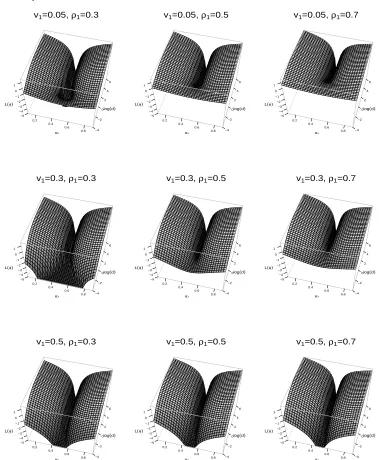
Note that the geometry of Φ is simple becauseρ1+ρ2= 1. Whenρ1+ρ26= 1 it is easily verified that the stationary points lie on a quadratic, giving rise to a much richer geometry in Φ. This is the algebraic reason for much of the strangeness of the induced selection. This phenomenon is illustrated in the central column of figure 7 where we graph Φ for two clusters with identical orientation and cardinality for various settings of the hyperparameters.
Note that the dependence of Φ ond is only significant when Φ takes large values. In this case, the clusters will usually be kept separate for other reasons anyway. Dependence on the relative distance from zero of the two clusters only occurs when d is of moderate magnitude. Furthermore, the discrepancy in relative variances is only significant when their ratio is substantially different from one and then only whendis quite far from zero.
The left hand column of figure 7 illustrates the phenomenon discussed in section 4.2 that when ρ1+ρ2 <1, clusters become increasingly large the further d is from zero: Φ eventually becoming very large regardless of how close the pair of cluster statistics are. On the other hand, the right hand column (whenρ1+ρ2 >1) shows asd becomes large, the two clusters will become close regardless of the value of the other statistics. This illustrates why Bayes Factor selection can be badly behaved unless the hyperparameters are chosen carefully.
7.5. Characteristics of non-proportional models
We have seen that when ρ1+ρ2 6= 1 the function Φ does not behave anything like a separation measure on the other components. On the other hand, when ρ1+ρ2 = 1 the characteristics of Φ can still sometimes act as an approximate separation measure. Writing vj=uju−1 forj = 1,2 andd=zu−1
Φ(d, γ, v1, v2, α1, ρ1) = log(1 +γd)−ρ1log(v1+α1d)−(1−ρ1) log(v2+ (1−α1)d)
so that
lim
d→∞Φ(d, γ, v1, v2, α1, ρ1) = logγ−ρ1logα1−(1−ρ1) log(1−α1)
which is at least bounded for fixed values of the hyperparameters. Also, for fixedρ1, γ and d, Φ is minimised: i.e. most inclined to combine when
v1+α1d=ρ1 and v2+α2d=ρ2
v1=0.05, ρ1=0.3 0.2 0.4 0.6 0.8 −4 −2 0 2 4 6 −5 −4 −3 −2 −1 0 1 α1
log(d) L(φ)
v1=0.05, ρ1=0.5
0.2 0.4 0.6 0.8 −4 −2 0 2 4 6 −5 −4 −3 −2 −1 0 1 α1
log(d) L(φ)
v1=0.05, ρ1=0.7
0.2 0.4 0.6 0.8 −4 −2 0 2 4 6 −5 −4 −3 −2 −1 0 1 α1
log(d) L(φ)
v1=0.3, ρ1=0.3
0.2 0.4 0.6 0.8 −4 −2 0 2 4 6 −5 −4 −3 −2 −1 0 1 α1
log(d) L(φ)
v1=0.3, ρ1=0.5
0.2 0.4 0.6 0.8 −4 −2 0 2 4 6 −5 −4 −3 −2 −1 0 1 α1
log(d) L(φ)
v1=0.3, ρ1=0.7
0.2 0.4 0.6 0.8 −4 −2 0 2 4 6 −5 −4 −3 −2 −1 0 1 α1
log(d) L(φ)
v1=0.5, ρ1=0.3
0.2 0.4 0.6 0.8 −4 −2 0 2 4 6 −5 −4 −3 −2 −1 0 1 α1
log(d) L(φ)
v1=0.5, ρ1=0.5
0.2 0.4 0.6 0.8 −4 −2 0 2 4 6 −5 −4 −3 −2 −1 0 1 α1
log(d) L(φ)
v1=0.5, ρ1=0.7
0.2 0.4 0.6 0.8 −4 −2 0 2 4 6 −5 −4 −3 −2 −1 0 1 α1
[image:21.612.122.501.68.528.2]log(d) L(φ)
Fig. 7. A plot ofL(Φ) = log(max{Φ−log(2),exp(−5)}). The magnitude of this measure represents the inclination of two clusters to merge,dis the mutual distance from zero of the two clusters,α1is the distance from zero of cluster 1 relative to this mutual distance, andv1 is the relative variance of the profile of cluster 1 relative to that of the combined cluster for the proportional model. The central column shows the recommended setting whenρ1+ρ2= 1whilst the left and right hand columns show
L(Φ)whenρ1+ρ2<1andρ1+ρ2>1respectively. Here,v1={0.05,0.3,0.5}, ρ1={0.3,0.5,0.7}
andα1∈[0.1,0.9],log(d)∈[−4,6]. We chooseρ1=ρ2,η= 0(since the two clusters are identically
respectively. Both these properties are clearly desirable. If we choose not to setbc = ˘bnc but just to a common value for all clusters, as is done in Heard et al. (2006), then if eithern1 orn2is large thenv1+v2≃1 and so little distortion from a separation is felt. Two clusters with low cardinality, small values ofd, and small but proportionately different values of sums of squares tend to be kept separate. For the purposes of gene clustering this is not a particularly germane property since such clusters are unlikely to be of regulatory interest and also occasionally distort the initial stages of forward selection techniques like AHC.
Finally a g-prior, ensures that Φ is increasing in the angular distance 1−cosθ between the clusters. However, without a g-prior and the more usual dependence model, with large (n1, n2) it is easily checked that this is still approximately the case.
Thus, whilst in our context of gene profile clustering we would recommend the use of the proportional model, provided that we set ρ1+ρ2 = 1 for larger cluster cardinalities, the conjugate combination algorithm will often have reasonable characteristics. Any prob-lems that arise tend to concern the combination of clusters with small cardinalities: an inevitable consequence of using algorithms like AHC, but avoidable if more sophisticated search algorithms (Chipman et al., 2001) are employed.
7.6. Setting hyperparameters in proportional models
There are two complementary and fully Bayesian ways of setting the hyperparameters (˘a,˘b,g˘). First, these parameters should be chosen so as to coincide with predictive be-liefs about the individual cluster profiles we expect to see before incorporating the data. The value of ˘a/˘bis our prior expectation of the precisionσ−2 of a typical cluster, whilst ˘a can be calibrated to our coefficient of variation of this information [˘anc]−1 for a cluster c of a given cardinalitync. The magnitude of ˘gdetermines the relative strength of the prior information on each unit profile and governs the extent that the cluster posterior means shrink towards zero. Note that, in agreement with Wakefield et al. (2003), we recommend setting these prior parameters so that they calibrate to pre-posterior predictions of the variance of a particular cluster.
Second, it is important that the values (˘a,˘b,g˘) calibrate hyperparameters to pre-posterior beliefs about the relative probabilities of adjacent partitions after realising certain hypo-thetical observations. Thus, the magnitude of parameter ˘g solely influences the relative weight we place on two clusters having different orientations of profiles. The smaller this parameter, the more likely clusters — all of whose characteristics are the same but whose orientations are different — are kept separate. That is, the higher weight given to ∆(2) relative to ∆(1). To fix an appropriate value of ˘g we suggest calibrating to two expected profiles of different orientation distances from the value of ˘g we suggest calibrating to two expected profiles of different orientation distances from the origin and asking the
The effect of the parameter ˘ais only felt through the thresholdκ′′. Thus, for example, using the default prior capacities suggested in Heard et al. (2006) it can be shown, after a little algebra, that ˘a also controls the penalty on cluster size. When, as will be most common, this prior coefficient of variation is high (so that ˘a is small) then the penalty tends to hold more equally sized clusters apart and to pull smaller clusters into larger ones whenever possible. However note that the setting of the prior capacities also acts solely as a penalty on (n1, n2) and is therefore somewhat confounded with ˘a.
8. Conclusions
Our experiences suggest that simply getting hyperparameters in the right ball park as described above can dramatically improve the characteristics of these search algorithms, see Anderson et al. (2006). Conjugate models with proportional parameter settings are not only fast but, if reasonably calibrated, behave appropriately. Even the occasional outlier can be identified and easily separated from the body of a cluster, iterating on the search algorithm if this is then necessary. The inconvenience in having to do this appears to us a small price to pay for the fast conjugate algorithm.
One useful spin-off of this analysis is that we have noted that for gene regulation, after a MAP partition has been found, the between-cluster statisticη is a useful summary. Thus clusters of genes that are potentially co-regulated can be expected to have similar profile shapes whilst the extent of the expressions, as measured by (ζ, d), is less biologically signif-icant. Note that under Bayesian selection, provided search is extensive, all subsets of genes in a cluster will have similar associated values ofη to other clusters and so this parameter not only characterises differences between clusters but also differences between collections of geneswithin clusters. This stability is important in this application since certain sub-sets of genes within clusters are of known biological function and therefore of more interest than others and would not be accounted for by other more ad hoc methods. Note that the separationη between any two clusters is trivial to calculate given the previously computed statistics associated with the clusters in the MAP partition.
9. Acknowledgements
Paul E. Anderson thanks BioSim, EPSRC and BBSRC and Silvia Liverani and Jim Q. Smith thank for support from EPSRC under CRiSM. We thank Nick Heard and Chris Holmes for valuable discussions and the use of their publicly available code and also Andrew J. Millar and Kieron D. Edwards for producing the biological data shown in figures 1 and 2.
Appendix A
A.1. Proof of Theorem 1
Ifx(c1) =x(c2) thenα1=α2= 0.5,v1=v2=v(say),n1=n2=nandρ1=ρ2=ρ
exp(Φ) = 22ρ 1 +γd (2v+d)2ρ
where
γ= 0.5 (λ1−2λ12+λ2) = [(g+ 2n)g1]−1(g+n)g
Clearly, Φ is a function ofz unlessρ= 0.5 implying ¯a= 2a1. Substituting gives
exp(Φ) = 21 +γd 2v+d
Since by definitionv anddare functionally independent, we therefore must have
v= 0.5 ⇔ ¯b= 2b1
and also
γ= 1 ⇔ 1 + n g1
= 1 +2n
g ⇔ g= 2g1
as required. Finally, under these conditions whenx(c1) =x(c2),Φ(x(c1),x(c2)) = log 2.
A.2. Proof of Theorem 2
Φ = log(1 +γd)−ρ1log(v1+α1d)−ρ2log(v2+α2d) = ∆(1)(γ, d) + ∆(2)(v1, ρ1, α1, d) +I(ρ)
where
∆(1)(γ, d) = log(1 +γd)−log(1 +d)≥0
since
γ=λ1α1−2λ12√α1α2+λ2α2≥γ0
with equality if and only if cosθ[z1,z2] = 1 whereγ0≥1 is defined above, and
∆(2)(v1, ρ1, α1, d) = log(1 +d)−ρ1log(v1+α1d)−ρ2log(v2+α2d)−I(ρ)
Note that
∆(1)= 0 ⇔ ρ2α1=ρ1α2
cosθ[z1,z2] = 1 ⇔ α1 n1
Also, for fixed ρ1, ρ2 with ρ1+ρ2 = 1,Pj=1,2ρjlogxj is maximised when xj =T ρj. So lettingT = 1 +d, vj=ρj gives
∆(2)(v1, ρ1, α1, d) ≥ log(1 +d)−ρ1log(ρ1(1 +d))−ρ2log [ρ2(1 +d)]−I(ρ) = 0
= ∆(2)(ρ1, ρ1, α1, d)
Therefore
Φ(v1, ρ1, α1, d)≥I(ρ) = Φ(ρ1, ρ1, α1, d)
A.3. Proof of Corollary 2
The first bullet is a direct consequence of the theorem on noting that ∆(1)≥0, and ∆(1)= 0 takes its maximum if and only if γ = 1 and α1n1 = α2n2 so that the scaled distances of the two profiles from zero satisfyn1−1βb1=n2−1βb2. Also, ∆(2) ≥0 and ∆(2)= 0 if and only if αj =ρj so that
vj+αjd=ρj(1 +d) ⇔ vj=ρj ⇔ σb21=bσ22
The second bullet is immediate from the symmetry in (x(c1),x(c2)) of the three functions Φ(x1(c1),x2(c2)),I(ρ) andκ′(n).
References
Anderson, P. E., J. Q. Smith, K. D. Edwards, and A. J. Millar (2006). Guided Conjugate Bayesian Clustering for Uncovering Circadian Genes. Technical Report 06-07, CRiSM paper, Department of Statistics, University of Warwick.
Barry, D. and J. A. Hartigan (1992). Product partitions for change point problems.Annals
of Statistics 20, 260–279.
Bernardo, J. M. and A. F. M. Smith (1994). Bayesian Theory. Wiley.
Chipman, H., E. George, and R. McCullough (1998). Bayesian CART Model Search. J.
Amer. Statist. Assoc. 93, 935–960.
Chipman, H. and R. Tibshirani (2006). Hybrid Hierarchical Clustering with Applications to Microarray Data. Biostatistics 7, 268–285.
Chipman, H. A., E. George, and R. E. McCullock (2001). The Practical Implementation of Bayesian Model Selection. Model Selection 38, 1–50.
Chipman, H. A., E. I. George, and R. E. McCulloch (2002). Bayesian treed models.Machine
Learning 48(1–3), 299–320.
Denison, D. G. T., C. C. Holmes, B. K. Mallick, and A. F. M. Smith (2002). Bayesian
Methods for Nonlinear Classification and Regression. Wiley Series in Probability and
Statistics. John Wiley and Sons.
Edwards, K. D., P. E. Anderson, A. Hall, N. S. Salathia, J. C. W. Locke, J. R. Lynn, M. Straume, J. Q. Smith, and A. J. Millar (2006). FLOWERING LOCUS C Mediates Natural Variation in the High-Temperature Response of theArabidopsis Circadian Clock.
Fernandez, C., E. Ley, and M. J. F. Steel (2001). Benchmark priors for Bayesian Model Averaging.Journal of Econometrics 100, 381–427.
Garthwaite, P. H. and J. H. Dickey (1992). Elicitation of prior distributions for variable-selection problems in regression. Annals of Statistics 20(4), 1697–1719.
Gordon, A. (1999). Classification (2nd ed.). CRC Press, London: Chapman and Hall.
Hastie, T., R. Tibshirani, and J. Friedman (2001). The Elements of Statistical Learning:
Data Mining, Inference and Prediction. New York: Springer-Verlag.
Heard, N. A., C. C. Holmes, and D. A. Stephens (2006). A Quantitative Study of Gene Regulation Involved in the Immune Response of Anopheline Mosquitoes: An Applictaion of Bayesian Hierarchical Clustering of Curves. J. Amer. Statist. Assoc. 101(473), 18–29.
O’Hagan, A. and J. Forster (2004). Bayesian Inference: Kendall’s Advanced Theory of
Statistics (2nd ed.). Arnold.
O’Hagan, A. and H. Le (1994). Conflicting Information and a Class of Bivariate Heavy-tailed Distributions. In P. R. Freeman and A. F. M. Smith (Eds.),Aspects of Uncertainty, pp. 311–327. Wiley.
Quintana, F. A. and P. L. Ingelias (2003). Bayesian Clustering and Product Partition Models. J. Royal Statist. Soc.: Series B 65(2), 557–574.
Ray, S. and B. Mallick (2006). Functional clustering by Bayesian wavelet methods.J. Royal
Statist. Soc.: Series B 68(2), 305–332.
Smith, M. and R. Kohn (1996). Non-parametric Regression using Bayesian Variable Selec-tion. Journal of Econometrics 75, 317–343.
Wakefield, J., C. Zhou, and S. Self (2003). Modelling gene expression over time: curve clustering with informative prior distributions. In J. M. Bernardo, M. J. Bayarri, J. O. Berger, A. P. Dawid, D. Heckerman, A. F. M. Smith, and M. West (Eds.), Bayesian
Statistics 7. Oxford University Press.
West, M., , and J. Harrison (1997). Bayesian forecasting and dynamic models (2nd ed.). New York: Springer-Verlag.
Zellner, A. (1986). On assessing prior distributions and Bayesian regression analysis with g-prior distributions. In P. K. Goel and A. Zellner (Eds.),Bayesian Inference and Decision