“Regionalism In A Globalizing World: An Asia-Pacific Perspective”
Dilip Das
CSGR Working Paper No. 80/01
September 2001
Regionalism In A Globalizing World: An Asia-Pacific Perspective Dilip K Das
CSGR Working Paper No. 80/01 September 2001
Abstract:
Somewhat incongruously, as global economic integration progressed the trend towards regionalism also strengthened. This paper introduces readers to the contemporary wave of regionalism. It delves into the principle characteristics of the second wave of regionalism, how it is different from the first and what is its texture. It focuses on regionalism in the Asia-Pacific region, which was slow to adopt the concept in its modern form. Outward-oriented economic growth, which was a salient economic feature of several super-achievers among the Asia-Pacific economies, helped in promoting trade and investment including intra-regional trade and investment. Unlike Europe, this trend in Asia was essentially market-led. Institutional arrangements followed market initiatives. Transnational corporations also contributed to expansion of regionalism in Asia. Regionalism of this variety can have a synergy of its own and co-exist with globalism.
Keywords: Regionalization, globalization, second wave of regionalization, Asia-Pacific
Address for correspondence: Dr. Dilip K. Das
Suite 408
330 Adelaide Street East Toronto Ontario M5A 4S9 Canada
1. REGIONALISM
Regionalism is in vogue and it is here to stay, however, in the ultimate analysis it is no substitute for globalism. Given that the global economy is not governed by free market rules, regionalism and globalism can function in a complementary manner. Regionalism that is not open, and is devoid of globalism, is antithetical for maximizing the global output and, therefore, for global economic welfare. As we shall see in Section 7, open regionalism was pioneered by Australia and New Zealand and is being practiced by the APEC forum.
The paper begins with an introduction of the contemporary regionalism, provides a definition of regionalism, and delves into its various characteristics as well as diversity of its texture. Relative to other regions, Asia-Pacific region caught on to regionalism late. In its institutional form, Asian policy makers ignored the concept for a long time. Economic growth in Asia has a certain characteristic pattern to it. Over the preceding half century, the high performing Asian economies adopted outward-oriented strategies, promoting trade and foreign investment. After a lag, this led to expansion of intra-regional trade and investment. Asia-Pacific regionalism was essentially market-led. Regional production networks were the consequence of market-led economic dynamics of the region. Large corporations, including transnationals, contributed to the growth of pan-Asian industrialization process. The institutional arrangements followed the market initiatives. Some regional initiatives were taken, which are operating with varying degrees of success. These regional initiatives can coexist with globalism and serve as “building blocs”.
2. REGIONAL TRADING AGREEMENTS
the Latin American Free Trade Area (LAFTA) in 1960. In 1963, Yaounde Convention between the EEC and former French, Belgium and Italian colonies in Africa gave these countries preferential access to the EEC markets. Following the formation of the EEC, there was a proliferation of regional agreements in the developing countries of Africa and Latin America. However, this first wave of regionalism was weak and did not go far. With the notable exception of EEC, the regional initiatives of the 1950s and the 1960s amounted to virtually nothing. This first wave of regionalism did not flourish outside Europe. Earlier regional initiatives like the ANDEAN pact had collapsed. The regional trading agreements (RTAs) of this period were neither large in number nor as successful as those of recent years. One of the important reasons was that the United States (US), the largest trading economy, was philosophically opposed to regionalism. The US considered regional initiatives detraction from multilateral liberalization. It took an anti-regional trade stance and championed the cause of free trade through the General Agreement on Tariffs and Trade (GATT). However, the formation of EEC received US support because the US saw a united Western Europe as an effective deterrent to the growing Soviet threat.
During the 1990s, regionalism returned with a vengeance. A second global wave of regional initiatives took place during the 1990s. It has also come to be known as the “new regionalism”. Here, chronological meaning of “new” is being taken. After the second wave started, division of global economy into three trading blocs—never an issue in the first wave of regionalism—was seriously debated by economists and political scientists. The beginning of second wave can be dated back to 1986-87 when the members of the EC hatched their Single Market plans to be completed by 1992. In this context, 1988-89 was a watershed point because this is when the US agreed to and implemented the Free Trade Area of Canada1 (CUSFTA) and abandoned 40 years of stringent opposition to the principle of regional integration. The US had considered regionalism an antithesis of multilateralism. During 1990-92, a new customs union was agreed in the eastern half of South America, called MERCOSUR (or the common market of the south). The North American Free Trade Association (NAFTA) was created in 1994. The deeper integration in the EU and the establishment of NAFTA led to a “domino effect” of renewed
interest in RTAs. Failure to launch the new Round of MTNs in Seattle in 1999 further heightened the popularity of RTAs globally.
Old preferential trade areas (PTAs), like the ANDEAN Pact and the Central American Common Market (CACM) began to be resuscitated in the early 1990s. In Africa, new PTAs were created. Some these were rebuilt on the old foundations while others were languishing for a long time were revived. Important illustrations include, Union Economique et Monaitarie de l’Africa Occidentale (UEMOA) which was created out of the Communaute Economique de l’Afrique Occidentale (CEAO), and the Common Market of Eastern and Southern Africa (COMESA) which was revived. The Preferential Trade Area for Eastern and Southern African States was enlarged and the Union Duaniere et Economique d’Africa Centrale (UDEAC) was strengthened. According to the World Trade Organization (WTO), there were 13 different RTAs in Africa in 2000. In Asia, the Association of Southeast Asian Nations (ASEAN) countries agreed in principle in 1991 on the ASEAN Free Trade Area (AFTA)2. Historically, protectionist tendencies in Asia, North America and South America had stymied proposals for regional integration. Spread of serious regional arrangements to these areas was a noteworthy change of attitude and beginning of a new trend.
The RTA scenario underwent a radical transformation during the 1990s, albeit not all the RTAs were negotiated with sincere trade-expansion and economic integration intentions. To be sure, some had imprecise objectives and vague aspirations. In its new incarnation, regionalism engulfed all major players of the global economy. If the APEC forum is counted as a planned or informal regional trading arrangement of sorts, virtually countries on all continents are now members of regional trade agreements3. Nearly all of WTO’s 140 members have notified participation in one or more RTAs, although notifications may also refer to the accession of new parties to an agreement that already existed4.
2The AFTA agreement was not signed until 1992.
3 Unlike the European Union (EU) and the North American Free Trade Area (NAFTA), APEC does not
have a formal trade treaty to back up its blue print of trade liberalization.
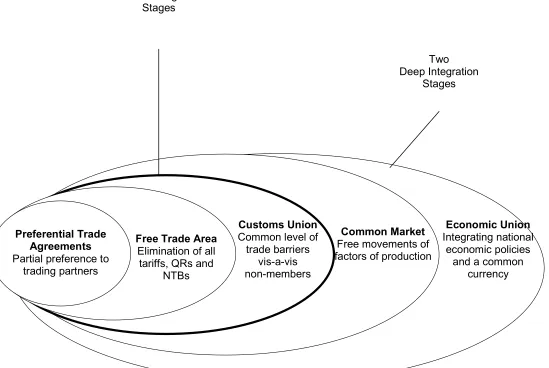
Regional economic integration is being taken to mean deepening of intra-regional trade, expansion of mutual foreign direct investment (FDI) and harmonization of commercial regulations, standards and practices. Regional economic integration can potentially have many formal shapes and, therefore, names. It could cover a spectrum of arrangements varying from preferential trading areas, to free trade areas, to customs union, to common markets and finally to economic union. These are the five tiers or stages of regional trading arrangements (Figure 1). Preferential trading areas are the first tier arrangement. In this arrangement, trading partners grant partial non-discriminatory tariff reductions to each other5. They leave their other tariffs,
non-tariff barriers (NTBs) and quantitative restrictions (QRs) unchanged. In a free trade area, which is the second tier, members of a preferential trade area eliminate all tariffs and non-tariff barriers (NTBs) among themselves, but each member can set its own tariff rates on imports from non-members (like Association of South East Asian Nations and North American Free Trade Area). The third tier is a customs union in which members go beyond removing tariff barriers among themselves and set a common level of trade barriers vis-à-vis non-members (like the EU). These three stages of regionalization directly and exclusively affect international trade of the member countries and together are known as shallow integration.
5 To be more explicit, if the concessions granted are one-way, it is called a preferential trade
Figure 1
Spectrum of Formal Regional Trading Arrangements
Preferential Trade Agreements
Partial preference to trading partners
Free Trade Area
Elimination of all tariffs, QRs and
NTBs
Common Market
Free movements of factors of production
Customs Union
Common level of trade barriers
vis-a-vis non-members
Economic Union
Integrating national economic policies and a common
currency Three
Shallow Integration Stages
Two Deep Integration
The fourth tier is a common market and is considered the first deep integration stage. This stage attempts to harmonize some institutional arrangements and commercial and financial laws. Beyond free exchange of goods and services, a common market entails free movement of factors of production. The fifth stage is the economic union and goes a step ahead of the free movement of goods, services, and factors6. An economic union, the last tier, involves integrating national economic policies, including taxes and common currency (Figure 1).
The new regionalism has several distinctive characteristics. First, while old regionalism was essentially confined to RTAs between industrial economies or the developing economies, the new regionalism is known for cross alliances between developing and industrial economies. The new bonds forged by developing and industrial economies offer considerable potential for gains from trade. The flip side is that this new relationship also has a great deal of potential for adjustment problems and trade tensions. Second, while old regionalism was essentially limited to RTA formations by contiguous economies, the new regionalism does not seem to be limited to neighboring economies. In some recent or proposed cases RTAs are intercontinental. Although there may be co-ordination related problems, from the gains-from-trade perspective this could be a healthy development. Third, under the new arrangement RTAs are not exclusive, meaning thereby one country can simultaneously be a member of more than one RTA. This may eventually turn out to be an aid to promoting multilateralism through RTAs. Fourth, while old regionalism was limited to shallow integration, the new regionalism is more ambitious. A number of recent agreements aspire for deep integration, with commitments to harmonization of regulatory measures, freeing factor movements, and other close integrating measures.
Implications of RTAs for the global trading system have been extensively debated in economic literature. More than 210 RTAs have been notified to the GATT and the WTO. Some no longer exist. Many of the discontinued RTAs were superseded by redesigned agreements among the same signatories. A large number of RTAs were concluded in the decade of the 1990s. Between 1995 and 2000, 90 RTAs covering goods or services, or both, have been notified to the WTO. Currently over 130 agreements are in force (WTO, 2000). The global network of RTAs is highly
6For tersely worded definitions and academic accounts readers are referred to Ethier, 1997; Ethier, 1998,
complex and many countries are members of several agreements, sometimes with very different rules. Shallow integration is far more common than deep. A large majority of existing RTAs is free trade areas (Figure 1). The only customs unions are the EU, the South African Customs Union (SACU), MERCOSUR in South America, and CARICOM in the Caribbean. The ANDEAN Pact and CACM have partial common tariffs. The EU now has 15 members7 and is moving ahead to form a common market and further on to be an economic union, having a single currency. A Euro zone of 12 economies already exists8. The enlargement of the EU is looming. Economic and political momentum behind EU expansion is powerful. Prospects of doubling its current membership to 28 or even 30 before 2010 are clear9. When the new members join in, it would be much more than a mere change of scale. In late 2000, the front runners for joining the EU were Cyprus, Estonia, Poland, the Czech Republic, and Slovenia. Eight more countries were applicants and likely to join later10 (Vedrine, 2000). The next wave of EU expansion would
increase the union’s population by 30 percent, to more than half a billion people, twice the total of the US. This would dwarf any previous expansion. More importantly, the integration of the EU with the emerging Europe is an economic quantum leap. When Spain and Portugal joined the EU, their GDP per capita was already 70 percent of the EU average in purchasing power parity terms. The 1995 accession countries even produced a higher output per capita than the existing union. The thirteen present candidates post a purchasing-power adjusted GDP per capita of less than 40 percent of the EU average. In Euro terms, this ratio is as low as 15 percent. Also, Central and Eastern Europe’s financial sectors are far less developed than their EU counterparts (Suppel, 2000). The EU also has known plans to bring the North African economies into its fold in the future.
7In fact, the EU membership reached 15 in 1995, when Austria, Finland and the United Kingdom joined. 8Greece became the twelfth member of the Euro zone on 01 January 2001.
9 The principal decision on enlargement was made as early as 1993. Back then, at the Copenhagen
summit, EU members agreed that the associated Central and Eastern European countries should integrate fully into the Union. At the same time, the European Council established political and economic conditions for accession. These “Copenhagen criteria” demand of the accession candidates:
(i) stability of institutions guaranteeing democracy, the rule of law, human rights, and protection of minorities;
(ii) existence of a functioning market economy with the capacity to withstand the competitive pressures in the EU Single Market; and
(iii) adoption of essential EU legislation (acquis communautaires) and administrative and judicial structures that ensure its effective implementation.
In addition, the EU set a reform agenda for its own institutions and a legal framework in the “Agenda 2000” put forward by the EU commission in 1997.
3. TEXTURE AND DIVERSITY
It is appropriate to outline the characteristic structures of RTAs and define them. Page (2000) defined an RTA as country groups which have “created a legal framework of cooperation covering an extensive economic relationship, with the intention that it will be of indefinite duration, and with the possibility foreseen that the region will economically evolve in the future”. The criterion of extensive economic linkage precludes single-issue alliances, while that of permanence is uncontroversial. The criterion of evolution is obvious and reinforces exclusion of groups formed for and limited, or a single, objective. The need for a dynamic evolution over time is inevitable because countries’ economic structures change constantly, and with that their linkages with the members of their RTA.
In an RTA, the economic and regulatory links between trade and the rest of the economic systems of the members gradually harmonize and strengthen. However, this strengthening process needs to be led by the trading relationship. Formation of an RTA entails lowering of conventional trade barriers, which brings to the fore a sequence of other differences in these economies which, if left unharmonized, would necessarily have a negative effect over trade expansion in the RTA (Page, 2000). The typology suggested in Section 2 is revealing in this regard. The expansion path of an RTA seems to be linear. It runs from freeing trade in goods and services of all tariff barriers within the RTA, to capital and labor movements and the right of establishment, from tariffs to non-tariffs to non-border measures, to taxes and other policies, and finally to common currencies and integration of economic and financial policies.
formal forms identified in Section 2, there are marked differences in content and form among RTAs, although most analytical discussions treat them as identical phenomena.
Members of an RTA can and do differ in important economic features. One of the features of economic integration is the level of economic interdependence among the member economies. For instance, trade as a proportion of GDP is high for most of the member economies of the EU, whereas the members of APEC and NAFTA are less interdependent. For the latter named two regions, trade between member states is lower as a percentage of GDP. Extra-regional trade is the second important variable which tends to be more widely spread for APEC and NAFTA than for the EU. The third dimension is the balance of symmetry, that is, if member economies of an RTA are differently dependent on the other regional economies for trade and investment, the economic relationships among them is likely to be to be asymmetrical. The reverse is equally true.
A wide diversity in content and form is found between RTAs among both developed and industrial countries. While tariff elimination is common to all of them, differences commonly exist on agreements related to (i) quantitative restrictions (QRs), (ii) positive or negative list approaches, (iii) rules of origin, (iv) external tariffs, (v) timetable for liberalization, (vi) trade in services, (vii) movement of labor and capital, (viii) promotion of industrialization, (ix) promotion of trade objectives, and (x) payments arrangements. Whalley noted that RTAs between industrial economies are generally concerned with and adopt variant approaches in dispute settlement procedures, including dispute settlement for anti-dumping and countervailing duties, and trade provisions relating to environment standards. They can be unipolar or multipolar. They are also known to have complex sectoral arrangements in areas like textiles and apparel and autos (Whalley, 2000). The EU has extensive sectoral arrangements in agriculture, steel, inter-regional resource transfers, labor mobility provisions. However, these provisions are not to be found in NAFTA.
Notwithstanding the diversity in the current trend in regionalism, the following characteristics are frequently—albeit not always—to be seen in many of the contemporary RTAs. First, the current RTAs, as noted above, typically involves one or more small countries linking up with one or more large industrial economies. Second, the small economies joining an RTA now undertake significant economic reforms and restructuring. It is true of the central European and Latin American economies. Third, the trade liberalization that is affected is largely confined to concessions given by the smaller partners of the RTA, not by the larger economies. The latter group generally has fairly, if not quite, liberalized economies. Typically the small countries get only small tariff advantage, because the larger partners of the RTAs have low tariffs to begin with (Ethier, 1998).
4. ROLE OF TNCs IN RTA EXPANSION
pharmaceuticals, machinerry including precision machinery, and electronics. In so ding, TNCs increase ability to exploit scale economies not only in production but also all along the value chain. They in turn lead to higher competitiveness. One of the direct impact of RTAs is creation and expansion of FDI opportunities. Business Associations in various regions support RTAs. In some RTAs, like in APEC, the role of business has been institutionalized by creating bodies like Pacific Business Forum (PBF).
Global competition has intensified over the last quarter century, which has made market access a strategic consideration. RTAs enable increased market access to corporations and TNCs. With technological advancement, product life cycle has become short in many products. This observation applies particularly to electronics, precision machinery, chemicals, and pharmaceuticals. Global diffusion of technologies and innovation has become increasingly rapid. The time span that competitors take to respond to new innovations has shortened considerably, making market access more important for spreading the fixed costs of innovation. In addition, according to the current customer-friendly business practices in sophisticated products, local presence of the manufacturing firm or services provider is essential. RTAs are known to facilitate it. Large corporations and TNCs in an RTA can also follow market trends closely and acquire smaller innovative firms, which in turn makes them more competitive (Fishlow and Haggard, 1992; Lawrence, 1996).
(ICT) and modes of transportation, they found that they could manufacture a range of products in a more cost-effective manner by sourcing from multiple locations in the same contiguous region. Sourcing of raw materials, labor-intensive processes, and technologically sophisticated processes began to be done in different countries in the same region. Several Asian economies— particularly the newly industrialized economies (NIEs) and ASEAN-4 (namely, Indonesia, Malaysia, Philippines, and Thailand) and subsequently China—participated in these pluri-country manufacturing processes. Production networks (Section 6) or regionalization of global production picked up momentum since the mid-1980s.
As seen in Section 2, merely dismantling of tariffs and NTBs leads to a relatively shallow form of regional integration. As opposed to this, development of regional production networks and promotion of investment in services sectors requires deeper form of international integration than that in RTAs. It requires complete harmonization of other policies including competition policies, product standards, regulatory regimes, investment codes, environmental policies. Without harmonization of this kind production integration becomes difficult, expensive, or even impossible. In addition, large investing firms and TNCs are not encouraged to invest unless they are ensured of credible and stable governments, and easy access to foreign markets. Harmonized customs procedures also help. This promotes a deeper form of international integration, which in turn is easier to achieve at the regional level.
The down side of this genre of deeper regional integration is that when small and large economies, with unequal bargaining power, negotiate for an RTA, the larger and more industrialized economies may successfully extract concessions of all kinds not just in trade nut in non-trade issues from smaller economies. Panagariya (1999) suspected that the agenda for deeper integration is likely to be determined by the larger, more industrialized economies, not by their smaller less-industrialized partners. The expected role of the smaller economies would be to adjust their norms and standards to this agenda. In the process, they may have to adopt some policy measures that they consider unsuitable to them. A hegemonic power may gain at the expense of the smaller partners of the RTA, if it chooses to bargain sequentially rather than simultaneously11.
5. TRADE AND INVESTMENT PATTERNS IN THE ASIA-PACIFIC REGION A great deal of evidence is available proving that trade was an animating force behind rapid economic growth in Asia. Intra-regional trade played a substantial role in integrating the regional economies. On the eve of the out break of the Asian crisis in 1997, intra-regional trade was approximately 51 percent of the total trade in Asia. Empirical evidence is available to conclude that with rapid growth, the economic structure of the newly industrialized economies12 (NIEs) of
Asia, the four Southeast Asian economies in the Association of Southeast Asian Nations13 (ASEAN-4), China and a lesser extent the South Asian economies underwent structural transformation, which had a direct bearing on factor endowments. Growth, structural transformation and changing factor endowments also ushered in transformation in the manufacturing sector. The Heckscher-Ohlin theory supports and provides and explanation for the resulting transformation in the comparative advantage of different Asian economies and/or country groups (Das, 1998). However, Asian economies did not record high (or low) trade in relative and absolute terms in certain products or sectors. Similarly, their trade was not concentrated in a few select sectors (Das, 2000a).
11 One example of such hegemonic bargaining power are the provisions with respect to intellectual
property protection and environment and labor standards secured by the US from Mexico, while Mexico was unable to obtain similar benefits in return.
Another germane observation in this regard is that there was no characteristic Asian export path or Asian export route and few generalizations could be made in this regard for the region. Japan had a higher income level and a larger range of manufactured exports. The export pattern of Japan, and to a certain extent that of Singapore, was found to be more similar to those of industrial economies than similar to that of other Asian economies. The export patterns of Hong Kong SAR, Korea and Taiwan were similar, and so were those of Malaysia, Philippines and Thailand. Over the years, similarities between these patterns increased. Indonesia was not comparable to these two country groups because of its oil exports. In the early stages of industrialization, Indonesia appeared a laggard because its exports were limited to oil and lumber. Noland (1997) examined the determinants of export patterns by estimating cross-national regressions of factor endowments on trade flows and generating a variety of descriptive statistics from these regressions. The main result of his regressions is that the factor endowment models cannot adequately explain the trade pattern of Japan, and to a lesser extent of Korea and Taiwan. In the case of Japan, the growth in Japanese exports was less than what would be explained on the basis of its factor accumulation. When regional dummies variables were introduced to capture group effects, there was a tendency for the Asian dummies to be positive with respect to gross exports and insignificant with respect to net export, leading to the inference that these economies are unusually trade oriented.
Section 6 shows, by the latter half of 1990s, most successful Asian trading economies were trading as much as 50 percent with the other regional economies. The only exception in this regard was Indonesia. Apart from this, only China saw its intra-regional trade share decline during the 1990s because of expansion of its trade share with the US. Most of the successful exporters in Asia held or reduced their share of trade with Japan, the dominant regional trader. Although Japan’s significance as a regional trade partner has declined over the years, in absolute terms it has expanded its exports in the region. During the last decade and a half, the most rapid growth in trade opportunities came instead from the four NIEs, as well as the other emerging economies of Southeast Asia.
The market expansion that took place in Asia was both vertical and horizontal. First the NIEs and then the other emerging market Asian economies fit into the lower tiers of complex trade hierarchies. However, this was a dynamic scenario. This tendency was conspicuous in association with the large flows of FDI into China and Southeast Asia. Over the last decade and a half, Japan, Taiwan and Korea have provided massive amounts of FDI to China and Southeast Asian economies and in the process increased their commitments in these markets. Firms in these countries have built subsidiaries or partnerships in China and the Southeast Asian economies, who in turn export intermediate goods to the investor firms’ home countries. These intermediate goods can be exported to the subsidiaries of the investing firms in other parts of the world. This kind of trade expansion is usually supported by complex commercial alliances in which the new partners enjoy many growth externalities (Lee and Roland-Holst, 1998). Trade between China, Hong Kong SAR and Taiwan—together referred to as greater China—is increasingly closely linked and large. China’s trade dependence on Hong Kong has declined considerably since 1990, because of its capability to trade directly has increased. China trades much more directly both intra-regionally and outside the region. Hong Kong is still the largest trade partner and an important intrapot for China.
6. SPREADING PRODUCTION NETWORKS
this trend. Gradually production locus shifted from the firms to networks of regional production. Production networks soon became an important force driving the process of economic integration in East and Southeast Asia as well as of globalization. They went far beyond horizontal and vertical integration of production. The integration of Malaysia, Thailand and the Pearl River basin of China with Northeastern Asian production has been one of the most marked changes in the spatial organization of the Asian economy since the Plaza Accord. Although superficially this trend lent credence to Akamatsu’s (1961) age old flying geese hypothesis, emerging organizational and spatial changes in production actually undermined many of its key assumptions. His hypothesis, somewhat simplistically, failed to grasp the complexities of technological changes and technology transfer. The regionalization of production networks in Asia came to be organized in ways that belied the neatness of the avian analogy. The product life cycle theory explains regionalization of production much more convincingly. It takes individual products as “disembodies” from larger industrial structures, whereby the life cycle of any given product can be treated in isolation from myriad of other products and the organizational foundations that initially spawned it. These new production modes or production linkages are most conspicuous in the electronics industry (Chen and Ku, 2000). This industry provides the most revealing illustration of how production linkages in Asia are more complex than the trade and investment data describe them. One of the most striking changes in regional production since the Plaza Agreement has been the rapid shift of much of Northeast Asia’s low-end consumer electronics production to Malaysia first and then to Thailand. Most prominent was the massive investment by the Japanese electronics industry. A similar pattern was followed by Taiwanese and, to a lesser extent, Korean electronics investment in Malaysia and Thailand. This great infusion of investment in the electronics industry represents the transfer in a mere five years (1996-90) of much of low-end, export-oriented consumer electronics assembly industry that had been built up in Japan, Korea and Taiwan since the 1950s. Northeast Asian investment in the ASEAN economies brought a number of changes to the structure of production and exchange in the electronics industry.
existed among the economies. It now includes Hong Kong SAR, Macao, Taiwan, and Southern provinces of China like Guangdong, Hainan, Fujian, Zhejiang and Shanghai. Geographically proximate regions possessing different resource endowments tended to develop close trade and investment ties, further intensifying the production networks. As Taiwan moved into high technology industries and Hong Kong SAR moved towards becoming a services economy, China was well placed to receive the “sunset” industries that were being phased out from both the NIEs. This reduced the pain of phasing out of these sunset industries of Hong Kong SAR and Taiwan, and to a lesser extent in Korea and Singapore. In the process the sunset industries got a new lease of life through relocation and the pace of industrialization in China quickened. This was China’s opportunity to move up the industrial value chain into high-tech faster.
Early in 2001, the government in Taiwan was considering was considering removing all investment value ceiling on projects intended for the mainland, but close off certain “strategic industries” like high-end electronics. Consequently, mutual industrial dependence of the two economies was on the rise (Sender, 2001). Malaysia and Thailand also integrated with this part of China by developing close trade and investment links. Together this sub-region of Asia has shown enormous dynamism and, therefore, it is bound to expand in size, level of sophistication, and scope of cooperation. A clarification is necessary here. When the so-called sunset industries were moving from the NIEs to China, the latter was not the recipient of outmoded industries. Hong Kong SAR transferred all its computer hardware sector to China by the early 1990s, which can hardly be called an outmoded industry.
closer and increasingly cohesive economic ties and greater regionalization of Asian economies14 (Das 1996).
7. REGIONALISM IN THE ASIA-PACIFIC
Notwithstanding the high level of market-driven intra-trade, historically the Asian-Pacific economies did not display as much enthusiasm for RTAs as those in the EU and Latin America. Formal regional trading arrangements are neither many nor have gone very far in Asia. The first wave of regionalism in the 1960s almost passed the region by. The contemporary genesis of regionalism can be traced back to a proposal for a counter-regional economic grouping to the EEC as it began to unfold after the signing of the Treaty of Rome. Kiyoshi Kojima (1968) is credited with positing the concept of the first ever regional organization for Asia, which he named the Organization for Pacific Trade and Development (OPTAD). Kojima also introduced the concept of a Pacific Free Trade Area (PAFTA). Under the aegis of OPTAD, a series of annual conferences were organized on Asia-Pacific trade and developmental issues, beginning with the first in Tokyo in 1968.
The Pacific Economic Co-operation Conference (PECC) was born in September 1980 and was the expression of the next wave of regionalism. It was a product of the Canberra seminar on the Pacific Community. In 1992, the PECC membership consisted of Australia, Brunei Darussalam, Canada, Chile, China, Hong Kong, Indonesia, Japan, Malaysia, Mexico, New Zealand, Peru, Philippines, Russia, Singapore, Taiwan, Thailand, the US and the Pacific Island Nations. OPTAD became an institutional member of the PECC. Both China and Taiwan were admitted to full participation of PECC in 1986, which became the new reality of Asia-Pacific regionalism in the 1980s.
Other than regional co-operation and integration, there are several areas in Asia where sub-regional co-operation is taking place. Towards the end of the 1980s, this new type of localized economic co-operation began to appear. The sub-regional blocs began to develop independent of each other. While there were differences, two common features of these regional groupings were the participation of two or more countries, and the inclusion of only parts of these countries. The
groupings were given various names but the tem “growth triangle” gradually emerged as a popularly accepted generic term. These growth triangles are the outcome of a complex interplay of key factors, including massive flows of FDI, outward-oriented development strategies, differences in factor costs and factor endowments, and the need for each country to have an element of balanced spatial development. Although these groupings are still relatively new, given the likely continued existence of these key factors, growth triangles have probably established their place within the region. The following sub-regions are presently operational: (i) the Southern China Growth triangle, which includes Fujian province of China, Hong Kong and Taiwan, (ii) the Johor-Singapore-Riau Growth Triangle, (iii) the Tumen River Area in Northeast Asia, which comprises China, Japan, the two Koreas, and Eastern Russia, and (iv) the East Asian Growth Area, which comprises Brunei Darussalam, Indonesia, Malaysia and Philippines. There are two more smaller growth triangles, namely, (i) Indonesia, Malaysia, Singapore Growth Triangle and (ii) Indonesia, Malaysia and Thailand Growth Triangle.
In their most basic form these growth triangles exploit complementarities between geographically contiguous areas of different Asian countries to gain a competitive edge in export promotion. To be effective, they require close co-operation between the private and public sectors of each of the countries involved. As a rule of thumb, the private sector provides the capital for investment, and the public sector provides infrastructure development, fiscal incentives, and a favorable administrative framework. Interest in forming growth triangles was heightened during the 1990s by the success of the southern part of China in achieving high rates of growth through economic co-operation with neighboring economies.
takes off for the industrial economies. By encouraging further regional integration in terms of investment and trade, Asia can create synergy which in turn would hold back its talented professionals.
Although there are not many RTAs in the Asia-Pacific region, the existing ones do show an impressive variety in the range of these agreements. In a chronological order, they include Australia-New Zealand Closer Economic Relations (ANZ-CER or only CER) agreement, ASEAN Free Trade Area (AFTA), APEC, and SAARC Preferential Trade Area (SAPTA). The history and objectives of these RTAs vary widely. Of these, only CER and AFTA can be treated as integrated RTAs. Of the other RTAs, some are formal, others are not. Some are successful, others are there only in a name. Some are more than a decade old, while others are inchoate, little more than a concept.
7.1 ANZ-CER
five years ahead of the schedule. In addition, anti-dumping actions against the trans-tasman partner ceased from the same date.
A comprehensive review of the CER was conducted in 1988, in which the two governments inter alia addressed the issue of domestic production subsidies. This issue had caused a great deal of acrimonious discussions in the mid-1980s. In 1988, the two partners of the CER decided that industry assistance should be avoided where it would have a distortive impact over trans-Tasman competition. Australia’s Export Facilitation Scheme for passenger motor vehicle was originally excluded from this arrangement, but the exclusion was later withdrawn. During the late 1980s, there was a change in the mindset of the policy makers. Both Australia and New Zealand became fairly aggressive trade reformers. Building on the achievements of free trade in goods, the two governments raised their sights to the more ambitious objective of creating a single trans-Tasman market. An important condition for the creation of a “single market” is the removal of administrative and the so-called “behind-the-border” impediments to trade and investment flows. The process of removing these impediments has come to be described as “facilitation”, to distinguish it from the removal of traditional trade barriers, described as “liberalization”. The CER used facilitation well through measures such as liberalization and integration of purchasing procedures, harmonization of standards and conformance procedures, harmonization of some aspects of business law, and streamlining and harmonization of customs procedures (BIE, 1995). Further facilitation measures continued to be introduced, with notable addition being the agreement on food standards in 1996 and food standards measures.
The CER is well advanced as an RTA. It has enjoyed a smooth and uncontroversial progress towards a single market because of the unilateral liberalization and deregulation that has occurred in Australia and New Zealand over the last 15 years. The common system of government, law and customs and a shared language have obviously been important. The CER agreement contained provisions on the application of countervailing measures, subsidies and government procurement. As noted, antidumping provisions do not apply to trade between Australia and New Zealand. This is an important innovative step in CER and has attracted international attention. Any “unfair trade” claims are treated according to national competition laws in the country where the complaint occurs. Disputes are settled by consultation. An important feature of this progress is that it was achieved with simple rules. There is no administrative organization or secretariat to supervise the agreement. Lloyd (1997) described CER as the “most clean and most outwardly open of all the RTAs approved under the GATT”. Lloyd also considers CER among the regional trading arrangements second only to the EU, particularly in its development of facilitation measures.
A notable feature of the CER is that it has been achieved by strong unilateral movements towards free trade and deregulation in both the partner economies. It exemplifies “open regionalism” because regional liberalization in CER has progressed with liberalization vis-à-vis countries outside the region. The other region, perhaps the only other, regional trading arrangement in the world that achieved substantial regional liberalization along with substantial unilateral liberalization is ASEAN.
dramatic. The significance of intra-trade and CER rises markedly when trade in manufactured goods is taken into account. Manufactures dominate the intra-trade of Australia and New Zealand, which is completely unlike their pattern of exports to the rest of the world. Another interesting feature is that whereas Australia is a net importer from the rest of the world as a whole in each of thirteen major categories of manufactured goods, it is a net exporter to New Zealand in all but three of those categories (Scollay, 2000).
McMillan (1993) and Scollay (1994) have inferred that significant reduction in external barriers against third countries have accompanied the elimination of barriers between the two partner economies of the CER. This is a welfare enhancing condition. Substantial unilateral trade liberalization took place in Australia and New Zealand, while they eliminated trade barriers between each other. The efficiency improvements imposed on the manufacturing sector through unilateral trade liberalization thus helped to ensure that the manufactured goods trade stimulated by CER would also be primarily welfare enhancing.
Using the gravity model for the CER, Frankel (1997) reports CER as being highly significant statistically. It had a slightly upward trend, reaching 1.7 in 1970. Empirical tests show that the antipodean pair trades 5.5 times as much as an otherwise similar pair of countries. The openness term shows that trade by Australia and New Zealand with other partners is consistently low. However, the openness term has no discernible impact on the bloc coefficient. In the future, further rationalization in the trans-Tasman market place would not only integrate the two partner economies closer, it would help them in making the profound adjustments that would be required as the APEC vision of free trade and investment in the Asia-Pacific region.
7.2 AFTA
ASEAN in 1984. Strengthening trade and economic linkages did not occur to ASEAN economies until 1978, when ASEAN put into force an Agreement on ASEAN PTA. This PTA granted 10 to 15 percent margins of preferences on 71 commodities and industrial products. A stronger free-trade proposal had fallen through during the negotiations. The PTA was weak and inconsequential, as the most important sectors were exempted from the system of preferences that they were supposed to grant each other. Product-by-product nature of negotiations, non-genuine offers of preferences, high domestic content requirements, and the limited nature of preferences themselves rendered the PTA had little ineffective. It had little impact over trade between ASEAN countries. In an infamous example, Indonesia removed mutual trade barriers on the imports of snow shovels. Over the 1985-87 period, the ASEAN leaders agreed to expand the list of sectors covered by the PTA and also to increase the margin of preferences. However, until the end of the 1980s the fraction of goods eligible regional preferences was still only of the order of 3 percent of the total. Thus, ASEAN had little success on the economic integration front. Between 1967 and 1992, it remained more or less a political organization.
ending 2006. By 2000, the membership of ASEAN had expanded to ten with the inclusion of Laos Peoples Democratic Republic, Myanmar, and Cambodia.
AFTA can indeed make a useful contribution to trade and welfare in the ragion. However, CEPT has serious limitations. First, it emphasizes on tariffs, which have become less important relative to regulatory NTBs as impediments to trade in the ASEAN countries. Second, CEPT also focuses on merchandise trade, which has been declining in importance relative to trade in services and investment. Third, most analysts consider the CEPT timetable to be slow. The justification given was that it would give business enterprises time to adjust and restructure. Besides, the AFTA economies have not overcome all their disagreements. More importantly, the CEPT agenda covered less than half of intra-ASEAN merchandise trade. Broadening CEPT to give a wider coverage of intra-ASEAN trade is vitally important.
At the time of creation of ASEAN, most member economies had only embarked on their industrialization programs and lacked confidence to let their tariff barriers and NTBs down. They have now developed a great deal of confidence, thanks to rapid outward-oriented industrial development. Many member economies have succeeded in learning about the global trade regulations and negotiations. AFTA has begun addressing trade facilitation issues. An ASEAN Consultative Committee on Standards and Quantity was established to work on harmonization of standards, testing and accreditation of laboratories, conformity assessment, and technical information. A Consultative Forum on FDI met in 1993, and there were plans to hold macroeconomic consultations. However, the trade facilitation agenda was slow to get off the ground. To make things worse, it was overtaken by that of the APEC forum. Disagreements among members have persisted. During the October 2000 meeting of the ASEAN, Malaysia scuttled the timetable for lowering tariff barriers. There was a possibility of a chain reaction whereby other members could decide to keep tariffs on favored local industries (AWSJ, 2000).
Singapore plays an entrepot role, its exports and imports are larger than its GDP. Therefore, extreme openness of Singapore can be reflected in the intra-ASEAN bias. To examine this, a Singapore dummy was added to Singapore, which was found to have a positive and significant coefficient. The coefficient on ASEAN dummy was reduced but it still remained quantitatively large and statistically significant. Thus, one can infer that Singapore’s extreme openness did not explain all the inward bias among the ASEAN countries and that—notwithstanding the plethora of problems and delays—it is likely that the ASEAN economies have a tendency to expand their trade with each other.
7.3 APEC
The APEC forum was launched in 1989. The idea of creating a multilateral forum to enhance economic cooperation among Asia and Pacific economies was launched by Australian Prime Minister Bob Hawke. The concept was nurtured jointly by Australia and Japan. The genesis of APEC lies in the specific circumstances of the late 1980s. The EU was promising to strengthen its customs union and create SEM, Canada and the US were negotiating extension of their free trade area to form NAFTA, and the Uruguay Round was stumbling. Asian economies were apprehensive of being left out of the move towards RTAs in a period when failure of multilateral trading system was a veritable threat. Australia was concerned about being left out of an Asian regional body, which was being suggested by Malaysia.
APEC had a fairly humble beginning and was initially greeted with sufficient skepticism. Initially, the basic objectives of the APEC forum were economic cooperation and consultation. Although APEC was born as a regional arrangement of sorts, it had adopted the difficult, if somewhat paradoxical, mission of combating preferential regionalism. Accordingly, members explored various ways in which regionalism can be open. As noted above, this kind of open regionalism was pioneered by CER.
time of launching. Five of them were industrial economies (Australia, Canada, Japan, New Zealand, and the US), six ASEAN members (Indonesia, Malaysia, the Philippines, Singapore, Thailand and Brunei Darussalam) and the Republic of Korea. Between 1989 and 1994, six more countries (China, Hong Kong SAR and Taiwan in 1991 and Mexico, Papua New Guinea and Chile in 1994) joined APEC, increasing membership to eighteen. A three-year membership moratorium was adopted in 1996. As soon as it ended, Peru, Russia and Vietnam were admitted to APEC, bringing its membership to 21. The criterion for inclusion was that the aspiring member must be on the Pacific Ocean, and also have close relations with existing members and accept the goal of trade liberalization by 2020 (see Bogor targets below). Although membership has now been closed for the next ten years, APEC represents the most significant and diverse group of countries ever assembled together. Spanning both sides of the Pacific Ocean and incorporating two of the global four trade super-powers—the US and Japan—APEC embraces 40 percent of the global population in 2000, 54 percent of the global GDP, and 42 percent of its trade.
Until 1994, notwithstanding the creation of APEC secretariat and Eminent Persons’ Group, APEC remained a rather loose consultative forum, which was in keeping with the original objectives behind its creation. This was the condition for continued participation of ASEAN economies in APEC. In the early 1990s, it was criticized by scholars for being a mere “talking shop” (Pomfret, 1995). Initially the members of ASEAN were hesitant to join APEC because they were apprehensive of being overshadowed by a larger group that included large industrial economies. However, they have since adopted the APEC cause as their own. Joining APEC was partly responsible for upgradation of ASEAN PTA to ASEAN free trade area or AFTA. An important development of the early 1990s was that Australia became more actively involved in the Asian economies and economic diplomacy.
diversity notwithstanding, dynamic Asian economies were more firmly committed to the multilateral trading system under the aegis of the GATT than the other developing economies. They saw several tangible benefits in the GATT system. First, they benefited from the lowering of tariff barriers under various rounds of MTNs under the aegis of the GATT. Several of them also benefited form the “special and differential treatment” which was provided to them under Part IV of the Articles of Agreement of the GATT. Consequently, these economies enjoyed considerable scope for domestic policy autonomy. In addition, while Asian economies remained avid supporters of the GATT, they eyed regionalism in other parts of the globe with suspicion. They were neither totally convinced of the advantages nor passionately after forming a formal RTA (Lawrence, 1996). They saw RTAs as unnecessary dependence on large economies. Developing Asian economies did not depend on Japanese market to the degree Mexico or Canada depends on the US market. The political logic that primarily brought the EU economies together in the form of an inward-looking RTA, did not exist for the Asian economies. Unlike the Europeans, few Asian nurtured the dream of eventually becoming a United States of Asia. Historical, cultural and economic differences among the Asian economies are much to large to support such regional arrangements. The distribution of political power in Asia was, and continues to be, highly skewed. Economic prowess of Japan or geo-political power of China would dominate the region for a long time to come. In the context of APEC, the US would be the most powerful country both economically and geo-politically.
development assistance and co-operation on projects in human resources, infrastructure, energy, and the environment. Trade facilitation related research work done under the aegis of APEC is widely considered pioneering and respectable, including by the WTO (Moore, 2000).
APEC has gradually progressed ahead of its initial objectives, organized better and got structured, starting with areas where members were in agreement. A significant time point for APEC was 1993, when the US hosted the first Economic Leaders’ Meeting in Seattle and proposed that APEC should aim at creating an Asia-Pacific economic community, something like an Asia-Pacific EU. Since this time point, APEC has made meaningful progress in trade liberalization and facilitation. In 1994, during the sixth Ministerial and leaders’ meeting, the ambitious Bogor declaration was adopted by members, with specified targets for trade liberalization in the region. The eighteen participating leaders declared their intention of turning the APEC forum into a zone of free trade and investment. The targets included trade liberalization by 2010 for the five industrial economies and by 2020 by the rest of the APEC members. The guidelines for implementing the Bogor plan were embodied in the Osaka Action Agenda adopted in 1995, during the seventh Ministerial and leaders’ meeting. They were further refined in 1996 at the eighth Ministerial and leaders’ meeting during the formulation of Manila Action Plan (Yamazawa, 2000).
the US involved. As opposed to these plausible benefits, the risk lay in over promising and in the process losing credibility (Lawrence, 1996).
There are two noteworthy features of APEC. Unlike other free trade agreements, the achievement of Bogor targets has so far been based on (i) individual or national action plans, rather than rigid target application to all member states, and (ii) concessions in terms of lowering of trade and non-trade barriers have been extended to all the non-member trading partners. This is based on the principle of open regionalism, noted above15. This strategy runs in contrast to
closed regionalism of the 1950s and the 1960s. Misperceptions exist regarding the term open regionalism because few attempts have been made to define the term systematically. Some fond it an oxymoron. The argument went as follows: if an arrangement is open, how can it be confined to a region. Two noteworthy attempts were made, one by the Eminent Persons Group (APEC, 1994) and the other by the Council of Economic Advisors (CEA, 1995) to the US President. The two definitions are similar. The CEA definition goes as follows: “Open regionalism refers to plurilateral agreements that are non-exclusive and open to new members to join. It requires first that plurilateral initiatives be fully consistent with Article XXIV of the GATT, which prohibits an increase in average external barriers. Beyond that, it requires that plurilateral agreements not constrain members from pursuing additional liberalization either with non-members on a reciprocal basis or unilaterally. Because member countries are able to choose their external tariffs unilaterally, open agreements are less likely to develop into competing bargaining blocs. Finally, open regionalism implies that plurilateral agreements both allow and encourage non-members to join.” APEC formally espoused open regionalism at its Osaka meeting in 1995 and the Osaka Action Agenda was premised on the voluntary nature of the APEC process, an essential corollary to the idea of open regionalism (APEC, 1995a). APEC took
15 It needs to be explained and clarified. The Eminent Persons Group report (APEC, 1994) has the
following to say about open regionalism, “We recommend that APEC advocate the maximum extent of further unilateral liberalization by all member economies”.
the stand that liberalization can only be achieved through voluntary actions of individual members. As the economic development levels of the members were diverse, it was believed that having one set of rules for all members would not be effective. This thinking was opposite of the stand taken by the WTO, which is wedded to the principle of “single undertaking” and binding of tariffs.
Thus viewed, one of the most important criteria of open regionalism is the freedom to member countries to liberalize further unilaterally or with non-members on a reciprocal basis. It should be noted that in a customs union, individual members are not permitted to lower their tariffs. Common external tariff of a customs union cannot be lowered unless all members agree to it. Under open regionalism, policy commitments are voluntary and are not legally binding. When adopted, this strategy of voluntary liberalization was considered without precedent. Its comprehensive coverage requires not only the reduction of tariff and NTBs and elimination of barriers on trade in services, but also harmonization of rules and standards and other facilitation measures. The last named ones are not attempted until a country group is attempting to form an economic union. During the APEC meeting in Manila, all the eighteen members announced their individual action plans (IAPs) and launched into implementation of IAPs in January 1997. These features of APEC are viewed by some scholars as positive and likely to lead, albeit with some modifications, to significant progress towards Bogor targets (Petri, 1997). However, others disagree and view these features as impediments to serious liberalization and negotiations. The earlier apprehension regarding the APEC forum persists in some quarters and some analysts still believe that with such characteristics APEC may well be reduced to little more than a “chat forum” (Flamm and Lincoln, 1998).
1993 summit in Seattle. This Forum includes business representatives from throughout the APEC region. The business leaders also presented a vision document that inter alia included calls for rapid liberalization of trade, a pacific investment code, facilitation of customs procedures, the establishment of a business-person visa, and establishment of a small and medium enterprise foundation.
If the members of APEC go beyond tariffs and NTBs dismantling and consider agreements on domestic practices that reinforce market forces, trade with and entry of non-members would become easier, which in turn would have trade creation effect rather than trade diversion effect. For instance, harmonized regulations, more efficient customs procedures, or increased regulatory transparency would automatically help both insiders and outsiders in APEC. This would also impart new meaning to open regionalism. In many Asian economies interest in deregulation has grown. Some countries might find it easier to undertake these measures if they were part of a regional agreement.
APEC declarations and statements recognized the superiority of the global trading system, let by the WTO, and emphasized that regional trade liberalization should be implemented within the framework of the WTO. After the conclusion of the Uruguay Round, APEC Ministerial declaration recognized the primacy of the WTO and the need to strengthen the multilateral trading system. (APEC, 1995b). After 1996, the APEC changed its stance and called for cooperation on trade liberalization at the regional and multilateral levels. At this stage, APEC appeared more inclined towards its regional identity and was even eager to emphasize its differences from the WTO. In the Vancouver declaration, ministers noted that “… regional and multilateral trade and investment initiatives complement and support each other” (APEC, 1997).
suggested that East and Southeast Asian economies, although trade a lot among themselves, did not trade substantially more than other APEC countries. Even after controlling for an APEC effect, there was a pan-Asia bloc effect that exhibited a strong inward bias.
Of late, regionalization moves through APEC has been losing their momentum and that APEC has become near-moribund, if not an “ailing regional organization”. One of the concerns at the 2000 Summit of APEC leaders16 was backslide on agreements made during the earlier APEC meetings. As the APEC agreement on achieving free trade and investment by 2010 and 2020 was non-binding and voluntary, this agenda fizzled, faltered and completely collapsed in the wake of 1997 Asian crisis. The IAPs were facing serious problems. In the absence of credible advances towards the target of free trade and investment, some APEC members are turning towards sub-regional arrangements to reach these goals (discussed below). In an assessment of three key areas, the private sector APEC Business Advisory Council found in 2000 that the IAPs in many cases contained incomplete information about how members intend to fulfill their commitments. Culpability for APEC’s stagnation rests with the two largest economies, Japan and the US. They have shown little leadership, so desperately needed by APEC. The US policy makers allowed global liberalization to stall as they lost control of domestic policy by pandering to special interests. Japan blocked attempts to pursue a sectoral approach to liberalization within APEC (Wain, 2000). Partly out of frustration with APEC, members were increasingly pursuing alternative institutional arrangements to achieve their priority economic objective. They took the form of sub-regional trade and financial pacts, discussed at length below. These initiatives primarily took place within East Asia and the Pacific but included some trans-Pacific members of the APEC as well. An immediate scrutiny of the progress and achievements of the organization is warranted to ensure that the proliferating sub-regional arrangements do not eventually serve to fragment the APEC initiative.
7.4 INDIAN OCEAN RIM AND SAPTA
The Indian Ocean rim or region (IOR) is a large geographical comprising sub-regions like Southeast Asia, South Asian sub-continent, West Asia, North and East Africa, South Africa, and
16 The 2000 Summit of APEC took place in Bandar Seri Begawan, Brunei Darussalam, during 12-13
Indian Ocean Island economies. Their total number adds up to 47 littoral and land-locked countries. A large majority of these economies are only small traders. There were comparatively large economies in this group, like India, but they have a history of adopting an inward-looking strategy, and their economies were dominated by public sector activity for a long time. They considered FDI irrelevant and using high tariff wall and NTB mechanisms, they discouraged trade. Consequently, their real long-term growth rates were disappointingly low, they fell behind technological know-how which led to a high incremental capital output ration (ICOR), developed a high-cost industrial structure and accumulated large foreign debt. Although country like India was able to achieve something close to an economic self-sufficiency, that was at the cost of low long-term growth rate and high level of absolute poverty. Although India is a part of the IOR, it failed to learn from the dynamic economies of the Eastern part of the IOR. Its growth potential was under achieved because of its autarkic policies. Although South Africa could have taken the East Asian route to success, apartheid and the periods of trade and investment embargoes forced it into a policy regime of self-dependence.
forces coalesce, there is a potential for the formation of an Indian Ocean Rim Grouping (IORG) in the future.
The South Asian Association for Regional Cooperation (SAARC) is a subset of IORG. It was formed in 1985 as a political consultation entity. Its membership included seven south Asian nations, namely, Bangladesh, Bhutan, India, the Maldives, Nepal, Pakistan, and Sri Lanka. A good deal of strategic rivalry exists between these seven nations. Any economic dimension of the organization was an afterthought. In April 1993, members of the SAARC concluded a trade agreement. They have cautiously formed a preferential trade area called SAARC preferential trade area (SAPTA), which has not made a great deal of progress. Interestingly, a great deal of trade between these seven south Asian countries is unofficial and unrecorded, suggesting possibilities of forming a successful RTA.
7.5 ASEAN+3
The newest idea in regional integration in Asia is the ASEAN+3 grouping. This group held its first summit in 1998 and two more in subsequent years. The membership comprises the ASEAN economies, plus China, Japan and Korea (Republic of). Asian governments were disappointed by the solutions applied to resolve the Asian crisis by the IMF and the western governments. Regional governments, therefore, turned to creating home-grown solutions to their economic and financial problems that may arise in the future. Failure to reform the global financial architecture has created a push for greater collaboration in the monetary and economic areas among the ASEAN+3 countries (FT, 2000). This group has begun holding regular meetings of its finance ministers and has a “vision group” to guide its work. It has become the most active RTA outside Europe, and has more sophisticated machinery than NAFTA (Economist, 2000b). The flip side of the coin is that it is still at an early stage and has not integrated the three new partners. The ASEAN+3 is proceeding more rapidly on financial issues than on trade. The Asian crisis of 1997-98 is responsible for this emphasis. Members of this group, in the Chang Mai Declaration (1999), announced a region-wide system of currency swaps to help them deal with future Asian crises. This facility has been created for ASEAN+3 economies, although no formal institution has been created. This plan is similar to the one drawn up by the Group of Ten industrial nations in the early 1960s, when they faced the first global monetary hiccups of the post-war era. The Bretton Woods institutions expressed strong supported the Chiang Mai initiative for expanded financial co-operation. They consider it a complement to the IMF’s own financial assistance for the Asian economies that were undertaking financial and corporate restructuring (Kohler, 2001).
Although the proposal of an Asian Monetary Fund (AMF) was rejected out of hand in 1998, it began to evolve in the later half of 2000. China was critical of the original AMF proposal by Japan, strongly supported the initiative in 2000. Hong Kong SAR and the Philippines have proposed an Asian currency unit (acu), patterned after the euro. This is an idea that will take years to materialize. However, a couple of years ago it would have not even been seriously considered by any of the group members. The ASEAN+3 is emerging as a credible economic initiative. Whether it would be a force to reckon with will only be evident in the medium-term.
7.6 SMALLER RECENT INITIATIVES
As alluded to above, there was a new fervor for bilateral and plurilateral free trade agreements during 2000. Australia, Canada, Chile, Japan, South Korea, Mexico, New Zealand, Singapore and the US rushed to sew up a web of bilateral free trade deals. Historically Japan relied completely on the multilateral system, but it is now actively pursuing preferential trade agreements with Korea, Mexico and Singapore. Japan and Korea expect to use their bilateral deals later on as a bridge to other free-trade constellations. The other two Asian economies, which traditionally relied on multilateral trading system and were negotiating preferential trade agreement were New Zealand was Singapore. The two economies signed a bilateral accord forming a “Closer Economic Partnership” or CEP on 14 November 200017. The accord has been characterized by the two partners as a model for other bilateral agreement. The provisions of the CEP accord include free trade in goods, clear rules of origin, ban on exports subsidies, open stance on investment, free trade in services which is to be phased in over ten years, harmonization of professional qualifications and technical standards and access to all government procurement in the other country.
In addition, in November 2000, Singapore and the US agreed to negotiate a free trade agreement (de Jonquieres, 2000). Singapore is also exploring possibilities of bilateral trade deals with Canada and Korea. Likewise, early in 2001 New Zealand was trying to negotiate these CEP deals with Chile and the US, and Australia was negotiating similar deal with the US. Similarly, AFTA is negotiating a linkage with the CER. A northeast Asia free-trade area is under study in China, Japan and Korea. It is likely to merge with AFTA, covering the whole of east and
Southeast Asia. There was a demonstration effect of these CEPs and the Philippines began discussing, not negotiating, similar CEPs with the US and Thailand with Korea in January 2001.
There are five reasons why bilateral trade pacts and financial initiatives have sprung to action at the outset of the 21st century. The first and the most important one is the Asian financial crisis (1997-98), which mauled virtually the whole region. The leading financial powers declined to assist the crisis affected Asian economies. As noted earlier, a good deal of disappointment persisted among Asian policy makers on this count. Second, the debacle at Seattle and resistance to starting the next WTO round of MTNs has caused a great deal of concern to the Asian economic policy makers. They grew extra anxious about their globalized economic sectors like telecommunications, banking and finance, information technology, agriculture and national airlines. They hoped that narrow bilateral trade pacts may supplement multilateral arrangements. Expectation regarding bilateral trade pacts correcting regional ills may not be correct, because it would take more that bilateral deals to resolve these problems (Bhatia, 2000). Third, the inspiration provided by European integration and the SEM was always one of the factors. Fourth, the regional political and economic leadership felt let down by the poor quality of leadership provided by the US and the EU on the global economic arena (Areddy, 2000; Economist, 2000). Fifth, impatience with the impasse in APEC and ASEAN was another cogent motivation behind rushing into the bilateral free trade agreements. Some of the perceptions may not be correct, but Asia seems to have decided that it does not want to be in the thrall to Washington or the West. It is neither rejecting the multilateral institutions, nor opting out of the international capital markets. It would continue to participate in the globalization of trade and investment. However, it seems that Asian economies have planned to work within the global economic framework, but be a more independent third pillar of the global economy.
for the region. Being the largest regional economy, and the second largest global economy, Japan is aptly suited to play a long-term lead role in Asia and contribute to regional stability.
8. SUMMING UP AND CONCLUSION