The influence of Smart Grids on the Dutch electricity
distribution
2
Table of contents
List of figures ... 4
List of tables ... 4
1.Introduction ... 5
1.2 Problem statement ... 7
1.3 Research objective ... 7
1.4 Research questions ... 8
1.5 Theoretical framework ... 8
1.6 Methodology... 8
1.7 Structure of the thesis ... 9
2.The concept of Smart Grids ... 10
2.1 Introduction ... 10
2.2 Technological aspects ... 11
2.3 Organizational aspects ... 13
2.4 The vision ... 14
2.5 Conclusion ... 15
2.6 Application of the concept to our research ... 15
3.Theoretical framework: The Institutional Analysis and Development framework ... 16
3.1 Introduction ... 16
3.2 The concepts of the IAD framework and its composition ... 17
3.3 Remaining components of the IAD-framework ... 19
3.4 External variables ... 19
3.4 How the framework will be used and why ... 20
4.Methodology ... 26
4.1 Introduction ... 26
4.2 Research design ... 26
4.2.1 Data collection ... 26
4.2.2 Literature study ... 27
4.2.3 Interviews ... 28
4.3 Shortcomings ... 29
4.4 Data analysis ... 30
5. Analysis ... 31
5.1 Introduction ... 31
5.2 The expected changes under the Smart Grid ... 31
5.2.1 Biophysical conditions ... 33
3
5.2.3 Rules-in-use ... 35
5.3 Smart Grids and the tasks of the DSO ... 39
5.4 The Smart grid and the position of the DSO ... 41
5.5 Smart Grids and the interaction of the DSO with government, regulator and consumer ... 42
5.5.1 The interaction with the government ... 43
5.5.2 Interaction with the ACM ... 44
5.5.3 Interaction with the consumer ... 46
5.6 Conclusion ... 46
6. Conclusion ... 48
4 List of figures
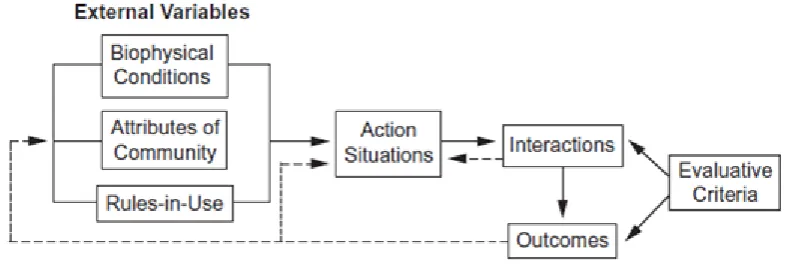
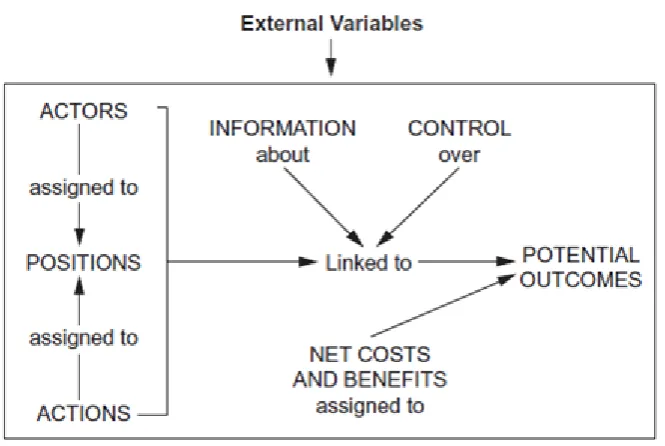
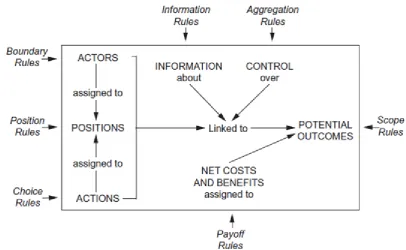
Figure 1: A framework for institutional analysis p. 16 Figure 2: The internal structure of an action situation p. 17 Figure 3: Rules affecting the elements within an action situation p. 22
List of tables
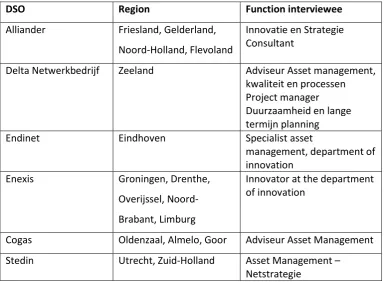
Table 1: Overview of the interviewees p.27
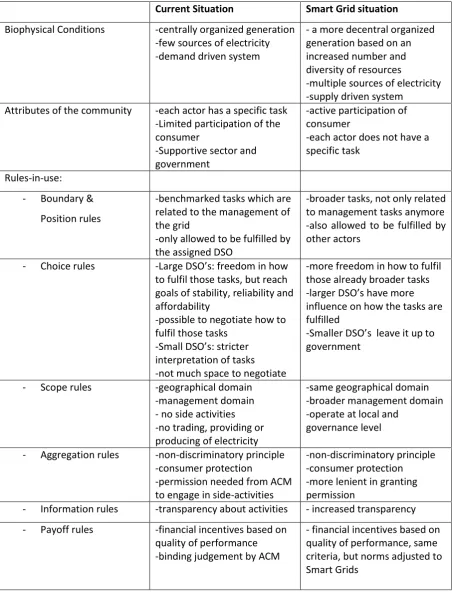
Table 2: Overview of the variables of the IAD framework in both the current
and the Smart Grids context p. 37
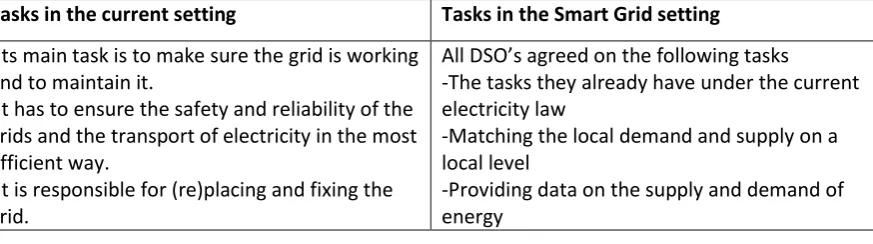
Table 3: Overview of the tasks of the DSO in both the current and the Smart
5 1.Introduction
The Dutch society is currently facing some trends with regard to electricity which could lead to challenges in the demand and supply of electricity. Goals of the European Union (EU) envision a 90 percent reduction of the CO2 emission by 2050. An important way of reaching this goals is to use more renewable resources, according to the EU. It is the Netherlands’ task to make sure that 14 percent of their energy consumption is generated from renewable resources by 2020, as set out in directive 2009/28/EG. This should be even 16 percent by 2023 (SER, 2013). Using an increasing amount of renewable resources such as sun and wind leads to challenges in the electricity supply. Generating electricity from renewable resources leads to a less stable supply of electricity (G. Verbong, Beemsterboer, & Sengers, 2013). This is called the intermittency of renewable resources which means that they are not always able to supply when we need it. Currently we are used to get electricity when we demand it, but sustainable resources are unable to fulfil that need. Renewable resources such as wind and sun supply when they are able to, this is not necessarily the moment we need the electricity. The introduction of new loads such as electrical vehicles and heat pumps and a further electrification of energy consumption are envisioned (G. Verbong et al., 2013). This increased electrification could also lead to challenges in the electricity demand.
The Smart Grids Innovation could be a solution for both the challenges in the demand and supply of electricity and enable the trends with regard to electricity. Smart Grids can be used to control the intermittency of renewable resources and to modify the discrepancy between supply of the renewable resources and the demand of the consumers (G. Verbong et al., 2013). This way the Smart Grid enables the trend and vision of the EU to use more renewable resources. Smart Grids could also be useful for future goals and trends at the demand side of electricity. Smart Grids can enable the use of new loads such as electrical vehicles and head pumps and the Smart Grids can facilitate this envisioned increased electrification of energy consumption (G. Verbong et al., 2013).
6 We are mainly interested in the organizational changes which the Smart Grids brings about and how this affects the netoperator. The term netoperator is a complicated. In the Netherlands a netoperator can be either the regional or the national netoperator. The national netoperator is responsible for the transmission of the electricity, while the regional operator is responsible for distributing the electricity to the consumers in their assigned region. Based on article 2.4 and 2.6 of the Electricity Directive 2009/72/EC the tasks are divided along the voltage lines: the high voltage grid is operated by the Transmission System Operators (TSO’s) and the middle and low voltage grid is operated by the Distribution System Operators (DSO’s). Applying this to the Dutch case, the national netoperator is the TSO. Nevertheless, the Dutch regional netoperators cannot be called DSO’s (yet). In the Netherlands the regional netoperators are currently only responsible for the net, not for the system. That is why they have to be called Distribution Net Operators(DNO’s). However, this is specific for the Netherlands. In international academic literature, they always refer to DSO’s instead of regional netoperators. In order to ensure the international understanding, we therefore chose to also refer to DSO’s.
In 2011 the government of the Netherlands already stated that the implementation of smart grids is necessary in order to benefit optimally from sustainable energy (energie akkoord, 2013). With an eye on the development of smart grids, the Dutch government has made available 22.5 million euro for pilot projects of smart grids ( Energy Report, 2011). This seems like the government is convinced that the future includes inevitably a Smart Grid. The DSO’s are also actively engaging in pilot projects with regard to Smart Grids.
7 This complicated position makes us interested in the DSO. Currently the main task of the DSO is to distribute the electricity to the consumer, but will this still be the main task of the DSO when the conventional grid has been transformed into a Smart Grid? The Smart Grid changes the organization of the grid. Will distributing the electricity still be the main tasks of the DSO after the organization of the grid has been changed due to the Smart Grid? And what does it mean for the position of the DSO? Currently the position of the DSO is described and protected by the electricity law, but what will the position of the DSO be in case of the Smart Grid?
We are also interested in the changes in the interaction of the DSO with other actors. As mentioned in the previous paragraph, the DSO depends on the government and the regulator. Will the DSO still be dependent on them when the Smart Grid is implemented? Furthermore, the Smart Grid enables the consumer to produce electricity, instead of only consuming it. How will this influence the interaction between the two? Therefore, we chose the government, the regulator and the consumer as point of focus.
The government: We will both looking mainly at the Dutch national government, but also at the local government. The national government decides by writing policies and the electricity law what the DSO is supposed to do. Will this interaction remain the same after the Smart Grid has been introduced?
The regulator: The Dutch regulator is called Autoriteit Consument en Markt(ACM). The regulator is responsible for monitoring the activities of the DSO.
Consumer: Currently there is not much interaction between the consumer and the regulator. The DSO connects the consumer to the grid and distributes the electricity to the consumer. The Smart Grid enables the consumer to also produce electricity. How will this affect the interaction between the consumer and the DSO?
1.2 Problem statement
This introduction can be summarized into the following problem statement: The Smart Grid innovation changes the organization of the grid, but what does this mean for the tasks, position and interaction of the DSO?
1.3 Research objective
8 1.4 Research questions
Central research question:
Does the Smart Grid innovation change the position and tasks of the DSO in the management of the
electricity grid and the relationship with the regulator, consumer and government and if yes in what
way?
Subquestions:
Which rules do currently structure the interaction between the DSO and the regulator, consumer and
government within the conventional electricity grid and which currently determine the position and
tasks of the DSO?
Which rules will structure the interaction between the DSO and the regulator, consumer and
government within the Smart Grid context and which rules determine the position and tasks of the DSO
within the Smart Grids context?
1.5 Theoretical framework
This research focusses on the management of conventional and smart electricity grids as an action situation as conceptualized by Elinor Ostrom’s Institutional and Development Framework (IAD Framework). The theory is used as a lens on the changing setting of grid management due to smart grid innovation. The IAD Framework is suitable for the purposes of this research because it conceives an action situation as an institutional setting. With the help of the IAD framework we can define the conventional and the smart grid as an institutional setting, which allows us to analyse changes in the setting and how this will affect the position, tasks, and interactions of the DSO in the management of the grid. Ostrom conceptualizes the action situation as “ a social space where individuals interact, exchange goods and services, solve problems, dominate one another, or fight” (Ostrom, 2011, p 11). For our research the action situation is of particular interest. The institutional rules suggested by Ostrom will be used for this research..
1.6 Methodology
9 The interviews will be used to fill out the action situation as part of the IAD framework. We will interview six of the eight DSO’s in the Netherlands. All of them are involved in the ongoing pilots on smart grids. The people who will be interviewed are the ones who are responsible for innovation within the DSO. They will be either the asset manager or the manager Innovation. We will choose them because innovation is their field of expertise. The questions will address the position and task of the DSO as well as their interactions under condition of the conventional and the smart grid. The interviews, combined with company documents, will be used to fine tune our analysis of the institutional settings. Finally we will complete our analysis and will conclude on the implications of smart grid innovation on the position, tasks, interactions of the DSO.
1.7 Structure of the thesis
10 2.The concept of Smart Grids
2.1 Introduction
The development of Smart Grids is ongoing. Many governments are willing to implement it in their country, but what does a smart grid actually contain? Many different definitions of the smart grids exist. Governmental institutions, the energy sector and academia have shed their light on smart grids. An example from the energy sector is the smart grids roadmap developed by Netbeheer Nederland, an organ representing the largest DSO’s in the Netherlands (Netbeheer Nederland, 2012). The Dutch ministry of economic affairs has described Smart Grids as a necessity to benefit optimally from sustainable resources (Energieakkoord, 2013). Everyone defines it in their own way. Most of the definitions have a technical focus ( for example: (Blumsack & Fernandez, 2012); (R. E. Brown, 2008); (Roncero, 2008)), while some definitions also take the organisational and economical aspects into account (for example: (Wolsink, 2012); (Mah, van der Vleuten, Hills, & Tao, 2012)). As Hledik describes “ Smart Grid means many things to many people”( Hledik, 2009, p.30). When trying to explain the concept to people who never heard of it before, one could explain it as a technical system full of ICT tools and other technology that enables us to use the energy produced by the solar panels of our neighbour directly. This is a very simple definition that does not cover all the aspects of smart grid. To make it a bit more confusing: different terms exist for smart grids such as smart power grid, Future Grid and Intelligent grid (Hassan & Radman, 2010).
11 Furthermore, we will give an overview of the main characteristics. Lastly, we apply the concept to our research by making decisions on it scope and degree of implementation.
2.2 Technological aspects
As already mentioned many conceptualizations of Smart Grids have a technological focus (for example: (Blumsack & Fernandez, 2012; R. E. Brown, 2008; Roncero, 2008). This makes sense because smart technology is essential for the Smart Grid. It is not based on one kind of technology, but rather an integration of different sets of technologies. Roncero distinguished the following: 1) Integrated communications across the grid, 2) advanced control methods, 3) sensing, metering and measurement, 4) advanced grid components, 5) decision support and human interfaces (Roncero, 2008, p. 2). This technology is responsible for making the ‘dumb’ grid a smart grid, or the so called smartening of the grid. An example of a very simple definition with a technological focus is “Smart Grid is simply the application of modern communications infrastructure to various segments of the electricity grid”(Blumsack, 2011, p. 62). One of the reasons why this definition is incomplete, is because it does not explain what the purpose of those technologies is.
12 In general, the goals that the smart grid have to meet is to generate and to distribute electricity more effectively, economically, securely, and sustainably. The grid has to become a “smart” grid, in order to facilitate or handle this (Molderink, 2011). So the purpose of the Smart Grid is to meet those future and current trends and goals.
The following description of Smart Grids is one that both takes into account the smart grid technology and the purpose of the technology. “ A Smart Grid generates and distributes electricity more effectively, economically, securely, and sustainably. It integrates innovative tools and technologies, products and services, from generation, transmission and distribution all the way to customer appliances and equipment using advanced sensing, communication, and control technologies. It enables a two-way exchange with customers, providing greater information and choice, power export capability, demand participation and enhanced energy efficiency” (Scott et al., 2008, p.8).
The previous definition needs some clarification. The beginning of the definition refers to the purposes of the smart grid which already have been discussed in the previous paragraph. To generate and distribute electricity more effectively means that costs will be controlled, the distribution and transmission costs will be kept minimal and the electricity is produced efficiently (National Energy Technology Laboratory, 2009) To generate and distribute electricity more economically means that the grid leads to fair prices and sufficient supplies (National Energy Technology Laboratory, 2009). To generate and distribute electricity securely means that no one is harmed, that it can resist physical and cyber-attacks, and recovers from disturbances(National Energy Technology Laboratory, 2009). To generate and distribute electricity more sustainably means that the grid enables a larger inclusion of renewables sources than before (National Energy Technology Laboratory, 2009).
13 (Wolsink, 2012). Those tools and functionalities enable the use of renewable resources and makes the distribution of electricity more efficient.
In sum, the smart grid enables the integration of different technologies to meet the current trends of more distributed generation of sources with an intermittent character and the goals of generating and distributing electricity more effectively, economically, securely and sustainably.
2.3 Organizational aspects
Although the previous section covers how and for what purpose the smart grid technology is used, there are still some aspects missing. Since our research focuses on the role of the DSO, the organizational aspects need to be part of the conceptualization.
Firstly, the inclusion of sustainable resources leads to a different way of organizing the grid. The current grid is based on more centrally organized generation of electricity, combined with a number of diverse and decentral sources. When electricity is based on renewable resources for the generation of electricity, the organization of the grid changes. The amount and diversity of decentral sources will increase further. The electricity will be generated from different sources such as solar panels and windmills which lead to an even more distributed generation, instead of the current centralised generation with a limited number of decentral resources (Scott et al., 2008).
Secondly, Smart grids creates a change from an one directional to two directional system(Delft, 2012). The ICT technologies enables the bidirectional flows between the consumers and producers of electricity. Those flows concern electricity, but also the flow of information. Through smart meters which function as hubs of data, information is exchanged between the consumers and producers which helps to make sure that the demand and supply of electricity are matched.
Thirdly, the tools and functionalities such as the smart meter and Demand Side Management change the whole system of generation, transmission and distribution from a mainly demand driven system into a mainly supply driven system. The system as we know it now, is mainly focussed on supplying electricity when we demand it. Smart grids is mainly focussing on making sure that the demand follows the supply in order to match the two (G. Verbong et al., 2013).
Fourthly, the ability to transfer the electricity generated by sustainable resources to the grid or to another consumer, changes the position of the consumer. The consumer is in the context of the conventional grid a passive actor who depends on other actors to get electricity. This changes when the grid becomes a smart grid, because it enables the consumer to produce electricity and give this electricity back to the grid. The consumer has the ability to become a producer ( or a so called prosumer) (Molderink, 2011).
14 related to the generation of electricity. This generation could for example take place at the household level, when someone has solar panels and transfer this back to the grid. It could also take place at a larger scale, when someone for example has a larger collection of solar panels and produces more electricity than one household. The business models can also consist of a aggregation of smart technologies. A household can have an electrical vehicle, apply active demand response and solar panels (Ruester, 2014).
Lastly, changes in policies of the government are needed for the introduction, but also for the maintenance of the smart grid. In order to make the introduction of Smart Grids possible, the policies of the national government have to be changed in such a way that they incentivize the actors of the electricity grid to change their behaviour towards a working smart grid. An example of a barrier for the development of a smart grids are the high investment costs(Brown & Zhou, 2013). The national government could help to lower this barrier by determining policies in which investment cost are for example subsidized or make sure that the costs are covered by higher charges. There are many more barriers for the deployment of smart grids and many more sorts of policies that can be used to overcome this, but this will be elaborated in the following chapter. On the other hand, policies have to be changed in order maintain a well-functioning smart electricity grid. An example of this are the regulatory policies on the cooperation and differentiation between the DSO and the TSO (Brown & Zhou, 2013). This is likely to change when the smart grids are introduced and therefore this needs to be reflected in national policy. More of such changes are needed, but this will be explained in a following chapter.
Shortly, the organization of the grid changes due to an increase in the number and diversity of decentral sources of electricity. The system shifts from one directional to two directional, from mainly demand driven to mainly supply driven. The position of the consumer changes from passive to active. New business models will become possible and policies need to be changed. How this influences the other actors that are part of the organization of the grid is still not completely known. In our research we will focus on how this changing way of organizing the grid influences the role of the DSO.
2.4 The vision
15 grid that can cope with current and future problems and needs. By conceptualizing smart grid as a vision, we do not see it as a simple thing consisting of different technologies. This way we can avoid the discussed uncertainties. We see it as a vision to cope with the current trends and the future goals (that we mentioned above), independent of which technology is available today.
2.5 Conclusion
Overview of the main characteristics of the concept of smart grids
- Integration of different sets of technology as key part of the smart grid
- Enabler of current trends and goals. Trends: more distributed generation of resources with an intermittent character. Goals: generate and distribute electricity more effectively, economically, securely, and sustainably
- A mainly decentral organization of the grid, more distributed generation
- From one directional to two direction, from mainly demand driven to mainly supply driven - Consumer becomes prosumer
- Smart grids as a vision for the future defined by goals.
2.6 Application of the concept to our research
16 3.Theoretical framework: The Institutional Analysis and Development framework
3.1 Introduction
In order to analyse how the position of the DSO changes due to the Smart Grids, we need a theoretical framework that we can use as a guide for our research. The framework should guide us in what questions we should ask and which aspects we should take into account. It should help defining the position of the DSO in the conventional electricity grid and the position of the DSO in the smart grid context. It should be a lens through which we can see the changing electricity grid and provide a certain focus for us.
We chose the Institutional Analysis and Development framework (IAD-framework) as developed by Elinor Ostrom as a foundation for our analysis. This is a broad framework which can be used to analyse complex social situations taking into account both physical, cultural and social aspects, by breaking it down into different pieces (Polski & Ostrom, 1999). It is a framework that is meant to make sure that the researcher asks the right questions for her analysis, rather than explaining or prescribing something(Ostrom, Gardner, & Walker, 1994). The first part of this chapter will explain the framework further by introducing the concepts of IAD and its composition. The focus will be on how Ostrom described and meant the framework.
One of the advantages of using the IAD framework for analysis is that it pays attention to cultural aspects that influence a social situation. In the second part of this chapter, we discuss more advantages of using the framework for our research. The framework has been developed by an interdisciplinary collective of social scientists who participated the past twenty-five years in a workshop called Workshop in Political Theory and Policy Analysis (Polski and Ostrom, 1999) and is based on political economy, public choice theory, transaction theory and noncooperative game theory(Ostrom et al., 1994). Over the past years Ostrom and other scholars have reflected upon the framework and based on those reflections, Ostrom decided to make some changes. In the second and last part of this chapter, we will elaborate on how we are going to use the framework and how it applies to our research. We will elaborate on the parts we use for our research and we will explain how we interpreted the framework.
17 3.2 The concepts of the IAD framework and its composition
[image:17.595.79.476.256.390.2]The IAD framework is a broad framework which is meant to analyse complex social problems by breaking it into pieces. It is a mulitier conceptual map because it takes into account both the cultural and physical aspects of a situation, but also the rules that the determine the interaction between actors (Ostrom, 2011). Those variables are mapped in the framework. The figure beneath shows the different components of the framework. It shows how the different components influence the main component, namely the action situation, and the other components. We will discuss each, starting with the action situation.
Table 1: A framework for Institutional Analysis Source: (Ostrom, 2011, p. 10)
Action situation
18
Figure 2: The internal structure of an action situation Source: (Ostrom, 2011, p. 10)
The figure above displays the internal structure of the action arena. It shows how actions and actors are assigned to certain position. And how this position is linked to potential outcomes, influenced by control and information variables and the costs and benefits that are assigned to it. The different concepts are defined in the following way:
Positions
A position is a place in the process that a participant holds. This place is associated to the participants with an authorized set of actions. “Positions are simply place holders to associate participants with an authorized set of actions (linked to outcomes) in a process”(Ostrom, 1994, p.30). The other elements within an action situation determine the position of the participant and what capabilities and limitations this position contains (Ostrom, 1994). Within the IAD framework, the focus is on what actions a participant in a certain position would take rather than on what an individual participant would do (Ostrom et al., 1994). Thus, it is the structure consisting of different variables that determines what position a participant has and what this positions means. So in order to describe the position of an actor completely, all other components need to be taken into account.
Action
19
Potential outcomes
The potential outcomes are “the outcomes a participants can affect through their actions” (Ostrom, 1994, p.31) To put it differently, the outcomes are the results of different actors interacting with each other in a certain institutional setting. The potential outcomes are the possible results of the interaction between the actors.
Information
This is the amount of information available to an actor in a certain position at a certain moment in the process. It is for example possible that an actor has incomplete information due to a certain rules (Ostrom, 1994).
Level of Control
This refers to the degree of control participants have over the other components of the action situation (Ostrom, 1994).
Costs and Benefits
This refers to the costs and benefits assigned to actions and outcomes. It assigns positive or negative weight to actions and outcomes (Ostrom, 1994).
3.3 Remaining components of the IAD-framework
Patterns of interaction
Patterns of interaction are the structure of the action situation that determine the behaviour of the actors. Based on the behaviour of the actors and the conduct within the action situation, the patterns of interaction can be found (Polski and Ostrom, 1999). Those structures become clear after doing an IAD analysis looking at all the elements discussed above.
Outcomes
The outcomes of an action situation are determined by all the different elements discussed above.
Evaluative Criteria
Ostrom distinguished the following evaluative criteria which can be both used for evaluating outcomes and the process of achieving outcomes: Economic Efficiency, fiscal equivalence, redistributional equity, accountability, conformance to values of local actors and sustainability (Ostrom,2011, p. 16). She focussed on those criteria, but it is also possible for a researcher to use her own criteria (Ostrom, 2011).
3.4 External variables
20 the types of action an actor can take, what the costs and benefits of those actions will be, and what the outcome of those actions will be (Ostrom, 2007).
Biophysical conditions
Ostrom described the biophysical conditions also as physical and material conditions which she defined “the physical and human resources and capabilities related to providing and producing goods and services. These conditions include production inputs like capital, labor, and technology, as well as sources of finance, storage, and distribution channels” (Polski and Ostrom, 1999, p. 9). The physical world is an important variable influencing the action situation. The physical and material characteristics and their changes can be seen as variables that condition what is possible in the action situation. Furthermore, the physical world determines the possibility of all the different aspects of the IAD-framework (Ostrom, 2007).
Attributes of the community
This set of external variables is socially and culturally oriented. They are related to the culture and community in which the action situation is located (Ostrom, 1994). Facts such as how a community demographically is organised, what norms with regard to politics exist in a community, what degree of common understanding participants have about political activities are attributes of a community which influence an action situation (Polski & Ostrom, 1999).
Rules-in-use
The rules-in-use in an action situation are the rules that determine the behaviour and interactions of the actors. “Rules are shared understandings among those involved that refer to enforced prescriptions about what actions (or states of the world) are required, prohibited, or permitted” (Ostrom, 2011, p. 17). The IAD framework will be used in the first place to analyse the working norms and rules that the actors use to make decisions. Working norms and rules are the rules actors will refer to when they try to justify and explain their actions and decision to other actors (Ostrom, 2011). Those rules create a certain order and predictability in an action arena.
3.4 How the framework will be used and why
After giving a description of the fundamental part of the IAD- framework, this part of the chapter will explain why this framework has been chosen and how it will be used.
21 for us. The IAD-framework is a foundation for our analysis. It is a broad framework which can be used to analyse complex social situations taking into account both physical, cultural and social aspects, by breaking it down into different pieces (Polski and Ostom, 1999). It is a framework that is meant to make sure that the researcher asks the right questions for her analysis, rather than explaining or prescribing something
For this kind of research, there are more theoretical frameworks to choose from, for example the Multi-level perspective as used and described by Verbong and Geel (for example: (Geels, 2005);(G. P. Verbong & Geels, 2010)). The multilevel perspective helps to understand how transitions take place as an interplay between technology and society. It takes into account multiple levels of society and different dynamics(Geels, 2005). Since it takes into account both society and technology, it could be suitable for our research because Smart Grids are a combination of technology and societal aspects. Nevertheless, Multi-level Perspective does not focus on the rules that shape the actions in the institutional setting, which the IAD framework does. Other reasons for choosing for the IAD framework and the advantages of it will be discussed in the remainder of the chapter.
The fact that the IAD framework is an institutional framework is also an important reason for using it. It is an institutional framework in the sense that it identifies the main structural variables that are present in all institutional arrangements, but the degree to which those are present in an arrangement differs (Ostrom, 2011). This is useful for our research because we can apply it to the situation before and after the introduction of the Smart Grid. We will be looking at how the position, tasks and interactions of the DSO in the management of the conventional electricity and the smart grid changes. We will analyse to what extent the structural variables distinguished by Ostrom are present and in what way. Focussing on the same variables enables a comparison between the situation before and after the introduction of the Smart Grid. It enables a comparison between the two institutional settings.
22 what kind of position in the management of the grid and what kind of position does the actor has towards the other participants. A set of allowable actions:the actions the participants are allowed to take and how this is linked to the outcomes of the process. We will look at which actions the actors are allowed to take with regard to the management of the grid and how this influence how the grid is managed in the end. The potential outcomes and how this is linked to the actions taken: how do the actions that have been taken influence which outcomes are possible. The degree of control each actor over choice: to what extent are actors able to choose which actions they take and to what extent are they able to change this. The information available: what do and are the actors able to know about the structure of the action situation. The costs and benefits: the positive and negative weights which can be assigned to the potential outcomes, those can also be seen as incentives or deterrents of the outcomes. The description of these variables forms the structure of the action situation, which we use as an institutional setting. This analysis will be done in the case of the conventional electricity grid, but also for the electricity grid in the smart grid context.
23 institutional setting functions. By both describing the attributes of the community and the rules in use, the IAD framework allows us to analyse the influence of culture and traditions for the management of the electricity grid and the interactions between its actors. Taking all three variables together shows us the context in which the DSO operates and interacts with the other actors.
[image:23.595.102.509.306.556.2]An important point of our research are the working rules that Ostrom defines as the rules to which actors refer when they explain or justify their actions and decisions(Ostrom, 2007). Those working rules can be identified by examining how those rules influence the variables in the action arena. Together with the biophysical conditions and the attributes of the community, those working rules explain the actions of the actors in the action situation. Therefore, we will after examining the biophysical conditions and the attributes of the community, analyse the working rules that affect the management of the grid. Ostrom distinguished seven types of working rules which influence the structure of the action situations, as shown in figure 3 below.
Figure 3: Rules affecting the elements within an action situation Source: (Ostrom, 2011, p. 20)
We will discuss each rules, explain how we understood it and how we are going to apply it to our topic.
24
Position rules: Those rules are related to the boundary rules. They determine what kind of position an actor has and what kind of positions exist in an action situation. Those rules also determine how an actor leaves or enters such a position. Ostrom shares this in her book under boundary rules (Ostrom, 1994), but in her most recent article under position rules (Ostrom,2011), therefore we also decided to share it under position rules. In our research those rules mean that we have to look at what kind of positions there are with regard to the electricity grid. What kind of position does the DSO have? What positions do the other actors have. What rules determine those positions? And how can the actors change from position? In figure 3, the position rules are related to the positions.
Choice rules: Choice rules are related to the position rules. Those rules determine what kind of action an actor in a certain position at a particular point may or must (not) take (Ostrom, 2011). So which kind of actions are considered appropriate for which position? What is considered forbidden, mandatory or authorized? In figure 3 the choice rules are linked to the actions. Applying this to our research, we have to figure out which actions relate to which positions regarding the management of the grid. Which actions are considered appropriate for the DSO and the other actors? In what position should an actor be to determine how the grid is managed?
Scope rules: Those rules are related to the potential outcomes in the action situation as shown in figure 3. They determine which potential outcomes may and can be affected (Ostrom, 2011). In our research we have to investigate what the scope is of the actors and which rules delimit that. Are there rules that determine what domain of the management of the grid belongs to what actor? Does the scope of the actors change after the Smart Grid?
Aggregation rules: Those rules are linked to the control an actor has over its actions. Aggregation rules influence the degree of control actors in a certain position have in the selection of its actions on a certain moment in the process (Ostrom, 2011). Applying this to our research means that we have to look at what the weight of the vote of each actor is in deciding how the grid is managed. We have to think of the following questions among others. Do the tasks that the DSO fulfils for the grid depend on rules? Does the DSO need permission to take action? Does the choice for Smart Grids depend on permission from others?
Information rules : This refers to the rules that affect the knowledge that is available to the actors at each position, at each decision moment (Ostrom, 1994). For our research we must figure out which rules determine what information actors have before they take a decision. Are there rule which force actors to make information public? Do the actors have full information about all aspects of the electricity grid?
25 set of actions taken and outcomes reached” (Ostrom, 1994, p. 42). Applying this to our research means we have to ask the following questions among others: who monitors the tasks of the DSO? Are there sanctions imposed when the DSO performs its task insufficiently? Does the DSO receive rewards for sufficient performance? Who imposes those sanctions and rewards? Does this change in case of the smart grid?
Those rules are related to each other and the effect of one type of rules also depends on the effect of the other types of rules. Therefore, it is the effect of those seven types of rules that affect the seven elements of the action situation (Ostrom, 1994). The effect of a change in one of the rules depends also on the other rules-in-use (Ostrom, 2011). By describing those rules, we are able to explain which rules currently structure the interaction between the DSO and the regulator, consumer and government within the conventional and smart electricity grid and which rules currently determine the position and tasks of the DSO.
26 4.Methodology
4.1 Introduction
Our methodology consists of both qualitative research methods and literature study in order to answer our research question. As already mentioned in the previous chapter, the IAD framework of Ostrom will be the foundation of our research. We focus on the external variables and the composition of the action situation as an institutional setting. In order to get the required data, we will do a literature study and interviews. The interviews will be semistandardized and consist of open ended question. The literature is related to the social, cultural, physical and rule-oriented aspects of the context and institutional setting in which the DSO operates. This chapter is structured in the following way. The first part will elaborate on the research design. The second part focusses on the data collection. It sets out how the data is collected and why we chose for these methods. The last part explains how the collected data will be analysed.
4.2 Research design
The research design for our research can be described as an embedded case study. “A case study is an empirical inquiry that investigates a contemporary phenomenon within its real-life context, especially when the boundaries between phenomenon and context are not clearly evident” (Yin, 1994, p. 13). Each case study consists of a DSO and its management of the electricity grid. The DSO’s have been selected based on the following criteria; geographical workingfield of the DSO and the commodity for which the DSO is responsible. The geographical workingfield of the DSO is taken into account due to time and financial constraints. We only looked at Dutch DSO’s. The commodity is a selection criteria because we only focus on the smart grid for electricity.
It is an embedded case study because we focus on multiple units within the case study. We are looking at how a DSO manages the grid, but also on how the DSO perceives its role and tasks. We will conclude our research by comparing the management of the current electricity grid with the management of the Smart Grid.
4.2.1 Data collection
27 structure the interaction between the DSO and the regulator, consumer and government in both situations. All this happens in a context. To understand this context, Ostrom has described external variables. We will look at those external variables in order to find out in which context the DSO operates and how this will change due to smart grids. This context together with the rules help us to determine how the position and tasks of the DSO in the management of the electricity grid and the interaction with the regulator, consumer and government change due to Smart Grids.
4.2.2 Literature study
The literature study will be used in two ways in this research. Firstly, it will be used to describe the external variables that have been distinguished by Ostrom. In her IAD framework, Ostrom refers to the biophysical conditions, attributes of the community and rules-in-use as the external variables which influence the behaviour of the actors in the action situation. We will try to describe the biophysical conditions under the conventional grid and how this changes due to smart grids by using literature, focussing on material, physical and the rule-oriented aspects of managing an electricity grid. We will set out the attributes of communities in the conventional electricity grid and how this changes due to the smart grid by using literature, focussing on the role of consumer and the public opinion on sustainable energy. We will explain the rules in use only partly based on literature, because it is not possible to describe the informal working rules based on literature. The formal rules will be explained by referring to government policies and company documents. We will be looking only at the government policies and regulation which are available until August 2015. We are aware of the fact that changes are upcoming1, but those are not part of our research. Based on a literature study we try to make clear what the context is in which the DSO operates. Keeping the biophysical conditions, the attributes of the community and the rules in use in mind, we describe what the literature says about those aspects. We will do this for both the conventional situation and the smart grid situation. It basically explains the changing world in which the DSO functions.
The second way in which we will use literature study is a more exploratory way. We will use it for our research is to prepare our interviews. We will study company documents of the DSO to see what their developments are on Smart Grids. We will look at what steps they already have taken towards Smart Grids. We want to know what their perspective is on Smart Grids. Besides studying the company’s documents and website, we will also study the literature that is available on the DSO and Smart Grids and the related aspects. This data contains background information on which problems
1 Currently the Dutch government is working on the development of STROOM which might change the rules of
28 the DSO’s are facing and make prediction on the position of the DSO in Smart Grids. Just as already studying the company’s websites and documents will makes us better prepared for the interviews, so will studying literature. During the interviews we can reflect on what we have studied before. We can test what has been described in literature.
4.2.3 Interviews
The interviews will be a tool to fill out the action situation as part of the IAD framework. The action situation consists of different components. Each of them will be discussed. Our focus will be on the rules that are related to those components. Ostrom distinguished seven types, each of them is related to one of the components. By interviewing Dutch DSO’s, we will try to get to know the rules that exist in the management of the conventional grid. We will do the same for the management of the smart grid.
[image:28.595.71.459.452.734.2]We will interview six of the eight Dutch DSO’s. In the Netherlands each DSO has its own region in which it operates. The DSO’s are all in some way involved in Smart Grids. They have pilotprojects, either on their own or in cooperation with other DSO’s. The people we will be interviewing will be either the or the manager innovation or the asset managers of the DSO. We chose them because they are responsible for the strategy and development of the DSO. They are in charge to decide which direction the DSO will go and what the DSO will do with regard to Smart Grids.
Table 1: Overview of the interviewees
DSO Region Function interviewee
Alliander Friesland, Gelderland, Noord-Holland, Flevoland
Innovatie en Strategie Consultant
Delta Netwerkbedrijf Zeeland Adviseur Asset management, kwaliteit en processen Project manager Duurzaamheid en lange termijn planning
Endinet Eindhoven Specialist asset
management, department of innovation
Enexis Groningen, Drenthe,
Overijssel, Noord-Brabant, Limburg
Innovator at the department of innovation
Cogas Oldenzaal, Almelo, Goor Adviseur Asset Management
Stedin Utrecht, Zuid-Holland Asset Management –
29 We chose interviews as a research method because we believe it is the best way to understand how the DSO perceives and encounters the management of the grid and the Smart Grid. Interviews are a tool to get to know the subjective understanding of actors. By interviewing actors, a researcher can get to know the context of the actor’s behaviour. The researcher gets to know what kind of meaning an actor gives to its behaviour and experience (Seidman, 2006). This is what we need for our research. We want to get to know the working rules that determine the position of the DSO and that structure the interaction of the DSO with the other actors. Those working rules are the rules that an actor refers to when she wants to explain or justify her actions and decisions (Ostrom, 2011). Those rules are informal and unwritten. Only by asking the relevant actors which informal rules exist, we can get to know those rules. Posing questions, should help us understand what meaning actors give to certain actions and rules.
We chose face to face, semi standardized interviews with open ended questions as our form of posing questions. We could have chosen for a survey, but that would only have made clear the role of the DSO and the interaction with other actors. It would not have made clear the working rules behind it. Interviewing face to face with open ended questions enables us to understand why actors act in a certain way and which rules are behind that action. The interviews will be semi standardized. This means that the major part of the questions will be determined before the interview, but during the interview additional questions can be asked. The questions will be related to the seven types of working rules as determined by Ostrom, but also to the external variables. It will question what the DSO’s mean by a Smart Grid and how they perceive the function of Smart Grids. The questions will be open ended to give the interviewees the opportunity to express their views.
4.3 Shortcomings
This way of collecting data has some shortcomings. In the first place, the perspectives which the interviewees describe are only the perspectives of the DSO. How the management of the grid is going to develop and what the tasks and position will be in this management, does not only depend on the what the DSO envisions. Especially the government and the ACM are important actors in this. In the interviews the larger DSO’s expressed their wish to facilitate the transition to Smart Grids. Does the government agree with this? The same goes for the consumer. The DSO’s expect the consumer to become active, produce electricity and cooperate closely with the DSO. But is this what the consumer will actually do? Those are all point for further research.
30 still investigating what a Smart Grid will actually look like for them. It is still difficult for them to describe adequately what a Smart Grids is and what it looks like. The answers they gave are still vague and superficial. Furthermore, the description differed among the DSO’s. The DSO’s are still investigating what the right way of organizing the Smart Grid. By engaging in pilotproject, the DSO’s are figuring out what their role could be and how they should cooperate with other actors in Smart Grids. The DSO’s also disagree on the necessity of Smart Grids. One of the smaller DSO’s stated that the IT application which are needed are not per se cheaper than enlarging or thickening the cables, while other DSO’s do state this is cheaper. Those uncertainties create a limitation for our research. The answers the DSO’s gave do not have to be the direction they will eventually take because they are still investigating what the right direction is.
4.4 Data analysis
The data retrieved from the interviews and the literature study will be used to fill out the IAD-framework of Ostrom. Based on the literature study and the interviews, we will describe the changing context by looking at the biophysical conditions, the attributes of the community and the rules in use. Those external variables show in what kind of changing context the DSO is operating and what is possible in the action arena. The data retrieved from the interviews will be used to determine the working rules that structure the action situation. It will show in what kind of institutional setting the DSO operates and what rules structure the tasks, position and responsibilities of the DSO and its interaction with the other actors. This will be done for the case of the management of the conventional electricity grid, but also for the management of the smart grid.
31 5. Analysis
5.1 Introduction
This chapter provides an analysis of the collected data in order to answer the main research question which stated: Does the Smart Grid Innovation change the position and tasks of the DSO in the management of the electricity grid and the interactions with the regulator, consumer and the government and if yes in what way?
The collected data consists of interviews with six Dutch DSO’s, the Dutch electricity law and literature. The interviews are the most important source for the analysis. Using the Institutional Analysis and Development framework of Elinor Ostrom we will figure out which rules structure the interaction between the DSO and the regulator, consumer and government and which rules determine the position and tasks of the DSO in the current setting and in the Smart Grids setting, as stated in the subquestions. The biophysical conditions, attributes of the community and the rules-in-use form together the context in which the DSO functions and interacts with other actors. As set out in the theoretical chapter, we will mainly focus on the rules which structure the interaction in the action situation. Those rules determine what is taking place in the action situation. Therefore we will start this chapter by explaining if and how the institutional setting of the DSO changes due to the Smart Grids Innovation. The institutional setting determines what the DSO is able to do. Therefore we describe how the tasks, position and interactions of the DSO changes based on the changed institutional setting. Each of the following sections will discuss respectively if and how the position, tasks and interactions of the DSO with the regulator, consumer and government change due to the Smart Grid innovation. In the analysis a distinction is made between the larger and smaller DSO’s because they interpreted their institutional setting in a different way. The larger DSO’s are Alliander, Enexis and Stedin, the smaller are Cogas, Endinet and Delta Netwerkbedrijf. It is important to note that our analysis is mainly based on the ideas that the DSO’s expressed during the interviews. This results in a analysis on how the Smart Grid is likely to change the position, tasks and interactions of the DSO based on the ideas of the DSO and the literature.
5.2 The expected changes under the Smart Grid
As shown in figure 1 in the theoretical chapter, the biophysical conditions, attributes of the community and the rules-in -use influence the institutional setting of the actor.
32
Table 2: Overview of the variables of the IAD framework in both the current and the Smart Grids context
Current Situation Smart Grid situation
Biophysical Conditions -centrally organized generation -few sources of electricity -demand driven system
- a more decentral organized generation based on an increased number and diversity of resources
-multiple sources of electricity -supply driven system
Attributes of the community -each actor has a specific task -Limited participation of the consumer
-Supportive sector and government
-active participation of consumer
-each actor does not have a specific task
Rules-in-use: - Boundary &
Position rules
-benchmarked tasks which are related to the management of the grid
-only allowed to be fulfilled by the assigned DSO
-broader tasks, not only related to management tasks anymore -also allowed to be fulfilled by other actors
- Choice rules -Large DSO’s: freedom in how to fulfil those tasks, but reach goals of stability, reliability and affordability
-possible to negotiate how to fulfil those tasks
-Small DSO’s: stricter interpretation of tasks -not much space to negotiate
-more freedom in how to fulfil those already broader tasks -larger DSO’s have more influence on how the tasks are fulfilled
-Smaller DSO’s leave it up to government
- Scope rules -geographical domain -management domain - no side activities -no trading, providing or producing of electricity
-same geographical domain -broader management domain -operate at local and
governance level - Aggregation rules -non-discriminatory principle
-consumer protection
-permission needed from ACM to engage in side-activities
-non-discriminatory principle -consumer protection -more lenient in granting permission
- Information rules -transparency about activities - increased transparency - Payoff rules -financial incentives based on
quality of performance -binding judgement by ACM
- financial incentives based on quality of performance, same criteria, but norms adjusted to Smart Grids
33 5.2.1 Biophysical conditions
The changing biophysical conditions have a lot of influence on the institutional setting of the DSO. Firstly, the organization of the grid changes due to the inclusion of sustainable resources. The current grid is mainly centrally organized generation of electricity with already a number of decentral and distributed resources. When electricity is based on renewable resources for the generation of electricity, the organization of the grid changes. The number and diversity of electricity resources will increase further. The electricity will be generated from even more different and decentral sources such solar panels and windmills which lead to a more distributed generation(Scott et al., 2008). This leads to a bigger challenge for the DSO, since they have to distribute the electricity from an increased number of diverse and decentral resources in the Smart Grid setting.
Secondly, the system changes from a one directional to a two directional system due to the Smart Grids innovation (Delft, 2012). The ICT technologies enable the bidirectional flows between the consumers and producers of electricity. Those flows concern electricity, but also the flow of information. Through smart meters which function as hubs of data, information is exchanged between the consumers and producers to make sure that the demand and supply of electricity are matched. This means that the DSO gets an extra tasks in distributing the flows of information. Furthermore their tasks in distributing the electricity gets more complicated since the flows of electricity are coming from two ways instead of one.
Thirdly, the whole system of generation, transmission and distribution changes from mainly demand driven into a mainly supply driven due to the tools and functionalities such as the smart meter and Demand Side Management. The conventional system supplies electricity when we demand it. Smart grids is mainly focussing on making sure that the demand follows the supply in order to match the two (G. Verbong et al., 2013) This shifts also the way of distributing of the DSO from demand driven to supply driven.
In sum, the biophysical conditions change due to Smart Grids and this has influence on the institutional setting in which the DSO functions and interacts. The institutional setting changes due to an increased number of diverse and decentral sources of electricity. It shifts from a mainly demand driven system based on one directional flows to a mainly supply driven system based on two directional flows.
5.2.2 Attributes of the community
34 The electricity community in which the DSO functions is organized in such a way that each task within the electricity cycle is executed by a different actor. The following tasks can be distinguished : distribution of electricity, trade in electricity, and the provision of electricity. When one actor is committed to executing one of the tasks, it is not allowed to execute one of the other tasks (electricity law, art. 10. B)
The DSO is responsible for the distribution of the electricity. A distinction has to be made between the regional and national netoperators. The national netoperator is responsible for the national transmission of electricity, while the regional netoperators(also called Distribution Network Operators) are responsible for distributing the electricity to the consumers. Due to Smart Grids the regional netoperators will turn Distribution System Operators (Veldman, 2013). This means the regional netoperator will have the responsibilities which it already had when it was still a DNO, but will also have additional tasks which belong to the DSO2. This will be elaborated in the section about the tasks of the netoperator. Those additional tasks are also tasks which currently belong to other actors in the electricity community. This shows that the actor in the electricity cycle will no longer have one specific task due to Smart Grids.
Another major change which will take place in the community of the DSO due to Smart Grids is the increased involvement of the consumer. The DSO’s expressed in the interviews that the majority of the consumers is not interested in energy, as long as it works properly and is cheap. One interviewee described consumers as passive. Currently the DSO’s are trying to engage the consumer more in energy transition. They are offering the consumer smart metering which enables the consumer to get more knowledge about their electricity use. Moreover the DSO’s invite consumers to participate in pilotprojects. This increases the active participation of consumers in the electricity process. This means the connection between the DSO and the consumer is getting a bit closer. The introduction of Smart Grids will increase this even further. Due to smart applications the consumer will be more involved in electricity. They will get insight in the demand and supply of electricity and can adjust their behaviour to it.
Although the individual consumer is not very interested in Smart Grids according to the DSO’s, the Dutch government and the electricity sector are exploring the possibilities of Smart Grids. In 2011 the government of the Netherlands already stated that the implementation of smart grids is necessary in order to benefit optimally from sustainable energy (energie akkoord, 2013). With an eye on the development of smart grids, the Dutch government has made available 22.5 million euro for pilot projects of smart grids ( Energy Report, 2011). Netbeheer Nederland ( the overarching organization for Dutch DSO’s) published a Roadmap for Smart Grids in which they portray the implementation of Smart
35 Grids as desirable and necessary (Netbeheer Nederland,2012) They also stress the importance of cooperation between the different actors.
Those changing characteristics of the community due to Smart Grids influence the institutional setting of the DSO. The consumer becomes more involved, an actor has no longer one specific task and Smart Grids are supported by the government and overarching organization for Dutch DSO’s.
5.2.3 Rules-in-use
The rules which have been distinguished by Ostrom influence the institutional setting of the DSO. By describing how those rules change due to Smart Grids, we will explain how the institutional setting of the DSO changes due to Smart Grids. Those rules govern the institutional setting, therefore also determine what is possible in the institutional setting.
Position and boundary rules: Those rules determine what the position of an actor is and what this position means. Those rules can be found back in the Dutch electricity law (elektriciteitswet 1998) which is the backbone of the institutional setting of the DSO. The details of this law determine the position of the DSO in the electricity cycle. The law clearly describes what a DSO is and which tasks belong to this position. Those tasks are all related to the management of the electricity grid. The law benchmarks those management tasks for the DSO and protects the position by only allowing the assigned DSO to fulfil those tasks. Other DSO’s or actors are not allowed to fulfil those tasks. Each actor in the electricity cycle has its own tasks and is not allowed to take up tasks from other actors. An actor can become a DSO if the actor is assigned by the owner of the grid as the DSO. This assignment is for ten years and has to be approved by the Dutch minster of economic affairs (art. 12 electriciteitswet, 1998).
The Smart Grid will change the boundary and position rules. Those rules will become broader. One the one hand, this is due to the fact that Smart Grids will create more tasks for the DSO than in the conventional grid. Those tasks will not be only related to the management of the grid anymore. So the rule that the DSO is only allowed to fulfil tasks related to the management of the grid seizes to exist. On the other hand the boundary and position rules become broader due to the fact that the tasks of the DSO will not only be allowed to fulfilled by the assigned DSO anymore. For example, one of the interviewees from a smaller DSO saw the possibility to transfer IT related tasks to companies which are specialized in IT applications.
36 goals for the management of the grid. As long as they are able to reach those goals, they can fulfil their tasks in any way they want. The larger DSO’s also negotiate with the ACM about how they are fulfilling their tasks. The smaller DSO’s interpret the choice rules differently. They see the description of the tasks in the electricity as strict and binding. They do not feel the freedom to fulfil their tasks in any way they want as long as they meet the criteria of the ACM. They also do not negotiate with the ACM directly on how to fulfil their tasks.
In the Smart Grids context the DSO’s will have more freedom in how to execute their tasks, but they still have to meet the goals of stability, safety and affordability. This enlarged freedom is based on two developments. Firstly, Smart Grids provide the DSO with more tools to fulfil its tasks. This enables the DSO to execute its tasks in different ways. Secondly, the DSO’s want to provide more input on how the smart grid should be managed in the best way. Before the implementation of Smart Grids, the DSO’s frequently engaged in pilotprojects which taught them many lessons on what the best way is to organize a Smart Grid. Based on this knowledge and experience, the larger DSO’s will have more freedom in how to manage the grid, meeting the goals of stability, safety and affordability, according to the expectancy of the DSO’s themselves. The smaller DSO’s encounter this in a different way. They want to share their experience with the government and the ACM, but leave it up to them to decide how the tasks should be fulfilled. So the choice rules become broader.
37 The introduction of Smart Grids will make some changes in the scope rules. The geographical domain of the DSO will remain the same. However this does not mean that this whole geographical area will be covered by Smart Grids. The DSO’s want to determine per case if smartening the grid is the best solution. The domain of the DSO in the electricity cycle does get broader due to the broader amount of tasks. Those tasks are not only related to the traditional management of the grid anymore. On the one hand the DSO’s are going to operate on a more local level at which they are responsible for matching local demand and supply. On the other hand the larger DSO’s also want to operate on a higher level. They want to have a role in facilitating the transition and operationalisation of Smart Grids, as shown in the interviews. This means they will also operate on a governance level. The current rule which states that DSO’s cannot engage in side-activities outside their tasks as described in the electricity law should also be more loosen. Smart Grids is an ongoing development which needs constant research from the DSO to find out what is the best way to use it. This research has to be done in experiments which are on top of their traditional tasks.
Aggregation rules: Those rules show whether the tasks which the DSO fulfils are dependent on rules. The tasks which the DSO fulfils are indeed dependent on rules. DSO’s have to take into account the non-discriminatory principle. This means they are not allowed to provide goods and services which makes them compete with others (art. 17). This non-discriminatory principle also means that the DSO is obliged to connect the consumer to the grid. Consumer protection is covered in the electricity law. It makes for example sure that the DSO sets fair conditions which are reasonable and enables the consumer to easily lay down a complaint about the DSO (art. 95).