P.
lt/
ll
z>t
European Communities
EUROPEAN
PARLIAMENT
Wbrking
Documents
1980
-
198 130 October l9t0
72
t
DOCUMENT t-521/80
Report
drawn up on behalf of the Committee on Energy and Research
on the proposd ftom the commission of the Eutopean Communities to
the Council (Doc. l-75D/7g)fo, g,'/rnuldannual Community
programme of research and development in biomolecular engineering
(indirect action lgEl- 1985)
Rapporteur: Mr G. SCHMID
By letter of L2 February 1980 the Council of the EuroPean t/
co^ unities requested the European Parliament to deriver an opinion on
the proposal from the commission of the European communities to the
Council (Doc. L-750/7g) for a multiannual Community Progralnme of research
and development in biomolecular engineering (indirect action 1981-1985)'
The president of the European Parliament referred this proposal to
the committee on Energy and Research as the committee resPonsible, aod
to the committee on Budgets, the committee on Economic and Monetary
Affairs and the Committee on the Environment, PubIic IIealth and Consumer
Protection for their oPinions.
on 21 February 1980 the Committee on Energy and Research appointed
Mr Sclrmid raPPorteur.
It considered the rePort at its meeting of 23 september 1980 and
adopted the motion for a resolution unanimously'
present: Mrs waIz, chairman; Mr Gallagher, l{r rppolito and
IvIr Normanton, vice-chairmen; Mr Schmid, rapporteur; Mr Adam, Mr BeazIey,
Mrs Bonino, Mr Calvez (deputizing for Mr Pintat), !1r Croux, Mrs Dekker
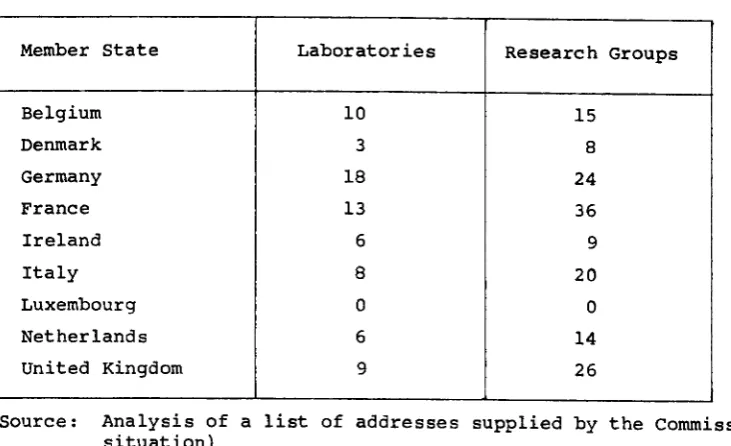
(deputizing f or Irlr capanna ) , Mr Hof fmann (dePutizing f or Mr Fuchs ) ,
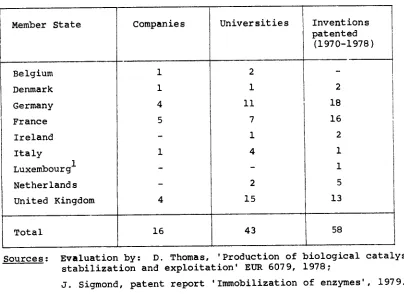
Mr KeIlett-Bowman (depLrtizing f or Mr Seligman), t'lr Linkohr, Mr Morelarrd
(deputizing for sir Peter vanneck), Mr Mi.llIer-Hermann, Mr Price, Mr purvis, I,lr Rinsche, Mr sdlzer, Mr sassano and t'lr veronesi.
The opinions of the committee on Budgets, the committee on the
Environment, Public Health and Consumer Protection and the Committee on
Economic and Monetary Affairs are attached.
CONTENTS
Page
A. MOTION FOR A RESOLUTION ... 5
B. EXPLANATORY STATEI,IENT .. 9
I. Molecular biology and its possible uses . 9
II. The need for, possible uses and limitations
of a Community research programme 19
III. Difficulties in realizing the aim of the
programme 27
IV. The plan for six research projects 3l
V. The Commission's proposal for implementing
the programme . 33
VI. Infringement of Parliament's budgetary
polrers by the Council . .. . .... 41
ANNEX: Acknowledgements and bibliography .. 42
Opinion of the Committee on Budgets ... 44
Opinion of the Committee on the Environment,
Public Health and Consumer Protection .. 56
Opinion of the Committee on Economic and
Monetary Affairs .. 5j
t\
The Committee on Energy and Regearch hereby submits to the European parliament the following motion for a resolution, together wlth explanatory statement:
r,rQrIoN FoE jl RESOLUTTON
embodying the opinion of the European Parliameot on the proposal from the
Commiseion of the European Comrnunities to the Council for a multiaonual
Community programme of research and development io biomolecular engineering
(indirect action 1981-1985)
@,
- having regard to the proposal frrxr the commission of the European
Cornmunitiea to the Council (COM(79) 793 f j.na1),
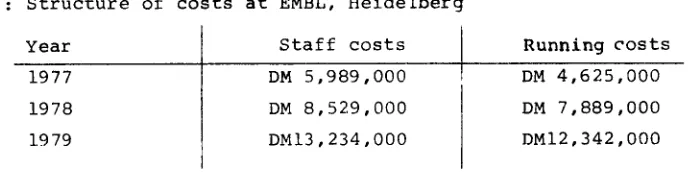
- having been coneulted by the Council (Doc. L-75O/79\,
- having regard to the opinion of the Economic and Social Committee
'I
(cES 5ssl80)',
- having regard to the report by Mr N. RALFOUR on the communication frorn
the Commiesion to the Council concerning convergence and budgetary
questione (Doc. 1-135/80),
- having regard to the draf,t council recommendation concerning the
registration of recombinant DNA (deoxyribonucleic acid) work
(poc. L-448/8o\ ,
--
-'
.havinqrcaardtoLherePortoftheComtniEceeonEnerqvandReeearctrand tlre oSriniorrs of t,he conrmitt('c on lludgeLs, the conrmi-ttee on the Environment'
publrc lteaIEh and Consltmer Protection and the Corunittee on Economic and
HonetarY Affairg (Doc. 1-52Il80)'
1. Recognizes the poseible value of the application of molecular biology in
industry and agriculture but drawa attentlon to the conjectural risks of
genetlc engtneering;
2. Recogrnizee that increaeed reaetrch in t'hiE field brings cloEer the
poesi-bility of, manipu).ating human gones and demande an early discussion of the
conseguenceg thereof;
I
o,: oto.c
230, 8.9,1980, p.1I3. Consider8 that it would be ugeful to have a com$unity resetrch programme
in the field of biotcchnology a8 an indlrect action with a view to:
- the future poeition of Europe on the world market'
- cloeing the gap betwcen the varying levels of econonic develolment in
the !,iember States of the Cotmunity,
- the contribution of a research programne to the harmonization of safety
giuidelines for recornbinant DNA work'
- the gocial demand for the medical application of biotechnology;
4. Demands however that by 1983 the Comnission should clearly establish the
economic and social demand and the eocial effects of the increaaed use of
biotechnology;
5. Calls on the conmlgelon to tightcn up the prograntnG, definc clear goals
and in so doing enaures
(a)thatnoprojecteareselectedwhichhavealreadybeenthesubjectof intenaiveworkintheUsAorJapaninordertoavoldunnecegaary duPlication of work'
(b) that practical projects are selected aimed at:
- Iowerlng productlon coete in agrteulture'
-loweringenergyconaumptioninthechemicalindugtry' - solving envlronmcntal Problens'
- eolving medical Problema'
- ueing agriculturtl waste Products'
- the biological exploitation of eolar energy'
- more baaic reeearch to aBsGaE the aafcty problerna ralccd by work
wlth recombinant DNA and particularry with regard to ite practical
appllcationa i
6.Demandgthatonlyonethirdofthencnbcrgoftheadvisorycomrtittee
should be appointed by the goverrunents of the l,ternbcr Statce with tuo
thlrds being appointed by the Conmieeion;
T.Stressesthattheadvisorycommitteemustincludehlghlyqurllficd ecientists in order to guarantee a critical choice;
8. Expects the Commission in implenentlng the progranne to:
-publishinvitat.ion8totenderfortheprojectsnotonlyintheOfficial
,fournal but also in technical publications'
9.
put Lhe re8eareh unrts together in such a way that the proportion of
ecientiste to technicrane corresponde to condltions prevailing in
prac-tice,
provide finante also for materials (chemicals, etc.),
pursue a prudent information poricy having regard to the aime of the
progralnme and the comPetitive situation both on thc world market and
within Europe,
carry out strict and continuous progranme monitoring with the participa-tion of scientific experts,
Iink the provision of funds to the observance of the appropriate national
safety gruidelines when concluding contracts on research with recombinant
DNA,
demand obsentance of the strictOet rule where the llember Statee, safety
guidelines for certain experiments differ widely;
Demands that in nagotiations for rescarch contracts the Commisaion:
- shall not deviate from tho principlcs lald dmn in Documont XII-I05,27G
to the detriment of the Community,
ensures that the corununity has a say in the exproitation of patents,
provides for the repalment of research coste where the contractor patents results obtained with community money and the commission doee not wish to exerciee influence over their exploltation;
10- States thatttreenew A posts are necessary for the implementation of the
Progralnme and expeets the remaining posts to be recruited from the staff;
Demands the opening of the conciliation proccdure should the council again
intend to encroach upon the budgetary povrers of the European parliament
by fixing appropriations and ;rcats for the duration of the reaearch
pro-gratnme in the text of the regulation and in the event of this legitimate
requeet being ignored would flnd itself under certain circumstances
compelred to freeze all the appropriatione earmarked in the budget for
thie purpose;
Approves the commission's protrrcsar subject to these amendments.
11
L2
B
Explanatorv statement
Molecu1ar bioloqv and its possible uses
1. In the field of nuclear energy the essential implications and concepts
are by now familiar to the layman. This is however not yet true of molecular
biology and its technical application. If it is to be fully understood, the
Commission's proposal for a research programme therefore requires some
introduction.
2. It was unavoidable that the proposal itself should be formulated in technical language. But in future the Commission should in such cases
auto-ratically supply Parliament with a readable introduction. rt is hard to see
why Parliament should be treated worse than the press, which the Commission
immediately provided with a more readily comprehensible description of the
Programme.
Biotechnoloqv in the past
3. The principle of using the metabolism of microorganisms (bacteria, yeasts,
moulds, etc.) to obtain useful products is well established. At a very early
stage microorganisms were being used - although no one hras aware of their
existence - to make vinegar, beer, leavened bread, curdled milk products,
cheese and alcohol. The breeding of better plant and aninal varieties grew
out of experience and in ignorance of the raws of heredity. Forlowing
Leeuwenhoek's discovery of microorganisms and after a first glimpse was
gained in the mid-I9th century of the metabolism of microorganisms, specific
Processes were devised for producing prlmary products and biomass by means
of microorganisms, e.g. laetie acld, butanol, acetone, ethyl alcohol,
citric acid, glycerin, nutritive and feeding yeasts. l,Iendel,s discovery of
the laws of heredity in 1855 permitted controlled breeding within the natural
Iaws, which prevent transfers of genes between unlike species. The production
of penicillin in the forties ushered in a new era. To make large quantities
it was necessary to cultivate the mould free of foreign germs. The
develop-ment of suitable processes for this purpose facilitated the production of
many other antibiotics, other metabolic products and the isolation of enzlzmes
on a large sca1e. The culture of improved varieties reached a further stage
of development with the deliberate induction of genetic mutation (mutagenesis).
This technique was used very successfully with microorganisms and in the last
few years great strides forward have been made. The individual building
blocks of the metabolic mechanisms, enz)rmes, can be isolated from the living cerr, fixed on inanimate supports and in this way used in large-scare
pro-cesses. The technique of genetic engineering, deveroped in r973, permits
the combinatj-on of different kinds of genes across the natural barriers. This is the point of departure of the proposed research programme.
Basic principles of modern biotechnoloqv
The following is a very brief summary of the more important concepts
(underlined).
(a) CeIIs and molecules
4. Living organisms consist of ceIls. A living ceII is composed of different
inanimate molecules. The different classes of molecules have quite specific
functions within the ceIl. But a cell is more than the mere sum of its
com-ponents. Only the specific combination and arrangement of the molecules
bring about the functions which characterize living organisms such as
metabolism, the generation of energy and reproduction. Ir{olecules can also
perform their individual functions outside the combination that makes up the
living ceIl.
(b) Enzymes and bioreactors
5 - Most of the chemical reaetions occurring in metabolism take place extremely
slow1y at normal temperatures and pressures in the absence of agents (catalysts)
to speed up the reaction. In the living cetl special protein molecules, the
enzymes, increase reaction rates by a factor of IO,OOO miltion and more. EnzYmes are the most effective catalysts known to us. They act selectively,
and in a mixture containing many possible reaetants accelerate precisely one
reaction. This property is most valuable in chemical processes.
EnzYmes also retain their catalytic properties outside the living cell.
They are isolated industrially from microorganisms (about 300 tonnes enzymefear
worldwide). An enzyme is unchanged by the chemical reaction which it catalyzes.
Thus in principle it can be used over and over again. Horrrever, reactions
take place in solution. Atthough it is theoreticatly possible to recover the
enzlrme from the sorution, it is difficult and much too costry. one way of
solving this problem is to bind the enzyme to a mechanical support such as
cellulose or aluminium oxide (immobitization). When the reaction is over,
the immobilized enzyme ean then simply be removed from the solution together
with the support. This method can be further refined if the reaction solution
is pumped continuously past imnobilized enzyrmes in a tank (bioreactor). The
use of bioreactors substantialty reduces the times required.
(c) Deoxyribonucleic acid (DNA) and protein svnthesis
6. A riving cerr is a protein factory. rt produces protein molecules
combining the components of proteins, i.e. the 20 different aminoacids
particular sequence. The blueprint is contained in the molecule which
the genetj-c information, deoxvribonucleic acid (DNA). DNA consists of
by
ina
carr ies
a
-r0-
PE 65 .a64 /fi'n.backbone and four different DNA eomponents, called bases, representing the
genetic code. These are adenine (A), cytosine (c), guanine (G) and thymine
(T). The bases are arranged along the DNA chain. A sequence of three bases
in a row on the chain (base triplet) indicates a word in the Sg!eEg--9oq-9.
For example, the base triplet c-A-c stands for the aminoacid glutamate.
Each word of the code stands for a particular aminoacid. The arrangement
of the base triplets along the DNA ehain thus determines the composition of
a protein molecule. The genetic information contained in the DNA molecule
is therefore translated in the cell into the protein structure, which by
virtue of its quite specific form is able to perform its function, e.9. of an enzlme.
Because of its strategic importance for the ceII, the genetic information
is stored in a special way, in duplicate. However, two separate chains of a
DNA double chain are not identical but complementary. Their relationship is
one of lock and key.
The part of a DNA chain which encodes the composition of a prctd.n is oalled
the Sjruc!_ura_I__gS_qe. In addition to the structural geoes, DNA also cairies
oPera-tionat orders, refufalq___gFrEs which ae also expressed in cede by means of bases. T'he simplest of t.hese Orders are 'start' and 'stop'. But there are also mOrc
complex orders. Ttrey are necessary because the DNA of each eell contains aII the information which may ever be needcd. But only parts are needed at any
cne time. The regulator genes corfiol which part cf the information is read off when anC 'g!.ressid' , i.e. translated into
proteins-The genetic code is universal. It is found in the ceIls of bacteria, algae, plants, animals and man. Thus a piece of foreign DNA introduced into
a bacterium is reproduced by its metabolic mechanism when the bacterium
reproduces by ceII division. However, the regutator genes of Heria are dif ferert
from those of higher cells. For this reason animal DNA is not automatically
expressed in bacteria. But there are processes by which these expression
barriers can be overcome.
(d) Genetic manipulation and DNA recombination
7. Genetic manipulation means deliberate interference with genetic
informa-tion, i.e. with the chemical composition of the DNA. Until a few years ago
it was only possible hasically to change the bases of a chain present in
nature (mutation). For some time now, it has been possible to incorporate
genes of one type of cell into the DNA of another type. The new genes are
reproduced together with the host cells as part of their genetic information.
Under certain conditions the foreign DNA may also be expressed, i.e.
trans-lated into proteins, in which case the host celI acquires new characteristics.
Cleavage site DNA ehain (e.9. mouse)
Plasmid
(r)
\'/
(et
I
Split into fragrnents by enzlrmes
I
o
\
opening the
plaurid ring AATT
(3, (
Insertionof
a fragment6
nePricatio"
[:,,l
chromoson€p\g
t---gaps cI sed by ligase enzyme
Fiqure 1: The process of gene transplantation (after
Stanl.ey N. Cohen, 'The Manipulation of Genes',
Scientific American, July 1975, p.30.)
into bacteria
-L2- PE 65.864/f:-o.
(4) /,-\\
.4rrnrfer of vector
TTAA
.4
There are various methods for transferring genes to other cells. The
method most frequently used for transfer into bacteria is briefly deseribed
below by way of introduction to genetic engineering anci to the main principles
of the technique. (See Fig. 1).
Phase 1:
8. The essential part of the genetic information in a bacterium is located
in a large ring-shaPed DNA molecule, the bacterial chromosome. Bacteria may
also contain small DNA rings called plasmids. Thql carry special information
such as resistance to antibiotics. Plasmids can be separated from the other
cel1 components and isolated.
Phase 2:
9. Special restrictirao enzvmes (of which there is a variety) cleaveDNA
mole-cures at specific sltes. The enzyme reeognlges these creavage sites gy
specific base comblnatLons. In the example illustrated, a cut is made after
the base sequence TTAA (thymine-thymine-adenine-adenine). A plasmicl generally
contains only one cleavage slte.
Restriction enzymes can be used not only to cleaveplasmids of host cells.
There are also cleavage sites along the chromosome of the cell from which
genes are to be transferred. By skilful use of restrictlon enzymes individual
genes can be cut out of the chromosome.
Phase 3:
10. The piece of DNA from the donor cell can be inserted into the segrnented
bacterial plasmid. Then the plasmid ring can be closed again in a further
step. A plasmid which has been manipulated in this way is called a vector.
Phase 4:
11. The manipulated plasmid (vector) now containing the foreign DNA as
an integral component can be infiltrated into the bacteria like a 'Trojan
horse'. The whole Process is referred to as 'cloning' the foreign gene into
bacterium celI. The plasmids are then reproduced with the bacterium and
with them the foreign DNA. A colony of bacteria all containing the same
fragrments of foreign DNA is ca1led a clone.
Application of molecular bioloqv
L2. In any discussion of the possible applications of molecular biology, a distinction has to be drawn between enzyme engineering and genetic
engineer-ing. Enzymes are already being used in industrial applications and their
usefulness is therefore easier to define, whereas in the case of genetic
engineering it is at present only possible to indicate potential areas of
application.
(a)
13.
Use of bioreaccors.
This technology makes poseible:
chemical processes at Iow temperatures perm5-tting energy savings,
cheaper manufacture of products which can be obtained only with
difficulty by conventional chemical processes,
the use of bioreactors for controlled waste-water purification,
the medical application of small bioreactors as replacement organs
(e.9. compact artificial kidneys) or for treating congenital enzyme
defects (e.9. phenyl ketonuria).
The advantage of bioreactors over conventional processes with enz]rmes
is clearly shown by the following example.
100
chequered column: staff costs and
ener9y
B
Source: Kula, R.!1., Chemie in unserer zeit 14 (1980) 61
(b) Possible uses of qenetic enqineerinq
14. For the moment the value of genetic engineering has only been demonstrated
in the field of basic research. Important new results have been produced
con-cerning hitherto unknown principles underlyi-ng the organization of genes and
in particular those of higher organisms.
15. As far as application is concerned, however, the technology is still in its infancy. The following list therefore gives a few of the possible areas
of application, although long periods of research may be required before they
reach the stage of industrial application:
Iarge-scale production of hormones,
production of interferon (a substance for combating virus diseases and
perhaps also cancer),
Fiq.2
A = conventional
B = bioreaetors
vertieal axis
black column white column
: Comparison of costs
of production of
L-amino aeids
Process
: relative costs in %
: raw materials costs
: costs of the enzyme
- production of vaccines against infectious jaundice,
- production of vaccines against animal dysentery (up to I0% of new-born
calves and piglets in the USA die from this disease),
- production of vaccines against contagious diseases without using
infec-tious germs (greater safety in production),
- improvement of microorganisms used in the production of enzymes,
anti-biotics, etc.,
- replacement of energy-intensive nitrogen artifical fertilizers by an
expansion of biotogical nitrogen fixation,
- production of vegetable proteins having the amino acid composition of
animal protein (which may lead to a reduction of the energy input for
essential proteins in human food to less than sne tenth of the present figmre),
- production of improved useful plants by somatic ceII hybridization,
- replacement of chemical high-pressure and high-temperature processes
into biochemical processes operating on a low energy input,
- biological processing of chemical by-produets without fresh production
of polluting waste (e.9. production from methanol of bacterial biomass
which can be used for animal feed),
- biological conversion of solar energy.
16. Most of the extremely interesting areas of application mentioned here
will however require considerable lead times. It is not possible to predict
with any accuracy whether the practical difficulties will be solved satis-factorily. Some of them are already known:
- many genes from other organisms are not stable in the host bacterium
used and therefore are destroyed when the baeterium reproduces;
- as in the immune system in higher organisms, there are also mechanisms
in bacteria capable of distinguishing between their own and foreign
proteins and which lead to the desired foreign protein being destroyed;
- a similar problem can occur with the overproduction of a substance
which on its own is stable. One of the new possibilities of genetic
engineering is to design high-efficiency strains of organisms for
specific products. Where a bacterium produces large quantities of a
substance it may happen that this substance is then decomposed. Thus
in such a case there is a quantitative limitation.
Risks in qenetic enqineerinq
17. Shortly after the discovery of the technique of DNA recombination,
American scientists pointed out the possible risks and dangers.
This topic was the subject of a report by Ivlr CERAVOLO (PE 64.494) on
the proposal for a directive establishing safety measures against the
con-jectural risks associated with recombinant DNA work (Ooc. 55/79\ - Your
rapporteur wiII therefore confine himself to those aspects which are of
direct relevance to the research programme.
Safety quidelines
18. Following the discussion referred to above, safety guidelines were issued
in aII industrialized countries classifying possible experirnents. The inid-vidual classes are then made subject to physical and biological safety
measures.
19. The physical measures have been adopted from previous experience in work
with infectious germs. They range from working with gloves and automatic
pipettes through the destruction of experimental material by heat (autoclaves)
to completely sealing off the laboratory from the outside. The different
Ievels of physical precautions are referred to as LI to L4 (also PI to P4).
20. Biological safety measures include the trse of crippled bacteria as host
organisms which cannot multiply outside the laboratory or can only do so
with difficulty. The different IeveIs of biological protection are referred
to as BI and 82 (also EK1 and EK2). Although these measures can never
com-pletely exclude risk, they do help to reduce it substantially.
2L. It is particul of the guidelines
arly relevant to the proposed programme
varies from one llember State to another.
that the strictness
The following summary shows this clearly.
Summary: Safety provisions in the various countries
(by John TOOZE with the addition of the revised Germany guidelines)
DNA - source
for a
' shotgun'
exPeriment
USA
( new)
France Germany (new)
Germany
(old )
Nether-Iand s
United
Kingdom
Primate
(ape, man)
MammaI fnvertebrate P4 P3 P3 P2 P2 P1 EKL E1<2 EK[ E1<2 EKL EK2 P3 P2 P3 P2 P2 PI EKl Et<2 EK1 EK2 EKT EK2 P3 P2 P3 P2 P2 P1 EKl EK2 EKL EK2 EKI EK2
P4 EK1
P3 EK2
P4 EKL
P3 EK2
P2 EKL
P4 E1<2
P3 EK2
P2 EKL P4 P3 P4 P3 P2 P1 EKl EK2 EK]. EK.2 EKl EK2
'shotgun' experiment = cloning of aII of one cell's segmented DNA.
I = lowest safety level, 4 = highest safety level; P = physical safety,
EK = biological safety
Source: H. Schultze: Nutzen und Risiken der Gentechnologie, 1979.
22. fn practice the varying guidelines amount to a distortion of competition.
In Europe Lhere are no more than a few P4-IeveI laboratories. The cost of
a P3 laboratory is about 100,000
is Iower in the case of a safety
level EK2 take longer because of
bacteria strain.
EUA. The number of staff per place of work
laboratory. In addition, experiments at
the slower reproduction of the erippled
23. with the exception of the United Kingdom, the safety guidelines are not
Iegal1y enforceabl-e. Compliance is either voluntary or more often ensured by
making the provision of research funds conditional on the observance of the
guidelines.
Three consequences flow from this:
- the harmonization of the guidelines must be taken further, this is what
the cornmission is aiming to achieve with its proposar for a councir
directive (cOtttt(781 644 final);
since with the exception of the United Kingdom there are no IegaIIy
binding regulations, research contracts should stipulate that the
pro-vision of funds shall be conditional upon complianee with the national
safety guidelines;
in the event of excessive disparities between national safety guidelines
for a specific project, the Commission should link the provision of
funds to the strictest regulations.
Risk assessment
24. The risk in using certain technologies, e.g. nuelear energy, is
ascer-tained by estimating the probability of harmful events. The events themselves
are already known as are the possible consequences. But in genetic
engineer-ing the risks are con'iectural because no harmful event has yet occurred. For
this reason, possible incidents are postulated in the form of scenarios.
Most of the scenarios are concerned with new synthetic germs and with the
disturbance of the already endangered biotogical balance. Unlike industrial
installations, the possible danger from sythetically produced living
organ-isms is not merely local. Ornce released into the environment, microorganisms
multiply and spread independently. They can never be recovered. For that
reason special care is called for.
25. Current risk assessment and the associated safety measures relate to the
scale of laboratory experiments. Thus there is a quantitative limit of 10
Iitres on almost all experiments involving bacterial cultures. But many
problems only become evident when the experiment is scaled up to larger
volumes e.g. 50 or 100 litres and later, in production, I,OOO litres. At
that point, in the present state of the art, it is no longer economically
feasible to ensure that microorganisms are securely contained.
26. Risk assessment is also difficult because there are still some gaps in
our scientific knowledge. It is true that in the last few years,
particu-Iarly in the USA and EMBO, experiments have been carried out in an effort to clear up unanswered questions. But some of the answers remain elusive.
In addition, successful risk assessment requires the continuous collection,
coordination and evaluation of the data acquired. Therefore in September
1979 the US National Institute of Health (NIH) submitted a programme for
further research into the problem of safety. The Commission for its part
produced a study by SARGEAI{I and EVANS on 'Hazards involved in the
indus-trial use of microorganisms' (EuR 6349, 1979). But the study did not
consider the problems of genetic engineering. The European community should
take prompt steps to promote the examination of questions of safety in its territory because if it does not do so they may prove to be a barrier to the industrial application of this technology.
Ethical problems
27. The proposed research programme evisages the genetic manipulation of
microorganisms and plants. The knowledge thereby obtained could however
Iead to this technology being applied to human beings. At that point, if
not before, ont only scientific and economic but also ethical problems wiII
be raised. These questions are already being discussed by philosophers and
in religious circles. In a speech to IJNESCO in Paris on 2 June 1980, Pope
John-Paul II said:
'Whereas the role of science is to serve mankind, it is all too often used
for purposes which destroy the true dignity of man and human life. This is
the case when scientific research sets itself aims or when its results are
put in the service of aims which run counter to the welfare of mankind.
This is true in the case of genetic engineering, biological experiments and
the development of chemical, bacteriological and nuclear weapons' (quotation
from: L'OSSERVATORE ROMANO, cerman weekly edition, 6 June 1980).
2A. Parliament cannot evade the question of interference with human genetics.
There must be some discussion on this subject before it becomes a praetical
possibility. The widespread view that in general pure scientific research
precedes a second more praetical phase of applied research, is not supported
by the facts of the history of science and technology. Thus it can be shown
that after the discovery of nuclear fission (i.e. at the basic research stage)
the development of the atomic bomb was politicallv virtually inevitable. It
follows that the social and political consequences and the ethical
implica-tions of recombinant DNA should be discussed at the basic research stage, and
that means now.
II The need for, possible uses and Iimitations of a corununitv research
proqramme
29. As the Committee on Budgets, asked for its opinion, has rightly remarked,
in terms of volume the proposed biomolecular engineering research programme
falls into the category of large-scale progralnmes and is only exceeded in
size by the JET programme, the energy research Programmes and the radiation
protection programme. For this reason aIone, a strict examination of the
need for the programme is called for.
Current European research
30. Research into biomolecular engineering is already being undertaken in
Europe. It is therefore necessary to consider whether the Community's
research programne overlaps with existing research progranmes.
31. This is denied in a study on genetic engineering in applied biology
(EUR 6078, 1978) carried out for the commission. The author, Professor
A. R6rsch (also Secretary-GeneraI of the EuroPean llolecular Biology
Confer-ence), stresses however that this is his personal and private opinion'
Therefore careful attention has been given to examining this assertion'
your rapporteur was unable to find anv element of competition between the
Commission,s proposal and existinq European efforts provided the Communitv
confines itself to promotinq applied research'
European Molecular Bioloqv orqanization (EMBo)
32. EI,IBO was set up in 1963 by scientists in Geneva as a non-profit-making
organization under Article 60 of the swiss civil code. It was intended to
advance the development of biomolecular research in Europe by exchange
fellowships, refresher courses, the setting up of a EuloPean Laboratory for
Molecular Biology and a programme for the promotion of research' To date'
the first three aims have been achieved. In 1978 the organization included
researchers from 18 countries, mainly from EuroPe but also from Israel (18) '
Australia (1) and the usA (4). Of 348 members in January L978, 248 came
from I countries of the Community (none from Luxembourg). Since L97O'
following a period of financing by the Volkswagen Foundation, the finances
of the EMBC have been administered by EMBO'
European MolecuIar Bioloqv Conference (EIvlBC)
33. In 1970, 13 governments (Austria, Denmark, Federal Republic of Germany,
France, Greece, Israel, Italy, Netherlands, Norway, Spain' Sweden'
switzerland and the united Kingdom; the Belgian Fonds National de Ia Recherche Scientifique is associated) signed an agreement setting up the European lvlolecular Biology Conference. This organization was intended to
ensure the tong-term financing of EMBO
laboratory. Since then other countries
(1976) and lcei.and (1977 ) - The 1978
anci remains at the same level for 1980. include inter alia:
(a) the award of exchanges of
(b) 20 workshoPs,
fellowships and the planned European
have joined: Ireland (I975), Finland
budget was DM 5,850,328 (2,333,9I4 EUA)
The EI"IBC's plans for the eighties
230 short-term and 155 long-term fellowships annually for scientists;
14 practical and 5 theoretical courses Per annum;
(c) the award of 10 lectureships per annum;
(d) an annual EMBO
symPosium-34. An analysis of the research topics of the recipients of exchange fellowships in 1979 showed that out of 243 short-term fellowships, 65 (i'e' 27%) related to genetic research. The working tiEIes of projects, however,
do not permit precise categorization so that the number may be even higher.
European ltolecular Bioloqv Laboratorv (EI'IBL)
35. In 1973, at the instigation of the EI'IBC, l0 countries (Denmark, Germany,
France, IsraeI, ItaIy, Netherlands, Austria, St/'eden,Switzerland, United
Kingdom) decided to build and run their own European laboratorv in Heidelberg
(Federal Renrrhl-i-e of Germanrr) . si-nep 5 llav I978 the lahor'atnrr" o hr1!:1:' lualif ied
staff has worked under the direction of Sir John Kendrew on basic research
into molecular biology. The 1979 budget was DI'l 3I, 344, OOO (12,504,290 EUA) '
At present 40 researchers work in the laboratory. In accordance with Article
II of its statutes it serves n-g--commg-Egial -purpose. There is a special
ciepartment for research into recombinant DNA. At the end of 1978 four
research grouPs were working in this field - now there are seven' Since
recently the EMBL has offered scientists one of the few P4 top-Ievel safety
laboratories in EuroPe.
States of the Communitv
36. A Community project is only relevant when it does not compete with the
existing efforts of the tr{ember States. Another factor in the assessment of
the need for a Community prograrnme is the differing state of development of
research and technologY.
3i . Despite the Commission's enquiries and efforts it was unable to obtain
fuII information for a precise assessment. The best that can be done
there-fore is to try to clarify the research situation in the light of selected information.
ituation
38. International exchanges of researchers provide a good yardstick for
research activities. Visiting researchers always seek out the more
attrac-tive laboratories. conclusions may be drawn from their country of origin
as to the countries in which the science is already weII developed or still in its infancy. EMBO's short-term fellowships to Community countries were
therefore analysed with regard to scientists' host countries and eountries
[image:21.572.55.491.243.735.2]of origin (Luxembourg is not included as it is not a member of the EMBC).
Figure 3 shows that research is most highly developed in the United Kingdom,
the Federal Republic of Germany and France. Italy sends far more researchers
than it receives - a clear indication that in Italy research is still in the
development stage but very active.
Fiqure 3: Exchanges of scientists among the countries of the Corununity in
the field of molecular biology (number of recipients of El,:gg
fel-Iorvships in 1979 bv host country and count-ry of origin)
verticql axis
horizontal axis
f ert-hagq__S_g]umg
riqht-hand column
: number of exchange fell-owships
: I"lember States in the following orcjer: Belgium, Denmark,
Germany, France, Ireland, ItaIy, Netherlands, United
Kingdom
: number of felLowships to a
: number of fellowships from
origin )
l,tember State (host country) a Member State (country of
Source: European lt{ol-ecular Biolog'y Conference, Annual Report fox L979
L7.3.1980, evaluation of part II.
39. In relation to research into recombinant DNA no representative figures
were available on research expenditure, publications, number of laboratories
or research groups. The survey of laboratories concerned with genetic
engin-eering on plant cells covers only a single field, albeit an important one for
the Community.
Table 1: Genetic engineering on prant celrs in the Member states
(number of laboratories and research groups)
Itlember State Laboratories Research Groups
Belgium
Denmark Germany
France
Ireland
ItaIy
Luxembourg
Netherland s
United Kingdom
10
3
t8
l3
6 I 0
6
9
15
I
24
36
9
20
0 I4
26
Source: Analysis of a list of addresses supptied by the Commission (1979 situation)
The table gives the impression that development in this specialized fietd
has reflected the general development of molecular biology in the llember
States.
40. The best illustration is given by the field of enzlzme immobilization.
The study by THOMAS for the Commission on 'Production of biological catalysts,
stablization and exploitation' (EUR 6079, 1978) also contains data on
labora-tories and companies although more in a descriptive than precisely comparative
form. It is also unclear whether the information is complete - for example
the author does not mention himself or his laboratory. The following table
has been compiled in conjunction with an evaluation of a study of patents
carried out for Directorate-General XIII of the Commission.
[image:22.572.99.465.197.420.2]Table 2: The situation in the Member States in the field of enzlrme
immobilization
Itlember State Companies Universities Inventions
patented
(1970-1978 )
Belgium
Denmark Germany
France
Ireland
ItaIy
I
Luxembourg-Netherland s
United Kingdom
1 I
4
5
1
4
2
1
II
7I
4
2
1s
2
18 15
2
1
I
5I3
TotaI 16 43 58
Sources3 Evaluation by: D. Thomas, 'Production of biological catalysts,
stabilization and exptoitation' EUR 6079, 1978;
J. Sigmond, patent report ,Immobilization of enzymes" 1979.
Companies: Number of comPanies concerned with the application of or
research into enzyme immobilization'
Universities: Number of basic research grouPs.
Patents: Number of patents applied for by companies or individuals.
'l
r This is a patent application by a Luxembourg national on behalf of a US
company.
As far as industrial use is concerned, cermany, France and the United
Kingdom have a clear lead over the other l'lember States'
4L. The promotion of applied research in the field of biotechnology varies
considerabty from Member State to lrlember State. Information was available
for Germany, France, the United Kingdom and lta1y'
Federal RePublic of Germanv
42. The Ministry for Research has run a biotechnology Progratnme since
1972-For the period I979-1983 the 'Leistungsplan 04-Biotechnologie' provides for
DM 313 miltion (125 million EUA) to be spent on projects. This does not
include the activities of the big state research institutions. DM 5'7 -4
[image:23.566.96.500.101.395.2]mirlion (23 mirrion EUA) are earmarked for bioreactors arone. That
corresPonds to the amount which the Community plans to spend on its entire
research Programme. In 1979 altogether DM 15 million (6 mitlion EUA) were
spent on genetic research in the Federal Republic of Germany. These figures
reflect the great importance which Germany attaches to biotechnology.
France
43. In France there is a biomass prograrnme coordinated by the Commissariat
i I'Energie Solaire on which 3.28 mitlion EUA were spent in 1979. There is
no special biotechnology Progralnme. The report on 'sciences de Ia vie et
soci6t6' (Paris L9791 to the President.of the Republic contains a number of
recommendations for research projects including projects for the development
of bioreactors and for nitrogen fixation. Expenditure on biotechnology is currently estimated at FF 20 million (3.4 million EUA).
Unit.ed Kinqdom
44. It is difficult to quantify how much is spent on research as there are
no official statistics. The report 'Biotechnology - Report of a Joint Working
Party' (Ivlarch 1980) estimates government support at €5 million (8.2 mitlion EUA) per annum. The report by Mr SPfNKS contains practical proposals with costs estimated at f,10 million per annum.
Italy
45. The National Research Council's (CNR) 24 applied researeh programmes include 6 on biotechnology:
blomedical technology
breeding
virus research
research into r
genetic s
irnprovement of
No figures are available because of the Italian government's failure to provide information.
Need for a programme
46- The Corunission justifies the need for a programme by referring to the
lead of the USA and ilapan on the world market. In support of this argument
it produces figures on patents. Since the importance of patents lies not in
their number but in their quality, such information has only limited value.
new protein sources
plants by genetic manipulation.
47. Thus a number of Japanese patents relate to the produetion of glutamate
and soy sauce ingredients. Your rapporteur is very fond of Asiatic cuisine
but cannot see the relevance of these patents to the world market. The other
data found after further research point more persuasively to the Iead of
Japan and the United States. This view is also expressed in the British,
French and German studies on the importance of biotechnology. But in each
case these are merely opinions rather than precise analyses.
48. The need for a Community prograrune can only be shown conclusively by a
clear analysis of the economic and social demand and the consequences of the
new technology. This must include comparable information from different
countries on, for example:
the number, size, turnover and earnings of companies in the field,
companies' shares of the world market for specific products,
the proportion of cDP in the different countries attributable to
biotechnology,
the importance of biotechnology for employment,
the promotion of research in the individual countries,
a conclusive analysis of the patent situation,
an appraisal of the market for new products,
the relationship of research costs to economic value,
a determination of social demand,
an estimate of the research costs for that demand,
an analysis of the overall social consequences of introducing the
technology (e.9. effects on employment).
There is no sign of any such information. The two studies on which the
proposal was based, fy niinscH and THOMAS, were carried out by molecular
biologists- They are known to be very competent in their field. They cannot however be expected to do the work of economists. thus nijRSCH's study
con-tains no relevant information at aI1. THOMAS describes the enzyme technology situation in different countries qualitatively and not in such a way as to afford comparison.
49. The Commission's explanatory memorandum does not therefore disclose any
pressing need for the programme from the point of view of foreign trade
consid-erations. But the arguments put forward by the Commission and others cannot
be dismissed out of hand.
50. The Commission puts further weighty arguments for a Community
have nothing to do with EuroPe's competitive position on the world
(a) There are no trade barriers between the Member States of the
but they are at varying stages of economic arowth which must
ized by Community efforts. Community actions in relation to
technologies can contribute to achieving this.
' action which market:
Community,
be
harmon-important
(b) the harmonization of safety guidelines for work with recombinant DNA is important if only on account of possible distortions of competition
within Europe. A Community research programme can help to achieve
this if the provision of funds is Iinked to compliance with uniform guidelines.
(c) There are less profitable areas which cannot be covered by industry,
such as the very limited market for medical bioreactors whi.ch will
require support from public funds. In such cases joint efforts by
the Member States will save time and money.
For these reasons a Community action will in any event be useful, and so
it should not be held up for want of a precise economic analysis. The social
consequences of biotechnology are in any event the subject of the programme
on'Forecasting and Assessment in the fierd of Science and Technorogy'
(Doc. xII/93/8o) the first results of which should be available in 1982.
For the evaluation of the research programme on biomolecular engineering
in the meantime Parliament should therefore demand a study on the economic
and social demand and their consequences. Approval of further funds from
the budget will then depend on the results of this examination.
Form of Communitv action
51. Three forms of action have been developed for the Community's research
policy:
direct (Joint Research Centre)
coordinated (coordination of national actions)
indirect (award of research contracti Uy the Community)
It must now be considered which of these possibilities best suits a
prograrnme in the field of biomolecular engineering.
Direct action
52. Biotechnology does not feature in the multiannual programme of the Joint
Research centre 1980-1983 (cot't(zg) 121 finat). on a visit to rspra your
raPporteur discovered that biological research is in fact carried out there,
but it is essentially environmental research carried out under the auspices
of DG xrI. Two Ispra scientists are included on an address list of researchers
concerned with genetic engineering on plant celIs. It is significant that at
the moment there is neither a safety laboratory nor the other necessary
equip-ment for this type of research. At present it is not possible to carrv out
a biomolecular enqineerinq research proqramme of the scope envisaqed at the
gei@.
53. The Commission should however consider whether a research group could
.be put together at Ispra to take part in the programme. In fact most Member
States lack institutes conducting research in the area between basic and
applied research.
54. The setting up of such a group would be valuable also having regard to
the need for safety measures in work with recombinant DNA. In drawing up
such guidelines governments are advised by scientists whose wish it is to
carry out their research as far as possible without interference and who
are to some extent involved with industry through consultancy contracts or
shareholdings. It would definitely be desirable to have experts not subject
to these constraints.
Coordinated action
55. A coordinated action would in principle be possible. With this type
of action the influence of the Commission, which is desirable for various
reasons, would not be very strong.
Indirect action
56. The indirect action proposed by the Commission is the best way to carry
out this research programme.
III. Difficulties in realizinq the aim of the proqramme
57. The stated aim of the programme is to suPPort EuroPean industry and
agriculture. This formula is a thread running through the whole proposal
and clearly forms part of the Corunission's sales talk for this programme,
but critical examination reveals flaws in the argument.
The concept of a European industrv
58. Many large chemical and pharmaceutical companies in Europe are engaged
in research and development in genetic engineering. The major companies in
the Federal Republic of cermany are Boehringer of Itlannheim, Hoechst of
Frankfurt am Main, Schering of Berlin, and recently also BASF, while other
pharmaceutical manufacturers are also active in this fie1d. In the United
Kingdom, ICI is involved in developments in genetic engineering while in
France and ftaly there are well known companies also oPerating in this field.
Clearly the Commission has these companies in mind when it speaks of the
European industry.
5g.Howevertheactualdevelopmentoftheapplicationofgeneticengineer-ingdoesnottakeplaceintheconventionallargecompany.IntheUSAsn..all individualundertakingshavebeensetupsuchastheCetusCorPorationof Berkeley,CaliforniaandGenentechlnc.ofSanFransisco,Ca}ifornia.By virtueoftheirflexibi}itythesetwocort::anieshavesucceededinrecr'uiting
alargeproportionofthecompetentscientistsinthisfieldeitherdirectly
asemployeesorasconsultants.Theintellectualcapitalofthesecompanies
is varued so highly that a number of rarge companies such as Eri Lirry'
in
the case of Genentech Inc" and Standard Oil of Indiana' in the case
of the
CetusCorporation,havegainedaccesstotheirexpertisethroughcontracts orcapitalinvestments.Noneofthesenew}yfoundedcompanieshasany ambitiononedaytoprodtrcepharmaceuticalsthemselvesonalargescaleor
tobuildupthenecessarysalesnetwork.Tlreyprefertoselltheirexper-tisetothegiantsofindustryratherthancompetewiththem.Thisform oforganizationwillthereforerrakeitpossibleinthefuturetoretain thepresentflexibitityalrdtheassociatec]highlevelofinventiveoutput.
60. A company named 'Biogen' has been set up in Luxembourg
and Geneva
withthesameideasinmind.Thisisaninternationalcommercialcompany consistingofscientistsaboutwhomverylittleisknown.BiogenS.A.of
Geneva was registered in Luxembourg in 5 May 1978.
The firm was set up
withventurecapitalfromlnternatiorralNickel(INCo),aCanadianmining comPany.ItsshareholdersarecorBpaniesoneithersideoftheAt}antic(1\.
6l.TheobjectofBiogenistodeve}opcommercialproductsinthephalm-aceutical, chemical and energy fields using modern microbiological
methods
andinparticulargeneticengineering.Biogen,sscientificconsultants includeeightscientistsfromtheUSAandvariousEuropeancountries: ProfessorW.Gilbert,chairman,Harva):(]University(USA);Professor B.Hartley,ImperialCollegeofscience&Technology(London,England);
ProfessorP.H.Hofschneider,Max-Planck-Institut(Munich,Germany);
Professor B. Mach, University of Geneva (Switzerland); Professor
K. l,lurray,
UniversityofEdinburgh(Scotland);ProfessorH.Schaller,Universityof Heidelberg(Germany);ProfessorP'Sharp'Ir{assachusettslnstituteof
Technotogy(USA);ProfessorC.I0eissrnann,InstituteofMolecularBiology (zurich, Switzerland)'
62.InrelationtoBiogen,itshouldbenotedthatthereisamissinglink
inthedevelopmentofgeneticengirreeringforindustrialProcesses.Basic researchinstitutionsareinterestedi'nlookingattheprincipleofgenetic
expressioninordertoshowthecircumstancesunderwhichgeneticexpression ofthestructuralproteinsofthehepatitis-B-viruscanbeobtained.But
itisnotintheinterestofsuchinstitutions,norisittheirPurpose,
oncetheyhaveestablishedtheprinciple,Eodevelophigh-outputstrains
for use in industrial production. Converselv, manv of the larqe established
pharmaceutical companies, particularlv in Europe, are interested onlv in
buv-inq hiqh-output strains. There is therefore a development gap between the
basic research institutes and the established pharmaceutical companies. This gap is now filled in Europe by Biogen.
Three things follow from this:
(a) SuPPort for Biogen means supporting US industry by virtue of the mixed
European,/American character of the companyi
(b) SuPPort for basic research has the disadvantages mentioned above and in the following section;
(c) Support for research in the conventional chemical,/pharmaceutical industry
may entail financing 'finger-exercises' for scientists in industry who
have been recruited now in preparation for the day when high-output
strains and expertise will be bought. The pharmaceutical industry says
this quite openly: 'Virtually all the large pharmaceutical companies in
the Federal Republic of cermany have decided to devote attert ion to this
technology. They are in the process of setting up working parties to
collect know-how and to design projectp with the established groups to
some extent as insiders (who will in the meantime familiarize themselves
with the special problems of industry) In order to bdcome
reason-ably active in this field it is necessary - I hope that the scientists
agree with me - to engage at least two and I would say more realistically
four or five scientists to practise their finger-exercises on such
pro-jects'. (Professor Dr. w. Frommer, Federal Assoeiation of the
Pharma-ceutical Industry, Minutes of the BIitFT hearing, Bonn, 19-21 September I979)
Scientists and patents
53. Basic researchers and industry have different goals. The reputation
and career of an academic scientist are dependent on the publication of his
work in the scientific literature. It is therefore important for him to be
the first in the field. This aim is not always consistent with the aim of
securing a patent because the additional work necessary to obtain a patent
can take a long time. A claim witl not be allowed where its subject matter
has already been disclosed in a prior publication. Without patent protection
the knowledge obtained is accessible not just to the European industry but
to anyone.
Problems of patentinq microorqanisms
64. Patenting microorganisms presents a special problem in biotechnologry.
According to the European Patent Convention of 7 October 1977 and the patent
law of most of the countries signatory to the Convention, it is possible to
patent new microorganisms not occurring in nature. This however requires
a sample of the microorganism to be deposited with a recognized institution.
The Convention provides that the culture must be available to third parties
on the publication of the European patent application. Account was taken
of the interests of the person depositing the microorganism in that anyone
who wishes to obtain such a culture must give the applicant or proprietor
of the patent an undertaking not to make t,he culture ivailable to other
persons and, where appropriate, only to use the culture for experimental
purposes until the European patent has been granted.
65. In some ways this protection is not sufficient for the industry. As
a consequence no applications for patents are filed and microorganisms are
kept strictly secret. How far the ratification of the Budapest treaty of 28 April L977 on the international recognition of the deposit of
micro-organisms can remedy the situation still remains to be seen. But in any
event secrecy is incompatible with the objects of the programme.
Effects of American patent applications on proiects 3, 4 and 5
66. On 6 November 1978 GENENIECH INc. filed three patent applications with
the European Patent Office in Munich. They cover the field of projects 3,
4 and 5 with a verv wide claim. The view of specialist patent attorneys
is that the patents will be granted. This could mean that inventions made
in connection with projects 3, 4 and 5 might be patentable but that the
patents granted would be dependent on master patents.
The underlyinq reason for the lack of development of biotechnolocnr in
Europe
67. In the explanatory statement to its proposal the Commission states
that the level of development of biotechnology in Europe is behind that
in the USA and Japan. It does not however state the reasons. In particular
it does not explain why European industry has hitherto shovrn so little
interest. The lack of applied research is only the slzmptom and not the
cause. One conclusion can be deduced from this: from the point of view of. private industry, there was hitherto no market for this technoloqv in Europe l
The question is whether this has changed to the extent that a Community
research programme could promote industrial developmcnt and, if so, why'.
The guestion is very important for the aim of the programme. Unless there
is strong demand, private enterprise will not take the results of basic
research forward to the stage where they are ready for application.
68. It should be noted that the large-scale inCustrial application of
biotechnology in the USA and Japan was in response to dernand for cheap food.
The production of isoglucose from maize starch is an excellent e:<ample of
the application of bioreactors using j-runobilized enzyrnes. This is a way of
replacing sugar from conventj.onal sources (sugar cane, sugar beet). T,he
protectiouism of the Comrnunity's aqri,cultural policy has effectively
pre-vented the development in Europe of isoglucose production using biotechnology.
One company in the United Kingdom whicir was interesteo in this process has
since had to drop its plans.
IV. The plan for six research proiect-s
69. It is Ilot tlre tasft; oI Parlia.ment to judge tne quality t>!' the ;-.rrtrpgsir,rl projects, but rather to concern itself with tlie ol:jectir,res of the arpplied
research. In this cctrnection the Commission's proposal. catls fo:r some critical remarks (Annex f of Doc. ].-'i5Oi'791 .
The proposed programme is very ambitious. The proposed subjects enrbrace
everYthing which is conceivable at the moment,. Some of the suhjects are
still a long way from the application stage. The draft is less a prograrune
of specific objectives than a eollection of all possible research interests
designed to open up additional sources of finance. Close examination
reveals that the funds proposed witl be insuffieient for all the research
topics mentioned. It also remains uncLear how many research units will be
used on each project.
70. This being so, the Commission or the advisory corrunittee has a completely
free hand in setting the objectives of an applied researeh progl:amme.
Parliament must deeide whether it is willing to be fobbed off with rather
general aims such as supporting European inCustry, agriculture and
enrriron-mental pr*otectj-on. Your rapporteur recommends t.hat lh"_j:"rol3"ron_b1 asked
to tiqhten up_the proqramm anrl define clear goals. A reminder of
Parlia-ment's budgetary rights in relation to non-compulsory expenditure should
Iend the neeessary emphasis to this demand.
77. It is not the Eask of Pa::liament to submit a detailed proposal for a tighter: Prografiune. But it should give the Commission some guidelines.
In view clf the Community's needs and the problems outlined in Sections
I(I7) and IIr, your rapporteur wouLd submit the following proposal:
1. No projects should be chosen which have already been the subject of
intensive work in Japan and the USA. The }ead of those countries can only be reduced in other as yet new fields.
2. The Commission shoulil choose practical projects aimed in particular at:
- Iowering agricultural production costs (e.9. nitrogen fixation, souatic
ceII hybridization),
- Iowering energy consumption in the chemical industry,
- solving environmental problems,
- solving medical problems,
- using agricultural waste products,
- the biological exploitation of solar energy.
3. A number of experts consider that the research subjects proposed in
project 6 are covered by projects 3, 4 or 5. Everyone working in
this field must be concerned with genetic stability. Project 6 should
therefore be deleted.
4. In its place a new project should be included with a view to
extend-ing knowledge in the assessment of safety problems in research, and
in particular in relation to applied research.
V. The Commission's proposal for implementinq the proqramme
72. The programme is to be implemented in the form of an indirect action
(I98I-1985) by means of cost-sharing contracts with private and state
organizations. There wiIl be a public invitation to tender. The maximum
participation from the Community will be 26 million EUA. The Ivlember States
are expected to provide 23.5 million EUA. The Commission is asking for six
posts (three A, one B and two C). In selecting prcjects and evaluating the
results, the Commission will be assisted by an advisory committee whose
composition is to be determined by the governments of the Mernlcer States.
The results of the programme will be made available to EuroPean industry and property in inventions will pass to the contractor if he so wishes.
73. The Commission's proposals therefore contain nothing unusual. In spite,
or perhaps because of this, they call for some comment.
Orqanization of research work
74. The Cornmission proposes a research unit of three researchers, two technicians, one Iaboratory assistant and secretarial assistance. Only the
most we1I endowed universities can afford a ratio of one researcher to one
technician. In industryr on€ researcher normally works with two or three
technicians. The Commission should therefore bring its proposal into Iine
with practice.
75. The Commission's proposal says nothing about money for materials
(chemicals, etc.). In biolmolecular engineering, operating costs can be as
high as staff costs. This is shown clearly by the example of the European l{olecular Biology Laboratory.
Table : Structure of
Year
costs at EMBL, Heidelberg
Staff costs Running eosts
L977 r978
L979
DM 5,989,000 DI4 8, 529 , 000
DMl3,234,OOO
DM 4,625,000
DM 7,889,000
DM12,342,000
Source : European Molecular Biology Laboratory, AnnuaI Report 1978
76. The EMBL figures are confirmed by the structure of costs at five
German universities chosen at random. for special areas of biolmolecular
engineering as defined by the cerman Society for the Promotion of Research.
CIearIy, materials costs are a problem.
The Commission should therefore spell out in its invitation to tender
that it accepts responsibility for both staff and materials costs.
[image:33.566.132.478.517.603.2]Public invitation to tender
77. The Commission always publishes
Journal of the European Communities,
circulation. Scientists who have not
will certain not be among the readers
rapporteur even doubts whether anyone
Approximate
number of research
units
invitations to tender in the OfficiaI
although this has only limited
previously worked for the Community
of the Official Journal (and your
reads it wiIIingIy) .
TotaI costs Ivlaximum Community
m EUA,/5 years Participation m EUA'/5 Years
7A. The Commission should therefore ensure that the invitation to tender is really public by advertising in newspapers and technical journals, not
merely to meet the formal requirement of a public invitation to tender but
in order to attract scientists who are not already in close contact with
the Commission or the national research agencies.
F inance
79. The total cost wiII be 47 million ELIA over five years. According to the
Commission's proposal, its participation in the programme for the period
I98I-I985 should not exceed 26 million EUA. The money is to be used for the part-financing (generally 5el.) of the research projects and wiII cover
the eost of management, programme coordination and a limited numlcer of
posts for Commission staff.
Contract research 43
Manaqem€nt and
coordination
Expenditure on experts,
fees, meetings, seminars, etc.
Commission staff
(3A, 18, 2C)
47 23.5
0.7
r.8
26.O
80. The Commission assumed 57,000 EUA per researcher/year and a 6%
inflation rate for research costs. Apart from that, it does not disclose
how it arrived at its figures. Further calculation on the basis of three
researchers (composition of one research unit according to the Conunission
proposal) produces a figure for total costs of 41.5 mil-Iion EttA rather than
47 million EUA. The Commission should state what it intends to use the
difference for. (Note: explained by an inflation rate of 6.5% instead of 6%.)
81. 43 research units and 47 million EUA/5 years give an average cost per
research unit of 218,600 EUA/year. Your rapporteur has calculated the cost