Wavelet Density Estimation and Statistical Evidences Role
for a GARCH Model in the Weighted Distribution
Mohammad Abbaszadeh, Mahdi Emadi
Department of Statistics, Ferdowsi University of Mashhad, Mashhad, Iran Email: [email protected], [email protected]
Received November 10, 2012; revised December 10, 2012; accepted December 17, 2012
ABSTRACT
We consider n observations from the GARCH-type model: Z = UY, where U and Y are independent random variables. We aim to estimate density function Y where Y have a weighted distribution. We determine a sharp upper bound of the associated mean integrated square error. We also make use of the measure of expected true evidence, so as to determine when model leads to a crisis and causes data to be lost.
Keywords: Density Estimation; GARCH Model; Weighted Distribution; Wavelets; Statistical Evidences; Strongly Mixing
1. Introduction
We suppose that Z1,,Zn is a sample of a strictly sta- tionary and exponentially strongly mixing process
Zi i where, for any i,,
i i i
Z U Y (1)
Ui i is a sequence of identically distributed ran- dom variables with common known density fU and i is a sequence of identically distributed random variables with common unknown density Y
Yif . For any , i and i are independent. We suppose that
i U
Y
Y
f is a weighted density of the form
X ,
0,1Y
w x f x
f x x
, (2)
where w is a known positive function, fX an un- known density of a random variable X and is the unknown normalization parameter:
1
0
d . X
w X w x f x x
Our goal is to estimate fX when only Z1,,Zn are observed. The Equation (1) is a GARCH-type time series model classically encountered in financial models see [1] and practical examples of Equation (2) can be found in e.g. [2-4].
In this article, we construct a linear wavelet estimator and measure its performance by determining upper bounds of the mean integrated squared error (MISE) over Besov space.
In what follows, we have also surveyed the role of data
and evidential inference in the model. The data play a very important essential role in statistical analysis, to the extent that many statistical researchers believe in the famous saying: “Ask the data.” We consider the Test
1 1
2 2 1
:
: 1
H H
, (3) for the model and we evaluate the sensitivity of the value in the test hypotheses. In this test, the evaluation criterion is the area between the curves of the cumulative dis- tribution functions under H1 and H2 hypotheses. De-tails on evidential inference can be found in [5,6]. Also [7] have studied about Comparing of record data and random observation based on statistical evidence.
Through the rest of the paper, at first assumptions and then an introduction about wavelets are presented in Section 2. The estimators and results are given in Section 3. In Section 4, general explanations regarding evidential inference and its application in a test. The proofs are gathered in Section 5.
2. Assumptions and Wavelets
2.1. Assumptions
We formulate the following assumptions:
Without loss of generality, we assume that fX and Y
f have the support
0,1 and fX2
0,1
where
1
1 22 2
0
0,1 g: 0,1 ; g x xd .
We suppose that for any m, the m-th strongly mixing coefficient of
Zi i by , ,0 ,
sup ,
Z Z
m
m
A B F F
a A B
A B
where, for any u, let , be the Z
u
F -algebra ge-
nerated by ,Zu1,Zu and ,
Z u
F is the -algebra
generated by Z Zu, u,.
We suppose that there exist three (known) constants,
0,c 0
and 0 such that
exp .
m
a cm
This assumption is satisfied by a large class of GARCH processes. See e.g. [8-10].
For any x
0,1 , it follows from the independence of U1 and Y1 that the density of Z1 is
1
1d .
Z U Y
x
x
f x f f y
y y
y We suppose that there exists two constants, 0
and c0, such that
C
0,1
sup Z .
x f x C (4)
and
0,1
0,1
0,1
sup , sup , inf .
x
x x
w x C w x C w x c
(5)
2.2. Wavelets and Besov Balls
Let N be a positive integer, and and be the Daubechies wavelets dbN which satisfy
1 ,supp supp N N. Set
2 ,
2 ,
2 2
2 2
j j
j k
j j
j k
,
.
x x k
x x k
Then, there exists an integer such that, for any integer , the collection
, , 0, , 2 1 ; ;
0, , 1 , 0, , 2 1
k
j
k
j k
j k,
is an orthonormal basis of (the space of square- integrable functions on 0,1). We refer to [11].
2[0,1]
For any integer , any can be ex- panded on as
2[0,1]
h
2 1
2 1
, , , ,
0 0
, 0,1
j
k k j k j k
k j k
h x x x x
,
where j k, and j k, are the wavelet coefficients of
defined by h
1
, ,
0 1
, 0
d ,
d . ,
j k j k
j k
h x x x
h x x x
j k
(6)
Let and . A function be- longs to
0, 0, 1
M s p r1 h
,s p r
B M
0
if and only if there exists a constant (depending on
M M ) such that the associated wavelet coefficients Equation (6) satisfy
1 1 2 1 1 2 1
,
1 0
2 .
j
r r p p j s p
j k
j k
M
We set 1,k ,k. Details on Besov balls can be found in [12].
3. Estimators and Results
Firstly, we consider the following estimator for
12 1
1
ˆ n i i i .
i i
w Z Z w Z
n w Z
(7)Then, for any integer j and any ,
we estimate
0, , 2j 1
k
1
, , , ,
1 0
ˆ ˆ
d , ,
n
j k X j k j k j k i i
f x x x T Z
n
(8)where, for any h:
0,1 , T is the operator
2
.h x w x xh x w x xh x w x
T h x
w x
(9)
,
ˆj k
and ˆ are similar with multiplicative censoring model (see [13]).
We are now in the position to define the considered estimators for X. Suppose that . We de- fine the linear estimator
f ,
s X p r
f B H
ˆ f by
0 0 0
2 1 , , 0
ˆ ˆ , 0,1
j
j k j k k
f x x x
, (10) where ˆj k, is defined by Equation (8) and is theinteger satisfying
0
j
1 2 n1 2 s q 32j0 n1 2 s q 3. (11) Lemma 3.1 Let ˆ be Equation (7) and . Then we have
10
d X w x f x x
1 1
.
ˆ
and for any integer j and any k
0,, 2j1
,
1 ,
0
j k fX x j k,
d
x x. Then we have
1n
, , .
j k i i
T Z
n
j k
For any integer j and any k
0,, 2j1
, let,
ˆj k
be Equation (8) and
1
, ,
0
d
X j k
j k f x x
x. Then, under the assumptions of Subsection 2.1, there exists a constant C0 such that
, , ,
1 1
ˆ .
ˆ
j k j k j k Zi j k
n
,
1
n i
C T
Proposition 3.1 For any integer j and any Then, under the assumptions of Sub- section 2.1,
0, , 2j 1
k
0,
0,1
sup
3 2
2 .j
j k x
T x
C
0
2 2
, 0 2 .
j j k
T Z C
Proposition 3.2 Let q
0,1
, for any integer j and any k
0,, 2j1
, let ˆj k, be Equation (8) and
1, ,
0
d j k fX x j k x x
. Then, there exists a constant C0 such that
2 , 1
2 . n
j q j k i
i
C
T Z
n n
there exists a constant C0 such that 1
. ˆ
C n
there exists a constant C0 such that
2
2 , ,
ˆj k j k 2j q. C
n
Theorem 3.1 (Upper bound for ) Consider Equa- tion (1) under the assumptions of Subsection 2.1. Sup-
pose that
ˆ f
s X p r,f B H with s0,p2,r1. For any
0,1q
and fˆ be Equation (10), then there exists aconstant C0 such that
1 2
2 2 3
0
ˆ d s s q
X
f x f x x Cn
.
Remark that n2s2s q 3 is the slower than the op- timal one in the standard density estimation problem i.e.
4. Statistical Evidence
4.1. Statistical Inference
The evidential approach to statistical inference concerns a novel approach in statistical analysis. Evidential infe- rence is solely based on data as evidence and calculation of the evidence strength. It is not influenced by mental and personal components and factors such as former beliefs and loss functions. Using evidential inference in the model Equation (1), we will survey when censoring of data will lead to considerable data loss, and we will determine the time when data is lost by determining an appropriate criterion. In the model Zi U Yi i for
1, ,
i n , the data observed from the variable Zi are denoted by the subscript (cen), and the data observed from the variable i are denoted by the subscript (ncen). Considering the Test Equation (3) in the above model, due to the symmetry of the test hypotheses in evidential methods and without losing the generality of the problem, the value of is assumed to be
Y
1
. In order to support
1
H and H2 hypotheses, we now use the following cri-
terion:
,cen ncen
abc
γ
abc (12)
where abccen
and abcncen
are the measure ofexpected true evidence in the censored and uncensored data respectively, and is the criterion of the support of data from H1 hypothesis against H2 hypothesis.
This support criterion is optimal when the area between the two curves of cumulative functions under H1
and H2 is maximum, please see [15]. This area which
is denoted by abc
in the form of
2 1
0 0
1 1
1 2
0 0
1 2
d d
1 d 1
= ,
1 1
d
abc
E E
where i
is the cumulative distribution function of and Ei
is the mean value of under
1, 2
:
Hi i hypotheses. In view of [6], the support
criterion is defined as follows: , 1
(13)
where is the likelihood ratio and for the two censored and uncensored cases we have
1 1
2 and 2 ,
Y Z
cen ncen
Z Y
f y
f z
f z f y
(14)
2s 2s1
n (see e.g. [14, Chapter 10]). This deterioration is due to the presence of GARCH model and weighted
for Zi and variables respectively, in the Equation (1) under hypotheses.
i
Y
i
H :
i1, 2
4.2. Measuring Statistical Evidence
We consider i.i.d case for variables in the Equations (1) and (2), also set and then, we investigate the behavior of
1w x
by means of simulation. In addition, we analyze H1 and H2 hypotheses in Test Equation (3)
by determining support criterion of the measure of expected true evidence abc
. The programming codes of this part are written in the MAPLE (15) envi- ronment.Example 1. In this example, we generate data from gamma and uniform distribution as follows, considering multiplicative censoring model:
Gamma 2, and Uniform 0,1 and : for 1, 2
i i i
i i
Y U
H i
Then, according to Equations (13) and (14), we calcu- late the support criterion and the likelihood ratio via be- low relations:
, 1
cen cen
cen
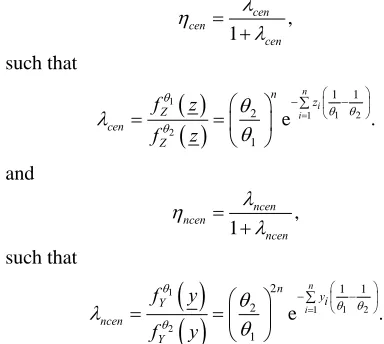
such that
11 2 1 2
1 1 2
1
e .
n i i n
z Z
cen Z
f z
f z
and
, 1
ncen ncen
ncen
such that
11 2 1 2
2 1 1
2
1
e .
n
i n
yi Y
ncen Y
f y
f y
For different values of and n, we calculate the value of according to Equation (12). The results can be observed in Table 1. By carefully considering this table, it is observed that as the value of increases (which implies the distance growth between 1 and
2
), the value of gets closer to one. In other words, cen approaches ncen more and more. This fact can be interpreted in this way that if the distance between
1
abc abc
and 2 is large, the data lost in censored data i is negligible. That is to say, evidential inference draws our attention to the time when 2
Y
is close to 1. The above
analysis can also be observed in Figure 1.
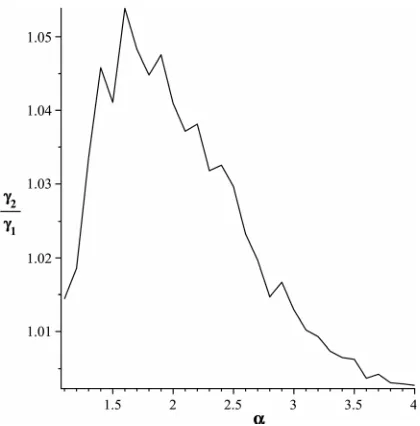
In what follows, the variations of sample volume ratio increase against are investigated, and the value of
in the
different values of n1 and n2. If 2
1
25 1.25 20
n
n then 1.6. The result can be
viewed in Figure 2, If 2 1
15 10
n
n 1.5 then 2.1.
The result can be viewed in Figure 3, If 2 1
n n
20 2 10
then 2.5 . The result can be viewed in Figure 4.
The above results can be interpreted in this way that as the sample volume increases from a certain stage on, the value of remains constant. In other words, it can be intuitively said that the
21
, ArgMax,
n n
ratio tends to
the constant value, which this also leads to an in- crease in evidential strength.
5. Proofs
In this section, denotes any constant that does not depend on and . Its value may change from one term to another and may depends on
C
,
j k n
[image:4.595.54.246.356.528.2] or . Table 1. Computed values for γ.
n value value
α = 1.1 α = 1.6 α = 2.1 α = 2.6 α = 3.1 α = 3.6 α = 4.1
10 0.5122 0.6427 0.7580 0.8398 0.8994 0.9317 0.9596
15 0.5165 0.6879 0.8273 0.9141 0.9572 0.9799 0.9894
20 0.5291 0.7251 0.8773 0.9516 0.9824 0.9931 0.9970
25 0.5219 0.7614 0.9145 0.9738 0.9923 0.9981 0.9991
30 0.5329 0.7881 0.9409 0.9862 0.9968 0.9992 0.9995
2 1
, ArgMax
,
n n
[image:4.595.309.536.381.706.2]Figure 2. The most relative changes when sample size n1 = 20 increases to n2 = 25 happens in α = 1.6.
Figure 3. The most relative changes when sample size n1 = 10 increases to n2 = 15 happens in α = 2.1.
Proof of Lemma 3.1. Proof can be found in [13]. Proof of proposition 3.1.
1. By Equation (9) and Equation (5), we have
,, ,
2
,
, ,
1
. j k
j k j k
j k
j k j k
T x
x w x x x w x
w x
x x w x
C x x
Figure 4. The most relative changes when sample size n1 = 10 increases to n2 = 20 happens in α = 2.2.
Therefore
0
0 0
, 0,1
, ,
0,1 0,1
3 3
2 2 2
sup
sup sup
2 2 2 .
j k x
j k j k
x x
j
j j
T x
C x
C C
x (16)
2. By Equation (9) and Equation (5), we have
2, 0
2 2
, 0 , 0 .
j k
j k j k
T Z
C Z Z
(17)
By Equation (4) and under the assumptions of Sub- section 2.1 and also doing the change of variables
2j
y x k , we have
(15)
2
, 0
1 1
2 2
, ,
0 0
2
2
d d
d .
j
j k
j k Z j k k
k
Z
x f x x C x x
C y y C
(18)
Using again Equation (4) and the assumptions of Sub- section 2.1, the equality
,
23 2
2
j j j k x x k
[image:5.595.68.280.333.545.2]tain
2 , 0 2 1 1 2 , , 0 0 2 2 2 2 d2 d 2 .
j j k
j k Z j k
k
j j
k Z
d
x f x x C x x
C y y C
(19)Combining Equations (17)-(19), we obtain
2
2
, 0 2 .
j j k
T Z C
(20)
The proof of Proposition 3.1 is complete. Proof of Proposition 3.2.
1. We have
0 0 0 0 0 0 , 1 2 , , 2 1 1 2 , 1 2 2 1 , , 2 2 1 2 , 1 2 2 1 , , 2 2 1 , 2 , 2 , nj k i i
n n
j k v j k
v j k n v
j k v j k
v j k n v
j k v j k
v
T Z
n
T Z T Z
n
T Z
n
T Z T Z
n
T Z
n
T Z T Z
n
. (21)Using Equation (20) we obtain
2
2
, 1 , 1 2 .
j
j k j k
T Z T Z C
(22)
also
0 0 0 0 0 0 1 , , 2 1, 0 ,
1
, 0 ,
1
,
,
, .
n v
j k v j k v
n
j k j k m m
n
j k j k m m
T Z T Z
n m T Z T Z
n T Z T Z
(23)By the Davydov inequality (see [16]) and for any we obtain
0,1q
0 0
0 0
, 0 ,
2 1
2
, ,
0,1
,
10 sup .
j k j k m
q q
q
m j k j k
x
T Z T Z
a T x T Z
0
Putting Equation (24), Eq tion (16) and Equation (20) to
(24)
ua gether, we have
0, 0 0,
2 1 2
3
,
10 2 2 2 .
j k j k m
j q j
q jq q
m
Z T Z
a C Ca
q
m
(25)
Since C
T 1 1 n q q m m m m
a a
, we obtain
0 0 1 , , 2 1 2 2 1 ,2 2 .
n v
j k v j k v
n
j q q j q m
m
T Z T Z
nC a nC
(26)Putting Equations (21) and (22) and Equation (26) together, we have
2 , 1
2 .
n
j q j k i
i
C
T Z
n n
(27)
2. We have
2 1 2 12 2 2
2 1
1 1
ˆ 1 2 , . n
i i i
i i
i i i i n v
v v v
v v
w Z Z w Z
n w Z
w Z Z w Z
n w Z
w Z Z w Z w Z Z w Z
n w Z w Z
(28)By Equation (5), we have
2 .
i i i
i
w Z Z w
Z
C w Z
(29)
By the Davydov inequality (see [16]) we obtain
2 , 2 m.
v
Ca
w Z w Z
(30)
Combining Equations (28)-(30), we obtain
v v v q
w Z Z w Z w Z Z w Z
1
1 C n q C
1 .
ˆ n m am n
(31)
3. Using Lemma (3.1), Equation (27) and Equation (31), then
2 , , 2 2 , , 1 2 , 1 ˆ 1 1 ˆ 1 2 . ˆj k j k n
j k i j k i
n
j q j k i
i
C T Z
n
C
C T Z
n n
(32)The proof of Proposition 3.2 is complete.
Proof of Theorem 3.1. For any integer , any
2
0,1 can be expanded on as X
k
0
,
0 0
,
X j
k j j k
00 0
2 1 2 1
, , ,
j j
j k j k j k
f x x
xwhere
Press, Stockton, 1985, pp. 287-296.
[5] R. Royall, “Statistical Evidence,” A Likelihood Paradigm, Chapman and Hall, London, 1997.
[6] R. Royall, “On the Probability of Observing Misleading Statistical Evidence,” Journal of the American Statistical
0
1 1
, , ,
0 0
d , d .
X j k j k X j k Association, Vol. 95, No. 451, 2000, pp. 760-780.
doi:10.1080/01621459.2000.10474264
[7] M. Emadi, J. Ahmadi and N. R. Arghami, “Compar Record Data and Random Observation
0,
j k
f x x x
f x x x
ing of Based on Statisti- We obtain
1 2
0
ˆ d ,
X
f x f x x A B
where
, 0
cal Evidence,” Statistical Papers, Vol. 48, No. 1, 2007, pp. 1-21. doi:10.1007/s00362-006-0313-z
[8] C. Chesneau and H. Doosti, “Wavelet Linear Density Estimation for a GARCH Model unde
r Various Depend-
erlag, New York, 1994.
0
0 0
0
2 1 2 2 1
2
, ,
0
ˆ , .
j j
j k j k j k
k j
A B
j k
Using Proposition 3.2 and inequalitity Equation (11)
ence Structures,” Journal of the Iranian Statistical Society, Vol. 11, No. 1, 2012, pp. 1-21.
[9] P. Doukhan, “Mixing Properties and Examples,” Lecture Notes in Statistics 85, Springer V
[10] D. Modha and E. Masry, “Minimum Complexity Regres- sion Estimation with Weakly Dependent Observations,”
0
0 2 2 2 3
2 2j j q s s q .
A Cn
n
C
and since , we have . Hence
IEEE Transactions on Information Theory, Vol. 42, No. 6, 1996, pp. 2133-2145. doi:10.1109/18.556602
[11] A. Cohen, I. Daubechies, B. Jawerth and P. Vial, “Wave- lets on the Interval and Fast Wavelet Transf
2
p s,
2,s
p rB H B
H 0 2s 2s q 3
2j s
B C Cn
have
2 .
Hence we
orms,” Ap-
1 2
2 2 3
0 ˆ
f x
fX x dxCn s s q .
This ends the proof of Theorem 3.1.
[1] M. Carrasco and Moment Proper- ties of Variou ic Volatility Mod-
plied and Computational Harmonic Analysis, Vol. 24, No. 1, 1993, pp. 54-81. doi:10.1006/acha.1993.1005
[12] Y. Meyer, “Wavelets and Operators,” Cambridge Univer- sity Press, Cambridge, 1992.
[13] M. Abbaszadeh, C. Chesneau and H. Doosti, “Nonpara- metric Estimation of Density under Bias and Multiplica- tive Censoring via Wavelet Methods,” Statistics and Pro- bability Letters, Vol. 82, No. 5, 2012, pp. 932-941.
doi:10.1016/j.spl.2012.01.016
[14] W. Härdle, G. Kerkyacharian, D. Picard and A. Tsyb “Wavelet, Approximation and
REFERENCES
akov, Statistical Applications,”
otheses,” Journal of Statical Theory and X. Chen, “Mixing and
s GARCH and Stochast
Lectures Notes in Statistics, Springer Verlag, New York, 1998, Vol. 129.
[15] M. Emadi and N. R. Arghami, “Some Measure of Support for Statistical Hyp
els,” Econometric Theory, Vol. 18, No. 1, 2002, pp. 17-39.
doi:10.1017/S0266466602181023
[2] S. T. Buckland, D. R. Anderson, K. P. Burnham and J. L. Laake, “Distance Sampling: Estimating Abundance of Biological Populations,” Chapman and Hall, London, 1993.
[3] D. Cox, “Some Sampling Problems in Technology,” In: N. L. Johnson and H. Smith Jr., Eds., New Developments in
Applications, Vol. 2, No. 2, 2003, pp. 165-176.
[16] Y. Davydov, “The Invariance Principle for Stationary Pro- cesses,” Theory of Probability & Its Applications, Vol. 15, No. 3, 1970, pp. 498-509. doi:10.1137/1115050
Survey Sampling, Wiley, New York, 1969, pp. 506-527. [4] J. Heckman, “Selection Bias and Self-Selection,” The