SHELL MODEL DESCRIPTION FOR SOME NUCLEI AROUND DOUBLE MAGIC NUCLEUS
Ali Khalaf Hasan AL-SINAAYID
Department of Physics, College of Education for Girls, University of Kufa
ARTICLE INFO ABSTRACT
The low lying Spectra and high spin states have been calculated for the isotopes (
134
Sn) in different model spaces. First set of calculations have been carried in (0g space. The second set of calculations have been performed in (1f
third set of calculations have been per
results showed that modified surface delta interaction is quite successful in introducing the spectrum energies of these nuclei and it able to produce the energy levels of the ground band clearly. work, the total angular momentum and parity for uncertainty and indeterminate experimentally energy levels were determinate and assured.
Copyright©2016, Ali Khalaf Hasan AL-SINAAYID and Fatema Hameed Obeed AL
Commons Attribution License, which permits unrestricted
INTRODUCTION
Originally, the nuclear shell model was adopted when an attempt to describe the nuclear system with the atomic shell structure which proved to be successful. The model describes the filling of orbits and completing shells by nucleons with increasing energy within the nuclear potential.
in a manner consistent with Pauli exclusion. Each nucleon is treating individually as an independent orbiting particle in a central potential despite of the existence of strong interactions between nucleons (Glassmaker, 1998).
nucleon retains an individual set of quantum numbers and wave function. The spherical shell model gives us an understanding of the observed magic numbers in atomic nuclei
2000). The magic numbers in nuclei has clearly demonstrated the nuclear shell structure associated with the independent particle model for nuclei (Vesselin, 2002). In this model each closed- shell configuration provides a convenient first approximation and one can assume that the system under consideration consists of a closed-shell core plus valence particles in a valence shell (Sheline et al., 1972
*Corresponding author: Fatema Hameed Obeed AL
Department of Physics, College of Education for Girls, University of Kufa, Al-Najaf, Iraq.
ISSN: 0975-833X
Article History:
Received 27th March, 2016 Received in revised form 10th April, 2016 Accepted 21st May, 2016 Published online 30th June,2016
Key words:
Nuclear Shell Model, EnergyLevels, Modified Surface Delta Interaction.
Citation: Ali Khalaf Hasan AL-SINAAYID and Fatema Hameed Obee
magic nucleus 132Sn”, International Journal of Current Research
RESEARCH ARTICLE
SHELL MODEL DESCRIPTION FOR SOME NUCLEI AROUND DOUBLE MAGIC NUCLEUS
SINAAYID and
*Fatema Hameed Obeed AL
Department of Physics, College of Education for Girls, University of Kufa
ABSTRACT
The low lying Spectra and high spin states have been calculated for the isotopes ( Sn) in different model spaces. First set of calculations have been carried in (0g space. The second set of calculations have been performed in (1f
third set of calculations have been performed in (0g7/2,1f7/2) valance space. Nuclear shell model
results showed that modified surface delta interaction is quite successful in introducing the spectrum energies of these nuclei and it able to produce the energy levels of the ground band clearly. work, the total angular momentum and parity for uncertainty and indeterminate experimentally energy levels were determinate and assured.
SINAAYID and Fatema Hameed Obeed AL-FATLAWI. This is an open access
permits unrestricted use, distribution, and reproduction in any medium, provided the original work is properly cited.
model was adopted when an attempt to describe the nuclear system with the atomic shell structure which proved to be successful. The model describes the filling of orbits and completing shells by nucleons with increasing energy within the nuclear potential. Shells are filling in a manner consistent with Pauli exclusion. Each nucleon is treating individually as an independent orbiting particle in a central potential despite of the existence of strong interactions However, every nucleon retains an individual set of quantum numbers and wave function. The spherical shell model gives us an understanding of the observed magic numbers in atomic nuclei (Casten, . The magic numbers in nuclei has clearly demonstrated the nuclear shell structure associated with the independent -
. In this model each shell configuration provides a convenient first approximation and one can assume that the system under shell core plus valence
1972).
Fatema Hameed Obeed AL-FATLAWI Department of Physics, College of Education for Girls, University of
Theory
The concept of an effective two
be very successful in describing a vast amount of the observable nuclear structure properties. The effective two body interaction can be determined by one of three basic approaches:
1. The model-independent method, based on fits of two matrix elements to nuclear properties.
2. The potential method which assumes an explicit mathematical form for the two
small number of parameters determined experimentally. 3. The G-matrix interaction, which a more fundamental
approach where the two body interaction is constructed from a measured
nucleon-2007).
The anti-symmetric matrix elements of the modified surface delta interaction used in this work, has the form
1980; Taqi, A.H, 2010).
1 1 ]} {[2 (2
)[ ( ) (
( ) , (
4 3 2 1
2 1 0 4 3 2 1
T j
j K j j K
f j j f C j j V j j
T J
J
J J
MSDI
International Journal of Current Research Vol. 8, Issue, 06, pp.33276-33280, June, 2016
INTERNATIONAL
SINAAYID and Fatema Hameed Obeed AL-FATLAWI,2016. “Shell model description for some nuclei around double
International Journal of Current Research, 8, (06), 33276-33280.
SHELL MODEL DESCRIPTION FOR SOME NUCLEI AROUND DOUBLE MAGIC NUCLEUS
132Sn
AL-FATLAWI
Department of Physics, College of Education for Girls, University of Kufa, Al-Najaf, Iraq
The low lying Spectra and high spin states have been calculated for the isotopes (134Te, 134Sb and Sn) in different model spaces. First set of calculations have been carried in (0g7/2 - 0h11/2) valance
space. The second set of calculations have been performed in (1f7/2 - 0i13/2) valance space and the
) valance space. Nuclear shell model results showed that modified surface delta interaction is quite successful in introducing the spectrum energies of these nuclei and it able to produce the energy levels of the ground band clearly. In this work, the total angular momentum and parity for uncertainty and indeterminate experimentally
is an open access article distributed under the Creative use, distribution, and reproduction in any medium, provided the original work is properly cited.
The concept of an effective two-body interaction has proved to be very successful in describing a vast amount of the observable nuclear structure properties. The effective two-body interaction can be determined by one of three basic
independent method, based on fits of two-body matrix elements to nuclear properties.
The potential method which assumes an explicit mathematical form for the two-body interaction, with a small number of parameters determined experimentally.
matrix interaction, which a more fundamental approach where the two body interaction is constructed -nucleon phase shifts (Mkhize,
symmetric matrix elements of the modified surface s work, has the form (Lawson,
. } ] 3 ) 1 2
] 1 1 [ ) , (
34 12 4
3
4 3 C B T
j
j JT
(
1
)
INTERNATIONAL JOURNAL OF CURRENT RESEARCH
Where
0 ) 2 1 ( 2 1 )
1 ( ) 1 2 ( 2
) 1 2 ( ) 1 2 ( 2 ) 1 ( ) ,
( 1 2
2 1 2 1
2 1
2
2 j j J
j j J
j j
j j
f j l
J
, 0 ) 2 1 ( 2 1 )
1 ( ) 1 2 ( 2
) 1 2 ( ) 1 2 ( 2 ) 1 ( ) ,
( 3 4
4 3 4 3
4
3 4 4 j j J
j j J
j j
j j
fJ l j
,
Mev A B A A T for A
T for A A A
C n n n n T T 25
, 1 : ...
0 : ... ,
) 1
( 0 1
1 0 0
4 3 2
1
(2)
where A0, A1, B, and C are the strength parameters of the MSDI obtained from fitting to experimental spectra in various mass regions (Brussard and Glaudemans, 1977). The independent - particle Hamiltonian of a (Z- particle) system can be written in terms of two – particle interactions as:
)
,
(
1 1 1
K lZ
K Z
K l Z
K
K
W
r
r
T
H
(3)
Where
W
(
r
K,
r
l)
is the two – body interaction between the kth and lth nucleons. Inserting an average potential ± U (rk), the Hamiltonian becomes:-)
(
)
,
(
]
)
(
[
1
1 1
1
K Z
K l K Z
K Z
K l K Z
K
K
U
r
W
r
r
U
r
T
H
(4)
Where the first term is identical to the independent – particle Hamiltonian, and the second and third account for the deviation from independent particle motion, known as the residual interaction. Separating the summations into core and valence contributions, eq. (4) can be re – written as (Coraggio
et al., 2009):
MSDI
Core
H
H
V
H
H
1
2
(5)Where
H
Core contains the interaction of nucleons making up the core,H
1 andH
2 are the single – particle contributions ofparticles (1) and (2), and
V
MSDI describe the residual interaction between particles (1) and (2), as well as any interaction with core nucleons, by inserting (eq (5)) into Schrödinger equation yields expression for the energy as:-T J MSDI T J
Core
E
E
V
E
E
1
2
,
, (6)Here
E
Core is the binding energy of the nucleus core andneeds to be defined by theory. It is important to note that the energy given by eq. (6) is for pure configurations only. In principle any close - lying state with the same total angular momentum (J) and total isospin (T) will mix. The mixed eigen states are giving by linear combinations of the unperturbed wave functions (Hasan and Hussain, 2013):
n
K
s JT s
T
J
a
ks1
,
)
(
)
(
(7)Where ( s) is the number of mixing configurations and takes values :(s=1,2,..,..n),The coefficients (aks ) fulfill the condition (Caurier et al., 2005):
1
2
1
n
K ks
a
(8)RESULTS AND DISCUSSION
In this study, we have taken a doubly magic isotope132
Sn
as aclosed core situated away from the line of stability , and let the
last two protons in 134Te nucleus occupy the five levels
2 / 11
0
2
,
1
,
1
,
0
g
7/2d
5/2d
3/2s
1/2and
h
) and the last twoneutrons in the 134Sn nucleus occupy the six levels
(
1
f
7/2,
1
f
5/2,
0
h
9/2,
2
p
3/2,
2
p
1/2and
0
i
13/2) while in 134Sb
nucleus, which have one proton in orbital (0g7/2) and one
neutron in orbital(1f7/2).Asingle proton energies that have
taken from the experimental spectrum of 133
Sb isotope are
791 . 2 , 439 . 2 , 962 . 0
( and 8002. )MeV for (1d5/2,1d3/2,2s1/2 and
0
h
11/2) respectively. While, A single neutrons energiesthat have taken from the experimental spectrum of133Sn
isotope are (2.004,1.561,0.853,1.363,and2.694)MeV (Sonzogni,
2004).
Te
134
Nucleus
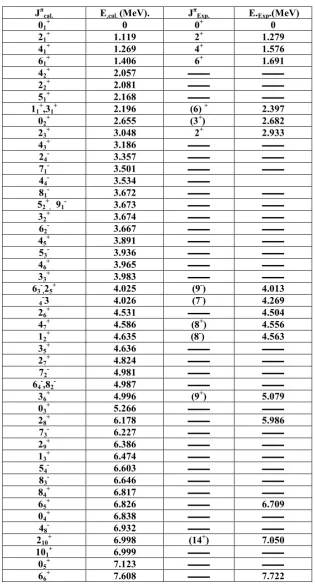
In our calculations for this nucleus, the high spin levels scheme have been extended to 7.608MeV excitation energy and spin 66+ as shown in the table (1). Our found the levels {01+, 21+ ,41+ and 61+ }with energies{0, 1.119,1.269 and 1.406} MeV when comparison with experimental values{0,1.279, 1.576 and 1.691}MeV. We expect the levels {11
+
or 3} and 02 +
values{4.504,5.986, 6.709 and7.722} MeV respectively which were undetermined the total angular momentum and parity. There are several levels in the ranges:{{42+ to 51+},{43+ to 33+}, { 35
+ to (64
or 82
-)},{03
+ ,73
to 84
+ },{04
+ to48
-},101
+ and 05
+ }, in
our calculations with energies {(2.057 to 2.168), (3.186 to 3.983), (4.636 to 4.987), (5.266, 6.227 to 6.817),(6.838 to 6.932),(6.999 and 7.123)} which were found without analoge experimental values and they were listed in Table (1).
[image:3.595.139.455.135.720.2]
Table 1. Comparison between calculated excitation energy levels with experimental data for 134Tenucleus
E.Exp.(MeV)
JπExp.
E.cal. (MeV).
Jπcal.
0 0+
0 01
+
1.279 2+
1.119 21
+
1.576 4+
1.269 41
+
1.691 6+
1.406 61
+
ـــــــــــ ـــــــــــ
2.057 42
+
ـــــــــــ ـــــــــــ
2.081 22
+
ـــــــــــ ـــــــــــ
2.168 51
+
2.397
+
) 6 ( 2.196
11 +
,31 +
2.682 )
+
3 ( 2.655
02 +
2.933
+
2 3.048
23 +
ـــــــــــ ـــــــــــ
3.186 43
+
ـــــــــــ ـــــــــــ
3.357 24
-
ـــــــــــ ـــــــــــ
3.501 71
-
ـــــــــــ 3.534
44
-ـــــــــــ ـــــــــــ
3.672 81
-
ـــــــــــ ـــــــــــ
3.673 52+, 91-
ـــــــــــ ـــــــــــ
3.674 32
+
ـــــــــــ ـــــــــــ
3.667 62
-
ـــــــــــ ـــــــــــ
3.891 45
+
ـــــــــــ ـــــــــــ
3.936 53
-
ـــــــــــ ـــــــــــ
3.965 46
+
ـــــــــــ ـــــــــــ
3.983 33
+
4.013 )
-9 ( 4.025
63
-,25
+
4.269 )
-7 ( 4.026
4
-3
4.504 ـــــــــــ
4.531 26
+
4.556 )
+
8 ( 4.586
47 +
4.563 )
-8 ( 4.635
12 +
ـــــــــــ ـــــــــــ
4.636 35
+
ـــــــــــ ـــــــــــ
4.824 27
+
ـــــــــــ ـــــــــــ
4.981
-72
ـــــــــــ ـــــــــــ
4.987 64
-,82
-5.079 )
+
9 ( 4.996
+
36
ـــــــــــ ـــــــــــ
5.266
+
03
5.986 ـــــــــــ
6.178
+
28
ـــــــــــ ـــــــــــ
6.227
-73
ـــــــــــ ـــــــــــ
6.386
+
29
ـــــــــــ ـــــــــــ
6.474 13
+
ـــــــــــ ـــــــــــ
6.603
-54
ـــــــــــ ـــــــــــ
6.646
-83
ـــــــــــ ـــــــــــ
6.817
+
84
6.709 ـــــــــــ
6.826
+
65
ـــــــــــ ـــــــــــ
6.838
+
04
ـــــــــــ ـــــــــــ
6.932
-48
7.050 )
+
14 ( 6.998
+
210
ـــــــــــ ـــــــــــ
6.999
+
101
ـــــــــــ ـــــــــــ
7.123
+
05
7.722 ـــــــــــ
7.608
+
Table 2. Comparison between calculated excitation energy levels with experimental data for134Sn nucleus
E.Exp. (MeV)
JπExp.
E.cal. (MeV).
Jπcal.
E.Exp. (MeV)
JπExp.
E.cal. (MeV).
Jπcal.
ـــــــ ـــــــ
4.392 27+
0
+
0 0
01+
ـــــــ ـــــــ
4.446 48+
0.725 2+
1.011 21+
ـــــــ ـــــــ
4.515 49
+
1.073
+
4 1.406
41 +
ـــــــ ـــــــ
4.654 28
+
1.247
+
6 1.565
61 +
ـــــــ ـــــــ
4.689 410+
ـــــــ ـــــــ
1.923 22+
ـــــــ ـــــــ
4.694 66+
ـــــــ ـــــــ
2.164 42+
ـــــــ ـــــــ
4.715 29+
ـــــــ ـــــــ
2.269 11+
ـــــــ ـــــــ
4.786 83-
ـــــــ ـــــــ
2.322 51+,31+
ـــــــ ـــــــ
4.819 210
-
2.508 )
+
8 ( 2.575 32
+
ـــــــ ـــــــ
4.836 38+
ـــــــ ـــــــ
2.649 02+
ـــــــ ـــــــ
4.984 67+
ـــــــ ـــــــ
2.685 43+
ـــــــ ـــــــ
5.012 39-
ـــــــ ـــــــ
2.746 52-
ـــــــ ـــــــ
5.016 68-,84+
ـــــــ ـــــــ
.7572 62-
ـــــــ ـــــــ
5.021 73
+
ـــــــ ـــــــ
2.832 33
+
ـــــــ ـــــــ
5.033 211
+
,411
+ +
16
ـــــــ ـــــــ
2.913 71
+
ـــــــ ـــــــ
5.384 412
-
ـــــــ ـــــــ
3.029 44
+
,23 +
,81 +
ـــــــ ـــــــ
5.439 74-
ـــــــ ـــــــ
3.098 24+
ـــــــ ـــــــ
5.461 04+
ـــــــ ـــــــ
3.248 63+
ـــــــ ـــــــ
5.509 212+
ـــــــ ـــــــ
3.331 34+
ـــــــ ـــــــ
5.526 05-
ـــــــ ـــــــ
3.431 25+
ـــــــ ـــــــ
5.607 85-
ـــــــ ـــــــ
3.472 53+
ـــــــ ـــــــ
5.651 413
+
ـــــــ ـــــــ
3.473
+
235
-,1
ـــــــ ـــــــ
5.658 102+
ـــــــ ـــــــ
3.554
3+1
ـــــــ ـــــــ
5.723 310-,57-,69-, 75-
ـــــــ ـــــــ
3.685 14+
ـــــــ ـــــــ
5.900 92-
ـــــــ ـــــــ
3.763
+
64
ـــــــ ـــــــ
6.038 213+
ـــــــ ـــــــ
3.787
+
54
ـــــــ ـــــــ
6.095
-76
ـــــــ ـــــــ
3.831
+
45
ـــــــ ـــــــ
6.137
-58
ـــــــ ـــــــ
3.882
-72
ـــــــ ـــــــ
6.166
-414
ـــــــ ـــــــ
3.955
+
36
ـــــــ ـــــــ
6.167 610-,86-,415+
ـــــــ ـــــــ
3.992
-46
ـــــــ ـــــــ
6.714
+
06
ـــــــ ـــــــ
4.026 26
+
ـــــــ ـــــــ
6.769
+
121
ـــــــ ـــــــ
4.033
-91
ـــــــ ـــــــ
6.870
+
87
ـــــــ ـــــــ
4.094
-55
ـــــــ ـــــــ
6.977
+
611
ـــــــ ـــــــ
4.163 47+,65-,82-, 101
-ـــــــ ـــــــ
6.982
-103
ـــــــ ـــــــ
4.291
-56
ـــــــ ـــــــ
7.071
-111
ـــــــ ـــــــ
4.326 37+15+
ـــــــ ـــــــ
4.379 03
+
Table 3. Comparison between calculated excitation energy levels with experimental data for 134Sb nucleus
E.Exp.(MeV)
JπExp.
E.cal. (MeV).
Jπcal.
0 ( 0-)
0 1
0.441 (5-)
0.404 8
0.555 (4-)
0.519 2
0.617 (6-)
0.594 6
ــــــــــــ ــــــــــــ
0.606 4
ــــــــــــ ــــــــــــ
0.622 3
ــــــــــــ ــــــــــــ
0.725 5
ــــــــــــ ــــــــــــ
[image:4.595.191.412.631.750.2]134
Sn Nucleus
The comparison between the calculated values and experimental data (Sonzogni, 2004) has shown in Table (2).
Recently, the levels of 134
Sn
nucleus are extended to 2.508MeV in the experimental data. The first, three calculated
levels are found to be {01 +
,
2
1,
4
6
1}
1
and
with energies {0,1.011,1.406 and 1.565} MeV which were rather close to with experimental values as {0,0.725, 1.073 and 1.247} MeV . We expect the level { 32+} at {2.575} MeV while experimental value is {2.508} MeV uncertain in spin and parity (8+). Another energy levels in the range{02+ to 111- }in our calculations which were undetermined the spins and energies in the experimental data, because the highest experimental level for this nucleus is {2.508}MeV (Sonzogni, 2004), with spin and parity (11-) while in this work the energies reached the values {7.071} MeV which increased (64) extra level on experimental values. We found in the framework of shell model calculations (64) new energy levels were determined for (134Sn) isotope. This investigation increases the theoretical Knowledge of all isotopes with respect to energy levels134Sb Nucleus
Experimental levels are available to 5.324 MeV excitation energy and spin (14-) for this nucleus. Comparison of the calculated levels with experimental data (Saleem et al., 2004) presented in table (3). The levels {1-,8- and 2-} are predicted by nuclear shell model with energies{0, 0.404 and 0.519}MeV, while experimental values are {0, 0.414 and 0.555}MeV uncertainty at {(0-) , 5- and 4-} spins and parity. We expect certain the level (6-) to energy 0.617 MeV uncertainty experimentally. Our choosing for this nucleus in this shell, we found that the number of levels limited compared with experimental values.
REFERENCES
Brussard, P.J.; Glaudemans, P. W. M. 1977. Shell Model Applications in Nuclear Spectroscopy; North Holland: Amsterdam.
Casten, R.F. 2000. Nuclear Structure from a Simple Perspective, 2nd ed.; Oxford University, Press Inc:New York.
Caurier, E.; Martinez, P.G.; Nowacki, F.; Poves, A.; Zuker, A.P. 2005. 'The shell model as a unified view of nuclear structure", Rev.Mod.Phys., 77,427.
Coraggio, L.; Covello, A.; Gargano, A.; Itaco, N.; Kuo, T.T.S. 2009. "Shell model calculations and realistic effective interactions",Prog.Part.Nucl.Phys., 62,143.
Glassmaker, T. 1998. Ann.Rev.of Nucl. Part. Sci., 48, 1. Hasan, A. K. and Hussain, F. M. 2013. Adv. in Phys. Theor.
and Appli., 20,128.,' Calculation of Energy Levels for
Nuclei 34S,34Ar,34Cl by using Surface Delta Interaction". Lawson, R. D. 1980. Theory of the Nuclear Shell Model;
Clarendon Press, Oxford: New York.
Mkhize, P.S. M.Sc, 2007. Department of physics, Western Cape University, WesternCape.
Saleem, K.A.; Chaudhury, Z.; Bernard, D.; Browne, E.; Sonzogni, A. A. 2004. Nucl. Data Sheet, 103, 1.
Sheline, R.; Ragnarsson, I.; Nilsson, S. 1972. Phys. Lett. B., 41,115.
Sonzogni, A. A. 2004. Nucl. Data Sheet, 103, 1.
Taqi, A.H. 2010. Acta Phys. Polon B., 6,1130-1331,".Particle– Particle and Hole–Hole Random Phase Approximation Calculations For 42Ca and 38Ca Nuclei".
Vesselin, G.G. PhD, 2002. Department of physics and Astronomy, Sofia University, Sofia.