EFFECT OF POST HARVEST APPLICATION OF DIFFERENT PACKAGING MATERIALS AND
STORAGE INTERVALS ON SHELF LIFE OF PEAR CV. PUNJAB BEAUTY
Ravinder
Department of Horticulture, Agriculture and Forestry, Khalsa
ARTICLE INFO ABSTRACT
The present investigation was carried out in the laboratory of Department of Horticulture Khalsa College, Amritsar during the year 2015
Beauty were harvested from the healthy trees at physiologica
from a well maintained Govt. Orchard and Nursery, Attari Distt, Amritsar and were packed in CFB and wooden boxes and kept under cold storage at 0° to 3.3°C and 90% relative humidity. The fruits from each treatment
cold storage period. The results revealed that
spoilage loss and increased firmness upto 60 days of storage with maximum edibl sugars were maximum in fruits packed in wooden boxes.
Copyright©2016, Ravinder Singh and Amarjeet Kaur.
unrestricted use, distribution, and reproduction in any medium, provided the original work is properly cited.
INTRODUCTION
Pear (Pyrus communis L.) belongs to family Rosaceae and is an important fruit cultivated throughout the temperate regions of the world (Anonymous, 2005). It is undoubtedly one of the most ubiquitous of all the fruits and ranks 2
apple in the deciduous fruits of the world (Chadha, 2001). The Greek poet 'Homer' giving an insight on early fruit culture praised "pears as one of the gift of God" (Ayn, 2014). The cultivars of pear mainly belongs to three groups, European, Asian and their hybrids. Two major species,
L. (European pear) and Pyrus pyrifolia (Burm) Nakai are commercially cultivated. Although pear is a temperate fruit, but it is less winter hardy due to which it can be grown in a wide range of climatic conditions, even in the warmer climates of subtropical regions. It is successfully grown in both the temperate and subtropical conditions, because of its low chilling requirements. The pear germplasm has been found to be suitable under sub-tropical conditions (Sa
Pear fruit is packed with health beneficial nutrients such as dietary fiber, anti-oxidants, minerals and vitamins which are necessary for optimum health. It is also a good source of vitamin C and folic acid (Brian and Cameron, 1995).
*Corresponding author: Amarjeet Kaur,
Department of Horticulture, Agriculture and Forestry, Khalsa College, Amritsar143001, India.
ISSN: 0975-833X
Vol.
Article History:
Received 08th September, 2016
Received in revised form 16th October, 2016
Accepted 26th November, 2016
Published online 30th December,2016
Key words:
Pear Fruits,
Pyrus Communis, Cold Storage,
TSS, CFB, Wooden Boxes, Sugars.
Citation: Ravinder Singh and Amarjeet Kaur, 201
of pear cv. Punjab beauty”, International Journal of Current Research
RESEARCH ARTICLE
EFFECT OF POST HARVEST APPLICATION OF DIFFERENT PACKAGING MATERIALS AND
STORAGE INTERVALS ON SHELF LIFE OF PEAR CV. PUNJAB BEAUTY
Ravinder Singh and
*Amarjeet Kaur
Department of Horticulture, Agriculture and Forestry, Khalsa College, Amritsar143001,
ABSTRACT
The present investigation was carried out in the laboratory of Department of Horticulture Khalsa College, Amritsar during the year 2015-16. The fruits of semi-soft pear(
Beauty were harvested from the healthy trees at physiologically mature stage in the last week of July from a well maintained Govt. Orchard and Nursery, Attari Distt, Amritsar and were packed in CFB and wooden boxes and kept under cold storage at 0° to 3.3°C and 90% relative humidity. The fruits from each treatment were analysed for physico-chemical characteristics after 0, 20, 40 and 60 days of cold storage period. The results revealed that the fruits packed in CFB boxes reduced the PLW, spoilage loss and increased firmness upto 60 days of storage with maximum edibl
sugars were maximum in fruits packed in wooden boxes.
. This is an open access article distributed under the Creative Commons Att use, distribution, and reproduction in any medium, provided the original work is properly cited.
L.) belongs to family Rosaceae and is an important fruit cultivated throughout the temperate regions of the world (Anonymous, 2005). It is undoubtedly one of the most ubiquitous of all the fruits and ranks 2nd next only to apple in the deciduous fruits of the world (Chadha, 2001). The Greek poet 'Homer' giving an insight on early fruit culture praised "pears as one of the gift of God" (Ayn, 2014). The cultivars of pear mainly belongs to three groups, European, eir hybrids. Two major species, Pyrus communis
(Burm) Nakai are commercially cultivated. Although pear is a temperate fruit, but it is less winter hardy due to which it can be grown in a ons, even in the warmer climates of subtropical regions. It is successfully grown in both the temperate and subtropical conditions, because of its low chilling requirements. The pear germplasm has been found to ndhu et al., 2007). Pear fruit is packed with health beneficial nutrients such as oxidants, minerals and vitamins which are necessary for optimum health. It is also a good source of vitamin C and folic acid (Brian and Cameron, 1995).
Department of Horticulture, Agriculture and Forestry, Khalsa
The fiber in pear is peptin which is a solute fiber that helps to control blood cholesterol level and cellulose is an insoluble fiber that promotes normal bowel function. It is also a rich source of proteins needed by both children and adults if properly processed and blended (Okaka
pear cv. Punjab Beauty has gained popularity because of its superior organoleptic qualities. This cultivar matures in the third week of July, when the temperature and humidity are very high, which interferes with the shelf life of f
market. The loss of great magnum at this time not only robs the labour and resources but also cuts short a profit. In order to prevent the glut in market, storage of fruits is necessary (Kaur
et al 2013). Further, the storage of fruits in prop
materials helps in curtailing the post preserves freshness (Ding et al
Kudachikar et al 2007). Hence, there is a need to study the combined effect of storage intervals and packaging materials in pear for maintenance of its quality during storage till it reaches to the consumer. Keeping these viewpoints in view, this study was taken into consideration.
MATERIALS AND METHODS
The present study was carried out in the laboratory of Department of Horticulture, Khalsa College, Amritsar during 2015-16. The fruits were harvested from healthy trees of a well maintained Govt. orchard and Nursery, Attari, Distt. Amritsar. International Journal of Current Research
Vol. 8, Issue, 12, pp.44183-44188, December, 2016
INTERNATIONAL
OF CURRENT RESEARCH
2016.“Effect of post harvest application of different packaging materials and storage intervals on shelf life
International Journal of Current Research, 8, (12), 44183-44188.
EFFECT OF POST HARVEST APPLICATION OF DIFFERENT PACKAGING MATERIALS AND
STORAGE INTERVALS ON SHELF LIFE OF PEAR CV. PUNJAB BEAUTY
Amritsar143001, India
The present investigation was carried out in the laboratory of Department of Horticulture Khalsa soft pear(Pyrus communis) cv. Punjab lly mature stage in the last week of July from a well maintained Govt. Orchard and Nursery, Attari Distt, Amritsar and were packed in CFB and wooden boxes and kept under cold storage at 0° to 3.3°C and 90% relative humidity. The fruits chemical characteristics after 0, 20, 40 and 60 days of fruits packed in CFB boxes reduced the PLW, spoilage loss and increased firmness upto 60 days of storage with maximum edible quality.TSS and
is an open access article distributed under the Creative Commons Attribution License, which permits
which is a solute fiber that helps to control blood cholesterol level and cellulose is an insoluble fiber that promotes normal bowel function. It is also a rich source of proteins needed by both children and adults if properly processed and blended (Okaka et al 2002). Semi-soft pear cv. Punjab Beauty has gained popularity because of its superior organoleptic qualities. This cultivar matures in the third week of July, when the temperature and humidity are very high, which interferes with the shelf life of fruits in the market. The loss of great magnum at this time not only robs the labour and resources but also cuts short a profit. In order to prevent the glut in market, storage of fruits is necessary (Kaur 2013). Further, the storage of fruits in proper packaging materials helps in curtailing the post-harvest losses and
et al 2002; Yadav et al 2005;
2007). Hence, there is a need to study the combined effect of storage intervals and packaging materials in for maintenance of its quality during storage till it reaches to the consumer. Keeping these viewpoints in view, this study
MATERIALS AND METHODS
The present study was carried out in the laboratory of ure, Khalsa College, Amritsar during 16. The fruits were harvested from healthy trees of a well maintained Govt. orchard and Nursery, Attari, Distt. Amritsar.
INTERNATIONAL JOURNAL OF CURRENT RESEARCH
The orchard is located 25 km away from Amritsar in West and falls at 31° - 38' N latitude and 74°-52' East longitude with an elevation of 236 m above MSL. The fruits of semi-soft pear(Pyrus communis) cv. Punjab Beauty were harvested from the healthy trees at physiologically mature stage in the last week of July from a well maintained Govt. Orchard and Nursery, Attari Distt, Amritsar and were packed in CFB and wooden boxes and kept under cold storage at 0° to 3.3°C and 90% relative humidity. The fruits from each treatment were analysed for physico-chemical characteristics after 0, 20, 40 and 60 days of cold storage period. The physiological loss in weight (PLW) was calculated on initial basis. The spoilage percentage of fruits was calculated on number basis, by counting the fruits from each box that had spoiled during each storage interval and expressed in percentage. The firmness was measured with the help of "Fruit tester" Penetrometer made in Italy by after removing about one square inch of skin of the fruit from the shoulder end. The reading was recorded in kg/cm2. The Total soluble solids of fruits sample were determined with the help of a Erma hand refractrometer. The titratable Acidity was calculated and expressed in terms of malic acid determined by titrating a known volume of juice with 0.1 N NaOH using phenolphthalein as an indicator. The sugars were determined by the method of (AOAC 2000).The data was analyzed statistically as Randomised block design with factorial arrangement having three replications, each replication comprising of 2 kg fruits.
RESULTS AND DISCUSSION
The loss in weight also increased significantly with the increasing period of storage. Minimum PLW (2.09%) was recorded after 20 days of cold storage while maximum PLW (7.38%) was recorded after 60 days of cold storage. The fruits packed in CFB boxes showed significantly lower PLW (3.14%) than fruits packed in wooden boxes showing PLW (3.45%).The percentage loss in weight of fruits packed in CFB boxes was less due to the build up of higher humidity condition inside the boxes resulting in lesser loss of net weight of fruits. Also, the retardation of enzymatic activity of post harvest pathogens might lead to lesser loss in weight. Wooden boxes showed maximum loss due to moisture absorption by the timber from the fruits and subsequent loss of this moisture to the atmosphere lead to shriveling of skin surface by high rate of dehydration (Kaur et al 2013). However, CFB boxes provided better barrier to water absorption (Kaushal et al 1996 and Kahlon 2007) observed minimum loss in weight of fruits of peach in CFB boxes whereas it was maximum in wooden boxes. Increase in PLW with prolongation of storage period might be due to the loss of water from fruits after harvest by transpiration and respiration triggered by physiological metabolic or enzymatic activities. Similar trends of PLW was noticed by Sandhu and Singh(2000), Mohla (2001) in Patharnakh pear, Bajaj (2004) in Baggugosha pear and Singh (2005) in ber fruits cv. Umran, Kaur (2006) in Punjab Nectar and Kaur et al 2013 in Punjab Beauty pear. The data on storage days revealed that upto 20 days of cold storage there was no spoilage (0.00%) noticed in the fruits. The spoilage increased significantly with the advancement of storage period. The maximum spoilage (12.57%) was recorded after 60 days of storage. The increase in the spoilage losses with the duration of storage period might be attributed to the fact that ripening, ageing, fungal infection and biochemical changes in post harvest fruits lead to softening, spoilage and deterioration of the fruits.
The hydrolysis of metabolites in the stored fruits with the time was also a reason for spoilage. The results are advocated by the findings of Singh (1997) in Baggugosha pear, Chug (2001) in Patharnakh pear, Kaur (2001) and Bajaj (2004) in Baggugosha pear, Kaur (2006) in pear cv. Punjab Nectar, Ayn et al (2014) in Bartlett pear. It is evident from the data that the fruits packed in CFB boxes after treatments showed significantly lower mean spoilage (4.59%) than the fruits packed in wooden boxes which resulted in higher spoilage (4.94%).Different treatments were found effective in minimizing spoilage losses of pear fruits under CFB than wooden boxes. Similar results were presented by Kaur (2006) in Punjab Nectar pear. The packaging material of CFB boxes proved successful than wooden boxes in recording significantly less spoilage of fruits. This might be due to lesser bruising and proper ventilation in CFB boxes. The fruits got spoiled because of the increased respiration rate leading to softening and ripening of fruits. The research findings of Kahlon (2007) in peach cv. Shan-i-Punjab and Kaur et al (2013) in pear cv. Punjab Beauty are in conformation with the present results.
The firmness showed a linear decline with the increase in storage intervals. Maximum firmness (10.94 kg/cm2) was recorded at day of harvest or zero day in CFB and wooden boxes respectively. Minimum firmness (7.55 kg/cm2 and 7.37 kg/cm2) was recorded after 60 days of cold storage in CFB and wooden boxes respectively. All the periods or days of storage exhibited significant firmness. It was observed that with the advancement of storage period the firmness decreased which might be due to the increased rate of senescence stage, which promoted respiration, transpiration and other microbial activities which reduced the firmness of fruits. The results are in agreement with Kaur (2013) in pear cv. Punjab Beauty and
Ayn et al (2014) in Bartlett pear who also reported a decrease
in fruit firmness with advancement in storage period.The fruits packed in CFB boxes had significantly higher firmness (9.70 kg/cm2) than fruits packed in wooden boxes which resulted in lower firmness (9.59 kg/cm2).Fruits packed in CFB exhibited higher fruit firmness than the fruits packed in wooden boxes which may be ascribed to the increased metabolic activities of the fruits in wooden containers resulting in breakdown of insoluble protopectin to soluble pectin and pectic acid by the activity of endopolygalacturonase enzyme in fruits.(Martin-Cabrejas et al 1994).These are in line with findings of Kaushal and Anand (1986) in apple fruits, Kaur et al (2013) in pear cv. Punjab Beauty, Gill et al (2016) in pear cv. Punjab Beauty.
Fig. 1(a): Effect of different treatments on physiological loss in weight (%) of pear cv. Punjab Beauty during cold storage
Fig. 2(a): Effect of different treatments on spoilage (%) of pear cv. Punjab Beauty during cold storage
Fig. 3(a): Effect of different treatments on fruit firmness (%) of pear cv. Punjab Beauty during cold storage
Fig. 4(a): Effect of different treatments on fruit colour of pear cv. Punjab Beauty during cold storage
Fig. 5(a): Effect of different treatments on organoletpic rating of pear cv. Punjab Beauty during cold storage
Fig. 6(a): Effect of different treatments on total soluble solids (%) of pear cv. Punjab Beauty during cold storage
Fig. 7(a): Effect of different treatments on acidity (%) of pear cv. Punjab Beauty during cold storage
[image:3.595.39.287.51.204.2] [image:3.595.320.548.60.196.2] [image:3.595.41.285.248.395.2] [image:3.595.322.541.256.391.2] [image:3.595.320.540.436.571.2] [image:3.595.46.277.439.586.2] [image:3.595.318.549.619.762.2] [image:3.595.42.286.622.777.2]Fig. 9(a): Effect of different treatments on reducing sugars (%) of pear cv. Punjab Beauty during cold storage
Fig. 10(a): Effect of different treatments on total sugars (%) of pear cv. Punjab Beauty during cold storage
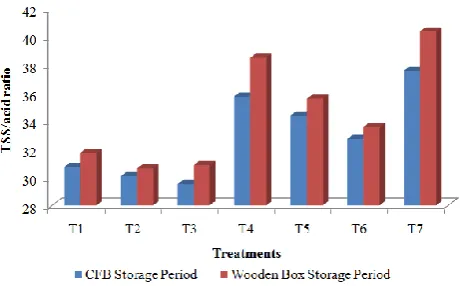
The mean TSS content (13.80%) after 40 days was significantly higher as compared to all other storage intervals under wooden boxes and (13.74%) in CFB. Minimum TSS content (12.48%) was recorded on the day of harvest before storage of fruits respectively. The increase in TSS content during storage might be due to the moisture loss, hydrolysis of polysaccharides and concentration of juice as a result of degradation. The TSS increased upto 40 days and declined thereafter which can be attributed to the fact that on complete hydrolysis of starch no further increase in TSS occur and consequently a decline in TSS is predictable as they are the primary substrate for respiration (Wills et al., 1980), Mahajan and Dhatt (2004). These results are in agreement with those of Paul (2002), Monika (2003), Singh (2004) and Bajaj (2004) in Baggugosha pear fruit, Kaur et al. (2013) in Punjab Beauty and Kaur (2006) in Punjab Nectar fruits. The data revealed that the fruits packed in CFB boxes registered lower TSS (12.86%) and fruits packed in wooden boxes registered higher TSS (12.95%) which differed significantly from each other. The higher TSS content in fruits packed in wooden boxes in comparison to CFB boxes may be ascribed to the increased metabolic activities, increase in PLW and hydrolysis of starch. These findings are in accordance with Kaur et al. (2013) in Punjab Beauty pear fruits, Thakur and Lal (1989), Kahlon (2007) who reported higher TSS in wooden boxes than in CFB boxes.
There was a progressive decrease in acidity with the increase in storage period upto 40 days and thereafter increase in acidity
upto 60 days. Higher mean acidity (0.46%) was recorded on day of harvest irrespective of packaging. Minimum mean acidity (0.36% and 0.34%) was noticed after 40 days in CFB and wooden boxes respectively. Such a decrease in the acidity level could be attributed to the use of organic acids as respiratory substrate during storage (Echeverria and Valich 1989) and by conversion of acids to sugars and their utilization in metabolic activities of fruits as reported by Kahlon and Sandhu. (1989) in Patharnakh, Mahajan and Dhatt (2004) in Asian pear, Kaur (2001) in Baggugosha pear, Monika (2003) and Bajaj (2004) in Baggugosha pear, Sidhu et al. (2009) in Punjab Beauty are also in agreement with this study. The fruits packed in CFB boxes and wooden boxes have non-significant difference (0.40% and 0.39%) in CFB and wooden boxes.
[image:4.595.43.283.60.219.2] [image:4.595.44.282.270.423.2]sugars in fruits packed in wooden boxes in comparison to CFB boxes might be due to the more moisture loss and faster rate of metabolic activities in wooden boxes resulting in breakdown of starch into sugars. The present study is in line with the findings of Kaur et al. (2013) in Punjab Beauty fruits and Kahlon (2007) in peach fruits.
It is evident from the data that there was increasing trend of total sugars upto 40 days and slightly declined thereafter upto 60 days of storage. The maximum mean total sugars (9.22% and 9.31%) were recorded after 40 days in CFB and wooden boxes respectively. The minimum mean total sugars (9.09%) was noticed on day of harvest irrespective of packaging. The increase in total sugars with the storage interval upto 40 days might be due to the hydrolysis of starch, yielding mono and disaccharides. Thereafter, decline could be attributed to metabolic break-down and senescence of fruit as a result of moisture and firmness loss during storage (Ryall and Pentzer, 1982). Similar findings were obtained by Kaur et al. (2013), Mahajan and Dhatt (2004) in Asian pear, Paul (2002) in pear cv. Punjab Beauty. From the data it is evident that the fruits packed in CFB boxes registered significantly lower total sugars (9.08%) as compared to fruits packed in wooden boxes (9.15%).The higher sugar content of fruits in wooden boxes might be the result of rapid loss of moisture and fast hydrolysis of starch and other polysaccharides to soluble form of sugars. These studies are in line with findings of Kaur et al. (2013) in Punjab Beauty fruits and Kahlon (2007) in peach fruits.
REFERERNCES
Anonymous 2005. Area and production of fruits in Punjab. Department of Horticulture, Punjab
AOAC 2000. Association of official Analytical Chemists. Official Methods of Analytical Chemists, Washington D C, USA.
Ayn, U.Q., Beigh, M.A., Mir, M.A. and Parveen, S. 2014. Shelf Life Study and Quality Changes of Bartlett Pear as Affected by Post Harvest Treatments under Ambient Storage Environmental Sciences ISSN-2249-555X.
Bajaj, A. 2004. Effect of fungicide and chemicals on the post-harvest life of pear cv. Baggugosha. M.Sc. Thesis GNDU Amritsar
Brian, A.F. and Cameron, A.G. 1995. Food Science, Nutrition and Health. Fifth Edition. Edward Arnold Publisher, London. 266-284.
Chadha, K.L. 2001. Handbook of Horticulture. 267-271. ICAR, New Delhi.
Chug, D. 2001. Effect of time of picking GA3 and CaCl2 on storage behaviour of pear cv. Baggugosha. M.Sc. Thesis GNDU Amritsar.
Ding, C.K., Chachink, Ueda Y., Imahori, Y. and Wang, C.Y. 2002. Modified atmosphere packaging maintains post harvest quality of Loquat fruit. Postharvest Bio Technol 24: 341-348.
Echeverria, E. and Valich, J. 1989. Enzymes of sugars and acid metabolism in stored ‘Valencia Oranges’. J Am Soc Hortic Sci 114: 445-449.
Gill, P.P.S., Jawandha, S.K., Sangwan, A., Singh, N.P. and Kaur, N. 2016. Influence of post harvest calcium chloride treatment and Shrink Film on storage life of pear fruits.
App Bio Res 18: 71-75.
Hussain, M.A., Mahdy, T.K. and Ibrahim, A.A. 2001. Effect of calcium chloride and gibberellic acid treatments on Anna
and Dorest Golden apples during storage. Chemical characteristics of fruits. Assiut J Agric Sci 32: 185-200. Kahlon, P. S. and Sandhu, R. S. 1989. Effect of different
treatments and date of harvesting on cold storage life of Patharnakh pear. J Food Sci Tech 26(5): 290 Id.
Kahlon, S.S. 2007. Effect of calcium salts, GA3 and packaging treatments on post harvest performance of peach cv. Shan-i- Punjab. M.Sc. Thesis GNDU Amritsar
Kaur, K., Dhillon, W.S. and Mahajan, B.V.C. 2013. Effect of different packaging materials and storage intervals on physical and biochemical characteristics of pear. J Food Sci
Technol 50: 147-152.
Kaur, N. 2001. Effect of post harvest calcium infiltration and wrappers on shelf life of individually packed fruits of pear cv. Baggugosha. M.Sc. Thesis GNDU Amritsar.
Kaur, S. 2006. Effect of various chemicals and packaging treatment on shelf life of pear cv. Punjab Beauty. M.Sc. Thesis GNDU Amritsar.
Kaushal, Lal, B. B., Thakur, K. S. and Thakur, N.S. 1996 Preliminary studies on use of new packaging and transportation of Starking Delicious apples. Indian Fd
Packer 27-32.
Kaushal, Lal, B.B. and Anand, J. C. 1986. Recent trials on grading and packaging of apples. Indian F D Packer 29-34. Kore, V.N. and Sharma, C.P. 1970. Effect of containers on storage of ber fruits at room temperature. Ist seminar on New forties in Horticulture held at Bangalore Nov 25-28 60-61.
Kudachikar, V.B., Kulkarni, S.G., Vasantha, M.S., Aravinda, P. B. and Aradhya, S.M. 2007. Effect of modified atmosphere packaging on shelf life and fruit quality of banana stored at low temperature. J Food Sci Technol 44: 74-78.
Mahajan, B.V.C. and Dhatt, A.S. 2004. Studies on postharvest calcium chloride application on storage behaviour and quality of Asian pear during cold storage. J of Food Agri &
Environment 2:157-159.
Martin-Cabrejas, M.A., Waldron, K.W., Selvandran, R.R., Parker, M.L. and Moates, G.K. 1994. Ripening related changes in cell wall of ‘Spanish’ pear. Physiol Plant 91: 671-679
Mohla, R. 2001. Effect of wrappers on shelf-life of Patharnakh pear. M.Sc. Thesis GNDU Amritsar.
Monika 2003. Storage behaviour of pear cv. Baggugosha. M.Sc. Thesis GNDU Amritsar.
Okaka, J.C., Akobundy, E.N.T. and Okaka, A.N.C. 2002. Human nutrition: An Integrated Approach Zed. OCJANCO Academic Publisher Enugu 312-320.
Paul, S. 2002. Studies on storage behaviour and shelf life of semi soft pear cv. Punjab Beauty. M.Sc. thesis PAU Ludhiana.
Ryall, A. L. and Pentzer, W. T. 1982. Handling, transportation and storage of fruits and vegetables. AVI Pub Co Inc Westport unipacked Baggugosha fruits. M.Sc. Thesis PAU Ludhiana, India.
Sidhu, G.S., Dhillon, W.S. and Mahajan, B.V.C. 2009. Effect of waxing and packaging on storage of pear cv. Punjab Beauty. Indian J Hort 66: 239-244.
Singh, M. 1997. Effect of post-harvest treatments of GA3 and CaCl2 on cold storage life of HDPE
Thakur, N.S. and Lal, B.B. 1989. Evaluation of plastic carton and CFB carton vis-à-vis conventional wooden box for packaging and transportation of apple. J Food Sci Technol
Wills, R.B.H., Cambridge, P.A., Scott, K. J. 1980. Use of flesh firmness and other objective tests to determine consumer acceptability of Delicious apples. Aust J Exp Agric Anim Husb 20: 252-256.
Yadav, S., Kumar, A., Saini, R.S. 2005 Biochemical and organoleptic quality changes during storage of ber fruit transported with different packaging material. Haryana J Sci 34: 25-28