
Efficient Multiobjective Genetic Algorithm for Solving
Transportation, Assignment, and Transshipment Problems
Sayed A. Zaki, Abd Allah A. Mousa, Hamdy M. Geneedi, Adel Y. Elmekawy Department of Mathematic and Statistics, Faculty of Sciences, Taif University, Taif, Saudi Arabia
Email: [email protected]
Received November 21, 2011; revised December 22, 2011; accepted December 30, 2011
ABSTRACT
This paper presents an efficient genetic algorithm for solving multiobjective transportation problem, assignment, and transshipment Problems. The proposed approach integrates the merits of both genetic algorithm (GA) and local search (LS) scheme. The algorithm maintains a finite-sized archive of non-dominated solutions which gets iteratively updated in the presence of new solutions based on clustering algorithm. The use clustering algorithm makes the algorithms prac-tical by allowing a decision maker to control the resolution of the Pareto set approximation. To increase GAs’ problem solution power, local search technique is implemented as neighborhood search engine where it intends to explore the less-crowded area in the current archive to possibly obtain more nondominated solutions. The inclusion of local search and clustering algorithm speeds-up the search process and also helps in obtaining a fine-grained value for the objective functions. Finally, we report numerical results in order to establish the actual computational burden of the proposed algorithm and to assess its performances with respect to classical approaches for solving MOTP.
Keywords: Transportation Problem; Genetic Algorithms; Local Search; Cluster Algorithm
1. Introduction
The transportation problem is considered a special prob-lem of resource allocation, which can be formulated as a linear programming problem, where the constraints have a special structure. In its classical form the transportation problem minimizes the cost of transporting some com-modity that is available at m sources (supply nodes) and required at n destinations (demand nodes). The source parameter ( i) may be production facilities, warehouse, etc. Whereas the destination parameter ( i) may be warehouse, sales outlet, etc. The penalty ( ij) that is, the co-efficient of the objective functions, could represent transportation cost, delivery time, number of goods transposed, unfulfilled demand, and many others. Thus multiple penalty criteria may exist concurrently which leads to the research work on multiobjective transporta-tion problem. Until now, many researchers also have a great interest in the multiobjective transportation prob-lem, and a number of methods had been proposed for solving it [1-8].
a
b
C
A large class of interesting problems, including many optimization problems, has no reasonably fast, guaran-teed algorithms for solution. In some applications a near optimal solution is acceptable if it can be computed rea-sonably quickly; one approach to finding such solutions is to use a Population based algorithms that, given
suffi-cient time, can find solutions as close to the real optimum as we wish. Michalewicz et al. [5,6] firstly discussed the use of genetic algorithm (GA) for solving linear and non- linear transportation problems. They used these problems as an example of constrained optimization problems, and investigated how to handle such constraints with GA. The matrix representation was used to construct a chro-mosome and designed the matrix-based crossover and mutation in their investigation. Gen et al. [7] further ex-tended Michalewicz’s work to bicriteria solid transporta-tion problem. They embedded the basic idea of criteria space approach in evaluation phase so as to force genetic algorithm towards exploiting the nondominated points in the criteria space.
Also, Gen et al. [8] have proposed a new approach which is spanning tree-based genetic algorithm for solv-ing MOTP. Spannsolv-ing tree-based encodsolv-ing was imple-mented with Prüfer number and adopted to represent a balanced transportation solution.
for continuous and discrete functions problems. However, a simple GA may suffer from slow convergence, and instability of results [11,12]. GAs’ problem solution power can be increased by local searching. In this study a new local random search algorithm in order to reach a quick and closer result to the optimum solution. Local search techniques have long been used to attack many recent optimization problems [13-15]. The basic idea is to start from an initial solution and to search for succes-sive improvements by examining neighboring solutions. The proposed local search technique is based on a dy-namic version of pattern search technique. Pattern search technique is a popular paradigm in Direct Search (DS) methods [16].
In this paper we present an improved genetic algorith to solve MOTP, The algorithm is an iterative multiobjec-tive algorithm with an external population of Pareto op-timal solutions that best conform a Pareto Front. Also, GAs’ problem solution power can be increased by local searching, where we present a new local random search algorithm in order to reach a quick and closer result to the optimum solution. The remainder of the paper is or-ganized as follows. This paper is oror-ganized as follows; Preliminaries is reviewed in Section 2. Section 3 gives out the definition of MOTP. The original algorithm is presented in Section 4. Experimental, results and discus-sions are discussed in Section 5. Conclusion follows in Section 6.
2. Preliminaries
A general multiobjective optimization problem is expres- sed by [17]:
1 2
1 2
MOP :
min ( ) , , ,
. .
, , ,
T k
T n
F x f x f x f x
s t x S
x x x x
where
f1
x ,,fk
x
, , , n
are the k objectives functions,
1 2
x x x
n
are the n optimization parameters, and is the solution or parameter space.
SR
Definition 1. [10] (Pareto optimal solution): x* is said to be a Pareto optimal solution of MOP if there exists no other feasible x (i.e., xS) such that,
*j j
f x f x for all j1, 2,,m and
*j j
f x f x for at least one objective function.
Definition 2. Clustering algorithm [18].
Let us describe the clustering algorithm which reduces the size of the external population with size N to (where
N NN) The clustering approach forms clus- ters from
N
N population by initially assuming each of
N members to be a separate cluster, thereafter all
2
N
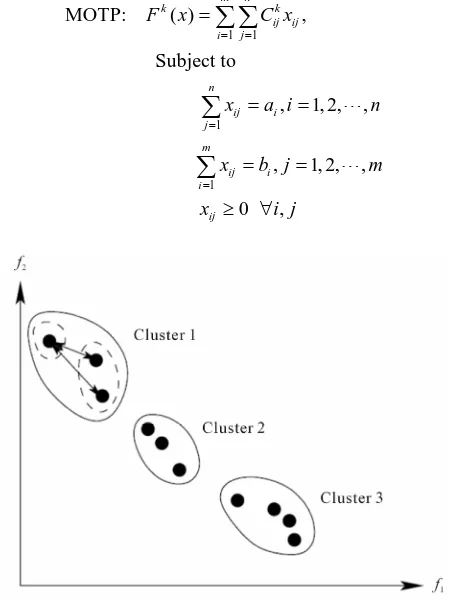
Euclidean distances in the objective space are computed. Then, the two cluster with the smallest distance are merged together to form one bigger cluster. This process reduces the number of cluster to N1. The inter-cluster distances are computed again and another merging is done. This process is repeated until the number of clus-ters is reduced to . With multiple population member occupying two clusters, the average distance of all pair-wise distances between solutions of the two clusters is used. Figure 1 illustrates this procedure.
N
This is especially important in higher dimensional ob-jective spaces, where the clustering algorithm can reduce the required number of solutions considerably. Also, it makes the algorithms practical by allowing a decision maker to control the resolution of the Pareto set ap-proximation by choosing an appropriate clusters number.
3. Multiobjective Transportation Problem
In real-life situations, the transportation problem (TP) usually involves multiple, conflicting, and incommensu-rate objective functions. This type of problem is called multiobjective transportation problem (MOTP). The mathematical model of MOTP can be stated as follows:
1 1
1
1
MOTP: ( ) ,
Subject to
, 1, 2, ,
, 1, 2, ,
0 ,
m n
k k
ij ij
i j
n
ij i
j m
ij i
i
ij
F x C x
x a i n
x b j m
x i j
[image:2.595.311.540.416.721.2]
kwhere
1
2
, , ,
k
F x F x F x F x is a vector of K objective functions, the superscript on both k
F x
and are used to identify the number of objective functions (k = 1, 2, ···, K), and m and n are the number of sources and destinations, respectively.
k ij
C
The above problem implies that the total supply
1
m i i
a
must be equal to the total demand
1
n
j j
b
. when total supply is equals to the total demand (i.e., total flow) the resulting formulation is called a balanced transportation problem. In this paper, we assume a balanced transporta-tion problem, where the unbalanced transportatransporta-tion lem can be converted to a balanced transportation prob-lem after including a dummy origin or a dummy destina-tion. The solution of this problem is called a nondomi-nated solution (if we refer to the objective function) and an efficient solution (if we refer to the decision variables space).4. The Proposed Algorithm
Genetic algorithms [11,12,19] are such a class of evolu-tionary based algorithms that start with a population of randomly generated candidates and “evolve” toward bet-ter solutions by applying genetic operators, modeled on the genetic processes occurring in nature. In the
follow-ing sub-sections, we present an improved evolutionary algorithm for solving the MOTP.
me equal to the
amount. That is for each sub-chromo-
ate structure of chromosome using proposed approach.
ich the nondominated set of solutions can be found [20].
4.1. Initialization Stage
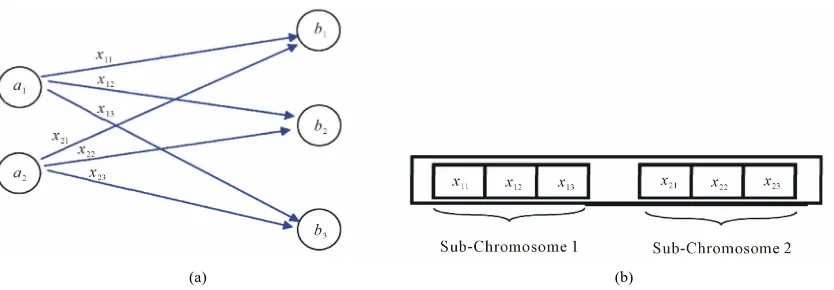
The genetic representation is a kind of data structure which represents the candidate solution of the problem in coding space. In order to form the appropriate design of chromosome, first consider each chromosome consists of a sequence of m sub-chromosome (m is the number of supplies). Each sub-chromosome (Figure 2) consists of n
genes (n is the number of demands). All chromosome are generated randomly such that the sum of total genes of each sub-chromoso corresponding supply
1
ij i
j
some i. In the example problem in Figure 3, we have two supplies (m = 2) and three demands (n = 3). In order to design the appropri
n
Gene a
[image:3.595.70.532.428.545.2]4.2. Evaluation of Non-Dominated Solutions A population of size N can be evaluated according to non-domination concept. Consider a set of population members, having K (K > 1) objective function values. the following procedure explains the algorithm by wh
Figure 2. Structure of chromosome for MOTP with n sources and m destinations.
(a) (b)
Figure 3. Illustration of c Chromosome structure.
[image:3.595.92.509.576.721.2]Step
N and , compare so- lu
0: Begin with i = 1.
Step 1: For all j1, 2,, ji
tions xi and xj for domination.
Step 2: If for any j. xi, is dominated by xj, mark
i
x as “dominated”.
Step 3: If all solutions (that is, when iN is re
: arked “dominated”
ar
tes an externally finite size ar
4.3. Selection Stage
) operator is intended to improve ached) in the set are considered, Go to Step 4, else in-crement i by one and Go to Step 1.
Step 4 All solutions that are not m e non-dominated solutions.
The algorithm initially loca
chive of observed nondominated solutions.
Selection (reproduction
the average quality of the population by giving the high- quality chromosomes a better chance to get copied into the next generation. The selection directs GA search to-wards promising regions in the search space. We propose a random-weight approach [20] to obtaining a variable search direction towards the Pareto frontier. Suppose that we are going to maximize k objective function. The weighted-sum objective is given as follows:
k
1 1
1
k k i i
i
f x w f x w f x w f x
where x is a string (i.e., individual), f x
is a com-bined fitness function, fi
x is the ith objective and1
1
k
w w
is a cons t for
i i
i
tant weigh fi x
.We employ roulette wheel selection as selection mech- anism in this study. Where, the individuals on each gen-eration are selected for survival into the next gengen-eration according to a probability value proportional to the ratio of individual fitness over total population fitness; this means that on average the next generation will receive copies of an individual in proportion to the importance of its fitness value. The probability of variable selection is proportional to its fitness value in the population, ac-cording to the formula given by
min
min,
x
f x f
p x
f x f
where, p x
, selection probability of a string x in a population and
min min
f f x x
4.4. Crossover Operators
exchange information be-The goal of crossover is to
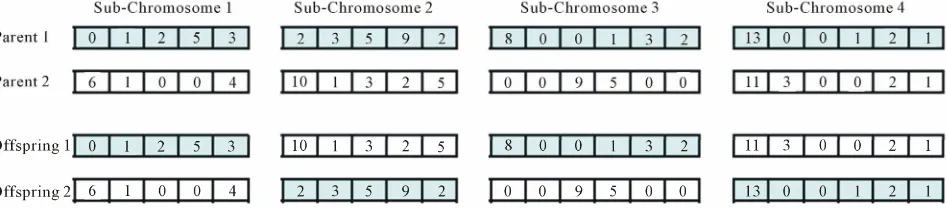
tween two parents chromosomes in order to produce two new offspring for the next population, we present a modified uniform crossover, where one offspring is con-structed by choosing every sub-chromosome with a pro- bability P (usually P0.5 is used) from either par-ent, as shown in Figur
In the example problem in
[image:4.595.63.536.610.714.2]e 4.
Figure 4 we have four sup-pl
4.5. Mutation Operators
ndom process where one ies (that is, we have four sub-chromosomes). The sec-ond and fourth sub-chromosome are exchanged between parents. It is interesting here to note that all offspring's chromosome are feasible.
A mutation operator is a ra
genotype is replaced by another to generate a new chro-mosome. Such a mutation operator first select a gene randomly from ith sub-chromosome and then replace it with a random integer within the interval of
0,ai
, all other genes in ith sub-chromosome are generated such that the sum of all genes in the ith sub-chromosome equalto the ith supply , n
Gene a
as shown in Figure 5.1
ij i
j
In the example problem in Figure 5, we have four sup-plies, a111, 21,a2 a314 and a417 the first
gene i e is (random
integer
n the first sub-chromosom mutated
0,a1
0,11
) and all other genes in the 1st
sub chromosom ated such that the sum of all genes equal to the supply amount
5
G a G G
e are gener
1 1 2 3 4 5
1
11 j
j
G G G
.Figure 5. Graphs visualizing the mutation operators.
Through this mutation operator, the population’s fea-si
4.6. Update Function
s the structure of the pro-bility was preserved.
Algorithm 1 (Figure 6) show
posed algorithm. The purpose of the function generate is to generate a new population in each iteration t, using the contents of the old population P(t1)
and the old archive set A(t1) in association with t ult of recombination and tion of parents. The function update gets the new population P( )t and the old archive set (t 1)
he res muta
A and determines the updated one, namely A( )t . Also, the func- tion LS is to explore the less-crowde ea in the current archive to possibly obtain more nondominated solutions.
As a result the proposed algorithm which is based on d ar
the (GA) uses a finite memory, successively updates a finite subset of vectors that dominate all vectors gener-ated so far. It guarantees that the subset contains only one element which are not dominated by any of the generated vectors. This puts limits to the size of the archive ac-cording the cluster algorithm Acac-cordingly the algorithm is more practical where a decision maker is able to con-trol the resolution of the Pareto set approximation ac-cording his needs. Also it guarantees an optimal distribu-tion of soludistribu-tions [9]. The algorithm has a low computa-tional time where, the computacomputa-tional time grows with the number of archived solutions. The proposed algorithm is capable to consider many objective functions. Accord-ingly it provides the facility to consider more criteria in MOTP problem.
(0) (0)
(0) (0)
(t)
( ) ( 1) ( 1)
( ) ( 1) ( ) 1. t 0
2. Create P ,
3. nondominated( )
3. terminate (A , ) do
4. : 1
5. P : generate( , ) {generate new search point}
6. : update( , ) {update arch
t t t
t t t
R
A P
while t false
t t
A P
A A P
( )
ive (algorithm 2)} 7.
8. : LS( )
9. Output : t end while
A A
A
Figure 6. Algorithm 1.
4.7. The Local Search
s a dynamic ver-ique. This study examines the
e external archive The local search p
sion of pattern search techn
hase is implemented a
usefulness of a dynamic version of pattern search tech-nique [21] to improve the solution quality of MOTPs. The search procedure looks for the best solution “near” another solution by repeatedly making small changes to a starting solution until no further improved solutions can be found.
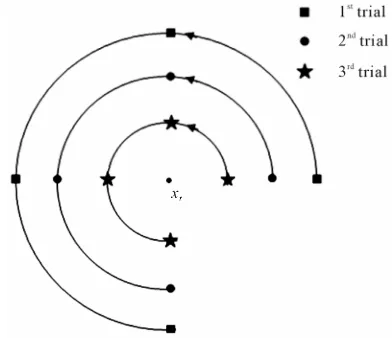
The local search is started by loading the Pareto solu-tions in th A. For every solution xm
)
in
n
the archive, we have
X n
mR A, where the
changes on the values for each imension (i1, 2,,
can be defined as
d
1 kx R
k 1 kmax
m r
where k is number of trial ( to obtain pre-ferred solution than m number in
max
0, ,
k k
r is the rando arch radius.
)
Xm, the range [0,1], R is the se
W e s u c c e s s i v e l y l o o k a t t h e p o i n t s
i,
1, 2, ,
k
m m
xx x e i n , until we find x
for which fj
x fj
xt for at least one objective. If we find no x such that fj
x fj
xt , then x xm.Then we u solutions by non dominated ones and th ominated o . This situ is represented in Figure 7 for the case in R2. Without
pdate the Pareto
[image:5.595.323.519.550.719.2]e d nes are removed ation
loss of generality, the elements discussed above are syn-thesized to evolve the proposed approach. The pseudo code of the proposed algorithm is given in Figure 8.
5. Experimental, Results and Discussions
[image:6.595.318.526.291.449.2] [image:6.595.66.277.388.541.2]The proposed algorithm was implemented on 2.7-MHz PC using MATLAB 6.5. To confirm the effectiveness of the algorithm on the transportation problem, three nu-merical problems were used in the computational studies.
Table 1 lists the parameter setting used in the algorithm for all runs. Let us consider the following numerical ex-ample presented by many researchers [3,4,22,23,24] to illustrate the application of the proposed algorithm.
Problem 1:
n do
pro y
sing different methods. The interactive approach in [24]
proach in [4] gave the following results: Z1 = 170 and Z2 he fuzzy approach in [23] gave the following results: Z1 = 160 and Z2 IFGP appr ] gave ing results: Z1 = 168 and Z2 = 185. lso, the obtaine result fro ] are (143,265 156,200), (1 5), (18 ). The pro sed approach i his stud u-tions as in Figure 9. It is obviously t ob-tained he proposed algorithm dom r re-sults ob ed by other di ent approac
Problem 2:
Let nsider the following nu -The problem has the following characteristics:
Supplies: a18, 19, 17.a2 a3
Demands: b111, 3, 14, 16.b2 b3 b4
Penalties:
1 2
1 2 7 7 4 4 3 4
1 9 3 4 , 5 8 9 10
C C
8 9 4 6 6 2 5 1
To evaluate the performance of the suggested ap-
Local search phase by adaptive pattern search
Input : A, search radius 0
k , load the Pareto solutions from the external archive while kkmax do
for j1:
k , 1, , m m
x x x e i i
n
If xxm do
end if
end for, end while
{replace the old solution}
m x x
1
k k
OutputA
Figure 8. The pseudo code of the proposed approach.
able 1. Parameters values used by the proposed algorithm for Value T all runs. Parameter Problem 1 em 2 Probl Problem size
3 4 4 5
Number of objective
3 Population e 15 15 Mutation rate Crossover rate 0.95 Maximum generation 100 100 2 siz 0.50 0.5 0.95
ach, let us consider the solution of the problem b u
provides the following results: Z1 =186 and Z2 = 174, the fuzzy ap
= 190, t
= 195, the oach in [3 the follow
A d
,17
m t-GA in [7 ), (
po
76 n t
6,171), (208,167 y gave a set of sol
hat the results by t
tain
inate all othe hes. ffer
us co merical example pre
sented in [3,4]. The problem has the following character-istics:
Supplies: a15, 4, 2, 9.a2 a3 a4
Demand: b14, 4, 6,b2 b3 b42, 4.b5
Penalties
1 2
3
9 12 9 6 9 2 9 8 1 4
7 3 7 7 5 1 9 9 5 2
6 5 9 11 3 8 1 8 4 5
6 8 11 2 2 2 8 6 9 8
2 4 6 3 6
4 8 4 9 2
5 3 5 3 6
C C
C
6 9 6 3 1
To evaluate the performance of the suggested ap-proach, let us consider the solution of th lem by us nt methods. The fuzzy appro n 4] pro-vi owing results: Z1 = 112, Z2 = 106 and Z3 = 80 other hand, the interactive approach in [3]
e prob
ing differe ach i [
des the foll . On the
140 150 160 170 180 190 200
170 180 190 270 200 210 220 230 240 250
260 Fuzzy Approach
Proposed Aproach fuzzy approach interactive approach IFGP 2 n d O b je c tiv e v a lu e T-GA
1st Objective value
[image:6.595.310.533.530.701.2] [image:6.595.58.285.594.731.2]gave the following results: Z1 = 127, Z2 = 104 and Z3 = 76.
Figure 10 shows the obtained Pareto frontier, The ob-tained results by the proposed algorithm dominate the results obtained by The fuzzy approach in [4] and the interactive approach in [3]. From the previous result, it was concluded that Integration of GA and local search technique has improved the quality of the founded solu-tion, Also it guarantee the faster converge to the Pareto optimal solution. GA has provided the initial set (close to the Pareto set as possible) followed by local search method to improve the quality of the solutions. However, because of its stochastic behavior, GA may suffer from slow convergence. In order to reach a quick and closer result to Pareto optimal solution, and to improve the eff
utions that best
6.
proach has been effectively applied i-ciency of the GA, the algorithm maintain an external archive of the observed nondominated sol
conform a Pareto Front.
Conclusions
In this paper, an improved algorithm for solving MOTP was presented. Our approach has two characteristic fea-tures. Firstly, the algorithm is an iterative multiobjective genetic algorithm with an external population of Pareto optimal solutions that best conform a Pareto front. Sec-ondly the algorithm implements GA to provide the initial set (close to the Pareto set as possible) followed by local search method to improve the quality of the solutions. It is concluded that Integration of GA and local search technique has improved the solution’s quality. To avoid an overwhelming number of solutions clustering algo-rithm saves the most representative solutions, which gets iteratively updated in the presence of new solutions. The main features of the proposed algorithm could be sum-marized as follows:
1) The proposed ap
60 80 100 120 140 40 60 80 100 120 50 60 70 80 90 100
1 st objective value 2 nd objective value
3
r
d
o
b
je
c
tiv
e
v
a
lu
e
Fi
third problem.
to olve the MOTP, with no limitation in handing higher dimensional problems.
2) The proposed algorithm was able to find well dis-tributed of the Pareto-optimal curve in the objective space.
3) The proposed algorithm keeps track of all the feasi-ble solutions found during the optimization and therefore do not have any restrictions on the number of the Pareto-optimal solutions found.
4) The inclusion of local search speeds-up the search process and also helps in obtaining a fine-grained value for the objective functions.
5) The success of our approach on most of the test problems not only provides confidence but also stress the importance of hybrid evolutionary algorithms in solving multiobjective optimization problems.
Genetic Algorithm and TOPSIS Te-
athematics, Vol. 87, No. 13, 2010, pp. 3017-3029.
gure 10. Pareto set using the proposed algorithm for the
s
REFERENCES
[1] A. A. Mousa, “Using
chnique for Multiobjective Transportation Problem: A Hybrid Approach,” International Journal of Computer M
doi:10.1080/00207160902875262
[2] L. Yang and Y. Feng, “A Bicriteria Solid Transportation Problem with Fixed Charge under Stochastic Environ- ment,” Applied Mathematical Modelling, Vol. 31, No. 12, 2007, pp. 2668-2683. doi:10.1016/j.apm.2006.10.011
[3] W. F. Abd El-Wahed and S. M. Lee, “Interactive Fuzzy Goal Programming for Multiobjective Transportation Pro- blems,” Omega, Vol. 34, No. 2, 2006, pp. 158-166. doi:10.1016/j.omega.2004.08.006
[4] W. F. Abd El-Wahed, “A Multi-Objective Transportation Problem under Fuzziness,” Fuzzy Sets and Systems, Vol. 117, No. 1, 2001, pp. 27-33.
doi:10.1016/S0165-0114(98)00155-9
[5] Z. Michalewic . Hobbs, “a Non-
standard Genet nlinear Transporta-
ac- etics, Vol. 21, No. 3, z, G. A. Vignaux and M
ic Algorithm for the No
tion Problem,” INFORSA Journal on Computing, Vol. 3, No. 4, 1991, pp. 307-316.
[6] G. A. Vignaux and Z. Michalewicz, “a Genetic Algorithm for the Linear Transportation Problem,” IEEE Trans tions on Systems, Man & Cybern
1991, pp. 445-452. doi:10.1109/21.87092
[7] M. Gen, K. Ida Kono and Y. Z. Li, “Solving Bi-Criteria Solid Transportation Problem by Genetic Algorithm,” Proceeding of the 16th International Conference on Com-
jec-anning Tree-Based Ge-
eb and E. Zitzler, “Archiv- Diversity in Mul-
, New York, puters& Industrial Engineering, San Antonio, 2-5 Octo- ber 1994, pp. 572-575.
[8] M. Gen, Y. Z. Li and Kenichi Ida, “Solving Multiob tive Transportation Problem by Sp
netic Algorithm,” IEICE Transactions on Fundamentals, Vol. E82-A, No. 2, 1999, pp. 2802-2810.
[9] M. Laumanns, L. Thiele, K. D ing with Guaranteed Convergence and
volutionary Algorithm for
Mul-ta Structures = 9-13 July 2002, pp. 439-447.
[10] M. S. Osman, M. A. Abo-Sinna and A. A. Mousa, “IT- CEMOP: An Iterative Co-E
tiobjective Optimization Problem with Nonlinear Con- straints,” Journal of Applied Mathematics & Computation, Vol. 183, No. 1, 2006, pp. 373-389.
[11] Z. Michalewicz, “Genetic Algorithms + Da
Evolution Programs,” 3rd Edition, Springer-Verlag, Ber- lin, 1996.
[12] M. Gen and R. Cheng, “Genetic Algorithms & Engineer- ing Design,” John Wily & Sons, New York, 1997.
[13] Y. Kilani, “Comparing the Performance of the Genetic and Local Search Algorithms for Solving the Satisfiabil- ity Problems,” Applied Soft Computing, Vol. 10, No. 1, 2010, pp. 198-207. doi:10.1016/j.asoc.2009.07.012
[14] G. Whittaker, et al., “A Hybrid Genetic Algorithm for Multiobjective Problems with Activity analysis-Based Lo- cal Search,” European Journal of Operational Research, Vol. 193, No. 1, 2009, pp. 195-203.
doi:10.1016/j.ejor.2007.10.050
[15] C. Hamzacebi,” Improving Genetic Algorithms’ Perfor- mance by Local Search for Continuous Function Optimi- zation”, Applied Mathematics and Computation, Vol. 196, No. 1, 2008, pp. 309-317. doi:10.1016/j.amc.2007.05.068
[16] A. A. Mousa, R. M. Rizk-Allah and W. F. Abd El-Wahed, “A Hybrid Ant Colony Optimization Approach Based Local Search Scheme Formultiobjective Design Optimi- zations,” Electric Power Systems Research, Vol. 81, No. 4, 2011, pp. 1014-1023. doi:10.1016/j.epsr.2010.12.005
[17] K. Miettinen, “Non-Linear Multiobjective Optimization,” Kluwer Academic Publisher, Dordrecht, 2002.
[18] M. S. Osman, M. A. Abo-Sinna and A. A. Mousa, “Epsi- lon-Dominance Based Multiobjective Genetic Algorithm for Economic Emission Load Dispatch Optimization Pro- blem,” Electric Power Systems Research, Vol. 79, No. 11, 2009, pp. 1561-1567.
[19] C. M. Fonseca and P. J. Fleming, “An Overview of Evo- lutionary Algorithms in Multiobjective Optimization,” Evo- lutionary Computation, Vol. 3, No. 1, 1995, pp. 1-16. doi:10.1162/evco.1995.3.1.1
[20] M. S. Osman, M. A. Abo-Sinna and A. A. Mousa, “An
ptimization Theory and Prac-
9, 5.1.73
Effective Genetic Algorithm Approach to Multiobjective Routing Problems (MORPs),” Journal of Applied Mathe- matics & Computation, Vol. 163. No. 2, 2005, pp. 769- 781.
[21] S. S. Rao,” Engineering O
tice,” 3rd Edition, John Wiley, New York, 1996, p. 903.
[22] Y. P. Aneja and K. P. K. Nair, “Bicriteria Transportation Problems,” Management Science, Vol. 25, No. 1, 197 pp. 73-80. doi:10.1287/mnsc.2
[23] A. K. Bit, M. P. Biswal, S. S. Alam, “Fuzzy Program- ming Approach to Multicriteria Decision Making Trans- portation Problem,” Fuzzy Sets and Systems, Vol. 50, No. 2, 1992, pp. 35-41. doi:10.1016/0165-0114(92)90212-M
[24] J. L. Ringuest and D. B. Rinks, “Interactive Solutions for
![Table 1 lists the parameter setting used in the algorithm for all runs. Let us consider the following numerical ex-ample presented by many researchers [3,4,22,23,24] to](https://thumb-us.123doks.com/thumbv2/123dok_us/9249525.413104/6.595.58.285.594.731/parameter-setting-algorithm-consider-following-numerical-presented-researchers.webp)
![Figure 10 shows the obtained Pareto frontier, The ob-tained results by the proposed algorithm dominate the results obtained by The fuzzy approach in [4] and the](https://thumb-us.123doks.com/thumbv2/123dok_us/9249525.413104/7.595.61.287.537.704/figure-obtained-frontier-proposed-algorithm-dominate-obtained-approach.webp)
