CONTENT BASED IMAGE RETRIEVAL USING COLOR HISTOGRAM
Khatua, C. K.,
Department of Computer Sc
ARTICLE INFO ABSTRACT
With the availability of easy and inexpensive methods to create and store images
the visual information preserved and shared electronically has grown dramatically. Since the non textual information like images, audio and video preserved in digital format are increasing day by day, effective applications to manage an
known as content based image retrieval (CBIR). Firstly, keyword annotation is labor intensive, and it is not even possible when large sets of images are to be indexed. Secondly, these annotations a drawn from a predefined set of keywords which cannot cover all possible concepts images may represent. Finally, keywords assignment is subjective to the person making it. This paper focuses on color based image retrieval to develop a system that uses th
images. To improve the efficiency and effectiveness of color
has been proposed. Experimental results show that the color histogram features containing spatial structural r
similar object from the image sequences, the color histogram method gives good retrieval precision with speed.
Copyright © 2015 Khatuaet al. This is an open access article distributed under the Creative Commons Att distribution, and reproduction in any medium, provided the original work is properly cited.
INTRODUCTION
Content-Based Image Retrieval (CBIR) systems are search engines for image databases, which index images according to their content. A typical task solved by CBIR systems is that a user submits a query image or series of images and the system is required to retrieve images from the database as similar as possible. Another task is a support for browsing through large image databases, where the images are supposed to be grouped or organized in accordance with similar properties
2008; Smeulders et al., 2000). The goal of content
retrieval systems is to extract a set of similarity features, such as color, shape and texture features which can effectively characterize the visual content of images, and then use them for retrieval purpose, which is called query by image example. The features should be robust enough for image content representation and simple enough for practical retrieval application (Aigrain et al., 1996). Histogram is the most commonly used scheme to represent the features composition of an image. Generally speaking, the existing histogram features can be divided into two categories: spatial
*Corresponding author: Nayak, S. K.
Department of Computer Sciences and Applications, Sambalpur University, Odisha, India
ISSN: 0975-833X
Article History:
Received 06th July, 2015
Received in revised form
20th August, 2015
Accepted 17th September, 2015
Published online 31st October,2015
Key words:
Content Based Image Retrieval (CBIR), Color histogram,
Feature extraction, Similarity measure.
Citation: Khatua, C. K., Nayak, S. K. and Dr. C. S. Panda
Journal of Current Research, 7, (10), 21692-21703
RESEARCH ARTICLE
CONTENT BASED IMAGE RETRIEVAL USING COLOR HISTOGRAM
Khatua, C. K., *Nayak, S. K. and Dr. C. S. Panda
Sciences and Applications, Sambalpur University, Odisha, India
ABSTRACT
With the availability of easy and inexpensive methods to create and store images
the visual information preserved and shared electronically has grown dramatically. Since the non textual information like images, audio and video preserved in digital format are increasing day by day, effective applications to manage and retrieve these content are essential, which are commonly known as content based image retrieval (CBIR). Firstly, keyword annotation is labor intensive, and it is not even possible when large sets of images are to be indexed. Secondly, these annotations a drawn from a predefined set of keywords which cannot cover all possible concepts images may represent. Finally, keywords assignment is subjective to the person making it. This paper focuses on color based image retrieval to develop a system that uses the color as a visual feature to represent the images. To improve the efficiency and effectiveness of color-based retrieval, color histogram method has been proposed. Experimental results show that the color histogram features containing spatial structural relations are robust to image translation, scaling and rotation, and for retrieval of visually similar object from the image sequences, the color histogram method gives good retrieval precision with speed.
ess article distributed under the Creative Commons Attribution License, which distribution, and reproduction in any medium, provided the original work is properly cited.
Based Image Retrieval (CBIR) systems are search engines for image databases, which index images according to their content. A typical task solved by CBIR systems is that a user submits a query image or series of images and the system retrieve images from the database as similar as possible. Another task is a support for browsing through large image databases, where the images are supposed to be grouped or organized in accordance with similar properties (Datta et al., . The goal of content-based image retrieval systems is to extract a set of similarity features, such as color, shape and texture features which can effectively characterize the visual content of images, and then use them for led query by image example. The features should be robust enough for image content representation and simple enough for practical retrieval . Histogram is the most commonly used scheme to represent the features composition of an image. Generally speaking, the existing histogram features can be divided into two categories: spatial-domain
Department of Computer Sciences and Applications, Sambalpur
histogram and frequency-domain histogram
2005). Color is one of the most important identifying features that are local and largely independent of view and resolution. The most widely used
spatial-color histogram which represents the spatial-color composition and distribution of the whole image
Content-Based Image Retrieval (CBIR) is the process of retrieving images from a database on the basis of features that are extracted automatically from the images themselves (Eakins and Graham, 1999). This paper focuses on the use of a single image feature for retrieval purposes, namely color. Color is a visual feature that one can immediately perceives when looking at an image (Del Bimbo
Image Retrieval
Basically they are divided into two frameworks:
i) Text based image retrieval ii) Content based image retrieval. International Journal of Current Research
Vol. 7, Issue, 10, pp.21692-21703, October, 2015
INTERNATIONAL
Khatua, C. K., Nayak, S. K. and Dr. C. S. Panda, 2015. “Content based image retrieval using color histogram 21703.
CONTENT BASED IMAGE RETRIEVAL USING COLOR HISTOGRAM
and Applications, Sambalpur University, Odisha, India
With the availability of easy and inexpensive methods to create and store images in digital formats, the visual information preserved and shared electronically has grown dramatically. Since the non-textual information like images, audio and video preserved in digital format are increasing day by
d retrieve these content are essential, which are commonly known as content based image retrieval (CBIR). Firstly, keyword annotation is labor intensive, and it is not even possible when large sets of images are to be indexed. Secondly, these annotations are drawn from a predefined set of keywords which cannot cover all possible concepts images may represent. Finally, keywords assignment is subjective to the person making it. This paper focuses on e color as a visual feature to represent the based retrieval, color histogram method has been proposed. Experimental results show that the color histogram features containing spatial elations are robust to image translation, scaling and rotation, and for retrieval of visually similar object from the image sequences, the color histogram method gives good retrieval precision
ribution License, which permits unrestricted use,
domain histogram (Datta et al., . Color is one of the most important identifying features that are local and largely independent of view and resolution. -domain histogram is the global resents the color composition and distribution of the whole image (Swain and Ballard, 1991).
Based Image Retrieval (CBIR) is the process of retrieving images from a database on the basis of features that are extracted automatically from the images themselves . This paper focuses on the use of a for retrieval purposes, namely color. Color is a visual feature that one can immediately perceives when
Del Bimbo, 1999).
Basically they are divided into two frameworks:
based image retrieval.
INTERNATIONAL JOURNAL OF CURRENT RESEARCH
Text-Based Retrieval
The traditional image retrieval employed text as the primary means by which to represent and retrieve images from databases (Del Bimbo, 1999). Text-based image retrieval can be traced back to the 1970’s; images were represented by textual descriptions and subsequently retrieved using a text-based database management system (Thomas et al., 1997). In addition, the annotator’s perception of an image may not necessarily reflect that of the user, since description and meaning of a visual image is open to individual interpretation (Enser, 1993). Researchers concluded that some means of interaction with the visual content of the images themselves was needed to perform effective retrieval. This led to the development of content-based image retrieval, wherein images are retrieved based on their visual features (Venters and Cooper, 2000).
Content-Based Image Retrieval
[image:2.595.55.546.260.732.2]In Content-based image retrieval, the images are indexed by their visual contents, such as color, texture, shape, structure, motion and combination of these. Initial research in the retrieval of images based on their inherent features has been reported in (Eakins and Graham, 1999). Content-based image retrieval utilizes representations of features that are automatically extracted from the images themselves. The system extracts the features of the query image, searches through the database for images with similar features, and displays relevant images to the user in order of similarity to the query (Myron Flickner et al., 1995; Patrick and Kelly, 1995; Chad Carson et al., 1999; Das et al., 1997).
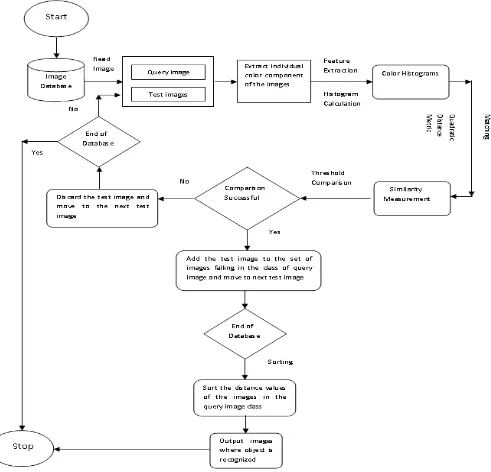
Many CBIR systems have been developed that analyze, compare and retrieve images based on one or more of these features. Some systems have achieved various degrees of success by combining both content-based and text-based retrieval (Ma et al., 1997; Ogle and Stonebraker, 1995; Michael Ortega et al., 1997). In typical Content Based Image retrieval systems Figure 1.1 shows the visual contents of the images in the database are extracted and described by feature vector.
Image Content Descriptors
A visual content descriptor can be either global or local. A global descriptor uses the visual features of the whole image, whereas a local descriptor uses the visual features of regions or objects to describe the image content. To obtain the local visual descriptors, an image is often divided into parts first.
Color-Based Retrieval
Since color is a low-level image feature that does not appear to classify images distinctly, few CBIR systems exist that utilize only color as the image retrieval feature (Petteri Kerminen and Moncef Gabbouj 2000). Yet color does have its advantages for image retrieval. It provides multiple measurements at a single pixel of the image, enabling classification to be done without the need for complex spatial decision-making (Stockman and Shapiro, 2001; Vishal Chitkara, 2001). Color content is also independent of view and resolution and is easy to extract from an image and to manipulate (Swain and Ballard, 1990). In this paper, we revisit the issue of using color as the dominant image feature in a CBIR system.
Objective of Work
The objective of this paper is to develop a simple Content-based image retrieval system for image databases using low-level feature as color and improve the performance of image retrieval. Content-based image retrieval (CBIR) techniques could be valuable to many image processing areas that could assist with decision support. From the previous section it is found that there are still many challenges open in the area of content-based image retrieval.
The ultimate goal of the work in this paper is:
To propose an accurate and efficient algorithm for retrieval of similar images form an image database and to develop a Graphical user interface for retrieval of image based on image content that could be as similar to human perception.
Secondly, steps will be taken to reduce both sensory and semantic gap. The semantic gap can be considered to be a break or discontinuity in the aspect of image understanding, with human understanding on one side of the gap and machine understanding on the other. The second gap is the sensory gap that describes the loss between the actual structure and the representation in a digital image.
RELATED WORKS
CBIR describes the process of finding images from a large data collection that match to a given query image. Many
general-purpose systems have been developed. QBIC (Flickner et al., 1995), VIR (Gupta and Jain, 1997), and AMORE (Mukherjea et al., 1999) are examples of commercial general purpose systems. Recently, academic systems have been developed such as MIT Photobook (Pentland et al., 1997). Berkeley Blobworld (Carson et al., 1999), Columbia Visualseek and Webseek (Smith and Chang, 1996), Netra (Ma and Manjunath, 1997), and Stanford WBIIS (Wang et al., 1998) are some of the recent well known systems.
General Purpose CBIR Systems
Several CBIR systems have been proposed recently. Even though a few of them be- came commercial products, many CBIR systems were proposed as research prototype, being developed in universities and research laboratories. QBIC (Query by Image Content) by IBM (Flickner et al., 1995), Photobook (Pentland et al., 1997; Veltkamp and Tanase, 2002), developed by the Mas-sachusetts Institute of Technology (MIT), Chabot, Netra, and VisualSEEK (Smith and Chang, 1996) allow query by image content. Chabot (Ogle and Stonebraker, 1995) integrates image content retrieving based on color information with text-based queries. Its interface allows user to search and update the image database. Ma et al. (1997) describe a toolbox for browsing large database collections called Netra. This prototype uses color, texture, shape, and spatial location of image segmented regions to retrieve similar images from a database. More recently, Cox et al. (2000) present the PicHunter system. In this system, a Bayesian framework is used to model user needs during query formulation. KIWI (Key-point Indexing Web Interface) (Loupias and Bres, 2001) has been developed in France by INSA Lyon in 2001. ImageMiner (Kreyss et al., 1997) has been developed by Technologie-Zentrum Informatik at Univerity of Bremen in Germany in 1997. It uses color, texture, and shape to describe the image. VisualSEEK and WebSEEK were developed by the Department of Electrical Engineering, Columbia University. Both these systems support colour and spatial location matching as well as texture matching (http://www.jtap.ac.uk/reports/htm/jtap-054.html).
Color Histogram Based Approaches
histogram for k-mean (CHKM). In 2002, Shin and Chen (2002) proposed the partition-based color-spatial method. The query image is divided into 100 blocks and for each block the three color moments are computed for each color layer. The mean vector of each block is considered as the primitive, of the image. This method is not suitable for image databases containing large images. However, Chan and Chen (2004) proposed a similar method of considering the mean value of the color component at each block. They divided the image into 3 x 3 blocks instead of 100m blocks. The mean value is computed for each block color layer (R, G, and B) separately. In 2008, another system is proposed by Mustaffa, Ahmad, Rahmat, and Mahmod based on color-spatial features (Mustaffa et al., 2008). In 2004, Zhang (2004) computed color and texture features from the image database. So, for each image, color and textures features are computed. When a query image is submitted, the color and texture features are computed. In 2010, Kekre and Mishra (2010) presented a new algorithm for digital search and retrieval. They used Fast Fourier Transform for each image color components (R, G, and B). In March 2011, Sharma, Rawat and Singh (Sharma et al., 2011) proposed an efficient CBIR using color histogram processing. The proposed method used color moments and color histograms. In Feb 2012, Singha and Hemachandran (Singha and Hemachandran, 2012) proposed Content Based Image Retrieval using Color and Texture content based image retrieval, using features like texture and color, called WBCHIR (Wavelet Based Color Histogram Image Retrieval). In 2013, Altaff Hussain Venkata Rao (2013) proposed content based; color has been taken as the property for searching.
METHODOLOGY
The main method of representing color information of images in CBIR systems is through color histograms (Swain and Ballard, 1991). A color histogram is a type of bar graph, where each bar represents a particular color of the color space being used. An improvement of the color histogram method includes the cumulated color histogram (Stricker and Orengo, 1995).
The histogram of an image refers to the probability density function of the image intensities with gray levels in the range (0,
L
1
) and defined as (Gonzalez and Woods, 2002; Pratt, 2007):n
n
r
p
kk
)
(
where,k
0
,
1
,
2
,....,
L
1
………..(1)
L
= number of levels,r
k= thek
th gray level,n
k= numberof pixels in the image having gray level,
n
= total number of pixels in the imageThe histogram of color image refers to the joint probabilities of the intensities of the three color channels and defined as:
)
,
,
(
Pr
.
)
,
,
(
,,
a
b
c
N
ob
A
a
B
b
C
c
h
ABC
………(2)
Where,
A
,B
andC
represent the three color channels like RGB or HSV andN
is the number of pixels in the image. The histogram expresses the frequency distribution of color bins in an image and each bin in the color histogram contains the information about the number of pixels belong to the color bin.Many distance formulas related to histogram matching has been described in literature out of which three distance formulas that have been used widely for image retrieval includes histogram Euclidean distance, histogram intersection distance and histogram quadratic (cross) distance (Color and texture feature-based image retrieval by using Hadamard matrix in discrete wavelet transform, 2013).
Let
h
andg
represent two color histograms withn
bins. The Euclidean distance between the color histogramsh
andg
is defined as (Li et al., 2003):2 2
))
,
,
(
)
,
,
(
(
)
,
(
A B C
c
b
a
g
c
b
a
h
g
h
d
…………(3)Where,
A
,
B
andC
represent the three color channels (R, G, B) anda
,
b
andc
are the corresponding histogram components of the channels. Using this distance metric, there is only comparison between the identical bins in the respective histograms.The Histogram intersection between the color histograms
h
andg
is defined as:)
,
min(
))
,
,
(
),
,
,
(
min(
)
,
(
g
h
c
b
a
g
c
b
a
h
g
h
d
A B C
……….(4)Histogram intersection is special for object tracking because it does not require the accurate separation of the object from its background. The result of the intersection of a query image histogram with a test image histogram is the number of pixels from the query image that have corresponding pixels of the same color in the test image.
The Quadratic distance between color histograms
h
andg
is defined as:)
(
)
(
)
,
(
h
g
h
g
A
h
g
d
T
……….(5)where
A
is a similarity matrix and thea
(
i
,
j
)
th
element in the similarity matrix for RGB color space is defined as:)
max(
/
1
ij ijij
d
d
a
………..(6)
The quadratic distance represents the cross-correlation between histogram bins based on the perception of similar colors represented by the bins and the set of all cross-correlation values are represented by the similarity matrix.
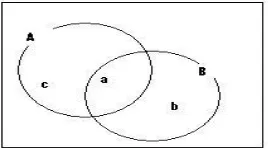
[image:5.595.98.232.212.288.2]As a result of histogram matching using a distance metric, the distances between the query image and the test images are calculated and compared against a predefined threshold value. The successful candidate images are ranked by their similarities with the query image. Finally, in order to evaluate the performance of the object tracking model using different distance measures, two metrics called recall and precision are used (Li et al., 2003).
Figure 3.5. Sets for explaining retrieval effectiveness
Let
A
be the set of relevant items,B
be the set of retrieved items,a
be the retrieved relevant images,b
be the retrieved irrelevant images, andc
be the unretrieved relevant images, thenRecall =
P
(
B
/
A
)
=)
(
)
(
A
P
B
A
P
=c
a
a
Number of relevant images retrieved (7)
Recall = --- Total number of relevant images in the database
Precision =
P
(
A
/
B
)
=)
(
)
(
B
P
B
A
P
=b
a
a
Number of relevant images retrieved (8) Precision = ---
Total number of retrieved images
Algorithm: Image Retrieval using Color Histogram
Algorithm: Image retrieval using color histogram method
Input: N = Total number of images in the database
P = Total number of individual color component in the image
t
d
= predefined distance thresholdC = Total number of images present in the class of query image E = Number of images to be extracted sequentially from
C
A = Total number of images inE
where object is found BeginStep 1: For each query image
Q
iin the database, i = 1 to N doStep 2: For each test image
T
jin the database, j = 1 to N doStep 3: If (Number of pixels in
Q
i
Number of pixels inj
T ) then Scale the image
T
j to have the same number ofpixels as
Q
i End ifStep 4: Extract the individual color component of the images
Step 5: For each color component of the image, p = 1 to P do Step 6: Extract the color component by computing histogram of
)
(k
Qi andTj(k)
Step 7: Compute normalized histogram of Qi(k)andTj(k)and
extract histogram parameters
Step 8: Compute
d
j= distance_between (histogram parameters of Qi(k)and histogram parameters ofTj(k), using a distance metricStep 9: Compare
d
j with a predefined distance thresholdd
tStep 10: If (the value of
d
j satisfy the required relation withthe pre-defined threshold
d
t) then flag = ‘object may bepresent’ Add test image
T
j to the set of output images fallingin the class of query image
Q
i Else Flag = ‘object not found’Discard the test image
T
j and move to the next image in the database End ifStep 11: Sort the distance values of the output images in the class of query image either ascending or descending as required by the used distance metric
Step 12: Count the number of output images C falling in the
class of query image Qiafter sorting End
EXPERIMENT AND RESULTS ANALYSIS
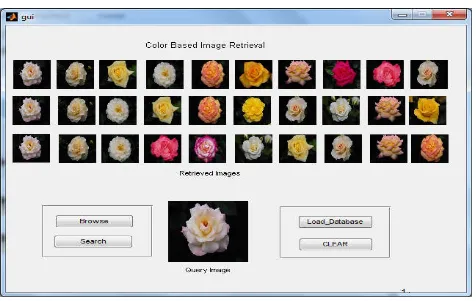
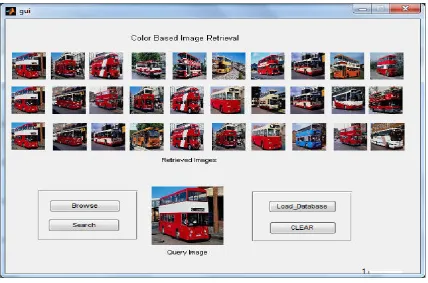
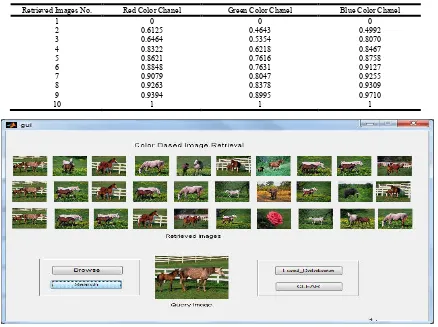
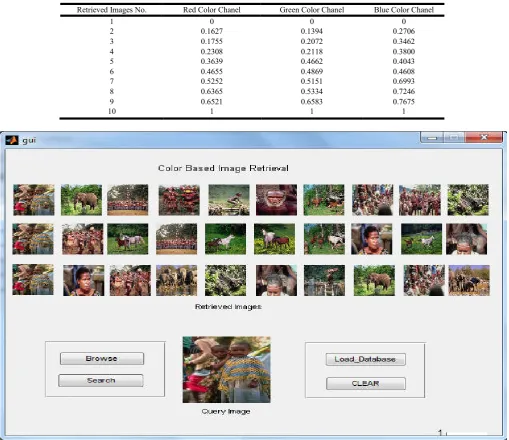
We carry out the experiments on image database from James Z. Wang Research Group (Li et al., 2003). The original database consists of 1000 JPEG images with 10 categories like African people, Beach, Building, Bus, Dinosaur, Elephant, Flower, Horse, Mountain and Food. But we have taken 06 categories like African people, Bus, Dinosaur, Elephant, Flower and Horse with 300 images from the original databases with 50 images from each category. All the images are RGB images of size 384 256 or 256 384 with bit depth of 24 bits per pixel. The sample images of image database are shown in Figure 4.1, the Original RGB image and its extracted Red, Green and blue components are shown in Figure 4.2, histogram of an image and histogram of individual color components are shown in Figure 4.3, the Graphical User Interface(GUI) of image retrieval system is shown in Figure 4.4, the retrieved flower class result using quadratic distance is shown in Figure 4.5, the result retrieved using quadratic distance for flower class is given in Table 4.1, Retrieved results for Bus class using quadratic distance is shown in Figure 4.6, the Result retrieved using quadratic distance for Bus class is given in Table 4.2, the Retrieved results for Elephant class using quadratic distance is shown in Figure 4.7, the Result retrieved using quadratic distance for Elephant class is given in Table 4.3, the Retrieved results for Horse class using quadratic distance is shown in Figure 4.8, the Result retrieved using quadratic distance for Horse class is given in Table 4.4, the Retrieved results for Dinosaur class using quadratic distance is shown in Figure 4.9, the Result retrieved using quadratic distance for Dinosaur class is given in Table 4.5, the Retrieved results for People class using quadratic distance is shown in Figure 4.10, the Result retrieved using quadratic distance for People class is given in Table 4.6 and the corresponding recall rate, retrieval precision and retrieval time for each image class with the color histogram method are given in Table 4.7.
Figure 4.1. Sample images from the database
Figure 4.2. (a) Original RGB image (b) extracted Red components, (c) extracted Green components, (d) extracted Blue components
[image:6.595.82.524.620.768.2]Figure 4.4. Graphical User Interface (GUI) of image retrieval system
Figure 4.5. Retrieved results for Flower class using quadratic distance
Table 4.1. Result for retrieved quadratic distance for Flower class
Retrieved Images No.
Red Color Chanel
Green Color Chanel
Blue Color Chanel
1 0 0 0
2 0.2335 0.1331 0.3017
3 0.3246 0.3082 0.3699
4 0.3988 0.3482 0.6265
5 0.5230 0.5319 0.6752
6 0.7161 0.5517 0.6764
7 0.8048 0.6849 0.7060
8 0.8425 0.8448 0.7649
9 0.9046 0.9695 0.9378
[image:7.595.179.419.665.782.2]Figure 4.6. Retrieved results for Bus class using quadratic distance
Table 4.2. Result for retrieved quadratic distance for Bus class
Retrieved Images No. Red Color Chanel Green Color Chanel Blue Color Chanel
1 0 0 0
2 0.5597 0.6531 0.7727
3 0.7245 0.6997 0.8749
4 0.7675 0.7156 0.8970
5 0.8095 0.7515 0.9043
6 0.8939 0.8804 0.9073
7 0.9077 0.9085 0.9115
8 0.9093 0.9484 0.9134
9 0.9098 0.9794 0.9622
10 1 1 1
Table 4.3. Result for retrieved quadratic distance for Elephant class
Retrieved Images No. Red Color Chanel Green Color Chanel Blue Color Chanel
1 0 0 0
2 0.6125 0.4643 0.4992
3 0.6464 0.5354 0.8070
4 0.8322 0.6218 0.8467
5 0.8621 0.7616 0.8758
6 0.8848 0.7631 0.9127
7 0.9079 0.8047 0.9255
8 0.9263 0.8378 0.9309
9 0.9394 0.8995 0.9710
10 1 1 1
[image:9.595.79.531.433.758.2]Figure 4.8. Retrieved results for Horse class using quadratic distance
Table 4.4. Result for retrieved quadratic distance for Horse class
Retrieved Images No. Red Color Chanel Green Color Chanel Blue Color Chanel
1 0 0 0
2 0.3550 0.2985 0.3798
3 0.3588 0.3755 0.4750
4 0.3774 0.4992 0.5903
5 0.6027 0.5846 0.8122
6 0.7255 0.5854 0.8368
7 0.7735 0.7139 0.8695
8 0.8738 0.7305 0.9648
9 0.8888 0.9681 0,9933
10 1 1 1
Table 4.5. Result for retrieved quadratic distance for Dinosaur class
Retrieved Images No. Red Color Chanel Green Color Chanel Blue Color Chanel
1 0 0 0
2 0.1627 0.1394 0.2706
3 0.1755 0.2072 0.3462
4 0.2308 0.2118 0.3800
5 0.3639 0.4662 0.4043
6 0.4655 0.4869 0.4608
7 0.5252 0.5151 0.6993
8 0.6365 0.5334 0.7246
9 0.6521 0.6583 0.7675
10 1 1 1
[image:10.595.97.509.570.676.2]Figure 4.10. Retrieved results for People class using quadratic Distance
Table 4.6. Result for retrieved quadratic distance for People class
Retrieved Images No. Red Color Chanel Green Color Chanel Blue Color Chanel
1 0 0 0
2 0.4666 0.6584 0.3782
3 0.6060 0.6681 0.4160
4 0.7209 0.6762 0.4469
5 0.8407 0.7374 0.6787
6 0.8966 0.7713 0.7119
7 0.8988 0.7825 0.8972
8 0.9219 0.8190 0.9098
9 0.9358 0.9501 0.9362
[image:10.595.186.419.711.780.2]10 1 1 1
Table 4.7. Recall, Precision and Retrieval Time
Category Name Recall Precession Retrieval Time in sec
Flower 0.6 1 37.6260
Bus 0.6 1 38.0040
Elephant 0.6 0.9 38.2680
Horse 0.5 0.9 42.7620
Dinosaur 0.6 1 45.8940
Conclusion and Future work
Content-Based Image Retrieval (CBIR) systems are search engines for image databases, which index images according to their content. Content-based image retrieval is the application of computer vision techniques to the problem of digital image search in large databases. During the last several years; CBIR emerged as powerful tool to efficiently retrieve images visually similar to query image. This paper presents image retrieval using Color Histogram Method (CHM). The primary goal of the proposed method is to improve the matching efficiency. The process of image retrieval using CHM involves steps like selection of the color space, quantization of the color space, extraction of the color feature using histogram, finding the distance between the query and test images using an appropriate distance function, sorting the retrieved distance values and finally ranking the retrieved images. In general, the color histogram method using quadratic distance metric showed good performance of image retrieval in considering both computation time and retrieval effectiveness with high precision values with good speed. Of course, this paper does not mark the end of research in the domain of content based image retrieval. To further improve the retrieval results, segmentation may be used to extract regions and objects from the image.
REFERENCES
“Color and texture feature-based image retrieval by using Hadamard matrix in discrete wavelet transform” by Hassan Farsi, Sajad Mohamadzadeh, Published in IET Image Processing, January 2013.
“Content-based texture image retrieval using fuzzy class membership” by Sudipta Mukhopadhyay, Pattern Recognition Letters of Elsevier Journal, January 2013. Aigrain P., H. J. Zhang, D. Petkovic, “Content-based
representation and retrieval of visual media: A state-of-the-art review”, in Multimedia Tools and Applications, Vol. 3, No. 3, 1996, pp.179-202.
Carson C., M. Thomas, S. Belongie, J.M. Hellerstein, and J. Malik, “Blobworld: A System for Region-Based Image Indexing and Retrieval,” Proc. Visual Information Systems, pp. 509-516, June 1999.
Chad Carson, Serge Belongie, Hayit Greenspan, Jitendra Malik, Blobworld: Image segmentation using Expectation-Maximization and its application to image querying, Third International Conference on Visual Information Systems, 1999
Chan Y. K. and C. Y. Chen, “Image retrieval system based on color-complexity and color-spatial features,” Journal of Systems and Software, Vol. 71, 2004, pp. 65-70.
Chan Y. K. and C. Y. Chen, “Image retrieval system based on color-complexity and color-spatial features,” Journal of Systems and Software, Vol. 71, 2004, pp. 65-70.
Colin C. Venteres and Dr. Matthew Cooper, “A Review of Content-Based Image Retrieval Systems”, (Online Document), Available at: http://www.jtap.ac.uk/reports/ htm/jtap-054.html.
Cox I. J., M. L. Miller, T. P. Minka, T. V. Papathomas, and P. N. Yianilos. The Bayesian Image Retrieval System, PicHunter: Theory, Implementation, and Psychophysical Ex- periments. IEEE Transactions on Image Processing, 9(1):20–37, January 2000.
Das M., E. M. Riseman, and B. A. Draper. Focus: Searching for multi-colored objects in a diverse image database, In IEEE Conference on Computer Vision and Pattern Recognition,pp 756-761, Jun 1997
Datta R., D. Joshi, J. Li, and J. Z. Wang. Image retrieval: Ideas, inuences, and trends of the new age. ACM Computing Surveys, 40(2, 2008. ISSN 0360-0300. doi: 10.1145/134 8246.1348248.
Datta R., J. Li, Z. W. James, “Content-based image retrieval-approaches and trends of the new age” in MIR'05, November, Singapore, 2005.
Del Bimbo A, Visual Information Retrieval, Morgan Kaufmann Ed., 1999
Eakins, J., M E Graham, Content-based Image Retrieval, A report to the JISC Technology Applications Programme, 1999
Enser P. G. B., Query analysis in a visual information retrieval context, Journal of Document and Text Management, pg. 25 -52, 1993
Flickner M., H. Sawhney, W. Niblack, J. Ashley, Q. Huang, B. Dom, M. Gorkani, J. Hafner, D. Lee, D. Petkovic, and P. Yanker, “Query by image and video content: The QBIC system,” IEEE Computer, vol. 28, no 9, pp.23-32, Sep. 1995.
Gonzalez, R.C., Woods, R.E. 2002. Digital Image Processing, 2nd ed., Upper Saddle River, New Jersey, Prentice-Hall Inc. Gupta A. and R. Jain, “Visual information retrieval,” Comm. Assoc. Comp. Mach., vol. 40, no. 5, pp. 70–79, May. 1997. Hussain, C. and Rao, D. 2013. “Color histogram based image
trtrieval”, International Journal of Advanced Engineering Technology, E-ISSN 0976-3945, 63-66
Kekre, H. and D. Mishra “CBIR using Upper Six FFT Sectors of Color Images for Feature Vector Generation,” International Journal of Engineering and Technology, Vol.2 (2), 2010, 49-54.
Kekre, H. and D. Mishra “CBIR using Upper Six FFT Sectors of Color Images for Feature Vector Generation,” International Journal of Engineering and Technology, Vol.2 (2), 2010, 49-54.
Kreyss J., M. R.per, P. Alshuth, Th. Hermes, and O. Herzog, “ Video retrieval by still image analysis with ImageMiner,” In Proceedings of ISandT/SPIE's Symposium on Electronic Imaging: Science and Technologie, 8-14 Feb. '97, San Jose, CA, 1997.
Li, Jia and Wang, James Z. 2003. ‘Automatic Linguistic Indexing of Pictures by a Statistical Modeling Approach’, IEEE Transactions on Pattern Analysis and Machine Intelligence, Vol. 25, No. 9, pp. 1075-1088.
Lin C., R. Chen, and Y. Chan, “A smart content-based image retrieval system based on color and texture feature,” Image and Vision Computing 27 (2009).
Lin C., R. Chen, and Y. Chan, “A smart content-based image retrieval system based on color and texture feature,” Image and Vision Computing 27 (2009).
Loupias E. and s. Bres, “Key point-based indexing for pre-attentive similarities: The kiwi system,” Pattern Analysis and Applications, 4(2/3):200–214, 2001.
Ma W. Y, B. Manjunath, NeTra: A toolbox for navigating large image databases, In Proceedings of IEEE Intl. Conference on Image Processing, pp. 568-571, 1997
Michael Ortega, Yong Rui, Kaushik Chakrabarti, Sharad Mehrotra and Thomas S. Huang, Supporting Similarity Queries in MARS. In Proceeding of the ACM International Multimedia Conference, pp. 403-413, 1997
Mukherjea S., K. Hirata, and Y. Hara, “AMORE: A World Wide Web Image Retrieval Engine,” Proc. World WideWeb, vol. 2, no. 3, pp. 115-132, June. 1999.
Mustaffa M., F. Ahmad, R. Rahmat, and R. Mahmod, “Content-Based Image Retrieval Based on Color-Spatial Features,” Malaysian Journal of Computer Science, Vol. 21(1), 2008.
Mustaffa M., F. Ahmad, R. Rahmat, and R. Mahmod, “Content-Based Image Retrieval Based on Color-Spatial Features,” Malaysian Journal of Computer Science, Vol. 21(1), 2008.
Myron Flickner M., H. Sawhney, W. Niblack, J. Ashley, Q. Huang, B. Dom, M. Gorkani, J. Hafner, D. Lee, D.Petkovic, D.Steele and P.Yanker, “Query by image content: The QBIC system”, In IEEE Computer, pp. 23-31, Sept.1995 Ogle V. E. and M. Stonebraker, Chabot: retrieval from a
relational database of images, IEEE Computer, Vol. 28, no. 9, pp. 40-8, Sept. 1995
Panda C.S., P.K.Mallick, S.Patnaik, “Object Tracking using Parallel Local Color Histogram Method” International Journal of Computational Vision and Robotics (IJCVR) published by Inderscience Publishers, Vol. 1, No. 4, pp. 363-379, 2010, ISSN: 1752-9131.
Patrick M. Kelly, Michael Cannon and Donald R. Hush, Query by Image Example: The CANDID approach. In Storage and Retrieval for Image and Video Databases III, volume 2420, pp 238-248, SPIE, 1995
Pentland A., R. Picard, and S. Sclaroff, “Photobook: Content based manipulation of image databases,” International Journal of Computer Vision, Vol.18, no 3, pp.233–254, June 1997.
Petteri Kerminen, Moncef Gabbouj, The Visual Goodness Evaluation of Colors- Based Retrieval Processes
Pratt, W.K. 2007. Digital Image Processing, 4th ed., Hoboken, New Jersey, John Wiley and Sons, Inc.
Sharma N., P. Rawa, and J. Singh, “Efficient CBIR Using Color Histogram Processing,” Signal and Image Processing : An International Journal(SIPIJ) Vol.2, No.1, March 2011. Sharma N., P. Rawa, and J. Singh, “Efficient CBIR Using
Color Histogram Processing,” Signal and Image Processing : An International Journal (SIPIJ), Vol.2, No.1, March 2011.
Shih J. L. and L. H. Chen, “Color image retrieval based on primitives of color moments,” in Proceedings of the Vision, Image, and Signal Processing, IEE, Vol.149, No. 6, 2002, pp. 370-376.
Shih J. L. and L. H. Chen, “Color image retrieval based on primitives of color moments,” in Proceedings of the Vision, Image, and Signal Processing, IEE, Vol.149, No. 6, 2002, pp. 370-376.
Singha, M. and Hemachandran, K. 2012. ’’Content Based Image Rerrieval using Color and Texture’’, Signal and Image Processing : An International Journal (SIPIJ), Vol.3, No.1, 2012, 39-57
Smeulders W., M. Worring, S. Santini, A. Gupta, and R. Jain. Content-based image retrieval at the end of the early years. IEEE Transactions on Pattern Analysis and Ma-chine Intelligence, 22(12):1349{1380, 2000. ISSN 0162-8828. doi: 10.1109/34.895972.
Smith J. and S. Chang, “Visualseek: A Fully Automated Content-Based Image Query System,” Proceedings of the 4th ACM international conference on Multimedia table of contents, Boston, Massachusetts, United States, Nov. 1996, pp. 87-98.
Stehling R., M. Nascimento, and A. Falcao, “On shapes of colors for content-based image retrieval,” In The ACM Multimedia Conference, Los Angeles, USA, Nov 2000. Stehling R., M. Nascimento, and A. Falcao, “On shapes of
colors for content-based image retrieval,” In The ACM Multimedia Conference, Los Angeles, USA, Nov 2000. Stockman G. and L. Shapiro, Computer Vision, Prentice Hall,
2001
Stricker M. A. and A. Dimai, “Color indexing with weak spatial constraints,” In Proc. of the SPIE conference on the Storage and Retrieval for Image and Video Databases IV, pages 29–40, San Diego, CA, USA, February 1996.
Stricker, M. and Orengo, M. 1995. Similarity of color images. In Proceedings of Storage and Retrieval for Image and Video Databases (SPIE). 381-392.
Swain M. J. and D. H. Ballard, Indexing via Color Histograms, ICCV'90, pp. 390- 393, 1990
Swain M. J., D. H. Ballard, “Color indexing” in International Journal of Computer Vision, Vol. 7, No. 1, 1991, pp.11-32. Swain, M. J. and Ballard, D. H. 1991. Color Indexing.
International Journal of Computer Vision, 7(1), 11–32. Thomas S. Huang, Yong Rui, and Shinh-Fu Chang, Image
retrieval: Past, Present and Future, International Symposium on Multimedia Information Processing, 1997. Veltkamp R. and M. Tanase, “Content-Based Image Retrieval
Systems: A Survey,” Department of Computing Science, Utrecht University, October 2002.
Venters C. C. and M. Cooper, Content-based image retrieval, Technical Report, JISC Technology Application Program, 2000
Vishal Chitkara, Color-Based Image Retrieval Using Compact Binary Signatures, 2001
Wang, J., G. Wiederhold, O. Firschein, and X. Sha, “Content-Based Image Indexing and Searching Using Daubechies' Wavelets, ” Int. J. Digital Libraries, vol. 1, no. 4, pp. 311-328, 1998.
Yousef Mahdy, Khaled Shaaban, and Ali Abd El-Rahim, “Image Retrieval Based on Content,” GVIP Journal, Volume 6, Issue 1, July 2006.
Yousef Mahdy, Khaled Shaaban, and Ali Abd El-Rahim, “Image Retrieval Based on Content,” GVIP Journal, Volume 6, Issue 1, July 2006.
Zhang, D. “Improving Image Retrieval Performance by Using Both Color and Texture Features,” In Proc. of IEEE 3rd International Conference on Image and Graphics (ICIG04), Hong Kong, China, Dec.18-20, 2004, pp.172-175.
Zhang, D. “Improving Image Retrieval Performance by Using Both Color and Texture Features,” In Proc. of IEEE 3rd International Conference on Image and Graphics (ICIG04), Hong Kong, China, Dec.18-20, 2004, pp.172-175.