162
Simple and Effective Text Simplification Using
Semantic and Neural Methods
Elior Sulem, Omri Abend, Ari Rappoport
Department of Computer Science, The Hebrew University of Jerusalem
{eliors|oabend|arir}@cs.huji.ac.il
Abstract
Sentence splitting is a major simplification operator. Here we present a simple and ef-ficient splitting algorithm based on an au-tomatic semantic parser. After splitting, the text is amenable for further fine-tuned simplification operations. In particular, we show that neural Machine Translation can be effectively used in this situation. Pre-vious application of Machine Translation for simplification suffers from a consid-erable disadvantage in that they are over-conservative, often failing to modify the source in any way. Splitting based on se-mantic parsing, as proposed here, allevi-ates this issue. Extensive automatic and human evaluation shows that the proposed method compares favorably to the state-of-the-art in combined lexical and struc-tural simplification.
1 Introduction
Text Simplification (TS) is generally defined as the conversion of a sentence into one or more sim-pler sentences. It has been shown useful both as a preprocessing step for tasks such as Machine Translation (MT;Mishra et al.,2014; ˇStajner and
Popovi´c, 2016) and relation extraction (Niklaus et al., 2016), as well as for developing reading aids, e.g. for people with dyslexia (Rello et al.,
2013) or non-native speakers (Siddharthan,2002). TS includes both structural and lexical tions. The main structural simplification opera-tion is sentence splitting, namely rewriting a single sentence into multiple sentences while preserving its meaning. While recent improvement in TS has been achieved by the use of neural MT (NMT) ap-proaches (Nisioi et al.,2017;Zhang et al.,2017;
Zhang and Lapata, 2017), where TS is
consid-ered a case of monolingual translation, the sen-tence splitting operation has not been addressed by these systems, potentially due to the rareness of this operation in the training corpora (Narayan and Gardent,2014;Xu et al.,2015).
We show that the explicit integration of sen-tence splitting in the simplification system could also reduce conservatism, which is a grave limita-tion of NMT-based TS systems (Alva-Manchego et al.,2017). Indeed, experimenting with a state-of-the-art neural system (Nisioi et al., 2017), we find that 66% of the input sentences remain un-changed, while none of the corresponding refer-ences is identical to the source. Human and au-tomatic evaluation of the references (against other references), confirm that the references are indeed simpler than the source, indicating that the ob-served conservatism is excessive. Our methods for performing sentence splitting as pre-processing al-lows the TS system to perform other structural (e.g. deletions) and lexical (e.g. word substitu-tions) operations, thus increasing both structural and lexical simplicity.
For combining linguistically informed sentence splitting with data-driven TS, two main methods have been proposed. The first involves hand-crafted syntactic rules, whose compilation and val-idation are laborious (Shardlow, 2014). For ex-ample,Siddharthan and Angrosh(2014) used 111 rules for relative clauses, appositions, subordina-tion and coordinasubordina-tion. Moreover, syntactic split-ting rules, which form a substantial part of the rules, are usually language specific, requiring the development of new rules when ported to other languages (Alu´ısio and Gasperin, 2010; Seretan,
2012; Hung et al., 2012; Barlacchi and Tonelli,
us-ing a parallel corpus. For example, in the sys-tem of Narayan and Gardent (2014) (henceforth, HYBRID), the state-of-the-art for joint structural and lexical TS, potential splitting points are deter-mined by event boundaries.
In this work, which is the first to combine struc-tural semantics and neural methods for TS, we propose an intermediate way for performing sen-tence splitting, presenting Direct Semantic Split-ting (DSS), a simple and efficient algorithm based on a semantic parser which supports the direct de-composition of the sentence into its main semantic constituents. After splitting, NMT-based simplifi-cation is performed, using the NTS system. We show that the resulting system outperforms HY-BRIDin both automatic and human evaluation.
We use the UCCA scheme for semantic repre-sentation (Abend and Rappoport,2013), where the semantic units are anchored in the text, which sim-plifies the splitting operation. We further leverage the explicit distinction in UCCA between types of Scenes (events), applying a specific rule for each of the cases. Nevertheless, the DSS approach can be adapted to other semantic schemes, like AMR (Banarescu et al.,2013).
We collect human judgments for multiple vari-ants of our system, its sub-components, HYBRID and similar systems that use phrase-based MT. This results in a sizable human evaluation bench-mark, which includes 28 systems, totaling at 1960 complex-simple sentence pairs, each annotated by three annotators using four criteria.1 This bench-mark will support the future analysis of TS sys-tems, and evaluation practices.
Previous work is discussed in §2, the semantic and NMT components we use in §3 and §4 re-spectively. The experimental setup is detailed in
§5. Our main results are presented in§6, while§7
presents a more detailed analysis of the system’s sub-components and related settings.
2 Related Work
MT-based sentence simplification. Phrase-based Machine Translation (PBMT;Koehn et al.,
2003) was first used for TS bySpecia(2010), who showed good performance on lexical simplifica-tion and simple rewriting, but under-predicsimplifica-tion of other operations. ˇStajner et al. (2015) took a similar approach, finding that it is beneficial to use training data where the source side is
1The benchmark can be found inhttps://github. com/eliorsulem/simplification-acl2018.
highly similar to the target. Other PBMT for TS systems include the work ofCoster and Kauchak
(2011b), which uses Moses (Koehn et al.,2007), the work ofCoster and Kauchak (2011a), where the model is extended to include deletion, and PBMT-R (Wubben et al., 2012), where Leven-shtein distance to the source is used for re-ranking to overcome conservatism.
The NTS NMT-based system (Nisioi et al.,
2017) (henceforth, N17) reported superior perfor-mance over PBMT in terms of BLEU and human evaluation scores, and serves as a component in our system (see Section 4). Zhang et al. (2017) took a similar approach, adding lexical constraints to an NMT model.Zhang and Lapata(2017) com-bined NMT with reinforcement learning, using SARI (Xu et al., 2016), BLEU, and cosine simi-larity to the source as the reward. None of these models explicitly addresses sentence splitting.
Alva-Manchego et al. (2017) proposed to re-duce conservatism, observed in PBMT and NMT systems, by first identifying simplification opera-tions in a parallel corpus and then using sequence-labeling to perform the simplification. However, they did not address common structural opera-tions, such as sentence splitting, and claimed that their method is not applicable to them.
Xu et al. (2016) used Syntax-based Machine Translation (SBMT) for sentence simplification, using a large scale paraphrase dataset ( Gan-itketitch et al., 2013) for training. While it does not target structural simplification, we include it in our evaluation for completeness.
Structural sentence simplification. Syntactic hand-crafted sentence splitting rules were pro-posed byChandrasekar et al.(1996),Siddharthan
(2002),Siddhathan(2011) in the context of rule-based TS. The rules separate relative clauses and coordinated clauses and un-embed appositives. In our method, the use of semantic distinctions in-stead of syntactic ones reduces the number of rules. For example, relative clauses and appos-itives can correspond to the same semantic cat-egory. In syntax-based splitting, a generation module is sometimes added after the split ( Sid-dharthan, 2004), addressing issues such as re-ordering and determiner selection. In our model, no explicit regeneration is applied to the split sen-tences, which are fed directly to an NMT system.
for defining two simplification models. The event-wise simplification one, which separates events to separate output sentences, is similar to our seman-tic component. Differences are in that we use a single semantic representation for defining the rules (rather than a combination of semantic and syntactic criteria), and avoid the need for complex rules for retaining grammaticality by using a sub-sequent neural component.
Combined structural and lexical TS. Earlier TS models used syntactic information for splitting.
Zhu et al.(2010) used syntactic information on the source side, based on the SBMT model ofYamada and Knight(2001). Syntactic structures were used on both sides in the model ofWoodsend and La-pata(2011), based on a quasi-synchronous gram-mar (Smith and Eisner, 2006), which resulted in 438 learned splitting rules.
The model of Siddharthan and Angrosh(2014) is similar to ours in that it combines linguistic rules for structural simplification and statistical methods for lexical simplification. However, we use 2 se-mantic splitting rules instead of their 26 syntactic rules for relative clauses and appositions, and 85 syntactic rules for subordination and coordination.
Narayan and Gardent(2014) argued that syntac-tic structures do not always capture the semansyntac-tic arguments of a frame, which may result in wrong splitting boundaries. Consequently, they proposed a supervised system (HYBRID) that uses semantic structures (Discourse Semantic Representations, (Kamp,1981)) for sentence splitting and deletion. Splitting candidates are pairs of event variables as-sociated with at least one core thematic role (e.g., agent or patient). Semantic annotation is used on the source side in both training and test. Lexical simplification is performed using the Moses sys-tem. HYBRIDis the most similar system to ours architecturally, in that it uses a combination of a semantic structural component and an MT com-ponent.Narayan and Gardent(2016) proposed in-stead an unsupervised pipeline, where sentences are split based on a probabilistic model trained on the semantic structures of Simple Wikipedia as well as a language model trained on the same cor-pus. Lexical simplification is there performed us-ing the unsupervised model ofBiran et al.(2011). As their BLEU and adequacy scores are lower than HYBRID’s, we use the latter for comparison.
ˇStajner and Glavaˇs(2017) combined rule-based simplification conditioned on event extraction,
to-gether with an unsupervised lexical simplifier. They tackle a different setting, and aim to simplify texts (rather than sentences), by allowing the dele-tion of entire input sentences.
Split and Rephrase. Narayan et al. (2017) re-cently proposed the Split and Rephrase task, fo-cusing on sentence splitting. For this purpose they presented a specialized parallel corpus, de-rived from the WebNLG dataset (Gardent et al.,
2017). The latter is obtained from the DBPedia knowledge base (Mendes et al., 2012) using con-tent selection and crowdsourcing, and is annotated with semantic triplets of subject-relation-object, obtained semi-automatically. They experimented with five systems, including one similar to HY-BRID, as well as sequence-to-sequence methods for generating sentences from the source text and its semantic forms.
The present paper tackles both structural and lexical simplification, and examines the effect of sentence splitting on the subsequent application of a neural system, in terms of its tendency to perform other simplification operations. For this purpose, we adopt a semantic corpus-independent approach for sentence splitting that can be easily integrated in any simplification system. Another difference is that the semantic forms in Split and Rephrase are derived semi-automatically (during corpus compilation), while we automatically ex-tract the semantic form, using a UCCA parser.
3 Direct Semantic Splitting
3.1 Semantic Representation
UCCA (Universal Cognitive Conceptual Annota-tion; Abend and Rappoport, 2013) is a seman-tic annotation scheme rooted in typological and cognitive linguistic theory (Dixon,2010b,a,2012;
Langacker, 2008). It aims to represent the main semantic phenomena in the text, abstracting away from syntactic forms. UCCA has been shown to be preserved remarkably well across translations (Sulem et al., 2015) and has also been success-fully used for the evaluation of machine transla-tion (Birch et al.,2016) and, recently, for the eval-uation of TS (Sulem et al.,2018) and grammatical error correction (Choshen and Abend,2018).
Figure 1: Example applications of rules 1 (Figure 1a) and 2 (Figure 1b). In both cases, the original sentence, the semantic parse, the extracted Scenes with the required modifications, and the output of the rules are presented top to bottom. The UCCA categories used are: Parallel Scene (H), Linker (L), Participant (A), Process/State (P/S), Center (C), Elaborator (E), Relator (R).
A Scene is UCCA’s notion of an event or a frame, and is a unit that corresponds to a move-ment, an action or a state which persists in time. Every Scene contains one main relation, which can be either a Process or a State. Scenes contain one or more Participants, interpreted in a broad sense to include locations and destinations. For example, the sentence “He went to school” has a single Scene whose Process is “went”. The two Participants are “He” and “to school”.
Scenes can have several roles in the text. First, they can provide additional information about an established entity (Elaborator Scenes), com-monly participles or relative clauses. For exam-ple, “(child) who went to school” is an Elaborator Scene in “The child who went to school is John” (“child” serves both as an argument in the Elabora-tor Scene and as the Center). A Scene may also be a Participant in another Scene. For example, “John went to school” in the sentence: “He said John went to school”. In other cases, Scenes are anno-tated as Parallel Scenes (H), which are flat struc-tures and may include a Linker (L), as in: “WhenL
[he arrives]H, [he will call them]H”.
With respect to units which are not Scenes, the category Center denotes the semantic head. For example, “dogs” is the Center of the expression “big brown dogs”, and “box” is the center of “in the box”. There could be more than one Center in a unit, for example in the case of coordination, where all conjuncts are Centers. We define the
minimal center of a UCCA unituto be the UCCA graph’s leaf reached by starting fromuand itera-tively selecting the child tagged as Center.
For generating UCCA’s structures we use TUPA, a transition-based parser (Hershcovich et al., 2017) (specifically, the TUPABiLST M
model). TUPA uses an expressive set of transi-tions, able to support all structural properties re-quired by the UCCA scheme. Its transition classi-fier is based on an MLP that receives a BiLSTM encoding of elements in the parser state (buffer, stack and intermediate graph), given word embed-dings and other features.
3.2 The Semantic Rules
For performing DSS, we define two simple split-ting rules, conditioned on UCCA’s categories. We currently only consider Parallel Scenes and Elabo-rator Scenes, not separating Participant Scenes, in order to avoid splitting in cases of nominalizations or indirect speech. For example, the sentence “His arrival surprised everyone”, which has, in addition to the Scene evoked by “surprised”, a Participant Scene evoked by “arrival”, is not split here.
Rule #1. Parallel Scenes of a given sentence are extracted, separated in different sentences, and concatenated according to the order of appearance. More formally, given a decomposition of a sen-tenceSinto parallel ScenesSc1, Sc2,· · ·Scn
following rule, where “|” is the sentence delimiter:
S−→Sc1|Sc2| · · · |Scn
As UCCA allows argument sharing between Scenes, the rule may duplicate the same sub-span ofSacross sentences. For example, the rule will convert “He came back home and played piano” into “He came back home”|“He played piano.”
Rule #2. Given a sentenceS, the second rule ex-tracts Elaborator Scenes and corresponding mini-mal centers. Elaborator Scenes are then concate-nated to the original sentence, where the Elabo-rator Scenes, except for the minimal center they elaborate, are removed. Pronouns such as “who”, “which” and “that” are also removed.
Formally, if {(Sc1, C1)· · ·(Scn, Cn)} are the
Elaborator Scenes of S and their corresponding minimal centers, the rewrite is:
S−→S− n [
i=1
(Sci−Ci)|Sc1| · · · |Scn
whereS−AisSwithout the unitA. For example, this rule converts the sentence “He observed the planet which has 14 known satellites” to “He ob-served the planet|Planet has 14 known satellites.”. Article regeneration is not covered by the rule, as its output is directly fed into the NMT component. After the extraction of Parallel Scenes and Elab-orator Scenes, the resulting simplified Parallel Scenes are placed before the Elaborator Scenes. See Figure1.
4 Neural Component
The split sentences are run through the NTS state-of-the-art neural TS system (Nisioi et al., 2017), built using the OpenNMT neural machine transla-tion framework (Klein et al., 2017). The archi-tecture includes two LSTM layers, with hidden states of 500 units in each, as well as global at-tention combined with input feeding (Luong et al.,
2015). Training is done with a 0.3 dropout prob-ability (Srivastava et al.,2014). This model uses alignment probabilities between the predictions and the original sentences, rather than character-based models, to retrieve the original words.
We here consider the w2v initialization for NTS (N17), where word2vec embeddings of size 300 are trained on Google News (Mikolov et al., 2013a) and local embeddings of size 200 are trained on the training simplification corpus (Reh˚uˇrek and Sojkaˇ ,2010;Mikolov et al.,2013b). Local embeddings for the encoder are trained on
the source side of the training corpus, while those for the decoder are trained on the simplified side.
For sampling multiple outputs from the system, beam search is performed during decoding by gen-erating the first 5 hypotheses at each step ordered by the log-likelihood of the target sentence given the input sentence. We here explore both the high-est (h1) and fourth-ranked (h4) hypotheses, which we show to increase the SARI score and to be much less conservative.2We thus experiment with
two variants of the neural component, denoted by NTS-h1 and NTS-h4. The pipeline application of the rules and the neural system results in two cor-responding models: SENTS-h1 and SENTS-h4.
5 Experimental Setup
Corpus All systems are tested on the test cor-pus ofXu et al.(2016),3comprising 359 sentences from the PWKP corpus (Zhu et al.,2010) with 8 references collected by crowdsourcing for each of the sentences.
Semantic component. The TUPA parser4 is trained on the UCCA-annotatedWikicorpus.5
Neural component. We use the NTS-w2v model6provided by N17, obtained by training on
the corpus of Hwang et al.(2015) and tuning on the corpus of Xu et al. (2016). The training set is based on manual and automatic alignments be-tween standard English Wikipedia and Simple En-glish Wikipedia, including both good matches and partial matches whose similarity score is above the 0.45 scale threshold (Hwang et al., 2015). The total size of the training set is about 280K aligned sentences, of which 150K sentences are full matches and 130K are partial matches.7
Comparison systems. We compare our findings to HYBRID, which is the state of the art for joint structural and lexical simplification,
imple-2Similarly, N17 considered the first two hypotheses and
showed that h2 has an higher SARI score and is less conser-vative than h1.
3https://github.com/cocoxu/
simplification (This also includes SARI tools and the SBMT-SARI system.)
4
https://github.com/danielhers/tupa 5
http://www.cs.huji.ac.il/˜oabend/ ucca.html
6https://github.com/senisioi/ NeuralTextSimplification
7
mented by Zhang and Lapata (2017).8 We use the released output of HYBRID, trained on a cor-pus extracted from Wikipedia, which includes the aligned sentence pairs fromKauchak (2013), the aligned revision sentence pairs inWoodsend and Lapata (2011), and the PWKP corpus, totaling about 296K sentence pairs. The tuning set is the same as for the above systems.
In order to isolate the effect of NMT, we also implement SEMoses, where the neural-based component is replaced by the phrase-based MT system Moses,9 which is also used in HYBRID. The training, tuning and test sets are the same as in the case of SENTS. MGIZA10is used for word alignment. The KenLM language model is trained using the target side of the training corpus.
Additional baselines. We report human and automatic evaluation scores for Identity (where the output is identical to the input), for Simple Wikipedia where the output is the corresponding aligned sentence in the PWKP corpus, and for the SBMT-SARI system, tuned against SARI (Xu et al.,2016), which maximized the SARI score on this test set in previous works (Nisioi et al.,2017;
Zhang and Lapata,2017).
Automatic evaluation. The automatic metrics used for the evaluation are: (1) BLEU (Papineni et al.,2002) (2) SARI (System output Against Ref-erences and against the Input sentence;Xu et al.,
2016), which compares the n-grams of the system output with those of the input and the human ref-erences, separately evaluating the quality of words that are added, deleted and kept by the systems. (3) Fadd: the addition component of the SARI score (F-score); (4)Fkeep: the keeping component of the SARI score (F-score); (5) Pdel: the dele-tion component of the SARI score (precision).11 Each metric is computed against the 8 available references. We also assess system conservatism, reporting the percentage of sentences copied from the input (%Same), the averaged Levenshtein dis-tance from the source (LDSC, which considers ad-ditions, deletions, and substitutions), and the num-ber of source sentences that are split (#Split).12
8https://github.com/XingxingZhang/ dress
9http://www.statmt.org/moses/ 10
https://github.com/moses-smt/mgiza 11
Uniform tokenization and truecasing styles for all sys-tems are obtained using the Moses toolkit.
12We used the NLTK package (Loper and Bird,2002) for
these computations.
Human evaluation. Human evaluation is car-ried out by 3 in-house native English annota-tors, who rated the different input-output pairs for the different systems according to 4 parameters: Grammaticality (G), Meaning preservation (M), Simplicity (S) and Structural Simplicity (StS). Each input-output pair is rated by all 3 annotators. Elicitation questions are given in Table1.
As the selection process of the input-output pairs in the test corpus ofXu et al.(2016), as well as their crowdsourced references, are explicitly bi-ased towards lexical simplification, the use of hu-man evaluation permits us to evaluate the struc-tural aspects of the system outputs, even where structural operations are not attested in the refer-ences. Indeed, we show that system outputs may receive considerably higher structural simplicity scores than the source, in spite of the sample se-lection bias.
Following previous work (e.g., Narayan and Gardent, 2014; Xu et al., 2016; Nisioi et al.,
2017), Grammaticality (G) and Meaning preser-vation (M) are measured using a 1 to 5 scale. Note that in the first question, the input sentence is not taken into account. The grammaticality of the in-put is assessed by evaluating the Identity transfor-mation (see Table2), providing a baseline for the grammaticality scores of the other systems.
Following N17, a -2 to +2 scale is used for mea-suring simplicity, where a 0 score indicates that the input and the output are equally complex. This scale, compared to the standard 1 to 5 scale, per-mits a better differentiation between cases where simplicity is hurt (the output is more complex than the original) and between cases where the output is as simple as the original, for example in the case of the identity transformation. Structural simplic-ity is also evaluated with a -2 to +2 scale. The question for eliciting StS is accompanied with a negative example, showing a case of lexical sim-plification, where a complex word is replaced by a simple one (the other questions appear without ex-amples). A positive example is not included so as not to bias the annotators by revealing the nature of the operations we focus on (splitting and deletion). We follow N17 in applying human evaluation on the first 70 sentences of the test corpus.13
The resulting corpus, totaling 1960 sentence pairs, each annotated by 3 annotators, also include
13We do not exclude system outputs identical to the source,
the additional experiments described in Section7
as well as the outputs of the NTS and SENTS sys-tems used with the default initialization.
The inter-annotator agreement, using Cohen’s quadratic weightedκ(Cohen,1968), is computed as the average agreement of the 3 annotator pairs. The obtained rates are 0.56, 0.75, 0.47 and 0.48 for G, M, S and StS respectively.
System scores are computed by averaging over the 3 annotators and the 70 sentences.
G Is the output fluent and grammatical?
M Does the output preserve the meaning of the input?
S Is the output simpler than the input?
[image:7.595.96.264.296.425.2]StS Is the output simpler than the input, ignoring the complexity of the words?
Table 1: Questions for the human evaluation.
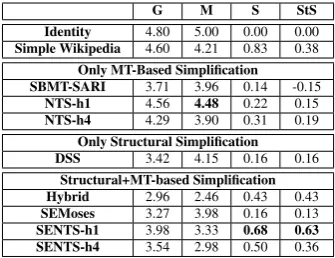
G M S StS Identity 4.80 5.00 0.00 0.00
Simple Wikipedia 4.60 4.21 0.83 0.38
Only MT-Based Simplification SBMT-SARI 3.71 3.96 0.14 -0.15
NTS-h1 4.56 4.48 0.22 0.15
NTS-h4 4.29 3.90 0.31 0.19
Only Structural Simplification DSS 3.42 4.15 0.16 0.16
Structural+MT-based Simplification Hybrid 2.96 2.46 0.43 0.43
SEMoses 3.27 3.98 0.16 0.13
SENTS-h1 3.98 3.33 0.68 0.63 SENTS-h4 3.54 2.98 0.50 0.36
Table 2: Human evaluation of the different NMT-based sys-tems. Grammaticality (G) and Meaning preservation (M) are measured using a 1 to 5 scale. A -2 to +2 scale is used for measuring simplicity (S) and structural simplicity (StS) of the output relative to the input sentence. The highest score in each column appears in bold. Structural simplification sys-tems are those that explicitly model structural operations.
6 Results
Human evaluation. Results are presented in Ta-ble2. First, we can see that the two SENTS sys-tems outperform HYBRID in terms of G, M, and S. SENTS-h1 is the best scoring system, under all human measures.
In comparison to NTS, SENTS scores markedly higher on the simplicity judgments. Meaning preservation and grammaticality are lower for SENTS, which is likely due to the more conserva-tive nature of NTS. Interestingly, the application of the splitting rules by themselves does not yield a considerably simpler sentence. This likely stems from the rules not necessarily yielding grammati-cal sentences (NTS often serves as a grammatigrammati-cal error corrector over it), and from the incorporation of deletions, which are also structural operations, and are performed by the neural system.
An example of high structural simplicity scores for SENTS resulting from deletions is presented in Table5, together with the outputs of the other systems and the corresponding human evaluation scores. NTS here performs lexical simplification, replacing the word “incursions” by “raids” or “at-tacks”’. On the other hand, the high StS scores obtained by DSS and SEMoses are due to sentence splittings.
Automatic evaluation. Results are presented in Table 3. Identity obtains much higher BLEU scores than any other system, suggesting that BLEU may not be informative in this setting. SARI seems more informative, and assigns the lowest score to Identity and the second highest to the reference.
Both SENTS systems outperform HYBRID in terms of SARI and all its 3 sub-components. The h4 setting (hypothesis #4 in the beam) is generally best, both with and without the splitting rules.
Comparing SENTS to using NTS alone (with-out splitting), we see that SENTS obtains higher SARI scores when hypothesis #1 is used and that NTS obtains higher scores when hypothesis #4 is used. This may result from NTS being more con-servative than SENTS (and HYBRID), which is re-warded by SARI (conservatism is indicated by the %Same column). Indeed for h1, %Same is re-duced from around 66% for NTS, to around 7% for SENTS. Conservatism further decreases when h4 is used (for both NTS and SENTS). Examining SARI’s components, we find that SENTS outper-forms NTS on Fadd, and is comparable (or even
superior forh1setting) to NTS onPdel. The
su-perior SARI score of NTS over SENTS is thus en-tirely a result of a superiorFkeep, which is easier
for a conservative system to maximize.
Comparing HYBRID with SEMoses, both of which use Moses, we find that SEMoses obtains higher BLEU and SARI scores, as well as G and M human scores, and splits many more sentences. HYBRID scores higher on the human simplicity measures. We note, however, that applying NTS alone is inferior to HYBRIDin terms of simplicity, and that both components are required to obtain high simplicity scores (with SENTS).
BLEU SARI Fadd Fkeep Pdel %Same LDSC #Split
Identity 94.93 25.44 0.00 76.31 0.00 100 0.00 0
Simple Wikipedia 69.58 39.50 8.46 61.71 48.32 0.00 33.34 0
Only MT-Based Simplification
SBMT-SARI 74.44 41.46 6.77 69.92 47.68 4.18 23.31 0
NTS-h1 88.67 28.73 0.80 70.95 14.45 66.02 17.13 0
NTS-h4 79.88 36.55 2.59 65.93 41.13 2.79 24.18 1
Only Structural Simplification
DSS 76.57 36.76 3.82 68.45 38.01 8.64 25.03 208
Structural+MT-Based Simplification
HYBRID 52.82 27.40 2.41 43.09 36.69 1.39 61.53 3
SEMoses 74.45 36.68 3.77 67.66 38.62 7.52 27.44 208
SENTS-h1 58.94 30.27 3.01 51.52 36.28 6.69 59.18 0
[image:8.595.141.458.61.192.2]SENTS-h4 57.71 31.90 3.95 51.86 39.90 0.28 54.47 17
Table 3: The left-hand side of the table presents BLEU and SARI scores for the combinations of NTS and DSS, as well as for the baselines. The highest score in each column appears in bold. The right hand side presents lexical and structural properties of the outputs.%Same: proportion of sentences copied from the input;LDSC: Averaged Levenshtein distance from the source;
#Split: number of split sentences. Structural simplification systems are those that explicitly model structural operations.
BLEU SARI Fadd Fkeep Pdel %Same LDSC #Split G M S StS
Moses 92.58 28.19 0.16 75.73 8.70 79.67 3.22 0 4.25 4.78 0 0.04
SEMoses 74.45 36.68 3.77 67.66 38.62 7.52 27.44 208 3.27 3.98 0.16 0.13
SETrain1-Moses 91.24 33.06 0.41 76.07 22.69 60.72 4.47 1 4.23 4.54 -0.12 -0.13
SETrain2-Moses 94.31 26.71 0.07 76.20 3.85 92.76 1.45 0 4.73 4.99 0.01 -0.005
MosesLM 92.66 28.19 0.18 75.68 8.71 79.39 3.43 0 4.55 4.82 -0.01 -0.04
SEMosesLM 74.49 36.70 3.79 67.67 38.65 7.52 27.45 208 3.32 4.08 0.15 0.14
SETrain1-MosesLM 85.68 36.52 2.34 72.85 34.37 27.30 6.71 33 4.03 4.63 -0.11 -0.12
SETrain2-MosesLM 94.22 26.66 0.10 76.19 3.69 92.20 1.43 0 4.75 4.99 0.01 -0.01
Table 4: Automatic and human evaluation for the different combinations of Moses and DSS. The automatic metrics as well as the lexical and structural properties reported (%Same: proportion of sentences copied from the input; LDSC: Averaged
Levenshtein distance from the source;#Split: number of split sentences) concern the 359 sentences of the test corpus. Human evaluation, with the G, M, S, and StS parameters, is applied to the first 70 sentences of the corpus. The highest score in each column appears in bold.
WEB-SPLIT corpus (Narayan et al., 2017) (See Section 2), which focuses on sentence splitting. We compare our results to those reported for a variant of HYBRIDused without the deletion mod-ule, and trained on WEB-SPLIT (Narayan et al.,
2017). DSS gets a higher BLEU score (46.45 vs. 39.97) and performs more splittings (number of output sentences per input sentence of 1.73 vs. 1.26).
7 Additional Experiments
Replacing the parser by manual annotation.
In order to isolate the influence of the parser on the results, we implement a semi-automatic version of the semantic component, which uses manual UCCA annotation instead of the parser, focusing of the first 70 sentences of the test corpus. We em-ploy a single expert UCCA annotator and use the UCCAApp annotation tool (Abend et al.,2017).
Results are presented in Table 6, for both SENTS and SEMoses. In the case of SEMoses, meaning preservation is improved when manual UCCA annotation is used. On the other hand, sim-plicity degrades, possibly due to the larger number of Scenes marked by the human annotator (TUPA tends to under-predict Scenes). This effect doesn’t
show with SENTS, where trends are similar to the automatic parses case, and high simplicity scores are obtained. This demonstrates that UCCA pars-ing technology is sufficiently mature to be used to carry out structural simplification.
We also directly evaluate the performance of the parser by computing F1, Recall and Precision DAG scores (Hershcovich et al.,2017), against the manual UCCA annotation.14 We obtain for pri-mary edges (i.e. edges that form a tree structure) scores of 68.9%, 70.5%, and 67.4%for F1, Recall and Precision respectively. For remotes edges (i.e. additional edges, forming a DAG), the scores are 45.3%, 40.5%, and 51.5%. These results are com-parable with the out-of-domain results reported by
Hershcovich et al.(2017).
Experiments on Moses. We test other variants of SEMoses, where phrase-based MT is used in-stead of NMT. Specifically, we incorporate se-mantic information in a different manner by im-plementing two additional models: (1) SETrain1-Moses, where a new training corpus is obtained by applying the splitting rules to the target side of the
[image:8.595.75.520.247.326.2]G M S StS
Identity In return, Rollo swore fealty to Charles, converted to Christianity, and undertook to defend the northern region of Franceagainst the incursions of other Viking groups. 5.00 5.00 0.00 0.00
Simple WikipediaIn return, Rollo swore fealty to Charles, converted to Christianity, and swore to defend the northern region of France againstraids by other Viking groups. 4.67 5.00 1.00 0.00
SBMT-SARI In return, Rollo swore fealty to Charles, converted to Christianity, and set out to defend the north of France from the raidsof other viking groups. 4.67 4.67 0.67 0.00
NTS-h1 In return, Rollo swore fealty to Charles, converted to Christianity, and undertook to defend the northern region of Franceagainst the raids of other Viking groups. 5.00 5.00 1.00 0.00
NTS-h4 In return, Rollo swore fealty to Charles, converted to Christianity, and undertook to defend the northern region of Franceagainst the attacks of other Viking groups. 4.67 5.00 1.00 0.00
DSS Rollo swore fealty to Charles. Rollo converted to Christianity. Rollo undertook to defend the northern region of Franceagainst the incursions of other viking groups. 4.00 4.33 1.33 1.33
HYBRID In return Rollo swore, and undertook to defend the region of France., Charles, converted 2.33 2.00 0.33 0.33
SEMoses Rollo swore put his seal to Charles. Rollo converted to Christianity. Rollo undertook to defend the northern region ofFrance against the incursions of other viking groups. 3.33 4.00 1.33 1.33
SENTS-h1 Rollo swore fealty to Charles. 5.00 2.00 2.00 2.00
[image:9.595.75.529.61.227.2]SENTS-h4 Rollo swore fealty to Charles and converted to Christianity. 5.00 2.67 1.33 1.33
Table 5: System outputs for one of the test sentences with the corresponding human evaluation scores (averaged over the 3 annotators). Grammaticality (G) and Meaning preservation (M) are measured using a 1 to 5 scale. A -2 to +2 scale is used for measuring simplicity (S) and structural simplicity (StS) of the output relative to the input sentence.
G M S StS DSSm 3.38 3.91 -0.16 -0.16
SENTSm-h1 4.12 3.34 0.61 0.58
SENTSm-h4 3.60 3.24 0.26 0.12
SEMosesm 3.32 4.27 -0.25 -0.25
SEMosesmLM 3.43 4.28 -0.18 -0.19
Table 6: Human evaluation using manual UCCA annota-tion. Grammaticality (G) and Meaning preservation (M) are measured using a 1 to 5 scale. A -2 to +2 scale is used for measuring simplicity (S) and structural simplicity (StS) of the output relative to the input sentence. Xm refers to the semi-automatic version of the system X.
training corpus; (2) SETrain2-Moses, where the rules are applied to the source side. The result-ing parallel corpus is concatenated to the original training corpus. We also examine whether train-ing a language model (LM) on split sentences has a positive effect, and train the LM on the split tar-get side. For each systemX, the version with the LM trained on split sentences is denoted byXLM.
We repeat the same human and automatic evalu-ation protocol as in§6, presenting results in Table
4. Simplicity scores are much higher in the case of SENTS (that uses NMT), than with Moses. The two best systems according to SARI are SEMoses and SEMosesLM which use DSS. In fact, they
resemble the performance of DSS applied alone (Tables2and3), which confirms the high degree of conservatism observed by Moses in simplifi-cation (Alva-Manchego et al., 2017). Indeed, all Moses-based systems that don’t apply DSS as pre-processing are conservative, obtaining high scores for BLEU, grammaticality and meaning preserva-tion, but low scores for simplicity. Training the LM on split sentences shows little improvement.
8 Conclusion
We presented the first simplification system com-bining semantic structures and neural machine translation, showing that it outperforms existing lexical and structural systems. The proposed ap-proach addresses the over-conservatism of MT-based systems for TS, which often fail to mod-ify the source in any way. The semantic com-ponent performs sentence splitting without rely-ing on a specialized corpus, but only an off-the-shelf semantic parser. The consideration of sen-tence splitting as a decomposition of a sensen-tence into its Scenes is further supported by recent work on structural TS evaluation (Sulem et al., 2018), which proposes the SAMSA metric. The two works, which apply this assumption to different ends (TS system construction, and TS evaluation), confirm its validity. Future work will leverage UCCA’s cross-linguistic applicability to support multi-lingual TS and TS pre-processing for MT.
Acknowledgments
[image:9.595.102.259.281.336.2]References
Omri Abend and Ari Rappoport. 2013.Universal Con-ceptual Cognitive Annotation (UCCA). InProc. of ACL-13, pages 228–238.
Omri Abend, Shai Yerushalmi, and Ari Rappoport. 2017. UCCAApp: Web-application for syntactic and semantic phrase-based annotation. In Proc. of ACL’17, System Demonstrations, pages 109–114.
Sandra Maria Alu´ısio and Caroline Gasperin. 2010.
Foestering disgital inclusion and accessibility: The PorSimples project for simplification of Portuguese texts. InProc. of NAACL HLT 2010 Young Inves-tigators Workshop on Computational Approaches to Languages of the Americas, pages 46–53.
Fernando Alva-Manchego, Joachim Bingel, Gus-tavo H. Paetzold, Carolina Scarton, and Lucia Spe-cia. 2017. Learning how to simplify from explicit labeling of complex-simplified text pairs. InProc. of IJCNLP’17, pages 295–305.
Laura Banarescu, Claire Bonial, Shu Cai, Madalina Georgescu, Kira Griffitt, Ulf Hermjakob, Kevin Knight, Philipp Koehn, Martha Palmer, and Nathan Schneider. 2013. Abstract Meaning Rrepresenta-tion for sembanking. Proc. of Linguistic Annota-tion Workshop and Interoperability with Discourse, pages 178–186.
Gianni Barlacchi and Sara Tonelli. 2013. ERNESTA: A sentence simplification tool for children’s stories in Italian. InProc. of CICLing’13, pages 476–487.
Or Biran, Samuel Brody, and No´emie Elhadad. 2011.
Putting it simply: a context-aware approach to lex-ical simplification. InProc. of ACL’11, pages 465– 501.
Alexandra Birch, Omri Abend, Ondˇrej Bojar, and Barry Haddow. 2016. HUME: Human UCCA-based evaluation of machine translation. In Proc. of EMNLP’16, pages 1264–1274.
Raman Chandrasekar, Christine Doran, and Bangalore Srinivas. 1996. Motivations and methods for sen-tence simplification. InProc. of COLING’96, pages 1041–1044.
Leshem Choshen and Omri Abend. 2018. Reference-less measure of faithfulness for grammatical error correction. In Proc. of NAACL’18 (Short papers). To appear.
Jacob Cohen. 1968. Weighted kappa: Nominal scale agreement provision for scaled disagreement or par-tial credit.Psychological bulletin, 70(4):213.
William Coster and David Kauchak. 2011a. Learning to simplify sentences using Wikipedia. InProc. of ACL, Short Papers, pages 1–9.
William Coster and David Kauchak. 2011b. Simple English Wikipedia: A new text simplification task. InProc. of ACL’11, pages 665–669.
Robert M.W. Dixon. 2010a. Basic Linguistic Theory: Grammatical Topics, volume 2. Oxford University Press.
Robert M.W. Dixon. 2010b. Basic Linguistic Theory: Methodology, volume 1. Oxford University Press.
Robert M.W. Dixon. 2012. Basic Linguistic Theory: Further Grammatical Topics, volume 3. Oxford University Press.
Jury Ganitketitch, Benjamin Van Durme, and Chris Callison-Burch. 2013. PPDB: The paraphrase database. InProc. of NAACL-HLT’13, pages 758– 764.
Claire Gardent, Anastasia Shimorina, Shashi Narayan, and Laura Perez-Beltrachini. 2017. Creating train-ing corpora for NLG micro-planntrain-ing. In Proc. of ACL’17, pages 179–188.
Goran Glavaˇs and Sanja ˇStajner. 2013. Event-centered simplification of news stories. InProc. of the Stu-dent Research Workshop associated with RANLP 2013, pages 71–78.
Daniel Hershcovich, Omri Abend, and Ari Rappoport. 2017. A transition-based directed acyclic graph parser for UCCA. InProc. of ACL’17, pages 1127– 1138.
Bui Thanh Hung, Nguyen Le Minh, and Akira Shi-mazu. 2012. Sentence splitting for Vietnamese-English machine translation. InKnowledge and Sys-tems Engineering, 2012 Fourth International Con-ference, pages 156–160.
William Hwang, Hannaneh Hajishirzi, Mari Ostendorf, and Wei Wu. 2015. Aligning sentences from Stan-dard Wikipedia to Simple Wikipedia. In Proc. of NAACL’15, pages 211–217.
Hans Kamp. 1981. A theory of truth and semantic representation. In Formal methods in the study of language. Mathematisch Centrum. Number pt.1 in Mathematical Centre tracts.
David Kauchak. 2013. Improving text simplification language modeling using unsimplified text data. In
Proc. of ACL’13, pages 1537–1546.
Guillam Klein, Yoon Kim, Yuntian Deng, Jean Senel-lart, and Alexander M. Rush. 2017. Open NMT: Open-source toolkit for neural machine translation. ArXiv:1701.02810 [cs:CL].
Philipp Koehn, Hieu Hoang, Alexandra Birch, Chris Callison-Buch, Marcello Federico, Nicola Bertoldi, Brooke Cowan, Wade Shen, Christine Moran, Richard Zens, Chris Dyer, Ondˇrej Bojar, Alexandra Constantin, and Evan Herbst. 2007. Moses: open source toolkit for statistical machine translation. In
Philipp Koehn, Franz Josef Och, and Daniel Marcu. 2003. Statistical phrase-based translation. InProc. of NAACL’03, pages 48–54.
Ronald W. Langacker. 2008. Cognitive Grammar: A Basic Introduction. Oxford University Press, USA.
Edward Loper and Steven Bird. 2002. NLTK: the nat-ural language toolkit. InProc. of EMNLP’02, pages 63–70.
Minh-Thang Luong, Hieu Pham, and Christopher D. Manning. 2015. Effective approaches to attention-based neural machine translation. In Proc. of EMNLP’15, pages 1412–1421.
Pablo N Mendes, Max Jakob, and Christian Bizer. 2012. DBpedia: A multilingual cross-domain knowledge base. InProc. of LREC’12, pages 1813– 1817.
Tomas Mikolov, Kai Chen, Greg Corrado, and Jeffrey Dean. 2013a. Efficient estimation of word repre-sentations in vector space. InProc. of Workshop at International Conference on Learning Representa-tions.
Tomas Mikolov, Ilya Sutskever, Kai Chen, Greg S Cor-rado, and Jeff Dean. 2013b. Distributed representa-tions of words and phrases and their compositional-ity. InAdvances in neural information processing systems, pages 3111–3119.
Kshitij Mishra, Ankush Soni, Rahul Sharma, and Dipti Misra Sharma. 2014. Exploring the effects of sentence simplification on Hindi to English Machine Translation systems. InProc. of the Workshop on Automatic Text Simplification: Methods and Appli-cations in the Multilingual Society, pages 21–29.
Shashi Narayan and Claire Gardent. 2014.Hybrid sim-plification using deep semantics and machine trans-lation. InProc. of ACL’14, pages 435–445.
Shashi Narayan and Claire Gardent. 2016. Unsuper-vised sentence simplification using deep semantics. InProc. of INLG’16, pages 111–120.
Shashi Narayan, Claire Gardent, Shay B. Cohen, and Anastasia Shimorina. 2017. Split and rephrase. In
Proc. of EMNLP’17, pages 617–627.
Christina Niklaus, Bernahard Bermeitinger, Siegfried Handschuh, and Andr´e Freitas. 2016. A sentence simplification system for improving relation extrac-tion. InProc. of COLING’16.
Sergiu Nisioi, Sanja ˇStajner, Simone Paolo Ponzetto, and Liviu P. Dinu. 2017. Exploring neural text sim-plification models. InProc. of ACL’17 (Short pa-per), pages 85–91.
Kishore Papineni, Salim Roukos, Todd Ward, and Wei-Jing Zhu. 2002. BLEU: a method for auto-matic evaluation of machine translation. In Proc. of ACL’02, pages 311–318.
Radim ˇReh˚uˇrek and Petr Sojka. 2010. Software frame-work for topic modelling with large corpora. In
Proc. of LREC 2010 Workshop on New Challenges for NLP Frameworks, pages 45–50, Valletta, Malta. ELRA.
Luz Rello, Ricardo Baeza-Yates, Stefan Bott, and Ho-racio Saggion. 2013. Simplify or help?: text simpli-fication strategies for people with dyslexia. InProc. of the 10th International Cross-Disciplinary Confer-ence on Web Accesibility, pages 15:1 – 15:10.
Violeta Seretan. 2012. Acquisition of syntactic sim-plification rules for French. InProc. of LREC’12, pages 4019–4026.
Matthew Shardlow. 2014. A survey of automated text simplification. International Journal of Advanced Computer Science and Applications.
Advaith Siddharthan. 2002. An architecture for a text simplification system. InProc. of LEC, pages 64– 71.
Advaith Siddharthan. 2004. Syntactic simplification and text cohesion. Technical Report 597, University of Cambridge.
Advaith Siddharthan and M. A. Angrosh. 2014.Hybrid text simplification using synchronous dependency grammars with hand-written and automatically har-vested rules. InProc. of EACL’14, pages 722–731.
Advaith Siddhathan. 2011. Text simplification using typed dependencies: A comparison of the robust-ness of different generation strategies. InProc. of the 13th European Workshop on Natural Language Generation, pages 2–11. Association of Computa-tional Linguistics.
David A. Smith and Jason Eisner. 2006. Quasi-synchronous grammars: Alignment by soft projec-tion of syntactic dependencies. InProc. of the 1st Workshop in Statistical Machine Translation, pages 23–30.
Lucia Specia. 2010. Translating from complex to simplified sentences. In Proc. of the 9th Interna-tional Conference on ComputaInterna-tional Processing of the Portuguese Language, pages 30–39.
Nitish Srivastava, Geoffrey E Hinton, Alex Krizhevsky, Ilya Sutskever, and Ruslan Salakhutdinov. 2014.
Dropout: a simple way to prevent neural networks from overfitting. Journal of Machine Learning Re-search, 15(1):1929–1958.
Sanja ˇStajner, Hannah Bechara, and Horacio Saggion. 2015.A deeper exploration of the standard PB-SMT approach to text simplification and its evaluation. In
Proc. of ACL’15 (Short papers), pages 823–828.
Sanja ˇStajner and Maja Popovi´c. 2016. Can text sim-plification help machine translation. Baltic J. Mod-ern Computing, 4:230–242.
Elior Sulem, Omri Abend, and Ari Rappoport. 2015. Conceptual annotations preserve structure across translations. In Proc. of 1st Workshop on Semantics-Driven Statistical Machine Translation (S2Mt 2015), pages 11–22.
Elior Sulem, Omri Abend, and Ari Rappoport. 2018. Semantic structural evaluation for text simplifica-tion. InProc. of NAACL’18. To appear.
Kristian Woodsend and Mirella Lapata. 2011. Learn-ing to simplify sentences with quasi-synchronous grammar and integer programming. In Proc. of EMNLP’11, pages 409–420.
Sander Wubben, Antal van den Bosch, and Emiel Krahmer. 2012. Sentence simplification by mono-lingual machine translation. In Proc. of ACL’12, pages 1015–1024.
Wei Xu, Chris Callison-Burch, and Courtney Napoles. 2015. Problems in current text simplification re-search: new data can help. TACL, 3:283–297.
Wei Xu, Courtney Napoles, Ellie Pavlick, Quanze Chen, and Chris Callison-Burch. 2016. Optimizing statistical machine translation for text simplification.
TACL, 4:401–415.
Kenji Yamada and Kevin Knight. 2001. A syntax-based statistical translation model. In Proc.of ACL’01, pages 523–530.
Xingxing Zhang and Mirella Lapata. 2017. Sentence simplification with deep reinforcement learning. In
Proc. of EMNLP’17, pages 595–605.
Yaoyuan Zhang, Zhenxu Ye, Dongyan Zhao, and Rui Yan. 2017. A constrained sequence-to-sequence neural model for sentence simplification. ArXiv:1704.02312 [cs.CL].