Proceedings of the Workshop on Machine Reading for Question Answering, pages 89–97 89
Comparative Analysis of Neural QA models on SQuAD
Soumya Wadhwa Khyathi Raghavi Chandu Eric Nyberg
Language Technologies Institute, Carnegie Mellon University
{soumyaw, kchandu, en09}@andrew.cmu.edu
Abstract
The task of Question Answering has gained prominence in the past few decades for testing the ability of machines to un-derstand natural language. Large datasets for Machine Reading have led to the de-velopment of neural models that cater to deeper language understanding compared to information retrieval tasks. Different components in these neural architectures are intended to tackle different challenges. As a first step towards achieving gen-eralization across multiple domains, we attempt to understand and compare the peculiarities of existing end-to-end neu-ral models on the Stanford Question An-swering Dataset (SQuAD) by performing quantitative as well as qualitative analysis of the results attained by each of them. We observed that prediction errors reflect cer-tain model-specific biases, which we fur-ther discuss in this paper.
1 Introduction
Machine Reading is a task in which a model reads a piece of text and attempts to formally represent it or performs a downstream task like Question An-swering (QA). Neural approaches to the latter have gained a lot of prominence especially owing to the recent spur in developing and publicly releasing large datasets on Machine Reading and Compre-hension (MRC). These datasets are created from different underlying sources such as web resources in MS MARCO (Nguyen et al., 2016); trivia and web in QUASAR-S and QUASAR-T ( Dhin-gra et al., 2017), SearchQA (Dunn et al., 2017), TriviaQA (Joshi et al., 2017); news articles in CNN/Daily Mail (Chen et al.), NewsQA (Trischler et al.,2016) and stories in NarrativeQA (Koˇcisk`y
et al.,2017). Another common source is large un-structured text documents from Wikipedia such as in SQuAD (Rajpurkar et al.,2016), WikiReading (Hewlett et al.,2016) and WikiHop (Welbl et al.,
2017). These different sources implicitly affect the nature and properties of questions and answers in these datasets. Based on the dataset, certain neural models capitalize on these biases while others are unable to. The ability to generalize across differ-ent sources and domains is a desirable character-istic for any machine reading system. Evaluating and analyzing systems on QA tasks can lead to in-sights for advancements in machine reading and natural language understanding, and Pe˜nas et al.
(2011) have also previously worked on this. One of the first large MRC datasets (over 100k QA pairs) is the Stanford Question Answering Dataset (SQuAD) (Rajpurkar et al., 2016). For its collection, different sets of crowd-workers for-mulated questions and answers using passages ob-tained from∼500 Wikipedia articles. The answer to each question is a span in the given passage, and many effective neural QA models have been devel-oped for this dataset. Our main focus in this work is to perform comparative subjective and empirical analysis of errors in answer predictions by four top performing models on the SQuAD leaderboard1.
We focused on Bi-Directional Attention Flow (BiDAF) (Seo et al.,2016), Gated Self-Matching Networks (R-Net) (Wang et al., 2017), Docu-ment Reader (DrQA) (Chen et al., 2017), Multi-Paragraph Reading Comprehension (DocQA) (Clark and Gardner,2017), and the Logistic Re-gression baseline model (Rajpurkar et al., 2016) We mainly choose these models since they have comparable high performance on the evaluation metrics and it is easy to replicate their results due to availability of open source implementations.
1https://rajpurkar.github.io/
While we limit ourselves to in-domain analysis of the performance of these models on SQuAD in this paper, similar principles can be used to ex-tend this work to study biases of combinations of different models on different datasets and thereby understand the generalization capabilities of these neural architectures.
The organization of the paper is as follows. Sec-tion2gives a comprehensive overview of the mod-els that are compared in further sections. Section3
describes the different experiments we conducted, and discusses our observations. In Section4, we summarize our main conclusions from this work and describe our vision for the future.
2 Relevant Neural Models
We present a brief overview of the models which we considered for our analysis in this section.
Bi-Directional Attention Flow (BiDAF): This model, proposed by Seo et al. (2016), is a hi-erarchical multi-stage end-to-end neural network which takes inputs of different granularity (char-acter, word and phrase) to obtain a query-aware context representation using memory-less context-to-query (C2Q) and query-to-context (Q2C) atten-tion. This representation can then be used for dif-ferent final tasks. Many versions of this model (with different types of input features) exist on the SQuAD leaderboard, but the basic architec-ture2(which we use for our experiments in this pa-per) contains character, word and phrase embed-ding layers, followed by an attention flow layer, a modeling layer and an output layer.
Gated Self-Matching Networks (R-Net): This model, proposed byWang et al.(2017), is a multi-layer end-to-end neural network whose novelty lies in the use of a gated attention mechanism so as to give different levels of importance to differ-ent passage parts. It also uses self-matching at-tention for the context to aggregate evidence from the entire passage to refine the query-aware text representation obtained. The architecture con-tains character and word embedding layers, fol-lowed by question-passage encoding and match-ing layers, a passage self-matchmatch-ing layer and an output layer. The implementation we used3 had some minor changes for increased efficiency.
2
https://allenai.github.io/bi- att- flow/ 3
https://github.com/HKUST- KnowComp/R- Net
Document Reader (DrQA): This model, pro-posed byChen et al.(2017), focuses on answering open-domain factoid questions using Wikipedia, but also performs well on SQuAD (skipping the document retrieval stage). Its implementation4 has paragraph and question encoding layers, and an output layer. The paragraph encoding is computed by representing each context as a se-quence of feature vectors derived from tokens: word embedding, exact match with question word, POS/NER/TF and aligned question embedding, and passing these as inputs to a recurrent neural network. The question encoding is obtained by us-ing word embeddus-ings as inputs to a recurrent neu-ral network.
Multi-Paragraph Reading Comprehension (DocQA): This model, proposed by Clark and Gardner (2017), aims to answer questions based on entire documents (multiple paras) rather than specific paragraphs, but also gives good results for SQuAD (considering the given paragraph as the document). The implementation5 contains input, embedding (character and word-level), pre-processing (shared bidirectional GRU be-tween question and passage), attention (similar to BiDAF), self-attention (residual) and output (bidirectional GRU and linear scoring) layers.
Logistic Regression (LR): This model was pro-posed as a baseline in the SQuAD dataset paper (Rajpurkar et al.,2016) and uses features based on n-gram frequencies, lengths, part-of-speech tags, constituency and dependency parse trees of ques-tions and passages as inputs to a logistic regression classifier6to predict whether each constituent span
is an answer or not.
3 Experiments and Discussion
We trained the aforementioned end-to-end neu-ral models and compare their performance on the SQuAD development set which contains 10,570 question-answer pairs based on Wikipedia articles.
3.1 Quantitative Analysis
To perform a systematic comparison of errors across different models, we investigate the predic-tions based on the following criteria.
4
https://github.com/facebookresearch/DrQA 5
https://github.com/allenai/document- qa 6
3.1.1 Span-Level Performance
The span-level performance is measured typically by Exact Match (EM) and F1 metrics which are reported with respect to the ground truth answer spans. These results are summarized in Table 1. The DocQA model gives the best overall perfor-mance which aligns well with our expectation, ow-ing to the usage of and improvements in the prior mechanisms introduced in BiDAF and R-Net.
Model BiDAF R-Net DrQA DocQA LR EM (%) 67.67 70.12 66.00 71.60 40.14
F1 (%) 77.31 78.94 76.28 80.78 50.98
Correct Sentence (%) 91.05 92.37 92.40 93.77 83.30
Table 1: Span and Sentence Level Performance
3.1.2 Sentence-Level Performance
To investigate trends at different granularities, we also measure sentence retrieval performance. The context given for each question-answer pair is split into sentences using the NLTK sentence to-kenizer7, and the sentence-level accuracy of each of the models is computed (Table 1). Since the default sentence tokenizer for English in NLTK is pre-trained on Penn Treebank data which contains formal language (news articles), we expect it to perform reasonably well on Wikipedia articles too. We observe that all the models have high sentence-level accuracy, with DocQA outperforming the other models with respect to this metric as well. Interestingly, DrQA performs better on sentence retrieval accuracy than both BiDAF and R-Net, but has a worse span-level exact match score, which is probably because of the rich feature vector rep-resentation of the passage due to the model’s fo-cus on open domain QA (and hence retrieval). But, none of these neural models have near-perfect ability to identify the correct sentence, and∼90% accuracy indicates that even if we have a perfect answer selection method, this is the best EM score we can achieve. However, incorrect span identifi-cation contributes more to errors in prediction for all the models, as seen from the disparity between the sentence-level accuracies and the final span-level exact match score values.
3.1.3 Passage Length Distribution
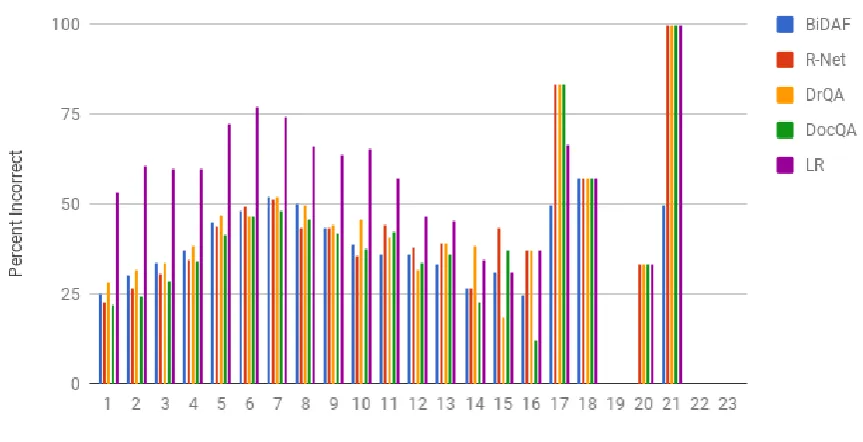
We analyze the impact of passage length on er-rors, since this can be an important factor in deter-mining the difficulty of understanding the passage. As seen in Figure1, DocQA performs the best on
7
http://www.nltk.org/api/nltk.tokenize.html
shorter passages, while R-Net and BiDAF are ob-served to be better for longer passages. However, there are no systematic error patterns and overall error rates, surprisingly, are not much higher for longer passages. This means that predictions on long passages are almost as good as on short (pre-sumably easier to understand) passages.
3.1.4 Question Length Distribution
We also do a similar error analysis for questions of different lengths. Since there are very few qutions which have length greater than 30, the es-timate for range 30-34 is not very reliable. In Figure 2, we observe that the error rate first de-creases and then inde-creases for BiDAF, DrQA and DocQA. A plausible explanation for this is that shorter questions contain insufficient information in order to be able to select the correct answer span and can hence be confusing, but it also becomes difficult for end-to-end neural models to learn a good representation when the question becomes longer and syntactically more complicated. How-ever, R-Net has an irregular trend with respect to question length, which is difficult to explain.
3.1.5 Answer Length Distribution
For answers of varying lengths, the error rates are shown in Figure 3. Again, estimates for answers with length >16 are not very reliable since data is sparse for high answer lengths. Here, we ob-serve an increasing trend initially and then a slight decrease (bell shape). This conforms to the hy-pothesis that shorter answers are easier to predict than longer answers, but only up to a certain an-swer length (observed to be around 7 for most models). The slightly better performance for very long answers is likely due to such answers having a higher chance of being (almost) entire sentences with simpler questions being asked about them.
3.1.6 Error Overlap
Figure 1: Percentage of total QA pairs for each range of passage lengths which have incorrect predictions by different models
Figure 2: Percentage of total QA pairs for each range of question lengths which have incorrect predictions by different models
of the pair of models under consideration is high. We observe that most overlap values are in the
[image:4.595.86.511.416.664.2]individ-Figure 3: Percentage of total QA pairs for each answer length which have incorrect predictions by different models
ual models. DocQA paired with other models gen-erates low values, as expected, but the least value is observed for the DocQA-DrQA pair probably because they both use very different feature rep-resentations and architectures, and hence generate diverse outputs. Note that DrQA is not the second best performing model (among the ones we ana-lyzed) when considered independently, but might add more value to an ensemble because of the ob-served answer overlap trends.
Model BiDAF R-Net DrQA DocQA LR BiDAF 32.33 21.97 22.56 21.22 26.58
[image:5.595.83.515.92.313.2]R-Net 21.97 29.88 22.06 21.35 24.99 DrQA 22.56 22.06 34.00 20.95 27.49 DocQA 21.22 21.35 20.95 28.40 23.59 LR 26.58 24.99 27.49 23.59 59.86
Table 2: Incorrect Answer Overlap (%)
One way in which this analysis can help in explor-ing ensemble-based methods is that instead of try-ing all possible combinations of models, we can adopt a greedy approach based on the incorrect an-swer overlap metric to decide which model to add to the ensemble (and only if it leads to a statisti-cally significant difference in this overlap). After determining an approximately optimal set of mod-els which such an ensemble should be composed
of, each of these models can be trained indepen-dently followed by multi-label classification (to select one of the generated answers) using tech-niques like logistic regression, a feed-forward neu-ral network or a recurrent or convolutional neuneu-ral network with input features based on the question, the passage and their token overlap. The entire network can also be trained end-to-end.
Also, all 5 models combined have an error over-lap of 13.68%, i.e., if we had a mechanism to perfectly choose between these models, we would get an Exact Match score of 86.32%. This indi-cates that future work based on ensembling differ-ent neural models can give promising results and is worth exploring.
An example of a passage-question-answer that all of the models get wrong is:
[image:5.595.75.289.540.612.2]in Poland and one of the most prestigious, the National Defence University, highest military academic institution in Poland, the Fryderyk Chopin University of Music the oldest and largest music school in Poland, and one of the largest in Europe, the Warsaw School of Economics, the oldest and most renowned economic university in the country, and the Warsaw University of Life Sciences the largest agricultural university founded in 1818.
Question: What is one of the largest music schools in Europe?
Answer:Fryderyk Chopin University of Music
This passage-question-answer is difficult for auto-matic processing because there several entities of the same type (school / university) in the passage, and the question is a paraphrase of one segment of a very long, syntactically complicated sentence which contains the information required to be able to infer the correct answer. This presents an inter-esting challenge, and such qualitative observations can be used to formulate a general technique for effectively testing machine reading systems.
3.2 Qualitative Analysis
For qualitative error analysis, we sample 100 incorrect predictions (based on EM) from each model and try to find common error categories. Broadly, the errors observed were either because of incorrect answer span boundaries or inability to infer the meaning of the question / passage. Exam-ples of each error type are shown in Table3, and these are further described below.
3.2.1 Boundary-Based Errors
Incorrect answer boundary (longer): This er-ror category includes those cases where the pre-dicted span is longer than the ground truth answer, but contains the answer.
Incorrect answer boundary (shorter): This er-ror category includes those cases where the pre-dicted span is shorter than the ground truth answer, and is a substring of the answer.
Soft Correct: This error category includes those cases where the prediction is actually correct, but due to inclusion / exclusion of certain question terms (such as units) along with the answer, it is deemed incorrect.
3.2.2 Inference-Based Errors
Multi-Sentence: This error category includes those cases where inference is required to be per-formed across 2 or more sentences in the given passage to be able to arrive at the answer, which leads to an incorrect prediction based on only 1 passage sentence.
Paraphrase: This error category includes those cases where the question paraphrases certain parts of the sentence that it is asking about which makes lexical pattern matching difficult and leads to er-rors in prediction.
Same Entity Type Confusion / Unit Confusion: This error category includes those cases where the question is about an entity type which is present multiple times in the passage and the model re-turns a different entity than the ground truth entity but of the same type.
Requires World Knowledge: This error cate-gory includes questions which can not be an-swered using the given passage alone and require external knowledge to solve, leading to incorrect predictions.
Missing Inference: This category includes inference-related errors which don’t belong to any of the other categories mentioned above.
3.2.3 Observations
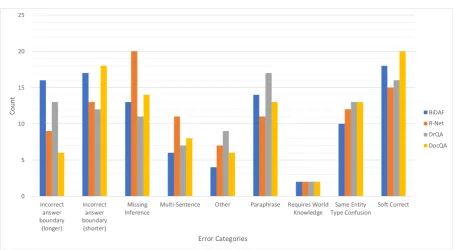
In this section, we record the main observations from our qualitative error analysis and analyze po-tential reasons for the error trends observed. Fig-ure4shows the different types of errors in predic-tions by various models.
We observe that BiDAF makes many boundary-based errors which indicates that a better output layer (since this is responsible for span identifica-tion – although errors might have percolated from previous layers, most of these are cases where the model almost got the correct answer but not exactly) or some post-processing of the answer might help improve performance. Paraphrases also contribute to almost 15% of errors observed which indicates that the question and the relevant parts of the context are not effectively matched in these cases.
Error Type Passage Question Predicted Answer
Incorrect answer boundary (longer)
... survey of 4,745 North American Lutherans aged 15-65 found that, compared to the other minority groups under con-sideration, Lutherans were theleast prejudicedtoward Jews. Nevertheless, Professor Richard (Dick) Geary, ...
What did a survey of North American Lutherans find that Lutherans felt about Jews compared to other minority groups?
15-65 found that, com-pared to the other mi-nority groups under consideration, Luther-ans were the least prej-udiced toward Jews Incorrect
answer boundary (shorter)
... In the United States, in order for a prescription for a con-trolled substance to be valid,it must be issued for a legiti-mate medical purpose by a licensed practitioner acting in the course of legitimate doctor-patient relationship. The filling ...
What conditions must be met to prescribe a controlled sub-stance?
issued for a legitimate medical purpose
Soft Correct ... for that time. The vBNS installedone of the first ever
production OC-48c (2.5 Gbit/s) IP linksin February 1999
and went on to upgrade the entire backbone ...
What did the network install in 1999?
OC-48c (2.5 Gbit/s) IP links
Multi-Sentence
... User Datagram Protocol(UDP) is an example of a
data-gram protocol. In the virtual call system ... model. The X.25 protocol suite uses this network type.
X.25 uses what type network type?
protocol suite
Paraphrase ... rather than consumers. There isno known caseof any U.S. citizens buying Canadian drugs for personal use with a prescription, who has ever been charged by authorities.
Has there ever been any-one charged with importing drugs from Canada for per-sonal medicinal use?
has ever been charged by authorities
Same Entity Type / Unit Confusion
... after the 1973 oil crisis, Honda, Toyota and Nissan, af-fected by the 1981 voluntary export restraints, opened US as-sembly plants and established their luxury divisions (Acura,
Lexus and Infiniti, respectively) to distinguish themselves from their mass-market brands.
Name a luxury division of Toyota.
Acura, Lexus and In-finiti
Requires World Knowledge
... disobedience in opposition to the decisions of non-governmental agencies such as trade unions, banks, and pri-vate universitiescan be justified if ...
What public entity of learning is often target of civil disobe-dience?
governmental
Missing In-ference
... Killer T cellsare a sub-group of T cells that kill cells that are infected with viruses (and other pathogens), or are otherwise damaged or dysfunctional. As with B cells ...
What kind of T cells kill cells that are infected with pathogens?
[image:7.595.75.525.59.357.2]sub-group
Table 3: Examples of error types observed in the qualitative analysis -blueindicates ground truth
Figure 4: Distribution of errors by various models across different categories using manual inspection
‘shorter’ answer type than ‘longer’. Also, miss-ing inference contributes to almost 20% of the ob-served errors (not including multiple sentences or paraphrases).
Paraphrasing is the most frequent error category observed for DrQA, which makes sense if we
con-sider the features used to represent each passage, such as exact match with a question word, which depend on lexical overlap between the question and passage.
[image:7.595.72.528.377.627.2]pre-dicting shorter answers than expected in most of the observed cases. A better root cause analysis can be performed by visualizing outputs from dif-ferent layers and evaluating these, and we leave this in-depth investigation to future work. Also, the high number of Soft Correct outputs across all models points to some deficiencies in the SQuAD annotations, which might limit the reliability of the performance evaluation metrics.
Although these state-of-the-art deep learning models for machine reading are supposed to have inference capabilities, our error analysis above points to their limitations. These insights can be useful for developing benchmarks and datasets which enable realistic evaluation of systems which aim to ‘solve’ the RC task. In Wadhwa et al.
(2018), we take a first step in this direction by proposing a method focused on questions involv-ing referential inference, a settinvolv-ing to which these models fail to generalize well.
4 Conclusion and Future Work
In this work, we analyze - both quantitatively and qualitatively - results generated by 4 end-to-end neural models on the Stanford Question Answer-ing Dataset. We observe interestAnswer-ing trends in the analysis, with some error patterns which are con-sistent across different models and some others which are specific to each model due to their dif-ferent input features and architectures. This is im-portant to be able to interpret and gain an intu-ition for the effective functions that different com-ponents in a neural model architecture perform versus their intended functions, and also to un-derstand model-specific biases. Eventually, this can enable us to come up with new models in-cluding specific components which tackle these er-rors. Alternatively, the overlap analysis demon-strates that learning ensembles of different neural models to combine their individual strengths and quirks might be an interesting direction to explore to achieve better performance.
Even though the scope of this paper is restricted to SQuAD, similar analysis can be done for any datasets / models / features, to gain a better under-standing and enable a better assessment of state-of-the-art in neural machine reading. To this end, we also performed some preliminary experiments on TriviaQA so as to analyze the difference be-tween the properties of the two datasets, but were unable to replicate the published results owing to
pre-processing / hyperparameters. We will con-tinue to work on this since the ability of a model to generalize and to be able to learn from a par-ticular domain and transfer some knowledge to a different domain is a very exciting research area.
We also believe that such analysis can help cu-rate datasets which are better indicators of the ac-tual natural language ‘reading’ and ‘comprehend-ing’ capabilities of models rather than falling prey to shallow pattern matching. One way to achieve this is by building new challenges that are specif-ically designed to put pressure on the identified weaknesses of neural models. Thus, we can move towards the development of datasets and models which truly push the envelope of the challenging machine reading task.
Acknowledgments
We would like to thank Chaitanya Malaviya and Abhishek Chinni for their valuable feedback, and the Language Technologies Institute at CMU for the GPU resources used in this work. We are also very grateful to the anonymous reviewers for their insightful comments and suggestions, which helped us polish the presentation of our work.
References
Danqi Chen, Jason Bolton, and Christopher D Man-ning. A thorough examination of the cnn/daily mail reading comprehension task.
Danqi Chen, Adam Fisch, Jason Weston, and An-toine Bordes. 2017. Reading wikipedia to an-swer open-domain questions. arXiv preprint arXiv:1704.00051.
Christopher Clark and Matt Gardner. 2017. Simple and effective multi-paragraph reading comprehen-sion.arXiv preprint arXiv:1710.10723.
Bhuwan Dhingra, Kathryn Mazaitis, and William W Cohen. 2017. Quasar: Datasets for question an-swering by search and reading. arXiv preprint arXiv:1707.03904.
Matthew Dunn, Levent Sagun, Mike Higgins, Ugur Guney, Volkan Cirik, and Kyunghyun Cho. 2017. Searchqa: A new q&a dataset augmented with context from a search engine. arXiv preprint arXiv:1704.05179.
(Volume 1: Long Papers), pages 1535–1545, Berlin, Germany. Association for Computational Linguis-tics.
Mandar Joshi, Eunsol Choi, Daniel S Weld, and Luke Zettlemoyer. 2017. Triviaqa: A large scale distantly supervised challenge dataset for reading comprehen-sion.arXiv preprint arXiv:1705.03551.
Tom´aˇs Koˇcisk`y, Jonathan Schwarz, Phil Blunsom, Chris Dyer, Karl Moritz Hermann, G´abor Melis, and Edward Grefenstette. 2017. The narrativeqa reading comprehension challenge. arXiv preprint arXiv:1712.07040.
Tri Nguyen, Mir Rosenberg, Xia Song, Jianfeng Gao, Saurabh Tiwary, Rangan Majumder, and Li Deng. 2016. Ms marco: A human generated machine reading comprehension dataset. arXiv preprint arXiv:1611.09268.
Anselmo Pe˜nas, Eduard H Hovy, Pamela Forner, ´
Alvaro Rodrigo, Richard FE Sutcliffe, Corina Forascu, and Caroline Sporleder. 2011. Overview of qa4mre at clef 2011: Question answering for ma-chine reading evaluation. In CLEF (Notebook Pa-pers/Labs/Workshop), pages 1–20.
Pranav Rajpurkar, Jian Zhang, Konstantin Lopyrev, and Percy Liang. 2016. Squad: 100,000+ questions for machine comprehension of text. InProceedings of the 2016 Conference on Empirical Methods in Natu-ral Language Processing, pages 2383–2392, Austin, Texas. Association for Computational Linguistics.
Minjoon Seo, Aniruddha Kembhavi, Ali Farhadi, and Hannaneh Hajishirzi. 2016. Bidirectional attention flow for machine comprehension. arXiv preprint arXiv:1611.01603.
Adam Trischler, Tong Wang, Xingdi Yuan, Justin Har-ris, Alessandro Sordoni, Philip Bachman, and Ka-heer Suleman. 2016. Newsqa: A machine compre-hension dataset. arXiv preprint arXiv:1611.09830.
S. Wadhwa, V. Embar, M. Grabmair, and E. Nyberg. 2018. Towards Inference-Oriented Reading Com-prehension: ParallelQA.ArXiv e-prints.
Wenhui Wang, Nan Yang, Furu Wei, Baobao Chang, and Ming Zhou. 2017. Gated self-matching net-works for reading comprehension and question an-swering. InProceedings of the 55th Annual Meet-ing of the Association for Computational LMeet-inguistics (Volume 1: Long Papers), volume 1, pages 189–198.