Won’t somebody please think of the children?
Improving Topic Model Clustering of Newspaper Comments for
Summarisation
Clare Llewellyn School of Informatics University of Edinburgh
Edinburgh, UK
Claire Grover School of Informatics University of Edinburgh
Edinburgh, UK
Jon Oberlander School of Informatics University of Edinburgh
Edinburgh, UK
Abstract
Online newspaper articles can accumulate comments at volumes that prevent close reading. Summarisation of the comments allows interaction at a higher level and can lead to an understanding of the over-all discussion. Comment summarisation requires topic clustering, comment rank-ing and extraction. Clusterrank-ing must be ro-bust as the subsequent extraction relies on a good set of clusters. Comment data, as with many social media datasets, contains very short documents and the number of words in the documents is a limiting fac-tors on the performance of LDA cluster-ing. We evaluate whether we can combine comments to form larger documents to im-prove the quality of clusters. We find that combining comments with comments that reply to them produce the highest quality clusters.
1 Introduction
Newspaper articles can accumulate many hun-dreds and sometimes thousands of online com-ments. When studied closely and analysed effec-tively they provide multiple points of view and a wide range of experience and knowledge from diverse sources. However, the number of com-ments produced per article can prohibit close read-ing. Summarising the content of these comments allows users to interact with the data at a higher level, providing a transparency to the underlying data (Greene and Cross, 2015).
The current state of the art within the comment summarisation field is to cluster comments us-ing Latent Dirichlet Allocation (LDA) topic mod-elling (Khabiri et al., 2011; Ma et al., 2012; Llewellyn et al., 2014). The comments within
each topic cluster are ranked and comments are typically extracted to construct a summary of the cluster. In this paper we focus on the clustering subtask. It is important that the clustering is ap-propriate and robust as the subsequent extraction relies on a good set of clusters. Research in a re-lated domain has found that topical mistakes were the largest source of error in summarising blogs – (Mithun and Kosseim, 2009) a similar data type.
Comment data, as with many social media datasets, differs from other content types as each ‘document’ is very short. Previous studies have indicated that the number of documents and the number of words in the documents are limiting factors on the performance of topic modelling (Tang et al., 2014). Topic models built using longer documents and using more documents are more accurate. Short documents can be enriched with external data. In our corpus the number of comments on each newspaper article is finite and the topics discussed within each set have evolved from the original article. We therefore decided not to increase the set with data from external sources. In this work we consider whether we can com-bine comments within a comments dataset to form larger documents to improve the quality of clus-ters. Combining comments into larger documents reduces the total number of comments available to cluster which may decrease the quality of the clus-ters. The contribution of this work is in showing that combining comments with their direct replies, their children, increases the quality of the cluster-ing. This approach can be applied to any other task which requires clustering of newspaper com-ments and any other data which contains small documents linked using a thread like structure. Combining data in this way to improve the clus-tering reduces the need to import data from exter-nal sources or to adapt the underlying clustering algorithm.
2 Related Work
2.1 Summarisation
The summarisation domain is well developed. The earliest focus of the field was single document summarisation – for a survey paper see (Gupta and Lehal, 2010). This approach was extended into the summarisation of multiple documents on the same topic (Goldstein et al., 2000) and to summarising discussions such as email or Twitter conversations (Cselle et al., 2007; Sharifi et al., 2010; Inouye and Kalita, 2011).
The basic idea behind the summarisation of tex-tual data is the grouping together of similar infor-mation and describing those groups (Rambow et al., 2004). Once these groups are formed they are described using either an extractive or abstractive approach. Extractive summarisation uses units of text, generally sentences, from within the data in the group to represent the group. Abstractive sum-marisation creates a description of the data in the group as a whole, analogous to the approach a hu-man would take.
2.1.1 Comment Summarisation
Abstractive summarisation is a very complex task, and because comment summarisation is a rela-tively new task, current work mostly focuses on extractive approaches. The general task involves clustering the comments into appropriate topics and then extracting comments, or parts of com-ments to represent those topics (Khabiri et al., 2011; Ma et al., 2012). Ma et al. (2012) summarise discussion on news articles from Ya-hoo!News and Khabiri et al (2011) summarise comments on YouTube videos. Both studies agree on the definition of the basic task as: clustering comments into topics, ranking to identify com-ments that are key in the clusters, and evaluat-ing the results through a human study. Both ap-proaches focus on using LDA topic modelling to cluster the data. Ma et al. (2012) explored two topic models, one where topics are derived from the original news article and a second, extended version that allows new topics to be formed from the comments. They found that the extended ver-sion was judged superior in a user study. Khabiri et al. (2011) contrasted LDA topic models with k-means and found topic modelling superior. A study by Llewellyn et al. (2014) contrasted topic modelling, k-means, incremental one pass cluster-ing and clustercluster-ing on common unigrams and
bi-grams. They found that the topic modelling ap-proach was superior. Aker et al. (2016) looked at a graph based model that included information from DBpedia, finding that this approach out per-formed an un-optimised LDA model. They then labelled the clusters using LDA clustering and ex-tracted keywords.
Other work has been conducted in related do-mains such as summarising blogs, microblogs and e-mail.
2.1.2 Blog Summarisation
Comments are similar to blogs in that they are generated by multiple individuals who exhibit a vast array of writing styles. Mithum and Koseim (2009) found that whereas news articles have a generalisable structure that can be used to aid sum-marisation, blogs are more variable. In particu-lar they found that errors in blog summarisation are much higher than in news text summarisation. They determined that errors were often due to the candidate summary sentences being off topic and they suggest that blog summarisation needs to be improved in terms of topic detection. When in-vestigating the summarisation of blogs and com-ments on blogs Balahur et al.(2009) found that it is very common to change topics between the orig-inal blog post and the comments, and from com-ment to comcom-ment. The research of Mithum and Koseim (2009) and Balahur et al. (2009) indicates that topic identification is a key area on which to concentrate efforts in the emerging field of com-ment summarisation.
2.1.3 Microblog Summarisation
tool, TweetMotif, O’Connor et al. (2010) use lan-guage modelling to create summaries. They form topic clusters by identifying phrases that could de-fine a topic, looking for those phrases in the corpus and merging sets of topics that are similar. Re-search on microblog summarisation indicates that when summarising comments it is possible but dif-ficult to use unsupervised clustering and several rules have been suggested that can be followed to produce the most suitable clusters for summarisa-tion.
2.1.4 E-mail Summarisation
E-mail and comments are similar in several re-spects: they both exhibit a thread-like structure, containing multiple participant conversations that occur along a variable time line, they may refer back to previous parts of the conversation and ex-hibit high variability in writing styles (Carenini et al., 2007). Topic identification is challenging in e-mail threads. Wan and Mckeown (2004) noted that several different tasks were conducted in email conversations: decision making, requests for ac-tion, information seeking and social interaction. Rambow et al. (2004) found that e-mail has an in-herent structure and that this structure can be use to extract e-mail specific features for summarisa-tion. This suggests that comments may have an inherent structure which can be used to assist in summarisation.
3 Methods
3.1 Data
The work reported here is based on comments from news articles taken from the online, UK ver-sion of the Guardian newspaper. It is composed of online comments that are created by readers who have registered and posted under a user-name. The site is moderated and comments can be re-moved. We harvested the comments once the com-ment section is closed and the data is no longer up-dated. The comment system allows users to view comments either in a temporal fashion, oldest or newest first, or as threads. Users are then able to add their own comments to the set by either post-ing directly or by replypost-ing to another user, addpost-ing their comments to any point in the thread. This de-velops a conversational style of interaction where users interact with each other and comment upon the comments of others. The topics discussed can therefore evolve from the topics of the original
ar-ticle.
In total we have gathered comments posted in response to thirteen articles. Each week a journal-ist from the Guardian summarises the comments on one particular article and we have selected data from these weekly summaries to provide a further point of comparison. A typical example is our comment set 5 where the initial article was titled ‘Cutting edge: the life of a former London gang leader’, the journalist had divided the comments into sets as follows:
• 40% criticised gang culture for creating a de-sire for fame and respect
• 33% would like to hear more from victims of gang violence
• 17% found Dagrou’s story depressing
• 10% believed he should be praised for turn-ing his life around
An example of a comment that fit into the jour-nalist based classification scheme is: “I’d love to see an in-depth article about a person whose life is made a complete misery by gangs. You know, maybe a middle-aged lady who lives on her own in a gang area, something like that.”
An example of a comment that does not fit into the classification scheme: “So people who don’t have to turn their lives around are ignored and not supported. These are the people who are sometimes homeless cause there is no help if you haven’t been in prison or don’t have kids”.
In this work we refer to all of the comments on a single article as acomment set. There is data that has been annotated by humans (the gold standard set) and data that has not. The gold standard data set contained three comment sets. It was produced by human(s) assigning all comments from a com-ment set to topic groups. For one comcom-ment set two humans assigned groups (Set 1) and for two com-ment sets (Sets 2 and 3) a single human assigned groups. No guidance was given as to the number of topics required, but the annotators were asked to make the topics as broad or as inclusive as they could.
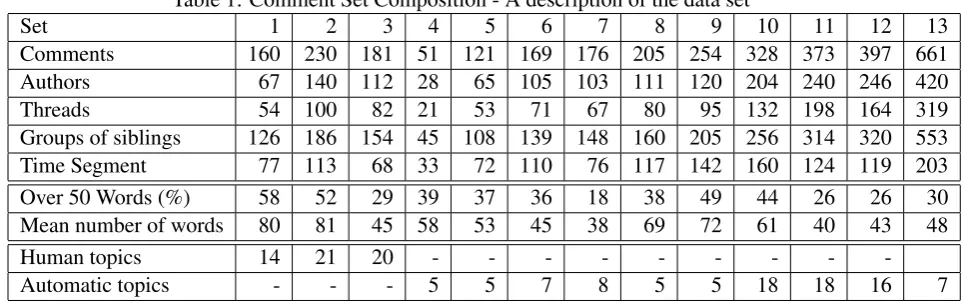
Table 1: Comment Set Composition - A description of the data set
Set 1 2 3 4 5 6 7 8 9 10 11 12 13
Comments 160 230 181 51 121 169 176 205 254 328 373 397 661
Authors 67 140 112 28 65 105 103 111 120 204 240 246 420
Threads 54 100 82 21 53 71 67 80 95 132 198 164 319
Groups of siblings 126 186 154 45 108 139 148 160 205 256 314 320 553
Time Segment 77 113 68 33 72 110 76 117 142 160 124 119 203
Over 50 Words (%) 58 52 29 39 37 36 18 38 49 44 26 26 30
Mean number of words 80 81 45 58 53 45 38 69 72 61 40 43 48
Human topics 14 21 20 - - -
-Automatic topics - - - 5 5 7 8 5 5 18 18 16 7
member. Once these were removed both annota-tors had created 14 clusters. The human-human F-Score was 0.607 including the single clusters and 0.805 without. It was felt that agreement at this level meant that double annotation was not re-quired for the futher two sets. All annotated sets have the clusters with single members removed.
A further 10 sets of comments were collected which were not annotated. Table I shows the com-position of these comment sets. We can see that the number of comments varies and that number of authors, threads, groups of siblings (comments that reply to the same comment) and time seg-ments tend to increase with size. The number of words in a comment does not. The sets of com-ments, with annotations where available, can be found at (Llewellyn, 2016).
3.2 Data Manipulation
We have investigated methods for combining the individual comments into larger ‘documents’ us-ing metadata features. The data is combined ac-cording to aspects extracted from the metadata; these are as follows:
• STANDARD: Comments are not combined in any way. This is a baseline result to which the other results can be compared.
• AUTHOR: Comments are grouped together if they have the same author. A common ap-proach to increase the size of Twitter docu-ments is to group tweets together that come from a single author on the assumption that authors stick to the same/similar topics. Here the same approach is tried with comments.
• TIME: Comments are grouped together within a ten minute segment. Comments may
be on the same topics if they are posted at the same time (if the users are viewing comments through the newest first method).
It is hypothesised that there may be topical consis-tency within threads. The ‘threadness’ was identi-fied in several ways:
• FULL THREAD: Comments were grouped together to reflect the full thread from the original root post and including all replies to that post and all subsequent posts in the thread.
• CHILDREN: A comment is grouped with all direct replies to that comment.
• SIBLINGS: A comment is grouped with its siblings, all other comments that reply to a specific comment.
All of the groups of related comments are com-bined together, according to the method, to form a single document for each group.
3.2.1 Short Documents
building stage, we therefore include them in our experiments detailed here.
3.3 Topic Modelling
The clustering method used in this work is Latent Dirichlet Allocation (LDA) topic modelling (Blei et al., 2003). It produces a generative model used to determine the topics contained in a text docu-ment. A topic is formed from words that often co-occur, therefore the words that co-occur more frequently across multiple documents most likely belong to the same topic. It is also true that each document may contain a variety of topics. LDA provides a score for each document for each topic. In this case we assign the document to the topic or topics for which it has the highest score.
This approach was implemented using the Mal-let tool-kit (McCallum, 2002). The MalMal-let tool kit topic modelling implementation allows dirich-let hyper-parameter re-estimation. This means that although the hyper parameters are initially set it is possible to allow them to be re-estimated to better suit the data set being modelled. In these exper-iments, after previous optimisation tests, we ini-tially set the sum of alpha across all topics as 4, beta as 0.08. We set the number of iterations at 1000, and we allow re-estimation of the dirichlet hyper-parameters every 10 iterations.
In order to cluster the comment data into topics an appropriate number of topics must be chosen. In choosing the number of topics we aim to pick a number which strikes a balance between produc-ing a small number of broad topics or a large num-ber of overly specific topics. We aim to echo a human like decision as to when something is on-or off-topic. Too few items in each topic is to be avoided, as is having a small number of topics (O’Connor et al., 2010).
In our data set, we choose the number of clus-ters by two methods. When data has been
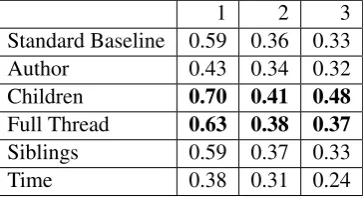
anno-Table 2: Combined Data, Annotated, F-score (re-sults that beat the standard baseline are in bold)
1 2 3
Standard Baseline 0.59 0.36 0.33
Author 0.43 0.34 0.32
Children 0.70 0.41 0.48
Full Thread 0.63 0.38 0.37
Siblings 0.59 0.37 0.33
Time 0.38 0.31 0.24
tated by humans the number of topics identified by humans was chosen as the cluster number. When the data had not been annotated by humans the cluster number was identified using an automatic method of stability analysis. This method was pro-posed by Greene, O’ Callaghan, and Cunningham (2014), and it assumes that if there is a ‘natural’ number of topics within a data set, then this num-ber of topics will give the most stable result each time the data is re-clustered. Stability is calculated using a ranked list of most predictive topic words. Each time the data is modelled, the change in the members and ordering of that list is used to cal-culate a stability score. Green et. al (2014) used the top twenty features to form their ranked list of features. Here, as the length of the documents is shorter, we use the top ten.
The sets of documents as described in the pre-vious sections are then used to build topic mod-els and the comments are assigned to topical clus-ters using these models. Ten-fold cross-validation is used. As topic modelling is a generative pro-cess, the topics produced are not identical on each new run as discussed in more detail in (Koltcov et al., 2014). Therefore the process is repeated 100 times, so that an average score can be supplied.
3.4 Metrics
There are two main metrics that are exploited in this work: Perplexity and micro-averaged F-score. Perplexity is judged by building a model using training data, and then testing with a held out set to see how well the word counts of the test doc-uments are represented by the word distributions represented in the topics in the model (Wallach et al., 2009). This score shows how perplexed the model is by the new data. Perplexity has been found to be consistent with other measures of clus-ter quality such as point-wise mutual information (Tang et al., 2014). PMI data is also available and can be supplied if requested.
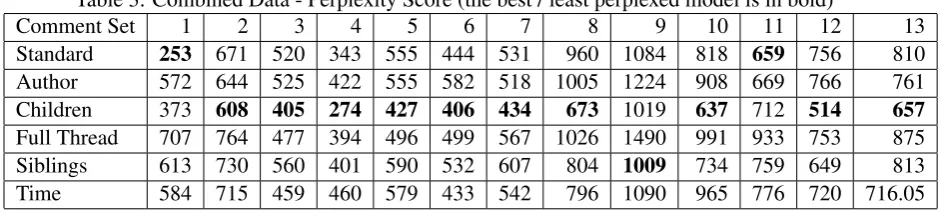
[image:5.595.90.272.665.764.2]Table 3: Combined Data - Perplexity Score (the best / least perplexed model is in bold)
Comment Set 1 2 3 4 5 6 7 8 9 10 11 12 13
Standard 253 671 520 343 555 444 531 960 1084 818 659 756 810
Author 572 644 525 422 555 582 518 1005 1224 908 669 766 761
Children 373 608 405 274 427 406 434 673 1019 637 712 514 657
Full Thread 707 764 477 394 496 499 567 1026 1490 991 933 753 875
Siblings 613 730 560 401 590 532 607 804 1009 734 759 649 813
Time 584 715 459 460 579 433 542 796 1090 965 776 720 716.05
Here we present scores in terms of micro-averaged F-score (when a gold standard is avail-able for comparison), and by perplexity. A higher F-score indicates a more human like model and a lower perplexity score indicates a less perplexed model. Significance is tested using a Student’s two tailed t-test and significant results are quoted when p<0.01 (Field, 2013).
4 Results and Discussion
First we will discuss the results from the 3 anno-tated data sets (1, 2 and 3). Using an F-score met-ric we find that, for all three annotated sets that grouping comments using the metadata features author and time does not improve topic cluster-ing. Grouping comments using thread based fea-tures was more sucessful. We found that combin-ing comments with their replies (the children) and combining comments within the full thread sets significantly beat the standard baseline (Table 2).
The results differ when judged by perplexity (Table 3). We found for two of the comment sets (2 and 3) the children data set gave models that were significantly less perplexed than the standard baseline but this was not the case for comment set 1. For comment set 1 no models beats the baseline using the perplexity metric.
When we look at all of the data, judged using a perplexity score (Table 3), we found that the combined children data sets consistently created models (for 10 out of the 13 sets) that are signifi-cantly less perplexed than a standard baseline. For one of the datasets the data combined with other replies to the same message, the siblings set, beats the baseline. For two of the sets no combination method beats the baseline.
The automated results and human results as in-dicated by perplexity and micro-averaged F-score are not in complete agreement, but there are some commonalities. Both sets of results indicate that the group that combines responses with comments
(the children group) has the highest agreement with the human model, and it consistently pro-duces the least perplexed model.
5 Conclusions
It is worth noting that although we focus here on newspaper comments, the need for summarisation applies to any web-based chat forum and the find-ings therefore have a wide applicability.
References
Ahmet Aker, Emina Kurtic, AR Balamurali, Monica Paramita, Emma Barker, Mark Hepple, and Rob Gaizauskas. 2016. A graph-based approach to topic clustering for online comments to news. In Advances in Information Retrieval, pages 15–29. Springer.
Alexandra Balahur, Mijail Alexandrov Kabadjov, Josef Steinberger, Ralf Steinberger, and Andres Montoyo. 2009. Summarizing opinions in blog threads. In PACLIC, pages 606–613.
David M. Blei, Andrew Y. Ng, and Michael I. Jordan. 2003. Latent dirichlet allocation. 3:993–1022.
Giuseppe Carenini, Raymond T Ng, and Xiaodong Zhou. 2007. Summarizing email conversations with clue words. In Proceedings of the 16th interna-tional conference on World Wide Web, pages 91– 100. ACM.
Gabor Cselle, Keno Albrecht, and Rogert Wattenhofer. 2007. BuzzTrack: topic detection and tracking in email. In Proceedings of the 12th International Conference on Intelligent User Interfaces, IUI ’07, pages 190–197. ACM.
YaJuan DUAN, CHEN ZhuMin WEIF uRu, ZHOU Ming Heung, and Yeung SHUM. 2012. Twitter topic summarization by ranking tweets using social influence and content quality. In Proceedings of the 24th International Conference on Computational Linguistics, pages 763–780.
Andy Field. 2013. Discovering statistics using IBM SPSS statistics. Sage.
Jade Goldstein, Vibhu Mittal, Jaime Carbonell, and Mark Kantrowitz. 2000. Multi-document sum-marization by sentence extraction. In Proceed-ings of the 2000 NAACL-ANLPWorkshop on Auto-matic Summarization - Volume 4, NAACL-ANLP-AutoSum ’00, pages 40–48. Association for Com-putational Linguistics.
Derek Greene and James P Cross. 2015. Unveil-ing the political agenda of the european parlia-ment plenary: A topical analysis. arXiv preprint arXiv:1505.07302.
Derek Greene, Derek O’Callaghan, and P´adraig Cun-ningham. 2014. How many topics? stability anal-ysis for topic models. In Machine Learning and Knowledge Discovery in Databases, pages 498–513. Springer.
Vishal Gupta and Gurpreet Singh Lehal. 2010. A survey of text summarization extractive techniques. 2(3).
David Inouye and Jugal K Kalita. 2011. Com-paring twitter summarization algorithms for mul-tiple post summaries. In Privacy, Security, Risk
and Trust (PASSAT) and 2011 IEEE Third Iner-national Conference on Social Computing (Social-Com), 2011 IEEE Third International Conference on, pages 298–306. IEEE.
Elham Khabiri, James Caverlee, and Chiao-Fang Hsu. 2011. Summarizing user-contributed comments. In ICWSM.
Sergei Koltcov, Olessia Koltsova, and Sergey Nikolenko. 2014. Latent dirichlet allocation: stability and applications to studies of user-generated content. InProceedings of the 2014 ACM conference on Web science, pages 161–165. ACM. Clare Llewellyn, Claire Grover, Jon Oberlander, and
Ewan Klein. 2014. Re-using an argument corpus to aid in the curation of social media collections. In LREC, pages 462–468.
Clare Llewellyn. 2016. Guardian Comments data. http://homepages.inf.ed.ac.uk/
s1053147/data/comments_2016.html.
[Online; accessed 09-June-2016].
Zongyang Ma, Aixin Sun, Quan Yuan, and Gao Cong. 2012. Topic-driven reader comments summariza-tion. InProceedings of the 21st ACM international conference on Information and knowledge manage-ment, pages 265–274. ACM.
AK McCallum. 2002. MALLET: a machine learning for language toolkit.
Shamima Mithun and Leila Kosseim. 2009. Summa-rizing blog entries versus news texts. InProceedings of the Workshop on Events in Emerging Text Types, pages 1–8. Association for Computational Linguis-tics.
Brendan O’Connor, Michel Krieger, and David Ahn. 2010. Tweetmotif: Exploratory search and topic summarization for twitter. InICWSM.
Owen Rambow, Lokesh Shrestha, John Chen, and Chirsty Lauridsen. 2004. Summarizing email threads. InProceedings of HLT-NAACL 2004: Short Papers, pages 105–108. Association for Computa-tional Linguistics.
Kevin Dela Rosa, Rushin Shah, Bo Lin, Anatole Ger-shman, and Robert Frederking. 2011. Topical clus-tering of tweets. Proceedings of the ACM SIGIR: SWSM.
Beaux Sharifi, Mark-Anthony Hutton, and Jugal Kalita. 2010. Summarizing microblogs automatically. In Human Language Technologies: The 2010 Annual Conference of the North American Chapter of the Association for Computational Linguistics, pages 685–688. Association for Computational Linguis-tics.
Jian Tang, Zhaoshi Meng, Xuanlong Nguyen, Qiaozhu Mei, and Ming Zhang. 2014. Understanding the limiting factors of topic modeling via posterior con-traction analysis. In Proceedings of The 31st In-ternational Conference on Machine Learning, pages 190–198.
Hanna M Wallach, Iain Murray, Ruslan Salakhutdinov, and David Mimno. 2009. Evaluation methods for topic models. InProceedings of the 26th Annual In-ternational Conference on Machine Learning, pages 1105–1112. ACM.