Banking capitalization and financial
development in Chad: the comparative
effects of the banking process
Djimoudjiel, Djekonbe
University of Dschang
6 September 2018
Online at
https://mpra.ub.uni-muenchen.de/89049/
1 Banking capitalization and financial development in Chad: the comparative effects of the
banking process
By Djimoudjiel Djekonbe
Abstract:
Chadian government’s decision to integrate officials in 2009 to banking sectors should
promote financial development firstly and then give visibility to the government
expenditures. The purpose of this article is to highlight the implications of capitalization and
bank risk management on financial development in Chad before and after the banking
(financial inclusion) of Chadian officials. To achieve this goal, we used Generalized Method of
moment (GMM) and the Seemingly Unrelated Regression (SUR) estimators on truncate data
from Chadian banks during the period 2000-2015. Results show, Chadian banks recapitalize
to reduce bank risks, while risks negatively affect financial development before the start of
the banking process. During the period of the mass banking and despite the risk inherent to
Chadian customers, the recapitalization of the banks however improved in weak proportion
the financial development in Chad.
Keywords: banking capitalization, financial development, banking risk, GMM, SUR
Codes JEL: G32; O10; O55
I.
I
NTRODUCTIONChad, among other CEMAC1 countries (Cameroon and Gabon) have a low level of financial
development. Resilience between the real and financial sector remains despite the
international interconnections of financial systems absent in Chad. While the COBAC2 reports
PhD candidate in Economics at the University of Dschang (Cameroon).
Email :
1 CEMAC: Economic Commission of Central African States uniting six countries (Cameroon, Central African
Republic, Congo, Gabon, Equatorial Guinea and Chad).
2 Banking Commission of Central African States created in 1992’s to ensure banking prudential regulation
2
(2004 and 2008) held a low concentration and therefore a significant competitive situation.
Studies on the SCP (Structure Behavior-Performance) model led to the conclusion that
banking behavior is subject to or sensitive to prudential standards (Dietsch, 1992). Prudential
norms that were once adopted after the plethora crises in financial systems around the world
have enabled banks to devise appropriate strategies that can reduce post-crisis costs.
Nevertheless, the objective here is not to allow the banks to states as "pyromaniac
firefighters" but to become aware of the harmful effects of crises on economic activity in
general. Prudential standards adopted at the Basel meetings (I and II and its current
extensions) revolve all around the recapitalization of banks and the respect of prudential
ratios. For the CEMAC microprudential regulatory management authority, COBAC, the banks
are required to comply with Basel's international prudential standards, to respect the holding
of capital above at least 8% of their risk-weighted assets. Alongside to hold minimum
regulatory capital of at least 10 billion francs, banks must accompany the proper monitoring
of prudential standards prudential ratios (capital ratio, liquidity, transformation and
immobilization). However, the change in capital is not without effect on the economy because
it has already been judged by economists to follow economic trend or conjuncture. Capital
banking evolution has been highlighted from several angles by previous works, linking it in
most cases with bank risks and returns ( (Ouédraogo R., 2011); (Ouédraogo, 2014);
(Djimoudjiel, 2018)). Given the recapitalization channel, bank capital has a discretionary part
evolving with bank profitability. Discretionary capital is that part conditioned by the annuities
of the assets of the bank. Indeed, the vast majority of banks increase the level of their
capitalization based on the margins generated on their liquid assets. An improvement in the
capital of banks explains a favorable economic situation for sustained growth. From
(Demirguc-Kunt & Detragiache, 1998) point of view, a period of recession (decline in GDP)
leads to the deterioration of the quality of bank loans and the rise of banking risks or defaults.
In other terms, bank capital conditions (is related to financial development process) the
process of financial development.
Recently in 2016, Garba’s work confirm in the case of sub-Saharan African countries, the
effects of bank capitalization standards on reducing the risks of macroeconomic default. In
3
capital on mitigating the risk of default (Ouédraogo, 2014). Extensions of the same work also
discussed the implications of these standards for financing economies. The countries of
CEMAC, and in particular Chad, are those despite systemic risk tendencies (risk design
according to Bordes (2013)), fewer studies are available to the public. In Chad, starting in
2009, the government's decision to fund Chadian officials has given banks new impetus in
managing client risks and “bad debts”. In addition to the traditional activity of providing
loanable funds, banks will increase their profits and create the attractiveness of the financial
system in general through new banking products and services.
However, subject to recapitalization and standards, did Chadian banks really accompany the
economic system after the banking system of Chadian officials and householders? Have the
prudential norms still made it possible to contain default risks and drain financial flows
towards access to credit and to influence the real sector of the Chadian economy? These are
the preliminary questions that this article attempts to provide further clarification. In other
terms, it is part of a dynamic to highlight the effects of bank capital on economic activity. It
provides also a contribution in terms of literature on the Chadian financial system on the one
hand and offers a framework for econometric analysis of the recapitalization of banks
regarding financial development.
II. LITERATURE REVIEW
Prudential regulation policy aimed to ensure a financial structure not subject to moral hazard
risks and excessive risk taking that could constitute an obstacle to the functioning of the
financial system in general (Lacoue-labarthe, 2003). The goal is to allow banks in a financial
system, in general to ensure the allocation of funds without harming productive investments
and savings. It globally attracts management of macroeconomic shocks and financial
instability (BCE, 2016). From a global and dynamic point of view, financial system
restructuration must revive economic growth and thus promote financial development (
(Simon, 2003) (Mishkin, 2010)).
The authorities in charge of regulating the banking system very quickly decided that bank
capitalization was the cause of the systemic phenomena of the first financial crises. Banking
4
the issue of exchange rates and international bank failures ((Goodhart et al., 2011); (Gehrig,
2013)). The first Basel standards adopted after the restructuring of the 1980s conditioned the
banks to own capital equal to at least 8% of risk-weighted assets. However, the current
objective of the prudential regulation is more accentuated on a sustainable competition
between banks while disciplining them by the obligation to maintain an adequate
capitalization at any time ( (Dewatripont & Tirole, 1993) (Lacoue-labarthe, 2003)) and
financial stability (Bordes, 2013). Rochet (2003) proposes a competitive market and
monopolistic competition to guarantee its efficiency. According to the models of the theory
of industrial organizations, the SCP (Structure-Behavior-Performance) considers that market
structure (particularly banks size, the concentration and the number of the offers) and banks
behavior influence their performance (Dietsch, 1992). Equity was the target as it was intended
to promote the financial stability and efficiency of banks (Pessarossi & Weill, 2015). In the
United States already, the adoption of the "Glass Steagall Act" has protected the banks for
almost 70 years from foreign competition. Banking concentration and banking competition
evolve differently in a banking system, Nafisah et al., 2014), the rise in market shares
(concentration) was accompanied by a proportional decline in competitive intensity,
whatever the area. It can thus be a source of systemic risk or constraint to the financing of
the economy (Allen, Beck, & Carletti, 2003). Stern & Feldman (2004) show that increased
banking concentration leads to the birth of "too big to fail" and increases the difficulty and
opacity of the banking system. Also, a somewhat concentrated banking market would reduce
the regulator's work (Haldane & May, 2011). Indeed, the authority in charge of the regulation
is obstinate only to control banks holding behaviors with the largest market shares, those
likely to cause the banking system in a crisis (Dewatripont & Tirole, 1993). In the same vein,
Berenger & Teiletche (2003), taking into account the second Basel agreement (Basle II),
conclude a process of "creative destruction" due to the procyclical nature of regulatory capital
( (Claessens, Dell'AAriccia, & Laevens , 2009) ; (Ouédraogo, 2014)) that banks can cope with
(Allen, Beck, & Carletti, 2003). The procyclicality of bank capital arises as regulatory capital
takes on a coexistent bearing on economic conjuncture. In the economic phase, whether
favorable or not, banks in order to comply with banking regulations will be forced to restrict
5
development trend. Apart from Schumpeter's theoretical work (1911) and the inclusion of a
monetary economy model in the real sector of the economy by Tobin (1965), several
empirical studies had to follow to confirm the role of credit. Banking in economic recovery.
Already, Bagehot (1873) empirically confirms the idea that the performance of British banks
remains conditional on bank credits. The evolution of credit for Kaminsky & Reinhart (1999)
makes it possible to implement a scenery of the cyclical trend of the economic conjuncture
whether it is favorable or not. Trends in financial crises are accompanied by a slowdown in
financial development followed by an upsurge in financial risks. For Simon (2003), the
adoption of prudential norms alone reduced the level of economic growth to 13 points during
the 1990s, thus significantly reducing the proportion of loanable funds to enterprises. Indeed,
in return for the significant reduction of banking risks via the cyclical variation of banks capital,
the primary sector of the economy in France has deteriorated considerably. Recent studies
are examining the effects of new standards given in view of the appearance of new risks3 on
the financing of economies and/or financial development. The results obtained from the
Generalized Method of Moments (GMM4) and two (2sls) as three (3sls) stage least squares
estimators relate to the effects of the probabilistic methods of determining capital and/ or
regulatory capital. The constraint on the respect of prudential ratios (taking into account the
internal and standard methods of determination of own funds to hold) modified the
adjustment behavior of 27 banks in India and adversely affect the financial contribution to
growth ( (Nag & Das, 2002) ; (Das, 2002)).
However, thanks to the estimators of the two stage least squares, they conclude a double
causality between taking risks and prudential norms. Qualified as "prophetic" standards by
Nitsure (2005), thanks to the low level of financial development (around 40% of bank liquid
assets finance growth), they have been able to contain trends in financial crises and their
imported influences. Yellen (2011) and Reza (2011) propose for this state of affairs, a holding
of the capital buffer or cousin of capital security to accompany financial development even in
times of recession.
3During the recent ratio adoption (McDonough ratio), authorities in charge of banking regulation of Basel judged
necessary to add to the old ratio (Cooke) established in 1988’s, credit risk operational and market risks. The aim
was to conduct banks to include in their managing functions the evolution of financial system and all inherent risks
6
According to Goodhart & al. (2004), unlike the standard weighting method, the internal or
probabilistic weighting of risks by rating agencies5 negatively influences the financing of
emerging economies (United States, Norway, Great Britain, France, Mexico, Germany, Italy,
Spain). Indeed, they analyze the behavior of banks from 1982 to 2003, and conclude that,
despite the positive effect of risk management under the internal weighting (increase in
regulatory capital), asphyxiation of the supply of credit to the economy. Indeed, periods of
recession suggest a high level of risk for economic agents. Banks, on the other hand, are likely
to refinance the economy in the event of low risk or expansion period ((Goodhart C., 2005)
(Garabiol, 2006)). The financial contribution to the process of economic growth or financial
development is a constraint on the behavior of the authority in charge of financial stability or
prudential regulation.
III. BRIEF OVERVIEW OF CHADIAN FINANCIAL SYSTEM
A. Chadian banking system facing prudential standards
For the Bank of Central African States (BEAC), less than half of the banks in the sub-region are
out of line with prudential standards as a whole (BEAC, 2016). In fact, out of the 52 banks
operating in overall the region, the latest reports states that 25 banks approximated legal
situation with prudential standards and 12 banks considered less risky against the other 40
considered at risk. Unlike other countries, however, Chadian banks can be considered as
"good" students of the authority in charge of prudential regulation. The revaluation of bank
capital in 2009 to 10 billion, was not a significant constraint for Chadian banks. Like other
countries, the increase in capital is a function of the strong presence of international banks
with a large foreign shareholding (Holdings). Also, the risky climate of the Chadian banking
system leaves an increase in provisions for risk to 52% to reach 26 billion francs (COBAC,
2010). In the same dynamic, compliance with the risk coverage ratio (capital ratio) has
constantly been evolving for banks. The decline in profits or net banking income (GNP)
observed (21%) by COBAC during this period, explains the reluctance of banks to raise the
7
level of lendable funds given the risky dynamics of the banking system. Most banks in the sub
region, and particularly in Chad, account for a large proportion or are generally generated
receivables (credits) granted to customers (at least 57%) and other types of transactions in
their GNP.
B. Financial Development and Banking Market Structure in Chad
Noted that the CEMAC countries include in their financial systems specifically liquid banks
with a marginal share of the economy. Despite the multitude of reasons given for this state
of affairs, the riskiness of the clientele and the financial environment remains a constraint.
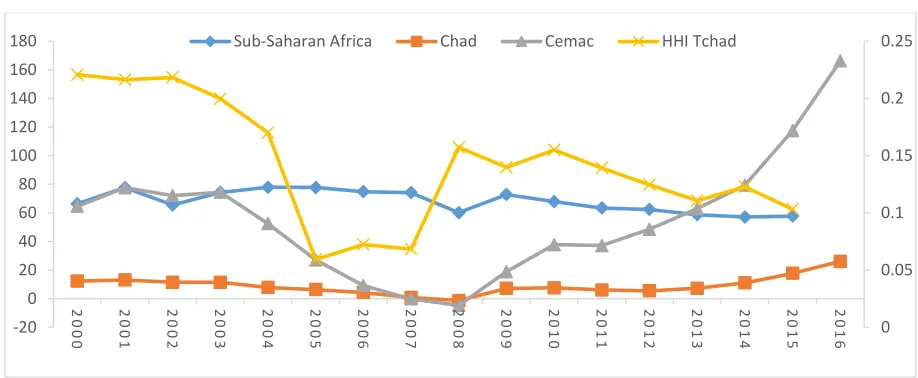
The already disturbing evolution of the Herfindhal-Hirshman index regarding credit granted
by the three (3) first banks shows (Figure 1) that banking activity in Chad is facing increasing
volatility regarding the quest for market share. Over the period in question, and particularly
before the banking of Chadian officials or householders, the competitive situation of the
banking industry has improved considerably (trend decline of the HHI on the chart). Indeed,
this downward trend of this index (at 18%) has evolved since 2005, was accompanied by a
23% drop in the level of financial development and therefore the supply of credit to the
economy before to stabilize somehow in 2007. Also, at the same time the economy was
significantly slower, with a very low threshold of development and the random tendency of
the level of concentration in the banking sector because of the warring rebel. However, the
dynamism of this economy has allowed recovery from mid-2008.
The year 2009 was marked by a prosperous development of macroeconomic aggregates in
Chad and banking activities in general (raising banks' capital). We can easily see an upsurge
of bank credit in growth and combined with an increase (from 0.15 point to 0.12 of the HHI)
in the structure of the banking market (competitive market). The plausible explanation to
bring outside the banking activity blast is thus related to the decision of the Chadian
government to starts the process of banking all Chadian officials. Other exogenous facts, such
as the degree of openness of the economy and the regulatory constraints already mentioned
above, can contribute to these stylized facts intrinsic to the Chadian banking system. The
increase of bank capital and the customer risks (credit losses and other) during the banking
8
recapitalization should adopt a causal risk-capital sense and under the same conditions curb
[image:9.595.70.529.161.350.2]the real sector of the economy.
Fig 1: Evolution of Chad HHI and Financial development in sub-Saharan and CEMAC
Source: author from WDI and Central Bank data
IV.
METHODOLOGYThe objective will be to test the implications of banking capital adjustment on financial
development in Chad during two different periods consider as transitory. Specifically, it a way
to make use of econometric robustness tests in order to understand if the prudential banking
recapitalization norm is to manage bank risks or to accompany the financing of the Chadian
economy. To guarantee the reliability of our results, we will use several estimates in panel
data to estimate the link.
A. Model specification
Several pioneering works on financial development has highlighted the various implications
of this concept for growth. Several variables of financial development made it possible to
understand the sense of causality existing between macroeconomic aggregates (growth in
particular) and financial development. Also, from the methodological point of view, most of
the work has used a known Cobb-Douglas function, which is mainly justified by the presence
of the GDP aggregate and the inherent explanatory variables of interest (Aka Brou, 2010).
0 0.05 0.1 0.15 0.2 0.25
-20 0 20 40 60 80 100 120 140 160 180
2000 2001 2002 2003 2004 2005 2006 2007 2008 2009 2010 2011 2012 2013 2014 2015 2016
9
Given the research hypotheses to be tested in this article, we will use simultaneous equations
as Shrieves & Dahl (1992) to highlight the implications of the procyclical capital of US banks
on banking risks. This model formalizes in a certain dimension the behavior of banks in
situation of revaluation of capital under the constraint of the structure of the market (quest
for market share) or the obligations of the authority in charge of the prudential regulation.
In the context of this article, the meaning of causality is justified by the effects of discretionary
capital on financial development. This causality can be double under certain tests (causality
test). Therefore, the objective of this article is to update the trend of the implication of the
revaluation of bank capital on the access to bank credit by sectors of the economy (household,
businesses etc.). In other words, it is part of an approach to illustrate whether the behavior
of Chadian banks in the period of revaluation of their equity facing banking risks or to promote
access to credit. To do this, the empirical model for estimating the effects of the bank capital
revaluation standard on the economy can be specified as follows:
1,
2,
( ; Z ) (1)
( ; ; ) (2)
it it
it it
devf f capital
risk f capital devf Z
With Devf the variable measuring financial development and Zi,t control variables influencing
financial development. The control variables consist of the inflation rate (Infl), the logarithm
of Gross Domestic Product (GDP), the degree of trade openness (Ouv) ( (Berthélemy &
Varoudakis, 1998); (Aka Brou, 2010)) and finally the Herfindhal-Hirshman concentration index
(HHI) and own funds reported to total assets of banks (RF). At this important level, it is
important to reiterate, given the theoretical and empirical review of the variables of financial
development, that the proxy variable for financial development chosen is the ratio of gross
credit to GDP (CRE / GDP)(Mohamed, 2008). The variable Actif is given by the logarithm of
the total asset. The banking capital (CAP) evolves in a discretionary way (banking capital
adjusted according to the profitability of the bank considered) while under a constraint of a
rule (social capital or minimum required). It will be taken into account for this variable the
sum of equity and other assets reported in total assets. In the end, for this paper we consider
as risk proxy, bad debts and outstanding debts of banks reported to their assets (Djimoudjiel,
10
0 1 2 3 4 1 5 6 7 8 1,
0 1 2 3 1 4 5 6 7 8 2,
(3)
(4)
it it it it it it it it it it
it it it it it it it it it it
devf CAP risk GDP devf HHI Ouv RF Infl
risk CAP devf risk RF GDP Infl HHI Actif
1,it
et 2,it are errors terms associated respectively to equations (3) et (4).
B. Descriptive statistics and estimation technique
Our study is based on BEAC database which includes data on active banks in Chad from 2000
to 2015. The determination of the concentration variable (HHI) will be done by simple
calculation according to the formula proposed in the literature (definition above). Also, for
macroeconomic variables such as GDP, inflation rate and opening rate, they are collected on
the WDI (World Development Indicators).
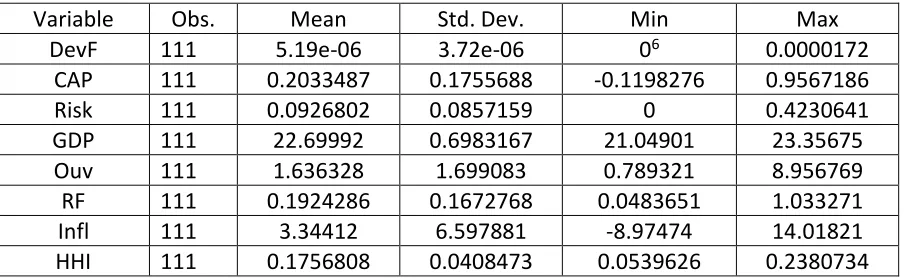
The table 1 below, sort the statistics description of variables used in the model. It is show
hence on 16 years (111 observations on Chadian banks), the mean level of financial
development still weak while banking capitalization and defaults risks have increased
significantly. Chadian banking market despite his concentration mean at 0.17 support or
conduct unfortunately to a higher risked costumer behavior. (0.09) whereas banking capital
raised discretionary or none (0.20). the substantial increasing of GDP (22.7) and inflation rates
(3.34) means are more in our case explain by petroleum incomes which have extensively
[image:11.595.74.527.523.662.2]supported others economy sectors than financial.
Table 1: Descriptive statistics
Variable Obs. Mean Std. Dev. Min Max
DevF 111 5.19e-06 3.72e-06 06 0.0000172
CAP 111 0.2033487 0.1755688 -0.1198276 0.9567186
Risk 111 0.0926802 0.0857159 0 0.4230641
GDP 111 22.69992 0.6983167 21.04901 23.35675
Ouv 111 1.636328 1.699083 0.789321 8.956769
RF 111 0.1924286 0.1672768 0.0483651 1.033271
Infl 111 3.34412 6.597881 -8.97474 14.01821
HHI 111 0.1756808 0.0408473 0.0539626 0.2380734
Source: author from Central Bank data (2000 to 2015)
11
The estimation model deduced above (Equation 3 and 4) takes into account two simultaneous
equations relating financial development and bank risk to choose the best estimator and to
obtain robust results. Different equations depending on whether they are identified at the
right level or over-identified is essential. The conditions of identification without any
restriction on the coefficients bring out a sur-identify model consider our specification (Annex
1). The presence of autocorrelation and heteroskedasticity of the errors justified by the
various tests thus leads to the use of the Generalized Moment Method (GMM) of Blundel and
Bond to correct this state of affairs in the empirical model. In the same way, the identification
of our model gives the possibility of the use of Triple Least Squares and the estimators of SUR
(Seemingly Unrelated Regression) develop by Zellner.
The purpose of this article is to test the implications of banks' behavior in responding to
regulatory constraints on financial development. Chad is one of the countries of Central Africa
with a low level of financial integration and a low contribution of the financial sector to
sectors of the economy. About Basel's prudential standards based on bank recapitalization
for risk management, the increasing leveling of capital must promote competition in the
market and finance the economy for this purpose. However, it is important to note that the
Chadian financial system has experienced a transition phase influencing the level of financial
development. The decision of the Chadian government in 2009 to bank the functionary is a
significant effect on the process of financial development. For this fact, the estimation periods
will be truncated to analyze the implications of the prudential norms before (2000-2008) and
after the banking period (2009-2015).
V. RESULTS BEFORE OFFICIALS FINANCIAL INCLUSION PERIODS
The process of financial development in Chad has took off since 2011 (Fig 1), whereas in
previous years it was at its lowest level. This fact, this descriptive result, as seen from the
statistics, confirms and explains the non-significance of the bank recapitalization variable
concerning financial development in the pre-banking period. Unfortunately, bank capital
adjustment is not intended to boost economic activity before the pre-banking period for
Chadian officials. Also, it has largely been used to reduce the increase in the risk of doubtful
12
more risks, and recapitalize in the same sense as the increase in losses likely to receivables on
customers (Djimoudjiel, 2018). For 1% change in bank capital corresponds to 10% risk of credit
losses to be covered by the banks during the relevant year range. The results also indicate
that the riskiness of the Chadian client conditions the behavior of banks to finance economic
activity. Credence risks on customers affect therefore the financial development processes at
5% level of significance. Despite the absence of robustness of this result, the coefficient
related to the losses credence risks is very higher and important, just for 1% of risk increasing.
While the banking commission ruled on a low concentration of the Chadian banking market
already from 2002, the fall in the level of risks has slightly improved financial development.
The constraint of owning capital about risk-weighted assets, despite being one of the key
prerogatives of the regulatory authority, adversely affects financial development. Raising
equity for the sole purpose of containing risks, however, reduces the chances of economic
recovery via bank financing. An increase in the ratio can be explained by a bank assets growth
or by a reduction in the risks related to receivables to the private sectors, to the government
or customers. While banks must hold a level of capital based on the credit risks granted to
customers, the risk aversion of bankers slows down financial development. This result
however not robust, has been obtained in studies as Ouédraogao S. (2014), Garba (2016), and
Djimoudjiel (2018) analyzing empirically relationship between prudential standards and
banking risks in developing countries and some sub-Saharan countries. While the inflationary
process would favor the improvement of the bank’s ability to promote financial development,
the domestic product negatively affects the latter. The results are robust regarding
significance, then considering the same effects on financial development obtain through the
GMM and SUR estimators. As a result, the added value of the Chadian economy would be
explained to a large extent by non-financial aggregates or from other sectors of the economy.
A situation of oligopolistic competition due to an improvement in the Herfindhal-Hirshman
Index (HHI) has a negative impact on the contribution of the banking sector to the economic
growth process. In other terms, in the pre-banking period a strong hold of the market shares
of some banks (top 3 or 5) can restrict the supply of credit to the economy. Would an
allocation of the customer base or the officials based on the choice of the latter (to be banked
13
comes in the sense that the Chadian officials are free to choose the bank where their account
will be domiciled. It should be understood that financial development was not significant
between 2000 and 2008, given the risk that customers were showing in Chad, and the
contribution regarding added value to other sectors of the economy.
VI. RESULTS AFTER OFFICIALS FINANCIAL INCLUSION IN CHAD
The post-2009 period, marked by a strong inclusion of Chadian households, naturally raised
the level of financial development as anticipated by the expected effects. According to our
two estimators, the difference in the capital variation is correspondingly and positively
aligned with the economic recovery via the banking sector and therefore the supply of
loanable funds at 10% of significance. This recapitalization is not inherent in the risks banks
face. Unlike the previous cases, the change in capital improves the conditions for access to
credit rather than reducing the harmful effects of bad debts. In spite of these results, the first
question to which it is imperative to answer whether the choice made by officials or civil
servants to choose their banks would restructure the structure of the banking market, the
answer seems to be positive. The decision of the Chadian government to banking officials
positively promoted financial development and improved bank shares. The inflationary
process, the role of which is to boost or boost GDP, can lead to a marginally weak competition
situation insofar as it is maintained. Unlike the previous conclusion, the HHI index improves
in the same direction as the financial development process. Given the two estimators used to
obtain these results, Chadian banks are more incentivized in return for the management of
the credit risks or receivables losses, to attract the customers following the policy of
bankability of officials. In the same conception of banking behavior, compliance with the
standard of holding capital against risks is more akin to risk taking. In the same vision, banking
revival activities created a financial moderated risky environment. An increase in equity of
1%, although it does not condition the supply of credit to the financing of the economy, is
14
VII.
C
ONCLUSIONThe purpose of this article is to provide an explanatory framework for the contribution of the
Chadian officials (civil servants) banking process to financial development in comparison with
a pre-banking period. In other words, the main idea is to ask if, about theories, Chadian banks
are adjusting their capital in the management of banking risks and the financing of the
economy. It is focused on the assumption that the government's decision to include civil
servants in the financial system promotes financial development. Indeed, using data from
Chadian banks over a period from 2000 to 2015, truncated in two periods (2000-2008 and
2009-2015) allowed us to test this hypothesis. Hence, the results obtained showed an
accentuation of the effects of the cyclical variation of the capital of the Chadian banks in the
management of the risks before the banking period. While the post-financial inclusion period
resulted in risk management reduction under the constraint of own funds according to bank
rents. Also, during this period, the recapitalization of banks has significantly improved
financial development. The rise in bad and bad debt losses is counteracting banks' efforts to
finance the Chadian economy. The low concentration of the banking system despite its low
coefficient explains significantly the improvement of the level of financial development. Also,
the process of banking has led to an upsurge in risks and conditioning the financing of the
economy via a less concentrated banking market.
VIII.
R
EFERENCESAka Brou, E. (2010). Développement financier et croissance économique dans les pays de l'UEMOA:ya t-il des différences sectorielles? Savings and Development, Vol. 34, No. 3 , 343-368.
Allen, F., Beck, T., & Carletti, E. (2003). Banques en Europe : conséquences des récentes réformes réglementaires. revue d'économie financière, No. 112, les systèmes bancaires europées : 2, 21-36.
Bagehot, W. (1873). Lombard Street: A Description of the Money Market. London: H S King.
BCE. (2016). Macroprudential Bulletin. Frankfurt, Germany: European Central Bank. BEAC. (2016). Rapport d'activité.
Berenger, F., & Teiletche, J. (2003). Bâle 2 et procyclité. revue d'économie financière, No. 73, 227-250.
15 Boot, A. (1996). comment on the paper by thomas Gerhig : market structure, monitoring and capital
adequacy regulation. Swiss journal of economics, vol 32, No. 1, 703-706. Bordes, C. (2013). Banque et risque systémique. Paris: Université de Paris 1.
Claessens, S., Dell'AAriccia, G., & Laevens , L. (2009). lessons and policyimplication we have learnt from the global financial crisis. economic policy fiftiefth panel meeting, University Van Tilburg, 23-24.
COBAC. (2010). rapport annuel.
Das, A. (2002). Risk and Productivity Change of Public Sector Banks. Economic and Political Weekly, Vol. 37, No. 5,, 437-448.
De Nicolo, G., & Kwast, M. (2002). Systemic risk and financial consolidation: Are they related? journal of banking and finance, 26, 861–880.
Demirguc-Kunt, A., & Detragiache, E. (1998). The Determinants of Banking Crises in Developing and Developed Countries. IMF Staff Papers, Vol. 45.
Dewatripont, M., & Tirole, J. (1993). réglementation prudentielle des Banques. France: Conférence Walras Pareto, Payot lausanne.
Dietsch, M. (1992). quel modèle de concurrence bancaire dans l'industrie bancaire? . revue économique, vol 43, 229-260.
Djimoudjiel, D. (2018). Prudential standards an banking risks: an econometric analysis of implications on the structure of the banking market in CEMAC. Munich paper research No 88437.
Garabiol, D. (2006). Bâle II: les risques de distorsion de concurrence. Groupe caisse d'épargne d'Espagne.
Garba, M. (2016). Analyse des approches prudentielles de la gestion des risques bancaires : quelques constats économétriques sur les banques africaines. Nice: Thèse de Doctorat, Université de Nice Sophia Antipolis.
Gehrig, P. (2013). capital, confiance et compétitivité dans le secteur bancaire. revue d'économie financière, No 112, les systèmes bancaires européens : 2 nouvelles perspectives, 175-193. Goodhart, C. (2005). Financial regulation, credit risk and financial stability. National Institute Economic
Review, No 192, 118-127.
Goodhart, C. (2011). the basel commitee on banking supervision : a history of the early years 1974-1997. cambridge press.
Goodhart, C., Boris, H., & Segovia, M. (2004). Bank regulation and macroeconomic fluctuations. Oxford Review of Economic Policy, Vol. 20, No. 4, 591-615.
Haldane, A. G., & May, R. M. (2011). Systemic risk in banking ecosystems. Nature, 469(7330), 351-355.
Kaminsky, G. L., & Reinhart, C. (1999). The Twin Crises : The Causes of Banking and Balance-of-Payments Problems. American Economic Review, vol.89, n°3, 473-500.
16 Mishkin, F. (2010). Monnaie, Banques et Marchés financiers. Paris: Pearson education.
Mohamed, E. (2008). Développement financier et croissance économique en Mauritanie: opportunités et conditions. African Review of Money Finance and Banking, rican Review of Money Finance and Banking , 23-44.
Nafisah , M., Ghafar , I., & Junaina , M. (2014). Evidence on market concentration in Malaysian dual banking system. Procedia - social and behavioral sciences, No 172, kuala lumpur, 169-176. Nag, A. K., & Das, A. (2002). Credit Growth and Response to Capital Requirements: Evidence from
Indian Public Sector Banks. Economic and Political Weekly, Vol. 37, No. 32, 3361-3368.
Nitsure, R. (2005). Basel II Norms: Emerging Market Perspective with Indian Focus. Economic and Political Weekly, Vol. 40, No. 12, 1162-1166.
Ouédraogo R., S. (2011). Banques et transmission de la politique montaire. Auvergne, France: Thèse de Doctorat, Université d'Auvergne Clermont-Ferrand I.
Ouédraogo, S. (2014). impact de la réglementation bancaire sur le comportement des banques de l'Union Economique et Monétaire Ouest Africaine (UEMOA). Ouagadougou: Thèse de Doctorat, Université Ouaga II, Burkina Faso.
Pessarossi, P., & Weill, L. (2015). les exigences de fonds propres influencent-elles l'efficience des banques? leçon d'une expérience naturelle en Chine. revue économique, Vol 66, No. 3, Risque systémique et politiques, 505-520.
Rochet, J.-C. (2003). réglmentation prudentielle et discipline de marché. Revue d'économie d'économie financière, No. 73, Bâle II: GENESE ET ENJEUX, 201-212.
Scialom, L. (1999). Economie bancaire. . Paris: la découverte, répères.
Simon, P. (2003). L'impact de Bâle II sur les PME françaises. Revue d'économie financière, No 73, 163-174.
Stern, G., & Feldman, F. (2004). Too big to fail: The hazards of bank bailouts. Brookings Institution Press. 35.
IX. ANNEX
Annex 1: identification methods of the model and estimators
- If (g - g’) + (k - k’) g – 1, equation is under-identify (OLS estimators)
- If (g –g’) + (k –k’) = g – 1, equation is just-identify (Two least squares)
- If (g – g’) + (k – k’) > g – 1, equation is over-identify (required Three and two least
17
With
- g : number of endogenous variables in the model (equation number)
- k : exogenous variables in the model ;
- g’ : endogenous variables in the identify equation ;
- k’ : exogenous variables in the equation to identify.
Determination of our estimation model identification:
g g’ k k’ (g –g’) + (k –k’) g – 1 Type
Equation (3) 2 1 8 7 2 1 Over-identify.
Equation (4) 2 1 8 7 2 1 Over-identify
Source : author
Annex 2: GMM and SUR estimation results (2000-2008))
GMM SUR
ΔDevF ΔRisk ΔDevF ΔRisk
D.DevF -4762.853 -7149.44*
(0.270) (0.068)
D.CAP 4.67e-06 0.109983* 3.41e-06 0.11674
(0.210) (0.050) (0.181) (0.123)
D.Risk -3.63e-06** -5.46e-06
(0.022) (0.202)
GDP -3.90e-06* -0.030119 -3.16e-06 ** -0.034160 (0.051) (0.600) (0.036) (0.324)
HHI -0.000157** -1.41850 -0.00015*** -1.823088
(0.019) (0.632) (0.006) (0.261)
Ouv -7.93e-08 -5.89e-08
(0.395) (0.680)
RF -6.62e-06* 0.041121 -4.37e-06 0.01605
(0.074) (0.845) (0.156) (0.915)
Infl 2.27e-07*** 0.0013026 2.21e-07*** 0.001923
(0.006) (0.482) (0.000) (0.201)
Actif -0.00690 -0.009673
(0.776) (0.531)
L.DevF -0.3874* -0.28133 ***
18
L.Risk - 0.33665*** -0.33474***
(0.001) (0.000)
Constante 0.0001208** 0.8216382 0.0001022** 1.241072
(0.037) (0.599) (0.021) (0.274)
Test AR (2) (0.146) (0.141)
Hansen test (1.000) (1.000)
Sargan test (0.006) (0.101)
Observations 48 48 48 48
Banks 7 7 8 8
RMSE 1.53e-06 0.04394
R-sq. 0.5257 0.3635
Chi2 55.68 22.67
Source: author
Annex 3: GMM and SUR estimation results after financial inclusion of Chadian official’s
(2009-2015)
GMM SUR
ΔDevF ΔRisk ΔDevF ΔRisk
D.DevF -6829.982 -10817.33**
(0.200) (0.038)
D.CAP 2.10e-06* -0.02698 2.07e-06* -0.019757
(0.093) (0.444) (0.084) (0.653)
D.Risk -2.11e-06 -4.43e-06
(0.572) (0.218)
GDP -1.42e-06 -0.028352 -1.41e-06 -0.05243
(0.307) (0.356) (0.419) (0.420)
HHI 0.0000372*** 0.13745 0.0004*** 0.3034
(0.001) (0.659) (0.000) (0.281)
Ouv -2.17e-06 -2.08e-06
(0.366) (0.352)
RF -1.28e-07 0.2029431** -1.45e-08 0.20410**
(0.941) (0.028) (0.993) (0.016)
Infl 1.04e-07** 0.0009535 1.06e-1*** 0 .0012051
(0.010) (0.332) (0.003) (0.342)
Actif 0.0335032* 0.03600**
(0.071) (0.035)
19
(0.603) (0.494)
L.Risk -0.11616 -0.091885
(0.578) (0.378)
Constante 0.0000297 0.241807 0.0003 0.7463091
(0.331) (0.738) (0.456) (0.598)
Test AR (2) (0.239) (0.147)
Hansen test (1.000) (1.000)
Sargan test (0.043) (0.071)
Observation 62 62 62 62
Banks 7 7 8 8
RMSE 1.39e-06 0.0495096
R-sq. 0.4721 0.1124
Chi2 57.62 9.72