30
https://doi.org/10.1107/S2056989018017176 Acta Cryst.(2019). E75, 30–32research communications
Received 9 November 2018 Accepted 3 December 2018
Edited by M. Weil, Vienna University of Technology, Austria
Keywords:crystal structure; K2NiF4structure;
Sr2CuO3structure type; linear chain compound.
CCDC reference:1882781
Supporting information:this article has supporting information at journals.iucr.org/e
Redetermination of Sr
2PdO
3from single-crystal
X-ray data
Gohil S. Thakur,a* Hans Reuter,bClaudia Felseraand Martin Jansena,c
a
Max Planck Institut for Chemical Physics of Solids, No¨thnitzer Strae 40, 01187, Dresden, Germany,bInstitute for Chemistry of New Materials, University of Osnabru¨ck, Barbarastrasse, 7, 49076 Osnabru¨ck, Germany, andcMax Planck Institut for Solid State Research, Heisenbergstr. 1, 70569 Stuttgart, Germany. *Correspondence e-mail:
The crystal structure redetermination of Sr2PdO3 (distrontium palladium
trioxide) was carried out using high-quality single-crystal X-ray data. The Sr2PdO3structure has been described previously in at least three reports
[Wasel-Nielen & Hoppe (1970). Z. Anorg. Allg. Chem. 375, 209–213; Muller & Roy (1971). Adv. Chem. Ser.98, 28–38; Nagataet al.(2002). J. Alloys Compd.346, 50–56], all based on powder X-ray diffraction data. The current structure refinement of Sr2PdO3, as compared to previous powder data refinements, leads
to more precise cell parameters and fractional coordinates, together with anisotropic displacement parameters for all sites. The compound is confirmed to have the orthorhombic Sr2CuO3structure type (space groupImmm) as reported
previously. The structure consists of infinite chains of corner-sharing PdO4
plaquettes interspersed by SrIIatoms. A brief comparison of Sr2PdO3with the
related K2NiF4structure type is given.
1. Chemical context
Low-dimensional transition-metal oxides with chain structures have received attention since they can enable interesting physical phenomena such as spin 1/2 antiferromagnetic Heisenberg coupling (Motoyamaet al., 1996; Takigawaet al., 1996), superconductivity (Hiroi et al., 1993), ultrafast non-linear optical response (Ogasawara et al., 2000) or even glucose sensing (El-Adset al., 2016). The particularly relevant sub-family based on square-planarMO4(M= divalent metal)
primary building units is dominated by oxidocuprates(II), while the chemistry of respective palladates(II), showing the same preference for a square-planar coordination by oxygen, is much less explored.
Here we address Sr2PdO3, which has previously been
obtained as a microcrystalline material (Wasel-Nielen & Hoppe, 1970; Muller & Roy, 1971; Nagataet al., 2002). Based on evaluations of powder X-ray diffractograms, Sr2PdO3was
identified as being isostructural with Sr2CuO3 (Teske &
Mu¨ller-Buschbaum, 1969; Weller & Lines, 1989) and Sr2FeO3
(Tasselet al., 2013). However, structural details derived from the given atomic parameters have only been reported with large uncertainties (Muller & Roy, 1971; Nagataet al., 2002). Therefore, a redetermination of Sr2PdO3 based on single
crystal X-ray data seemed appropriate.
2. Structural commentary
The crystal structure of Sr2PdO3 is essentially the same as
& Roy, 1971; Nagata et al., 2002). The lattice parameters (Table 1) are almost identical to those in the previous reports but with higher precision. The PdII atom occupies the 2d
crystallographic sites withmmmsite symmetry. We would like to point out that we chose a different cell setting as compared to all the previous reports, where the PdIIatom was chosen to be located at the cell origin (site 2a; 0, 0, 0; hence the different site designations). The PdIIatom forms distorted PdO4square
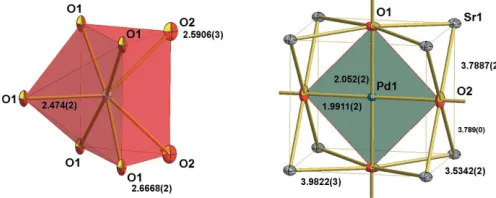
planes, which are linked by sharing oxygen atoms in thetrans -position to form infinite chains extending along the b-axis direction as shown in Fig. 1. Corresponding to this connec-tivity pattern, the Pd—O bond lengths are longer for the shared oxygen atoms, 2.052 (2) A˚ , and shorter for the terminal ones, 1.9911 (2) A˚ . The Sr atom is situated at the 4jWyckoff site having mm2 site symmetry. It is seven-coordinate in a monocapped trigonal–prismatic fashion by oxygen with three different bond lengths (Table 1, Fig. 2). In addition to the square-planar first coordination of PdII with oxygen, the second consists of eight SrIIatoms present at the corner of a cuboid with dimension 3.5342 (2)3.7887 (2)3.9822 (3) A˚3 (Fig. 2). Of the two kinds of oxygen atoms, both surrounded by six metal ions that form distorted octahedra, O1 is coordinated by one PdIIatom [2.052 (2) A˚ ] and five SrIIatoms with one short [2.474 (2) A˚ ] and four long distances [2.6668 (2) A˚] (Fig. 3). O2 is connected to four equidistant SrII[2.5906 (3) A˚ ] and two PdII atoms [1.9911 (2) A˚ ] (Fig. 3). In our current
structure determination, much more precise values of the cell parameters along with the zparameters of Sr and O1 have been determined, consequently, yielding very precise values for the bond lengths (see Table 1). The quality of the current refinement is also clearly reflected by better reliability factors (see Table 2) as compared to the previous refinements. The atomic arrangement described here is same as provided by Wasel-Nielen & Hoppe (1970).
The structural features discussed above are closely related to those of the K2NiF4type of structure, which is regarded as
the prototype structure for all the high Tc cuprates. K2NiF4
consists of layers of corner-shared NiF6octahedra extending
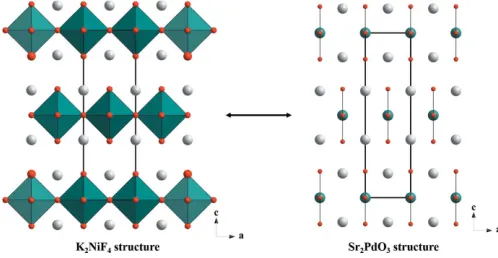
in theabplane. One can derive the Sr2PdO3structure from the
K2NiF4 structure by systematically removing the bridging F
atoms from the NiF6octahedra lying in the a-axis direction
(Fig. 4). This would reduce the dimensionality of the layer, resulting in linear chains of square planes connected by edges along only one direction.
3. Synthesis and crystallization
Millimeter-sized block-shaped crystals of dark-yellow colour with composition Sr2PdO3 as confirmed by SEM–EDS, were
obtained from a mixture of different phases while attempting to synthesize SrPd3O4 using a KOH flux (Smallwood et al.,
2000). SrCO3and Pd metal powder were mixed in the molar
ratio of 2:3, placed in an alumina crucible, and 15 grams of KOH pellets were added on top. The crucible was heated in a muffle furnace to 1023 K in 24 h with a 6 h dwell time. The
research communications
Acta Cryst.(2019). E75, 30–32 Thakuret al. Sr
[image:2.610.314.562.74.173.2]2PdO3
31
Table 1Comparison of lattice parameters and bond lengths (A˚ ) in Sr2PdO3 determined in different studies.
1970 worka
1971 workb
2002 workc
This work
a 3.977 3.97 3.985 3.5342 (2)
b 3.53 3.544 3.539 3.9822 (3)
c 12.82 12.84 12.847 12.8414 (8)
Pd—O1 (2) 2.08 2.045 2.068 2.052 (2)
Pd—O2 (2) 1.99 1.985 1.993 1.9911 (1)
Sr—O1 2.45 2.504 2.467 2.474 (2)
Sr—O1 (4) 2.67 2.668 2.671 2.6668 (2)
Sr—O2 (2) 2.58 2.57 2.588 2.5906 (3)
References: (a) Wasel-Nielen & Hoppe (1970); (b) Muller & Roy (1971); (c) Nagataet al.
[image:2.610.43.297.103.196.2](2002).
Figure 2
[image:2.610.46.292.569.711.2] [image:2.610.313.567.600.707.2]Coordination around the SrII(left) and PdIIatoms (right). All atoms are drawn with displacement ellipsoids at the 80% probability level. Distances are in A˚ .
Figure 3
Coordination polyhedra of two types of oxygen atoms, O1 (left) and O2 (right). All atoms are drawn with displacement ellipsoids at the 80% probability level. Distances are in A˚ .
Figure 1
furnace was then cooled slowly to 873 K over 125 h after which it was switched off and allowed to cool naturally. The product was washed several times with water to remove the solidified flux and subsequently rinsed with ethanol.
4. Refinement
Crystal data, data collection and structure refinement details are summarized in Table 2.
References
Brandenburg, K. (2006).DIAMOND. Crystal Impact GbR, Bonn, Germany.
Bruker (2009). APEX2, SAINT and SADABS. Bruker AXS Inc., Madison, Wisconsin, USA.
El-Ads, E. H., Galal, A. & Atta, N. F. (2016).RSC Adv.6, 16183– 16196.
Hiroi, Z., Takano, M., Azuma, M. & Takeda, Y. (1993).Nature,364, 315–317.
Motoyama, N., Eisaki, H. & Uchida, S. (1996).Phys. Rev. Lett.76, 3212–3215.
Muller, O. & Roy, R. (1971).Adv. Chem. Ser.98, 28–38.
Nagata, Y., Taniguchi, T., Tanaka, G., Satho, M. & Samata, H. (2002).
J. Alloys Compd,346, 50–56.
Ogasawara, T., Ashida, M., Motoyama, N., Eisaki, H., Uchida, S., Tokura, Y., Ghosh, H., Shukla, A., Mazumdar, S. & Kuwata-Gonokami, M. (2000).Phys. Rev. Lett.85, 2204–2207.
Sheldrick, G. M. (2008).Acta Cryst.A64, 112–122. Sheldrick, G. M. (2015).Acta Cryst.C71, 3–8.
Smallwood, P. L., Smith, M. D. & zur Loye, H. C. (2000).J. Cryst. Growth,216, 299–303.
Takigawa, M., Motoyama, N., Eisaki, H. & Uchida, S. (1996).Phys. Rev. Lett.76, 4612–4615.
Tassel, C., Seinberg, L., Hayashi, N., Ganesanpotti, S., Ajiro, Y., Kobayashi, Y. & Kageyama, H. (2013). Inorg. Chem. 52, 6096– 6102.
Teske, C. L. & Mu¨ller-Buschbaum, Hk. (1969).Z. Anorg. Allg. Chem.
371, 325–332.
Wasel-Nielen, H. D. & Hoppe, R. (1970).Z. Anorg. Allg. Chem.375, 209–213.
Weller, M. T. & Lines, D. R. (1989).J. Solid State Chem.82, 21–29.
32
Thakuret al. Sr2PdO3 Acta Cryst.(2019). E75, 30–32
[image:3.610.45.294.72.201.2]research communications
Figure 4
Interconversion of the Sr2PdO3and K2NiF4structures.
Table 2
Experimental details.
Crystal data
Chemical formula Sr2PdO3
Mr 329.64
Crystal system, space group Orthorhombic,Immm
Temperature (K) 296
a,b,c(A˚ ) 3.5342 (2), 3.9822 (3), 12.8414 (8)
V(A˚3) 180.73 (2)
Z 2
Radiation type MoK
(mm 1) 34.15
Crystal size (mm) 0.180.160.12
Data collection
Diffractometer Bruker APEXII CCD
Absorption correction Multi-scan (SADABS; Bruker, 2009)
Tmin,Tmax 0.062, 0.102
No. of measured, independent and observed [I> 2(I)] reflections
8304, 178, 176
Rint 0.035
(sin/)max(A˚ 1) 0.702
Refinement
R[F2> 2(F2)],wR(F2),S 0.009, 0.021, 1.27
No. of reflections 178
No. of parameters 16
max,min(e A˚ 3) 0.43, 0.51
Computer programs:APEX2and,SAINT(Bruker, 2009),SHELXS97andSHELXTL
[image:3.610.313.561.91.339.2]supporting information
sup-1 Acta Cryst. (2019). E75, 30-32
supporting information
Acta Cryst. (2019). E75, 30-32 [https://doi.org/10.1107/S2056989018017176]
Redetermination of Sr
2PdO
3from single-crystal X-ray data
Gohil S. Thakur, Hans Reuter, Claudia Felser and Martin Jansen
Computing details
Data collection: APEX2 (Bruker, 2009); cell refinement: SAINT (Bruker, 2009); data reduction: SAINT (Bruker, 2009);
program(s) used to solve structure: SHELXS97 (Sheldrick, 2008); program(s) used to refine structure: SHELXL2014/7
(Sheldrick, 2015); molecular graphics: DIAMOND (Brandenburg, 2006); software used to prepare material for
publication: SHELXTL (Sheldrick, 2008).
Distrontium palladium trioxide
Crystal data Sr2PdO3 Mr = 329.64
Orthorhombic, Immm a = 3.5342 (2) Å b = 3.9822 (3) Å c = 12.8414 (8) Å V = 180.73 (2) Å3 Z = 2
F(000) = 292
Dx = 6.057 Mg m−3
Mo Kα radiation, λ = 0.71073 Å Cell parameters from 1490 reflections θ = 3.2–29.9°
µ = 34.15 mm−1 T = 296 K
Block, yellow-brown 0.18 × 0.16 × 0.12 mm
Data collection Bruker APEXII CCD
diffractometer φ and ω scans
Absorption correction: multi-scan (SADABS; Bruker, 2009) Tmin = 0.062, Tmax = 0.102 8304 measured reflections
178 independent reflections 176 reflections with I > 2σ(I) Rint = 0.035
θmax = 29.9°, θmin = 3.2° h = −4→4
k = −5→5 l = −18→18
Refinement Refinement on F2 Least-squares matrix: full R[F2 > 2σ(F2)] = 0.009 wR(F2) = 0.021 S = 1.27 178 reflections 16 parameters 0 restraints
w = 1/[σ2(F
o2) + (0.0092P)2 + 0.2817P] where P = (Fo2 + 2Fc2)/3
(Δ/σ)max < 0.001 Δρmax = 0.43 e Å−3 Δρmin = −0.51 e Å−3
Extinction correction: SHELXL-2014/7 (Sheldrick, 2015),
supporting information
sup-2 Acta Cryst. (2019). E75, 30-32
Special details
Geometry. All esds (except the esd in the dihedral angle between two l.s. planes) are estimated using the full covariance matrix. The cell esds are taken into account individually in the estimation of esds in distances, angles and torsion angles; correlations between esds in cell parameters are only used when they are defined by crystal symmetry. An approximate (isotropic) treatment of cell esds is used for estimating esds involving l.s. planes.
Fractional atomic coordinates and isotropic or equivalent isotropic displacement parameters (Å2)
x y z Uiso*/Ueq
Pd1 0.5000 0.0000 0.5000 0.00493 (11)
Sr1 0.5000 0.0000 0.14752 (2) 0.00656 (11)
O1 0.5000 0.0000 0.34021 (18) 0.0085 (5)
O2 0.5000 0.5000 0.5000 0.0128 (8)
Atomic displacement parameters (Å2)
U11 U22 U33 U12 U13 U23
Pd1 0.00765 (19) 0.00396 (17) 0.00320 (18) 0.000 0.000 0.000 Sr1 0.00752 (17) 0.00760 (16) 0.00456 (17) 0.000 0.000 0.000 O1 0.0117 (13) 0.0101 (12) 0.0037 (11) 0.000 0.000 0.000
O2 0.021 (2) 0.0035 (15) 0.0134 (18) 0.000 0.000 0.000
Geometric parameters (Å, º)
Pd1—O2i 1.9911 (1) Sr1—O1ix 2.6668 (2)
Pd1—O2 1.9911 (1) Sr1—O1vii 2.6668 (2)
Pd1—O1 2.052 (2) Sr1—Pd1xi 3.2674 (2)
Pd1—O1ii 2.052 (2) Sr1—Pd1xii 3.2674 (2)
Pd1—Sr1iii 3.2674 (2) Sr1—Pd1xiii 3.2674 (2)
Pd1—Sr1iv 3.2674 (2) Sr1—Pd1xiv 3.2674 (2)
Pd1—Sr1v 3.2674 (2) Sr1—Sr1xv 3.5342 (2)
Pd1—Sr1vi 3.2674 (2) O1—Sr1viii 2.6668 (2)
Pd1—Sr1vii 3.2674 (2) O1—Sr1iii 2.6668 (2)
Pd1—Sr1viii 3.2674 (2) O1—Sr1vii 2.6668 (2)
Pd1—Sr1ix 3.2674 (2) O1—Sr1ix 2.6668 (2)
Pd1—Sr1x 3.2674 (2) O2—Pd1xvi 1.9911 (1)
Sr1—O1 2.474 (2) O2—Sr1ix 2.5906 (3)
Sr1—O2xi 2.5906 (3) O2—Sr1iv 2.5906 (3)
Sr1—O2xii 2.5906 (3) O2—Sr1viii 2.5906 (3)
Sr1—O1viii 2.6668 (2) O2—Sr1vi 2.5906 (3)
Sr1—O1iii 2.6668 (2)
O2i—Pd1—O2 180.0 O1—Sr1—O1vii 86.61 (5)
O2i—Pd1—O1 90.0 O2xi—Sr1—O1vii 119.68 (4)
O2—Pd1—O1 90.0 O2xii—Sr1—O1vii 65.87 (4)
O2i—Pd1—O1ii 90.0 O1viii—Sr1—O1vii 96.597 (9)
O2—Pd1—O1ii 90.0 O1iii—Sr1—O1vii 83.000 (8)
supporting information
sup-3 Acta Cryst. (2019). E75, 30-32
O2i—Pd1—Sr1iii 52.455 (3) O1—Sr1—Pd1xi 125.435 (5) O2—Pd1—Sr1iii 127.545 (3) O2xi—Sr1—Pd1xi 37.546 (3) O1—Pd1—Sr1iii 54.565 (5) O2xii—Sr1—Pd1xi 86.845 (8) O1ii—Pd1—Sr1iii 125.435 (5) O1viii—Sr1—Pd1xi 147.95 (5) O2i—Pd1—Sr1iv 127.545 (3) O1iii—Sr1—Pd1xi 38.82 (5) O2—Pd1—Sr1iv 52.455 (3) O1ix—Sr1—Pd1xi 97.52 (3) O1—Pd1—Sr1iv 125.435 (5) O1vii—Sr1—Pd1xi 86.43 (3) O1ii—Pd1—Sr1iv 54.565 (5) O1—Sr1—Pd1xii 125.435 (5) Sr1iii—Pd1—Sr1iv 180.0 O2xi—Sr1—Pd1xii 86.845 (8) O2i—Pd1—Sr1v 52.455 (4) O2xii—Sr1—Pd1xii 37.546 (3) O2—Pd1—Sr1v 127.545 (3) O1viii—Sr1—Pd1xii 97.52 (3) O1—Pd1—Sr1v 125.435 (5) O1iii—Sr1—Pd1xii 86.43 (3) O1ii—Pd1—Sr1v 54.565 (5) O1ix—Sr1—Pd1xii 147.95 (5) Sr1iii—Pd1—Sr1v 70.871 (10) O1vii—Sr1—Pd1xii 38.82 (5) Sr1iv—Pd1—Sr1v 109.129 (10) Pd1xi—Sr1—Pd1xii 65.481 (6) O2i—Pd1—Sr1vi 127.545 (3) O1—Sr1—Pd1xiii 125.435 (5) O2—Pd1—Sr1vi 52.455 (4) O2xi—Sr1—Pd1xiii 86.845 (9) O1—Pd1—Sr1vi 125.435 (5) O2xii—Sr1—Pd1xiii 37.546 (3) O1ii—Pd1—Sr1vi 54.565 (5) O1viii—Sr1—Pd1xiii 38.82 (5) Sr1iii—Pd1—Sr1vi 114.520 (6) O1iii—Sr1—Pd1xiii 147.95 (5) Sr1iv—Pd1—Sr1vi 65.480 (6) O1ix—Sr1—Pd1xiii 86.43 (3) Sr1v—Pd1—Sr1vi 75.090 (7) O1vii—Sr1—Pd1xiii 97.52 (3) O2i—Pd1—Sr1vii 52.455 (3) Pd1xi—Sr1—Pd1xiii 109.130 (10) O2—Pd1—Sr1vii 127.545 (3) Pd1xii—Sr1—Pd1xiii 75.091 (7)
O1—Pd1—Sr1vii 54.565 (5) O1—Sr1—Pd1xiv 125.435 (5)
O1ii—Pd1—Sr1vii 125.435 (5) O2xi—Sr1—Pd1xiv 37.546 (3) Sr1iii—Pd1—Sr1vii 65.480 (5) O2xii—Sr1—Pd1xiv 86.845 (8) Sr1iv—Pd1—Sr1vii 114.520 (6) O1viii—Sr1—Pd1xiv 86.43 (3) Sr1v—Pd1—Sr1vii 104.910 (7) O1iii—Sr1—Pd1xiv 97.52 (3) Sr1vi—Pd1—Sr1vii 180.0 O1ix—Sr1—Pd1xiv 38.82 (5) O2i—Pd1—Sr1viii 127.545 (3) O1vii—Sr1—Pd1xiv 147.95 (5) O2—Pd1—Sr1viii 52.455 (3) Pd1xi—Sr1—Pd1xiv 75.091 (7) O1—Pd1—Sr1viii 54.565 (5) Pd1xii—Sr1—Pd1xiv 109.130 (10) O1ii—Pd1—Sr1viii 125.435 (5) Pd1xiii—Sr1—Pd1xiv 65.481 (6) Sr1iii—Pd1—Sr1viii 109.129 (10) O1—Sr1—Sr1xv 90.0 Sr1iv—Pd1—Sr1viii 70.871 (10) O2xi—Sr1—Sr1xv 133.011 (5) Sr1v—Pd1—Sr1viii 180.0 O2xii—Sr1—Sr1xv 46.991 (5) Sr1vi—Pd1—Sr1viii 104.910 (7) O1viii—Sr1—Sr1xv 48.500 (3) Sr1vii—Pd1—Sr1viii 75.090 (7) O1iii—Sr1—Sr1xv 131.500 (4) O2i—Pd1—Sr1ix 127.545 (4) O1ix—Sr1—Sr1xv 131.500 (4) O2—Pd1—Sr1ix 52.455 (3) O1vii—Sr1—Sr1xv 48.500 (4) O1—Pd1—Sr1ix 54.565 (5) Pd1xi—Sr1—Sr1xv 122.741 (3) O1ii—Pd1—Sr1ix 125.435 (5) Pd1xii—Sr1—Sr1xv 57.260 (3) Sr1iii—Pd1—Sr1ix 75.090 (7) Pd1xiii—Sr1—Sr1xv 57.260 (3) Sr1iv—Pd1—Sr1ix 104.910 (7) Pd1xiv—Sr1—Sr1xv 122.741 (3)
Sr1v—Pd1—Sr1ix 114.520 (6) Pd1—O1—Sr1 180.0
supporting information
sup-4 Acta Cryst. (2019). E75, 30-32
Sr1viii—Pd1—Sr1ix 65.480 (6) Pd1—O1—Sr1iii 86.61 (5)
O2i—Pd1—Sr1x 52.455 (3) Sr1—O1—Sr1iii 93.39 (5)
O2—Pd1—Sr1x 127.545 (3) Sr1viii—O1—Sr1iii 173.23 (10)
O1—Pd1—Sr1x 125.435 (5) Pd1—O1—Sr1vii 86.61 (5)
O1ii—Pd1—Sr1x 54.565 (5) Sr1—O1—Sr1vii 93.39 (5) Sr1iii—Pd1—Sr1x 104.910 (7) Sr1viii—O1—Sr1vii 96.597 (9) Sr1iv—Pd1—Sr1x 75.090 (7) Sr1iii—O1—Sr1vii 83.001 (8)
Sr1v—Pd1—Sr1x 65.480 (5) Pd1—O1—Sr1ix 86.61 (5)
Sr1vi—Pd1—Sr1x 109.129 (10) Sr1—O1—Sr1ix 93.39 (5) Sr1vii—Pd1—Sr1x 70.871 (10) Sr1viii—O1—Sr1ix 83.001 (8) Sr1viii—Pd1—Sr1x 114.520 (6) Sr1iii—O1—Sr1ix 96.597 (9) Sr1ix—Pd1—Sr1x 180.0 Sr1vii—O1—Sr1ix 173.23 (10)
O1—Sr1—O2xi 136.990 (5) Pd1xvi—O2—Pd1 180.0
O1—Sr1—O2xii 136.990 (5) Pd1xvi—O2—Sr1ix 90.0
O2xi—Sr1—O2xii 86.020 (11) Pd1—O2—Sr1ix 90.0
O1—Sr1—O1viii 86.61 (5) Pd1xvi—O2—Sr1iv 90.0
O2xi—Sr1—O1viii 119.68 (4) Pd1—O2—Sr1iv 90.0
O2xii—Sr1—O1viii 65.87 (4) Sr1ix—O2—Sr1iv 180.0
O1—Sr1—O1iii 86.61 (5) Pd1xvi—O2—Sr1viii 90.0
O2xi—Sr1—O1iii 65.87 (4) Pd1—O2—Sr1viii 90.0
O2xii—Sr1—O1iii 119.68 (4) Sr1ix—O2—Sr1viii 86.018 (11) O1viii—Sr1—O1iii 173.22 (10) Sr1iv—O2—Sr1viii 93.982 (11)
O1—Sr1—O1ix 86.61 (5) Pd1xvi—O2—Sr1vi 90.0
O2xi—Sr1—O1ix 65.87 (4) Pd1—O2—Sr1vi 90.0
O2xii—Sr1—O1ix 119.68 (4) Sr1ix—O2—Sr1vi 93.982 (11) O1viii—Sr1—O1ix 83.000 (8) Sr1iv—O2—Sr1vi 86.018 (11) O1iii—Sr1—O1ix 96.597 (9) Sr1viii—O2—Sr1vi 180.0
Symmetry codes: (i) x, y−1, z; (ii) −x+1, −y, −z+1; (iii) −x+1/2, −y−1/2, −z+1/2; (iv) x+1/2, y+1/2, z+1/2; (v) x−1/2, y−1/2, z+1/2; (vi) x−1/2, y+1/2, z+1/2; (vii) −x+3/2, −y−1/2, −z+1/2; (viii) −x+3/2, −y+1/2, −z+1/2; (ix) −x+1/2, −y+1/2, −z+1/2; (x) x+1/2, y−1/2, z+1/2; (xi) x−1/2, y−1/2, z−1/2; (xii) x+1/2,