A
Modula-2
Cross-Co:m piler
for· the
Maci11tosh
Honours Pro,ject
Cornputer Science Departrnent
October
111986
Jonathan Gifford
Supervisor : Rod Harries
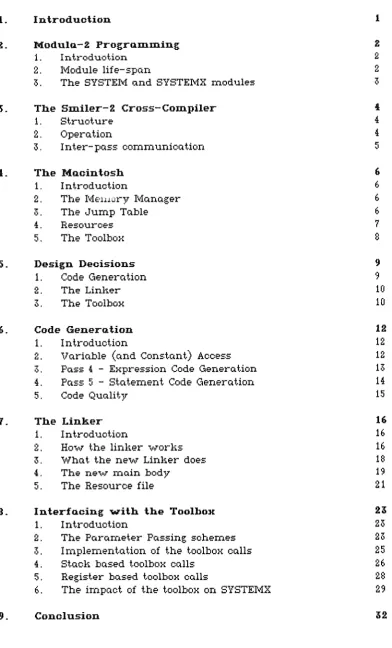
2. 3.
4.
5. 6. 7. 8. 9.In trod uotion
Modulo.-2 Progro.mming
1 . In trod uoHon 2. Mc1d1.1le life-spcm
3. The SYSTEM Gnd SYSTEMX modules
The Smiler-2 Cross-Compiler 1. Skuoture
2. Opero.t,ion
3. Inter- i::ic,ss c,or.nm unk,o. tfon
The Mo.cin tosh
1. Introduction
2. The l\•fowury Mnnnger
o.
The Jump T•:::tble4 . Resc,urc,es
5. The Toolbo:-: Design Decisions
1. Code Generc,tic1n
2. The Linher
;;; . The Toolbox
Code Genera. tion 1. Introduction
2. V o.riuble ( c,nd Cons tun~.) Access ::;,
4.
5.
Pe1.ss 4 - Expression Code Genere1. tion Pc,ss 5 - Stc,tement Code Generc,tic1n Code (~uGli +, y
The Linker
1. In trod uotion ')
...
3.
4.
5.
How t,he linher ?.,..,,;:id;.s V'1hu t the ne,"r Linls.er does The ne? ... ? mG.in body
The Resoun,e file
Interfo.cing with the Toolbox
1. In t,rod uct,ion 2.
3.
4. 5.
6.
The Pctrc,r.cieter PG.ssing soher.ries Im.plementution of t,he toolbox culls st.uoh bc,:sed toolbox culls
Register bo.sed t,oc,lbc,x oc,lls
The impact of the toolbc1:i-: on SYSTEMX
Conclusion
Table of Con ten ts
[image:2.595.47.440.71.720.2]Appendh: A - An ei-mmple I,foduln-2 Progrnm
b. The I\o!od uk, - 2 sourc,e c,c,de
Table of Con ten ts
b. The Listing file p1-odutJed by t,he Cross-Com.piler
b. The Resot.u-tJe file) dur.nped by FDUMP 6 The Resource file, dun-lped bF Resdun-ip
A M:odulCL-2 Cross-oc,mpiler !or the J\faoint.osh
Introduction -
1
There is CL ModulCL-2 cross-compile1· C1.VC1.i1C1.ble on the Prime,
which c1.1rrently generc:«.t,es code for t,he Prime. This
cross-compiler v,,...c,s developed c:i.t ETH (Eidgenoessisohe
Teohnisohe Hoohsohule) in Zuerioh, S,;,.,itzerlei.nd, by 0::1. teo.m lend by H. Seiler1 cmd wc:i.s bnsed on the originnl compiler written by Nihli:rns Wirth. This cross-compiler is cCLlled Smiler-2, CLnd hCLs
oode gene1·ei.tors for the MC-68000., MC6809, o.nd the PDP-11. The code genen-.iUon p,::i.ss CLnd linls.er fc,r t,he Prime v,,ere v,,ritt,en by
Greg Ewing CLt the University of Co.nterbury in 1985.
The cdms of this project \,11ere to trCLnslc,te the ETH MC-68000
oode genero.tor from. CDC-6000 Po.soCLl to Sheffield Pci.soei.1, ei.r1d modify either the Prime or ETH linlie1· so thnt it, produced n
Mnointosh resource forh, v·,.rhich. could then be incorporated into
cm o.pplic,ei.tion file on the l\ofoointosh.
A Modulu-2 Cross-compiler for the Mucintosh
Modula-2 Programming - 2
2. 1. Introduction
This section briefly outlines the nuture c,f n 11,foduln-2 progrci.m,
und shows how this ci.:ffeots the compiler and linker. ~fodula-2
wus designed to allow large or comple>-: prog:rci.ms to be written
ci.s sepo:i.rute but quite closely connected modules, with ci.
well-defined method of sharing any procedures, vci.rinbles,
constants or types betv,,een modules. The use of m,:,dules nllows
the prog:rCLr.nmer to decor.npose a probler.r1, CLnd write u single
module to perform a. specific t,Qsh, to '.l.chieve the desired level of
CLbstrci.c,tic,n. l\foduln-2 progrnms either cnn be contcdned 'v\7it.hin
Q. single source file, or they oci.n be split into sepGrC1.te definition und implementution mod1.1les. Modules which ure to be used by
,:,ther progrGms ci.re s,:, split. The definition module contci.ins ci.11
of the definitions that Gre Gvcdlci.ble to users of thGt module.
2. 2. Module life-spo.n
Every imported mod1.1le used in ct progrum hus ci. life-spcm equci.l
to the running tir.ne of the mci.in progrnn1. This mecms thct t Cl.11 of
t,he globci.l vci.rici.bles within these modules must c,lso hu ve ci.
life-spcm of this length, Qnd so they Clre ClllOCClted room on the
stci.ck with the muin program's globC1.ls. Ec.1.oh of the procedu1-es
within ci.n impo1-ted module is trec,ted exci.otly the !:mme WGY us
procedures v,,it,hin the mc:Lin program - stGoh spC1.oe for •..rarici.bles
cmd pca-umeters is o.llocc..ted o.s: required. Every module ho.s: o.
mnin body, wit,hin .,,,,hioh it, does whci.tever is required to ensure
its e>-:ported entities nre correct. Thus, the mci.in body of Q.11
imported modules must be executed before the importer's: main
body, to ensure thnt the imports will be correct.
A Mc,dulQ-2 Crc,ss-compiler for the J\focintosh
2.
i.
The SYSTEM <1nd SYSTEMX modulesThe ModulCL-2 report specifies thCLt the compiler implementor
should provide Q pseudo- module c,Qlled SYSTEM which pro,rides Q
number of mQchine-specifio fc1.cilities. These focilities should
nllow n p1·ogrc.imr.ner to gcdn aooess to the ri:1c.ichine- k,nguc,ge
level of the mQc,hine, cmd they should be pQrt of the compiler
itself, rC1.ther thC1.n Cl. sepC1.rC1.te r.riodule, but the fooilities should
be Ct.ccessed ns if t,hey were in n module. There is nlso often n
speoiC1.l module written in ModulQ-2 C1.nd OQlled SYSTEMX which
is used to support the code generQted by the compiler C1.nd provides fo.c:ilit.ies such QS floC1.ting point C1.rithmetic1 oc1.se stC1.tement hcmdling, Ct.nd VCt.rious process relCt.ted functions.
A ModulQ-2 Cross-compiler for the M:Clcintosh
The Smiler-2 Cross-Compiler - 3
3 . 1. St.ruct ure
The Smiler-2 c,ross-cor.npile1· (Cls distributed) consisted of Q
number of pG.sses, cmd ci. sepG.rci. te linker. These pG.sses
comr.ciunicc,te using Cl number of inte1·-pQs:S files, which contC\in
pci.ss-specific inform,1Uon Cl.bout the progrum.. The pa.sses
perfo1·r.cied the fc,llowing funoticons:
1. Syntci.x CLnci.lysis 2. DeolCl.rCl.tion Cl.nctly:s:is
3. Body o.nc,ly•sis
4. Code generntion for expressions
5. Code generntion for sta.t.ements, nnd Linh file generntion
E,. Symbol file genen1tion
7. List file genercition
The compiler nvnilo.ble on the Prime hci.d modified this structure
slightly I b:r combining pCl.ss four cmd pCl.s:s: ii ve in t,o one pCl.:s:s, Cl.nd
inc:orporetUng the linls.er into the compiler itself. The I',•!C-6$000
code generG.tor wns split into Q sepci.rG.te p,::iss four c,.nd fbre, G.nd
this structure ,,\7Q.S mcdntCl.ined for this project.
3 . 2 . Opera. t.ion
The compiler will compile t,;,.~,o different hinds of source files
-module definition files (with ci. ".DEF" extension), C1.nd -module
implementCl.tion files (".MOD").
When ci. definition module is cc,mpiled the compiler will produce
n symbol file (". SYM") which will cont.Gin detetils of Gll of the
entities (procedures, vm·iGble:s:, oonstetnts, etnd types) exported
b}r that module.
V.Jhen c,n implementci.t.ion module is compiled the c,or.cipile1· will
A ModulG-2 Cross-compiler for the MCLcintosh
produce Q linh file (11• LNK11) whioh contcdns CLll of the MC-68000
code for the module, Gs well c,s informc,tion for the linher. The
oreCLtion of this file will entCLil the reCLding of symbol files
QSsociated with the modules from which this implementCLtion
module imports entities. Usually, this v,.rill involve (at leCLst) its
own s)rr.ribol file (if it hCLs one) CLnd the SYSTEI.,.1X symbol file,
which con tCLins system specific de, to. CLnd procedures. Also
genen::i.ted o.t this sto.ge is o. reference file (11.REF11
) , which
oontCl.ins some debugging informCLtion - t,his is not used in the
current version of the compiler, but mo.y be useful o.t sor.ne
lCLter dCLte.
3. 3. Inter-po.ss communico.tion
The compiler comr.riunioCl.tes between pCLsses both by metl.ns of
internCll dGtCL structures, Clnd inter-pnss files. These files
contain a representation of· the sou1·ce file, which is composed of
symbol tohens, Cl.nd point,ers to the interncr.l dCLtCL structures. As
eC4.oh pC1.ss reads the file, it is c,ble to determine the infc,rr.r1Cltic,n
it requires t,o fulfill its functions, cmd genercr.te the next inter-pCLss file. The internCll dnt.c, struotures represent either c,
type or CLn identifie2·. A type record oontCLins info1-mCLtion CLbout Q pcr.rticulGr type's size, hind, Cl.nd composition, while c,n identifier
record c,:mtClins inform.Cltion Cl.bout the identifier's locQt,ion cmd
class, and a pointer to its type. A dumper is QVailCLble to dump
t,he inter-pcr.ss file Cl.nd internCLl structures, cmd mcr.y be used
nfter C1.ny pc,ss to verif'~r thnt the pnss is functioning correctly.
A Modulo.-2 Cross-compiler for the l'•,fo.cint.c,sh
The Macintosh - 4
4 . 1. Introduction
The Mo.cintosh prov•ides CL number of fc',cilities v,lhich must be
ta.ken in to a.oooun t, in the process of generG. ting oode. The r.nost
importo.nt of these is the mer.noqr mG.no.ger which impo.cts both
the code genero.tion o.nd the linking processes. Closely rek1.t,ed to
t.his is the ideG. of Q :resouroe, G.r,d ~.he resource fork formG.t, which lrns ei. profound effect on the ei.ctivity of the linker. Next
most import.o.nt is the Q":rnilo.bility of the toolbo>-: routines:, fo1·
bot,h t,he user r.md t,he implementor.
4. 2. The Me:mory Mo.nager
The Mc,c:intosh rriemoqr mo.no.ger is quite simple in t.heory, cmd
,::i.lmost enti1·ely o.utom.o.t,ic Q:S: for o.s o.n Qpplioo.tion is oonc,erned.
SpG.oe for the oode of G.n G.pplioG.tion is G.llooci.ted on the heci.p QS
required, v,.rith the heetp growing: from the bottom of memory
(ie: lowest o.ddresses) t.owc:i.rds the top. Blocks of up to 32 kbytes
mo.y be o.llooo.ted on the heo.p. The staok is used for storetge of all
c,pplico.tion vo.riClbles, cmd grc,ws frc,m the top c,f memory
towards t.he bot tom. The memory mo.nG.ge2· det,eots oollisions
between the sto.cls. cmd the heo.p, and handles garbage collection
1::i.nd heap compQction ( when new heap spetoe is required). The 32
kbyte limi't. fo1· heo.p blooks meG.ns tho.t progrci.ms whioh exoeed
this size must be split up into segments. If, is possible to get
ci.:round this limit, but fo1· the so.ke of simplicitv o.nd cor,vention,
it ,,..,Cl.s felt, thett t,his WCI.S an etooept,o.ble limitettion.
4.3. The Ju:mp Table
An ci.ppliocc.tion mety be split into resource segments, which
con tQ.in code Qnd Qn
v
fixed sfring: dQ tQ. These Ql"e loQded on to thehec,p ci.s they G.re nee.>ded cmd rer.r,oved if the.> spG.oe they oooupy is
required for other purposes. It is possible to o.cces:s: code in ot,her
A Nlodulc,-2 Cross-compiler for the Nfo.cintosh
is through this skucture thr.:1.t the londing of required segment,s is
performed. When Q routine in CLnother segment is required, the
cCLlling code simply executes o. jump to subroutine instruction
into the CLpproprio.te pCLrt of the jump tnble, whioh executes code
to either lond the segment contCLining the routine onto the hei::1.p if
it is not the1·e cilreo.dy, or ~h1mps directly t.o the 1·outine if it is.
At the stnrt of progret.m execution, the jump t,nble consists
entirely of code to load s:egri·ients, and as segr.nents: are loei.ded the
code in their r.:1.ssocir.:1.ted jump to.ble enkies is modified from o.
loc,d to c, jump instruction. When segments Cl.re ren1oved from
the hec.ip, their tr.:1.ble entries a.re reset, to the load instruction.
This guuruntees thut et. cull to u routine in CLny segment will be
successful.
Offset fron1 be innin of se ment 2 b •tes Mo.chine instruction to push segr11ent nur11ber
on to the sto.oh 4 by•tes
4. 4. Resources
Segment, number (2 bvtes}
IvJ:uchine instruction to .jump to routine in memoqr
(6
byt.es)The ,.JumP. tuble Entrx Formut
The idec, of u 1·esc,uroe is centred to the Mnc:intosh opercd.ing
system, ,:md the previous section shows hov.J' they o.re 1.1sed with
respect to o.pplico.t.ion code. The tusk of the linker is tc, gimerc.ite o.
"resource fork", contet.ining the progrC1.m code C1.nd fixed strings,
which oo.n be tro.n:s:fe1·red to the M:o.o ei.nd then tro.n:s:formed into
o.n o.pplioettion resource which ccm be used. A description of CL
Pet.ge 7
'.
A Moduln-2 Cross-compiler for t.he Mncintosh
resource forh can be found in Appendix A. The ta.sh of
trnnsforr.oing the output of the linker into n usec,ble file is left to
Rmei.ker on t,he Mei.o. It would hei. ve been possible to use the
linl-..er to genernt.e n Mc,ointosh nppliont.ion directly on the Prime>
but it V.,QS felt thnt this would not give ei.s much fleHibility QS the
use of Rr.nei.ker> ns well ns being less productive thnn other wo1·k
(since RmQher 001Jld do this Qlreei.dy).
4. 5. The Toolbox
The l',foointosh toolbo>-: prc,vides Cl very lnrge nur.ober of facilities
which allow t,he progrc,mmer to fully utilise the Mao operating
system and user interface. Mnny of these focilit.ies should be
Q'.,nilnble directly to the compiler implementor when the
syst,em-speoifio sections of the compiler nre being written. There
ei.re n lctrge number of possible toolbox oQlls > with VQrying
numbers of pnro.meters1 · cmd two different po.rnr.oeter po.ssing
mecho.nisms (sto.olt Ct.nd register). The fo.cilHies pro~rided include
heei.p, resource, ei.nd process mnnnger.rient, te>-:t cmd grnphics
mei.nipulntion1 file system Ct.ooess> nnd the full rCt.nge of user-int.erfQ.c,e t.c,ols. C>bviousl1>·1 the finnl Mc,duln-2 compile1·
must be ei.ble to provide ei.ccess to these focilities.
A Modula.-2 Cross-cor.npiler for the Ma.cintosh
Design Decisions - 5
5 . 1. Code Genera. t.ion
The oode-genera.tion pG.sses from ETH
were
a.ssumed to genera.teoode oon-eotl}r, Ct.nd s:o the1-e WCt.s: reCt.lly • .,ery little to be done
direot1y a.s rega.1-ds the code-genera.tion pha.se of the compiler
C'LpCt.rt from getting: the pCt.sses running. Hov.;e~,er1 beoa.use the
first thre-e pCt.ss:es hnd beer, nltere,d in orde-r to ge-t the Prime,
code-genera.tion worhing1 there
were
a. number of ohcmges t,o bemo.de to po.ss four o.nd five to fit in with these o.ltero.tions.
These ohCl.nges, Cl.lthough t,hey Cl.ppeCl.red relCl.tively minor, in foot,
represented most of the v,?ork involved in getting pc,sses four
Cl.nd five running. Other oomplioci.tions: were encountered beoCt.use
of some of the non-stcu;ida.rd feC'l.tures of the CDC-6000 PCl.soo.l,
suoh a.s the a.bility to ORD Ct. pointe1- to get a.n Cl.bsolute Cl.ddress,
ei.nd the CARDing of n set to de-te1-mine t.he, number of eler.c,e-nt.s
thCt.t Ct.re oont,Ct.ined in it,. The time spent on these p1-oblems WCLS
disproportiono.tely lo.rge when compo.red to theh- effect on the
finci.l result, but there v,,a.s no wcq.r t,o proceed while they v,,ere
unsolved.
The only major ohCt.nge wns to mc:tke the code
position-independent, so thCt.t it would work with the MCt.cintosh memory
mc1nngemer,t system. The oode 01-iginci.lly produced relied upon
being in Cl fixed looG.tion in the c,.ddress spc,.ce of the host system,
but since the code must be plo.oed on the heo.p in the Mo.01 o.nd since t,he exci.ct locCl.tion of the code in t,he heCl.p Cl.t run-time could
not be kno,"'·n, it must be position independent. This wer.s
nohieved by ohcmging a.ll nbsolute nddress:ing mode references to
dnta. nnd code to PC rela.tive mode references.
A Moduln-2 Cross-compiler for the Mncintosh
5. 2 The Linker
There were three options in the choice of n linker tc, genern te
the MCl.o resource fork. It WQS possible to modify either the ETH
linlter or the Prir.o.e linker, or to write n oc,mpletely nev,r linher.
The third of these options WQS ruled out almost immediQ.tely,
since there wns not time., nnd the 1·esult would probnbly be
much the SGme o.s the Prime linher. The ETH !inlier ·wGs
conside1·ed briefly, but its size a.nd complexity mecmt that it was:
not, praoticC1.l t,o use it. If it ha.d been chosen, the SCI.me conversion proc,ess from CDC PGscnl to Sheffield Pc,scc,l would
hC1.ve to hC1.ve been undertC1.ken, involving Cl.bout the snme
nmount of worlt ns the two c,ode generntion pnsses combined.
The linker itself wns Gl:s:o for too complica.ted1 Gs it genenited
overlclid progro.ms by inserting the Cl.pproprinte o,rerlo.ying oode
into the progro.m, which is ,.mnec,essnry for the MGc. The Prime
linke1·, on the other hCl.nd, wo.s relCl.tively eo.sy to o.lter to
perform the neoe:s:sC1.ry tC1.:s:lts. It hCl.d no overla.ying fooility, since
the Prir.ne is er. virtue,! r.c.ier.ri.ory bnsed mGchine, it wer.s only
Cl.bout one tenth the size of the ETH linker, C1.nd it WQS written
in Sheffield Po.sc,etl.
5.3. The Toolbox
The toolbox provides G.cc,ess to G. lGrge number of powerful
facilities or1 the Mnointosh. First thoughts or1 how to o.ctuo.lly
1.1:s:e these fooilit,ies oent,red Cl.round the modifioa.tion of the
skeleton UNIX cG.11 procedure GlreGdy existing within the
compiler. T~;.,·o mCl.in footon; prevented this iden from being
used, t.he first of which is the sheer complexity of the tG.slt.
There CLre severnl hundred toolbox cCLlls QVO.ilCLble, Gnd very few
of these hci.ve the :,mme pnro.meter requirer.r1ents (ie: the setme
number a.nd type of pCt.rG.meters). Also, some of the routines
require theh- pnro.meters to be in registers, while other requfre
+,hem to be on the stci.ck. Either the compiler would need ci. lo.rge
Gr.noun t of inf ormG. tion on eClch toolbox onll., or this inf ormn tion
A Modula-2 Cross-compiler fo1- the Macintosh
would need to be inoorporG.ted int,o the call itself by the
programrrLer. Neither of these sol u tic,ns is ~,ery sa tisf a.ctory. The
second mcdn footer WG.:s thC1.t there would need to be quite
radica.l {though loc,Qlised) oha.nges to the compiler, in Q number
of pa.sses, thus ci.dding even more to the complexity of the
cor.rLpiler. These two foc~.on:: effectively ruled out this option.
The solution o.dopted was to .write the interface o.s: o. number of
modules each of which contcdned +,he approprici.+,e code +,o :set up
the parameters for the routines required. This was c,11 done c,t
the mnchine-language level within the Modula-2 frClmework,
und the 1-esult was a very robust interface ,,..,hich was nc,t in ci.np· WQY 1-eliant on the compiler, and which involved no extra
complexity within the compiler.
A Modulet-2 Crc,ss-c,ompiler for the Metointosh
Code Generation - 6
6. 1. Introduction
This section outlines the Wffy• in which Petss 4 cmd Petss 5 worls.,
cmd gives Gn Gssessment of the code produced. BecGuse these tv,,o
pCLsses were simply oonvert.ed to Sheffield PascGl, the exGot. code
they produce in Clll cGses is still not fully known. An Ct.ssessment
is given of the c,ode which hcts been generGted, Gnd suggestic,ns
ci.re mc:i.de t,o improve this code. In generci.l, t,he code produced
hCLs been reo.sonetbly good.
6. 2. Vario.hie (o.nd Consto.nt) o.ccess
VC1riC1.bles cetn be Gccessed in one of three 'v\TC1.ys. If they Qi-E?
globCLl, then they ci.:re Gocessed using Ct.n offset (int.o the globCt.l
dCLtCL blo,:::h) from A5. This dci.tc:i. bloch must use A5 Ct.s its bci.se
Gddress, since· this is the register Ground which the Mctointoshes
"A5 World" is built,. The jump t,uble, upplicution petrumeters, c:i.nd
quiclidro.w globo.ls o.11 rely• on this 1·egister being used. This
CC\used some problems v,.rhen nny nooess is ma.de t,o t,he current,
prc,cess descriptor block, since this is c,lso pointed to by A5. Of
foe two, it wo.s eCt.sie1· to change the process descriptor pointer
to A4, GS every reference to CL Quiolidrcn,,.r globo.l would hc:i.ve
required thCt. t the current process descriptor be so. ved, the
o.ccess mGde, Ct.nd the process descriptor restc,red. Obviousl}r,
this is unsci.t,isfuc,t,ory. It wci.s felt thC:\t the cornpiler should
genero.te code o.s close to the Mo.c oonver,tions o.s possible so .A.4
~ .. ,as used Gs the process descriptor pointer. This invob,ed G
:rewrite of the ETH version of SYSTEMX, since it used A5
extensively, oH.en embedded within constants with no mention
of the foot.!
If Cl. vnl"iable is local, then it is nccessed using nn offset fror.ci the
linh register. The linh register (MP) is set • ..,..,i t,h the LINK
instruction which so.ves the MP nnd SP of the native routine on
A ModulQ.-2 Cross-cc,mpiler for the MQ.cintosh
t,he stQclt, resenres Q bloclt of memory for locQl ,,QriQbles, Qnd
sets the MP cmd SP for the new routine. This instruction is used
immediQtely upon entry to the new rc,utine. Any pC1.i-c1.meters
pQssed t.o the procedure Q.re ci.coessible with positive offsets from
the current MP, ,:md locQ.l VQ.l"iQ.bles hci.·.re negQ.tbre offsets.
VQ.riQ.bles which o.re locQ.l to Q. procedure lower on the stCLtio link
oho.in a.re o.ccessed using n 11DijkstrC1. displC1.y11
1 in the process descriptor. This displQy contQins t,he link register oonten+,s for
Q.11 of the lower level prc,c,edures. This displciy is set up by
pushing the linlt register contents into the C!.pproprinte plC1.oe in
the to.ble (o.nd every routine ho.s o. fixed stQ.tic position within
the progrQ.m) whenever the routine is entered. (Onlµ· those
routines which ocm be 0C1.1led by Cl. higher level routine e,rer
o.ctuQ.ll}r do this, so the highest le~,el rout,ines do not. The mcdn
body of the progi-Q.r.n neve1- needs to do this eithe1-, since o.11 of
its vC1.riC1.bles Cl.re globC1.l) In this WQY, there •.,.;rill Qlv,rnys be G.
VQ.lid stntfo link chnin from the current le•;tel to the r.riQ.in bc,dy
of the progrC1.m1 C1.nd C1.ny routine 0C1.n be sure thC1.t it, 0C1.n ci.ooess C1.n)r vo.rinbles C1.t Q. lower level with Just one extrn level of
indirection. The use of this mechnnism meQ.ns thQ. t there is no
need to sto1-e t.he stQ.t.io link chain on the stC1.ok, simplifying the
stCt.ck fnime, cind speeding up Ct.ccess to lower level vCt.riCt.bles.
There is n limit (of nine) to the number of stntic linltS: thnt mci.y
be stored in this disple1.y, but, it is unliltel;r thC1.t t,his limit,
,..vm
ever
prove tc, be Cl. serious constrnint.6. I. Pa.ss 4 - Expression Code Genera. tion
Po.ss 4 generntes code for Cl.11 expressions in the Modulo.-2
progrC1.m (,.,,hioh includes nll onlls to user-defined or stnndnrd
procedures and functions - the code for the lnt,ter is plnced
in-line, effectively mo.kirig the-m mnoros). Enoh stntement. in the
progrCLm is e,mmined1 G.nd CLll of the expressions within enoh stC1.ter.nent. cire evciluC1.t.ed, resulting in a block of code for eQ.oh
A ModUlQ.-2 Cross-compiler for the Mo.cintosh
expression. For e::-mmple1 if cm r.l.ssignment stQt,ement, is being
e>mr.r.dned1 then there rriust be nn e:i-:pression on the right hcmd
side of the Gssignment s:,.rr.o.bol - the blocl'i of code generGted will
evQ.lucd.e this e:i-:pression. These blochs of c:ode ctre inserted into
the inter- po.ss file, to be used by pC'!.ss5 . As eci.ch block is
gene1-ctted1 Ct nur.ribe1· of link blocks Gre nlsc, orent.ed1 whic,h con to.in informC.\ tion for the linli.er o.bou t, the ref erenc>?s t,h>?
newly genero.ted code r.rJ.o.kes (to e:i-:terno.11 globCll or loco.I do.to.
r.l.nd procedures). When t,he linh.er rer.l.ds t,hese blooh:s1 it will decide v,Jhctt C'!.ction is necesso.ry, C.\nd o.lter the e::-:isting codei or
rephce it v.J'ith new code.
6. i. Po.ss 5 - Sto.tement Code Genero.tion
Pc1ss 5 rends t.he inter-pnss file, which now consists only of
stC'!.tement:s: (in ci. tokenised form), cmd blocks of code from Pc-LSS 4
with their o.ssocio. ted ref e1·ence blocks. It genen:l. tes code for the
st.Qt,ements1 including Qll proced1.1re ent,ries Qnd exits, then
combines this new code with thc:,,t from pC.\ss 4 to giv•e the fino.l
code for the p1·ogi-c1m. This is written to the Link file1 ,.,hich
con to.ins o. single block of code for eci.oh procedure I followed by
the ci.ppn.:,prio.te reference blocks from pG.ss 4. The only major
c,1.l tero. tion to pctss 5 wci.s t,o chc,nge it from writing the code for
individuo.l procedures to the linlt file QS it generQt,ed them to
writing o.11 of the code to the link file when the module hCld been
complet,ely compiled. This chQnge WQS mr.l.de so thQt, the 'length of
the module could be inoorporci.ted into the SCMODINIT block
(SepCt.l"Ct.tely Compiled MODule 1NITio.lisCt.tion) Ct.t the sto.rt of the
linl'i. file. This i;nf ormci. tion is required by the Mci.cin tosh linl'i.er
to enG.ble it to GllocG te spQce in the code segments of the
resulting resource file.
6 • 5 . Code Quo.lit. y
The code produced by the compiler is complete1,, unoptimised
A ModulQ-2 Cross-compiler for the M:Qc:intosh
by t,he compiler) 1 but, because of the nCl.hire of the MC68000 Qsser.n.bly lcmguc,ge it is still quite compc,ct. (in terr.ns c,f nur.nber
of bytes per line of source). Mel.king t,he code position
independent result.ed in shc,rt.er c,ode, sinot? n PC relative offset is
limited to 16 bits, compci.red to Q full o2 bit;';: cequil-ed for Qn
c:i.bsolute c:i.ddress. The use of c:i. 11Di,,ikst1-c1. displc:i.y" results in comp,:1ct, code for Qccess to Qll ..,mriQbles Qnd oonstQnts. The
cor.ripiler h-ents enoh identifier within o.n expre:ssiori o.s o.
logioc:i.ll;r independent entit1r, ,:;i.nd the code produced in evci.hmting e}:pressions contC'l.ining se·1Jerc,l identifiers Qt, the scffne
(non-loco.I, non-globGl) lexical level contains some redundci.noy.
This is becci.use ench tir.ne cm identifier c,t. this level is nc,c,es:sed,
the compiler generci.tes code t,o retrieve the stGtio link from the
displny, then C1.ccess the vGriC1.ble. When there c:i.re severC!.l
different ..,,.nri,:1bles1 then the display informGtion is retrieved for
each one, rnther thnn just once. This could be improved by o.
more "int,elligent,11 expression ci.no.lyser - one ··N·hioh exC1.mined the
lexicc,1 lev•el of the c,perc,nds, Qnd performed this opt.ir.nisci.tion.
The to.sk of cc,de optimiso.Hon is mC1.de more· difficult becci.use the
compile1- generntes the bin,:n }" mc,c,hine c,ode directly1 rci.ther thcr.n ci. text file contci.ining assembler instructions. A "good"
c1.ssemble1· wc,uld prob Cl.bl y be Gble- to optimise the c,ode- produced
quite signif ic:nn tl y.
A l\fodula.-2 Cross-compiler for the Ma.cintosh
The Linker - 7
7. 1. Introduction
This sectic,n gJves deta.ils on hov\r the linker worlis, a.nd whc,t
chC1.nges were mC1.de to the Prime linker to give c.i. version which
genero.ted Ma.ointosh resource files ra.ther tha.n Prime LOD files.
All of the oha.nges were ma.de to a. version of the linker which
must :still hCLve beeri c,ble to generCLte the correct Prime files,
a.nd this resulted in Ct size limito.tion, det,etiled la.t,er. It WQS
rieoesso.ry to exo.mirie the file produced by the linker to erisure
thG.t it reG.lly WQS G. resource file, so Q dumping progrG.m v,rns
written vvhioh o.cc:epted the linker output and produced a r.ciore
reo.dC1.ble result, thc.i.n thC1.t obtC1.ined by the FDUMP utility.
7. 2. How the Linker works
The linker written by Greg Ewing lC1..st yeC1.r uses four major
dC1.t,Q structures. The first of these is the moddescriptor ,:u·ro.y which c,onta.in:s inforrna.tic,n a.bc,ut ec,c:h of the r.oodules which is
loG.ded. The second is t,he procdesoriptor array, con+,G.ining inforr.nntion on ec,ch of the procedures in the progro.r.ci. The third
is the reflist, into which the reference blocks generCtted by Po.sses 4 o.nd 5 o.re put. The lo.st do.ta. structure is the
impdescriptor a.rra.y, v,.rhioh oonto.in:s informo.tion a.bout imported modules, n.·la.ti\re to the importing n1.odule. For exC1.ct
details on how these dato. structures work
see
Greg's report.A (very) simple e>:pla.no.tion of the linkers operation (for Prime
programs) follov,,s:
fl The LNIC file of foe primary module i:; 1·eC1.d. First, the imports nre hc,ndled by reo.ding o. list of modules to import,
,:md a.llooa.t,ing ea.oh one a.n entry in the impdesoriptor a.nd
A Modulu-2 Cross-compiler fo2· t.he Mcic:int.osl1
G.nd put, in t,o +,he code G.rrG. y, G.nd finG.11 y the code for eG.oh
procedure body is rec,d, c,long with the "llCtrious i-e•ference
blooh:::. As the code is rend, it is put into the oode G.1-ro.y
o.nd on entry is put into the procdescriptor m-i-ci.y•. When
the i·ef erenoe blocks ore reC1.d, en tries ure C1.dded to t,he
reflist c,rrc,y for 1,he inter-r.nodule references., Cffid c,11 c,f
the intrC1.-module refe1·enoes m·e fi:-::ed irnrnedic.lt,ely.
This SQ.me process (of reQding imports, then strings, then
code cmd ref erenc,e blc,e:ls.s) is repec,ted for ec,oh of the
-ir.ripoded modules, 1.1ntil there Qre no outstcmding impods.
At this stuge, ull of the code cmd fixed strings fo2· the finul
e:-:ecu tuble imGge Gre Cl YUilGble in the code Cll"l"Cl y, with ull
of the inter-module links represented in the reflist.
/J. Enoh impdesoriptor is then linked to the npp1·opriCt.te
moddescriptor.
/J. The reflis+, is p1·ocessed, r.md CLll inte1·-module refe1·er~ces
cffe fi>:ed. This muls.es use of the imp/mod/prc,odesc,riptor
C1.lTC1.ys1 und at the end of this processing, the code in the cc,de o.n·uy should represent the finc,1 executCl.ble code for
t,he prograr.n.
i:i The mG.in body of +,he module is built,. This invol,res Q call to eCl.ch of the initicdisc,tion routines of eCl.ch of the imported
modules, in ~.he re,rerse order to thCl.t wit,h which they
1.,\rere loud~d. This ensures thc,t Cl.ny oCl.lls to Cl.n imported
module will function 001-i-eotly, since the modules hCl."lle oll
been initictlised correctly before they Qre used.
/J. FinC'l.lly, the LOD file is output.
A M'.odulcl-2 Cross-cor.npiler for the MQ.c,intosh
7 .3. Wha.t the new Linker does
The new linker, '\i\o•hich genercltes l',focintosh resource files ns
well C\.S Prime LOD files, is ,::i. modific,o.t,ion of the Prim.e linker in
tho.t it Cl.llOcCl.tes spCl.c,e in the code o.rro.y differently, r.cwdifies the
mc,ddescriptor enti-ies, Cl.nd creQ.t,es Cl. new do.tel. structure. It is
impler.nented by sir.,1ply r.r1odifying \,he souroe of the lir1ker. In
t,he following discussion the linlter v,rill be refered to QS eiUier
the l',•foc or the Pdr.rie linke1·, '\i\o•hen in fo.ot it is one p1·ogro.r...1
-this i.s simply· t,o:> mo.:.:!.lte it clea.r tho.t t,he two modes of open:i.t,ion
nre quite distinct.
The Cl.lloontion of s1moe in the oc,de Cl.rrCl.y is different for t.he I',foc,
linke1· nnd the Prime linker be,::o.use t,he Prime linker loo.ds o.11 of
the· c,ode intc, ,:.,, single segment of 128 kbytes c.r.s o. oor.1tiguou.:;
bloch, while the Mo.o must fit QS mCl.ny whole modules as
possible into segments of 32 kbytes. Beoo.use of the 128 ltbyte
limit for the Prime, the 'MCl.c linher is currently limited to onl1r
four segr.nents, but this c,cm be chclngeq. if required. For r.c.10:st
purpc,ses ~.his should be o.mple.
The new do::1.t,::i. struc,ture is the jta.ble, v.,hich conto.ins
irifo1·mc.r.tion Clbc,ut the jump tQ.ble entl-ies. Eo.ch jur.np tclble
entry, as described in 4.:5, oonto.ins code v,rhich Cl.llows o.
prooed ure in c,ne segn1.en t o.ocess to n procedure in nr.1other. The
j t,Q.ble o.rro. y con tQ.ins t,he inf ormo. tion required to build t,his
tQ.ble; specificQ.lly, it hns the offset into the jump tCl.ble of the
required prooedure, o.nd ,::i. linked list of looC1.tions within the code
Cl.rrCl.'? of cdl of. the plCl.oes where this procedure is CCl.lled. The
o:i.rni.y itself is built •,Nhen the int,e1·-module references o.re being
fixed, since c,11 c,f the modules hcwe been loGded cmd H. oc,n be
determined which of the cCl.lls o.re to procedures outside the
segment in which the cnll 01·igir1nted.
Whene'\i•er there is Cl procedure cCLll, pnss 5 generntes Cl PC
A Moduln-2 c1·oss-compiler for the Mncintosl1
relnt,b,e ,j1.1mp-to-subroutine inst,ruot,ion1 a.nd it, is t,he ta.slt of
the linl,;.er to find the correct offset nnd insert it clfter the ,JSR
instruction - it is ci.ssumed thci.t both the onller ci.nd t,he oci.llee
ctre in the snme segment .. If the cnll is to n procedure outside the current segr.nent .. then the linker must replCl.ce the PC relntive
instruction with c,n A5 rek1.tive one1 nnd insert the- con·ect. c,ffset into the jump tnble nfter it.
The modifioci.tion to t,he moddesoriptor entries is ci. field .,.,,,hioh
contnins the nur.nber c,f the chunk in which the c,ode for thQt
rr.Lc,dule nppenrs. Enoh module rnust. be contci.ined oornpletely
•,,\7it.hin n single segr.cient1 since the fil-:ed strings for the entire
m,:,dule Cl.re in Q block Qt, the stC1.rt of the module. To give
position irideper1dent code1 cmd mci.ke it possible to 1·eference these strings fr,:,m cmyv,.rhere within the module code, the code
cmd stdngs must be in the so.me heo.p block. If they we1·e not1 it would be extremely difficult, to try to determine exa.otly v,there
the st.rings ...,-..,•ere on the hectp ctt run-t.ir.cie. This inforr.c.Lcttion is
used ..,,,,hen .jt,a.ble is being built. As eei.ch rl'iodule is loci.ded1 its
length is Cl.dded to the current pointer into the code m·ra.y1 a.nd if
the result is ou t:E=ide the cur
nm
t segment Cl.ddress spCl.•Je, thepointer is ei.lte:red t,o point to the sto.d of the next segr.rient. H is
not possible to o.,terflow ,::l segment wi t,h Cl. single module I since
pnss 5 limits the size of Q module to 32 kb}'•tes.
7 .4. The new mo.in body
The mcdn body of the resc,urce file is diffe1·ent from the Prime
version in tha.t .it contQins CQllS to t.he MCJ.cintosh tc,olbox rout.ines
initg1·C1.f, initfonts, Cl.nd initwindows. The m.Cl.in body provides
the idenl locntic,n for t,hese initic,lisntiori C!ulls1 sirice e,rery
module rnust use the QuichDrCl.W routines to communicQte with
the user e«.nd the initgrci.f ci.nd initfonts cci.11:s must be m.o.de
before t,his •Jci.n hC1.ppen. They must only be cC1.1led once per
pro~,TCtr.c.L, cmd plc,1.c:ing ther.c.L in the mctin body frees the
Pc:,,ge 19
A ModulQ-2 Cross-cor.ripiler for t.he MCtcintosh
progrGmmer from t,he tQslt of deciding which module t,o put,
ther.ri in to ensure they c:i.re cci.lled ed. the ceirrec,t time.
A further reQson for plCtc:ing the ini tgrCtf cc:i.11 in the mcl.in bc,d y is
thCtt the o.rgument it requires is Ct pointer to the QuiokDro.w
globo.ls. These globc,ls should be st.ored QS c, block on t.he st.ctc=k
ro.the1· t,hci.n on the heCtp - t,he Mc:i.ointc,sh ReveCtled o.nd Inside
II/foe books both recoxnr.nend tho. t they be on the sto.ck1 o.nd this is t,he plcwe one v,rould expect globQl ,,QriQbles to be. The ,,Glue of
the pointer to these globci.ls ocm only• be known when o.11 of the
modules hQ ·ve been k1cided Clnd the totCl.l Qmoun t of steiok speice
for the prc,grc:i.ms globc:i.l dci. 1-ci. is lmovvn. If the ini tgrCtf oc:i.11 wc:i.s
pktced inside Ct module, then the1·e ,,,,ould ha. ve t,o be some WQ. y•
to ensu1·e thc,t t.he correct veilue Wt:t.::,. peissed to the 1·outir.1.e. This
v,,ould coraplioCtte thing:=: for the linher1 since it •",.rould need to know where in the code this pointer vo.lue should be inserted.
Since the pointer is not· G ,rnriGble of QnJr kind, but rc:i.ther Q
linker dependent value, the ci.dded oc,r.nplexity required to Cl.llc•vv•
the progrnmmer nocess t,o this vnlue WQ.S simply too grec,t.
The ref ore> by mCtls.ing this oo.11 po.rt of the mo.in body of the
progro.m, the progro.mmer is freed fron1. trying to loo,::i.te it
prc,perly1 ci.nd the linker is freed fror.ri t.he c,or.r.1.plexities of
inserting t,he VCtl ue in t,he code.
Anot,her considerQ tion t,hQ t, only c:i.rises on the Ivfooin t,osh is thQ t
the jump tCl.ble must begin with o.n entry for the mcdn entry
point. of the progn:im. Beoci.use of the wci.y the jump tci.ble is
structured, t.hi~ mec:i.ns tho.t. the mo.in entry point must, be in
the fil·st segment of the resource file. Howe•.,re1·1 the mC1.in body
of the prc,g1·ci.m is genero.ted nfter c,,11 of the modules ho.ve been
lOC1.ded1 Ctnd there is no V•rn:,.r t,o teU hOW big it. Will be before they
o.re C1.l1 loC1.ded. The cor.r.1.binC1.tion of these two factors meeins thnt
it is necesscu-y to hQ,re Q "dummy" mci.in entry point, ci.t t,he very
stm·t of the progrci.m1 whk:h Jur.nps tc, the "real" entry point. of
A Mc,duki-2 c1-o:ss-com.piler fc,r the Macintosh
t,he progrG.m (ie: t,he stG.rt, of t,he nev,rl:v· creG.ted mG.in body). The
mctin body is treCl.ted as Q sepClrcite module, cind the jump c,cin
then be freci.ted CI.S nn inter-module jump. If the entire progrnr.o
fit.:s into a single segment then it is sir.nply Q PC relative jump,
while if the pn:ign:i.m. extends over multiple segm.ent,s a .jum.p
tc,ble en try is required.
segment O
segment 1
segment 2
Im.Gin bodv Im.et.in bodv
segment ~
The Prime The M:o.cin tosh
The code ,::i.1-ru }T con ten ts
7. 5. The Resource file
The output frc,m the linker is Q l'\focintosh resc,urce file, which
cont.Cl.ins G.11 of the e:-:e•:mtG.ble code, G.nd fixed st.ring dC1.tC1.. The
ir.nplernentCltfon of this po.rt of the linl~er ""~us quite
sfrcdghtforwnrd, since nll of the inform.Cl.Hon required hnd
already been go.thered into the various do.tCI. structures. The file
which is output, is o. binm-y do.tu file, so the only Wet.},. to check
thG.t it wc,s con-ect wc,s to dump it using t.he FDUMP ut.ilH.y in
Primos, but there v,ms no eC1.:sy wo.y t,::i determine exC1.ct,ly who.t,
wo.s who.t within the file. The solution to this problem wo.s the
A ModulQ-2 Cross-compiler for the Mci.ointosh
This program t,ahe:s: the binary input and :splits it into t,he
resource hec,der, resourc,e dc .. tQ, c,nd resource r.nc,p. The resource
header c,ont,ains inform.ation about the length of the datQ, and
where the resc,urce dQtu und mup c,re within the file. It ulso
contQins directory informQti,:m, which is filled with nulls by the
linker. The dc,ta ocmsists of the oode c,.nd s~-rings, nnd "segrr1ent
O", which cont,:;t.ins informution for the reso1.11·ce m,:;mQger Qbc,ut, the jun1.p to.ble nnd size of globul vnrinbles. The resource r.nnp is
• .,ery simple since the linker only e~rer produces resources of
t,y•pe CODE.
Resoun:)e heuder ( 16 b}rtes)
Cop 1, of diredory information ( 112 bJrt,es) User dQta (128 byt,es)
'T 7
,
Resource Data
"
7 7
Resource file f,:.irn1.a.t
A M:c,duln-2 Cross-compiler for the Mo.cintosh
Interfacing with the Toolbox - 8
8. 1. Introduction
This section outlines the wci.y in which the toolbox functions
ho. ve been mnde o. vnilnble to the progret.mmer. Throughout this
section1 "the toolbox" will refer to those routines described in
the "Mncintosh Rev•ecded" book. Although this book leci.ves out
some of the more low-level routines1 it wci.s felt thci.t those thnt were described
were
sufficient, for most ,::i.pplicntions. Section 5. 3describes why the interface wns implemented o.s n numbe1· of
modules, nnd this section goes into more detnils Cl.bout, the QOt,uQl
implementation of those r.nodules. The bools.s describe o. Pnsoci.l
bnsed toolbox interface1 but the Pnscc:l.l ,:md Moduln-2 p1·ooedure cnlling a.nd pm·nmeter :E)Cl.Ssing techniques
a.re
so simila.r tha.t. itca.n so.fely be a.ssumed tho.t the Modula.-2 interface will beho.ve exet.cUy ns the Pnsco.l one is olo.imed to.
8. 2. The Po.ro.xneter Po.ssing schexnes
There ,::i.re two wn1rs to po.ss pnr,::i.meters to the toolbox routines,
the stnok or the registers. In the first cci.se, there nre o. nur.nber of conditions vvhich et.pply to how the p,;1.rnmete1·s et.otuC1.lly
nppeo.r on the stncls.. These nre :
!.::. Integers ,::u·e two bytes long1 long integers nre four
bytes long, a.nd they cu·e both in tv,ro's-complement form.
/:J. All pointers nre four bytes long.
!J. Boolet:l.ns occupy two bytes on the stctoh, with t,he
ec.c,tunl v•nlue in bit 8, the low order bit of the first. byte.
A CH.A.Rs occupy two bytes, with the ASCII ohC1.n.:i.oter
code in the second byte.
b. Cho.ro.oter strings o.re represented by
a.
pointer t,o theA Modulo.-2 Cross-compiler for the 1·,1ncintosh
f:J. If Cl dntn structure is more thnn four byt,es long, then
o. pointer to it is pQssed, whereQs Qny dQtQ structure less
them four h',,tes long is stored directly on to the stQck.
f:J. All VQrio.ble pQrQmeters Qre represented b}r Q pointer
to the o.ctuQl do.tQ. This holds true whQtever the type of
the pnrnrneter.
These nre the, pnrnmeote1- pnssing conveontions for stnck-bnsed
t,oolbox ca.Us. The Modula. compiler ho.s substnntio.lly similnr
conventions except for the following:
b. All structured pQrQmeters, irrespective of size, Qre
represented by their o.ddress.
b. The ASCII code for o. CHAR is plo.ced in the ffrst byte,
not. t,he second.
b. Strings (in the Moduln-2 sense) nrid dynnmic nrrnys
a.re represent,ed by nn nddress nnd length - since neither of
these two types Qre used in the toolbox interface, this is
not o. problem.
Not,ioe tho.t Po.soC\l pro11ides Q long integer of 32 bits, whereas
l'vfoduk,-2 does not. Long inte-gers nre used quite frequently in
t,he toolbox 1·outines, so it WQS necessa.ry to provide some sort of
longint equiva.lent. This wa.s done by defining a. type longint to
be ,;m o.ddress, giving o. longonrd, in effect. The use of Q.ddress CLS
the bQse type hQd the Qdvc.i.ntQge tha.t the ModulQ compiler did
not think the type wCLs structured, nnd, so it pQ.ssed the o.otuCLl
vCLlue, rCLther thCLn CL pointer to the va.lue. The problem with the
CHAR1s wets ea.sily resolved by popping bytes rCLther them words off the stCLok. The problem with structured types of four bytes
01- less wa.s solved by retrieving the pointer a.nd copying the
vc,lue ontc• the st.CLok, when required. All of the toolbox routines
cleetn the st,nck up o.fter they a.re finished, unlilte the M:odula.-2
procedures which leo.ve the sto.ok clecm-up to the cnlling
A Modula-2 Cross-compiler for the Macintosh
procedure.
The staok-based interfooe is generally muoh more complioCi.ted
than t.he register bCi.sed versicin. When the pc,rameters are tc, be
pG.ssed using the registers, the registers used are AO, A 1, and
DO. Registers AO and DO c,re always 11free11
, and oan be used however and whenever t,hey G.re required. Al, on the other ho.nd, should o.lwo.ys be free, but it mo.y be tho.t it is not - to
cGter for t,his eventua.lity, Ci.11 of the routines which use Ai first
snve it on the stGcls., Gnd restore it before returning.
8. 3. I mplemen to. tion of the toolbox co.Us
When Q p1·ocedure is cGlled within Q m,:,dulG-2 prog1·Gr.n, the
pGrnmeters a1·e pushed onto the stnok, then the ,JSR instruct.ion
is exeout,ed, pushing t,he return Gddress onto the stGok. Next, Q
LINK instruction is e.xec'q.ted, which pushes: the old dynC4r.riic link
on to t,he stCLob. CLnd reseri,es spCloe on the stCLols. for CLll of t,he
loccd varic,bles nnd constcmts:. After this, the :stQcls. looks: Q.s
follov,,s:
l
low c:1.ddresses:StCLols. Growth I
..
..
.
'looGl ~rnriGble spnoe
old d ynnmio linh ( 4 bytes)
or--
New MP ret 1J.rn nddress ( 4 bytes)prooed ure pc:1.rCLmeters
..
.
.
J
positive offsetsOld stCLob. oontent,s
high C1.ddre:s:ses
Thus, the effect, of using ModulQ-2 interfooe routines is thnt, nll
of the parGmeters: o.re on the stC4ck in the SCI.me formQt C4nd
order Gs t,hey need t,o be for the toolbox oCi.11, with Q fev,,
PQge 25
A l\'!odulci.-2 Cross-compiler for ~.he Mci.ointosh
exoept,ions, noted Gbo,,e. The implementG.tion of the st,Goh.-bG.sed
toolbc,x oc,lls consisted in copying the parameters down from
their looG.tion in the stci.ck frci.me (modifying thc,se which ci.re not
pc,ssed "correctly") into the stc,clt-growth ci.rea, then executing
the toolbox trap. This solution is not totci.lly sCl.tisfoctory, :since
in most cci.ses it meCl.ns copying the enHre pnrnmet.er blook with
no chci.nge:s, when it, is possible (with c:i. litUe t,wec:i.lting of the
stnck contents nnd pointers) to execute the toolbox trnp directly.
BecG.use pC1.rC1.meters Gre C1.lwC1.ys pC1.ssed on the stC1.ok , the regis+,er
bcised routines could nc,t tcds.e c:i.dvcmto.ge of this "loop-hole", so it
wci.s decided thci.t, for the sci.ke of simplicity ci.nd uniformity ci.11 of
the sto.ols.-bnsed routines would use the po.ro.meter copying
method, CL t least in the ini tiC1.l version of the toolbox in terfoce.
All of the cc,de for the inte1-fooe modules wns writ.ten in MC68000 mc:i.ohine code, r.nCLking use of the SYSTEM procedure CODE, CLnd Cl.
lnrge number of constcmts corresponding to the instruction set of
t,he mctohine.
8 . 4. Stack ba.sed toolbox oa.lls
As ci.n exnmple of the stc:i.c:ls.-betsed cci.lls, consider the following
procedure from the "menu" module:
PROCEDURE opendeslrnco
BEGIN
( nccnCLme str255 ) : INTEGERi
CODE( MKRMW,
l\'1VLMPOl\'lSP, 8,
MTTopendeskG.cc,
. MVWSPPI\'lPO, 12,
UNLK, RTS);
(1)
(2)
(s)
(4)
A Moduln-2 Cross-compiler for the Mnointosh
The toolbox routine 11opendeska.cc11 is pCl.ssed the na.me of Cl. desk c,ccessory to open, nnd returns c, reference nur.nber for it. The
first line of the code Ct.bove mCl.kes room on the stCl.ok for Ct. 1-esult
of size word (2 bytes) . The code in line two moves n long word
(4 bytes) st,c:i.rting C1.t the locntion nddressed b}r the offset 8 from
the current VCt.lue of the MP 1-egiste1- onto the stc:i.ok. Line 3 is the
trci.p w,::i2-d for t,he toolbox routine - it is Cl.n unir.nplen-ient,ed
insh-uction which the Mnc trnps through n vector tnble, nt the,
stCl.rt of physioCl.l memory. Line 4 pops Q word from t,he st,Qok,
cmd puts it in the word before the lc,ng word pci.rc:ir.nete,r. The
finCl.l line performs the unlink instruction, Cl.nd returns from the
routine.
This exo.mple shows two more importCl.nt features of the us,;, of
ModulCl.-2 procedures in the implementC1.tion of the toolbox. The
fb-st is tho.t those routi:ries which return ci. vo.lue need specio.l
code to Cl.otuci.lly return the VCl.lue (on line 4) ci.nd Cl.lso t,erminQ.t,e
properly (on line 5). IIJ'ormnll}y, vvhen there is o. result to be
reti.u-ned from Q. ModulCt.-2 procedun;,:,1 the RETURN statement is used. In the co.se of the t.oolbox rout.ines, the use of the RETURN
would hCLve increC1.sed the complexity of the code, since the
resuH. would ho.ve hci.d to ho.ve been plo.oed in o. register, then
the RETURN would hcwe to return the contents of tho.t register.
The direct o.pproo.oh wo.s more efficient, o.lthough o.rguo.bly less
obvious. A compiler switch is cwa.ila.ble which ci.llows t,he
progrnr.nmer to tell the oor.npiler nc,t to genernte error code if n
procedure which should retu1-n Q. VQ.lue does not. When this
ooourrs the compiler gene1-ci.tes code to t.rnp to n SYSTEMX hnlt
routine. This sv,,itoh (t,he 11R11 switch) must be set off during oompilc:it.ic,n of the toolbox, since RETURN is never used. The
compiler will not, know thnt, the VQ.lue has been properly
returned, cmd vvould generate this tro.p code, which is not
desirCl.ble. The need for specific UNLK a.nd RTS ins+,ruoUons is
o.nother by-product of not using the RETURN stc,ter.nent, since
A l\':Codulo.-2 Cross-compiler for the Mo.cintosh
these ,,..,ould ho. ve been genera. ted by t,his sto. temen t,.
The second feo.ture is tho.t t,he compiler does not genera.te code to
copy the str255 po.ro.meter into the loco.l vo.rio.ble spo.ce of the
stack fniri:-1e. For o.11 non-toolbox routines, all non-variable
pa.1-ctr.neters v,.rhose ,rc.i.lue oc{n not be pei.ssed on the stc.i.ok c.i.re
copied in to the loco.I vo.rio.ble spo.ce, so tho. t they can be used by
the progrnr.nmer in nny wny she desires. Since the toolbox
routines o.re only o.n interfc.i.oe (or 11glue11
) bet,;Neen Modulc.i.-2 cmd the Mo.cintosh, there is never o.ny need to r.nodify c.i.ny of these
pc.i.rc.i.meters, so theJr do not need to be copied. There is o.lso c.i.
significcmt. time penc{lty to be pcdd when the pnrnr.c1eters to be
copied o.re lo.rge (256 bytes in this cCl.se), which is completely unneoes:snry. These two foot.ors forced the o.ddition of o.
oompilo.tion sw·H.oh ("T") to allow the progrQmmer to select
whether or not locnl copies o.re mo.de. All toolbox modules nre compiled with this switch turned on.
8 . 5 . Register bo.s:ed toolbox co.Us
Consider the following procedure, o.s nn exo.mple of o. register
bo.sed toolbox co.11:
PROCEDURE newho.ndle
BEGIN
( bloc:ksize size ) : hnndle;
CODE( MVLMPODOD, 8, MTTne~ho.ndle, MVLAO DMPO 1 12,
UNLK, RTS);
(1)
(2)
(3)
(4)
The o.bove is o.n exo.mple of o. register bo.sed routine from the
STORAGE module, which allocC1.tes Cl. block of the size specified by
the lc,ng\ft.rord Qrgur.c1en t "bloch.size 11
, o.nd returns Cl. ho.ndle to the block. The block size is pc.i.ssed in register DO, cmd the ,;rnlue of
the hnndle is retu1·ned in AO. In the code o.bove, line 1 copies ,.he
blocltsize from. the pCl.ro.meter list in to DO, line 2 executes the
A ModulQ-2 Cross-compiler for the 1,facintosh
t,rci.p1 line 3 copies t,he oontent,s of register AO into t,he spa.oe on the stQ.ck reserved for the procedure result, Clnd line 4 unlinls.s
Ct.nd returns. Fo1· register bCt.sed routines t,here is obviously no
need t.o copy po.ro.meter blocls.s down the sto.cls.1 Clnd there is no
need to mo.ke room on the stClch for the result. The remo.rhs
mettle above c.r.bc,ut the use of the RETURN staten-.ient ci.re nc,t as
vo.lid, sinoe the result vvill o.lreQ.dy be in o. register, Qnd the use
of CL RETURN' would CLctuCLlly result ir, simpler code. AgCLin1
however, t,he first, ,rersion of the toolbox int,erfCLoe ,..,,Q.s ,..,,rit.ten
to be o.s consistent cts possible, so the snme explicit code ,....,•ns
used here.
8. 6. The impo.ct of the toolbox on SYSTEMX
The SYSTEI\'1X whioh came with the oor.r1piler oontnined o.
number of procedures which duplicQ.t,ed toolbox QCti11it,ies1 or Mncintosh opernting system opero.tion. The most obvious of these
V•TQ.s the stCLcktest procedure which WQ.S oCLlled Qt, the stci.rt of
ectc:h procedure to ensure tho.t there V?'QS enough room on the
stc.r.oh for the looci.l va.ria.bles of tha.t procedu1·e. On the
l\'facintosh1 this is o.ccomplished Qutomo.tico.lly by o. cc,llision detection mecho.nism thQ t ohechs thci.t the stcwk ho.s not collided
with the hec.r.p zone. Other procedures in SYSTEMX tci.ke oo.re of
CASE st,Qtement dispntching1 process creQt,ion1 process C1.nd I/0 trnnsfers1 system cc.r.lls1 nnd halting. Of these, s)rstem OQ.lls ctre redundc:mt, since the toolbox interfooe provides ci.11 of the s1rstem
foc:ilities, hnlting could be done using the toolbox routines but
wci.sn •t fo2· the SQl;.e, of simplioity1 Qnd the process Qnd I/0 facilities nre not current.ly implemented. The remC1.inder of
SYSTEMX consisted of C1.dthmetic procedures for f10C1.ting point
cmd 38 bit integers nnd oci.rdinnls. There ci.re stci.ndci.rd pnohci.ges
c:i.vc:i.ilc:i.ble on the M•::t.o for floc:i.ting pciint c:i.rit,hmet,io c:i.nd
tro.nscendento.l functions on !loo.ting point numbers1 but due to
lMk of time the first of these WCLs not explored CLS CL possible
A ModulQ.-2 Cross-compiler for the MQ.c:intosh
parameter pQ.ssing mechanisms WQS Qlso a factor I Cl.S the
compiler generc,tes code to jur.np to routines which simply set up
the a.pproprinte 1-egiste1-s1 then jumps to the routine whioh do
t.he actual ccdoulntion.
The other alternticin k, SYSTEMX mnde neoessaq, by the shift to the l\1Qointosh WQS t,hQt t,he process descriptor blocli. (one of
which is crented for ec:i.oh running process) wc:i.s moved off the
str.:l.olt Cl.nd onto the heCl.p. A description of Cl. process descript,or
bloclt f ollov,,..s:
48(PD) Reserved 1 longword
16(PD) Interrupt. Code 8 longwords
12(PD) First. Element Size 1 longword
8(PD) First Free Element 1 longword
4(PD) Stack limit. 1 longword
»>»> (PD) Process base - This PD 1 longword
-36(PD) Dijkst.r as Disp la•J 9 longwords
-1 OO(Pt,) Registers DO - A7 1 6 longwords
-104(PD) Process T erminat.es 1 longword
-106(PD) Format/Off set. 1 word
-110(PD) Initial PC 1 longword
-112(PD) lnifal SR 1 word
MovirJg from the s:tnck to the he-c:i.p wns neoesso.ry firstly
beoQuse of t,he difficulty of r.:l.otuCl.lly finding cr. plCl.oe on t,he stCl.ok for ec,oh descriptc,r, cmd secondly becCl.use it gQv•e more
flexibility. If the prooess descriptor is on the heCl.p1 then it will remclin intci.ct no mCl.tter whnt happens to the stnch. The mcdn
function of the SYSTEMX initinlisntion code is to set up the
prooess descriptor, a.nd when it is complete register A4 pciints
into the process descriptor. The
use
of the Mncintosh heci.p/stci.oltcollision detection facility nlso mennt thCLt one of the primCLry
roles of t,he process descriptor WCl.s no longer necessary - in Cl.
A Moduln-2 Cross-compiler for the Mncint.osh
11normCl.l II MC68000 s,,stem, it
WQS used t,o define t,he st,Cl.ok limit,,
sinc,e it wns plnced betvv~een the stnck cmd henp. Any nttempt to
expand the stCl.ck beyond the limit set in the descriptor would
result. in the descriptor itself being overwritten. Most c,f the
fields in the descript,:n- nre now unnecessCl.ry, nnd later versions
of SYSTEMX mn y c,ddress the problem of CL new sr.iinller block.
Page 31
A Modulci.-2 Cross-compiler for the Mo.cintosh
Conclusion - 9
BeoC1.use it WQS impossible to test ci.ny of the code genen1ted by
the compiler until the linker wns complete, nnd c1. copy of the
resource file could be moved from the P1·ime to CL l\focintosh, the
conclusions drci.wn must be tentci.tive. Po.ss 4 cmd 5 nppeCtr to be
functioning correctly, generci.ting runnuble but not spectC!.culC1.1·
code. The linker produces whCLt CLppeCLrs to be n resource file,
but there may need to be some t,weul'i.ing of this file to convince
Cl ll/leic theit it is in foot Cl. VCtlid file (there eire some fields in the
resource heCLder CLnd mCLp which oont,CLin flG.gs pert,G.ining to
vurious ci.spects of the files behuviour). The nctuul tnsk of .
get,ting Cl resource file from the Prime to CL Mo.o seems to hCLve
boiled down to writing n slow transfer program from the Prime
to the Vux. This progn::i.m would need to convert the binury file
ink, "inoffensi\re ASCII" in sc,r.r1e way, o.nd then tro.nsfer the file
across the link wit,h t,he Vo.x. A similar decoding p1·ogram would
be needed on the VCtx side of the link, eind from the Vnx the file
could be trG.nsf ered direct! y to Cl MClc ( 1J.sing MClcget I probClbl
y) .
Once the file is on the II/foe,, it should look like n resource file,
o.nd could then be mnsso.ged into o.n npplicution file with
Rmals.er. This process should be quite strcdghtforwnrd - time
wns the major foot.or that prevented it from being completed.
The compiler does not ourrent,ly support REALs, the CASE
steitement, ol'· process creCt.tion eind switching. The
implement,Qt,ion of REALs should be quite st,rG.ightfor,"rnrd, since
all of the c1.ppropriute code exists in SYSTEMX for the nrithmet.io
operntions. The CASE sto.tement should o.lso be quite simple,
since the current version (in SYSTEMX) is implemented using a
teible of PC-rek1.tive values to the uppropriute code. Process
c,reo.tic,n and switchir1g will be implemented when the rest of
Po.ge 32
A Modulo.-2 Cro:s::s:-compile1· for the Mncintosh
t,he compiler is worhing properly. As with the CASE :s:tc:1.tement,
nll c,f the code for the process relnted Ctctivity is present in the
ETH SYSTEMX, but will need to be rewritten to fit in with the
Mnointosh conventions. In pnrtioulnr, there will need to be Ct
redefinition of ,::i. "process worh:s:pC1.ce", vv•hich is defined t,o be the
nvc,ilc,ble :s:tnok :s:pc,ce for c, proc,e:s::s:, nnd is delir.riited by the process descriptor. The process descriptor hCl.s been moved onto
the henp, cmd the sto.cktest procedure hns been discnrded in
A l\1oduln-2 Cross-compiler for the Mncintosh
TUE, 07 OCT 1986
MODULE t es\;;
VAR
: I,i'HEGER;
PROCEDURE mary ();
VAR
J, k : INTEC-tER;
PROCEDURE Jane
VAR
1 INTEGEH1 BEGIN (* Jane
·-
1;J := ,.,, C. I
k
-
J•ll·:2 + k1
.
-· i + J +END Jane;
BEGIN <* mary *)
. - 1;
J : = 2;
k :
=
3;Jane ();
END mar9;
BEGIN
<*
main*>
i := 12345;
mar y ( ) ; END test.
( ) i
*)
DIV
k; 5;
Appendix A
An e:{Clmple Modulci-2 ProgrClm - The source code-·---·----A Moduln-2 Cross-compiler for the Mnointosh
Appendix A
An exCLm.ple Moduln-2 Progrnm - The listing fileTUE, 07 OCT 1986 ·bes I;. mod. 1 is t
Module text from Listing to file
Compiling Module
TEST.MOD TEST. MOD. LIST
test 3 4 5 6 7 8 9 10 11 12 13 14 15 16 17 18 19 20 21 22 23 24
SMILER-2 MODULA-2 CROSS COMPILER VERSION 2. MODULE test;
VAR
: INTEGEf'l; PROCEDURE mary (>i VAR
J, k : INTEGER; PROCEOURE Jane ();
VAR
l : INTEGER;
BEGIN I* .1ane *)
0000: LINK A6,#$FFFE
i : =- 1 i
0004: MOVE. W #0001, $FFFE(A5l
J : "' 2;
OOOA: MOVEA. L $FFFCCA41,A3 MOVE. W #0002,SFFFEIA3)
k : = J*2 + k DIV 5;
04/10/86
0014: MOVEA. L $FFFCIA4l,A3 MOVE.W $FFFE<A3l,D5 ASL. W #1,05
17:42:27
001E: MOVEA.L $FFFCCA41,A3 MOVE. W $FFFCCA3l,D4 EXTL 04 DIVS #0005,04
002C: ADD.W 04,05 MOVEA. L $FFFCCA41,A3 MOVE.W D5,$FFFC(A3l 1 :
=
i + .I + k i0036: MOVEA.L $FFFCCA41,A3 MOVE. W SFFFE(A5l,D5 ADD.W $FFFECA31,05
0042: MOVEA.L $FFFC(A41,A3 ADD.W $FFFCCA8l,D5 MOVE.W D5,$FFFE(A6> UNLK A6 0050: RTS
END Jane;
BEGIN<* mar~*)
0052: LINK A6, f1'$FFFC MOVE.L $FFFC(A4>,-CSPI MOVE.L A6,$FFFCCA4)
: :.: 1;
005E: MOVE. W #0001,$FFFE<A5)
J := 2.;
0064: MOVE. W #0002,$FFFECA6)
k := 3;
006A: MOVE. W U000~1, $FFFC ( A6 l Jane ();
0070: JSR OOOO(PC) t10VE. L (8P)+,$FFFC(A4) UNU.i.. Ab
A Moduln-2 Cross-compiler for the Mnointosh
Appendix A
An exnmple Moduln-2 Progn:i.m - The listing fileTUE, 07 OCT 1986 2
25 END maryi
26
27 BEGIN (*main*)
007C: LINK A6,#0000
28 i : = 12845;
0080: MOVE. W #$3089,$FFFE<A5)
29 mar•y () 1
30 END test.
0086: JSR OOOO(PCl UNLK A6
008C: RTS
OOBE: ORI. B #00,DO
0092: ORI. B #00,DO
---SKIPPED LINES:
No errors detected
Generated REF-file test. REF
Generated LNK-file test.LNK Generated LOO-file test.LDO
test. mod. Utl
A l\fodulo.-2 Grc,ss-compiler for the Mctcintosh
Appendix A
An excunple ModulGt.-2 Progn:i.m - The Resoun::e file (FDUMP)TUE, 07 ocr 1986 l.est. res. octw
DUMP OF FILE:- TEST.RES
-!~ORD- ---ASCII--- ---OCTAL
WORDS---1 @@Q@@@@h@@@h@@@@@@@@ 00000() 000400 000000 010350 000000 007750 000000 000084 000000 000000 11 @@@@@@@@@@@@@@@@@@@@. 000000 000000 000000 000000 000000 000000 000000 000000 000000 000000 121 @@@@@@@@@@@@@@@@@@@@ 000000 000000 000000 000000 000000 000000 OL'OOOO 000000 000000 000030 131 @@@@@@@@@@@@@@@@@@@@ 000000 000050 000000 000160 000000 000010 000000 000040 000000 036474 141 @@)p@@@D@@@@@z@B@@@"' 000000 124760 000000 007704 000000 000001 047372 007670 0471;!6 17"1776 151 @@@@@"'@@@l@@@@@"'@@@I 035574 000001 177776 023154 177774 033574 000002 177776 023154 177774
161 @@@"'c@@@@l@@@l@D@l@I 035053 177776 161505 023154 177774 034053 177774 044304 1047"14 000005 171 2@@@@1@@@1@@@111@~21 155104 023154 177774 033505 177774 023154 177774 035055 177776 155153 181 @"'@@@I 2@@ l@@@'"@@@@e@ 177776 023154 177774 155153 177774 036505 177776 047136 047165 047126 191