1
Sustainability assessment within a
design process
An analysis of the impact of sustainability assessment within a design process
Bachelor thesis September 9th 2014
Research period March 11th- June 6th 2014
Author: P.F.M. (Klaas) Tutelaers
Bachelor student Civiele Techniek Universiteit Twente
student number: 9508554 University Twente
University supervisor:
Dr. ir. T. (Timo) HartmannAssistant Professor
Department of Construction Management & Engineering
University of Twente
Vibes Building Engineers
Company supervisors: J.K. (Jan Kees) Pikkaart,
2
Acknowledgements
During my search for a thesis topic I quickly discovered my interests were at investigating business processes of companies working in the field of civil engineering. Thanks to my University professor Timo Hartmann I quickly got hold on a very interesting topic. During the following months conducting my research I gained insights about my research topic, how to conduct a thesis, and I learned a lot about myself.
This experience wouldn’t have been realized without the support of a lot of people. First I would like to thank my parents, who supported me every minute of the day and kept believing in me. Next I would like to thank Timo Hartmann and the employees at Vibes building engineers for assisting me in realizing my research. Finally I would like to thank all my friends and family who helped me along the way of completing this thesis.
Abstract
A design process of a new building is becoming increasingly complex which makes it difficult to implement sustainability assessment during a building process of a new building. By modeling an existing business process using IPD with Petri nets, and extending this business process with sustainability assessment, this paper analyzes the impact of sustainability assessment on the design process of a new building. A Petri net is a mathematical modeling language that can be used to describe the behavior of a business process with many components and parts. Integrated Project Delivery (IPD) is a method of project delivery distinguished by a contractual arrangement among a
minimum of owner, constructor and design professional that aligns business interests of all parties.
IPD motivates collaboration throughout the design and construction process, tying stakeholder
3 To reach this goal my research is divided in four parts: investigating the IPD method at Vibes building engineering and modeling it into a Petri net, validation of the IPD model, investigating Breeam.nl and incorporating this assessment method with the existing IPD model into a new model, and finally, analyzing and comparing the two models. This resulted in a comprehensible model which maps an IPD process for a company like Vibes building engineers. The analysis of the model shows a
4
Table of Contents
Acknowledgements ...2
Abstract ...2
Table of Contents...4
Introduction...5
Point of departure ...7
Integrated Project Delivery ...7
Breeam.nl ...9
Petri nets ... 11
Research method ... 13
Investigating the IPD method ... 14
Validation of the IPD model ... 15
Investigating Breeam.nl ... 16
Analyzing and comparing the two models ... 16
Research data ... 18
Results ... 18
Investigating IPD ... 18
IPD Petri net model and validation of the Petri net ... 22
Investigating and incorporating Breeam.nl ... 23
Research Analysis ... 24
Reachability comparison ... 25
Fairness comparison ... 25
Conclusions and recommendations... 26
Recommendations ... 27
Theoretical contributions ... 28
Practical implications ... 28
Limitations and delimitations ... 28
References ... 30
Appendix A, ... 32
Task list of the IPD definition phase ... 32
Appendix B, ... 34
Petri net model of the IPD design process ... 34
5
Introduction
Nowadays, it has become common practice to assess the sustainability of new buildings during the design process. This trend started after evidence appeared concerning the impact of buildings on the environment. An example of this evidence is the fact that 40% of the global carbon emissions are caused by buildings (Schlueter & Thessling, 2009). Governments all over the world initiated different kinds of assessment methods to guide new legislation regarding sustainability. Frequently used assessment methods in the world are Leadership in Energy and Environmental Design (LEED), the Building Research Establishment Environmental Assessment Method (BREEAM), CASBEE, SBTool and Green Globes. (Motawaa & Carter, 2013). In the Netherlands only two methods are being used that cover all aspects of sustainability according to research from the Royal Institution of Chartered Surveyors, RICS (2013). These two methods are BREEAM (specified tot the Dutch market as Breeam.nl) and LEED. Of these two methods Breeam.nl has been used most often, 138 certificates and pre-certificates have been granted in the period 2012/2013 to only 1 LEED Project over the same period (RICS, 2013).
6 An example of BIM integrated with sustainability assessment is examined by Jrade A and Jalaei F (2013). In this case BIM was integrated with sustainability assessment to be able to assess new buildings in the concept phase of the design process. This model consists of 4 phases and combines BIM, sustainability, Life Cycle Analysis (LCA) and the sustainability assessment method (Jrade A, Jalaei F, 2013).
To be able to apply BIM in a design process, it is necessary to implement a suitable delivery method. (Asmar et al, 2013) indicate Integrated Project Delivery method (IPD) most suitable as a delivery method to be used in present day building projects. Asmar et al, investigated 35 recently finished building projects and divided them between IPD and non-IPD- methods. Projects delivered by IPD performed with the best results based on nine performance areas.
In current literature IPD and BIM present solid resources to integrate sustainability assessment in the design process of a new building. However, it remains unclear what influence the sustainability assessment has on the design process of a new building itself while using tools like BIM. By modeling an existing business process using IPD and extending this business process with sustainability assessment, I intend to analyze the impact of sustainability assessment on the design process of a new building. These two business processes will be designed as Petri nets.
A Petri net is a mathematical modeling language that can be used to describe the behavior of a business process with many components and parts (van der Aalst & Stahl, 2011). The advantages of Petri net to model the design process of a new building project are (van der Aalst & Stahl, 2011):
A Petri net has a mathematical foundation, which allows a researcher to apply various
analysis techniques.
Petri nets offer a formal but also graphical notation and are, therefore accessible for
non-experts.
A Petri net model is easily modified to represent different situations within a business
process.
7 By modeling an existing business process using IPD with Petri nets, and extending this business process with sustainability assessment, I intend to analyze the impact of sustainability assessment on the design process of a new building.
Point of departure
To accomplish the research goal, current knowledge about the most relevant topics has to be obtained first to establish a foundation for the research. First, the current knowledge regarding integrated project delivery method will be presented to give insight to the business process based on IPD we intend to investigate. Next, more details will be delivered about the sustainability assessment method, Breeam.nl, which will be applied as the sustainability assessment method, mentioned in the research goal. Breaam.nl is has been chosen for this research because it’s used most often in the Netherlands as sustainability assessment during the design of buildings, (RICS 2013).
Finally, more detailed information about Petri nets will be presented. Petri nets have been chosen to model the IPD process because their accessibility for non-experts and the various analysis techniques they provide.
Integrated Project Delivery
A project delivery method is a system used by an agency or owner for organizing and financing design, construction, operations, and maintenance services for a structure or facility by entering into legal agreements with one or more entities or parties (Wikipedia 2014).
8 prepared by architects. These documents generally include drawings, specifications, and supporting information. In general the work phases are conducted in linear sequence: the owner contracts with an architect for design, uses the design documents produced by the architect to secure competitive bids from contractors and, based on an accepted bid, contracts a contractor to construct the building (AIA 2011).
Integrated project delivery is substantially different compared to DBB. According to the AIA/AIAA: “IPD is a method of project delivery distinguished by a contractual arrangement among a minimum of owner, constructor and design professional that aligns business interests of all parties. IPD motivates collaboration throughout the design and construction process, tying stakeholder success to project success, and embodies the following contractual and behavioral principles” (AIA, 2010).
The contractual principles are:
• Key participants bound together as equals.
• Shared financial risk and reward based on project outcome.
• Liability waivers between key participants.
• Fiscal transparency between key participants.
• Early involvement of key participants.
• Jointly Developed Project target criteria.
• Collaborative Decision Making.
The behavioral principles are:
• Mutual respect and trust.
• Willingness to collaborate.
• Open communication.
9 By implementing an integrated project, a building project starting from conceptualization and to finishing a project is significantly different for a non integrated project:
Moving design decisions upstream as far as possible to where they are more effective and less costly suggests a re-thinking of typical project phases.
Integration of early input from constructors, installers, fabricators and suppliers as well as from designers during the design process: this integration often is the result of modeling and simulating the project accurately using BIM tools.
These two concepts enable the design to elevate to a much higher level of completion before the documentation phase is started. These concepts take effect in the IPD process phases called Conceptualization, Criteria Design, and Detailed Design. During theses phases all participants will have to show more involvement and effort than in a traditional flow of the design phase.
This higher level of completion in earlier project stages means that the next phase, Implementation Documents, requires less effort than the traditional Construction Documents phase, and the early participation of regulatory agencies, trade contractors, and fabricators allows shortening of the fifth and sixth phases, Agency Review and Buyout, as well. The IPD phases conclude at project Closeout (AIA 2007).
Breeam.nl
BREEAM (Building Research Establishment's Environmental Assessment Method) has been
developed by the Centre for Sustainable Construction, part of the Building Research Establishment (BRE) in 1990. A BREEAM assessment uses performance indicators, to evaluate a building’s
10 management processes. The BREEAM performance indicators are called credits and, for each credit, a certain amount of points can be acquired. These points can be obtained per category and through qualitative weighting a total score is obtained. Within bandwidths the total score of the examined building receives a qualification on the certificate: Pass, Good, Very Good, Excellent or Outstanding.
The goal of the BREEAM assessment is:
Market recognition for low environmental impact buildings.
Confidence that tried and tested environmental practice is incorporated in the building. Inspiration to find innovative solutions that minimize the environmental impact. A benchmark that is higher than regulation.
A system to help reduce running costs, improve working and living environments.
A standard that demonstrates progress towards corporate and organizational environmental objective (Breeam.nl homepage).
Breeam.nl is based on BREEAM-international standard which was translated into Dutch and adjusted to Dutch standards by the Dutch Green Building Council (DGBC).
11
Petri nets
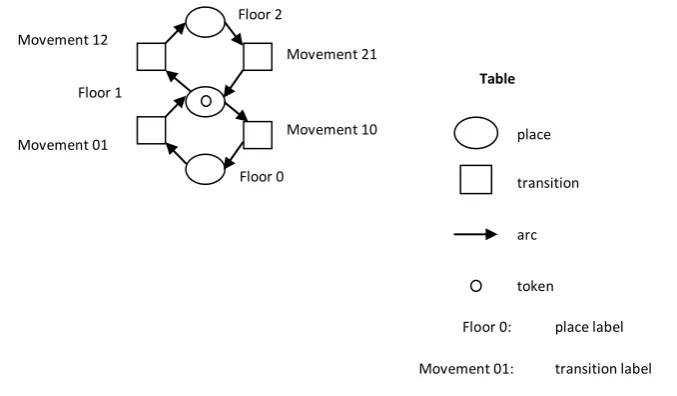
The basic concept behind a Petri net is developed by Carl Adam Petri (1962-2010). Other developers extended the concept with new additions over time to facilitate more complex business processes. Displayed below is a simple Petri net model of an elevator:
Figure 1, Example of an elevator as a Petri net (derived from: Modeling Business Processes, a Petrinet Oriented Approach)
In the table of the figure displayed above, graphical shapes correspond with Petri net characteristics. “Tokens” are used to express the dynamics of the system and are situated in the circles, called places, of the Petri net model. Transitions are the active components of the system, places and tokens themselves are passive. A transition can only be executed when every “input” place contains a token.
If the Elevator, displayed in the figure above, moves from floor 1 (it’s current position, displayed by the token) to floor 2, the toke itself will move too, via movement12 to place “floor2”. This movement is called the “firing” of a transition. In other words, moving the elevator from floor 1 to floor 2 will fire transition movement12. The arcs inside the Petri net model represent the direction of the change.
Table
Floor 2
Floor 0
Floor 0: place label Floor 1
Movement 01 Movement 12
Movement 21
Movement 10
Movement 01: transition label place
transition
arc
[image:11.595.143.482.217.415.2]12 In general:
A current state of a process is modeled in a Petri net as a token in a designated place. Changes from one state to another, are modeled by transitions.
Tokens often represent object (people, goods, machines), informative, object, current situation of an object.
Places represent blockades, channels, geographic locations, conditions or a state. Transitions represent events, transformations or transportations.
Mathematically, a Petri net is a bipartite graph. A graph consists of a collection of points, called nodes and lines or arcs. A bipartite graph is a graph whose vertices can be divided into two disjoint sets U and V (that is, U and V are each independent sets) such that every edge connects a vertex in U to one in V. Equivalently, a bipartite graph is a graph that does not contain any odd-length cycles. (Wikipedia, 2014).Displayed below is a example of an bipartite graph (Wikipedia 2014):
Figure 2, graphical representation of a bipartite graph
Petri net extensions
When very complex business processes need to be modeled, a normal Petri net has to be extended to a high level Petri net. Most important extensions to a basic Petri net are the extensions called “color”, “time”, and “hierarchy” (van der Aalst & Stahl, 2011).
Hierarchy makes it possible to display a simpler overview of a complex Petri net model. A square, representing a transition in a Petri net model, is supplemented a text frame beneath, which describes the name of the square: . This figure is called a module and stands for a black box
13 Petri net model is called a subnet. Consequently, a subnet can have its own modules. These modules of subnet are called sub-subnets of the original Petri net.
The extension color facilitates a token in a Petri net model to change color. These kinds of Petri nets are called “colored Petri nets” (van der Aalst & Stahl, 2011). Different values can be added to token in a colored Petri net.
Lastly, the extension time makes a token available in a Petri net after a certain amount of time. With this extension a token is able to receive a “time stamp”. A token with a time stamp isn’t available until a certain amount of time delay is reached. With this extension, the run time of token can be influenced.
State space
The state space of a Petri net contains all possible situations within a business process. Like in the previous Petri net model of an elevator displayed in figure 1, the state space of our example are the possible floors the elevator can reach. For a Petri net model the state spaces can described as all possible situations tokens of a Petri net can be distributed in the Petri net between all its transitions. Just one possible distribution of a token like shown in the Petri net elevator model is called a
marking. All possible markings define the state space of a Petri net. Those possible markings can be represented by a reachability graph which serves as a tool for verifying various Petri net properties.
Research method
14 To reach this goal my research, I divided my research in four steps before I started with the research. These four steps were:
1. Investigating the IPD method at Vibes building engineering and modeling it into a Petri net with the software program CPN Tools.
2. Validation of the IPD model.
3. Investigating Breeam.nl and incorporating this assessment method with the existing IPD model into a new model.
4. Analyzing and comparing the two models.
My research method will be explained next divided between the four steps:
Investigating the IPD method
First, the IPD design process in use at Vibes building engineers was investigated. Vibes building engineers is a company providing design, engineering, consulting and management to realize and manage of buildings by means of an integrated approach and cooperation. Investigation of the IPD design process did start by examining the IPD agreement. A literature study was conducted about the agreement, a back ground investigation and interviews were held with J.K. Pikkaart, the Vibes
general manager who realized the agreement.
15 With the main conditions of the IPD agreement acquired, design phases indentified and the tasks per design phase catalogued, this knowledge is now transformed into an information system model with the help of Petri Nets. A literature study about Petri nets was conducted with the help of the book “modeling business process”.
In the first version of the model most of the IPD design tasks were transformed into transitions if these tasks represented actions within the process that changed a current state of the IPD process. Tasks that could represented as documents needed during the IPD process were transformed into places of the Petri net. The places and transitions were given names corresponding IPD process tasks/documents they represent in the Petri net as clarification. The interactions between these transition-tasks and place-tasks were represented by arcs. This first version of the Petri net was modeled with CPN tools. After verification the Petri net the internal consistency was inadequate and a higher abstraction level was applied. This resulted in a Petri net with less places, transitions and arcs and the internal consistency of the model was improved.
Validation of the IPD model
16 Validation of the Petri net model can be summarized as followed:
Dividing all IPD process tasks into a hierarchal Petri net with five subnets confirming with the five IPD phases into a minimum amount of transitions and places to represent the critical tasks of the IPD process.
Detailed validation of each subnet separately.
Validating the sequencing of transitions and places in each subnet.
Investigating Breeam.nl
Documentation provided by the DGBC about Breeam.nl provided the core for the investigation about Breeam.nl. This documentation provided information regarding the required tasks to be performed for acquiring the desired credits in accordance with the targeted Breeam.nl qualification. Besides these documents, a Breeam.nl expert, Michel Kemper employed at Lomans Installatie Techniek, was interviewed. A Breeam.nl expert has received had training by the DGBC about the basic concepts regarding Breeam.nl. This interview helped acquiring knowledge about applying Breeam.nl during the design process of a new building project. The required Breeam.nl tasks were integrated into the existing IPD model. Management tasks crucial or executing Breeam.nl were also integrated. With this information the existing IPD- Petri net model was developed into a second model with the Breeam.nl assessment method incorporated.
Analyzing and comparing the two models
.17
Reachability analysis
Reachability analysis is a common verification technique to explore the state space of a model. Reachability analysis investigates the state space of a Petri net. The state space of a Petri net is defined by the reachability graph of the Petri net. The amount of arcs and nodes of a reachability graph indicate all markings of a Petri net, therefore the amount of arcs and nodes represent an indication of complexity of a Petri net provided the reachability graph is finite.
Fairness analysis
Fairness is an indicator for transitions of a Petri net. It detects a sequence of transitions within a Petri net that can repeat itself infinitely often. This occurs in a Petri net when a certain decision has to be made as nondeterministic choice between two transitions. To detect a so called infinite run in a Petri net, four notions of fairness are defined to describe transitions in a Petri net;
1. Impartial: an impartial transition occurs infinitely often in every infinitely run of the Petri net. 2. Fair: a fair transition occurs infinitely often in every infinitely run of the Petri net where it is
enabled infinitely often.
3. Just: a just transitions occurs infinitely often in every infinitely run of the Petri net where it is continuously enabled form a marking onward.
4. Not Fair: a Not Fair transition if and only it is not just: there is an infinite run in the Petri net that enable it from a marking onward and does not fire anymore.(van der Aalst & Stahl, 2011).
18 business process multiple times. Fairness analysis therefore is used in the research to analyze the amount of transitions that have more influence on the Petri nets than normal transitions.
Research data
Results
In this chapter the construction of the IPD design process will be explained in detail. The development of the Petri net model and its validation process are explained thereafter.
Investigating IPD
Background IPD process
The integrated project delivery process currently in use at Vibes Building engineers is formalized in the IPD agreement devised by Vibes building engineers themselves. The Vibes IPD agreement is based on the standard IPD agreement devised by the company Hanson Bridget and adapted to the requirements of Vibes. “The Hanson Bridgett IPD model is a multi-party agreement that seeks to succinctly state IPD principles within a readable and logical agreement (Hanson Bridgett 2010).The agreement of Hanson Bridget is based on the article “Integrated Product Delivery: A Guide” published in 2007 by the American institute of Architects and Hanson Bridgett’s experience and involvement in actual IPD projects (Hanson Bridgett 2010).
The content of the Vibes IPD agreement is similar to the Hanson Bridget agreement. The main conditions in both agreements concern:
How project decisions are made.
How and when the project target cost is set. How compensation and incentives are structured.
How changes in the work and contingency are addressed.
19 Transparency and access to project documents and records.
Dispute resolution procedures.
The main conditions of the IPD agreement that determine the structure of the IPD process are:
How project decisions are made
Project decisions are made by the Project Management Team (“PMT”), which includes a
representative for the Owner, Architect and Contractor. Decisions by the PMT must be unanimous. PMT decisions affecting design, cost, schedule or reallocation of the Work are confirmed through a PMT Directive. There is also a Project Implementation Team (“PIT”), which includes the PMT
representatives and consultants, design-build subcontractors and others who may have a significant impact on the project outcome. The PMT actively seeks and considers input from the PIT.
How and when the project targets are set
Validated Target Cost, abbreviated for the Vibes IPD process as VDK, is set during the
Conceptualization Phase. The VDK represents the costs according PMT deems sufficient to design and construct the project in accordance with the Validated Target Program (“VDP”) and within the Validated Target Schedule (“VDT”).
The VDK, VDP, VDT are part of the Project Objective (“Project Doel stelling, PDS”), which must be unanimously adopted by the PMT during the Conceptualization Phase.
20 The function of the five design phases can be described as followed:
1. “initiatie” phase (conceptualization): what, who how will the project be built?
2. “project definitie” phase (criteria design): a general description of the project will be defined and multiple options are examined.
3. “scenario studie” phase (detailed design): The question “what” to build is specified and answered. In BIM terms, level of development (LOD) of 200 will be reached as a BIM model 4. “technisch ontwerp” phase (implementation documents): documentation about “how” the
project will be built should be nearly finished and the BIM model will reach LOD 300. 5. “productie voorbereiding” phase (agency review and buyout): The momentum of “what” to
[image:20.595.72.544.331.372.2]build will shift to “how” to build.
Figure 3, phases of the IPD process, darker colored phases are part of the design phase.
IPD design tasks
Besides the IPD agreement, the IPD Process is influenced by general design tasks that have to be performed to realize the design of a new building. These tasks, regulated by Dutch law, are described in the “ Standaard taakbeschrijving (DNR-STB), 2009” issued by BNA/ONRI in 2009. In this document the design process of a building is split in all possible tasks deemed possible to successfully execute a design process. About 2000 possible tasks are described divided into eight design phases. These tasks are categorized between “critical” and “non critical” tasks. The total amount of critical tasks contains the minimum requirements for a responsible construction design. Non critical tasks are possibly performed depending on the building project specifically.
Initiatie Project definitie
Scenario studie
Technisch ontwerp
Productie
21 Furthermore, all tasks are categorized into three themes:
1. Owner/client theme: all tasks concerning decision making and support from advisors 2. Design theme; all tasks concerning design process of the construction and it’s direct
environment
3. Project management theme; all management tasks concerning the design process, these tasks are meant to guide the design project towards its goal.
This DNR-STB list was transformed to a list of tasks that are needed to realize a new building designed with the IPD process. The total amount of tasks was reduced during this transformation because less project management related tasks are needed by reducing the amount of phases. The list of tasks concerning decision making could also be reduced.
[image:21.595.67.529.435.501.2]Table 1 and table 2 show the reduction in design phases as a result of transforming the DNR-STB list to the IPD process and the reduction of total amount of tasks that are necessary to realize a new building.
Table 1, all tasks concerning the DNR/STB task list during the design process
Design phases IPD
initiatie Project definitie Scenario studie Technisch ontwerp
Productie voorbereiding
No. tasks IPD (total 565)
[image:21.595.70.533.548.607.2]60 52 138 209 106
Table 2, all tasks concerning the IPD design Process
Appendix A shows the tasks of the Project definition phase as an example of the task list per design phase of the IPD process. This example contains the tasks necessary to design a new building according to DNR_STB list supplemented with tasks necessary to fulfill the conditions of the IPD agreement during the project definition phase.
Design phases DNR/STB
initiatie Project definitie
Structuur ontwerp
Voor ontwerp
Definitief ontwerp
Technisch ontwerp
Uitvoerings gereed ontwerp
Inkoop
No. tasks
DNR/STB (total 792)
22
IPD Petri net model and validation of the Petri net
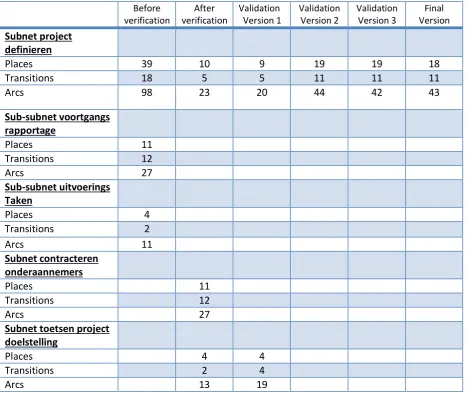
In the chapter research method the development of the Petri net during verification and performance analysis has been explained. This resulted in one Petri net model before final verification of the model and one afterwards, which was used for validation. After validation with Vibes’ employees, four more models were produced until the final one fulfilled the requirements. To show the transformation of the Petri net during its design process, the changes in the sub net project definition during verification and validation of the Petri net is shown in Table 3 below.
Before verification
After verification
Validation Version 1
Validation Version 2
Validation Version 3
Final Version
Subnet project definieren
Places 39 10 9 19 19 18
Transitions 18 5 5 11 11 11
Arcs 98 23 20 44 42 43
Sub-subnet voortgangs rapportage
Places 11
Transitions 12
Arcs 27
Sub-subnet uitvoerings Taken
Places 4
Transitions 2
Arcs 11
Subnet contracteren onderaannemers
Places 11
Transitions 12
Arcs 27
Subnet toetsen project doelstelling
Places 4 4
Transitions 2 4
[image:22.595.66.534.259.652.2]Arcs 13 19
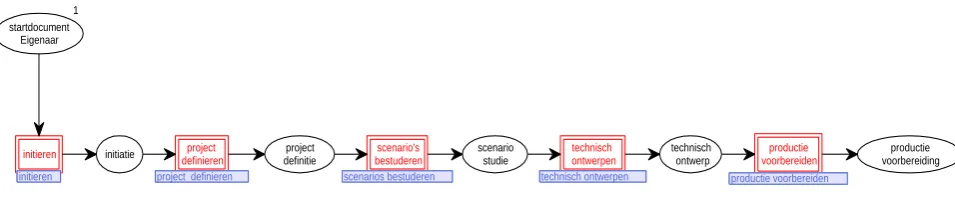
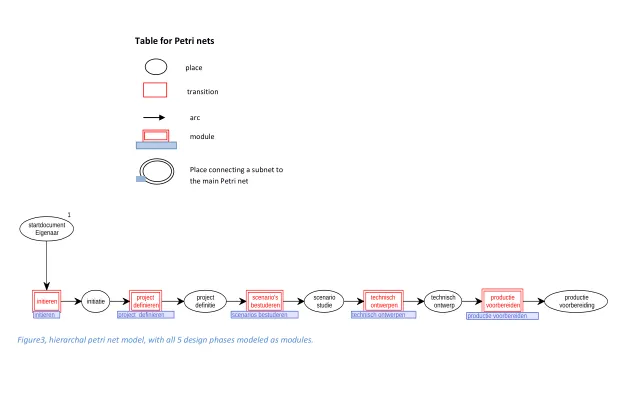
23 The final Petri net model with its five modules is shown is below:
Figure 4, hierarchal Petri net model, with all 5 design phases modeled as modules.
The final version of each subnet of the five modules can be found in Appendix B.
Investigating and incorporating Breeam.nl
Executing the Breaam.nl assessment during the design process of a new building adds extra tasks to be performed during the IPD process. These tasks are described in the document
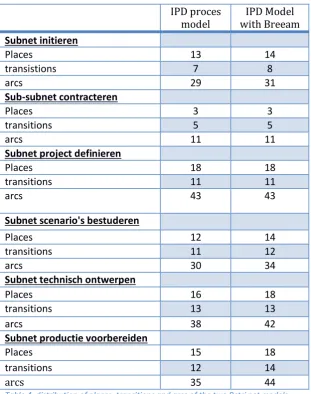
Beoordelingsrichtlijn Nieuwbouw (DGBC 2011). After indentifying the Breeam.nl tasks, these tasks were divided between the five IPD process phases. This resulted in a new IPD business process model with Breeam.nl tasks incorporated. The same procedure was used for creating the second Petri net model as was used for the first Petri net model. Only one evaluation was necessary to discuss new Petri net model. In the table on the next page, the differences in places, transitions and arcs are shown.
startdocument Eigenaar
1
initiatie project definitie
scenario studie
technisch ontwerp
productie voorbereiding initieren
initieren
project definieren project definieren
scenario's bestuderen scenarios bestuderen
technisch ontwerpen technisch ontwerpen
24 IPD proces
model with Breeam IPD Model Subnet initieren
Places 13 14
transistions 7 8
arcs 29 31
Sub-subnet contracteren
Places 3 3
transitions 5 5
arcs 11 11
Subnet project definieren
Places 18 18
transitions 11 11
arcs 43 43
Subnet scenario's bestuderen
Places 12 14
transitions 11 12
arcs 30 34
Subnet technisch ontwerpen
Places 16 18
transitions 13 13
arcs 38 42
Subnet productie voorbereiden
Places 15 18
transitions 12 14
[image:24.595.66.378.67.462.2]arcs 35 44
Table 4, distribution of places, transitions and arcs of the two Petri net models.
The final version of each subnet of the Petri net model altered by Breeam.nl incorporated can be found in appendix C.
Research Analysis
The goal of this investigation is to compare a design process with and without sustainability
25
Reachability comparison
Reachability analysis was done with CNP tools. Table 3 below show the reachability properties of both models.
Petri net model Petri net model with Breeam.nl
No. arcs 188 207
No. transitions 59 64
No. places 90 100
State space: nodes 76 90
[image:25.595.64.532.167.302.2]State space: arcs 145 170
Table 5, distribution of places, transitions and arcs between two Petri net models.
Despite the few extra added transitions, places and arcs the reachability graph is increased
significantly with both 18% more nodes and arcs. This indicates adding Breaam.nl to the IPD process will have a significant impact on the IPD business process, since the state space of the extended model is significantly larger than the state space of the original model.
Fairness comparison
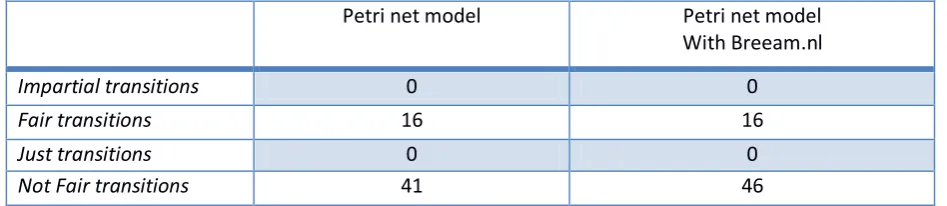
In table 4 below, the transitions are shown with the four different notions of fairness.
Table 6, fairness transitions
With the addition of Breeam.nl to IPD process, the Petri net is increased with 5 more transitions affected by fairness, indicating more influence of infinite runs on the transitions of the Petri net with Breeam.nl. These transitions are “Breeam_credits_bepalen” from subnet “scenario’s bestuderen”,
Petri net model Petri net model
With Breeam.nl
Impartial transitions 0 0
Fair transitions 16 16
Just transitions 0 0
[image:25.595.62.536.520.623.2]26 “Breeam_credits_bepalen” from subnet “technisch ontwerpen”, 'Breeam_Specificaties” and
“Controleren_Breeam_Rapport_door_Assessor “from the subnet ”productie voorbereiden (see appendix C).
This increase is caused by three extra infinite runs that are caused by the addition of Breeam.nl to the existing Petri net model of the IPD process. The subnets scenario studie (detailed design), technisch ontwerp (implentation documents) and product voorbereiding (agency review and buyout), each gain an extra infinite run. ”. The fifth transition
”BREEAM_credtis_bepalen_aan_de_hand_van_streefkwalificatie_en_budget” from subnet initiëren , marked as not fair by the fairness analysis is not part of an infinite run with any consequence to the IPD process.
Conclusions and recommendations
After modeling the IPD process into a Petri net and extending this Petri net model with the sustainability assessment Breeam.nl, it was possible to analyze the impact of sustainability
assessment on the IPD design process of a new building. Using analysis techniques specified for Petri nets, the extension of the Petri net resulted in a significant increase of complexity of the Petri net while both Petri nets had a similar amount of transitions, places and arcs.
27 This research further shows the possibility of analyzing two Petri nets. In making two models of an IPD process with and without sustainability assessment, the impact of such assessment can be clearly indentified in the Petri net. Notable results were:
With a Petri net a comprehensible model can devised which helps to map an IPD process for a company like Vibes building engineers.
A clear chain of events that occurring during the IPD process, can be identified as fairness transitions in the Petri net. These transitions gain in importance if sustainability assessment is applied in the design process. These transitions become visible thanks to their fairness properties.
Recommendations
Since the research concluded sustainability assessment may have a significant impact on the IPD design process despite its small size compared to the total design process, companies should be well aware of the impact of sustainability assessment. In general, this awareness can be realized in general by carefully integrating the Breeam.nl assessment method into the IPD process. This can be done by planning all Breeam.nl related tasks as early as possible during the design process and informing all relevant participants of the task requirements.
28
Theoretical contributions
Modeling an Integrated Project delivery method.
Integrated Project Delivery is a new project delivery method in the Netherlands. This Petri net helps as a roadmap for creating other Petri net models of project delivery methods in the construction industry and provides a tool to compare those different methods in theory.
A Petri net modeling a design process of a new building
Petri net are used to model all different kinds of business processes. The two models created in this research can be used for analyzing Petri nets in general. Especially concerning translating tasks in a business process to states and transitions in a Petri net.
Practical implications
The two Petri net models created in this research can be used for further analysis concerning:
Investigating the design process of a new building, based upon a project delivery method other than the IPD method
Investigating an IPD process of a new building and the sustainability assessment other than Breeam.nl
This research can also act as a resource for other research, which investigates assessment methods in a design process of a building like cost evaluation during the design process. A Petri net model can be extended with such an assessment method besides the Breeam.nl assessment method used in this research.
Limitations and delimitations
29 required during the project definition phase are incorporated into existing transitions and can’t be modeled as separate places and/or transitions of a Petri net.
Since the goal of this research was focused on the IPD design process and not the whole IPD (building) process, the research investigated only one part of the IPD process. Therefore, only these design phases were modeled as a Petri net and only the “Breeam.nl tasks” to be performed during the design process have been included the research.
Using a timed Petri net model would have provided additional useful information concerning a business process (van der Aalst & Stahl, 2011). Assigning time stamps to tokens would enable the model to predict time estimates on completion of the modeled business process. This would greatly improve the usefulness of the Petri net model. The use of timed Petri net model was considered at the start of the research, but after consultation with Vibes, the use a timed Petri net was rejected due to the lack of information required to construct such a model. The time limitation set to this research was also a restricting factor.
30
References
van der Aalst W, Stahl C, 2011.Modelling Business Process, A Petrinet-Oriented Approach
(internet) American Institute of Architects(AIA),2010. Integrated Product Delivery: Case Studies, (acquired 23-2-2014)
(internet) American Institute of Architects(AIA),2007. Integrated Product Delivery: A Guide (acquired 23-2-2014)
(internet) American Institute of Architects(AIA),Primer on Project Delivery,Second Edition (2011) http://www.aia.org/aiaucmp/groups/aia/documents/pdf/aiab093116.pdf, (acquired June 2104)
(internet) Autodesk, 2008. Improving building industry results through integrated project delivery and building information modeling, (acquired 23-2 2014)
Asmar M E, Hanna A S, Loh W-Y, 2013, Quantifying performance for the Integrated Project Delivery system as compared to established delivery systems. Journal of Construction Engineering and Management Volume: 139 Issue: 11, nr UNSP 04013012
(internet )Koninklijke Maatschappij tot Bevordering der Bouwkunst, Bond van Nederlandse Architecten (BNA) & Brancheorganisatie van advies-, management- en ingenieursbureaus (ONRI) 2009. Standaardtaakbeschrijving DNR-STB 2009,Toelichting en takenoverzicht. (acquired may 2014)
(internet) BRE Global Breeam homepage, (acquired June 2014)
Dal Gallo L, O’Leary S T, Louridas L J, Comparison of integrated Project delivery agreements, 2010.
(acquired 3-6-2014)
(internet)Dutch Green Building Council (DGBC),2011. Keurmerk voor duurzame vastgoedobjecten, Beoordelingsrichtlijn Nieuwbouw, (acquired March 2014)
Jrade A, Jalaei F, 2013, Integrating building information modeling with sustainability to design building projects at the conceptual design. Building
Simulation Volume: 6 Issue: 4 pp 429-444
Kats G, Alevantis L, Berman A, Mills E, Perlman J, 2003
The costs and financial benefits of green buildings, A Report for California's Sustainable Building Task Force, (acquired Janauri-2014)
Motawaa I, Carter, K, 2013, Sustainable BIM-based Evaluation of Buildings Procedia - Social and Behavioral Sciences Volume 74, pp 419–428
Schlueter A,Thessling F, 2009. Building information model based on energy/exergy
performance assessment in early design changes. Automation in Construction, 18(2), pp. 153-163.
31
(internet) Wikipedia (acquired January 2014)
(internet)Dutch Green Building Council (DGBC),2012 BREEAM-NL procesmodel v1.1, 2012. (acquired May, 2014)
(internet)Hanson Bridgett, Standard IPD agreement,2009. (acquired June 2014)
(internet) American Institute of Architects(AIA),Primer on Project Delivery,Second Edition (2011)
http://www.aia.org/aiaucmp/groups/aia/documents/pdf/aiab093116.pdf (acquired June 2104)
32
Appendix A,
Task list of the IPD definition phase
This task list is still in Dutch and has not been translated
fase 2 project definitie
PMT
02.01 Opdrachtgeving
1. 02.01.010 N Evalueren en bijstellen beleidsuitgangspunten project 2. 02.01.020 N Nemen besluiten over faseresultaten en voortgang 02.03 Projectdoestelling
3. Opstellen Projectdoelstelling
De Projectdoelstelling is ontwikkeld door de Partijen op basis van eisen doestellingen en beperkingen van de Eigenaar. De Projectdoelstelling bestaat uit bestaat uit het geValideerde Doel Programma (VDP), de geValideerde Doel Kosten (VDK), en de geValideerde Doel
Tijdsplanning (VDT).
02.13 Organisatie/procesintegratie 4. 02.13.010 N Organiseren project 5. 02.13.020 N Sturen en bewaken project 6. Samenstellen PIT
7. Onderzoek Bouwplaats
Het PMT zal een gezamenlijk bezoek aan de bouwplaats organiseren 8. Opstellen Projecthandboek
Het PMT zal een projectboek maken overeenkomstig met afgesproken (IPD) contract 9. Management en Organisatie van het PMT
Vaststellen management en organisatie middels een Kostenmanagement strategie,PMT werkplan en een BIM uitvoeringsplan
10. Kennisgeving van Impasse
Indien de Partijen geen overeenstemming bereiken over de Projectdoelstelling, kan een partij een impasseverklaring indienen door een schriftelijke kennisgeving
11. Bonus Malus Regeling
Vaststellen uitkeringspercentage Bonus Malus Regeling 12. Aansturen PIT
03.02 Contracten
13. Formuleren gewenste werkzaamheden aanvullende expertise (M-taak)
14. N Voorbereiden/contracteren van nieuwe leden PIT 15. N M Contracteren van nieuwe leden PIT
PIT
02.12 Geld
16. 02.12.010 N Bewaken fasebudget volgens VDK
17. 02.12.015 N C Adviseren bouwkosten per projectdeel (cluster)
33 20. 02.12.035 C Ramen exploitatiekosten per projectdeel (cluster)
21. 02.12.040 Ramen exploitatiekosten: integreren ramingen per projectdeel 22. 02.12.045 C Analyseren kosten-baten exploitatie per projectdeel (cluster)
23. 02.12.050 Analyseren kosten-baten exploitatie: integreren analyses per projectdeel 24. 02.12.055 C Inventariseren financieringsmogelijkheden per projectdeel (cluster) 25. 02.12.060 Inventariseren financieringsmogelijkheden: integreren inventarisaties per
projectdeel
26. 02.12.065 C Inventariseren subsidiemogelijkheden per projectdeel (cluster)
27. 02.12.070 Inventariseren subsidiemogelijkheden: integreren inventarisaties per projectdeel 02.11 Ontwerpintegratie
28. 02.11.010 N Coördineren adviezen participanten (Partijen en PIT leden) 29. 02.11.030 Integreren toetsingen realiseerbaarheid Projectdoelstelling 02.14 Tijd
30. 02.14.010 N Plannen projectdoorlooptijd volgens VDT 02.15 Informatie en communicatie
31. 02.15.001 N Opstellen en beheren informatie- en communicatieplan fase Projectdefinitie 32. 02.15.010 N M Voeren van overleg met het PMT
33. 02.15.015 N Voorbereiden, voorzitten, verslagleggen van teamvergaderingen 34. 02.15.020 N M Deelnemen aan teamvergaderingen
35. 02.15.024 N Voorbereiden, voorzitten, verslagleggen van stuurgroepvergaderingen 36. 02.15.025 N M Deelnemen aan stuurgroepvergaderingen)
37. 02.15.030 N M Voeren van overleg met bevoegde instanties 38. 02.15.035 N M Voeren van overleg over financiering en subsidies 39. 02.15.040 N Beheren projectdocumenten
02.16 Kwaliteitszorg en risico’s
40. 02.16.005 C Analyseren en behandelen projectrisico`s per projectdeel (cluster)
41. 02.16.010 Analyseren en behandelen projectrisico`s: integreren RI&E`s per projectdeel 02.17 Vergunningen
42. 02.17.010 N M Inventariseren benodigde vergunningen 02.04 Architectuur
43. 02.04.010 Toetsen realiseerbaarheid Projectdoelstelling vanuit expertise Architectuur/bouwkunde
02.05 Interieur
44. 02.05.010 Toetsen realiseerbaarheid Projectdoelstelling vanuit expertise Interieurarchitectuur
02.06Landschap
45. 02.06.010 Toetsen realiseerbaarheid Projectdoelstelling vanuit expertise Landschapsarchitectuur
46. 04.02.035 Contracteren aanvullende expertise door engineer
02.04 Bouwkunde
47. 02.04.010 Toetsen realiseerbaarheid Projectdoelstelling vanuit expertise bouwkunde 02.07 Bouwfysica en akoestiek
48. 02.07.010 Toetsen realiseerbaarheid Projectdoelstelling vanuit expertise Bouwfysica 49. 02.07.020 Toetsen realiseerbaarheid Projectdoelstelling vanuit expertise Akoestiek 02.08 Constructie
50. 02.08.010 Toetsen realiseerbaarheid Projectdoelstelling vanuit expertise Constructies 02.09 Installaties
51. 02.09.010 Toetsen realiseerbaarheid Projectdoelstelling vanuit expertise Installaties 02.10 Geotechniek
34
Appendix B,
Petri net model of the IPD design process
35 1
2 3 4 5 6 7 8
[image:35.842.54.681.73.466.2]9
Figure3, hierarchal petri net model, with all 5 design phases modeled as modules.
10 11 12 13 14
startdocument Eigenaar
1
initiatie project definitie
scenario studie
technisch ontwerp
productie voorbereiding initieren
initieren
project definieren project definieren
scenario's bestuderen scenarios bestuderen
technisch ontwerpen technisch ontwerpen
productie voorbereiden productie voorbereiden initieren project definieren scenarios bestuderen technisch ontwerpen productie voorbereiden
Table for Petri nets
place
transition
arc module
36 15
16
[image:36.842.74.669.94.477.2]17
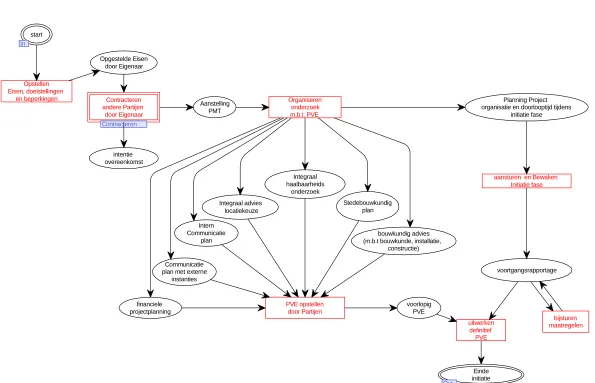
Figure 4, “initiatie” (conceptualization phase), modeled as a subnet
18 start In In Einde initiatie Out Out Opgestelde Eisen door Eigenaar Aanstelling PMT intentie overeenkomst Planning Project organisatie en doorlooptijd tijdens
initiatie fase Integraal advies locatiekeuze Integraal haalbaarheids onderzoek Intern Communicatie plan Communicatie plan met externe
instanties financiele projectplanning voortgangsrapportage voorlopig PVE bouwkundig advies (m.b.t bouwkunde, installatie,
constructie) Stedebouwkundig
plan
Opstellen Eisen, doelstellingen
en beperkingen Organiseren
onderzoek m.b.t. PVE
37 19
[image:37.842.75.662.87.487.2]20 21
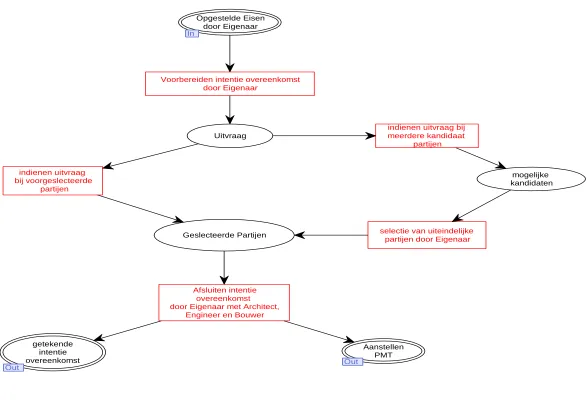
Figure 5, sub subnet ” Contracteren ander partijen door eigenaar”
22
getekende intentie overeenkomst Out
Out
Aanstellen PMT Out
Out Opgestelde Eisen
door Eigenaar In
In
mogelijke kandidaten Uitvraag
Geslecteerde Partijen indienen uitvraag
bij voorgeslecteerde partijen
Voorbereiden intentie overeenkomst door Eigenaar
indienen uitvraag bij meerdere kandidaat
partijen
selectie van uiteindelijke partijen door Eigenaar
Afsluiten intentie overeenkomst door Eigenaar met Architect,
38 23
24
[image:38.842.79.666.111.486.2]25
Figure 6 “project definitie “(criteria design phase) modeled as a subnet
26
Start Project definitie fase op basis van informatie/documenten initiatie fase In In einde project definitie Out Out geValideerde Doel Kosten (VDK) geValideerde Doel Tijdsplanning (VDT)
geValideerde Doel Programma (VDP)
aanvullende expertise verkregen van adviseurs/
specialisten Bezeting PIT Planning fase projectdefinitie periodieke voortgangs raportage projecthandboek (PHB) Kennisgeving van Impasse Regeling Bonus Malus Bedrag (BMB) Gezamelijk onderzoek bouwplaats Kosten Management-strategie PMT Werkplan BIM Uitvoeringsplan startdocument PDS
Go/ NO Go Startdocument leveringen Budgetraming fase projectdefinitie Opstellen IPD leveringen door PIT
Organiseren van fase project definitie door het PMT
formuleren mogelijke werkzaamheden voor aanvullende expertise
IPD overeenkomst tekenen door Partijen
sturen en bewaken Project door PMT toetsen voorwaarden IPD overeenkomst vaststellen Management en Organisatie Project Vaststellen Project Doelstelling (PDS)/ takenlijst bijlage C
Opstellen aan te passen leveringen door PIT
uitwerken leveringen
39 27
28
[image:39.842.71.675.116.474.2]29
Figure 6, scenario studie (detailed design phase) modeled as a subnet
30
Eindrapportage scenario studie
Out Out
Start Scenario studie op basis van informatie/documenten project definitie In In startdocument scenario studie
taken PIT leden BIM model
(LOD 200)
Planning fase scenario studie
informatie/specificaties van data en output
inkoopplanning conform VDT
Go/ NO Go
aangepaste PDS? 1 aangepaste taken Bezetting PIT Budgetraming fase Scenario Studie
periodieke voortgangs rapportage
Organiseren van fase Scenario Studie
door PMT* evalueren bezetting PIT op basis
van taken uit te voeren tijdens scenario studie door PMT
Opzetten BIM Model
sturen en bewaken Project door PMT
uitvoeren takenpakket per PIT lid
40 31
32
[image:40.842.68.685.111.486.2]33
Figure 8, “Technisch ontwerp”(implementation documents phase) modeled as a subnet
34
technisch ontwerp
Out Out
Start technisch ontwerp op basis van informatie/documenten Scenario Studie In In startdocument technisch ontwerp
taken PIT leden
Planning fase technisch ontwerp
uitgewerkte informatie/specificaties
van data en output
OLO dossier aangemaakt
Aangepast BIM model (LOD 300)
Go/ NO Go definitieve inkoopplanning periodieke voortgangs rapportage aangepaste taken Bezetting PIT Budgetraming fase technisch ontwerp aangepaste PDS? 1 overige rapporten tekeningen en gedetailleerde specificaties gecontroleerde tekeningen en specificaties
evalueren bezetting PIT (op basis van taken uit te voeren tijdens technisch ontwerp door PMT)
Organiseren van fase technisch ontwerp
door PMT*
uitvoeren takenpakket per PIT lid
Aanpassen BIM Model met uitgevoerde taken scenario studie Controleren resutaten door PIT aangepast takenpakket doorsturen naar verantwoordelijke partij
sturen en bewaken Project door PMT
Inleveren aanvraag vergunningen/ documenteren resultaten
fase technisch ontwerp takenpakket
aanpassen Organiseren takenlijst
Bijlage C door PIT
invullen en controleren vergunningenaanvraag
41 35
36
[image:41.842.72.674.114.488.2]37
Figure 9, “productie voorbereiding” (agency review and buyout phase) modeled as a subnet
38
Start productie voorbereiding op basis van informatie/documenten Technisch Ontwerp In In productie voorbereiding Out Out startdocument productie voorbereiding Bezetting PIT
taken PIT leden
definitieve informatie/specificaties
van data en output
Aangepast BIM model (LOD 400)
Go/ NO Go Planning fase productie voorbereiding aangepaste taken inkoop Periodieke voortangs rapportage benodigde vergunningen Budgetraming fase productie voorbereiding aangepaste PDS? 1 vastgestelde prefabricage elementen uitvoerings documenten
Organiseren van fase Productie voorbereiding
door PMT*
uitvoeren takenpakket per PIT lid
takenpakket aanpassen Organiseren takenlijst bijlage C door PIT Controleren resutaten door PIT Aanpassen BIM Model naar uitgevoerde taken technisch ontwerp
sturen en bewaken Project door PMT aangepast takenpakket doorsturen naar verantwoordelijke partij resultaten documenteren fase productie voorbereiding evalueren bezetting PIT op basis
van taken uit te voeren tijdens productie voorbereiding door PMT
Bijstellen en maatregelen
42
Appendix C, Petri net model with Breeam.nl
39
In this appendix the subnets of the original Petri net model, influenced by the addition of Breeam.nl 40
to the design process, are displayed. 41
43 46
Fig 10, breeam impact on the ”initiatie” modeled as a subnet
47 48 49 start In In Einde initiatie Out Out Opgestelde Eisen door Eigenaar Aanstelling PMT intentie overeenkomst Planning Project organisatie en doorlooptijd tijdens
initiatie fase Integraal advies locatiekeuze Integraal haalbaarheids onderzoek Intern Communicatie plan Communicatie plan met externe
instanties financiele projectplanning voortgangsrapportage voorlopig PVE bouwkundig advies (m.b.t bouwkunde, installatie,
constructie) Stedebouwkundig
plan
Eisen, doelstelling en beperkingen project t.a.v. BREEAM
Opstellen Eisen, doelstellingen
en beperkingen Organiseren
onderzoek m.b.t. PVE
aansturen en Bewaken Initiatie fase PVE opstellen door Partijen uitwerken definitief PVE Contracteren andere Partijen door Eigenaar Contracteren Contracteren bijsturen maatregelen BREEAM credtis
44 50
Fig 11, breeam impact on the “scenario studie” phase modeled as a subnet
51 52 53 Eindrapportage scenario studie Out Out
Start Scenario studie op basis van informatie/documenten project definitie In In startdocument scenario studie
taken PIT leden
BIM model (LOD 200)
Planning fase scenario studie
informatie/specificaties van data en output
inkoopplanning conform VDT
Go/ NO Go
aangepaste PDS? 1 aangepaste taken Bezetting PIT Budgetraming fase Scenario Studie
periodieke voortgangs rapportage Breeam specificaties Gegevens betreffende Breeam Credits
Organiseren van fase Scenario Studie
door PMT* evalueren bezetting PIT op basis
van taken uit te voeren tijdens scenario studie door PMT
Opzetten BIM Model
sturen en bewaken Project door PMT
uitvoeren takenpakket per PIT lid
45 54
Fig 12, breeam impact on the “technisch ontwerp” phase modeled as a subnet
55 56 57 technisch ontwerp Out Out Start technisch ontwerp
op basis van informatie/documenten Scenario Studie In In startdocument technisch ontwerp
taken PIT leden
Planning fase technisch ontwerp
uitgewerkte informatie/specificaties
van data en output
Aangepast BIM model (LOD 300)
Go/ NO Go definitieve inkoopplanning periodieke voortgangs rapportage aangepaste taken Bezetting PIT Budgetraming fase technisch ontwerp aangepaste PDS? 1 tekeningen en gedetailleerde specificaties Breeam specificaties Gegevens betreffende Breeam Credits overige rapporten OLO dossier aangemaakt gecontroleerde tekeningen en specificaties evalueren bezetting PIT (op basis
van taken uit te voeren tijdens technisch ontwerp door PMT)
Organiseren van fase technisch ontwerp
door PMT*
uitvoeren takenpakket per PIT lid
Aanpassen BIM Model met uitgevoerde taken technisch ontwerp Controleren resutaten door PIT aangepast takenpakket doorsturen naar verantwoordelijke partij
sturen en bewaken Project door PMT
Iindienen aanvraag vergunningen/ archiveren resultaten fase technisch ontwerp takenpakket aanpassen Organiseren takenlijst Bijlage C door PIT Bijstellen en Maatregelen Breeam credits bepalen
46 58
Fig 13, breeam impact on the “productie voorbereiding” phase
59
Start productie voorbereiding op basis van informatie/documenten Technisch Ontwerp In In productie voorbereiding met Voorlopige Breeam kwalificatie Out Out startdocument productie voorbereiding Bezetting PIT
taken PIT leden
definitieve informatie/specificaties
van data en output
Aangepast BIM model (LOD 400)
Go/ NO Go Planning fase productie voorbereiding aangepaste taken inkoop Periodieke voortangs rapportage benodigde vergunningen Budgetraming fase productie voorbereiding aangepaste PDS? 1 vastgestelde prefabricage elementen uitvoerings documenten Breeam Specificaties Rapport Voorlopig Breaam kwalificatie voor Assessor Voorlopige Breeam kwalificatie
Organiseren van fase Productie voorbereiding
door PMT*
uitvoeren takenpakket per PIT lid
takenpakket aanpassen Organiseren takenlijst bijlage C door PIT Controleren resutaten door PIT Aanpassen BIM Model met uitgevoerde taken productie voorberteden
sturen en bewaken Project door PMT aangepast takenpakket doorsturen naar verantwoordelijke partij resultaten archiveren fase productie voorbereiding evalueren bezetting PIT op basis
van taken uit te voeren tijdens productie voorbereiding door PMT