Antarctic
Future
Technologies
PCAS K220 (2017/2018)
Syndicate Report
(ANTA604)
Word count
7966
Ashley Fletcher - 18013743
Bjorn Battaerd - 67070969
Francesca Mills - 15013596
Abstract
Contents
Section 1 - Introduction, p. 4 - 9
Section 2 - Renewable energy technology, p. 10 - 18
Section 3 - Waste management, p. 19 - 27
Section 4 - Field and science technology, p. 28 - 37
Section 5 - Data collection, transmission, and
communication, p. 38 - 44
Section 6 - Conclusion, p. 45 - 46
References - p. 48 - 53
“Although scientific research in Antarctica is of paramount importance in addressing
climatic and environmental challenges, there is no doubt that the value of Antarctica
for science should be weighed against the environmental impact of scientific work and
its logistic support.”
(Bargagli, 2005)
Introduction
The science conducted in Antarctica has been crucial to improving our understanding of climate change and the important role of Antarctic and Southern Ocean in the earth’s oceanic and atmospheric systems. However, current and past scientific programs have had a direct impact on the Antarctic environment. Technological advancements in energy, transport, waste and data networks all have the ability to reduce the impact of science in antarctica and provide scientific programs new ways to conduct research in the field and help to reduce the human impact and carbon footprint. The aim of this report is to show that National Antarctic Programs (NAP) can reduce their carbon footprint, their physical impacts on the environment whilst taking their scientific programs to new heights. These goals seem ambitious but the report will show that they are achievable and have real potential to reduce the human impact on Antarctica.
Footprints
SCAR, 2018
The physical impacts of the NAPs are easy to see: there are over 80 bases on the continent, greater numbers of vehicles traversing the continent, more flights and new field and science camps being established and are able to travel further into the continent than ever before (SCAR, 2018; Tin, Liggett, Maher & Lamers, 2013).
Carbon Footprint
This report will also examine the carbon footprint of the NAPs and the ability of technology to reduce it. It is well established that greenhouse gas emissions are causing climate change and Antarctica will be heavily impacted in the future (IPCC, 2013). It is therefore in the interest of the NAP to reduce their carbon emissions and implement cleaner technology.
The emissions produced on Antarctica are recorded by individual nations on a voluntary basis and therefore there is no complete record that covers the whole continent. Compared to emissions produced by the United States and Australia the emissions produced in Antarctica are relatively small. The heavy reliance on fuel for almost every activity in Antarctica means that emissions are comparatively large per person and a reduction in fuel use has the potential to make a real difference.
The NAPs have been world leading in putting the environment as leading in importance, burning large amounts of fuel is inconsistent with the environmental principle.
Carbon Footprint Definition
It is important to consider what to include in assessing the environmental credentials of a technology and how to define carbon footprint. For this report the carbon footprint will be considered as the direct emissions produced by human activity on the Antarctic continent. For example the emissions produced from power generators on a specific base.
This definition is based on the Global Footprint Network who define the carbon footprint as the 'fossil fuel footprint' caused by an activity measured in CO2 (The Global Footprint Network, 2018). In choosing this definition the report excludes the 'life-cycle' assessment of a product. The 'life-cycle' assessment covers the emissions from the input material, production, deconstruction and end-life of the product (Wiedmann & Minx, 2008). It is still debated among academics and civil society as to what is included in the 'life-cycle' assessment and how to calculate and value the processes in producing a product (Wiedmann & Minx, 2008). It is difficult to decide what to include in the 'life-cycle' for example the production of wind turbines has been criticized for being emission intensive (Binner, 2015). Difficulties occur when trying to value ongoing costs and issues associated
with acquiring fuel on a year to year basis as well as potential risks of contamination of Antarctica during traverses and on base this creates a large cost for NAPs (Bargagli, 2005; Olivier, Harms & Esterhuyse, 2008)
Therefore, fossil fuels have multiple environmental costs which also need to be considered in a life-cycle assessment (Klee, 2001). In consideration of the above this report will focus on the potential for the technology to reduce the emissions at the stations and the co-benefits which they will have.
Regulatory Framework
Currently the NAP are not bound to reduce their emissions under any regulatory framework. The Paris Agreement establishes the framework for nations to reduce their respective greenhouse gas emissions with the aim of limiting global warming to “well-below 2 degrees (Christoff, 2016). The agreement does not cover emissions produced in Antarctica as it is not a country. The 30 nations present in Antarctica have ratified the Paris Agreement although as Antarctic territories are not recognised by international law the emissions do not contribute to a countries overall emissions. Despite announcing the United States (US) would withdraw from the Paris Agreement President Trump announced only yesterday the US could ‘go back’ into the agreement (Sampathkumar, 2018). This however is not highly important as the parties that operate in Antarctica have already shown environmental leadership. In signing the Antarctic treaty the continent has been dedicated to peace, science, cooperation and the environment. The NAPs have continually updated environmental standards and practices based on the latest information.
In keeping with this spirit the impact of increased human activity and large carbon footprint have already featured on the agenda during The Antarctic Treaty Consultative Meetings (ACTM).
Positives and Barriers
The technologies outlined in this report will provide numerous benefits as they can be cheaper to run, less reliant on fuel, make science easier, increase outreach, engagement and access to the continent while decreasing the human impact and carbon emissions. This report will outline the positives of each technology and weigh those up with the potential barriers which might arise.
There are of course obstacles to be overcome, anyone who has been to or worked in Antarctica understands the significant and unique challenges the continent poses for technology and infrastructure. In a presentation of this report the authors polled a room of Antarctic researchers, NAP managers and academics to gauge what they believed were the biggest barriers to implementing new technology in Antarctica (figure 1). Figure 1 displayed clear concerns with cost and environmental factors also featured highly.
Whilst we acknowledge barriers exist it is important to imagine the possibilities the technologies in this report can bring with them. The focus of this report is therefore not on the perceived barriers so alternate avenues to implementing these technologies have been explored in this report.
Section 2
Energy in Antarctica
Energy concerns in Antarctica;
-
Science operations in Antarctica are very
energy-intensive
-
All new and existing science technologies
require some form of energy
-
All technology deployed in Antarctica
requires a robust and reliable energy
source
(Tin et al., 2010)
This section of the report will present some of the technologies used, or that are being further developed, to reduce carbon emissions on the ground in Antarctica. Studies have looked into alternative renewable energies in other areas of the globe and some are presented here as future possibilities to solving emission problems in Antarctica.
Historically energy generation included practices such as burning animal blubber, diesel generators, and nuclear power. Today, fossil fuels are the prominent energy source that powers Antarctic science, and are used to support bases, transport, field teams, and almost all of the equipment used in Antarctica.
Base generators are large consumers of fuel and through combustion produce noxious gases, including carbon monoxide, nitrous, and other greenhouse gases which are released into the atmosphere (Tin et al., 2010). Therefore NAPs have begun to analyse energy generation on the ground in Antarctica and assess whether the impact of the carbon footprint resulting from Antarctic science is sustainable and ‘best practice’.
Ross island wind farm construction in 2009. Image credit Meridianenergy.co.nz
A hot water drilling team complete with portable diesel generators. Image credit
http://newsroom.unl.edu
Expansion and progression of scientific programs throughout the continent will lead to increasing demand for power generators and will inevitably cause exponential increases in fuel needs. Continuing with current practice is inconsistent with increasing the carbon emissions and cost for NAP. Clean and efficient energies should be implemented to reduce the carbon footprint whilst enabling scientific programs to expand.
The cost of supplying fuel to different bases varies due to the logistics involved, especially when traverses are required for delivery.
This issue is one that has been highlighted previously in ATCM’s and within NAP’s (Kennicutt et al., 2015; 2016). The importance of this is that science and National Programs are beginning to recognise the need for developments in this area. The need for clean renewable energy grows at the same rate as the scientific progression that is being made in Antarctica.
- ‘Energy efficiency practices’ are a low cost and easily implemented way to reduce emissions eg. best practice within bases. These are not regarded as new or advanced technologies and therefore, will not be covered in this section.
- ‘Carbon life-cycle assessment’ debates surrounding some of the renewable energies have recently proven a contentious issue and are far from being settled. The scientific findings, implications, and debate around this has not been included in the review of possible technologies, as the goal of this report is to present possibilities that can reduce the footprint on the ground.
A number of NAP’s are already implementing renewable energies and some of the most promising examples are presented here as it gives a sense of the possibilities available in the future.
Renewable energy generated by the Ross Island wind farm. Credit Meridianenergy.co.nz
Renewable Energies
Wind Power
Wind energy is a technically feasible alternative energy despite the strong Antarctic winds and variable weather. It has been utilised by a number of NAPs since the early 2000’s (Tin et al., 2010; 2013).
Significant amounts of wind power were first utilised at the Australian Mawson Station, where two wind turbines supply up to 70% of the station’s electrical energy (Boccaletti, Di Felice, & Santini, 2014). In 2009 the Ross Island wind farm became fully operational and supplies Scott Base with 100% of their annual electrical power needs (this excludes a portion of heating and other operational requirements). The turbines also supply a portion of the power used at the American’s McMurdo station.
The turbines are estimated to save around 463,000L of fuel annually between the two bases which is estimated to be 11% of the two bases annual fuel needs. This will translate into a reduction in costs for the NAP (Tin et al., 2010). The wind farm is also estimated to have
reduced the carbon emissions of the two bases by up to 1242 tonnes of CO2 annually (Ayodele & Ogunjuyigbe, 2016).
The potential savings are an opportunity for NAP’s to demonstrate how the implementation of wind power in Antarctica can not only be cost effective but also be a step in the right direction for reducing carbon emissions on the ground. The success of the Ross Island wind farm can prove to nations that even in some of the harshest conditions on the planet, the right steps can be taken towards preserving the future.
The collaboration between the two nations’ bases has allowed the benefits and costs to be shared and the Ross Island wind farm is the first of its kind to share the utilisation of energy resources and the benefits that it generates.
Wind Power progressions
Progressions are being made within wind power technologies and are providing the ability for NAP’s to pursue new installations of smaller or variation turbines similar to the vertical axis turbine at Germany’s Neumayer Station (Tin et al., 2010). These types of turbines are seen as a lower carbon impact (footprint and lifecycle) as well as being cheaper to run, construct, and maintain (Ayodele & Ogunjuyigbe, 2016; Tin et al., 2010).
The utilisation of newer turbines may be seen in the near future at the South African, SANAE IV base. The costs and emissions of the stations 300,000L per year multi diesel-electric generator systems has become too great and is threatening the feasibility of continuing work at the base (Ayodele & Ogunjuyigbe, 2016). Currently SANAE IV uses three 12m turbines that offset power generation by 35%, but efforts are being made to improve this.
In 2016 a study was carried out to assess the feasibility of installing 15 small-scale turbines at SANAE IV to supply 100% of the bases electrical energy needs at a Cost of Energy (COE) of just over 1cent ($0.103/kwh). The 15 smaller turbines have the ability to be more sensitive to low wind speeds whilst still able to withstand winds of up to 70m/s (Ayodele & Ogunjuyigbe, 2016).
Solar Power
The other obvious renewable energy source used in Antarctica is solar power and has also been utilised in many bases over the last two decades. In 2010 countries like Sweden, Japan, Australia and Belgium were using solar for small scale electrical production (Tin et al., 2010).
Since 2010 more efficient and robust panels have been developed with the added ability to heat significant amounts of water (Mussard, 2017). This has seen even greater fuel and cost savings at bases, but the utilization of the latest technology panels have not yet been reported on or described as being applied in Antarctica.
Companies are now producing portable and rollable solar panels that are being used by the American military on vehicle rooftops as a portable energy source, and have been proven as a very valuable energy alternative away from infrastructure.
The application of this type of technology may be more suited for field work rather than bases but can still contribute to the overall reduction of carbon emissions.
http://www.powerfilmsolar.com
http://www.powerfilmsolar.com
http://www.powerfilmsolar.com http://www.antarcticstation.or
g
http://www.antarcticstation.or g
Hybrid systems
The combination of both solar and wind has proven that bases are already capable of achieving Zero Emissions (Sanz Rodrigo, van Beeck, & Buchlin, 2012).
Belgium’s Princess Elisabeth station opened in 2009 and has been designed to run on 100% renewable energy and has diesel generators for emergency backup only. The bases energy needs are powered by roughly 50% wind power and the combination of Photovoltaic and thermal panels provide the other 50% and also power water heating (Sanz Rodrigo et al., 2012). Smart systems allow the base to be controlled remotely over winter and managed more efficiency (fig. 2.1 on page over).
The bases can produce substantial cost savings on fuel, reduce the emission production of bases, decrease the need for fuel transportation, and therefore reduce risks of spillage and contamination at sites (Kennicutt et al., 2015).
The benefits presented by these types of bases promotes more research into higher-tech hybrid systems combining wind and solar. There is also the potential for anaerobic digestion systems with the ability to harness biogas and methane, produced from organic waste products to be part of a hybrid system but this is yet to be realised (de Christo, Fardin, Simonetti, Encarnação & de Alvarez, 2016).
The presence and success of renewable energies in Antarctica encourages the potential for further development in renewable technologies and alternative energy technologies to be included in new or refurbished stations.
Belgium’s Princess Elisabeth station and it’s solar and wind infrastructure. http://www.antarcticstation.org
http://www.antarcticstation.org
Figure 2.1
Growing Technologies
In the Pipeline
Other renewable energy harnessing technologies that are being researched involve:
- Small-scale hydroelectric projects aimed at harnessing the energy released by melting glaciers (Kumar & Katoch, 2014). This science however, is still in early stages of development in the Himalayas.
- Hydrogen fuel cells with the ability to store excess wind energy. Advanced technology turbines and storage systems are being developed to harness excess wind power in hydrogen form. The generated hydrogen can then be stored and utilised as a fuel cell for further electricity generation when wind resources are low. The hydrogen can also be utilized as fuel for heaters or vehicles. It has been proposed that the use of this type of system would mean that wind energy could supply all energy needs in bases (Ayodele & Ogunjuyigbe, 2016).
- The utilization of methane gasses and also thermal gradients have been proposed by using of waste-to-energy systems (covered in section 3).
Harnessing and generating energy has become relatively easier in Antarctica. The main problem lies in the ability to store the energy for prolonged periods. Without this ability renewable power can only be utilized when conditions permit.
Companies like Tesla have proven that large battery stations are able to make a huge impact in places like South Australia when there are fluctuations in power availability (Drawdown, 2016; Ong, 2017).
Until these technologies are refined and proven to withstand the extreme cold temperatures, there will always be a constraint on energy progressions in Antarctica.
Battery power
Section 3
While having permanent infrastructure in Antarctica can be hugely beneficial to science and the management of activities, it also results in huge direct impact to the environment. Wherever humans set up permanent or semi-permanent settlements, waste is an inevitable outcome.
Waste management is therefore a high priority for reducing footprint and new technologies can play a great role in helping to reduce these direct impacts.
Before the Protocol on Environmental Protection to the Antarctic Treaty was signed in 1991, there were no set limits for how waste could be disposed of and dealt with, and a complete disregard for the environment was seen. In this time Antarctic stations would dump wastewater into the ocean, burn waste materials or just leave waste behind on ice flows to eventually end up in the ocean when the ice melted.
Annex III of the Protocol requires that:
“the amount of wastes produced or
disposed of in the Antarctic Treaty area shall
be reduced as far as practicable so as to
minimize impacts on the Antarctic
environment and to minimize interference
with the natural values of Antarctica… .”
(Art. 1.2, 1991)
Article 1.2 was the catalyst for a wave of new management plans and use of technologies to streamline waste management in Antarctica.
The key outcome from this, for many Antarctic stations was to reduce the amount of materials and wastes coming to the continent in the first place.
The waste management strategy used by Antarctica New Zealand outlines that “Minimisation is the key means of reducing the logistic and environmental impacts of waste” (Antarctica New Zealand, 2015).
Section 3 of the waste management strategy is dedicated to waste minimisation and this is a common practice across all Antarctic Stations.
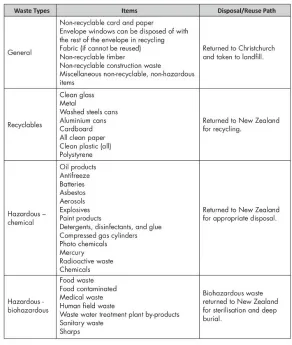
Identified in table 1 from the Antarctica New Zealand Waste Management Handbook are the most common types of wastes produced in Antarctica. Hazardous wastes (both biological and chemical) are more reliant on new technologies to improve management and disposal.
[image:21.720.387.679.45.390.2]This report will focus on wastewater treatment and clean-up of contaminated sites. New technologies and modifications to old technologies are proving to be successful in reducing the impacts of these wastes.
http://www.antarctica.gov.au
Wastewater includes both greywater (the resultant water from activities such as showering, laundry and kitchen) and blackwater (sewage) (Antarctica New Zealand, 2015). It is an inevitable outcome of base settlement and needs to be dealt with in an efficient and discrete manner to reduce the direct footprint on the environment. Common methods for dealing with wastewater in Antarctica at present include biological treatment of wastewaters, incineration, or maceration and disposal (Gröndahl et al., 2009).
A number of stations have installed biological systems for treating wastewater, however methods vary among bases. Appendix one (taken from Tarasenko, 2009) gives a few examples of where biological systems are used and what the differences are. Scott Base, the New Zealand station uses aeration, where wastewater is treated in a chamber with a bacterial biofilm and is then disinfected by UV-radiation.
This is a common method however the process has evolved to be even more efficient and achieve better water-recycling results.
Membrane Bioreactor (MBR) offers an alternative technology to biological treatment systems. Not only does the MBR offer a smaller footprint, higher biomass concentration and fewer phases involved developments have been made by National Aeronautics and Space Administration (NASA) to upgrade the technology for use on long-duration space missions (Arévalo et al., 2009). The end goal is to be able to recycle 100% of the wastewater produced to a drinkable standard (Zhang et al., 2008).
Further technological developments of the MBR include a submerged MBR which combines the biologically activated sludge process with physical separation by membrane, avoiding the need for an intermediate or second purifying step (Arévalo et al., 2009).
“The British Antarctic Survey is
at the forefront of innovation in
the study of human impact on
the planet. As a company
dedicated to lowering this
impact, their activities align
closely with Veolia’s own global
strategy to preserve resources
and lower carbon emissions
with an aim of achieving a
circular economy. Our
continuing support for this work
will help them maintain their
unique work environment and
protect the Polar regions.”
Estelle Brachlianoff, Senior
Executive Vice-President Veolia
UK & Ireland.
(Messenger, 2017)
Turning wastewater into energy is an even better solution to the wastewater problem (Capel, 2010). Waste-to-Energy companies such as Veolia have in fact trialled their technology at British Antarctic Survey’s Rothera Station.
There are a few different methods for turning waste into energy, with Veolia using two main methods: Biogas and Biomass. These differ in the way the energy is produced and harvested. Biogas harvests energy created by microorganisms while biomass is simply the burning of wastes.
Biogas technology has been used extensively in Australia with recent figures published in September 2017 revealing the impressive power generation capabilities of the bioreactor, which is capable of meeting the energy requirements of up to 30,000 Australian homes (Veolia, 2017).
While the use of new technologies for wastewater treatment has the potential to improve efficiency, Antarctica provides a unique set of barriers that these technologies must overcome before they can be implemented. A constant flow of water, at a temperature between 10 and 20 degrees Celsius is required for biological treatment to be successful. This water flow must also remain within certain levels of flow rate for the system to maintain a significant level of treatment.
Clean-up of contaminants is the other major area of waste-management where new technologies could greatly increase the success and efficiency of clean-up.
Sites such as Wilkes and Casey are well known areas of contaminated soils and remediation efforts have been underway for years.
A few technologies are available that would greatly help the clean-up of these sites, and some have already been used in the Antarctic.
The British Antarctic Survey, with the help of an engineering company, have developed a portable hydraulic drum crusher which can easily be dismantled, loaded into a twin otter plane and flown out to remote field depots to crush empty drums (BAS, 2015). This technology is useful for removing abandoned materials such as oil drums, but there is still the question of how to remediate contaminants left behind in the soils.
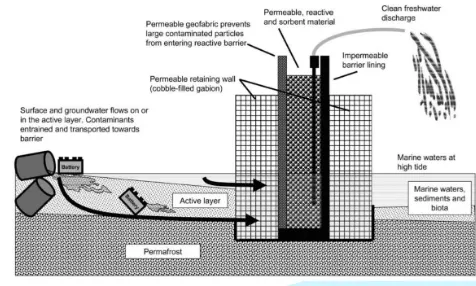
Alternative remediation technologies such as permeable reactive barriers and bioremediation are currently being developed for the Antarctic and bioremediation techniques are increasingly viewed as the most appropriate for cold climate soils (Aislabie et al., 2004). While the Antarctic appears to be an ice-covered desert, high numbers of hydrocarbon degrading microbes have been detected in the coastal areas near contaminated sites (Aislabie et al., 2004). This is ideal for bioremediation technologies such as Permeable Reactive Barriers (PRBs).
Fig. 3.1. above shows how this PRB system works and has been taken from Snape, Morris & Cole et al. (2001).
[image:24.720.384.622.52.195.2]Contaminated Sites
Considered the “First step in a multi-step process used to treat a contaminated site” by Australian Antarctic Divisions’ (AAD) very own remediation specialist Mr Tim Spedding (Pyper, 2014). PRBs control dispersion of non-aqueous phase liquids by channeling them through a treatment system (Filler et al., 2006). The photos below were taken by AAD of their very own PRB treatment system.
Other bio-remediation technologies have been developed and include: bio-piles, bioventing, and bioreactors (Khan et al., 2004). All three of these methods use traditional biodegradation processes however the application of these processes differ. All three systems do require aid via pumping air or heat through the system, or by adding nutrients to catalyse the degradation process. Examples of these can be seen in the following diagrams:
[image:26.720.36.225.195.328.2]Fig. 3.3 Diagramatic explanation of bioremediation processes. (Shujing et al., 2017)
Fig. 3.2 Diagram representing biopile system used for crude oil bioremediation (Christofi & Ivshina, 2002).
[image:26.720.443.682.217.364.2]“through the Antarctic Treaty system we’ll
be able to pass on what we’ve learned to
other nations, so that they can apply it
without having to go through the lengthy
tests and trials we’ve already undertaken”
- Mr Tim Spedding, Australian Antarctic
Division Remediation Specialist
(Pyper, 2014)
Antarctica New Zealand, 2015 The implementation of both wastewater treatment
technologies and technologies for contaminated site clean-ups are restricted by the extreme conditions that Antarctica presents. As previously discussed, wastewater treatment must overcome high variability in population between summer and winter, and extreme cold where pipes can freeze and biological processes can cease.
Section 4
Field and Science
Technologies
Antarctic field science often takes place in isolated environments where contaminants can impact the ecosystem and therefore, the scientific potential. This chapter will discuss potential future technologies which will decrease the environmental footprint created through field science. The technology isolated in this section has been chosen for its potential to impact how field science functions.
On-continent transport
Antarctica was first visited in the early 1800’s, when ships were sail only or sail with engine assistance (Morrell & Capparell, 2011). Once on the continent the primary source of transport tended to be active transport such as walking, skiing, dog sledding and use of livestock with exception of Sir Edmund Hillary in 1958 who used a fuel powered tractor.
Over time technology for transport has evolved with a larger proportion of travel today done through fuel powered vehicles. Current transport options to Antarctica are ship travel as well as air travel on airplanes and helicopters. Evolution of technology has allowed for more diversity in travel. With this comes a wider range of opportunities to reduce fuel consumption. Air travel has been highlighted as being inefficient at carrying heavy masses long distance in comparison to both ships and overland vehicles, while ship travel is slow (COMNAP, 2013; U.S. Antarctic Program, 2010). This has implications for on continent transport in Antarctica.
Due to the significant amount of emissions produced by aircraft fuel, overland fuel powered vehicles have been replacing flights for on continent logistical expeditions (U.S. Antarctic Program, 2010). The overland fuel powered vehicle used by the U.S. Antarctic Program can provide 1.8kg of product for every litre of fuel used, while the airplane used only provided 0.7kg/L of fuel (U.S. Antarctic Program, 2010). Use of overland vehicles instead of an airplane saves more than 473,000 litres of fuel in one South Pole traverse, almost equating to the amount of fuel used in 40 overland traverses (U.S. Antarctic Program, 2010).
Eco-vehicles
Recent interest on new technologies has been paving the way to create more environmentally friendly technologies. In 2010 the U.S. Antarctic programme planned to trial electric trucks at McMurdo Station aimed at increasing vehicle energy efficiency, reducing produced emissions and reducing hazardous material/contaminants such as oil and glycol (U.S. Antarctic Program, 2010). Further developments to eco-vehicles have occurred since then, including wind powered and electric vehicles. One example of each of these is the WindSled and the ‘Antarctica’ model produced by Venturi. Using an eco-vehicle over a ski-plane can save 100 barrels of fuel for every 1200 km travelled (Rosen, 2017). Regular use of the WindSled and Venturi could significantly reduce the carbon footprint of field expeditions.
The importance of vehicle options
As no emissions are produced, the use of the WindSled and Venturi vehicle allowed samples to be obtained with no contamination to the surrounding environment (Inuit WindSled - Greenland Net, 2018; Wysocky, 2015). Using the WindSled, collected samples can be analysed in situ with use of the mobile solar powered laboratory and transported in the storage areas (Inuit WindSled - Greenland Net, 2018). The WindSled can also provide an economical alternative to producing a base which would enable continued Antarctic exploration efforts without large investment (Inuit WindSled - Greenland Net, 2018).
WindSled
Antarctic expeditions:- 2005 - 2006 – Reaching Vostok, the South Pole of inaccessibility - 2011- 2012 – Geographic South Pole
- 2018 - 2019 – Upcoming expedition over 7000km with team of 6.
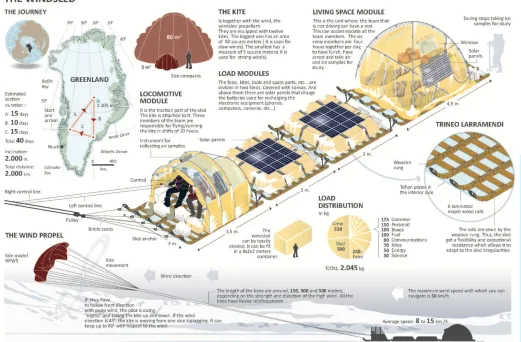
The WindSled is currently able to transport up to 4 tonnes enabling transport of the science team, supplies, equipment and cargo (Inuit WindSled - Greenland Net, 2018). The WindSled has solar panels attached to power an on-board laboratory as well as various on board scientific equipment for testing for atmospheric and snow data (Inuit WindSled - Greenland Net, 2018). Developments in field generation of energy is important for personal use. Small portable wind turbines are currently being created to produce 5 – 15 watts of power, while portable solar panels are commonly already used (Goal Zero, 2018; James Dyson Foundation, 2018). Traverse speed is determined through kite size where 30 sizes are ranging from 5m² to 80m² selected based off wind conditions enabling travel up to 50km/h (WindSled - Greenland Net, 2018). For further information see figure 4.1.
WindSled by Inuit WindSled - Greenland Net (2018)
Figure 4.1.
Capabilities and features of the WindSled
Venturi - The Electric Polar Vehicle
Venturi electric polar vehicle image from Venturi sourced through (Wysocky, 2015)
The Venturi ‘Antarctica’ electric polar vehicle is designed for use by the French Polar Institute to be used as a short distance travel vehicle within 10km of a charging station. The vehicle can reach speeds up to 45km/h and has adaptability through enabling the use of tracks or wheels. The Venturi vehicle is easy to drive and can function in temperatures as low as -70°C (Wysocky, 2015).
This vehicle was designed to enable collection of samples in areas where combustion engines are banned and use of fuel may compromise scientific data such as ice drilling (Wysocky, 2015). Through careful vehicle design, each Venturi can accommodate 5 passengers, although the two-passenger vehicle weighs 2 tonnes without adding the overhead cover to protect passengers.
MinION - Portable DNA Sequencer
These vehicles when paired alongside other eco-friendly technologies, such as the minION can enable scientific development with a small footprint on the environment.
The ability for technology to enable the development of new scientific knowledge is important in Antarctica where conditions can be limiting. The MinION is a handheld DNA sequencer used without electricity or internet. It is able to store DNA sequences on the device or be connected to a laptop for reading of the data (Pennisi, 2017). The MinION provides large potential for field science due to the rapid production of results, diagnosing the bacteria causing urinary tract infections in patients in less than 4 hours (Pennisi, 2016). Although this has beneficial implications for the health and safety of the field team there is also implications for the environment. This information may impact the decision to plane evacuate which would use large amounts of fuel and therefore add emissions which in some cases may not be necessary.
Another significant impact from using the minION is that researchers in the field would be able to get almost real-time DNA results of organisms around them, preventing cross-contamination by moving species as well as enabling further scientific decisions in the field without returning to base (Cali, Kim, Ghose, Alkan & Mutlu, 2017; Pennisi, 2016). This shows the potential of where science could lead and on a low budget as currently the minION is available in a starter kit costing $1000 (Pennisi, 2016). This technology like other new technologies is still being developed to reduce errors which currently occur 5-30% of the time (Hayden, 2015).
Section 5
Data Collection, Transmission and
Communication
There is a trend in both science and technology towards extensive networks of sensors that are able to continuously monitor the world around us (Kitchin, 2014). This sensing can often be achieved in real-time or near-real-time if desired, including data transfer from Antarctica (Bracke, Gonsette, Rasson, Poncelet, & Hendrickx, 2017). As the technology develops it is becoming possible to monitor entire ecosystems, populations, and physical processes (Hampton et al., 2013). The movement towards extensive sensor networks for scientific research and operations have already been identified as opportunities in future technology in Antarctica and the Southern Ocean (National Research Council, 2011).
A downside of such intensive data collection is that the cyber-infrastructure and infrastructure available can become limiting. The collection, transfer, storage and analysis of the data needs to be considered carefully. Reliable, and ideally constant network connections for transmission of data need to be maintained.
It is possible for networks to transfer data despite disruptions but this can come with a loss of the real-time interpretation of the data (Gao, Yu, Luan, & Zhou, 2015). When it comes to science communication the ability to interact ‘live’ via social media and other platforms is often lost if a high-bandwidth connection is not constant and maintained.
Data Collection
The use of remote sensing technology in the Antarctic has become much more important to allow for formation of large-scale images of the polar region and the environmental processes that occur there (Lazzara, Keller, Stearns, Thom, & Weidner, 2003). As fuel use by bases for both power generation and travel is the main source of carbon emissions in Antarctic operations (Tin et al., 2013) opportunities to reduce the use of fuel while still allowing for the gathering of data for science should be explored. The use of Unmanned Autonomous Vehicles and remote sensing presents such an opportunity.
Wireless Sensor-based Online Monitoring
Platform (WSOOP)
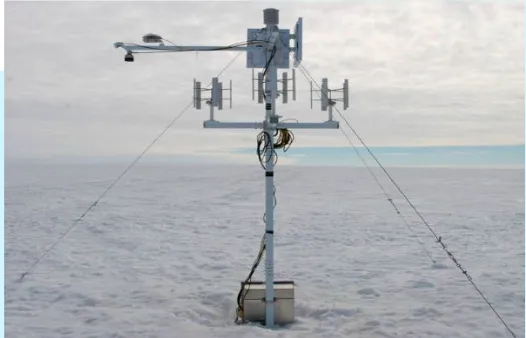
Modern techniques can help acquire environmental data such as the freezing and melting of ice, surface temperature, which can be used in the research of global climate change, Antarctic ice sheet responses, and ice cap formation and evolution (Li et al., 2016). The use of the WSOOP has shown promise for the use of remote sensing stations in validation of environmental data collected from satellites (Li et al., 2016).
[image:39.720.392.655.198.367.2]One of the benefits of this system is that it has been designed to improve universality and extensibility, it is able to measure multiple parameters at the same time, and has a general design to allow for different sensors to be fitted (Li et al., 2016). An argument for greater collaboration between nations is the potential for standardisation of technology use, such as network nodes, to allow for greater versatility and use by different nations (Hart & Martinez, 2015).
Unmanned Autonomous
Vehicles (UAVs)
Increasing the energy efficiency and range of UAVs could lessen the need to have a physical human presence in the field, or at least lessen the need to move around in the field (Bollard-Breen et al., 2015).
The use the “Polar Fox” (Figure 5.1) unmanned aerial vehicle was combined with aerial imagery and GIS spatial mapping to identify and map the extent of cyanobacterial mats in the McMurdo Dry Valleys while also detecting the physical “footprint” of camping sites and walking trails to and from sites that are several years old (Bollard-Breen et al., 2015). The “Jaguar” Autonomous Underwater Vehicle (AUV) (Figure 5.2) shows potential for greater data collection under the sea ice, with 100 kilometre transects being planned (Singh, Maksym, Wilkinson & Williams, 2017). This is demonstrable use of UAVs as powerful tools for both reducing the impact of human activity and the monitoring impacts of human activity.
[image:40.720.449.693.13.178.2]It is not unimaginable that the need for control of data collection and analysing of data could be moved off Antarctica. Remote control could prompt a movement towards more technician and support personnel and lessen the need for scientists and data analysts in Antarctica. The downside of a reduced human presence is that insights into the Antarctic environment that may be gained from personal experiences in field by scientists, technicians, and other field personnel are lost.
[image:40.720.447.682.23.374.2]Figure 5.1 -Polar Fox Unmanned Aerial Vehicle (UAV) (Bollard-Breen et al., 2015)
Data transmission
The evolution of environmental sensing systems using internet connectivity to communicate between each other and directly with the internet. The networks can be arranged in a number of ways to facilitate internet connection (figure 5.3). IoT networks can facilitate interoperability and usability between sensors and should also allow for far more adaptability than a usual sensor network (Hart & Martinez, 2015).
The hardware that needs to be supported is energy intensive in comparison to data loggers and wireless sensors. This allows for direct storage of data to the cloud and potentially “real-time” processing and application of web-based technologies (Hart & Martinez, 2015). The pairing networks of sensors with intelligent software can allow for systems to ‘react’ to changes in what is being monitored, such systems can include warning systems, power usage and generation etc. Improving the efficiency of systems can lead to a reduction in the carbon footprint and environmental footprint in Antarctica.
The Internet of Things is already in use in Antarctica. SigFox communications company teamed up with Belgium’s Princess Elisabeth Research Station to install a Low-Power Wide-Area Network with a radius of 40 km for staff safety
on the ice (‘How we helped scientists in Antarctica’, 2016). Figure 5.3: Adapted from (Hart & Martinez, 2015)– The diagram shows different families of Internet of Things systems. At the core there are higher connectivity and power availability but these properties decrease toward the periphery.
[image:41.720.432.695.71.353.2]A ‘selfie’ taken at McMurdo Station in Antarctica, made its way to the space station on Nov. 20 using Disruption Tolerant Networking (DTN). NASA engineers Mark Sinkiat, Peter Fetterer and Salem El-nimri held up a picture of Vint Cerf, a distinguished visiting scientist at NASA’s Jet Propulsion Laboratory who helped develop the technology.
Credits: NASA
Disruption Tolerant Networking
A data networking protocol that allows for transfer of data across a network (between nodes) that are prone to disruptions or delays between the nodes accessibility. The data is moved using a “store and forward” approach along the network as connectivity becomes available (Gao et al., 2015). Ultimately this allows for more flexible arrangement of networks, the type of flexibility that may be useful within extreme environments.
Communicating Data
The use of social media to communicate the science and experience of conservation has been identified as a pivotal dimension for digital conservation (Arts, van der Wal, & Adams, 2015). ‘Digital conservation’ is an umbrella term for the use of digital technology in nature conservation. Social media allows for the transfer of experiences, images and videos often in a spectacular manner but this can bring with it a risk of obscuring the scientific and conservation purposes the media is generated to promote (Verma, van der Wal, & Fischer, 2015).
The Cyberforest live sound system has been described as an inspiring example of digital conservation (Saito et al., 2015; van der Wal & Arts, 2015). Sound recordings streamed live from remote and inaccessible areas of Japan were used to monitor birds and in combination with the social media platform Twitter, were used to facilitate public and expert participation (Saito et al., 2015). It is not difficult to imagine that live 360 degree video and sound of an Adélie penguin colony would be a fantastic experience to use for public engagement.
https://technology.ie/big-data-looks-like/ provided the image
International Collaboration
This report has shown the possibilities and potential of new technology to reduce the human impact and carbon footprint of NAP.
The barriers mentioned in section 1 included cost, isolation and environmental factors. Cost is an unavoidable result of operating in the most remote place in the world. The obvious answer would be to increase funding for NAP considering the importance of the science conducted in Antarctica. Unfortunately, increasing funding is not feasible in the current political climate where science funding is currently being cut (Wadman, 2013). New thinking may be required to find alternative solutions to the funding problem. A benefit of some of the technologies looked at in the report is that they can reduce costs. Globally renewable energy is becoming more accessible as the cost of production goes down.
Fuel is a substantial cost for NAPs and running bases off renewable energy can help with that. Currently waste is being transported back to their respective countries for processing, the ability to process waste on-site can reduce emissions from transportation, the physical impact of waste and provide a potential energy source. It is also possible to cut costs in field science through changing current systems.
There are some examples of nations working together including the jointly operated Concordia Research Station run by the Italians and French; The South African program promote their facilities at the SANAE IV station and encourage fellow scientists to make use of their facilities, however, these are the exception (ASOC, 2006; Sánchez and Birgit, 2013). The opportunity to truly share stations would have multiple benefits for the NAPs including: shared costs, reducing the human impact, reducing carbon emissions and increasing the resources for science (ASOC 2004; ASOC, 2006). Additionally, increased cooperation and share stations would fulfill the cooperation principles of the treaty and has the potential to inspire more cooperation (ASOC, 2006; Tin et al., 2013; Kennicutt et al., 2015).
The International Geophysical Year which prompted the Antarctic Treaty and the spirit of cooperation and peace showed the amazing heights that can be reached if international collaboration is fully realized (Summerhayes, 2008). In the age of new technology, we believe it is time to revisit the spirit of international collaboration and move towards a cleaner, more collaborative and forward focussed based Antarctic future.
Reference List
Aislabie, J., Balks, M., Foght, J. and Waterhouse, E., (2004), Hydrocarbon Spills on Antarctic Soils: Effects and Management, Environmental Science and Technology no. 5, (1265 – 1274)
Antarctic Treaty Secretariat. (2011). Parties. Retrieved January 4, 2018, from http://www.ats.aq/devAS/ats_parties.aspx?lang=e
Arts, K., van der Wal, R., & Adams, W. M. (2015). Digital technology and the conservation of nature. Ambio, 44(Suppl 4), 661–673. https://doi.org/10.1007/s13280-015-0705-1
Australia, 2010 "Topic Summary: Footprint" IP48 submitted to the XXXIII Antarctic Treaty Consultative Meetings, Punta del Este, Uruguay
Ayodele, T. R., & Ogunjuyigbe, A. S. O. (2016). Wind energy potential of Vesleskarvet and the feasibility of meeting the South African׳s SANAE IV energy demand. Renewable and Sustainable Energy Reviews, 56(Supplement C), 226–234. https://doi.org/10.1016/j.rser.2015.11.053
Binner, A. (2015). Just how green is wind power? Retrieved January 11, 2018, from https://phys.org/news/2015-03-green-power.html
Bollard-Breen, B., Brooks, J. D., Jones, M. R. L., Robertson, J., Betschart, S., Kung, O., … Pointing, S. B. (2015). Application of an unmanned aerial vehicle in spatial mapping of terrestrial biology and human disturbance in the McMurdo Dry Valleys, East Antarctica. Polar Biology, 38(4), 573–578.
https://doi.org/10.1007/s00300-014-1586-Bracke, S., Gonsette, A., Rasson, J., Poncelet, A., & Hendrickx, O. (2017). Automated observatory in Antarctica: real-time data transfer on constrained networks in practice. Geoscientific Instrumentation, Methods and Data Systems, 6(2), 285–292. https://doi.org/10.5194/gi-6-285-2017
British Antarctic Survey, (2015), Waste Disposal from Antarctica, retrieved from:
https://www.bas.ac.uk/about/antarctica/environmental-protection/waste-pollution-and-clean-up-in-antarctica/waste-disposal-from-antarctica (accessed on 8/10/2018)
Capel, C, (2010, March 1), Innovations in waste: as waste management climbs the political and environmental agenda, bright sparks in the industry respond with innovation, Waste Management World, retrieved from: https://waste-management-world.com/a/1-innovations-in-waste
de Christo, T. M., Fardin, J. F., Simonetti, D. S. L., Encarnação, L. F., & de Alvarez, C. E. (2016). Design and analysis of hybrid energy systems: The Brazilian Antarctic Station case. Renewable Energy, 88, 236–246. https://doi.org/10.1016/j.renene.2015.11.014
Christoff, P. (2016). The promissory note: COP 21 and the Paris Climate Agreement. Environmental Politics, 25(5), 765–787.
Christofi, N. and Ivshina, I.B., (2002), Microbial surfactants and their use in field studies of soil remediation, Journal of Applied Microbiology 93, (915-929)
Council of Managers of National Antarctic Programs (COMNAP) (2013). “Cost/Energy Analysis of National Antarctic Program Transportation.” IP32 submitted to the XXXVI Antarctic Treaty Consultative Meetings. Brussels, Belgium,Cool Antarctica. (2001). The Ships of the Antarctic.
Drawdown. (n.d.). Retrieved January 8, 2018, from http://www.drawdown.org/
Egger, F, (2004, Novemebr 8th) Antarctica Research Station adds sewage treatment plant, installs innovative sewage grinders on head, retrieve from:
https://www.wwdmag.com/channel/casestudies/antarctica-research-station-adds-sewage-treatment-plant-installs-innovative-sewage
Filler, D.M., Reynolds, C.M., Snape, I., Daugulis, A.J., Barnes, D.L., and Williams P.J., (2006), Advances in engineered remediation for use in the Arctic and Antarctic, Polar Record 42, (111-120)
Foundation, I. P. (2016). Princess Elisabeth Antarctica. Retrieved January 4th, 2018, from Antarctic Stations: http://www.antarcticstation.org Gao, L., Yu, S., Luan, T. H., & Zhou, W. (2015). Delay Tolerant Networks. Cham: Springer International Publishing. Retrieved from
http://link.springer.com/10.1007/978-3-319-18108-0
Goal Zero. (2018). Goal Zero. Retrieved from Portable Solar Power: http://www.goalzero.com/portable-solar-power/
Gröndahl, F., Sidenmark, J. and Thomsen, A., (2009) Survey of wastewater disposal practices at Antarctic research stations, Polar Research,28, (298-306). Hampton, S. E., Strasser, C. A., Tewksbury, J. J., Gram, W. K., Budden, A. E., Batcheller, A. L., … Porter, J. H. (2013). Big data and the future of ecology. Frontiers in
Ecology and the Environment, 11(3), 156–162. https://doi.org/10.1890/120103
Hayden, E. C. (2015). Pint-sized DNA sequencer impresses first users. Nature, 521(7550), 15-16.
How we helped scientists in Antarctica. (2016, September 23). Retrieved 11 January 2018, from https://sigfoxfoundation.org/how-we-helped-scientists-in-antarctica/
Inuit WindSled - Greenland Net . (2018). 2011 - 2012 WINDSLED Acciona Antarctica Expedition . Retrieved from Inuit WindSled: http://greenland.net/windsled/ws-2011-2012-acciona-antarctica-expedition/
Inuit Windsled - Greenland Net. (2018). The WindSled. Retrieved from Inuit WindSled: http://greenland.net/windsled/ws/
Isento, J., Rodrigues, J., Dias, J., C. G. Paula, M., & Vinel, A. (2013). Vehicular Delay-Tolerant Networks?A Novel Solution for Vehicular Communications (Vol. 5). James Dyson Foundation . (2018). Micro Wind Turbine. Retrieved from James Dyson Award: https://www.jamesdysonaward.org/projects/micro-wind-turbine/ Juang, P., Oki, H., Wang, Y., Martonosi, M., Peh, L. S., & Rubenstein, D. (2002). Energy-efficient Computing for Wildlife Tracking: Design Tradeoffs and Early
Experiences with ZebraNet. In Proceedings of the 10th International Conference on Architectural Support for Programming Languages and Operating Systems (pp. 96–107). New York, NY, USA: ACM. https://doi.org/10.1145/605397.605408
Kennicutt, M. C., Chown, S. L., Cassano, J. J., Liggett, D., Peck, L. S., Massom, R., … Sutherland, W. J. (2015). A roadmap for Antarctic and Southern Ocean science for the next two decades and beyond. Antarctic Science, 27(01), 3–18. https://doi.org/10.1017/S0954102014000674
Kennicutt, M. C., Kim, Y. D., Rogan-Finnemore, M., Anandakrishnan, S., Chown, S. L., Colwell, S., … Yang, H. (2016). Delivering 21st century Antarctic and Southern Ocean science. Antarctic Science, 28(06), 407–423. https://doi.org/10.1017/S0954102016000481
Khan, F., Husain, T., and Hejazi, R., (2004), An overview and analysis of site remediation technologies, Journal of Environmental Management 71, (95-122) Kitchin, R. (2014). Big Data, new epistemologies and paradigm shifts. Big Data & Society, 1(1), 205395171452848. https://doi.org/10.1177/2053951714528481 Klee, R.J., (2001), Industrial metabolism on ice: a case study of industrial materials flows and environmental management alternatives for Scott base, New
Zealand’s Antarctic research station, Journal of the Royal Society of New Zealand, 31, (393-409)
Li, X., Cheng, X., Yang, R., Liu, Q., Qiu, Y., Zhang, J., … Zhao, L. (2016). Validation of Remote Sensing Retrieval Products using Data from a Wireless Sensor-Based Online Monitoring in Antarctica. Sensors (Basel, Switzerland), 16(11). https://doi.org/10.3390/s16111938
Messenger, B (2017, June, 16th) Veolia Deal to Treat Waste from British Antarctic Survey at UK Waste to Energy & Recycling Facilities, Retrieved from:
https://waste-management-world.com/a/veolia-deal-to-treat-waste-from-british-antarctic-survey-at-uk-waste-to-energy-recycling-facilities
Morrell, M., & Capparell, S. (2011). Shackleton's way: leadership lessons from the great Antarctic explorer. Hachette UK.
Morrissey, A.J., and Browne, J., (2004), Waste management models and their application to sustainable waste management, Waste management 24,
(297-308)
Mussard, M. (2017). Solar energy under cold climatic conditions: A review. Renewable and Sustainable Energy Reviews, 74(Supplement C), 733–745. https://doi.org/10.1016/j.rser.2017.03.009
National Research Council. (2011). Future Science Opportunities in Antarctica and the Southern Ocean. Washington, DC: The National Academies Press. Retrieved from https://www.nap.edu/read/13169/chapter/2
O’Doherty, K., & Einsiedel, E. (2013). Public Engagement and Emerging Technologies. Vancouver, CANADA: UBC Press. Retrieved from http://ebookcentral.proquest.com/lib/canterbury/detail.action?docID=3412828
Oberhaus, D. (2017, November 29). This Antarctic Selfie Is Helping Build the Interplanetary Internet. Retrieved 6 January 2018, from https://motherboard.vice.com/en_us/article/pa374m/antarctica-dtn-selfie-interplanetary-internet-nasa
Olivier, J. R., Harms, T. M., & Esterhuyse, D. J. (2008). Technical and economic evaluation of the utilization of solar energy at South Africa's SANAE IV base in Antarctica. Renewable Energy, 33(5), 1073-1084.
Ong, T. (2017, December 1). Elon Musk’s giant battery is now delivering power to South Australia. Retrieved January 8, 2018, from https://www.theverge.com/2017/12/1/16723186/elon-musk-battery-launched-south-australia
Pennisi, E. (2016, February 19). Pocket DNA sequencers make real-time diagnostics a reality. Science, 351(6275), pp. 800-801. doi:10.1126/science.351.6275.800 Pennisi, E. (2017, May 12). Pocket-sized sequencers start to pay off big. Science, 356(6338), pp. 572-573. doi:10.1126/science.356.6338.572
Pyper, W. (2014), Cleaning up Fuel spills in Antarctica, Australian Antarctic Magazine, 27, retrieved from:
Rosen, J. (2017). Sustainability: A greener culture. Nature, 546(7659), 565-567.
Saito, K., Nakamura, K., Ueta, M., Kurosawa, R., Fujiwara, A., Kobayashi, H. H., … Nagahama, K. (2015). Utilizing the Cyberforest live sound system with social media to remotely conduct woodland bird censuses in Central Japan. Ambio, 44(S4), 572–583. https://doi.org/10.1007/s13280-015-0708-y
Sampathkumar, M. (2018). Donald Trump says US could “go back” into Paris climate agreement. Retrieved January 12, 2018, from
http://www.independent.co.uk/news/world/americas/us-politics/trump-paris-climate-deal-agreement-us-go-back-latest-a8152531.html
Scientific Committee on Antarctic Research (SCAR). (2018). Antarctic Digital Database Map Viewer. Retrieved from http://www.add.scar.org/
Singh, H., Maksym, T., Wilkinson, J., & Williams, G. (2017). Inexpensive, small AUVs for studying ice-covered polar environments. Science Robotics, 2(7), eaan4809. https://doi.org/10.1126/scirobotics.aan4809
Snape, I., Morris, C.E. and Cole, C.M. (2001). The use of permeable reactive barriers to control contaminant dispersal during site remediation in Antarctica, Cold Regions Science and Technology 32, (157-174)
Summerhayes, C. P. (2008). International collaboration in Antarctica: the International Polar Years, the International Geophysical Year, and the Scientific Committee on Antarctic Research. Polar Record, 44(4), 321–334.
Tarasenko, S. (2009). Wastewater treatment in Antarctica, (p21-28), retrieved from: https://ir.canterbury.ac.nz/handle/10092/14196 (2018, January 9th)
The Global Footprint Network. (2018). Ecological Footprint. Retrieved January 3, 2018, from https://www.footprintnetwork.org/our-work/ecological-footprint/
There Will Be Netflix on Mars. (2016, March 1). Retrieved 6 January 2018, from
http://www.popularmechanics.com/technology/infrastructure/a19469/there-will-be-netflix-on-mars/
Tin, T., Liggett, D., Maher, P. T., & Lamers, M. (2013). Antarctic futures: human engagement with the Antarctic environment. Springer Science & Business Media.
Tin, T., Sovacool, B. K., Blake, D., Magill, P., El Naggar, S., Lidstrom, S., … Berte, J. (2010). Energy efficiency and renewable energy under extreme conditions: Case studies from Antarctica. Renewable Energy, 35(8), 1715–1723. https://doi.org/10.1016/j.renene.2009.10.020
van der Wal, R., & Arts, K. (2015). Digital conservation: An introduction. Ambio, 44(4), 517–521. https://doi.org/10.1007/s13280-015-0701-5
Veolia, (2017), Woodlawn Bioreactor, NSW, retrieved from: https://www.veolia.com/anz/papakura/our-services/our-facilities/landfills/woodlawn-bioreactor-facility, accessed on 8/01/2018
Verma, A., van der Wal, R., & Fischer, A. (2015). Microscope and spectacle: On the complexities of using new visual technologies to communicate about wildlife conservation. Ambio; Stockholm, 44, 648–660. https://doi.org/http://dx.doi.org.ezproxy.canterbury.ac.nz/10.1007/s13280-015-0715-z
Wiedmann, T., & Minx, J. (2008). A definition of “carbon footprint.” Ecological Economics Research Trends, 1, 1–11.
Winkelmann, R., Levermann, A., Ridgwell, A., & Caldeira, K. (2015). Combustion of available fossil fuel resources sufficient to eliminate the Antarctic Ice Sheet. Science advances, 1(8), e1500589.
Wysocky, K. (2015, April 24). Autos - Venturi. Retrieved from BBC: http://www.bbc.com/autos/story/20150423-venturis-antarctica-is-a-sports-car-for-the-snowcat-set Zhang, K., Choi, H., Dionysiou, D. and Oerther, D., (2008), Application of Membrane Bioreactors in the Preliminary Treatment of Early Planetary Base
Appendix 1:
Modification on Table in Tarasenko, S (2009), Wastewater treatment in Antarctica, (p21-28),
retrieved from: https://ir.canterbury.ac.nz/handle/10092/14196 (2018, January 9th)
Name of Station Country Method of Treatment Description of Technology
Bellinghausen Russia Biological and UV-Sterilization
The wastewater treatment plant EOS‐15 was used at the station. A new biological plant “Astra‐20” and a
UV‐steriliser for the station are under construction (in 2009/2010 season).
Davis Australian Mechanical and Biological All human waste and waste water from the new station complex passes through the Waste Treatment Building, where it receives primary and secondary treatment in a two‐stage rotating biological contactor (RBC) before discharge of the effluent through an outfall into the sea
Jubany Argentina Biological and UV-Sterilisation
Grey and black waters are treated in biological treatment plant; effluent is treated with ultraviolet sterilization before release into the sea. Sludge is dehydrated and then removed from Antarctica. The sewage treatment plant is an AQUAMAR System (Germany)
Maitri India Mechanical and Biological The station is equipped with incinerator toilet facilities. Two modules (four toilets) are located in the summer station area, and five single modules are located in the main station building. The incineration temperature is 600°C. Solid human waste is incinerated once a day. The ashes are collected in drums and transported out of the Antarctic Treaty area once a year.
The grey water is fed into a rotational biological contractor. The treatment involves three stages: a primary settling basin, followed by a bio‐digester and a final settlement basin. The settled waste material is incinerated.
McMurdo USA Mechanical and Biological and Disinfection
The Wastewater Treatment Plant uses conventional methods of solids removal (clarification) and microbial digestion. The system is capable of treating 495,900 litres per day of domestic wastewater. The four major treatment components are an anoxic zone, an aerobic zone, clarification, and disinfection. These four components
Neumayer Germany Biological and UV-Sterilisation
During the season 1995/96 a sewage treatment plant was installed at Neumayer Station. This plant was designed in a way that it only requires electric energy and heat energy of the station to be able to clarify the waste water. The entire system of waste water and sludge treatment is installed in a 20 ft container. The waste heat of the diesel generators is used to keep the container at a temperature of +15°C and to dry the sludge. The sewage is collected in a level regulated tank.
rom that tank water is turned out by a screw‐spindle pump through a pipe to the sewage treatment plant over a distance of about 60 m. There the sewage is purified in a biological process. Then the clarified water is sterilized by UV‐rays and pumped through a pipe to the dump in the shelf ice which is located approximately 100 m away from the station.
Rothera Britain Biological and UV-Sterilisation
Untreated sewage has been released into the sea since the base opened in 1976. In February 2003 a submerged aerated biological filter sewage treatment plant (Hodge Separators Ltd) was commissioned at Rothera. The produced sludge is pressed,
dewatered and bagged for shipment to UK for disposal. The effluent water is treated under ultraviolet light and discharged into the bay
Scott Base New Zealand