Original Article
Analysis of high-risk factors and effect of early
intervention on preterm infant neurodevelopment
Fang He1, Qiu-Ping Li2, Nan-Ping Li1, Li Yao1, Xiu-Wei Ma2, Zhi-Chun Feng2
1Children Health Clinic, Army General Hospital Affiliated Bayi Children’s Hospital, Beijing 100071, China; 2Army
General Hospital Affiliated Bayi Children’s Hospital, Beijing 100071, China
Received June 27, 2016; Accepted September 5, 2016; Epub March 15, 2017; Published March 30, 2017
Abstract: Objective: This study aims to determine the influence of high-risk factors and the effect of early interven
-tion on abnormal neurodevelopmental outcomes in preterm infants with certain risk factors. Methods: The outcome of neurodevelopment was confirmed by Gesell scores. Associations between high-risk factors and neurodevelop
-mental outcome were examined by chi-square test and logistic-regression analysis. The effect of early intervention on the neurodevelopmental outcome of preterm infants with certain risk factors was determined by two indepen -dent sample t-tests. A P<0.05 was considered statistically significant. Results: We found that both maternal age
(OR: 25.477; 95% CI: 4.870-133.290; P<0.001) and education level (OR: 0.287; 95% CI: 0.120-0.686; P=0.005)
were significant prenatal risk factors for abnormal neurological outcomes. Significant perinatal risk factors that were identified included gestational diabetes (OR: 0.127; 95% CI: 0.022-0.752; P=0.023), preeclampsia (OR: 54.405; 95% CI: 12.442-237.888; P<0.001) and meconium (OR: 38.260; 95% CI: 10.935-133. 864; P<0.001). Significant postnatal risk factors included gestational age (OR: 9.170; 95% CI: 2.454-34.265; P=0.001), birth weight (OR: 20.960; 95% CI: 4.285-102.519; P<0.001) and multiple birth (OR: 114.853; 95% CI: 13.209-998.612; P<0.001).
The DQ value in the early intervention group was significantly higher than in the non-early intervention group for all five aspects of the Gesell score (P<0.05). Conclusions: Maternal age and educational level, gestational diabetes
preeclampsia, meconium, gestational age, birth weight and multiple births are risk factors for abnormal neurode
-velopmental outcomes among preterm infants. A positive effect of early intervention was identified on the neurode
-velopmental outcomes of preterm infants with certain risk factors.
Keywords:Early intervention, high-risk factors, neurodevelopmental outcomes, preterm infants
Introduction
The 2012 World Health Organization (WHO) official data revealed that the number of global preterm infants has reached 15 million cases annually, which accounts for 10% of the total number of neonates. China ranks second in the world for the number of preterm infant cases. Although the survival rates of preterm infants have progressively increased in recent years, the 12-32% prevalence of major neurodevelop-mental handicaps in surviving preterm children represents a growing public health concern [1, 2]. Thus, survival is not an adequate measure of success in infants who remain at high risk for neurodevelopmental morbidities. More atten-tion should be given on primary and even long-term neurodevelopmental outcomes.
very important. Population-based studies sug-gest that low birth weight and small sug-gestational age increase the prevalence of CP [5]. Birth asphyxia such as the 5-minute Apgar score was previously considered to be the most common etiology of CP. Furthermore, some published studies have focused on preterm infants with a high risk of CP due to bronchopulmonary dys-plasia (BPD), retinopathy of prematurity (ROP), and intraventricular hemorrhage (IVH) [6, 7]. Moreover, previous studies have identified sev-eral high-risk factors for the development of CP. However, these studies focused on the inci-dence of CP, and were limited by either a small sample size or the absence of statistical signifi-cance. In this study, the investigators aimed to observe the incidence of its abnormal neurode-velopmental outcome (pre-CP) and high risk factors.
Another fundamental question is whether these children would benefit from being identi-fied earlier and receiving specific, early inter-vention. Various early intervention (EI) strate-gies have been developed to improve long-term outcomes. Fredrik Serenius observed 1,011 infants born before 27 completed gestational weeks, and found that among children born extremely preterm and receiving active perina-tal care, 73% of them had mild or no disability, and neurodevelopmental outcome improved with each week of gestational age [8]. In ano- ther study, Arne Ohlsson assessed the effec- tiveness of the Newborn Individualized Deve- lopmental Care and Assessment Program (NIDCAP) through a systematic review and meta-analyses of randomized controlled trials that included 627 preterm infants; and revealed that there was no evidence to prove that NIDCAP improved long-term neurodevelopmen-tal or short-term medical outcomes [9]. Hence, in this study, we analyzed 1,337 pre-term infants at the prenatal, perinatal and post-natal periods to determine the relationship between certain potential risk factors and the incidence of abnormal neurodevelopmental outcomes. At the same time, we focused on the role of early intervention on the neurodevelop-mental outcome of preterm infants with certain risk factors to provide precise evidence for the promotion of the neurodevelopment of preterm infants.
Methods
Subjects and ethics
From 2010 to 2012, a total of 2,374 preterm infants were discharged from Bayi Children’s Hospital and received follow-up examinations. Among these infants, 1,027 infants who only had one follow-up were excluded from the study. Finally, 1,337 preterm infants were enrolled into this study. These infants were within the gestational age of 26-36 weeks, and their birth weight was within 650-2350 g. Furthermore, among these 1,337 preterm infants, 823 infants had no major neurological disability (case group); and the remaining 514 infants had abnormal developmental quotients (DQs, <75; control group). Infants in the control group were matched for age, gender and pa- rental educational and occupational status. A complete neuropsychological profile was con-ducted for each infant by assessing parame-ters from the time of discharge until two years of age.
Written informed consent was obtained from all guardians of these patients, and the study pro-tocol was approved by the Ethics Committee of our hospital.
Neurodevelopment evaluation
Neurodevelopmental outcomes were qualita-tively defined using Gesell developmental schedules including adaptive, gross motor, fine motor, language comprehension, and expres-sion and personal social parameters [10]. Preterm infants were normally assessed at 18 months corrected age.
Early intervention methods
Early intervention methods that were referred to NIDCAP intervention after discharge were reviewed. NIDCAP consisted of nutrition and feeding guidance, as well as developmental guidance for gross motor, fine motor and adap-tive parameters; which include a rich environ-ment for early intelligence developenviron-ment, tactile stimulation by massage, skin and physical touch, and attention development training [11]. Statistical analysis
Table 1. Univariate analysis for high risks
Variable Gesell normal Gesell abnormal Statistic P
Prenatal risks
Maternal age
<25 163 113 -13.427# <0.001
25-35 171 350
>35 489 51
Maternal educational level
Illiterate 2 26 -8.824# <0.001
Primary school 199 21
High school 74 20
College 469 337
Graduate 79 110
History of adverse pregnancy
No 680 409 1.951* 0.162
Yes 143 105
Perinatal risks Gestational diabetes
No 454 383 50.599* <0.001
Yes 369 131
Preeclampsia/pregnancy-induced hypertension
No 771 41 -30.895# <0.001
I 38 201
II 14 272
Maternal fever
No 592 320 -4.311# <0.001
<38 171 110
38-39 40 58
>39 20 26
Rupture of membrane -27.424# <0.001
No 680 44
<24 h 136 257
24-48 1 100
>48 6 113
Natural delivery
No 540 160 150.842* <0.001
Yes 283 354
Cesarean delivery
No 283 354 150.842* <0.001
Yes 540 160
Meconium
No 641 2 -31.134# <0.001
I 172 77
II 0 230
III 10 205
Tight nuchal cord
No 517 299 2.874* 0.09
Yes 306 215
Sex
Male 599 199 152.602* <0.001
Female 224 315
Gestational age
32-37 774 57 -30.118# <0.001
28-32 45 377
<28 4 80
Birthweight
>2500 184 10 -29.260# <0.001
1500-2500 601 30
1000-1500 35 437
<1000 3 37
5-minute Apgar score <7
No 565 254 49.324* <0.001
Yes 258 260
Neonatal seizures
No 771 479 0.125* 0.723
Yes 52 35
Fraction of inspired oxygen 1st 48 h
No 769 239 375.781* <0.001
Yes 54 275
Intraventricular hemorrhage
No 795 252 -20.670# <0.001
I 24 124
II 4 61
III 0 77
Retinopathy of prematurity
No 578 387 -0.776# 0.438
I 238 71
II 7 22
III 0 34
BPD
No 769 224 -20.772# <0.001
I 48 117
II 5 109
III 1 64
Multiple births
No 817 233 546.070* <0.001
Yes 6 281
#Wilcoxon rank sum test, statistic: Z; *chi-square test, statistic: chi-square.
medical files for accuracy. Chi-square test and logistic regression analysis were performed to assess associations with high-risk factors and abnormal neurodevelopmental outcomes, and statistical significance was determined using Wald 2 or F tests. Results from comparisons between cases and controls were presented as odds ratios (OR) with 95% confidence intervals (95% CI). Student’s t-test for two independent
samples was performed to assess the influ-ence of early intervention on preterm infants with certain risk factors. P<0.05 was consid-ered statistically significant.
Results
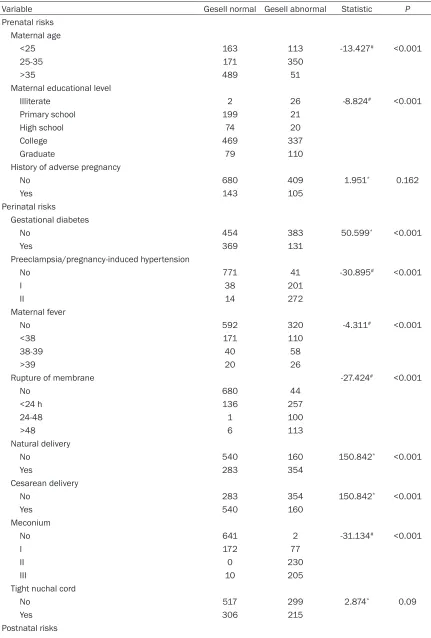
these were classified into three groups: prena-tal, perinatal and postnatal risks (Table 1) [12, 13].
Analysis of prenatal risk factors on abnormal neurodevelopmental outcomes
There was a significant relationship between maternal age/educational level and neurodev-lopment outcomes. Logistic regression analy-sis revealed the following: OR: 25.477, 95% CI: 4.870-133.290, P<0.001; OR: 0.287, 95% CI: 0.120-0.686, P=0.005; and no significant rela-tionship was identified between the outcome and history of adverse pregnancy (K=1.951, P=0.162). These results indicate that a higher maternal educational level was associated with better neurodevelopmental outcome, while a maternal age within 25-35 years old was more related with abnormal neurodevelop-mental outcome.
Analysis of perinatal risk factors on abnormal neurodevelopmental outcomes
Univariate analysis revealed that all perinatal risk factors (P<0.001), except the tight nuchal cord (K=2.874, P=0.09), had significant asso-ciations with neurodevelopmental outcome. However, subsequent logistic regression
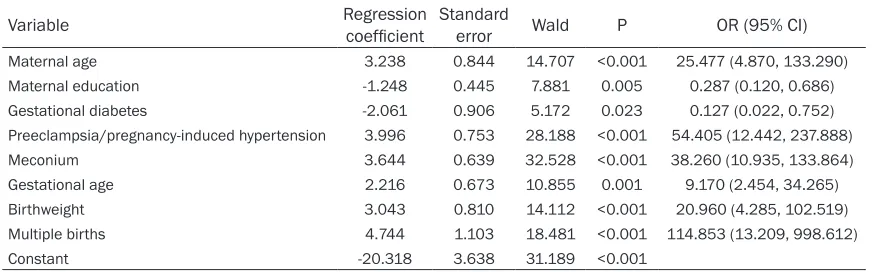
analy-sis revealed that only gestational diabetes (OR: 0.127; 95% CI: 0.022-0.752; P=0.023), pre-eclampsia (OR: 54.405; 95% CI: 12.442-237.888; P<0.001) and meconium (OR: 38.260; 95% CI: 10.935-133.864; P<0.001) were high-risk factors for abnormal neurodevel-opmental outcomes. There was no obvious effect of maternal fever, rupture of membrane and delivery method by logistic regression anal-ysis (P>0.10).
Analysis of postnatal risk factors on abnormal neurodevelopmental outcomes
[image:5.612.89.528.85.221.2]Table 1 shows the postnatal risk factors that were assessed in this study. It was found that gestational age (OR: 9.170; 95% CI: 2.454-34.265, P=0.001), birth weight (OR: 20.960; 95% CI: 4.285-102.519, P<0.001) and multiple births (OR: 114.853; 95% CI: 13.209-998.612; P<0.001) were significant risk factors for abnor-mal neurodevelopmental outcomes (Table 2). In addition, infants with younger gestational age and lower birth weight were more likely to have abnormal neurodevelopmental out-comes. Gender, neonatal seizures, the fraction of inspired oxygen during the first 48 hours, a five-minute Apgar score of <7, as well as ROP, BPD and IVH, were not significant risk factors. Table 2. Logistic-regression analysis
Variable Regression coefficient Standard error Wald P OR (95% CI)
Maternal age 3.238 0.844 14.707 <0.001 25.477 (4.870, 133.290)
Maternal education -1.248 0.445 7.881 0.005 0.287 (0.120, 0.686)
Gestational diabetes -2.061 0.906 5.172 0.023 0.127 (0.022, 0.752) Preeclampsia/pregnancy-induced hypertension 3.996 0.753 28.188 <0.001 54.405 (12.442, 237.888)
Meconium 3.644 0.639 32.528 <0.001 38.260 (10.935, 133.864)
Gestational age 2.216 0.673 10.855 0.001 9.170 (2.454, 34.265)
Birthweight 3.043 0.810 14.112 <0.001 20.960 (4.285, 102.519)
Multiple births 4.744 1.103 18.481 <0.001 114.853 (13.209, 998.612)
Constant -20.318 3.638 31.189 <0.001
[image:5.612.87.524.288.339.2]Variable selection: stepwise regression. Variables included criteria were P<0.05, and excluded criteria were P>0.10. Univariate analysis of P<0.4 variables as candidate variables into logistic regression. Considering whether vaginal delivery and cesareandelivery are the same cocept, we choose keep cesarean delivery.
Table 3. The DQ value of two groups with certain high-risk factors
Group N Adaptive Gross motor Fine motor Language Personal social
Early intervention group 362 86.09 ± 1.543* 91.72 ± 1.849* 86.11 ± 1.939* 85.68 ± 1.849* 89.33 ± 1.819* Non-early intervention group 465 60.71 ± 2.586 69.69 ± 2.649 58.31 ± 3.111 55.35 ± 2.753 61.13 ± 2.726
P value <0.01 <0.01 <0.01 <0.01 <0.01
The effect of early intervention on the neuro-developmental outcome of preterm infants with certain risk factors
Table 3 shows the Gesell scores in the early and non-early intervention groups. It was found that DQ values in the early intervention group were higher than in the non-early inter-vention group for adaptive (86.09 ± 1.543 and 60.71 ± 2.586), gross motor (91.72 ± 1.849 and 69.69 ± 2.649), fine motor (86.11 ± 1.939 and 58.31 ± 3.111), language (85.68 ± 1.849 and 55.35 ± 2.753) and personal so- cial (89.33 ± 1.819 and 61.13 ± 2.726) catego-ries, respectively (all categocatego-ries, P<0.01). Discussion
As survival continues to increase for preterm infants due to advancements in clinical medi-cine and greater availability for healthcare, more information has been obtained on short- and long-term neurodevelopmental outcomes. The most common occurring outcome after birth of early preterm infants is CP. In this stu- dy, 38.44% (514/1,337) of preterm children had an abnormal neurodevelopmental out-come based on Gesell scores. Studies have suggested that a combination of biologic and environmental factors contribute to the abnor-mal neurodevelopmental outcome of preterm infants [14]. The order of effects of these high risk factors from high to low in this study was multiple birth, preeclampsia, meconium, mater-nal age, birth weight, gestatiomater-nal age, matermater-nal education and gestational diabetes.
Prenatal risk factors on neurodevelopmental outcome
Both maternal age and education had a clear association with the prognosis of high-risk pre-term infants. We found that mothers within the age of 25-35 years old were more likely to have preterm infants with abnormal neurodevelop-mental outcomes, compared with the other two groups. The reason may be the majority of this group and the less attention given to these pre-term infants. Mothers with higher educational levels had children with better neurodevelop-mental outcomes, compared to mothers with lower educational level; although statistical data revealed the OR value was only 0.287. This is possibly due to better follow-up compli-ance, which allows for the easy identification of
problems and the initiation of earlier inter- vention.
Perinatal risk factors on neurodevelopmental outcome
Preeclampsia is associated with a significant developmental delay in gross motor, fine motor, and visual motor functions in early childhood. Epidemiological studies have also shown that the incidences of preeclampsia and intrauter-ine growth retardation are significantly elevat-ed in children with CP, comparelevat-ed with the nor-mal population [15, 16]. Importantly,our find-ings were in agreement with previous studies; which revealed that severe preeclampsia was significantly associated with worse neurologi-cal outcomes (OR=54.405).
Infants born with meconium-stained amniotic fluid were more likely to have neurodevelop-mental impairment than normally born infants, and this is attributable to intrauterine hypoxia and subsequent infection [17]. We found that meconium was significantly correlated with abnormal neurodevelopmental outcomes (OR= 38.260).
Postnatal risk factors on neurodevelopmental outcome
neurodevelop-mental outcomes, when compared with infants born within 32-37 weeks of gestation; while infants born with a weight below 1,000 g were 19 times correlated with these outcomes, than an infant with a birth weight within 1,500-2,500 g.
Extremely preterm infants are born during a period of active brain development and matura-tion, placing them at extremely high risk for brain injury from hypoxia, ischemia, malnutri-tion and infecmalnutri-tion; and these are associated with IVH. Severe IVH is the strongest predictor of CP [23]. Multiple studies have reported a 2-6-fold increase in risk of CP in patients with severe IVH [6]. However, we found in this study that IVH was not significantly associated with abnormal neurological outcomes. There were only 10.6% preterm infants with moderate or severe IVH, when compared with other high risk factors; the influence of IVH was negligible.
Common neonatal morbidities including BPD and ROP have been shown to be associated with poor cognitive function and academic abilities in infancy and at school age [24]. However, our study revealed that BPD and ROP were not significant risk factors for abnormal neurological outcomes. The reason might be the same with IVH. Furthermore, 4.7% and 13.4% preterm infants had moderate or severe ROP and BPD, respectively.
Previous reports have indicated that the rate of neurodevelopmental impairment at 18-22 months (after correcting for age) is directly proportional to the duration for mechanical ventilation requirement in the neonatal intensive-care unit (NICU) [7]. However, in our study, the fraction of inspired oxygen during the first 48 hours post-birth was not significantly associated with the risk of developing neurode-velopmental impairment. The possible reason maybe that some preterm infants did not have any severe organic pathology such as neonatal respiratory distress syndrome (NRDS) or BPD, and the time of inspired oxygen did not last long.
Multiple births is an important risk factor for both death and neurodevelopment impair-ments (NDI) among VLBW infants [25]. In a National Institute of Child Health and Human Development (NICHD) Neonatal Network study, ELBW twins born between 1997 and 2005 had
increased risk of moderate to severe CP (8.4% vs. 6.3%), a mental developmental index (MDI) less than 70 based on Bayley Scales of Infant Development, Second Edition (BSID II, 39% vs. 29.9%), NDI (45.1% vs. 36.0%) and death (64% vs. 53%), when compared with singletons, respectively [26]. In this study, the incidence of abnormal neurodevelopmental outcome in multiple birth infants was 97.9% (OR=114.853). The effect of early intervention on preterm infants
We focused on the effect of early intervention on preterm infants based on our previous find-ings. We found that 362/827 of preterm infants, who were exposed to one or more certain risk factors, had normal DQ values at 18 months (after correcting for age) after receiving NIDCAP intervention upon discharge. In contrast, a total of 465 preterm infants who had one or more certain risk factors, and did not receive any intervention until one year of age or later, or had only received rehabilitation therapy when diagnosed with CP, always had an abnormal DQ value. Gesell scores were statisti-cally significant between these two groups (P<0.01), which suggest that early intervention had a positive effect on the neurodevelopmen-tal outcome of preterm children. Some reports have also indicated a positive effect on early intervention in children with brain damage [27]. Another study found that integrated interven-tion, including medicainterven-tion, hyperbaric oxygen, body massage, passive gymnastics, as well as visual, listening and tactile stimulation adminis-tered to children with hypoxic ischemic enceph-alopathy (HIE), significantly improved the devel-opmental and intellectual index of children, compared to controls [28].
difference, compared to assessment based on chronological age. In addition, there is currently increasing evidence of abnormal outcomes in school age children and adolescents [31]. For more immature children, this correction could be continued for a longer period of time, since the difference would be significant up to three years (24 weeks gestation: 11% difference) [32]. However, the observation of the neurode-velopment in preterm infants can be extended to the school age: if without early intervention, these preterm infants may exhibit differences with peers of the same chronological age. Under this situation it is difficult to reduce the gap in Gesell scores [33].
Future studies should explore additional fac-tors for increased risk of abnormal neurological outcomes with longer and more suitable obser-vation periods, as well as additional interven-tion methods, in a large group of preterm infants. These studies would provide a more precise indication of preterm infant neurode- velopmental outcomes, and would minimize the incidence of disability in children with the identified risk factors.
Disclosure of conflict of interest
None.
Address correspondence to: Zhi-Chun Feng, Army
General Hospital Affiliated Bayi Children’s Hospital,
Chaoyangmen No. 2 North Street, Dongcheng Dis- trict, Beijing 100071, China. Tel: +86 13321154215;
Fax: +86 010-66721786; E-mail: zhjfengzc@126. com; [email protected]
References
[1] Muglia LJ, Katz M. The enigma of spontaneous
preterm birth. N Engl J Med 2010; 362: 529-35.
[2] Iams JD, Romero R, Culhane JF, Goldenberg
RL. Preterm birth: primary, secondary, and ter-tiary interventions to reduce the morbidity and
mortality of preterm birth.Lancet 2008; 371: 164-75.
[3] Panteliadis CP, Hagel C, Karch D, Heinemann
K. Cerebral palsy: A lifelong challenge asks for
early intervention. Open Neurol J 2015; 26: 45-52.
[4] Bonnier C. Evaluation of early stimulation pro
-grams for enhancing brain development. Acta
Paediatr 2008; 97: 853-58.
[5] Wilson-Costello D, Friedman H, Minich N, Siner
B, Taylor G, Schluchter M, Hack M. Improved
neurodevelopmental outcomes for extremely low birth weight infants in 2000-2002.
Pediatrics 2007; 119: 37-45.
[6] Lee JY, Kim HS, Jung E, Kim ES, Shim GH, Lee HJ, Lee JA, Choi CW, Kim EK, Kim BI, Choi JH. Risk factors for periventricular-intraventricular hemorrhage in preterm infants. J Korean Med
Sci 2010; 25: 418-24.
[7] Schmidt B, Asztalos EV, Roberts RS, Robertson CM, Sauve RS, Whitfield MF; Trial of
Indome-thacin Prophylaxis in Preterms (TIPP) Inve-
stigators. Impact of bronchopulmonary
dys-plasia, brain injury, and severe retinopathy on
the outcome of extremely low-birth-weight in
-fants at 18 months: results from the trial of
indomethacin prophylaxis in preterms. JAMA 2003; 289: 1124-9.
[8] Serenius F, Källén K, Blennow M, Ewald U, Fellman V, Holmström G, Lindberg E, Lundqvist
P, Maršál K, Norman M, Olhager E, Stigson
L, Stjernqvist K, Vollmer B, Strömberg B; EXPRESS Group. Neurodevelopmental out
-come in extremely preterm infants at 2.5 years after active perinatal care in Sweden. JAMA
2013; 309: 1810-20.
[9] Ohlsson A, Jacobs SE. NIDCAP: A Systematic Review and Meta-analyses Randomized Controlled Trials. Pediatrics 2013; 131: e881-93.
[10] Wang G, Chen Y, Zeng R. The value of neurobe
-havior tests on the assessment of brain func
-tion in infants with hypoxic ischemic encepha -lopathy. Chin J Nat Med 2010; 12: 9-12. [11] Als H, Butler S, Kosta S, McAnulty G. The
Assessment of Preterm Infants Behavior (APBI): furthering the understanding and mea
-surement of neurodevelopmental competence in preterm and full term infants. Mend Retard
Dev Disabil Res Rev2005; 11: 94-102. [12] Bastek JA, Sammel MD, Paré E, Srinivas SK,
Posencheg MA, Elovitz MA. Adverse neonatal
outcomes examining the risks between pre
-term, late preterm and term infants. AM J Obstet Gynecol 2008; 199: e361-8.
[13] Thompson DK, Warfield SK, Carlin JB, Pavlovic M, Wang HX, Bear M, Kean MJ, Doyle LW, Egan GF, Inder TE. Perinatal risk factors alter -ing regional brain structure in the preterm
in-fant. Brain 2007; 130: 667-77.
[14] Kolevzon A, Gross R, Reichenberg A. Prenatal and perinatal risk factors for autism: a review and integration of findings. Arch Pediatr
Adolesc Med 2007; 161: 326-33.
[15] Zetterström K, Lindeberg S, Haglund B, Magnuson A, Hanson U. Being born small for gestational age increases the risk of severe pre-eclampsia. BJOG 2007; 114: 319-24.
with a birth weight ≤750 g without major
str-uctural anomalies and chromosomal abnor-malities. Am J Perinatol 2011; 28: 367-75. [17] Aarnoudse-Moens CS, Weisglas-Kuperus N,
van Goudoever JB, Oosterlaan J. Meta-Analysis of Neurobehavioral outcomes in very preterm
and/or very low birth weight children. Pediatrics2009; 124: 717-28.
[18] Narchi H, Skinner A, Williams B. Small for ges -tational age neonates-are we missing some by only using standard population growth stan-dards and does it matter? J Matern Fetal Neonatal Med 2010; 23: 48-54.
[19] Fanaroff AA, Stoll BJ, Wright LL, Carlo WA, Ehrenkranz RA, Stark AR, Bauer CR, Donovan EF, Korones SB, Laptook AR, Lemons JA, Oh W, Papile LA, Shankaran S, Stevenson DK,
Tyson JE, Poole WK; NICHD Neonatal Research
Network. Trends in neonatal morbidity and mortality for very low birthweight infants. Am J Obstet Gynecol2007; 196: 147, e1-8. [20] Taylor HG, Klein N, Drotar D, Schluchter M,
Hack M. Consequences and risks of <1000 g birth weight for neuropsychological skills, achievement, and adaptive functioning. J Dev Behav Pediatr 2006; 27: 459-69.
[21] Vohr BR, Wright LL, Poole WK, McDonald SA. Neurodevelopmental outcomes of extremely low birth weight infants <32 weeks’ gestation
between 1993 and 1998. Pediatrics 2005; 116: 635-43.
[22] Petrini JR, Dias T, McCormick MC, Massolo ML, Green NS, Escobar GJ. Increased risk of adverse neurological development for late pre
-term infants. J Pediatr 2009; 154: 169-76.
[23] McRea HJ, Men LR. The diagnosis
manage-ment and postnatal prevention of intraventric -ular hemorrhage in the preterm neonate. Clin perinatol 2008; 35: 1882-4.
[24] Chyi LJ, Lee HS, Gould J, Sutcliffe T. School out
-comes of late preterm infants:special needs and challenges for infants born at 32 to 36 weeks gestation. J Pediatr 2008; 153: 25-31.
[25] Pharoah PO. Neurological outcome in twins. Semin Neonatol 2002; 7: 223-30.
[26] Wadhawan R, Oh W, Perritt RL, McDonald SA,
Das A, Poole WK, Vohr BR, Higgins RD. Twin
gestation and neurodevelopmental outcome in
extremely low birth weight infants. Pediatrics
2009; 123: e220-7.
[27] Cameron EC, Maehle V, Reid J. The effects of an early physical therapy intervention for very preterm, very low birth weight infants:a ran -domized controlled clinical trial. Pediatr Phys Ther 2005; 17: 107-19.
[28] Parkes J, Hill N, Dolk H, Donnelly M. What influ -ences physiotherapy use by children with cere-bral palsy? Child Care Health Dev2004; 30: 151-60.
[29] Stephens BE, Bann CM, Poole WK, Vohr BR.
Neurodevelopmental impairment: predictors
of its impact on the families of extremely low birth weight infants at 18 months.Infant Ment
Health J 2009; 29: 570-87.
[30] Marlow N, Hennessy EM, Bracewell MA, Wolke D. Motor and executive function at 6 years of age after extremely preterm birth. Pediatrics
2007; 120: 793-804.
[31] Bhutta AT, Cleves MA, Casey PH, Cradock MM,
Anand KJ. Cognitive and behavioral outcomes
of school-aged children who were born pre -term: a meta-analysis. JAMA2002; 288: 728-37.
[32] Marlow N, Wolke D, Bracewell MA, Samara M.
Neurologic and developmental disability at six
years of age after extremely preterm birth. N
Engl J Med 2005; 352: 9-19.
[33] Itabashi K, Mishina J, Tada H, Sakurai M, Nanri Y, Hirohata Y. Longitudinal follow-up of height up to five years of age in infants born preterm small for gestational age, comparison to full
--term small for gestational age infant. Early