(Re)introducing Regular Graph Languages
Sorcha Gilroy University of Edinburgh [email protected]
Adam Lopez University of Edinburgh [email protected]
Sebastian Maneth Universit¨at Bremen [email protected]
Pijus Simonaitis
Ecole Normale Sup´erieure de Lyon [email protected]
Abstract
Distributions over strings and trees can be represented by probabilistic regular lan-guages, which characterise many mod-els in natural language processing. Re-cently, several datasets have become avail-able which represent natural language phe-nomena as graphs, so it is natural to ask whether there is an equivalent of proba-bilistic regular languages for graphs. This paper presentsregular graph languages, a formalism due toCourcelle(1991) that has not previously been studied in nat-ural language processing. RGL is cru-cially a subfamily of both Hyperedge Re-placement Languages (HRL), which can be made probabilistic; and Monadic Sec-ond Order Languages (MSOL), which are closed under intersection. We give an accessible introduction to Courcelle’s proof that RGLs are in MSOL, provid-ing clues about how RGL may relate to other recently introduced graph grammar formalisms.
1 Introduction
NLP systems for machine translation, summarisa-tion, paraphrasing, and other problems often fail to preserve the compositional semantics of sentences and documents because they model language as bags of words, or at best syntactic trees. To pre-serve semantics, they must model semantics. In pursuit of this goal, several datasets have been pro-duced which pair natural language with composi-tional semantic representations in the form of di-rected acyclic graphs (DAGs), including the Ab-stract Meaning Represenation Bank (AMR; Ba-narescu et al. 2013), the Prague Czech-English Dependency Treebank (Hajiˇc et al.,2012), Deep-bank (Flickinger et al., 2012), and the Univer-sal Conceptual Cognitive Annotation (Abend and
Anna fehlt
ihrem Kater Anna’s catmisses her
miss’ arg0 arg1 cat’
[image:1.595.311.518.210.262.2]poss Anna’
Figure 1: Semantic machine translation using AMR (Jones et al.,2012). The edge labels identify ‘cat’ as the subject of the verb ‘miss’, ‘Anna’ as the object of ‘miss’ and ‘Anna’ as the possessor of ‘cat’.
Rappoport, 2013). To make use of this data, we require probabilistic models of graphs.
Consider how we might use compositional semantic representations in machine translation (Figure1). We first parse a source sentence to its semantic representation, and then generate a tar-get sentence from this representation. To do this practically, we must be able to compose a string-to-graph model with a graph-to-string model, and we must be able to compute the probability of this composition. To compose the models, we need to be able to compute the intersection of the graph domains of each model. Hence, we must be able to define probability distributions over the graph do-mains and efficiently compute their intersection.
For NLP problems in which data is in the form of strings and trees, such distributions can be rep-resented by finite automata (Mohri et al.,2008; Al-lauzen et al.,2014), which are closed under inter-section and can be made probabilistic. It is there-fore natural to ask whether there is a family of graph languages with similar properties to finite automata. Recent work in NLP has focused pri-marily on two families of graph languages: hy-peredge replacement languages (HRL; Drewes et al. 1997), a context-free graph rewriting for-malism that has been studied in an NLP context by several researchers (Chiang et al.,2013;Peng et al.,2015;Bauer and Rambow,2016); andDAG automata languages, (DAGAL; Kamimura and Slutzki 1981), studied by (Quernheim and Knight,
2012). (Thomas, 1991) showed that the latter are a subfamily of the monadic second order languages(MSOL), which are of special interest to us, since, when restricted to strings or trees, they exactly characterise the recognisable—or regular—languages of each (B¨uchi, 1960;B¨uchi and Elgot,1958;Trakhtenbrot,1961).
The HRL and MSOL families are incompara-ble: that is, the context-free graph languages do not contain the recognisable graph languages, as is the case in languages of strings and trees ( Cour-celle,1990). So, while each formalism has appeal-ing characteristics, neither appear adequate for the problem outlined above: HRLs can be made prob-abilistic, but they are not closed under intersection; and while DAGAL and MSOL are closed under intersection, it is unclear how to make them prob-abilistic (Quernheim and Knight,2012).1
This situation suggests that we might want a family of languages that is a subfamily of both HRL and MSOL. Courcelle (1991) defines all such languages as the family ofstrongly context-free languages(SCFL).2,3 Unfortunately, SCFLs
are defined non-constructively, but Courcelle (1991) exhibits a constructively-defined subfam-ily: Regular Graph Languages (RGL), defined as a restricted form of HRL, which Courcelle demonstrates is also in MSOL.
Recently, two new graph grammar formalisms have been defined which are also restricted forms of HRL: Tree-like Grammars (TLG;Matheja et al. 2015) and Restricted DAG Grammars (RDG; Bj¨orklund et al. 2016). TLGs are claimed to be in SCFL, but the relationship of RDG to SCFL is unknown. The grammar restrictions of TLGs, RDGs and RGGs are incomparable, but they share important characteristics, which we discuss in§5.
This paper provides an accessible proof that RGL are a subfamily of MSOL, since only a sketch is provided inCourcelle (1991). Our aim in studying the proof is to gain insights into the
re-1Semiring-weighted MSOLs have been defined, where weights may be in the tropical semiring (Droste and Gastin, 2005). However, for the weights to define a probability distri-bution, they must meet the stronger condition that the sum of multiplied weights over all definable objects is one. This does not appear to have been demonstrated for DAGAL, which violate the sufficient conditions that (Booth and Thompson, 1973) give for probabilistic languages. We suspect that there are DAGAL (hence MSOL) for which it is not possible.
2Courcelle’s definition of strongly context-free is unre-lated to use of this term in NLP.
3The equality of SCFL and MSOL∩HRL was recently proved by (Bojanczyk and Pilipczuk,2016).
HRL∗ MSOL† Graphs
CFTL∗
CFL∗
RTL†∗ Trees
RL†∗ Strings
RGL†∗
[image:2.595.327.505.64.162.2]DAGAL†
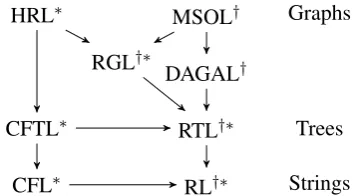
Figure 2: Containment relationships for families of regu-lar and context-free string and tree languages, hyperedge re-placement languages (HRL), monadic second order definable graph languages (MSOL), directed acyclic graph automata languages (DAGAL), and the regular graph languages (RGL). ∗indicates that the family of languages is probabilistic and† indicates that the family of languages is intersectible.
lationship of RGL, TLG, and RDG, which might enable us to define more general classes of graph languages that are also within SCFL. Our discus-sion emphasises points at which Courcelle’s proof relies on particular restrictions of RGL, and is in-tended to highlight the places where relaxations of these restrictions may be possible.
Figure2summarises the relationship of RGL to other formalisms and their properties. The proof of each Lemma, Proposition and Theorem in this paper that does not appear here is provided in full in the supplementary materials.4
2 Monadic Second-Order Logic
The regular string and tree languages precisely coincide with the monadic second-order logic (MSO) definable sets of strings and trees, re-spectively (B¨uchi, 1960; B¨uchi and Elgot, 1958; Trakhtenbrot, 1961), so it is natural to look at MSO over graphs.
We use the following notation. Ifnis an integer,
[n]denotes the set{1, . . . , n}. IfAis a set,s∈A∗ denotes that s is a sequence of arbitrary length, each element of which is inA. We denote by|s|
the length ofs. Aranked alphabetis an alphabet Apaired with an arity function rank:A→N.
Definition 1. Ahypergraphover a ranked alpha-bet Γ is a tuple G = (VG, EG,attG,labG,extG)
where VG is a finite set of nodes; EG is a finite
set of edges (distinct fromVG); attG :EG → VG∗
maps each edge to a sequence of nodes; labG :
EG → Γ maps each edge to a label such that
|attG(e)|=rank(labG(e)); and extGis an ordered
subset ofVGcalled theexternal nodesofG.
X a
b
(1) (2)
G
(2)
c
(1)
a
(3)
d
H
(1)
c d
a
(2)
b a
G[X/H]
2
1 1 2
1 2 3
2 1
1
2 1
2
2 1
1
2 1
2 1
2 1
[image:3.595.75.297.67.152.2]2
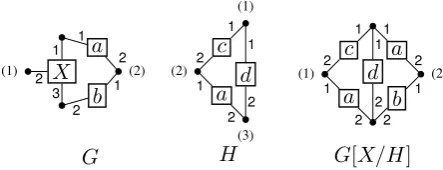
Figure 3: The replacement of theX-labeled edge inGby the
graphH.
We assume that both the elements of extG and
the elements of attG(e)for each edge eare
pair-wise distinct. An edge eis attached to its nodes by tentacles, each labeled by an integer indicat-ing the node’s position in attG(e) = (v1, . . . , vk).
The tentacle frometovi has labeli, so the
tenta-cle labels lie in the set[k]wherek=rank(e). To express that a nodev is attached to thei-th tenta-cle of an edgeewe say vert(e, i) = v. The nodes in extG are labeled by their position in extG. In
figures, thei-th external node is labeled(i). The rankof an edgeeiskif att(e) = (v1, . . . , vk)(or
equivalently, rank(lab(e)) =k). Therankof a hy-pergraphGis|extG|. Aninduced subgraphof a
hypergraphGby edgesE0 ⊆EGis the subgraph
ofGformed by including all edges inE0and their endpoints. Define HGΣ,Γ to be the set of all
hy-pergraphs with node labels inΣand edge labels in Γ (the hypergraphs as defined here have no node labels so are in HG∅,Γ).
Example 1. HypergraphG in Figure 3 has four nodes (shown as black dots) and three hyperedges labeleda,b, andX(shown boxed). The bracketed numbers(1)and(2)denote its external nodes and the numbers between edges and the nodes are ten-tacle labels. Call the top nodev1and, proceeding
clockwise, call the other nodesv2,v3, andv4. Call
its edgese1, e2ande3. Its definition would state:
attG(e1) = (v1, v2) labG(e1) =a
attG(e2) = (v2, v3) labG(e2) =b
attG(e3) = (v1, v4, v3) labG(e3) =X
extG = (v4, v2).
MSO on graphs quantifies over nodes, sets of nodes, edges, and sets of edges.5 The atomic
formulas are x ∈ X, x = y, labγ(x), and
vert(x, i) = y. We construct MSO sentences us-ing the atomic formulas, connectives∧,∨,¬,⇒,
5Formally, this is called MS2(Courcelle and Engelfriet,
2011); MS1only quantifies over nodes and sets of nodes.
and quantifiers ∃,∀. We allow vert(x, i) = y to hold only when x is an edge and y is a node. In the case of edge-labelled graphs, the x in labγ(x) must be an edge. We define the
formula edg(x, y1, . . . , yk) : vert(x,1) = y1 ∧
. . .vert(x, k) = yk ∧Vk0>k∀y¬vert(x, k0) = y
which expresses att(x) = (y1, . . . , yk).
We can write down an MSO formula to ex-press that sets X1, . . . , Xn partition the domain.
PART(X1, . . . , Xn):
∀x[x∈X1∪ · · · ∪Xn∧ ¬x∈X1∩X2 ∧¬x∈X1∩X3∧ · · · ∧ ¬x∈Xn−1∩Xn]
(1)
We use!to denote unique existential quantifica-tion. For any formulaR:
∃!xR(x) :∃xR(x)∧ ∀yR(y)→x=y.
We can define an MSO statement expressing that the graph is a string by defining an edge la-belled graph where the edges have rank 2, there is exactly one node with no incoming edge, there is exactly one node with no outgoing edge, and every node has at most one incoming edge and at most one outgoing edge:
STRING:∀y∃!x1∃!x2edg(y, x1, x2)∧
∃!x1∀y¬vert(y,2) =x1∧ ∃!x2∀y¬vert(y,1) =x2 ∧ ∀x¬x=x1 ⇒ ∃!y∃!x0edg(y, x0, x)
∧ ∀x¬x=x2 ⇒ ∃!y∃!x0edg(y, x, x0)
Let First(x) denote that x has no incoming edges and Last(x) denote that xhas no outgoing edges.
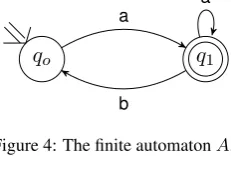
Example 2. LetAbe the automaton in Figure4. The corresponding MSO quantifies over a subset Xi for each stateqiin the automaton. The subsets
partition the nodes of the string graph to simulate a run of the automaton.
Finally, we encode each transition of the form (qi, a, qj) as x ∈ Xi ∧ ∃y∃x0edg(y, x, x0) ∧
laba(y)⇒x0∈Xj.
FromA, we construct the formula autA:
autA:STRING∧ ∃X0∃X1PART(X0, X1) ∧ ∀xFirst(x)⇒x∈X0
∧ ∀xLast(x)⇒x∈X1
∧∀x∈X0∧∃y∃x0edg(y, x, x0)∧laba(y)⇒x0 ∈X1 ∧∀x∈X1∧∃y∃x0edg(y, x, x0)∧laba(y)⇒x0 ∈X1 ∧∀x∈X1∧∃y∃x0edg(y, x, x0)∧labb(y)⇒x0 ∈X0
qo q1
a
b
[image:4.595.123.239.70.161.2]a
Figure 4: The finite automatonA.
a a b a
Figure 5: The graph representing the stringaaba.
Gthat makesφtrue.
Example 3. The string graphG=aabaas shown in Figure5can be produced by automatonA. The letters are edge labels and call its nodes from left to rightv0, v1, v2, v3, andv4. If we letX0={v0, v3}
andX1 ={v1, v2, v4}thenG|=autA.
Let aut0
A(X0, X1)be the MSO formula
identi-cal to autAwith∃X0∃X1removed from the
begin-ning of the formula. X0andX1 are free variables
of aut0
A, and we refer to the set of free variables
of a formula as itsparameters. Given a graph G and a formulaφ(W)with parametersW, letαbe function fromW to subsets of nodes and edges in
G. Then we say that (G, α) |= φ(W) if G and α satisfyφ(W). We callα aparameter
assign-ment. The MSO interpretation of an automaton is satisfied if we can find a parameter assignment that simulates a run of the automaton—more pre-cisely, G |=autA if(G, α) |=aut0A(X0, X1). In
general, there may be more than one suchα.
Example 4. LetW ={X0, X1}be parameters. If
α(X0) ={v0, v3}andα(X1) ={v1, v2, v4}then (G, α)|=aut0
A(W).
We can use an MSO statement φ to define a language, L(φ) = {G | G |= φ}, and we call the family of languages definable this way asMSOL. We define the intersection of two lan-guages L(φ1)∩L(φ2) = {G | G |= φ1 ∧φ2}.
This clearly shows that MSO languages are closed under intersection.
2.1 MSO Transductions
One way to show that a language is MSO defin-able is to use the backwards translation theorem (Courcelle and Engelfriet, 2011), which depends onMSO transductions (MSOT), a generalisation of finite-state string and tree transductions. The theorem is a generalisation to graphs of the fact that regular string and tree languages are closed
under inverse finite-state transductions (Hopcroft and Ullman,1979;?).
Theorem 1(Backwards Translation Theorem). If
L is an MSO definable graph language andf is
an MSO graph transduction thenf−1(L)is effec-tively MSO definable.
Definition 2. An MSO transducer
τ : HGΣ,Γ → HGΣ0,Γ0 is τ =
hρ(W), δ(x,W),(θr(x1, . . . , xN(r),W))r∈Ri.
W is a set of parameters;ρ(W)is aprecondition which input graphs must satisfy; δ(x,W) is a
domain formula defining the output domain
(i.e. nodes); and θr(x1, . . . , xN(r),W) is a
relation formula defining relationships between the elements in the output domain (i.e. edges).6
The role of parameters here is to allow non-determinism. Given a graph G and a parame-ter assignmentα fromW to VG ∪EG such that
(G, α) |= ρ(W), we define the output of the transducer τ(G, α) = (D, R) such that D = {x ∈ G | (G, x, α) |= δ(x,W)} and R = {θr(x1, . . . , xN(r)) | (G, x1, . . . , xN(r), α) |=
θr(x1, . . . , xN(r),W), r ∈ R}. Define τ(G) = {τ(G, α) | (G, α) |= ρ(W)}and for a language
L,τ(L) ={τ(G)|G∈L}.
3 Hyperedge Replacement Grammars Iff is a function andSis a set,f|Sis the
restric-tion off to domain elements inS. Iff, gare func-tions,f◦gis their composition.
Definition 3. LetGbe a hypergraph with an edge eof rankkand letHbe a hypergraph also of rank
k disjoint from G. The replacement of e by H
is the graph G0 = G[e/H]. Let VG0 = (VG∪
VH)−extH,EG0 = (EG∪EH)−{e}. Let extH =
(v1, . . . , vk), attG(e) = (u1, . . . , uk) and letf :
(VG∪VH)→VG0 replacevibyuifori∈[k]and
be the identity otherwise. The extension of f to
(VG∪VH)∗is also denotedf. LetE=EG− {e},
then attG0 =attG|E∪(f◦attH), labG0 =labG|E∪
labH.
Example 5. Replacement is shown in Figure 3. We denote the replacement asG[X/H]since the edge is unambiguous given its label.
S p:
X
(1)
1 go
1
2 I
arg0 s: Y Z (1)
(2)
1
2
1
arg0 arg1
X
q: W
Y
(2) (1)
1
2
1 1
2 arg1
arg0 t: W
(1)
1
want
Y
r: Z
X
(2) (1)
1
2
1 1
2 arg1
arg0 u: Z
(1)
1
[image:5.595.72.293.58.291.2]need
Table 1: Productions of a HRG. The labelsp, q, r, s, t, andu
label the productions so that we can refer to them in the text. Note thatY can be rewritten either via productionrors.
terminals, a finite set of productionsP, and a start symbol S ∈ N. Every production in P is of the
formX→HwhereX ∈N is of rankkandHis
a hypergraph of rankkoverN andT.
A HRGG produces graphs in HG∅,TG. In each
example, we only show terminal edges of rank 2, and depict them as directed edges where the direc-tion is determined by the tentacle labels: tentacle 1 attaches to the source and 2 attaches to the tar-get (Table1). For each production p : X → G, we useL(p)to refer to its left-hand side (X) and R(p) to refer to its right-hand side (G). An edge is a terminal edge if its label is terminal and a nonterminal edge if its label is nonterminal. A graph is terminal if all of its edges are labeled with terminal symbols. The terminal subgraph of a graph is the subgraph induced by its terminal edges. Let NT(p) ={e1, . . . , en}be an
enumera-tion of the nonterminal edges inR(p), let|NT(p)|
be the number of nonterminal edges inR(p) and let|NT(P)|= maxp∈P|NT(p)|.
Given a HRG G, we say that graph G
de-rives graph G0, denotedG → G0, iff there is an edge e ∈ EG and a nonterminal X ∈ N such
that labG(e) = X and G0 = G[e/H], where
X → H is inP. We extend the idea of deriva-tion to its transitive closure G →∗ G0. For ev-ery X ∈ N we also use X to denote the con-nected graph consisting of a single edge e with lab(e) =Xand nodes(v1, . . . , vrank(X))such that
att(e) = (v1, . . . , vrank(X)), and we define the
lan-guageLX(G) = {G | X →∗ G, Gis terminal}.
Thelanguage ofGis thenL(G) =LS(G). We call
the family of languages that can be produced by any HRG thehyperedge replacement languages (HRL).
3.1 HRL and MSOT
Since HRGs are context-free, for each HRG G, there is an underlying regular tree grammar TG
defining the derivation trees of the graphs inL(G). EachT ∈ TG has node labels inPG and edge
la-bels in|NT(P)|. If a node has labelpandR(p)has
nnonterminalsX1, . . . , Xnthen for eachi∈[n],
there is an i labelled edge from p to a node la-belledq whereL(q) = Xi. The label of the root
ofT must bepfor some p withL(p) = S. Let VAL :L(TG) → L(G)be a mapping from
deriva-tion trees to graphs so thatG = VAL(T)iffTis
a derivation tree of G. Since HRGs can be am-biguous, this mapping is not injective. (Courcelle, 1991) shows that VAL is an MSO transduction.7 This does not imply that HRLs are MSOL, since in general MSOL is not closed under MSOT. Hence an MSOT representing the inverse ofVALmay not exist for an arbitrary HRG, but we later discuss a subfamily for which it does (§4), allowing us to apply Theorem1.
To distinguish between elements of a graph and its derivation tree, we denote a grammar by G, graph byG, derivation tree byT, derivation tree
node by v, edges and nodes in productions are
written with a bar (v¯) and nodes and edges inG are unmarked (x).
The transduction VAL preserves the terminal subgraph of every production used in a deriva-tion and fuses nodes from different producderiva-tions together in the output graph. Node fusion is de-termined by an equivalence relation∼ generated
by a relation∼0. Let NT(p) = (e1, . . . , en) the
nonterminal edges ofR(p), let NTi(p) = ei, and
let extG(i)be theith external node ofG.
Definition 5. LetGbe a HRG andTbe a deriva-tion tree ofG, so thatG =VAL(T). Define a
bi-nary relation∼0on pairs(¯x,v)wherex¯is a node inR(p)for somep∈P andvis a node ofTwith labelp. Then(¯x,v)∼0(¯y,v0)iff:
1. v,v0are nodes inTandv0is theith child of
vinT.
2. p=labT(v),p0=labT(v0).
3. x¯is thejth node of NTi(p),y¯=extR(p0)(j).
We define∼as the reflexive, symmetric,
transi-tive closure of∼0.
The mappingVAL translates derivation trees to graphs in two steps. First, the terminal subgraph of every instance of every production used in the derivation tree is produced in the output. Then, all equivalent nodes under ∼ are fused. (Courcelle, 1991) shows that each step is a MSOT; their com-position is also a MSOT.
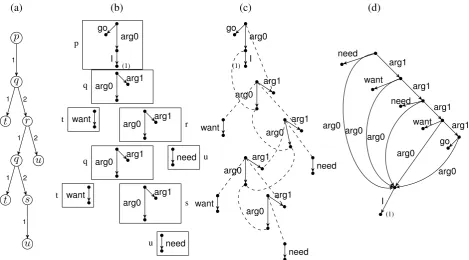
Example 6. Figure6illustrates how VALmaps a derivation tree to a graph.
The mapping VAL can be defined in terms of two finer-grained mappings. Let EP =
∪p∈PER(p) and VP = ∪p∈PVR(p). Then he :
EP ×VT → EG maps a pair (¯e,v) to its
im-ageein the graph, where¯eis a terminal edge inp and lab(v) =p. This mapping is one-to-one since edges cannot be fused.hv :VP ×VT →VGmaps
a pair(¯x,v)to its imagev, wherex¯is a node inp and lab(v) = p. It is not one-to-one since nodes can be fused.
Lemma 1. LetGbe a HRG, and letGbe a graph in L(G) with derivation tree T. If x¯ and x¯0 are nodes such thathv(¯x,v) =hv(¯x0,v0)withv6=v0
and, ifx¯is internal inR(p)forp=labT(v), then
¯
x0 is an external node ofR(p0)forp0 =labT(v0)
andvis an ancestor ofv0inT.
Consequently, if hv(¯x,v) = hv(¯x0,v0) then x¯
andx¯0cannot both be internal.
4 Regular Graph Grammars
A regular graph grammar (RGG;Courcelle 1991) is a restricted form of HRG. To explain the restric-tions, we first require some definitions.
Definition 6. Given a graphG, apathinGfrom
a nodevto a nodev0 is a sequence
(v0, i1, e1, j1, v1)(v1, i2, e2, j2, v2). . .(vk−1, ik, ek, jk, vk)
such that vert(er, ir) = vr−1 and
vert(er, jr) = vr for each r ∈ [k], v0 = v, andvk=v0. The length of this path isk.
A path is terminalif every edge in the path is terminal. A path isinternalif eachvi is internal
for1≤i≤k−1. The endpointsv0andvkof an
internal path can be external.
Definition 7. A HRG G is a Regular Graph Grammar if each nonterminal in N has rank at
least one and for eachp∈PGthe following hold:
(C1) R(p)has at least one edge. Either it is a single terminal edge, all nodes of which are exter-nal, or each of its edges has at least one internal node.
(C2) Every pair of nodes inR(p)is connected by a terminal and internal path.
RGLs are HRLs by definition; we will prove that they are also MSOLs by constructing the in-verse of VAL, a transducer from RGL graphs to their derivation trees. Since the derivation trees are MSO definable, RGLs must also be MSO de-finable by Theorem1. The construction requires a unique anchor element (a node or edge) for each production in the grammar. Given an input graph, the transducer first guesses—via parameter assignment—the preimage of each edge and the set of elements whose preimages are anchors. It then checks whether the guess satisfies constraints that must be true for every derived graph:
1. It must be possible to partition the graph into a set of edge-disjoint connected subgraphs, each isomorphic to the terminal subgraph of some pro-duction.
2. For each node that is in two such subgraphs, the node must be the image of two nodes in the productions that are allowed to be fused under the grammar.
If these constraints are satisfied, the transducer outputs each guessed anchor and an edge between anchors that it identifies to be in a parent-child re-lationship.
Every valid parameter assignment corresponds to a different output from the transducer, and we will show that all derivation trees for any input graph in the grammar lie in this output set. Theorem 2. RGL⊆MSOL.
The proof of each Lemma and Proposition in this section either appears here or in the supple-mentary materials. The proof of Theorem2is pro-vided in§4.2.1.
4.1 Anchors and Parameters
p (a)
q
t r
q u
t s
u 1
1 2
1 2
2 1
1
(b)
(1)
p
q
r
q
s t
t
u
u
(c)
(1)
go arg0
I
arg1 arg0
arg1 arg0
arg1 arg0
arg1 arg0 want
want
need
need
go arg0
I
arg1 arg0
arg1 arg0
arg1 arg0
arg1 arg0 want
want
need
need
(d)
(1)
arg1
arg1
arg1 arg1 need
want
need
want
go
I
arg0 arg0
[image:7.595.72.542.64.324.2]arg0 arg0 arg0
Figure 6: A derivation tree (a), the terminal subgraphs of every copy of every production in the derivation tree (b), the relation ∼illustrated with dashed lines (c) and the resulting graph (d).
that a pair of anchors cannot be fused, so the set of anchors in any derived graph is guaranteed to be in one-to-one correspondence with the nodes of its derivation tree.
We define two sets of parameters: E and C, where E guesses preimages of edges, and C
guesses anchors (which may be either nodes or edges). To define E precisely, we require some
notation. LetG be an RGG, and for eachp ∈ P, let T(p) ={f¯p,1, . . . ,f¯p,|T(p)|}enumerate the
ter-minal edges of R(p) and let γp,j be the label of
¯
fp,j for eachp∈P andj ∈[|T(p)|]. Let|NT(p)|
be the number of nonterminal edges in p and let
|NT(P)| = maxp∈P|NT(p)|. Given a nodev in
a derivation treeT, we say thatv is ani-child if it is the ith child of some other node in T. By
convention, the root node is the only 0-child. LetGbe inL(G)and letTbe a derivation tree ofG. For each i∈ [0,|NT(P)|],p ∈ P andj ∈ [|T(p)|], we define a parameterEi,p,j:
Ei,p,j ={e∈EG|he( ¯fp,j,v)andvis ani-child.}
LetE ={Ei,p,j}fori∈[0,|NT(P)|],p∈ P and
j∈[|T(p)|].
For eachi∈[|NT(P)|]andp∈P, define Ci,p={h(¯cp,v)|p=labT(v),vis ani-child.}
Whereh=he∪ev since¯cpcan either be an edge
or a node. LetC=∪i,pCi,p.
p
v1
q
v2
t
v3 r v4
q
v5 u v6
t
v7 s v8
u
v9
1
1 2
1 2
2 1
1
v5
v4
v10
v11
v12
v9
v3
v8
v2
v7
v1
v6 e1
e2
e3
e4
e5
e6
e7
e8
e9
e15
e14
e12
e13
e11 e 10
Figure 7: The derivation tree from Figure6(a) and the graph from Figure 6 (d) with variable names for the nodes and edges.
LetW =E ∪ C.
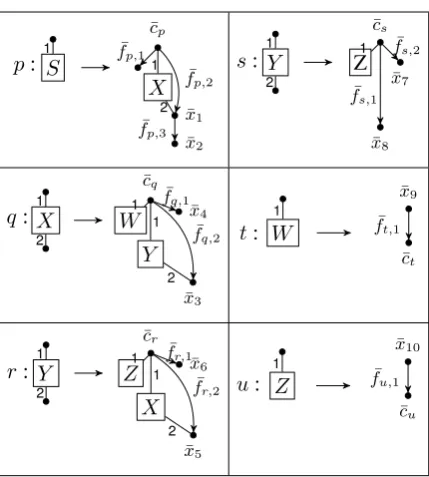
Example 7. Table2shows the productions of Ta-ble1 with labels on each node and edge. Figure 7shows the derivation tree and graph from Figure 6with variable names added. We use these vari-able names to refer to specific nodes and edges in the text. For example, hv(¯cs,v8) = v1, and
he( ¯fu,1,v9) =e5.
Example 8. Using the labels in Table2and Figure 7, we see thatE0,p,1 ={e9},E1,q,2 ={e12, e14},
[image:7.595.312.538.383.542.2]S p:
¯
cp
X ¯
x1
¯
x2
1 f¯p,1 1
2 ¯
fp,3
¯
fp,2
Y Z
s:
¯
cs
¯
x7
¯
x8
1
2
1
¯
fs,1
¯
fs,2
X
q: W
¯
cq
Y
¯
x3
¯
x4
1
2
1 1
2 ¯
fq,1
¯
fq,2 t: W
¯
x9
¯
ct
1
¯
ft,1
Y
r: Z
¯
cr
X
¯
x5
¯
x6
1
2
1 1
2 ¯
fr,1
¯
fr,2 u: Z
¯
x10
¯
cu
1
¯
[image:8.595.74.289.57.296.2]fu,1
Table 2: The productions from Table1with variable names added to each of the nodes and terminal edges. Node vari-ables of the form¯cxforx∈ {p, q, r, s, t, u}indicate anchors.
4.1.1 Path Properties of RGLs
The precondition will exploit the properties of RGGs, particularly the properties of paths be-tween nodes. LetG be an RGG,G ∈ L(G), and letT be a derivation tree ofG. In the following, we relate paths within individual productions inP (denotedπ) to paths inG(denotedλ). For eache inG, we define o(e) = (i, p, j)iffe∈Ei,p,j.
For every pathλinGof the form
(v, i1, e1, j1, v1)(v1, i2, e2, j2, v2). . .(vk−1, ik, ek, jk, v0)
we define itstraceas the sequence
tr(λ) := (o(e1), i1, j1)(o(e2), i2, j2). . .(o(ek), ik, jk).
Now letπbe a path
(¯v, i1,e¯1, j1,v¯1). . .(¯vk−1, ik,e¯k, jk,¯v0)
in R(p) for some p ∈ P. Let v ∈ VT, p = labT(v). We denote byh(π,v)the following path
inG:
(h(¯v,v), i1, h(¯e1,v), j1, h(¯v1,v)). . .
(h(¯vk−1,v), i1, h(¯ek,v), j1, h(¯v0,v))
If v is an i-child of some node in VT then
tr(h(π,v))is the sequence
((i, p, m1), i1, j1). . .((i, p, mk), ik, jk)
where e¯j = ¯fp,mj for each j ∈ [k]. Note that
tr(π) = tr(h(π,v)). The trace is a property that remains constant when a path is projected from a production into a graph. This projection is not
one-to-one since a production can be applied sev-eral times; a trace appears in the graph once for each application of the corresponding production in a derivation. For v ∈ VT, we write π ∈ R(labT(v))to denote thatπ is a path in the
pro-duction which is the label ofv.
Example 9. Let π be the path
(¯x3,2,f¯q,2,1,¯cq)(¯cq,1,f¯q,1,2,x¯4) in
produc-tion q in Table 2. h(π,v4) for v4 is the path (v11,2, e13,1, v4)(v4,1, e4,2, v5) in Figure 7,
and its trace is((1, q,2),2,1)((1, q,1),1,2). Lemma 2(Lemma 5.5 from (Courcelle, 1991)). LetGbe an RGG,Gbe a graph inL(G), andTbe
a derivation tree ofG. Letλbe a path inGof the
formh(π,v)for somev∈VTand some terminal
pathπ ∈R(labT(v)). The final node ofπmay be
internal or external but every other node must be internal. Ifλ0 is another path inGwith the same
trace and the same initial node asλ, thenλ0=λ. Lemma 2 guarantees a unique trace for every path in a graph that is the projection of a path in a single production. By property C2 of RGGs, this guarantee must hold for at least one path from the anchor node of an int-production to every other node in the production. For ext-productions, all paths are of the form π = (¯e, i,v¯i), where e is
the single nonterminal edge; these paths are also guaranteed unique traces.
4.1.2 MSO Formulas for the Precondition Given an assignment to our parameters, we can use the path property in Lemma2to define some useful MSO statements. The first,ANC, relates an-chors to the nodes in the graph. Throughout this section, given a derivation treeT, we will refer to
αT which is the parameter assignment fromW to VG∪EGas defined above.
Lemma 3(Lemma 5.6 from (Courcelle, 1991)). LetG be an RGG,Gbe a graph inL(G), andT
be a derivation tree ofG. For everyp ∈ P,
ev-eryi ∈ [0,|NT(P)|], and every nodex¯ ∈ R(p),
one can construct a formulaANCp,i,x¯(u, w,{W}) such that, for everyu∈VG∪EG,w∈VG:
(G, u, w, αT)|=ANCp,i,¯x(u, w,{W})
iffu = h(¯cp,v) andw = hv(¯x,v)for somev ∈
VTwhich is ani-child andp=labT(v).
We say that nodeuanchorsnodevif for some p,iandx¯,ANCp,i,¯x(u, v,{W})holds. We use the
Example 10. Looking at Table2and Figure7, we can establish that ANCp,0,x¯1(v5, v11,{W}) holds and thatv5 ∈C0,p.
The next MSO formula we construct relates pairs of anchors to each other. Since the anchors define the output domain of the transducer, the for-mulaPARdefines the edges of the output.
Lemma 4(Lemma 5.7 of (Courcelle,1991)). Let Gbe an RGG,Gbe inL(G),Tbe a derivation tree ofG, andαbe the parameter assignment defined
with respect to T. One can construct a formula
PARp,i,p0,i0(u, w,{W})such that, foru, w ∈VG∪
EG:
(G, u, w, α)|=PARp,i,p0,i0(u, w,{W})
iffu = h(¯cp,v), w =h(¯cp0,v0)for somev,v0 in VT where p = labT(v), p0 = labT(v0), v is an i-child, andv0is thei0th child ofvinT.
IfPARp,i,p0,i0(u, u0,{W})holds, thenuwill be-come the parent ofu0in the output tree. The proof of this lemma relies on C1 of RGG.
Example 11. From Table 2 and Figure 7, PARq,1,s,2(v2, v1,{W})holds.
As introduced in §3, we have a binary
equiv-alence relation ∼ over pairs of the form (¯x,v) wherex¯is a node in a productionpandvis a node
in the derivation tree with label p. We use this relation for the precondition of the transducer so that a pair of nodes are only fused if the grammar and derivation tree allows them to be. We project
∼ into the graph to construct a relation over
an-chors such thatFUSEp,i,x,p¯ 0,i0,x¯0(u, u0,{W})holds if and only if(¯x,v)∼(¯x0,v0),u=h(¯cp,v), u0 =
h(¯cp0,v0), andh(¯x,v) =h(¯x0,v0).
Lemma 5. LetG be an RGG,Gbe inL(G), and
T be a derivation tree of G. One can construct
a formula FUSEp,i,x,p¯ 0,i0,x¯0(u, u0,{W}) such that, foru, u0 ∈VG∪EG:
(G, u, u0,{W})|=FUSEp,i,x,p¯ 0,i0,x¯0(u, u0,{W}) iffu =h(¯cp,v), u0 = h(¯cp0,v0)for somev,v0 in VT where p = labT(v), p0 = labT(v0),v is the ith child of some node,v0is thei0th child of some
node, andhv(¯x,v) =hv(¯x0,v0).
Example 12. From Table 2 and Figure 7, we can see that FUSEp,0,¯x1,s,2,x¯8(v5, v1,{W}) holds since v5 = hv(¯cp,v1), v1 = hv(¯cs,v8), v11 =
hv(¯x1,v1) =hv(¯x8,v8),ANCp,0,x¯1(v5, v6,{W}) andANCs,2,x¯8(v1, v11,{W})
4.1.3 The Precondition of the Transducer LetX be inN, thenPX = {p ∈P|L(p) =X},
and anX-derivation tree is a derivation tree with respect toX as the start symbol (in this case, the root will have label inPX). AnS-derivation tree
is referred to simply as a derivation tree. Edge Requirements
(E1) α(E)partitionsEG,
(E2) for alle∈α(Ei,p,j)ehas labelγp,j
(E3) there is a unique p ∈ PX such that
α(E0,p,j) has exactly one element for each j ∈
[|T(p)|]and for everyp0 =6 p,α(E0,p0,j)is empty for allj.
Recall the MSO statement PART(X1, . . . , Xn)
from Equation1which expresses thatX1, . . . , Xn
form a partition over the domain. We can also de-fine a partition over a restricted domainY to be: resPART(Y, X1, . . . , Xn) :
∀x∈Y[x∈X1∪ · · · ∪Xn∧ ¬x∈X1∩X2 ∧ ¬x∈X1∩X3∧ · · · ∧ ¬x∈Xn−1∩Xn]
Using this formula, the requirements E1,E2 and E3 are all expressible in MSO as follows:
EDGEX(W) :resPART(EG,E)∧
^
i,p,j
∀e∈Ei,p,jlabγp,j(e)∧
_
p∈PX
[^
j
∃!e∈E0,p,j∧
^
p0∈P,p06=p
^
j
E0,p0,j=∅]
LetEDGE(W) =EDGES(W). In using the symbol
∧i,p,j we are quantifying over i ∈ [0,|NT(P)|],
p∈P, andj∈[|T(p)|].
Lemma 6. Let G be an RGG and let G ∈
L(G) then for each derivation tree T of G,
(G, αT)|=EDGE(W).
Example 13. For the grammar in Table 2, and derivation tree and graph in Figure 7, we obtain
E = {E0,p,1 = {e9}, E0,p,2 = {e14}, E0,p,3 = {e15}, E1,q,1 = {e4, e2}, E1,q,2 = {e13, e11},
E2,r,1 = {e3}, E2,r,2 = {e12}, E2,s,1 = {e1},
E2,s,2 ={e10},E1,t,1 ={e6, e8},E2,u,1 ={e7},
E1,u,1 ={e5}}. This clearly forms a partition of
the edges, and we can easily check that the rest of the requirements ofEDGEalso hold.
Decomposition into Subgraphs This con-straint partitions the graph into a set of connected subgraphs, each of which is isomorphic to the ter-minal subgraph of the right-hand side of some pro-duction. The requirements are:
(S2) for each anchoru ∈ Ci,p we can identify
a unique edgee∈Ei,p,j for eachj ∈ |T(p)|such
thatuanchors all of the endpoints ofe,
(S3) for each edgee∈Ei,p,j we can identify a
unique anchoru ∈Ci,psuch thatuanchors all of
the endpoints ofe.
SUBGRAPHi,p,j(W) :
(∀v∃e∨jvert(e, j) =v)∧
∀c∈Ci,p∃!e∈Ei,p,j
∃v1ANCp,i,x¯1(c, v1,{W})∧ · · · ∧
∃vjkANCp,i,¯xjk(c, vjk,{W})∧
edg(e, v1, . . . , vjk)
∧
∀e∈Ei,p,j∃!c∈Ci,p
∃v1ANCp,i,x¯1(c, v1,{W})∧ · · · ∧
∃vjkANCp,i,¯xjk(c, vjk,{W})∧
edg(e, v1, . . . , vjk)
DefineSUBGRAPH(W) :Vi,p,jSUBGRAPHi,p,j.
Lemma 7. LetG be an RGG and letG ∈ L(G) then for each derivation treeTofG,(G, αT) |=
SUBGRAPH(W).
Example 14. For the graph in Figure 7, we look at SUBGRAPH1,q,1. We need to look at
C1,q = {v4, v2}, and E1,q,1 = {e4, e2}.
Look-ing at the graph, we can see that each of ANCq,1,¯cq(v4, v4,{W}), ANCq,1,x¯4(v4, v5,{W}), ANCq,1,¯cq(v2, v2,{W}), ANCq,1,x¯4(v2, v3,{W}) hold. The label ‘arg1’ is one2, e4 andfq,1 so we
can quickly verify that this shows that the graph satisfiesSUBGRAPH1,q,1.
Subgraph Composition
We require that for a graph G with derivation tree T, (G, αT) |= ANCp,i,x¯(u, v,{W}) for
u ∈ Ci,p and(G, αT) |= ANCp0,i0,x¯0(u0, v,{W}) for u0 ∈ Ci0,p0 if and only if (G, αT) |=
FUSEp,i,x,p¯ 0,i0,x¯0(u, u0,{W}) holds. This part of the precondition ensures that two different ways of looking at how nodes can be fused agree with one another. The first is if a node can be anchored by two different anchors then this node must be the image of two nodes from different production ap-plications. The second is that we haveFUSEwhich is the equivalence relation generated by a relation over the neighbouring nodes in the derivation tree.
SHARE(W) :
^
i,p,x,i¯ 0,p0,x¯0
∀c1 ∈Ci,p∀c2 ∈Ci0,p0
ANCp,i,¯x(c1, v,{W})∧
ANCp0,i0,x¯0(c2, v,{W})
↔ FUSEi,p,x,i¯ 0,p0,x¯0(u, u0,{W})
Lemma 8. Let G be an RGG and letG ∈ L(G) then for each derivation treeTofG, there exists αTsuch that(G, αT)|=SHARE(W).
Example 15. Looking at Table 2 and Figure 7, FUSEp,0,x¯1,s,2,x¯8(v5, v1,{W}) holds and ANCp,0,¯x1(v5, v6,{W}) and ANCs,2,x¯8(v1, v6,{W})both also hold.
The proof of each of the above lemmas is avail-able in the supplementary materials. In each of these proofs, we prove by induction on the size of T that (G, αT) |= R(W) for R ∈
{EDGE,SUBGRAPH,SHARE}. In each induction, we use the equations (defined below) which ex-pressαTin terms of the parameter assignments of
sub-trees ofT.
Let G ∈ LX(G) and q : X → H such
that H has nonterminals Y1, . . . , Yn and G =
H[Y1/H1]. . .[Yn/Hn]. Then Hη ∈ LYη(G) for
eachη ∈ [n]. LetTη be a derivation tree forHη
and letαTη be the assignment ofW to the nodes
and edges in Hη. Then we can define αT(E) in
terms of the set ofαTη(E)s:
αT:
e∈Ei,p,j ife∈EHη, αTη :e∈Ei,p,j, i6= 0
e∈Eη,p,j ife∈EHη, αTη :e∈E0,p,j
e∈E0,q,j ife∈EH, e=he( ¯fq,j,v0).
(2) Where e = he( ¯fq,j,v0) means that e can be
uniquely identified as corresponding tof¯q,j since
H andR(q) are isomorphic andv0 is the root of
T. For the anchor set,
αT(C) =c∪η∈[n]αTη(C) (3)
wherec=h(¯cq,v0).
4.1.4 RGLs Satisfy the Precondition
The precondition of the transducer is the conjunc-tion of each of these formulas,
ρX(W) : EDGEX(W)∧SHARE(W)∧SUBGRAPH(W)
Defineρ(W) =ρS(W).
Proposition 1. Let G be an RGG and let G ∈
there exists a parameter assignmentαT such that
(G, αT)|=ρ(W).
Proof. We use the parameter assignment αT
which is defined fromTin§4.1. Lemma6proves
that(G, αT) |=EDGE(W). Lemma7proves that
(G, αT)|=SUBGRAPH(W). Lemma8proves that
(G, αT) |= SHARE(W). Therefore, (G, αT) |= ρ(W).
4.2 Parsing as Transduction
The transducer is made up of three types of for-mulas: the precondition, the domain formulas, and the relation formulas. We have established the pre-condition ρ(W) and next we define the domain and relation formulas. The domain formulas de-fine the nodes of the derivation tree and so we write node(x,{W}). The relation formulas define which output node is theith child of another out-put node, written childi(x, y,{W}), and the labels
of the output nodes, written labp(x,{W}).
The domain of the output for a parameter as-signmentαisDTwhere:
DT(α) :{x|(G, x, α)|=node(x,{W})}
and node(x,{W}) :x∈ C.
The relation formula childr(x, y,{W})defines
the edges of the output of the transducer. We use the formula PARp,i,p0,i0(u, u0,{W}) from Lemma 4, this encodes that the derivation tree node corre-sponding tou0 is thei0th child of the node corre-sponding tou(which itself is theith child of some other node).
childi0(x, y,{W}) : _
i,p,p0
(PARp,i,p0,i0(x, y,{W})
We also need to assign labels to the tree nodes which can be done via the unary relation:
labp(x,{W}) :
_
i
x∈Ci,p
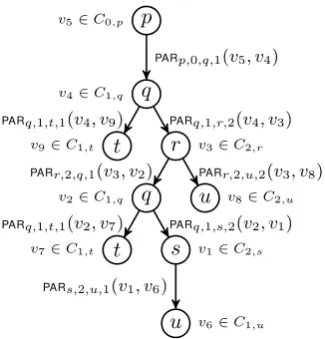
Example 16. Figure 8 shows the output of the transducer when it takes Figure7as input withα defined as in the previous examples. The domain formulas specify the existence of the 9 nodes and the relation formulas specify the edges between the nodes, labelled by PAR formulas, and the la-bels of the nodes, according to theCi,psets.
We have now defined each part of the transducer τ from graphs to their derivation trees. Let G be an RGG, and letX ∈N. Then the corresponding
p
v5∈C0,p
q
v4∈C1,q
t
v9∈C1,t r v3∈C2,r
q
v2∈C1,q u v8∈C2,u
t
v7∈C1,t s v1∈C2,s
u v6∈C1,u
PARp,0,q,1(v5, v4)
PARq,1,r,2(v4, v3) PARq,1,t,1(v4, v9)
PARr,2,u,2(v3, v8) PARr,2,q,1(v3, v2)
PARq,1,s,2(v2, v1) PARq,1,t,1(v2, v7)
[image:11.595.335.498.60.230.2]PARs,2,u,1(v1, v6)
Figure 8: The output of the transducer, variable names are based on those of Figure7. ThePARformulas are there to
explain why the edge exists and thev ∈ Ci,p formulas are
there to show where the node labels come from.
transducerτX is
hρX({W}),node(x,{W}),
(labp(x,{W}))p∈P,
(edger(x, y,{W}))r∈[|NT(P)|]i.
For start symbol S of G, let τ = τS. LetG
be a graph inL(G), and letα be a parameter as-signment such that(G, α) |= ρ({W}). Then the output of the transducer with respect toαis τ(G, α) = (VH,labH,(childHi )i∈[0,|NT(P)|])
where VH = DT(α) = {x | (G, x, α) |=
node(x,{W})}, labH : VH → P such that
labH(x) = p if x ∈ α(Ci,p) for some i, and
childi
H : VH → VH such that childHi (x, y) if
(G, x, y, α)|=PARp,i,p0,r(x, y,{W}).
4.2.1 Transducer Output and Derivation Trees
We will show that for eachG ∈ L(G) ifT is a
derivation tree ofGthenT∈τ(G). We will also show that for eachT∈ τ(G), if it is a derivation tree inTGthen it is a derivation tree ofG.
Proposition 2. LetGbe an RGG andτ be the
cor-responding transducer. LetG∈L(G)andTbe a derivation tree ofG. ThenT∈τ(G).
By Proposition 2, we know that for each G,
{T|val(T) =G} ⊆τ(G).
Proposition 3. Let G be an RGG and G ∈ L(G). Letαbe a parameter assignment such that (G, α) |= ρ(W). Then ifT = τ(G, α) is inTG
thenVAL(T) =G.
Proof. LetGbe an RGG andτ be the correspond-ing transducer. By Propositions2and3, for each G ∈ L(G), τ(G) is a set which contains all of the derivation trees of G and possibly other ele-ments none of which are derivation trees of any G0 ∈ L(G)where G0 6= G. Therefore, for each G∈L(G),
τ(G)∩ TG={T∈ TG|VAL(T) =G}.
Therefore,
τ(L(G))∩ TG ={T∈ TG |VAL(T) =G, G∈L(G)}. And since {T ∈ TG | VAL(T) = G, G ∈ L(G)}=TG,
τ−1(τ(L(G))∩ TG) =τ−1(TG).
τ−1(τ(L(G))∩ TG) ={G∈L(G)|τ(G)∩ TG 6=
∅)}=L(G). Therefore,
L(G) =τ−1(TG)
and so by Theorem1and the fact thatTG is MSO
definable,L(G)is MSO definable.
5 Conclusions and Discussion
Property C1 of RGGs is used repeatedly in the proof that RGL is in MSOL. This property implies connectedness of the terminal subgraph, a prop-erty that both Tree-like Grammars (Matheja et al., 2015) and Restricted DAG Grammars (Bj¨orklund et al., 2016) share, although both of these for-malisms allow nodes that are connected only to nonterminals, which is forbidden in RGG. We sus-pect that all three families of languages are incom-parable. That these restricted forms of HRG all share the property of connectedness suggests that it may be an important property. In particular, we plan to investigate whether connectedness of ter-minal subgraphs implies that an HRL is in MSOL. Languages which contain graphs of the form shown in Figure9 are MSOL but not in RGL or TLG; hence both RGL and TLG are proper sub-families of SCFL. Languages of this form can be produced by RDG, whose relationship to SCFL is unknown. To produce graphs like this, we must al-low productions containing nonterminals that are not incident to any internal node. We would need to allow this only in certain circumstances how-ever, as we could easily produce a language of graphs that look like the graph in Figure 9 with equal numbers ofa-labelled andb-labelled edges; such languages are not MSO-definable. On a tech-nical level, allowing such extensions would mean thatPAR no longer holds. (Courcelle,1991)
dis-cusses this problem and introduces an alternative representation of derivation trees called reduced trees which enable some cases of this type to be defined in MSOL. This point requires further in-vestigation.
Another possible extension would be to con-sider alternative forms of Lemma 2. Every MSO formula in the transducer depends on this lemma. We could potentially extend RGG if we can de-fine other cases in which a path could be dede-fined in terms of its trace and initial vertex. We intend to investigate such cases in future work.
. . .
a a
Figure 9: A graph where every edge is labelledaand has the same tail but each edge has a unique head.
Acknowledgments
This work was supported in part by the EPSRC Centre for Doctoral Training in Data Science, funded by the UK Engineering and Physical Sci-ences Research Council (grant EP/L016427/1) and the University of Edinburgh; and in part by a Google faculty research award (to AL). We thank Clara Vania, Sameer Bansal, Ida Szubert, Fed-erico Fancellu, Antonis Anastasopoulos, Marco Damonte, and the anonymous reviews for helpful discussion of this work and comments on previous drafts of the paper.
References
Omri Abend and Ari Rappoport. 2013. Univer-sal conceptual cognitive annotation (ucca). In
ACL (1). The Association for Computational Linguistics, pages 228–238. http://dblp.uni-trier.de/db/conf/acl/acl2013-1.html#AbendR13.
Cyril Allauzen, William Byrne, Adria de Gispert, Gon-zalo Iglesias, and Michael Riley. 2014. Pushdown automata in statistical machine translation. Compu-tational Linguistics.
Laura Banarescu, Claire Bonial, Shu Cai, Madalina Georgescu, Kira Griffitt, Ulf Hermjakob, Kevin Knight, Philipp Koehn, Martha Palmer, and Nathan Schneider. 2013. Abstract meaning representa-tion for sembanking. In Proceedings of the 7th Linguistic Annotation Workshop and Interoper-ability with Discourse. Association for Computa-tional Linguistics, Sofia, Bulgaria, pages 178–186.
Daniel Bauer and Owen Rambow. 2016. Hy-peredge replacement and nonprojective de-pendency structures. In Proceedings of the 12th International Workshop on Tree Ad-joining Grammars and Related Formalisms (TAG+12), June 29 - July 1, 2016, Heinrich Heine University, D¨usseldorf, Germany. pages 103– 111. http://aclweb.org/anthology/W/W16/W16-3311.pdf.
Henrik Bj¨orklund, Frank Drewes, and Petter Eric-son. 2016. Between a Rock and a Hard Place – Uniform Parsing for Hyperedge Replacement DAG Grammars, Springer International Publishing, Cham, pages 521–532. https://doi.org/10.1007/978-3-319-30000-9 40.
Mikolaj Bojanczyk and Michal Pilipczuk. 2016.
Definability equals recognizability for graphs of bounded treewidth. In Proceedings of the 31st Annual ACM/IEEE Symposium on Logic in Computer Science. ACM, New York, NY, USA, LICS ’16, pages 407–416.
https://doi.org/10.1145/2933575.2934508.
Taylor L. Booth and Richard A. Thompson. 1973. Ap-plying probability measures to abstract languages.
IEEE Transactions on Computers 22(5):442–450.
https://doi.org/http://doi.ieeecomputersociety.org/10.1109/T-C.1973.223746.
Julius Richard B¨uchi. 1960. On a decision method in restricted second-order arithmetic. Proceedings Logic, Methodology and Philosophy of Sciences.
Julius Richard B¨uchi and Calvin Elgot. 1958. Decision problems of weak second order arithmetic and finite automata, part i. Notices of the American Mathe-matical Societypage 5;834.
David Chiang, Jacob Andreas, Daniel Bauer, Karl Moritz Hermann, Bevan Jones, and Kevin Knight. 2013. Parsing graphs with hyper-edge replacement grammars. In Proceedings of the 51st Annual Meeting of the Associa-tion for ComputaAssocia-tional Linguistics (Volume 1: Long Papers). Association for Computational Linguistics, Sofia, Bulgaria, pages 924–932.
http://www.aclweb.org/anthology/P13-1091.
Bruno Courcelle. 1990. The monadic second-order logic of graphs i. recognizable sets of finite graphs.
Information and Computationpages 12–75.
Bruno Courcelle. 1991. The monadic second-order logic of graphs V: on closing the gap between definability and recognizability. The-oretical Computer Science 80(2):153–202.
https://doi.org/10.1016/0304-3975(91)90387-H.
Bruno Courcelle and Joost Engelfriet. 2011. Graph Structure and Monadic Second-Order Logic, a Lan-guage Theoretic Approach. Cambridge University Press.
Frank Drewes, Hans-J¨org Kreowski, and Annegret Ha-bel. 1997. Hyperedge replacement graph grammars. In Grzegorz Rozenberg, editor,Handbook of Graph Grammars and Computing by Graph Transforma-tion, World Scientific, pages 95–162.
Manfred Droste and Paul Gastin. 2005. Weighted Automata and Weighted Logics, Springer Berlin Heidelberg, Berlin, Heidelberg, pages 513–525.
https://doi.org/10.1007/11523468 42.
Dan Flickinger, Yi Zhang, and Valia Kordoni. 2012. Deepbank : a dynamically annotated treebank of the wall street journal. In Proceedings of the Eleventh International Workshop on Treebanks and Linguistic Theories (TLT11). Lisbon, pages 85–96. HU.
Jan Hajiˇc, Eva Hajiˇcov´a, Jarmila Panevov, Petr Sgall, Ondˇrej Bojar, Silvie Cinkov´a, Eva Fuˇc´ıkov´a, Marie Mikulov´a, Petr Pajas, Jan Popelka, Jiˇr´ı Se-meck´y, Jana ˇSindlerov´a, Jan ˇStˇep´anek, Josef Toman, Zdeˇnka Ureˇsov´a, and Zdenˇek ˇZabokrtsk´y. 2012. Announcing prague czech-english dependency tree-bank 2.0. In Nicoletta Calzolari (Conference Chair), Khalid Choukri, Thierry Declerck, Mehmet Uur Doan, Bente Maegaard, Joseph Mariani, Asun-cion Moreno, Jan Odijk, and Stelios Piperidis, ed-itors, Proceedings of the Eight International Con-ference on Language Resources and Evaluation (LREC’12). European Language Resources Associ-ation (ELRA), Istanbul, Turkey.
John E. Hopcroft and Jeffrey D. Ullman. 1979. Intro-duction to automata theory, languages and compu-tation. Addison-Wesley.
Bevan Jones, Jacob Andreas, Daniel Bauer, Karl Mor-tiz Hermann, and Kevin Knight. 2012. Semantics-based machine translation with hyperedge replace-ment grammars. InProceedings of COLING.
Tsutomu Kamimura and Giora Slutzki. 1981. Parallel and two-way automata on directed ordered acyclic graphs.Information and Control49(1):10–51.
Alexander Koller and Marco Kuhlmann. 2011. A generalized view on parsing and translation. In
Proceedings of the 12th International Conference on Parsing Technologies. Association for Compu-tational Linguistics, Dublin, Ireland, pages 2–13.
http://www.aclweb.org/anthology/W11-2902.
Christoph Matheja, Christina Jansen, and Thomas Noll. 2015. Tree-Like Grammars and Separa-tion Logic, Springer International Publishing, Cham, pages 90–108. https://doi.org/10.1007/978-3-319-26529-2 6.
Xiaochang Peng, Linfeng Song, and Daniel Gildea. 2015.A synchronous hyperedge replacement gram-mar based approach for AMR parsing. In Pro-ceedings of the 19th Conference on Computa-tional Natural Language Learning, CoNLL 2015, Beijing, China, July 30-31, 2015. pages 32–41.
http://aclweb.org/anthology/K/K15/K15-1004.pdf.
Daniel Quernheim and Kevin Knight. 2012. Towards probabilistic acceptors and transducers for feature structures. InProceedings of the Sixth Workshop on Syntax, Semantics and Structure in Statistical Trans-lation. Association for Computational Linguistics, Stroudsburg, PA, USA, SSST-6 ’12, pages 76–85.
http://dl.acm.org/citation.cfm?id=2392936.2392948.
Wolfgang Thomas. 1991. Automata, Languages and Programming: 18th International Colloquium Madrid, Spain, July 8–12, 1991 Proceedings, Springer Berlin Heidelberg, Berlin, Heidelberg, chapter On logics, tilings, and automata, pages 441– 454. https://doi.org/10.1007/3-540-54233-7-154.
Boris Trakhtenbrot. 1961. Finite automata and logic of monadic predicates. Doklady Akademii Nauk SSSR