Exact Learning of Regular Pattern Languages from
One Positive Example Using a Linear Number of
Membership Queries
Satoshi Matsumoto, Tomoyuki Uchida,
Member, IAENG,
Takayoshi Shoudai, Yusuke Suzuki
and Tetsuhiro Miyahara
Abstract—A query learning model is an established mathe-matical model of learning via queries in computational learning theory. A regular pattern is a string consisting of constant symbols and distinct variable symbols. The language of a regular pattern is the set of all constant strings obtained by replacing all variable symbols in the regular pattern with constant strings. In a query learning model, it is known that the class of languages of regular patterns is identifiable from one positive example using a polynomial number of membership queries. In this paper, we show that the class is identifiable from one positive example using a linear number of membership queries. This result means that the number of membership queries is reduced to be linear with respect to the length of the positive example.
Index Terms—pattern language, membership query, query learning, computational learning theory
I. INTRODUCTION
The query learning model of Angluin [1] is an established mathematical model of learning via queries in computational learning theory. In this learning model, a learning algorithm accesses oracles, which answer specific types of queries, and collects information about a target. The query learning model is regarded as a mathematical model of a data mining strategy using queries for large databases (e.g.,[2]). Querying whether or not a target exists in the database, which is called a membership query in the query learning model, is frequently performed in data mining using databases. Hence, to extract characteristic features from large databases, data mining algorithms that identify features using fewer membership queries are required. From this motivation, in this paper, we consider a query learning algorithm that uses a linear number of membership queries with respect to the length of a given string contained in a target.
Angluin [3] presented a pattern as a string consisting of constant symbols and variable symbols. Particularly, a pattern πis said to beregularif each variable symbol occurs inπat most once. For example, letπ1=xaybazandπ2=xaybyz be two strings consisting of two constant symbols a, b and variable symbols x, y, z. The stringπ1 is a regular pattern but π2 is not regular. The pattern language of a pattern π is the set of all strings w consisting of constant symbols
This work was partially supported by Grant-in-Aid for Scientific Research (C) (Grant Numbers 15K00312, 15K00313, 17K00321) from Japan Society for the Promotion of Science (JSPS).
S. Matsumoto is with the Faculty of Science, Tokai University, 4-1-1 Kitakaname, Hiratsuka, Japan, e-mail: [email protected].
T. Uchida, Y. Suzuki and T. Miyahara are with Hiroshima City University, e-mail:{uchida, y-suzuki, miyares19}@hiroshima-cu.ac.jp.
T. Shoudai is with Kyushu International University, e-mail: [email protected].
such that w is obtained from π by replacing all variable symbols with strings consisting of constant symbols. There is considerable research [1], [4], [5], [6] about learning algorithms for identifying a target pattern language in the same query learning model. Angluin [1] showed that the class of pattern languages is not identifiable using polynomial numbers of membership queries and restricted equivalence queries. Here, a restricted equivalence query is to query an oracle as to whether or not the pattern language derived by a pattern given as input is equal to the target language. Because of this result, Marron [4] presented the query learning setting in which the learner initially receives a string that belongs to the target language before starting the process of asking queries. Matsumoto and Shinohara [5] showed a query learning algorithm for identifying a target pattern language from one positive examplew using a polynomial number of membership queries with respect to the length of w. Moreover, they presented a non-trivial subclass of regular pattern languages that is identified from one positive example using a linear number of membership queries.
In this paper, we show that the full class of regular pattern languages is identified from one positive example using a linear number of membership queries. The proposed query learning algorithm consists of the following two phases, called ShrinkString and IdentifyVariables, while shifting the index in a given positive example from the start to the end of it. The ShrinkString phase is to recursively shrink the given positive example by asking membership queries, until it is confirmed that the resulting example is a shortest one. The IdentifyVariables phase is to determine whether or not the target pattern has a variable symbol at the index by asking membership queries. By shrinking constant symbols at the position of the rightmost variable symbol in the substring up to the index in both the ShrinkString and IdentifyVariables phases, we update a shortest example. From this algorithm, we expand a target class that is exactly learnable from one positive example using a linear number of membership queries to the class of regular pattern languages. That is, this result shows that a target class is extended from the subclass of regular pattern languages in [5] to the full class of regular pattern languages in the same query learning setting as [5].
This paper is organized as follows. In Sec. II, we introduce a regular pattern and its language. Moreover, we briefly introduce the query learning model proposed by Angluin [1]. In Sec. III, by presenting a query learning algorithm, we show that the class of regular pattern languages is exactly learnable from only one positive example using a linear number of membership queries. We conclude this paper and give future work in Sec. IV.
II. PRELIMINARIES
In this section, we introduce a regular pattern and its language. Then, we introduce the query learning model proposed by Angluin [1].
A. Regular Pattern and Its Language
Let Σ be a nonempty finite set of constant symbols. Let X be an infinite set of variable symbols such thatΣ∩X =∅ holds. Then, a string on Σ∪X is a sequence of symbols in Σ∪X. Particularly, the string having no symbol is called the empty string and is denoted by ε. We denote by (Σ∪X)∗ the set of all strings onΣ∪X and by(Σ∪X)+the set of all strings onΣ∪X exceptε, i.e.,(Σ∪X)+= (Σ∪X)∗\ {ε}. Apattern onΣ∪X is a string in (Σ∪X)+. Note that the empty stringεis not a pattern onΣ∪X. Then, a patternπ onΣ∪X is said to beregularif each variable symbol inX appears at most once inπ. The set of all regular patterns on Σ∪X is denoted byRP⊊(Σ∪X)+. Hereafter, we omitΣ andX if they are obvious from the context. Asubstitution
θ is a mapping from (Σ∪X)+ to(Σ∪X)+ such that (1) θ is a homomorphism with respect to string concatenation, denoted by ‘·’, that is, for two patterns π1, π2∈(Σ∪X)+,
θ(π1·π2) =θ(π1)·θ(π2)holds, and (2) for each constant symbola∈Σ,θ(a) =aholds. Namely, for a patternπ,θ(π) is a pattern obtained from πby replacing variable symbols with patterns according to θ. For a pattern π, the pattern language of π, denoted by L(π), is the set of all strings w in Σ+ such that w is obtained from π by replacing all variable symbols in π with strings in Σ+, that is, L(π) =
{w ∈Σ+ | w =θ(π) for some substitution θ}. We define
RPL={L(π)|π∈ RP}.
Example 1: Let Σ = {a, b} and X = {x, y, z, . . .}. Let π1=abxbybe a regular pattern onΣ∪X. Then, we have
L(π1) ={ababa, ababb, abbba, abbbb, abaaba, ababba, . . .}.
Next, we prepare some notations on strings. For a string w∈(Σ∪X)∗, the length ofw, denoted by|w|, is the number of symbols composing w, e.g., |ε| = 0 and |abcxay| = 6. For a string w ∈ (Σ∪X)+ and a positive integer i with 1 ≤ i ≤ |w|, we denote by w[i] the i-th symbol of w. For two positive integers i, j with 1 ≤ i ≤ j ≤ |w|, we denote by w[i :j] the substring w[i]w[i+ 1]· · ·w[j]. Note thatw[i:i] =w[i]. Letwbe a pattern onΣ∪X,aa symbol inΣ∪X or the empty stringεandia positive integer with 1 ≤ i ≤ |w|. Then, we denote by w.rep(i, a) the pattern obtained fromw by replacing thei-th symbol ofwwitha.
Example 2: Let π2 = abcabc ∈ Σ+ be a pattern, and
a, b constant symbols in Σ. Then, we have π2[2] = b,
π2.rep(2, a) = aacabc, π2.rep(2, ε) = acabc, and π2[2 : 4] =bca.
If a pattern π contains a variable symbol, we denote by rmvs(π) the index of the rightmost variable in π, that is,
rmvs(π) = max{i |π[i]is a variable symbol}. Otherwise, we definermvs(π) = 0. Note that0≤rmvs(π)≤ |π|.
Example 3: Let Σ = {a, b} andX = {x, y, z, . . .}. Let π2 = abcabc, π3 = axyaxa, and π4 = axybaza be patterns. Then, we havermvs(π2) = 0,rmvs(π3) = 5and rmvs(π4) = 6.
B. Learning Model
Let L be a class consisting of sets of strings such that each set inLhas its own representation of finite length. Let R be the set of representations for all sets of strings in L. For each representation r ∈R, we denote by L(r) the set of strings that is represented by r. For example, for a set L of strings, a regular pattern π is a representation ofL if L=L(π)holds.
Let L∗ ∈ L be a target. Let r∗ ∈ R be one of the representations of L∗. i.e., L∗ = L(r∗). A string w ∈ Σ+ is said to be apositive example of L∗ if w∈L∗ holds. In the query learning model presented by Angluin [1], learning algorithms can accessoraclesthat will answer queries about the target L∗. In this paper, we consider the membership querydefined as follows. The input is a stringw∈Σ+. The output is “yes” ifw∈L(r∗)holds and “no” otherwise. We denote byMQthe oracle that answers membership queries. For a target L∗ and a string w ∈ Σ+, a notation MQ(w) denotes the answer ofMQfor the membership query in the case that the input ofMQis w.
Example 4: Let abxby be a target regular pattern.
MQ(abaaba)is “yes”, andMQ(abaaa) is “no”.
A learning algorithmAis said toexactly identify a target
L∗ ∈ L if A outputs a representation r ∈ R satisfying L(r) =L(r∗). In the next section, we will present a learning algorithm that exactly identifies any target L∗ ∈ RPL using only one positive example and a linear number of membership queries, that is, the algorithm outputs a regular patternπ∈ RP satisfying L(π) =L∗.
III. LEARNINGALGORITHM
We consider the case thatΣis a set of one constant sym-bol. LetL∗be a target regular pattern language. The shortest positive example is obtained from a given positive example by asking a linear number of membership queries. Then, we can identify a regular patternπ such thatL(π) =L∗ holds, by replacing the first constant symbol of the shortest positive example with a variable symbol. Thus, we assume thatΣis a set of two or more constant symbols. Let π∗ be a target regular pattern, that is,L(π∗) =L∗.
Let π be a regular pattern, w a string in L(π) and i an integer with 1 ≤ i ≤ |π|. We say that a triple (π, w, i) satisfies Condition 1 if the following conditions hold: (1) there exists a substitutionθi such thatw=θi(π)andw[1 :
i] = θi(π[1 : i]) hold, and (2) for each integer j with i <
j≤ |w|, there exists no substitutionθj such thatw=θj(π)
andw[1 :j] =θj(π[1 :i])hold.
Example 5: For the regular pattern π4 = axybaza, the triplet(π4, abababbbba,5)satisfies Condition 1 (see Fig. 1). But the triplet (π4, abababbbba,6) does not satisfy Condi-tion 1 (see Fig. 2).
Fig. 1. The triplet(π4, abababbbba,5)satisfies Condition 1. There exists a substitutionθsuch thatababa=θ(π4[1 : 5])andabababbbba=θ(π4). And for each integerjwith5< j≤10, there exists no substitutionθjsuch thatw[1 :j] =θj(π4[1 : 5])andw=θj(π4), wherew=abababbbba.
Fig. 2. The triplet(π4, abababbbba,6)does not satisfy (2) of Condition 1, since there exists a substitutionθsuch thatabababbbb=θ(π4[1 : 6])and
abababbbba=θ(π4)hold.
with 0 ≤k ≤ |π∗|. We assume that(π∗, w, i−1) satisfies Condition 1, and k = rmvs(π∗[1 : i−1]). Let s be the output of ProcedureShrinkString whenw,i, andkare given as input. Then the triplet(π∗, s, i)satisfies Condition 1.
Proof: By the assumption, the triplet (π∗, w, i− 1) satisfies Condition 1. There exists a substitution θi−1 such thatw[1 :i−1] =θi−1(π∗[1 :i−1])andw=θi−1(π∗). For
each integerj withi≤j ≤ |w|, there exists no substitution θj′ such that w[1 : j] = θj′(π∗[1 :i−1]) and w =θ′j(π∗). We consider the following two cases.
1) In the case thatπ∗[i] is a variable symbol. Letw1 be the string obtained fromw after the loop of lines 1– 3. Then,MQ(w1.rep(i, ε))is “no”. We show that for each integer j with i < j ≤ |w1|, there exists no substitutionθ1′,j such that w1[1 : j] = θ′1,j(π∗[1 : i])
and w1 = θ1′,j(π∗). Suppose that there exists a
sub-stitution θ′1,j such that w1[1 : j] = θ′1,j(π∗[1 : i]) and w1 = θ1′,j(π∗) for some integer j with i <
j ≤ |w1|. Since π∗[i] is a variable symbol, by the substitutionsθi−1 andθ1′,j, there exists a substitution
θ1′ such that w1[1 : i− 1] = θ1′(π∗[1 : i− 1]), w1[i : j] = θ1′(π∗[i]) and w1 = θ′1(π∗). Since
|w1[i : j]| > 1, MQ(w1.rep(i, ε)) is “yes”. This is a contradiction. This satisfies (2) of Condition 1. Sincew1 ∈L(π∗), there exists a substitution θ1 such that w1[1 : i] = θ1(π∗[1 : i]) and w1 = θ1(π∗). This satisfies (1) of Condition 1. Therefore, the triplet (π∗, w1, i)satisfies Condition 1.
In the case of k = 0, it is clear that s = w1. Thus, The triplet(π∗, s,1)satisfies Condition 1. We consider the case of k >0, that is, a variable symbol appears in π∗[1 : i−1]. Note that 0 < k < i. Let w2 be the string obtained after the loop of lines 5–7. Then, we show that w1 and w2 are the same. We assume thatw2 is different fromw1. By the loop of lines 5–7,
MQ(w1.rep(k, ε)) is “yes”. Let w1′ = w1.rep(k, ε). Sincew′1 ∈L(π∗), there exists a substitution θ1′ such that w′1[ℓ : |w′1|] = θ′1(π∗[i : |π∗|]) for some integer
ℓ with i ≤ℓ. Since w′1[ℓ : |w′1|] =w1[ℓ+ 1 : |w1|],
Procedure 1ShrinkString
Input: A string w in L(π∗), a positive integer i and a nonnegative integerk
Output: A stringwinL(π∗)
1: while MQ(w.rep(i, ε)) =“yes”do
2: w:=w.rep(i, ε); 3: end while
4: if k >0then
5: while MQ(w.rep(k, ε)) =“yes” do
6: w:=w.rep(k, ε); 7: end while
8: end if
9: output w;
there exists a substitutionθ′′1 such thatw1[1 :i−1] =
θ1′′(π∗[1 : i−1]), w1[i : ℓ + 1] = θ ′′
1(π∗[i]) and
w1=θ ′′
1(π∗). Therefore, we have|w1[i:ℓ+ 1]|>1.
MQ(w1.rep(i, ε)) is “yes”. This is a contradiction. Thus,w1 andw2 are the same. The triplet (π∗, w2, i) satisfies Condition 1. Sinces=w2, the triplet(π∗, s, i) satisfies Condition 1.
2) In the case that π∗[i] is a constant symbol. At first, we consider the case k = 0. Since π∗[1 : i] consists of constant symbols, it is clear that(π∗, w, i)satisfies Condition 1. Next, we consider the case k > 0. Let w2 be the string obtained after the loop of lines 5–7.
MQ(w2.rep(k, ε))is “no”. We assume that there exists a substitution θ′2,j such that w2[1 : j] = θ′2,j(π∗[1 :
i]) and w2 = θ2′,j(π∗) for some integer j with i <
j ≤ |w2|. Since π∗[i] is a constant symbol, by the substitution θi−1 and θ2′,j, there exists a substitution
θ2′ such that w2[1 :k−1] =θ2′(π∗[1 :k−1]),w2[k:
m] = θ′2(π∗[k]) and w2 = θ′2(π∗) for some integer
m > k. Since|w2[k: m]| >1, MQ(w2.rep(k, ε))is “yes”. This is a contradiction. Thus, for each integerj withi < j≤ |w2|, there exists no substitutionθ2,jsuch
thatw2[1 :j] =θ2,j(π∗[1 :i])andw2=θ2,j(π∗). This
satisfies (2) of Condition 1. Since w2 ∈ L(π∗), there exists a substitutionθ2 such thatw2[1 :i] =θ2(π∗[1 :
i])andw2=θ2(π∗). This satisfies (1) of Condition 1. The triplet(π∗, w2, i)satisfies Condition 1. Sinces=
w2, the triplet(π∗, s, i)satisfies Condition 1.
From the above, the triplet(π∗, s, i)satisfies Condition 1. Example 6: Letπ∗=axabacy andi= 2. Then, we have rmvs(π∗[1]) = 0. Procedure ShrinkString outputs a string ababacbacbwhen it takesw=abbabacbacb,i= 2, andk= 0as input (see Fig. 3). In casei= 6, we havermvs(π∗[5]) = 2. And the procedure outputs a stringababacbwhen it takes w=ababacbacb,i= 6, andk= 2as input (see Fig. 4).
Lemma 2: Letwbe a string inL(π∗). Letibe a positive integer with 2 ≤i ≤ |π∗|. Let k be a nonnegative integer with 0 ≤ k ≤ |π∗|. We assume that (π∗, w, i) satisfies Condition 1, and k=rmvs(π∗[1 :i−1]). Given w, i and kas input, ProcedureIdentifyVariables correctly outputs the value ofrmvs(π∗[1 :i]).
Proof:Since(π∗, w, i)satisfies Condition 1, there exists a substitutionθi such that w[1 :i] =θi(π∗[1 :i]) andw=
θi(π∗). For each integer j with i < j ≤ |w|, there exists
[image:3.595.78.223.182.242.2]abbabacbacb ⇒ abbabacbacb.rep(2, ε) =ababacbacb∈L(axabacy) }
The loop of lines 1–3
[image:4.595.303.545.227.459.2]⇒ ababacbacb.rep(2, ε) =aabacbacb̸∈L(axabacy)
Fig. 3. A running example of ProcedureShrinkStringwhen a stringw=abbabacbacb,i= 2, andk= 0are given as input. The procedure outputs the stringababacbacb.
ababacbacb ⇒ ababacbacb.rep(6, ε) =abababacb∈L(axabacy) }
The loop of lines 1–3
⇒ abababacb.rep(6, ε) =ababaacb̸∈L(axabacy)
⇒ abababacb.rep(2, ε) =aababacb∈L(axabacy) }
The loop of lines 5–7
⇒ aababacb.rep(2, ε) =ababacb∈L(axabacy)
⇒ ababacb.rep(2, ε) =aabacb̸∈L(axabacy)
Fig. 4. A running example of ProcedureShrinkStringwhen a stringw=ababacbacb,i= 6, andk= 2are given as input. The procedure outputs the stringababacb.
Procedure 2IdentifyVariables
Input: A string w in L(π∗), a positive integer i and a nonnegative integerk
Output: an integerk=rmvs(π∗[1 :i])
1: Letabe a constant symbol inΣ\ {w[i]}; 2: if MQ(w.rep(i, a)) =“yes” then
3: w′:=w.rep(i, a);
4: if((k >0and MQ(w′.rep(k, ε)) =“yes”)
or k= 0) thenk:=i; 5: end if
6: outputk;
w = θj(π∗). Then, we consider the following two cases,
that is, π∗[i] is a variable symbol, or a constant symbol.
1) In the case that π∗[i] is a variable symbol. From the substitution θi, MQ(w.rep(i, a)) is “yes”, where
a ∈ Σ\ {w[i]}. Let w1 be the string obtained from
w at line 3. At first, we consider the case k = 0, that is, rmvs(π∗[1 : i − 1]) = 0. Then, it is clear that k is updated. Next, we consider the case k > 0, that is, rmvs(π∗[1 : i−1]) > 0. Suppose thatMQ(w1.rep(k, ε))is “yes”. Sincew1.rep(k, ε)∈
L(π∗), there exists a substitutionθ′1,j such thatw1[1 :
j] =θ′1,j(π∗[1 :i])andw1=θ′1,j(π∗)for some integer
jwithi < j. Sincew[1 :i−1] =w1[1 :i−1]andπ∗[i] is a variable symbol, by usingθi andθ′1,j, there exists
a substitutionθ′1such thatw[1 :j] =θ1′(π∗[1 :i])and w=θ′1(π∗)for some integer j with i < j. This con-tradicts that the triplet(π∗, w, i)satisfies Condition 1. SinceMQ(w1.rep(k, ε))is “no”, kis updated. 2) In the case thatπ∗[i]is a constant symbol. We assume
thatMQ(w.rep(i, a))is “yes”, wherea∈Σ\ {w[i]}. Letw1 be the string obtained fromwat line 3. There exists a substitutionθ1 such thatw1[1 :j] =θ1(π∗[1 :
i]) and w1 = θ1(π∗) for some integer j with i <
j. If rmvs(π∗[1 : i]) = 0, then MQ(w.rep(i, a)) is “no”. Thus, we have rmvs(π∗[1 : i]) > 0. Let k =
rmvs(π∗[1 :i−1]). Since w[i]̸=w1[i], by using θi
andθ1, there exists a substitution θ such that w1[1 :
k−1] = θ(π∗[1 : k−1]), w1[k : m] = θ(π∗[k]) and w1 = θ(π∗) for some integer m with m > k. Thus MQ(w1.rep(k, ε)) is “yes”. Therefore k is not updated.
From the above, if π∗[i] is a variable symbol, then k is updated. Otherwise,kis not updated. Thus, Procedure
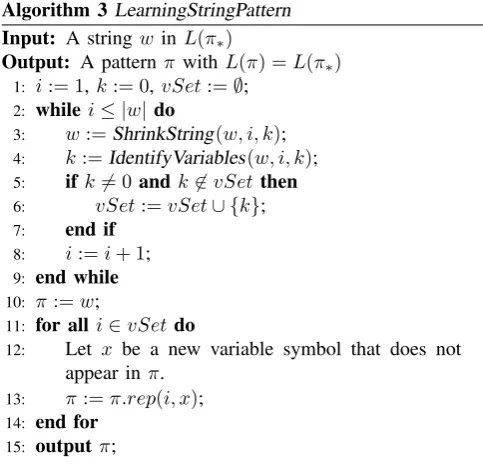
Iden-Algorithm 3LearningStringPattern
Input: A stringw inL(π∗)
Output: A patternπ withL(π) =L(π∗)
1: i:= 1,k:= 0,vSet:=∅; 2: whilei≤ |w|do
3: w:=ShrinkString(w, i, k); 4: k:=IdentifyVariables(w, i, k); 5: ifk̸= 0 andk̸∈vSetthen
6: vSet:=vSet∪ {k}; 7: end if
8: i:=i+ 1; 9: end while
10: π:=w;
11: for alli∈vSetdo
12: Let x be a new variable symbol that does not appear inπ.
13: π:=π.rep(i, x); 14: end for
15: output π;
tifyVariables correctly outputs the value ofrmvs(π∗[1 :i]).
Letw0 be the string which is given to Algorithm
Learn-ingStringPattern, andk0= 0. Letw1, w2, . . .be the sequence of strings output by ProcedureShrinkStringat line 3 of Algo-rithmLearningStringPattern. Letk1, k2, . . . be the sequence of nonnegative integers output by Procedure IdentifyVari-ablesat line 4 ofLearningStringPattern. At each stagei≥1, ProcedureShrinkString outputs the stringwi when wi−1,i, andki−1are given as input, and ProcedureIdentifyVariables outputs the nonnegative integerki whenwi,i, andki−1 are given as input.
In Table I, we write strings w1, . . . , w7 output by Pro-cedureShrinkString and integers k1, . . . , k7 output by Pro-cedure IdentifyVariables when a string w0 = abbabacbacb is given to Algorithm LearningStringPattern as a positive example. At last, the string ababacb is obtained after the loop of lines 2–9.
Lemma 3: For each integeriwith1≤i≤ |π∗|, the triplet (π∗, wi, i)satisfies Condition 1, andki=rmvs(π∗[1 :i]).
[image:4.595.51.293.229.364.2]TABLE I
ARUNNING EXAMPLE OFALGORITHMLearningStringPatternWHEN A POSITIVE EXAMPLEw0=abbabacbacbIS GIVEN AS INPUT,WHERE
π∗=axabacy.
i Procedure output vSet
1 ShrinkString(abbabacbacb,1,0) w1=abbabacbacb ∅ IdentifyVariables(abbabacbacb,1,0) k1= 0 ∅
2 ShrinkString(abbabacbacb,2,0) w2=ababacbacb ∅ (see Fig. 3) IdentifyVariables(ababacbacb,2,0) k2= 2 {2}
3 ShrinkString(ababacbacb,3,2) w3=ababacbacb {2} IdentifyVariables(ababacbacb,3,2) k3= 2 {2}
4 ShrinkString(ababacbacb,4,2) w4=ababacbacb {2} IdentifyVariables(ababacbacb,4,2) k4= 2 {2}
5 ShrinkString(ababacbacb,5,2) w5=ababacbacb {2} IdentifyVariables(ababacbacb,5,2) k5= 2 {2}
6 ShrinkString(ababacbacb,6,2) w6=ababacb {2} (see Fig. 4) IdentifyVariables(ababacb,6,2) k6= 2 {2}
7 ShrinkString(ababacbacb,7,2) w7=ababacb {2} IdentifyVariables(ababacb,7,2) k7= 7 {2,7}
vSet={2,7} a new variable symbol pattern
2 x1 ax1abacb=ababacb.rep(2, x1)
7 x2 ax1abacx2=ax1abacb.rep(7, x2)
The regular patternax1abacx2is output byAlgorithmLearningStringPattern.
We assume inductively that the results hold for any number of iterations of the while loop less thani. By the inductive hypothesis, the triplet(π∗, wi−1, i−1)satisfies Condition 1, and ki−1 =rmvs(π∗[1 :i−1]). By Lemma 1, the triplet (π∗, wi, i) satisfies Condition 1. Since the triplet (π∗, wi, i)
satisfies Condition 1, and ki−1 = rmvs(π∗[1 : i−1]), by Lemma 2, we haveki=rmvs(π∗[1 :i]).
Theorem 1: Algorithm LearningStringPattern outputs a regular pattern π with L(π) = L(π∗) from one positive example wusing O(|w|)membership queries.
Proof: Let ℓ = |π∗|. By Lemma 3, the triplet (π∗, wℓ, kℓ) satisfies Condition 1. Since wℓ ∈ L(π∗), we
have|wℓ| ≥ℓ. We assume that |wℓ|> ℓ. Then, there exists
a substitution θℓ such that wℓ[1 : j] = θℓ(π∗[1 : ℓ]) and
wℓ=θℓ(π∗)for some integerj withℓ < j. This contradicts
that the triplet(π∗, wℓ, ℓ)satisfies Condition 1. Therefore, we
have|wℓ|=ℓ=|π∗|andwℓ∈L(π∗). By Lemma 2 and 3,
the set vSet in Algorithm LearningStringPattern equals the set{i|π∗[i]∈X, 1≤i≤ |π∗|}of positive integers. Thus, AlgorithmLearningStringPattern outputs a regular patternπ withL(π) =L(π∗).
At thei-th repetition of lines 2–9, letni be a nonnegative
integer that is the number of constant symbols removed in Procedure ShrinkString. Then, the procedure uses ni + 2
membership queries. At thei-th repetition, Procedure Identi-fyVariables uses at most two membership queries. The loop
of lines 2–9 uses at most
|π∗|
∑
i=1
(ni+ 4) membership queries.
Since
|π∗|
∑
i
ni≤ |w|and|π∗| ≤ |w|hold,
|π∗|
∑
i=1
(ni+ 4)≤4· |π∗|+
|π∗|
∑
i=1
ni≤4· |w|+|w|= 5· |w|.
Thus, Algorithm LearningStringPattern uses O(|w|) mem-bership queries.
IV. CONCLUSION
In this paper, we have shown that the class of regular pattern languages is exactly learnable from only one positive example using a linear number of membership queries. This result shows that the number of membership queries is reduced to be linear with respect to the length of the positive example.
We introduced a primitive formal ordered tree system (pFOTS) as a formal system defining ordered tree languages [11]. For a pFOTS programΓas background knowledge, we showed in [11] that the class of tree languages derived using Γand one primitive graph rewriting rule is exactly learnable from one positive example using a polynomial number of membership queries. As future work, we will consider a query learning algorithm for exactly identifying the class of tree languages derived from a pFOTS as background knowl-edge and primitive graph rewriting rules from one positive example using a linear number of membership queries with respect to the number of edges of the positive example.
REFERENCES
[1] D. Angluin. Queries and concept learning. Machine Learning, 2(4):319–342, 1988.
[2] H. Mamitsuka and N. Abe. Efficient mining from large databases by query learning. In Proc.7th International Conference on Machine Learning(ICML’00), Morgan Kaufmann, pp.575–582, 2000. [3] D. Angluin. Finding patterns common to a set of strings. Journal of
Computer and System Sciences, 21:46–62, 1980.
[4] A. Marron. Learning pattern languages from a single initial example and from queries. In Proc. Workshop on Computational Learning Theory(COLT’88), Morgan Kaufmann, pp.345–358, 1988.
[5] S. Matsumoto and A. Shinohara. Learning pattern languages using queries. In Proc.European Conf. on Computational Learning Theory
(EuroCOLT’97), LNAI Vol.1208, Springer, Berlin, pp.185–197, 1997. [6] S. Lange and R. Wiehagen. Polynomial-time inference of arbitrary
pattern languages. New Generation Computing, 8, 361–370, 1991. [7] D. Angluin. Learning regular sets from queries and counterexamples.
Information and Computation, 75:87–106, 1987.
[8] J. Nessel and S. Lange. Learning erasing pattern languages with queries.Theoretical Computer Science, 348:41–57, 2005.
[10] S. Matsumoto, T. Shoudai, T. Uchida, T. Miyahara, and Y. Suzuki. Learning of finite unions of tree patterns with internal structured variables from queries. IEICE Transactions on Information and Systems, E91-D(2):222-230, 2008.
[11] T. Uchida, S. Matsumoto, T. Shoudai, Y. Suzuki, and T. Miyahara. Exact learning of primitive formal system defining labeled ordered tree languages via queries. IEICE Transactions on Information and Systems, E101-D(3), to appear, 2019.
![Fig. 1.The tripletthat (π4, abababbbba, 5) satisfies Condition 1. There existsa substitution θ such that ababa = θ(π4[1 : 5]) and abababbbba = θ(π4).And for each integer j with 5 < j ≤ 10, there exists no substitution θj such w[1 : j] = θj(π4[1 : 5]) and w = θj(π4), where w = abababbbba.](https://thumb-us.123doks.com/thumbv2/123dok_us/397074.537232/3.595.78.223.50.111/tripletthat-abababbbba-satises-condition-substitution-abababbbba-substitution-abababbbba.webp)