Exploring Topic Continuation Follow-up Questions using Machine Learning
Manuel Kirschner KRDB Center
Faculty of Computer Science Free University of Bozen-Bolzano, Italy
Raffaella Bernardi KRDB Center
Faculty of Computer Science Free University of Bozen-Bolzano, Italy
Abstract
Some of the Follow-Up Questions (FU Q) that an Interactive Question Answering (IQA) sys-tem receives are not topic shifts, but rather continuations of the previous topic. In this pa-per, we propose an empirical framework to ex-plore such questions, with two related goals in mind: (1) modeling the different relations that hold between the FU Q’s answer and either the FU Q or the preceding dialogue, and (2) show-ing how this model can be used to identify the correct answer among several answer candi-dates. For both cases, we use Logistic Regres-sion Models that we learn from real IQA data collected through a live system. We show that by adding dialogue context features and fea-tures based on sequences of domain-specific actions that represent the questions and an-swers, we obtain important additional predic-tors for the model, and improve the accuracy with which our system finds correct answers.
1 Introduction
Interactive Question Answering (IQA) can be de-scribed as a fusion of the QA paradigm with di-alogue system capabilities. While classical QA is concerned with questions posed in isolation, its in-teractive variant is intended to support the user in finding the correct answer via natural-language dia-logue. In an IQA setting, both the system and the user can pose Follow-Up Questions (FU Q). In the second case, whenever an IQA system receives an additional user question (note that this is what we call aFollow-Up Questionthroughout this work), it can either interpret it as being thematically related to a previous dialogue segment (topic continuation), or
as a shift to some new, unrelated topic (topic shift). A definition of thematic relatedness of FU Qs might rely on the elements of the attentional state, i.e., on the objects, properties and relations that are salient before and after processing the user question. Topic continuation FU Qs should be interpreted within the context, whereas topic shift FU Qs have to be treated as first questions and can thus be processed with standard QA technologies. Therefore, a first task in IQA is to detect whether a FU Q is a topic shift or a topic continuation (Yang et al., 2006).
To help answering topic continuation FU Qs, an IQA system would need to fuse the FU Q with cer-tain information from the dialogue context (cf. (van Schooten et al., 2009)). Thus, asecond taskin IQA is to understand which turns in the dialogue context are possible locations of such information, and ex-actly what kind of information should be considered. Knowing that a FU Q concerns the same topic as the previous question or answer, we thus want to study in more detail the way the informational content of questions and answers evolves before/after the FU Q is asked. A model of these so-calledinformational transitionswould provide insights into what a user is likely to ask about next in natural coherent human-machine dialogue.
In order to tackle any of the two IQA tasks men-tioned above we need IQA dialogues. Most current work on IQA uses the TREC QA data; the TREC QA tracks in 2001 and 2004 included series of con-text questions, where FU Qs always depended on the context set by an earlier question from the same se-ries. However, these data were constructed artifi-cially and are not representative of actual dialogues from an IQA system (for instance, system answers are not considered at all). Real IQA data yield
lenges for an automatic processing approach (Yang et al., 2006). Our work is based on collecting and analyzing IQA dialogues from users of a deployed system.
In this paper, we address the second task intro-duced above, namely the study of common relations between the answer to a topic continuation FU Q and other turns in the dialogue context. Our collected di-alogue data are from the “library help desk” domain. In many of the dialogues, library users request in-formation about a specific library-related action; we are thus dealing with task-oriented dialogues. This work is based on two hypotheses regarding relations holding between the FU Q’s answer and the dialogue context. For studying such relations, we want to ex-plore the usefulness of (1) a representation of the library-related action underlying questions and an-swers, and (2) a representation of the dialogue con-text of the FU Q.
2 Background
In order to understand what part of the history of the dialogue is important for processing FU Qs, significant results come from Wizard-of-Oz stud-ies, like (Dahlb¨ack and J¨onsson, 1989; Bertomeu et al., 2006; Kirschner and Bernardi, 2007), from which it seems that the immediate linguistic context (i.e., the last user initiative plus the last system re-sponse) provides the most information for resolving any context-dependency of the FU Qs. These studies analyzed one particular case of topic continuation FU Q, namely those questions containing reference-related discourse phenomena (ellipsis, definite de-scription or anaphoric pronoun); we assume that the results could be extended to fully specified ques-tions, too.
Insights about the informational transitions within a dialogue come from Natural Language Genera-tion research. (McCoy and Cheng, 1991) provide a list of informational transitions (they call them fo-cus shifts) that we can interpret as transitions based on certain thematic relations. Depending on the con-versation’s current focus type, they list specific focus shift candidates, i.e., the items that should get focus as a coherent conversation moves along. Since we are interested in methods for interpreting FU Qs au-tomatically, we decided to restrict ourselves to use
Node type Informational transition targets Action Actor, object, etc., of the action –
any participant (Fillmore) role; pur-pose (goal) of action, next action in some sequence, subactions, special-izations of the action
Table 1: Possible informational transition targets for “ac-tion” node type (McCoy and Cheng, 1991)
only the “action” focus type to represent the focus of questions and answers in IQA dialogues. We con-jecture that actions form a suitable and robust basis for describing the (informational) meaning of utter-ances in our class of task-based “help desk” IQA di-alogues. Table 1 shows the focus shift candidates for a current focus of type “action”. In this work we concentrate on the informational transitions in-volvingtwo actions(i.e., including one of the focus targets listed in bold face in the table).
3 Exploring topic continuation FU Qs using Machine Learning
We base our study of topic continuation FU Qs on the two main results described in Section 2: We study snippets of dialogues consisting of four turns, viz. a user question (Q−1), the corresponding sys-tem answer (A−1), the FU Q and its system answer (A0); we use Logistic Regression Models to learn from these snippets (1) which informational (action-action) transitions hold between A0 and the FU Q or the preceding dialogue, and (2) how to predict whether a specific answer candidate A0is correct for a given dialogue snippet.
3.1 Machine learning framework: Logistic Regression
Logistic regression models (Agresti, 2002) are gen-eralized linear models that describe the relationship between features (predictors) and a binary outcome (in our case: answer correctness). We estimate the model parameters (the beta coefficientsβ1, . . . , βk)
learning framework (as opposed to other, possibly better performing approaches) is that the learned co-efficients are easy to interpret. The logistic regres-sion equation which predicts the probability for a particular answer candidate A0 being correct, de-pending on the learned interceptβ0, the other beta coefficients and the feature valuesx1, . . . , xk(which
themselves depend on a combination of Q−1, A−1, FU Q or A0) is:
Prob{answerCorrect}= 1
1 + exp(−Xβˆ), where
Xβˆ = β0+ (β1x1+. . .+βkxk)
3.2 Dialogue data collection
We have been collecting English human-computer dialogues using BoB, an IQA system which is pub-licly accessible on the Library’s web-site of our university1. We see the availability of dialogue
data from genuinely motivated visitors of the library web-site as an interesting detail of our approach; our data are less constrained and potentially more dif-ficult to interpret than synthesized dialogues (e.g., TREC context track data), but should on the other hand provide insights into the structure of actual IQA dialogues that IQA systems might encounter. We designed BoB as a simple chatbot-inspired ap-plication that robustly matches user questions using regular expression-based question patterns, and re-turns an associated canned-text answer from a repos-itory of 529. The question patterns and answers have been developed by a team of librarians, and cover a wide range of library information topics, e.g., opening time, lending procedures and different library services. In the context of this work, we use BoB merely as a device for collecting real human-computer IQA dialogues.
As a preliminary step towards automatically mod-eling action-based informational transitions trig-gered by FU Qs, we annotated each of the 529 an-swers in our IQA system’s repository with the “li-brary action” that we considered to best represent its (informational) meaning. For this, we had de-vised a (flat) list of 25 library-related actions by an-alyzing the answer repository (e.g.: access, borrow, change, deliver). We also added synonymous verbs
1www.unibz.it/library
to our action list, like “obtain” for “borrow”. If we did not find any action to represent a system an-swer, we assigned it a special “generic-information” tag, e.g. for answers to questions like “What are the opening times?”.
We base our current study on the dialogues col-lected during the first four months of the IQA sys-tem being accessible via the Library’s web site. Af-ter a first pass of manually filAf-tering out dialogues that consisted only of a single question, or where the question topics were only non-library-related, the collected corpus consists of 948 user questions (first or FU Qs) in 262 dialogue sessions (i.e., from differ-ent web sessions). We hand-annotated the user FU Qs in these dialogues as either “topic continuation” (248 questions), or “topic shift” (150 questions).
The remaining FU Qs are user replies to system-initiative clarification questions, which we do not consider here. For each user question, we marked whether the answer given by the IQA system was correct; in the case of wrong answers, we asked our library domain experts to provide the correct answer that BoB should have returned. However, we only corrected the system answer in those cases where the user did not ask a further FU Q afterwards, as we must not change on-going dialogues.
To get the actual training/test data, we had to fur-ther constrain the set of 248 topic continuation FU Qs. We removed all FU Qs that immediately follow a system answer that we considered incorrect; this is because any further FU Q is then uttered in a situa-tion where the user is trying to react to the problem-atic answer, which clearly influences the topic of the FU Q. Of the then remaining 76 FU Qs, we keep the following representation of the dialogue context: the previous user question Q−1and the previous system answer A−1. We also keep the FU Q itself, and its corresponding correct answer A0.
3.3 Features
In the machine learning framework introduced above, the model is intended to predict the correct-ness of a given system answer candidate, harcorrect-nessing information from the local dialogue context: Q−1, A−1, FU Q and the particular answer candidate A0. We now introduce different features that relate A0to either the FU Q or some other preceding turn of the dialogue. The features describe specific aspects of how the answer candidate relates to the current dia-logue. Note that we do not list features relating Q−1 and A0, since our experiments showed no evidence for including them in our models.
tfIdfSimilarityQA, tfIdfSimilarityAA: TF/IDF-based proximity scores (ranging from 0 to 1) be-tween two strings, namely FU Q and A0, or A−1 and A0, respectively. Based on vector similarity (us-ing the cosine measure of angular similarity) over dampened and discriminatively weighted term fre-quencies. Definition of the TF/IDF distance: two strings are more similar if they contain many of the same tokens with the same relative number of occur-rences of each. Tokens are weighted more heavily if they occur in few documents2, hence we used a
sub-set of the UK English version of the Web-as-Corpus data3to train the IDF scores.
Features based on action sequences. To describe the action-related informational transitions we ob-serve between the FU Q and A0 and between A−1 and A0, we use two sets of features, both of which are based on hand-annotated actions for answers and automatically assigned actions for questions. actionContinuityQA, actionContinuityAA: sim-ple binary features indicating whether the same li-brary action (or one of its synonyms) was identi-fied between the FU Q and A0, or A−1 and A0, re-spectively. lmProbQA, lmProbAA:encode Statis-tical Language Model probabilities for action tag se-quences, i.e., the probability for A0having a certain action, given the action associated with FU Q, or the action of A−1, respectively. The underlying Statis-tical Language Models are probability distributions
2Cf. Alias-i’s LingPipe documentation http: //alias-i.com/lingpipe/demos/tutorial/ stringCompare/read-me.html
3http://wacky.sslmit.unibo.it
over action-action sequences that reflect how likely certain action sequences occur in our IQA dialogues, thus capturing properties of salient action sequences. More technically, we use Witten-Bell smoothed 2-gram statistical language models, which we trained on our action-tagged FU Q data.
4 Results
For the evaluation of the logistic regression model, we proceed as follows. Applying a cross-validation scheme, we split our 76 FU Q training examples randomly into five non-intersecting partitions of 15 (or 16) FU Q (with corresponding Q−1, A−1, and correct A0) each. To train the logistic regression model, we need training data consisting of a vec-tor of independent variables (the various feature val-ues), along with the binary dependent variable, i.e., “answer correct” or “answer false”. We generate these training data by “multiplying out” each train-ing partition’s 61 FU Qs (76 minus the held-out test set of 15) with all 529 answer candidates; for each FU Q dialogue snippet used for training, this results in one positive training example (where A0 is the 1 correct out 529 answer candidates), and 528 nega-tive training examples (for all other answer candi-dates).
For each of the five training/test partitions, we train a different model. We then evaluate each of these models on their corresponding held-out test set. Following the cross-validation idea through, we also train separate Statistical Language Models on sequences of action tags for each of the five training splits; this ensures that the language model proba-bilities were never trained on test data. We perform the evaluation in terms of the mean rank that the cor-rect answer A0is assigned after ranking all 529 an-swer candidates (by evaluating the logistic regres-sion equation to yield answer scores).
result-ing models become simpler and easier to interpret. With this goal in mind, we applied a fast backwards elimination routine that drops uninformative predic-tors (cf. (Baayen, 2008, p.204)) on the five training data splits. In all five splits, both TF/IDF features turned out to be important predictors; in four of the splits, also lmProbQA was retained. lmProbAA was dropped as superfluous in all but two splits, and ac-tionSimilarityAA was retained only in one. With these results, the set of features we retain for our modeling experiments is: tfIdfSimilarityQA, tfIdf-SimilarityAA and lmProbQA.
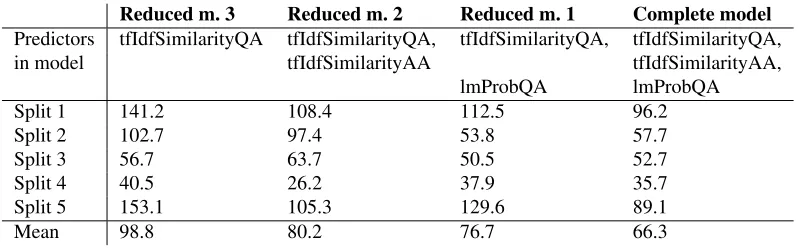
“Complete” model: tfIdfSimilarityQA, tfIdfSim-ilarityAA and lmProbQA We estimated logistic regression models on the five cross evaluation train-ing sets ustrain-ing all three features as predictors. Table 2 shows the mean ranks of the correct answer for the five evaluation runs, and an overall mean rank with the average across the five splits.
To illustrate the contribution of each of the three predictors towards the score of an answer candi-date, we provide the (relevant linear part of) the learned logistic regression equation for the “com-plete” model (trained on split 1 of the data). Note that the “answer ranker” evaluates this equation to get a score for an answer candidate A0.
Xβˆ = −8.4 + (9.5∗tfIdfSimilarityQA +
4.6∗tfIdfSimilarityAA +
1.7∗lmProbQA)
Reduced model 1: No representation of dialogue context Only the features concerning the FU Q and the answer A0 (tfIdfSimilarityQA, lmProbQA) are used as predictors in building the logistic re-gression model. The result is a model that treats every FU Q as a stand-alone question. Across the five models, the coefficient for tfIdfSimilarityQA is roughly five times the size of that for lmProbQA.
Reduced model 2: No action sequences We keep only the two TF/IDF features (tfIdfSimilari-tyQA, tfIdfSimilarityAA). This model thus does not use any features that depend on human annotation, but only fully automatic features. The coefficient learned for tfIdfSimilarityQA is generally twice as large as that for tfIdfSimilarityAA.
Reduced model 3: No dialogue context, no action sequences Considered as a baseline, this model uses a single feature (tfIdfSimilarityQA) to predict answer correctness, favoring those answer candi-dates that have the highest lexical similarity wrt. the FU Q.
5 Discussion
In order to better understand the relatively high mean ranks of the correct answer candidates across Table 2, we scrutinized the results of the answer ranker (based on all tests on the “complete” model). The distribution of the ranks of correct answers is clearly skewed; in around half of the 76 cases, the correct answer was actually ranked among the top 20 of the 529 answer candidates. However, the mean correct rank deteriorates badly due to the ranking third of cases. Analyzing these lowest-ranking cases, it appears that they are often instances of two sub-classes of topic continuation FU Qs: (i) the FU Q is context-dependent, i.e., underspecified or exhibiting reference-related discourse phenom-ena; (ii) the FU Q is a slight variation of the pre-vious question (e.g. only the wh-phrase changes, or only the object changes). This error analysis seems to suggest that it should be worthwhile to distin-guish between sub-classes of topic-continuation FU Qs, and to improve specifically how answers for the “difficult” sub-classes are ranked.
The relatively high mean ranks are also due to the fact that in our approach of acquiring dialogue data, for each FU Q we marked onlyoneanswer from the whole repository as “correct”. Again for the “com-plete” model, we checked the top 20 answer can-didates that ranked higher than the actual “correct” one. We found that in over half of the cases an an-swer that could be considered correct was among the top 20.
Reduced m. 3 Reduced m. 2 Reduced m. 1 Complete model
Predictors tfIdfSimilarityQA tfIdfSimilarityQA, tfIdfSimilarityQA, tfIdfSimilarityQA,
in model tfIdfSimilarityAA tfIdfSimilarityAA,
lmProbQA lmProbQA
Split 1 141.2 108.4 112.5 96.2
Split 2 102.7 97.4 53.8 57.7
Split 3 56.7 63.7 50.5 52.7
Split 4 40.5 26.2 37.9 35.7
Split 5 153.1 105.3 129.6 89.1
[image:6.612.107.506.56.180.2]Mean 98.8 80.2 76.7 66.3
Table 2: Mean ranks of correct A0out of 529 answer candidates, across models and training/test splits
answers to topic continuation FU Qs. Secondly, as for the role of the immediate dialogue context for providing additional clues for identifying good an-swers to FU Qs, our data show that a high lexical similarity score between A−1and A0indicates a cor-rect answer candidate. While (Yang et al., 2006) point out the importance of Q−1 to provide context information, in our experiments it was generally su-perseded by A−1.
As for the two features relating the underlying actions of A−1 and A0 (actionContinuityAA, lm-ProbAA), the picture seems less clear; in our current modeling experiments, we had not enough evidence to keep these features. However, we plan to explore the underlying idea of action-action sequences in the future, and conjecture that such information should come into its own forcontext-dependentFU Qs.
6 Future work
Besides annotating and using more dialogue data as more people talk to our IQA system, we plan to implement a state-of-the-art topic-shift detection al-gorithm as proposed in (Yang et al., 2006), train-ing and testtrain-ing it on our own FU Q data. We will attempt to improve this system by adding action-based features, and then extend it to distinguish three classes: topic shifts, (topic continuation) FU Qs that are fully specified, and (topic continuation) context-dependent FU Qs. We then plan to build dedicated logistic regression models for the differ-ent sub-classes of topic continuation FU Qs. If each model uses a specific set of predictors, we hope to improve the overall rank of correct answers across the different classes of FU Qs. Also, from compar-ing the different models, we are interested in study-ing the specific properties of different FU Q types.
References
[Agresti2002] Alan Agresti. 2002. Categorical Data Analysis. Wiley-Interscience, New York.
[Baayen2008] R. Harald Baayen. 2008. Analyzing Lin-guistic Data. Cambridge University Press.
[Bertomeu et al.2006] N´uria Bertomeu, Hans Uszkoreit, Anette Frank, Hans-Ulrich Krieger, and Brigitte J¨org. 2006. Contextual phenomena and thematic relations in database QA dialogues: results from a wizard-of-oz experiment. InProc. of the Interactive Question An-swering Workshop at HLT-NAACL 2006, pages 1–8, New York, NY.
[Dahlb¨ack and J¨onsson1989] Nils Dahlb¨ack and Arne J¨onsson. 1989. Empirical studies of discourse repre-sentations for natural language interfaces. InProc. of the 4th Conference of the European Chapter of the ACL (EACL’89), pages 291–298, Manchester, UK. [Kirschner and Bernardi2007] Manuel Kirschner and
Raffaella Bernardi. 2007. An empirical view on iqa follow-up questions. InProc. of the 8th SIGdial Workshop on Discourse and Dialogue, Antwerp, Belgium.
[McCoy and Cheng1991] Kathleen F. McCoy and Jean-nette Cheng. 1991. Focus of attention: Constraining what can be said next. In Cecile L. Paris, William R. Swartout, and William C. Mann, editors,Natural Lan-guage Generation in Artificial Intelligence and Com-putational Linguistics, pages 103–124. Kluwer Aca-demic Publishers, Norwell, MA.
[van Schooten et al.2009] Boris van Schooten, R. op den Akker, R. Rosset, O. Galibert, A. Max, and G. Illouz. 2009. Follow-up question handling in the IMIX and Ritel systems: A comparative study. Journal of Natu-ral Language Engineering, 15(1):97–118.