Generation by Inverting a Semantic Parser That Uses
Statistical Machine Translation
Yuk Wah Wong and Raymond J. Mooney
Department of Computer Sciences The University of Texas at Austin
1 University Station C0500 Austin, TX 78712-0233, USA {ywwong,mooney}@cs.utexas.edu
Abstract
This paper explores the use of statisti-cal machine translation (SMT) methods for tactical natural language generation. We present results on using phrase-based SMT for learning to map meaning repre-sentations to natural language. Improved results are obtained by inverting a seman-tic parser that uses SMT methods to map sentences into meaning representations. Finally, we show that hybridizing these two approaches results in still more accu-rate generation systems. Automatic and human evaluation of generated sentences are presented across two domains and four languages.
1 Introduction
This paper explores the use of statistical machine translation (SMT) methods in natural language gen-eration (NLG), specifically the task of mapping statements in a formalmeaning representation lan-guage(MRL) into a natural language (NL), i.e. tacti-cal generation. Given a corpus of NL sentences each paired with a formalmeaning representation(MR), it is easy to use SMT to construct a tactical gener-ator, i.e. a statistical model that translates MRL to NL. However, there has been little, if any, research on exploiting recent SMT methods for NLG.
In this paper we present results on using a re-cent phrase-based SMT system, PHARAOH (Koehn et al., 2003), for NLG.1Although moderately
effec-1
We also tried IBM Model 4/REWRITE(Germann, 2003), a word-based SMT system, but it gave much worse results.
tive, the inability of PHARAOH to exploit the for-mal structure and grammar of the MRL limits its ac-curacy. Unlike natural languages, MRLs typically have a simple, formal syntax to support effective au-tomated processing and inference. This MRL struc-ture can also be used to improve language genera-tion.
Tactical generation can also be seen as the inverse ofsemantic parsing, the task of mapping NL sen-tences to MRs. In this paper, we show how to “in-vert” a recent SMT-based semantic parser, WASP
(Wong and Mooney, 2006), in order to produce a more effective generation system. WASP exploits the formal syntax of the MRL by learning a trans-lator (based on a statistical synchronous context-free grammar) that maps an NL sentence to a lin-earized parse-tree of its MR rather than to a flat MR string. In addition to exploiting the formal MRL grammar, our approach also allows the same learned grammar to be used for both parsing and genera-tion, an elegant property that has been widely ad-vocated (Kay, 1975; Jacobs, 1985; Shieber, 1988). We present experimental results in two domains pre-viously used to test WASP’s semantic parsing abil-ity: mapping NL queries to a formal database query language, and mapping NL soccer coaching instruc-tions to a formal robot command language. WASP−1
is shown to produce a more accurate NL generator than PHARAOH.
We also show how the idea of generating from linearized parse-trees rather than flat MRs, used effectively in WASP−1, can also be exploited in
PHARAOH. A version of PHARAOH that exploits this approach is experimentally shown to produce more accurate generators that are more competi-tive with WASP−1’s. Finally, we also show how
((bowner our {4})
(do our {6} (pos (left (half our)))))
If our player 4 has the ball, then our player 6 should stay in the left side of our half.
(a) CLANG
answer(state(traverse 1(riverid(’ohio’))))
What states does the Ohio run through?
(b) GEOQUERY
Figure 1: Sample meaning representations
aspects of PHARAOH’s phrase-based model can be used to improve WASP−1, resulting in a hybrid sys-tem whose overall performance is the best.
2 MRLs and Test Domains
In this work, we consider input MRs with a hi-erarchical structure similar to Moore (2002). The only restriction on the MRL is that it be defined by an available unambiguous context-free grammar (CFG), which is true for almost all computer lan-guages. We also assume that the order in which MR predicates appear is relevant, i.e. the order can affect the meaning of the MR. Note that the order in which predicates appear need not be the same as the word order of the target NL, and therefore, the content planner need not know about the target NL grammar (Shieber, 1993).
To ground our discussion, we consider two ap-plication domains which were originally used to demonstrate semantic parsing. The first domain is ROBOCUP. In the ROBOCUP Coach Competition (www.robocup.org), teams of agents compete in a simulated soccer game and receive coach advice written in a formal language called CLANG (Chen et al., 2003). The task is to build a system that trans-lates this formal advice into English. Figure 1(a) shows a piece of sample advice.
The second domain is GEOQUERY, where a func-tional, variable-free query language is used for querying a small database on U.S. geography (Kate et al., 2005). The task is to translate formal queries into NL. Figure 1(b) shows a sample query.
3 Generation using SMT Methods
In this section, we show how SMT methods can be used to construct a tactical generator. This is in
con-trast to existing work that focuses on the use of NLG in interlingual MT (Whitelock, 1992), in which the roles of NLG and MT are switched. We first con-sider using a phrase-based SMT system, PHARAOH, for NLG. Then we show how to invert an SMT-based semantic parser, WASP, to produce a more effective generation system.
3.1 Generation using PHARAOH
PHARAOH (Koehn et al., 2003) is an SMT system that uses phrases as basic translation units. Dur-ing decodDur-ing, the source sentence is segmented into a sequence of phrases. These phrases are then re-ordered and translated into phrases in the target lan-guage, which are joined together to form the output sentence. Compared to earlier word-based methods such as IBM Models (Brown et al., 1993), phrase-based methods such as PHARAOH are much more effective in producing idiomatic translations, and are currently the best performing methods in SMT (Koehn and Monz, 2006).
To use PHARAOH for NLG, we simply treat the source MRL as an NL, so that phrases in the MRL are sequences of MR tokens. Note that the grammat-icality of MRs is not an issue here, as they are given as input.
3.2 WASP: The Semantic Parsing Algorithm
Before showing how generation can be performed by inverting a semantic parser, we present a brief overview of WASP(Wong and Mooney, 2006), the SMT-based semantic parser on which this work is based.
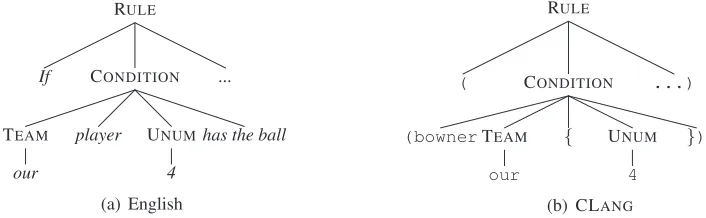
corre-RULE
If CONDITION
TEAM
our
player UNUM
4
has the ball ...
(a) English
RULE
( CONDITION
(bownerTEAM
our
{ UNUM
4
}) ...)
[image:3.612.123.476.61.170.2](b) CLANG
Figure 2: Partial parse trees for the CLANGstatement and its English gloss shown in Figure 1(a)
sponding CLANGparse from which an MR is con-structed. Note that the two parse trees are isomor-phic (ignoring terminals).
Each SCFG rule consists of a non-terminal, X, on the left-hand side (LHS), and a pair of strings,
hα, βi, on the right-hand side (RHS). The non-terminals inβare a permutation of the non-terminals inα(indices are used to show their correspondence). In WASP,α denotes an NL phrase, andX → β is a production of the MRL grammar. Below are the SCFG rules that generate the parses in Figure 2:
RULE→ hifCONDITION1 ,DIRECTIVE2 ., (CONDITION1 DIRECTIVE2)i CONDITION→ hTEAM1 playerUNUM2 has the
ball,(bownerTEAM1 {UNUM2})i
TEAM→ hour,ouri UNUM→ h4,4i
All derivations start with a pair of co-indexed start symbols of the MRL grammar,hS1, S1i, and each step involves the rewriting of a pair of co-indexed non-terminals (byα andβ, respectively). Given an input sentence,e, the task of semantic parsing is to find a derivation that yieldshe,fi, so thatfis an MR translation ofe.
Parsing with WASPrequires a set of SCFG rules. These rules are learned using a word alignment model, which finds an optimal mapping from words to MR predicates given a set of training sentences and their correct MRs. Word alignment models have been widely used for lexical acquisition in SMT (Brown et al., 1993; Koehn et al., 2003). To use a word alignment model in the semantic parsing scenario, we can treat the MRL simply as an NL, and MR tokens as words, but this often leads to poor results. First, not all MR tokens carry spe-cific meanings. For example, in CLANG,
parenthe-ses and braces are delimiters that are semantically vacuous. Such tokens can easily confuse the word alignment model. Second, MR tokens may exhibit polysemy. For example, the CLANG predicate pt has three meanings based on the types of arguments it is given (Chen et al., 2003). Judging from thept
token alone, the word alignment model would not be able to identify its exact meaning.
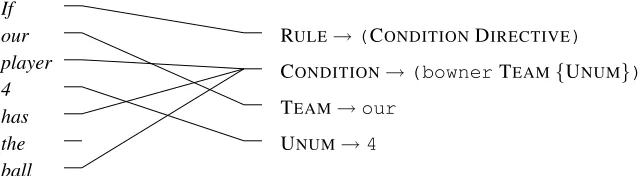
A simple, principled way to avoid these difficul-ties is to represent an MR using a list of productions used to generate it. This list is used in lieu of the MR in a word alignment. Figure 3 shows an exam-ple. Here the list of productions corresponds to the top-down, left-most derivation of an MR. For each MR there is a unique linearized parse-tree, since the MRL grammar is unambiguous. Note that the structure of the parse tree is preserved through lin-earization. This allows us to extract SCFG rules in a bottom-up manner, assuming the alignment isn-to-1
(each word is linked to at most one production). Ex-traction starts with productions whose RHS is all ter-minals, followed by those with non-terminals. (De-tails can be found in Wong and Mooney (2006).) The rules extracted from Figure 3 would be almost the same as those used in Figure 2, except the one for bowner: CONDITION→ hTEAM1 player UNUM2 has(1) ball, (bowner TEAM1 {UNUM2})i. The token(1)denotes aword gapof size 1, due to the un-aligned wordthethat comes between hasandball. It can be seen as a non-terminal that expands to at most one word, allowing for some flexibility in pat-tern matching.
RULE→(CONDITIONDIRECTIVE)
TEAM→our
UNUM→4 If
our player 4 has the ball
[image:4.612.157.478.63.151.2]CONDITION→(bownerTEAM{UNUM})
Figure 3: Partial word alignment for the CLANGstatement and its English gloss shown in Figure 1(a)
ambiguous. Therefore, a maximum-entropy model that defines the conditional probability of deriva-tions (d) given an input sentence (e) is used for dis-ambiguation:
Prλ(d|e) =
1 Zλ(e)
expX
i
λifi(d) (1)
The feature functions, fi, are the number of times each rule is used in a derivation. Zλ(e) is the normalizing factor. The model parameters, λi, are trained using L-BFGS (Nocedal, 1980) to maxi-mize the conditional log-likelihood of the training examples (with a Gaussian prior). The decoding task is thus to find a derivation d⋆ that maximizes
Prλ(d⋆|e), and the output MR translation,f⋆, is the yield ofd⋆. This can be done in cubic time with re-spect to the length ofeusing an Earley chart parser.
3.3 Generation by Inverting WASP
Now we show how to invert WASP to produce WASP−1, and use it for NLG. We can use the same grammar for both parsing and generation, a partic-ularly appealing aspect of using WASP. Since an SCFG is fully symmetric with respect to both gen-erated strings, the same chart used for parsing can be easily adapted for efficient generation (Shieber, 1988; Kay, 1996).
Given an input MR, f, WASP−1 finds a sentence
ethat maximizesPr(e|f). It is difficult to directly model Pr(e|f), however, because it has to assign low probabilities to output sentences that are not grammatical. There is no such requirement for pars-ing, because the use of the MRL grammar ensures the grammaticality of all output MRs. For genera-tion, we need an NL grammar to ensure grammati-cality, but this is not availablea priori.
This motivates the noisy-channel model for WASP−1, wherePr(e|f)is divided into two smaller
components:
arg max
e
Pr(e|f) = arg max
e
Pr(e) Pr(f|e) (2)
Pr(e) is the language model, and Pr(f|e) is the
parsing model. The generation task is to find a sen-tenceesuch that (1)eis a good sentence a priori, and (2) its meaning is the same as the input MR. For the language model, we use ann-gram model, which is remarkably useful in ranking candidate generated sentences (Knight and Hatzivassiloglou, 1995; Ban-galore et al., 2000; Langkilde-Geary, 2002). For the parsing model, we re-use the one from WASP (Equa-tion 1). Hence computing (2) means maximizing the following:
max
e Pr(
e) Pr(f|e)
≈ max
d∈D(f)Pr(
e(d)) Prλ(d|e(d))
= max
d∈D(f)
Pr(e(d))·expPiλifi(d)
Zλ(e(d))
(3)
where D(f) is the set of derivations that are con-sistent withf, and e(d) is the output sentence that a derivation d yields. Compared to most exist-ing work on generation, WASP−1has the following characteristics:
1. It does not require any lexical information in the input MR, so lexical selection is an integral part of the decoding algorithm.
2. Each predicate is translated to a phrase. More-over, it need not be a contiguous phrase (con-sider the SCFG rule forbownerin Section 3.2).
requires the order in which MR predicates appear to be fixed, i.e. the order determines the meaning of the MR. Since the order need not be identical to the word order of the target NL, there is no need for the content planner to know the target NL grammar, which is learned from the training data.
Overall, the noisy-channel model is a weighted SCFG, obtained by intersecting the NL side of the WASPSCFG with then-gram language model. The chart generator is very similar to the chart parser, ex-cept for the following:
1. To facilitate the calculation ofPr(e(d)), chart items now include a list of(n−1)-grams that encode the context in which output NL phrases appear. The size of the list is2N+ 2, whereN is the number of non-terminals to be rewritten in the dotted rule. 2. Words are generated from word gaps through special rules (g) → hα,∅i, where the word gap,
(g), is treated as a non-terminal, and α is the NL string that fills the gap (|α| ≤ g). The empty set symbol indicates that the NL string does not carry any meaning. There are similar constructs in Car-roll et al. (1999) that generate function words. Fur-thermore, to improve efficiency, our generator only considers gap fillers that have been observed during training.
3. The normalizing factor in (3),Zλ(e(d)), is not a constant and varies across the output string,e(d). (Note thatZλ(e) is fixed for parsing.) This is un-fortunate because the calculation ofZλ(e(d))is ex-pensive, and it is not easy to incorporate it into the chart generation algorithm. Normalization is done as follows. First, compute thek-best candidate out-put strings based on the unnormalized version of (3),
Pr(e(d))·expPiλifi(d). Then re-rank the list by normalizing the scores usingZλ(e(d)), which is ob-tained by running the inside-outside algorithm on each output string. This results in a decoding al-gorithm that is approximate—the best output string might not be in thek-best list—and takes cubic time with respect to the length ofeachof thekcandidate output strings (k= 100in our experiments).
Learning in WASP−1 involves two steps. First, a back-offn-gram language model with Good-Turing discounting and no lexical classes2 is built from all
2
This is to ensure that the same language model is used in all systems that we tested.
training sentences using the SRILMToolkit (Stolcke, 2002). We usen= 2since higher values seemed to cause overfitting in our domains. Next, the parsing model is trained as described in Section 3.2.
4 Improving the SMT-based Generators
The SMT-based generation algorithms, PHARAOH
and WASP−1, while reasonably effective, can be substantially improved by borrowing ideas from each other.
4.1 Improving the PHARAOH-based Generator
A major weakness of PHARAOH as an NLG
sys-tem is its inability to exploit the formal structure of the MRL. Like WASP−1, the phrase extraction al-gorithm of PHARAOH is based on the output of a
word alignment model such as GIZA++ (Koehn et al., 2003), which performs poorly when applied di-rectly to MRLs (Section 3.2).
We can improve the PHARAOH-based generator by supplying linearized parse-trees as input rather than flat MRs. As a result, the basic translation units are sequences of MRL productions, rather than se-quences of MR tokens. This way PHARAOH can exploit the formal grammar of the MRL to produce high-quality phrase pairs. The same idea is used in WASP−1 to produce high-quality SCFG rules. We call the resulting hybrid NLG system PHARAOH++.
4.2 Improving the WASP-based Generator
There are several aspects of PHARAOH that can be used to improve WASP−1. First, the probabilistic
model of WASP−1 is less than ideal as it requires an extra re-ranking step for normalization, which is expensive and prone to over-pruning. To remedy this situation, we can borrow the probabilistic model of PHARAOH, and define the parsing model as:
Pr(d|e(d)) = Y d∈d
w(r(d)) (4)
which is the product of the weights of the rules used in a derivationd. The rule weight,w(X → hα, βi), is in turn defined as:
P(β|α)λ1P(α|β)λ2P
w(β|α) λ3P
w(α|β)
λ4exp(−|α|)λ5
the lexical weights (Koehn et al., 2003). The word penalty, exp(−|α|), allows some control over the output sentence length. Together with the language model, the new formulation of Pr(e|f) is a log-linear model withλi as parameters. The advantage of this model is that maximization requires no nor-malization and can be done exactly and efficiently. The model parameters are trained using minimum error-rate training (Och, 2003).
Following the phrase extraction phase in PHARAOH, we eliminate word gaps by
incorpo-rating unaligned words as part of the extracted NL phrases (Koehn et al., 2003). The reason is that while word gaps are useful in dealing with unknown phrases during semantic parsing, for generation, using knownphrases generally leads to better fluency. For the same reason, we also allow the extraction of longer phrases that correspond to multiple predicates (but no more than 5).
We call the resulting hybrid system WASP−1++. It is similar to the syntax-based SMT system of Chi-ang (2005), which uses both SCFG and PHARAOH’s probabilistic model. The main difference is that we use the MRL grammar to constrain rule extraction, so that significantly fewer rules are extracted, mak-ing it possible to do exact inference.
5 Experiments
We evaluated all four SMT-based NLG systems in-troduced in this paper: PHARAOH, WASP−1, and the hybrid systems, PHARAOH++ and WASP−1++.
We used the ROBOCUPand GEOQUERYcorpora in our experiments. The ROBOCUPcorpus consists of 300 pieces of coach advice taken from the log files of the 2003 ROBOCUPCoach Competition. The ad-vice was written in CLANGand manually translated
to English (Kuhlmann et al., 2004). The average MR length is 29.47 tokens, or 12.82 nodes for lin-earized parse-trees. The average sentence length is 22.52. The GEOQUERYcorpus consists of 880 En-glish questions gathered from various sources. The questions were manually translated to the functional GEOQUERY language (Kate et al., 2005). The av-erage MR length is 17.55 tokens, or 5.55 nodes for linearized parse-trees. The average sentence length is 7.57.
Reference: If our player 2, 3, 7 or 5 has the ball and the ball is close to our goal line ...
PHARAOH++:If player 3 has the ball is in 2 5 the ball is in the area near our goal line ...
WASP−1++: If players 2, 3, 7 and 5 has the ball and the ball is near our goal line ...
Figure 4: Sample partial system output in the ROBOCUPdomain
ROBOCUP GEOQUERY
BLEU NIST BLEU NIST
PHARAOH 0.3247 5.0263 0.2070 3.1478 WASP−1 0.4357 5.4486 0.4582 5.9900
PHARAOH++ 0.4336 5.9185 0.5354 6.3637 WASP−1++ 0.6022 6.8976 0.5370 6.4808
Table 1: Results of automatic evaluation;boldtype indicates the best performing system (or systems) for a given domain-metric pair (p <0.05)
5.1 Automatic Evaluation
We performed 4 runs of 10-fold cross validation, and measured the performance of the learned generators using the BLEUscore (Papineni et al., 2002) and the NIST score (Doddington, 2002). Both MT metrics
measure the precision of a translation in terms of the proportion ofn-grams that it shares with the refer-ence translations, with the NISTscore focusing more
onn-grams that are less frequent and more informa-tive. Both metrics have recently been used to eval-uate generators (Langkilde-Geary, 2002; Nakanishi et al., 2005; Belz and Reiter, 2006).
All systems were able to generate sentences for more than 97% of the input. Figure 4 shows some sample output of the systems. Table 1 shows the automatic evaluation results. Paired t-tests were used to measure statistical significance. A few observations can be made. First, WASP−1
pro-duced a more accurate generator than PHARAOH. Second, PHARAOH++ significantly outperformed PHARAOH, showing the importance of exploiting
the formal structure of the MRL. Third, WASP−1++ significantly outperformed WASP−1. Most of the gain came from PHARAOH’s probabilistic model.
Decoding was also 4–11 times faster, despite ex-act inference and a larger grammar due to extrac-tion of longer phrases. Lastly, WASP−1++
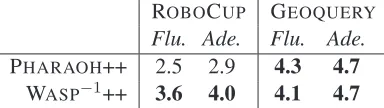
ROBOCUP GEOQUERY Flu. Ade. Flu. Ade.
PHARAOH++ 2.5 2.9 4.3 4.7 WASP−1++ 3.6 4.0 4.1 4.7
Table 2: Results of human evaluation
domain. This is because WASP−1++ allows
dis-contiguous NL phrases and PHARAOH++ does not. Such phrases are commonly used in ROBOCUP
for constructions like: players 2 , 3 , 7 and 5; 26.96% of the phrases generated during testing were discontiguous. When faced with such predicates, PHARAOH++ would consistently omit some of the
words: e.g.players2 3 7 5, or not learn any phrases for those predicates at all. On the other hand, only 4.47% of the phrases generated during testing for GEOQUERYwere discontiguous, so the advantage of WASP−1++ over PHARAOH++ was not as obvious.
Our BLEU scores are not as high as those re-ported in Langkilde-Geary (2002) and Nakanishi et al. (2005), which are around 0.7–0.9. However, their work involves the regeneration of automati-cally parsed text, and the MRs that they use, which are essentially dependency parses, contain extensive lexical information of the target NL.
5.2 Human Evaluation
Automatic evaluation is only an imperfect substitute for human assessment. While it is found that BLEU
and NISTcorrelate quite well with human judgments
in evaluating NLG systems (Belz and Reiter, 2006), it is best to support these figures with human evalu-ation, which we did on a small scale. We recruited 4 native speakers of English with no previous experi-ence with the ROBOCUPand GEOQUERY domains. Each subject was given the same 20 sentences for each domain, randomly chosen from the test sets. For each sentence, the subjects were asked to judge the output of PHARAOH++ and WASP−1++ in terms
of fluency and adequacy. They were presented with the following definition, adapted from Koehn and Monz (2006):
Score Fluency Adequacy
5 Flawless English All meaning 4 Good English Most meaning 3 Non-native English Some meaning
PHARAOH++ WASP−1++ BLEU NIST BLEU NIST English 0.5344 5.3289 0.6035 5.7133
Spanish 0.6042 5.6321 0.6175 5.7293
Japanese 0.6171 4.5357 0.6585 4.6648
[image:7.612.323.530.60.141.2]Turkish 0.4562 4.2220 0.4824 4.3283
Table 3: Results of automatic evaluation on the mul-tilingual GEOQUERYdata set
Score Fluency Adequacy
2 Disfluent English Little meaning 1 Incomprehensible No meaning
For each generated sentence, we computed the av-erage of the 4 human judges’ scores. No score normalization was performed. Then we compared the two systems using a paired t-test. Table 2 shows that WASP−1++ produced better generators than PHARAOH++ in the ROBOCUP domain, con-sistent with the results of automatic evaluation.
5.3 Multilingual Experiments
Lastly, we describe our experiments on the mul-tilingual GEOQUERY data set. The 250-example data set is a subset of the larger GEOQUERY cor-pus. All English questions in this data set were manually translated into Spanish, Japanese and Turkish, while the corresponding MRs remain un-changed. Table 3 shows the results, which are sim-ilar to previous results on the larger GEOQUERY
corpus. WASP−1++ outperformed PHARAOH++ for some language-metric pairs, but otherwise per-formed comparably.
6 Related Work
[image:7.612.89.281.61.115.2]White and Baldridge (2003) for CCG. More re-cently, statistical chart generators have emerged, in-cluding White (2004) for CCG, Carroll and Oepen (2005) and Nakanishi et al. (2005) for HPSG. Many of these systems, however, focus on the task of sur-face realization—inflecting and ordering words— which ignores the problem of lexical selection. In contrast, our SMT-based methods integrate lexical selection and realization in an elegant framework and automatically learn all of their linguistic knowl-edge from an annotated corpus.
7 Conclusion
We have presented four tactical generation systems based on various SMT-based methods. In particular, the hybrid system produced by inverting the WASP
semantic parser shows the best overall results across different application domains.
Acknowledgments
We would like to thank Kevin Knight, Jason Baldridge, Razvan Bunescu, and the anonymous re-viewers for their valuable comments. We also sin-cerely thank the four annotators who helped us eval-uate the SMT-based generators. This research was supported by DARPA under grant HR0011-04-1-0007 and a gift from Google Inc.
References
A. V. Aho and J. D. Ullman. 1972.The Theory of Parsing, Translation, and Compiling. Prentice Hall, Englewood Cliffs, NJ.
S. Bangalore, O. Rambow, and S. Whittaker. 2000. Evaluation metrics for generation. InProc. INLG-00, pages 1–8, Mitzpe Ramon, Israel, July.
A. Belz and E. Reiter. 2006. Comparing automatic and human evalu-ation of NLG systems. InProc. EACL-06, pages 313–320, Trento, Italy, April.
P. F. Brown, V. J. Della Pietra, S. A. Della Pietra, and R. L. Mercer. 1993. The mathematics of statistical machine translation: Parameter estimation.Computational Linguistics, 19(2):263–312, June.
J. Carroll and S. Oepen. 2005. High efficiency realization for a wide-coverage unification grammar. InProc. IJCNLP-05, pages 165–176, Jeju Island, Korea, October.
J. Carroll, A. Copestake, D. Flickinger, and V. Pozna´nski. 1999. An efficient chart generator for (semi-)lexicalist grammars. In Proc. EWNLG-99, pages 86–95, Toulouse, France.
M. Chen et al. 2003. Users manual: RoboCup soccer server man-ual for soccer server version 7.07 and later. Available athttp: //sourceforge.net/projects/sserver/.
D. Chiang. 2005. A hierarchical phrase-based model for statistical machine translation. InProc. ACL-05, pages 263–270, Ann Arbor, MI, June.
G. Doddington. 2002. Automatic evaluation of machine translation quality using n-gram co-occurrence statistics. InProc. ARPA Work-shop on Human Language Technology, pages 128–132, San Diego, CA.
U. Germann. 2003. Greedy decoding for statistical machine translation in almost linear time. InProc. HLT/NAACL-03, Edmonton, Canada.
P. S. Jacobs. 1985. PHRED: A generator for natural language inter-faces.Computational Linguistics, 11(4):219–242.
R. J. Kate, Y. W. Wong, and R. J. Mooney. 2005. Learning to transform natural to formal languages. InProc. AAAI-05, pages 1062–1068, Pittsburgh, PA, July.
M. Kay. 1975. Syntactic processing and functional sentence per-spective. InTheoretical Issues in Natural Language Processing— Supplement to the Proceedings, pages 12–15, Cambridge, MA, June.
M. Kay. 1996. Chart generation. InProc. ACL-96, pages 200–204, San Francisco, CA.
K. Knight and V. Hatzivassiloglou. 1995. Two-level, many-paths gen-eration. InProc. ACL-95, pages 252–260, Cambridge, MA.
P. Koehn and C. Monz. 2006. Manual and automatic evaluation of machine translation between European languages. InProc. SMT-06 Workshop, pages 102–121, New York City, NY, June.
P. Koehn, F. J. Och, and D. Marcu. 2003. Statistical phrase-based translation. InProc. HLT/NAACL-03, Edmonton, Canada.
G. Kuhlmann, P. Stone, R. J. Mooney, and J. W. Shavlik. 2004. Guiding a reinforcement learner with natural language advice: Initial results in RoboCup soccer. InProc. of the AAAI-04 Workshop on Supervi-sory Control of Learning and Adaptive Systems, San Jose, CA, July.
I. Langkilde-Geary. 2002. An empirical verification of coverage and correctness for a general-purpose sentence generator. InProc. INLG-02, pages 17–24, Harriman, NY, July.
R. C. Moore. 2002. A complete, efficient sentence-realization algo-rithm for unification grammar. InProc. INLG-02, pages 41–48, Harriman, NY, July.
H. Nakanishi, Y. Miyao, and J. Tsujii. 2005. Probabilistic models for disambiguation of an HPSG-based chart generator. InProc. IWPT-05, pages 93–102, Vancouver, Canada, October.
J. Nocedal. 1980. Updating quasi-Newton matrices with limited stor-age.Mathematics of Computation, 35(151):773–782, July.
F. J. Och and H. Ney. 2003. A systematic comparison of various statis-tical alignment models.Computational Linguistics, 29(1):19–51.
F. J. Och. 2003. Minimum error rate training in statistical machine translation. InProc. ACL-03, pages 160–167, Sapporo, Japan, July.
K. Papineni, S. Roukos, T. Ward, and W. J. Zhu. 2002. BLEU: a method for automatic evaluation of machine translation. InProc. ACL-02, pages 311–318, Philadelphia, PA, July.
S. M. Shieber. 1988. A uniform architecture for parsing and generation. InProc. COLING-88, pages 614–619, Budapest, Hungary.
S. M. Shieber. 1993. The problem of logical-form equivalence. Com-putational Linguistics, 19(1):179–190.
A. Stolcke. 2002. SRILM—an extensible language modeling toolkit. InProc. ICSLP-02, pages 901–904, Denver, CO.
M. White and J. Baldridge. 2003. Adapting chart realization to CCG. InProc. EWNLG-03, Budapest, Hungary, April.
M. White. 2004. Reining in CCG chart realization. InProc. INLG-04, New Forest, UK, July.
P. Whitelock. 1992. Shake-and-bake translation. InProc. COLING-92, pages 784–791, Nantes, France.