Coreference or Not: A Twin Model for Coreference Resolution
Xiaoqiang Luo
IBM T.J. Watson Research Center
1101 Kitchawan Road
Yorktown Heights, NY 10598, U.S.A.
{xiaoluo}@us.ibm.com
Abstract
A twin-model is proposed for coreference res-olution: a link component, modeling the coref-erential relationship between an anaphor and a candidate antecedent, and a creation com-ponent modeling the possibility that a phrase is not coreferential with any candidate an-tecedent. The creation model depends on all candidate antecedents and is often expensive to compute; Therefore constraints are imposed on feature forms so that features in the cre-ation model can be efficiently computed from feature values in the link model. The pro-posed twin-model is tested on the data from the 2005 Automatic Content Extraction (ACE) task and the proposed model performs bet-ter than a thresholding baseline without tuning free parameter.
1
Introduction
Coreference resolution aims to find multiple mentions of an entity (e.g., PERSON, ORGANIZATION) in a document. In a typical machine learning-based coref-erence resolution system (Soon et al., 2001; Ng and Cardie, 2002b; Yang et al., 2003; Luo et al., 2004), a statistical model is learned from training data and is used to measure how likely an anaphor1 is
corefer-ential to a candidate antecedent. A related, but often overlooked, problem is that the anaphor may be non-coreferential to any candidate, which arises from sce-narios such as an identified anaphor is truly generic and
1In this paper, “anaphor” includes all kinds of phrases to
be resolved, which can be named, nominal or pronominal phrases.
there does not exist an antecedent in the discourse con-text, or an anaphor is the first mention (relative to pro-cessing order) in a coreference chain.
In (Soon et al., 2001; Ng and Cardie, 2002b), the problem is treated by thresholding the scores re-turned by the coreference model. That is, if the max-imum coreference score is below a threshold, then the anaphor is deemed non-referential to any candidate an-tecedent. The threshold approach does not model non-coreferential events directly, and is by no means the op-timal approach to the problem. It also introduces a free parameter which has to be set by trial-and-error. As an improvement, Ng and Cardie (2002a) and Ng (2004) train a separate model to classify an anaphor as either
anaphoric or non-anaphoric. The output of this
clas-sifier can be used either as a pre-filter (Ng and Cardie, 2002a) so that non-anaphoric anaphors will not be pre-cessed in the coreference system, or as a set of features in the coreference model (Ng, 2004). By rejecting any anaphor classified as non-anaphoric in coreference res-olution, the filtering approach is meant to handle non-anaphoric phrases (i.e., no antecedent exists in the dis-course under consideration), not the first mention in a coreference chain.
non-coreferential events. Both models are trained automat-ically and are used simultaneously in the coreference system. The twin-model coreference system is tested on the 2005 ACE (Automatic Content Extraction, see (NIST, 2005)) data and the best performance under both ACE-Value and entity F-measure can be obtained without tuning a free parameter.
The rest of the paper is organized as follows. The twin-model is presented in Section 2. A maximum-entropy implementation and features are then presented in Section 3. The experimental results on the 2005 ACE data is presented in Section 4. The proposed twin-model is compared with related work in Section 5 be-fore the paper is concluded.
2
Coreference Model
A phrasal reference to an entity is called a mention. A set of mentions referring to the same physical object is said to belong to the same entity. For example, in the following sentence:
(I) John said Mary was his sister. there are four mentions: John, Mary, his, and sister. John andhisbelong to the same entity since they refer to the same person; So doMaryand sister. Furthermore, Johnand Maryare named mentions,sisteris a nominal mention andhisis a
pronominal mention.
In our coreference system, mentions are processed sequentially, though not necessarily in chronological order. For a document withnmentions{mi: 1≤i≤
n}, at any timet(t > 1), mentionm1 throughmt−1
have been processed and each mention is placed in one ofNt(Nt≤(t−1))entities:Et ={ej: 1≤j≤Nt}. Index i inmi indicates the order in which it is pro-cessed, not necessarily the order in which it appears in a document. The basic step is to extendEt toEt+1
withmt.
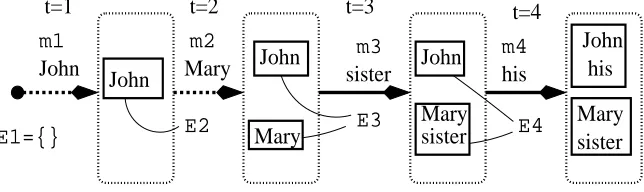
Let us use the example in Figure 1 to illustrate how this is done. Note that Figure 1 contains one possible processing order for the four mentions in Example (I): first name mentions are processed, followed by nom-inal mentions, followed by pronomnom-inal mentions. At timet= 1, there is no existing entity and the mention
m1=Johnis placed in an initial entity (entity is
signi-fied by a solid rectangle). At time t = 2,m2=Mary
is processed and a new entity containingMaryis cre-ated. At timet= 3, the nominal mentionm3=sister
is processed. At this point, the set of existing entities
E3=
n
{John},{Mary}o.
m3 is linked with the existing entity{Mary}. At the
last stept = 4, the pronominal mentionhisis linked with the entity{John}.
The above example illustrates how a sequence of coreference steps lead to a particular coreference result. Conversely, if the processing order is known and fixed, every possible coreference result can be decomposed and mapped to a unique sequence of such coreference steps. Therefore, if we can score the set of coreference sequences, we can score the set of coreference results as well.
In general, when determining if a mention mt is coreferential with any entity inEt, there are two types of actions: one is thatmt is coreferential with one of the entities; The other is that mt is not coreferential with any. It is important to distinguish the two cases for the following reason: ifmtis coreferential with an entityej, in most cases it is sufficient to determine the relationship by examiningmt andej, and their local context; But ifmtis not coreferential with any existing entities, we need to considermt with all members in
Et. This observation leads us to propose the following twin-model for coreference resolution.
The first model,P(L|ej, mt), is conditioned on an entityejand the current mentionmtand measure how likely they are coreferential.Lis a binary variable, tak-ing value 1 or 0, which represents positive and nega-tive coreferential relationship, respecnega-tively. The second model, on the other hand,P(C|Et, mt), is conditioned on the past entitiesEtand the current mentionmt. The random variableCis also binary: whenCis1, it means that a new entity{mt}will be created. In other words, the second model measures the probability thatmt is
not coreferential to any existing entity. To avoid
con-fusion in the subsequent presentation, the first model will be written asPl(·|ej, mt)and called link model; The second model is written asPc(·|Et, mt)and called
creation model.
For the time being, let’s assume that we have the link and creation model at our disposal, and we will show how they can be used to score coreference decisions.
Given a set of existing entitiesEt ={ej}N1t, formed
by mentions {mi}t−1
i=1, and the current mention mt, there areNt + 1possible actions: we can either link
cre-John
John
Mary
John
Mary
sister
John
his
Mary
sister
John
Mary
sister
his
t=1
t=2
t=3
t=4
E1={}
m3
m4
m2
m1
E3
[image:3.612.74.396.64.160.2]E2
E4
Figure 1: Coreference process for the four mentions in Example (I). Mentions in a document are processed se-quentially: first name mentions, then nominal mentions, and then pronominal mentions. A dashed arrow signifies that a new entity is created, while a solid arrow means that the current mention is linked with an existing entity.
ation model Pc(·|Et, mt). Denote the score for ac-tion at by S(at|a1t−1), where dependency of at on
a1 throughat−1 is emphasized. The coreference
re-sult corresponding to the action sequence is written as
En({ai}ni=1). When it is clear from context, we will
drop{ai}n
i=1and writeEnonly.
With this notation, the score for a coreference out-comeEn({ai}ni=1)is the product of individual scores
assigned to the corresponding action sequence{ai}n i=1,
and the best coreference result is the one with the high-est score:
ˆ
En=argmax En
S(En)
=argmax {at}n1
n
Y
t=1
S(at|at1−1). (1)
Given n mentions, the number of all possible entity outcomes is the Bell Number (Bell, 1934):
B(n) =1
e
P∞
k=0k
n
k!. Exhaustive search is out of the
question. Thus, we organize hypotheses into a Bell Tree (Luo et al., 2004) and use a beam search with the following pruning strategy: first, a maximum beam size (typically 20)Sis set, and we keep only the topS hy-potheses; Second, a relative thresholdr(we use10−5)
is set to prune any hypothesis whose score divided by the maximum score falls below the threshold.
To give an concrete example, we use the example in Figure 1 again. The first step at t = 1 creates a new entity and is therefore scored byPc(1|{},John); the second step also creates an entity and is scored by Pc(1|{John},Mary); the step t = 3, how-ever, links sister with {Mary} and is scored by
Pl(1|{Mary},sister); Similarly, the last step is scored by Pl(1|{John},his). The score for this coreference outcome is the product of the four
num-bers:
S(n{John,his},{Mary,sister}o) =Pc(1|{},John)Pc(1|{John},Mary)·
Pl(1|{Mary},sister)·
Pl(1|{John},his). (2) Other coreference results for these four mentions can be scored similarly. For example, if his at the last step is linked with{Mary,sister}, the score would be:
S(n{John},{Mary,sister,his}o) =Pc(1|{},John)Pc(1|{John},Mary)·
Pl(1|{Mary},sister)·
Pl(1|{Mary,sister},his). (3) At testing time, (2) and (3), among other possible out-comes, will be searched and compared, and the one with the highest score will be output as the coreference result.
Examples in (2) and (3) indicate that the link model
Pl(·|ej, mt)and creation modelPc(·|Et, mt)form an integrated coreference system and are applied simul-taneously at testing time. As will be shown in the next section, features in the creation modelPc(·|Et, mt)can be computed from their counterpart in the link model
in (Luo et al., 2004). But there is a crucial differ-ence: the starting model in (Luo et al., 2004) is an ad-hoc use of the link scores and is not learned auto-matically, whilePc(·|Et, mt)is fully trained. Training
Pc(·|Et, mt)is covered in the next section.
3
Implementation
3.1 Feature Structure
To implement the twin model, we adopt the log linear or maximum entropy (MaxEnt) model (Berger et al., 1996) for its flexibility of combining diverse sources of information. The two models are of the form:
Pl(L|ej, mt) =
expP
kλkgk(ej, mt, L)
Y(ej, mt)
(4)
Pc(C|Et, mt) =
expP
iνihi(Et, mt, C)
Z(Et, mt)
, (5)
whereL andC are binary variables indicating either
mt is coreferential withej, ormt is used to create a new entity.Y(ej, mt)andZ(ej, mt)are normalization factors to ensure thatPl(·|ej, mt)andPc(·|Et, mt)are probabilities; λk and νi are the weights for feature
gk(ej, mt, L) and hi(Et, mt, C), respectively. Once the set of features functions are selected, algorithm such as improved iterative scaling (Berger et al., 1996) or sequential conditional generalized iterative scal-ing (Goodman, 2002) can be used to find the optimal parameter values of{λk}and{νi}.
Computing features {gk(ej, mt,·)} for the link model Pl(L|ej, mt) 2 is relatively straightforward: given an entity ej and the current mention mt, we just need to characterize things such as lexical similar-ity, syntactic relationship, and/or semantic compatibil-ity of the two. It is, however, very challenging to com-pute the features{hi(Et, mt,·)}for the creation model
Pc(·|Et, mt)since its conditioning includes a set of en-titiesEt, whose size grows as more and more mentions are processed. The problem exists because the decision of creating a new entity withmt has to be made after examining all preceding entities. There is no reason-able modeling assumption one can make to drop some entities in the conditioning.
To overcome the difficulty, we impose the follow-ing constraints on the features of the link and creation
2
The link model is actually implemented as:
Pl(L|ej, mt) ≈ maxm0∈ejPˆl(L|ej, m
0
, mt). Some features are computed on a pair of mentions(m0
, mt)while some are computed at entity level. See (Luo and Zitouni, 2005) and (Daum´e III and Marcu, 2005).
model:
gk(ej, mt, L) =g(1)k (ej, mt)gk(2)(L) (6)
hi(Et, mt, C) =h(1)i {g
(1)
k (e, mt) :e∈Et}
·
h(2)i (C), for somek. (7)
(6) states that a feature in the link model is separable and can be written as a product of two functions: the first one,g(1)k (·,·), is a binary function depending on the conditioning part only; the second one,g(2)k (·), is an indicator function depending on the prediction part
Lonly. Likeg(2)k (·),h(2)i (·)is also a binary indicator function.
(7) implies that features in the creation model are also separable; Moreover, the conditioning part
h(1)i {g
(1)
k (e, mt) : e ∈ Et}
, also a binary function, only depends on the function values of the set of link features{gk(1)(e, mt) :e∈Et}(for somek). In other words, once{gk(1)(e, mt) :e∈Et}andCare known, we can computehi(Et, mt, C)without actually com-paringmtwith any entity inEt. Using binary features is a fairly mild constraint as non-binary features can be replaced by a set of binary features through quantiza-tion.
How fasth(1)i {gk(1)(e, mt) :e∈Et}
can be
com-puted depends on howh(1)i is defined. In most cases – as will be shown in Section 3.2, it boils down test-ing if any member in{g(1)k (e, mt) : e ∈ Et}is non-zero; or counting how many non-zero members there are in {g(1)k (e, mt) : e ∈ Et}. Both are simple op-erations that can be carried out quickly. Thus, the as-sumption (7) makes it possible to compute efficiently
hi(Et, mt, C).
3.2 Features in the Creation Model
We describe features used in our coreference system. We will concentrate on features used in the creation model since those in the link model can be found in the literature (Soon et al., 2001; Ng and Cardie, 2002b; Yang et al., 2003; Luo et al., 2004). In particular, we show how features in the creation model can be computed from a set of feature values from the link model for a few example categories. Sincegk(2)(·)and
h(2)i (·)are simple indicator functions, we will focus on
gk(1)(·,·)andh(1)i (·).
3.2.1 Lexical Features
applied to name and nominal mentions only. For the link model, a lexical featureg(1)k (ej, mt)is 1 ifej con-tains a mention matchesmt, where a match can be ex-act, partial, or one is an acronym of the other.
Since gk(ej, mt) is binary, one corresponding fea-ture used in the creation model is the disjunction of the values in the link model, or
h(1)i (Et, mt) =∨e∈Et{g
(1)
k (e, mt)}, (8) where∨is a binary “or” operator. The intuition is that if there is any mention in Et matchingmt, then the probability to create a new entity with mt should be low; Conversely, if none of the mentions inEtmatches
mt, thenmt is likely to be the first mention of a new entity.
Taket = 2in Figure 1 as an example. There is only one partially-established entity{John}, soE2=
{John}, and m2 = Mary. The exact string match
featuregem(1)(·,·)would be
g(1)em({John},Mary) = 0,
and the corresponding string match feature in the cre-ation model is
h(1)em({John},Mary) =∨e∈Et{g
(1)
em(e,Mary)}
= 0.
Disjunction is not the only operation we can use. Another possibility is counting how many times mt matches mentions inEt, so (8) becomes:
h(1)i (Et, mt) =Q X e∈Et
{g(1)k (e, mt)}, . (9)
whereQ[·]quantizes raw counts into bins.
3.2.2 Attribute Features
In the link model, features in this category compare the properties of the current mentionmtwith that of an entityej. Properties of a mention or an entity, when-ever applicable, include gender, number, entity type, reflexivity of pronouns etc. Similar to what done in the lexical feature, we again synthesize a feature in the creation model by taking the disjunction of the corre-sponding set of feature values in the link model, or
h(1)i (Et, mt) =∨e∈Et{g
(1)
k (e, mt)},
wheregk(1)(e, mt)takes value 1 if entityeand mention
mt share the same property; Otherwise its value is 0. The intuition is that if there is an entity having the same
property as the current mention, then the probability for the current mention to be linked with the entity should be higher than otherwise; Conversely, if none of the en-tities inEtshares a property with the current mention, the probability for the current mention to create a new entity ought to be higher.
Consider the gender attribute at t = 4 in Fig-ure 1. Let g(1)gender(·,·) be the gender feature in the link model, assume that we know the gender ofJohn, Mary andhis. Theng(1)gender({{John},his)is 1, whileg(1)gender({Mary, sister},his)is 0. There-fore, the gender feature for the creation model would be
h(1)gender(
{John},{Mary, sister} ,his) =0∨1 = 1,
which means that there is at least one mention which has the same the gender of the current mentionmt.
3.2.3 Distance Feature
Distance feature needs special treatment: while it makes sense to talk about the distance between a pair of mentions, it is not immediately clear how to compute the distance between a set of entitiesEtand a mention
mt. To this end, we compute the minimum distance be-tween the entities and the current mention with respect to a “fired” link feature, as follows.
For a particular featuregk(1)(·,·)in the link model, define the minimum distance to be
ˆ
d(Et, mt;gk) = min{d(m, mt) :m∈Et,
andgk(1)(m, mt) = 1}, (10)
whered(m, mt)is the distance between mentionmand
mt. The distance itself can be the number of tokens, or the number of intervening mentions, or the number of sentences. The minimum distancedˆ(Et, mt;gk)is quantized and represented as binary feature in the cre-ation model. The idea here is to encode what is the nearest place where a feature fires.
Again as an example, consider the gender attribute at
t= 4in Figure 1. Assuming thatd(m, mt)is the num-ber of tokens. Since onlyJohnmatches the gender of his,
ˆ
d(E4, m4;ggender) = 3.
In general, binary features in the link model which measure the similarity between an entity and a mention can be turned into features in the creation model in the same manner as described in Section 3.2.1 and 3.2.2. For example, syntactic features (Ng and Cardie, 2002b; Luo and Zitouni, 2005) can be computed this way and are used in our system.
4
Experiments
4.1 Data and Evaluation Metric
We report the experimental results on ACE 2005 data (NIST, 2005). The dataset consists of 599 doc-uments from a rich and diversified sources, which in-clude newswire articles, web logs, and Usenet posts, transcription of broadcast news, broadcast conversa-tions and telephone conversaconversa-tions. We reserve the last 16%documents of each source as the test set and use the rest of the documents as the training set. Statistics such as the number of documents, words, mentions and entities of this data split is tabulated in Table 1.
DataSet #Docs #Words #Mentions #Entities
Training 499 253771 46646 16102
Test 100 45659 8178 2709
Total 599 299430 54824 18811
Table 1: Statistics of ACE 2005 data: number of docu-ments, words, mentions and entities in the training and test set.
The link and creation model are trained at the same time. Besides the basic feature categories described in Section 3.2, we also compute composite features by taking conjunctions of the basic features. Features are selected by their counts with a threshold of 8.
ACE-Value is the official score reported in the ACE task and will be used to report our coreference system’s performance. Its detailed definition can be found in the official evaluation document3. Since ACE-Value is a
weighted metric measuring a coreference system’s rel-ative value, and it is not sensitive to certain type of errors (e.g., false-alarm entities if these entities con-tain correct mentions), we also report results using un-weighted entity F-measure.
4.2 Results
To compare the proposed twin model with simple thresholding (Soon et al., 2001; Ng and Cardie, 2002b),
3The official evaluation document can be found at: www.nist.gov/speech/tests/ace/ace05/doc/ ace05-evalplan.v3.pdf.
55 60 65 70 75 80 85 90 95
0.1 0.2 0.3 0.4 0.5 0.6 0.7 0.8 0.9
Performance
Threshold Performances vs. Threshold
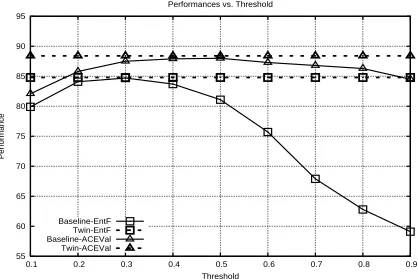
[image:6.612.311.520.67.207.2]Baseline-EntF Twin-EntF Baseline-ACEVal Twin-ACEVal
Figure 2: Performance comparison between a thresh-olding baseline and the twin-model: lines with square points are the entity F-measure (x100) results; lines with triangle points are ACE-Value (in %). Solid lines are baseline while dashed lines are twin-model.
we first train our twin model. To simulate the thresh-olding approach, a baseline coreference system is cre-ated by replacing the creation model with a constant, i.e.,
Pc(1|Et, mt) =θ, (11)
whereθis a number between 0 and 1. At testing time, a new entity is created with scoreθwhen
Pl(1|ej, mt)< θ, ∀ej∈Et.
The decision rule simply implies that if the scores be-tween the current mentionmtand all candidate entities
ej∈Etare below the thresholdθ, a new entity will be created.
Performance comparison between the baseline and the twin-model is plotted in Figure 2. X-axis is the threshold varying from 0.1 to 0.9 with a step size 0.1. Two metrics are used to compare the results: two lines with square data points are the entity F-measure results, and two lines with triangle points are ACE-Value. Note that performances for the twin-model are constant since it does not use thresholding.
the twin model F-measure is 0.848, a43.5%difference; On the other hand, the corresponding ACE-Values are 84.5% (baseline) vs. 88.4% (twin model), a mere4.6% relative difference. There are at least two reasons: first, ACE-Value discounts importance of nominal and pro-noun entities, so more nominal and propro-noun entity er-rors are not reflected in the metric; Second, ACE-Value does not penalize false-alarm entities if they contain correct mentions. The problem associated with ACE-Value is the reason we include the entity F-measure re-sults.
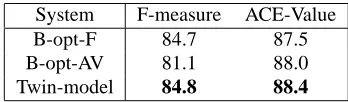
Another interesting observation is that an optimal threshold for the entity F-measure is not necessarily op-timal for ACE-Value, and vice versa: θ = 0.3is the best threshold for the entity F-measure, whileθ= 0.5 is optimal for ACE-Value. This is highlighted in Ta-ble 2, where row “B-opt-F” contains the best results op-timizing the entity F-measure (atθ= 0.3), row “B-opt-AV” contains the best results optimizing ACE-Value (at
θ = 0.5), and the last line “Twin-model” contains the results of the proposed twin-model. It is clear from Table 2 that thresholding cannot be used to optimize the entity F-measure and ACE-Value simultaneously. A sub-optimal threshold could be detrimental to an un-weighted metric such as the entity F-measure. The pro-posed twin model eliminates the need for threshold-ing, a benefit of using the principled creation model. In practice, the optimal threshold is a free parameter that has to be tuned every time when a task, dataset and model changes. Thus the proposed twin model is more portable when a task or dataset changes.
System F-measure ACE-Value
B-opt-F 84.7 87.5
B-opt-AV 81.1 88.0
[image:7.612.93.267.443.494.2]Twin-model 84.8 88.4
Table 2: Comparison between the thresholding base-line and the twin model: optimal threshold depends on performance metric. The proposed twin-model outper-forms the baseline without tuning the free parameter.
5
Related Work
Some earlier work (Lappin and Leass, 1994; Kennedy and Boguraev, 1996) use heuristic to determine whether a phrase is anaphoric or not. Bean and Riloff (1999) extracts rules from non-anaphoric noun phrases and noun phrases patterns, which are then applied to test data to identify existential noun phrases. It is in-tended as as pre-filtering step before a coreference
res-olution system is run. Ng and Cardie (2002a) trains a separate anaphoricity classifier in addition to a corefer-ence model. The anaphoricity classifier is applied as a filter and only anaphoric mentions are later considered by the coreference model. Ng (2004) studies what is the best way to make use of anaphoricity information and concludes that the constrained-based and globally-optimized approach works the best. Poesio et al. (2004) contains a good summary of recent research work on discourse new or anaphoricity. Luo et al. (2004) uses a start model to determine whether a mention is the first one in a coreference chain, but it is computed ad hoc without training. Nicolae and Nicolae (2006) con-structs a graph where mentions are nodes and an edge represents the likelihood two mentions are in an entity, and then a graph-cut algorithm is employed to produce final coreference results.
We take the view that determining whether an anaphor is coreferential with any candidate antecedent is part of the coreference process. But we do recog-nize that the disparity between the two types of events: while a coreferential relationship can be resolved by examining the local context of the anaphor and its an-tecedent, it is necessary to compare the anaphor with all the preceding candidates before it can be declared that it is not coreferential with any. Thus, a creation componentPc(·|Et, mt)is needed to model the second type of events. A problem arising from the adoption of the creation model is that it is very expensive to have a conditional model depending on all preceding enti-tiesEt. To solve this problem, we adopt the MaxEnt model and impose some reasonable constraints on the feature functions, which makes it possible to synthe-size features in the creation model from those of the link model. The twin model components are intimately trained and used simultaneously in our coreference sys-tem.
6
Conclusions
A twin-model is proposed for coreference resolution: one link component computes how likely a mention is coreferential with a candidate entity; the other compo-nent, called creation model, computes the probability that a mention is not coreferential with any candidate entity. Log linear or MaxEnt approach is adopted for building the two components. The twin components are trained and used simultaneously in our coreference system.
makes it feasible to compute efficiently the features in the creation model from a subset of link feature val-ues. We test the proposed twin-model on the ACE 2005 data and the proposed model outperforms a threshold-ing baseline. Moreover, it is observed that the optimal threshold in the baseline depends on performance met-ric, while the proposed model eliminates the need of tuning the optimal threshold.
Acknowledgments
This work was partially supported by the Defense Ad-vanced Research Projects Agency under contract No. HR0011-06-2-0001. The views and findings contained in this material are those of the authors and do not necessarily reflect the position or policy of the U.S. government and no official endorsement should be in-ferred.
I would like to thank Salim Roukos for helping to improve the writing of the paper. Suggestions and com-ments from three anonymous reviewers are also grate-fully acknowledged.
References
David L. Bean and Ellen Riloff. 1999. Corpus-based identification of non-anaphoric noun phrases. In
Proc. ACL.
E.T. Bell. 1934. Exponential numbers. Amer. Math.
Monthly, pages 411–419.
Adam L. Berger, Stephen A. Della Pietra, and Vincent J. Della Pietra. 1996. A maximum entropy approach to natural language processing. Computational
Lin-guistics, 22(1):39–71, March.
Hal Daum´e III and Daniel Marcu. 2005. A large-scale exploration of effective global features for a joint entity detection and tracking model. In Proc. of
HLT and EMNLP, pages 97–104, Vancouver, British
Columbia, Canada, October. Association for Com-putational Linguistics.
Joshua Goodman. 2002. Sequential conditional gener-alized iterative scaling. In Pro. of the 40th ACL.
Christopher Kennedy and Branimir Boguraev. 1996. Anaphora for everyone: Pronominal anaphora reso-lution without a parser. In Proceedings of
COLING-96 (16th International Conference on Computa-tional Linguistics), Copenhagen,DK.
Shalom Lappin and Herbert J. Leass. 1994. An algo-rithm for pronominal anaphora resolution.
Compu-tational Linguistics, 20(4), December.
Xiaoqiang Luo and Imed Zitouni. 2005. Multi-lingual coreference resolution with syntactic fea-tures. In Proc. of Human Language Technology
(HLT)/Empirical Methods in Natural Language Pro-cessing (EMNLP).
Xiaoqiang Luo, Abe Ittycheriah, Hongyan Jing, Nanda Kambhatla, and Salim Roukos. 2004. A mention-synchronous coreference resolution algorithm based on the bell tree. In Proc. of ACL.
Vincent Ng and Claire Cardie. 2002a. Identifying anaphoric and non-anaphoric noun phrases to im-prove coreference resolution. In Proceedings of
COLING.
Vincent Ng and Claire Cardie. 2002b. Improving ma-chine learning approaches to coreference resolution. In Proc. of ACL, pages 104–111.
Vincent Ng. 2004. Learning noun phrase anaphoric-ity to improve conference resolution: Issues in rep-resentation and optimization. In Proceedings of the
42nd Meeting of the Association for Computational Linguistics (ACL’04), Main Volume, pages 151–158,
Barcelona, Spain, July.
Cristina Nicolae and Gabriel Nicolae. 2006. BEST-CUT: A graph algorithm for coreference resolution. In Proceedings of the 2006 Conference on
Empiri-cal Methods in Natural Language Processing, pages
275–283, Sydney, Australia, July. Association for Computational Linguistics.
NIST. 2005. ACE 2005 evaluation. www.nist.gov/speech/tests/ace/ace05/index.htm.
M. Poesio, O. Uryupina, R. Vieira, M. Alexandrov-Kabadjov, and R. Goulart. 2004. Discourse-new de-tectors for definite description resolution: A survey and a preliminary proposal. In ACL 2004: Workshop
on Reference Resolution and its Applications, pages
47–54, Barcelona, Spain, July.
Wee Meng Soon, Hwee Tou Ng, and Chung Yong Lim. 2001. A machine learning approach to coreference resolution of noun phrases. Computational
Linguis-tics, 27(4):521–544.